Issue: EXTROPY #17 · Second Half 1996
Author: The Editors
Pages: 35–37 · 3 scanned pages
The Heat Death of Timothy Leary
The HEAT DEATH of TIMOTHY LEARY
For at least a part of his short life, Timothy Leary was a proto-Extropian. These were not the days of his fascination with psychedelics to the exclusion of other mind-changing technologies, nor were they his last days in which he came to accept and embrace death. Leary ended up accepting age-old traditions of giving in to the final and ultimate blow to human freedom. Why did Leary, such an iconoclast and one-time physical immortalist, end up being incinerated rather than frozen? Why, on May 31st 1996, did Leary leave existence forever rather than use cryonics to give himself a chance of returning to life?
In the 1970s and ’80s, Leary showed his extropic side, wonderfully encapsulated in his SMFLE formula: Space Migration, Intelligence Increase, and Life Extension. It seemed Leary had grasped three aspects of the extropic drive to overcome limits: escaping the confines of the Earth’s gravity well, allowing indefinite expansion; augmenting human intelligence to allow wiser thinking and continued breakthroughs; and extension of lifespan to make all other goals possible. Combined with Leary’s frequent individualist admonishment to ‘Question Authority, Think for Yourself’, the SMFLE formula covered some of the core extropian attitudes and values. Given these writings, no one could be too surprised when Leary made arrangement for cryonic suspension in the late 1980s.
It is instructive to note what is missing from these formulas and from Leary’s life. We see no mention of improving our emotional nature, taking control of the urges evolved into us. No mention is made of long-term thinking and planning. I know of nowhere in Leary’s writings where he acknowledges the importance of clarifying one’s values and goals. Although he urged independent thinking, he never stressed rationality and objective thinking, nor the desirability of modifying one’s desires in accordance with the conclusions of reason.
The missing extropic elements in Leary’s thinking and personality go a long way towards explaining his disappointing death. Six factors seem to have had some influence, contributing to Leary’s fatal last-month abandonment of cryonics. However, most of these are merely contributing factors. They would not have made a difference if Leary had developed his thinking and his character to include more rationality and responsibility as well as his abundant independence and enjoyment-seeking.
In November 1994, Leary switched his membership from the Alcor Life Extension Foundation to CryoCare (without telling Alcor for some time). Nearer his death it seems that his relationship with CryoCare’s agents, particularly Mike Darwin, may not have been the best, though we can’t be sure whether Darwin, when removing the equipment, gave Leary a condescending lecture or a concerned talk. (The event was recorded on video.) Charles Platt says about this:
Timothy Leary praised Mike Darwin highly, expressed affection for him, and enjoyed his company. There was never a ‘blow up,’ so far as I am aware, and Leary was so grateful for the free medical care he had received, he suggested that if we made money selling the story of his cryopreservation, the money should not go into Leary’s own patient-care fund, but should be donated to BioPreservation. (Eventually I compromised with Leary on this, suggesting a 50-50 split between his patient-care fund and BioPreservation, although I never thought we would be able to sell the story anyway—at least, not unless we sensationalized it in a way that was clearly unacceptable.)
It appears that Mike Darwin’s decision sion to remove Biopreservation’s equipment from the Leary house may have precipitated Leary’s decision to abandon cryonics. (For an account of the reasons for the withdrawal of equipment—but not of commitment to provide suspension—see Charles Platt’s extensive report in CryoCare Report #8* or at http://www.cryocare.org/cryocare.)
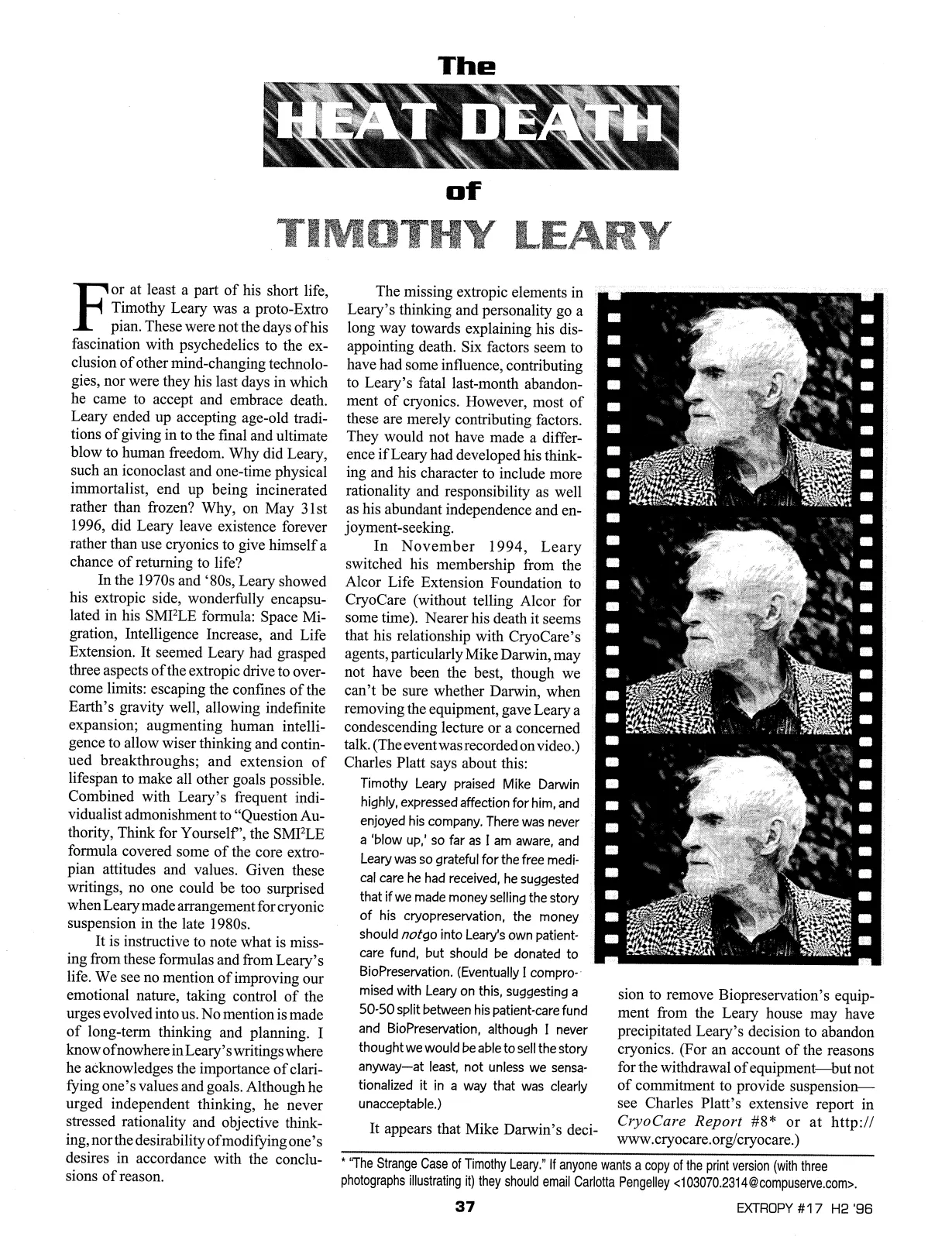
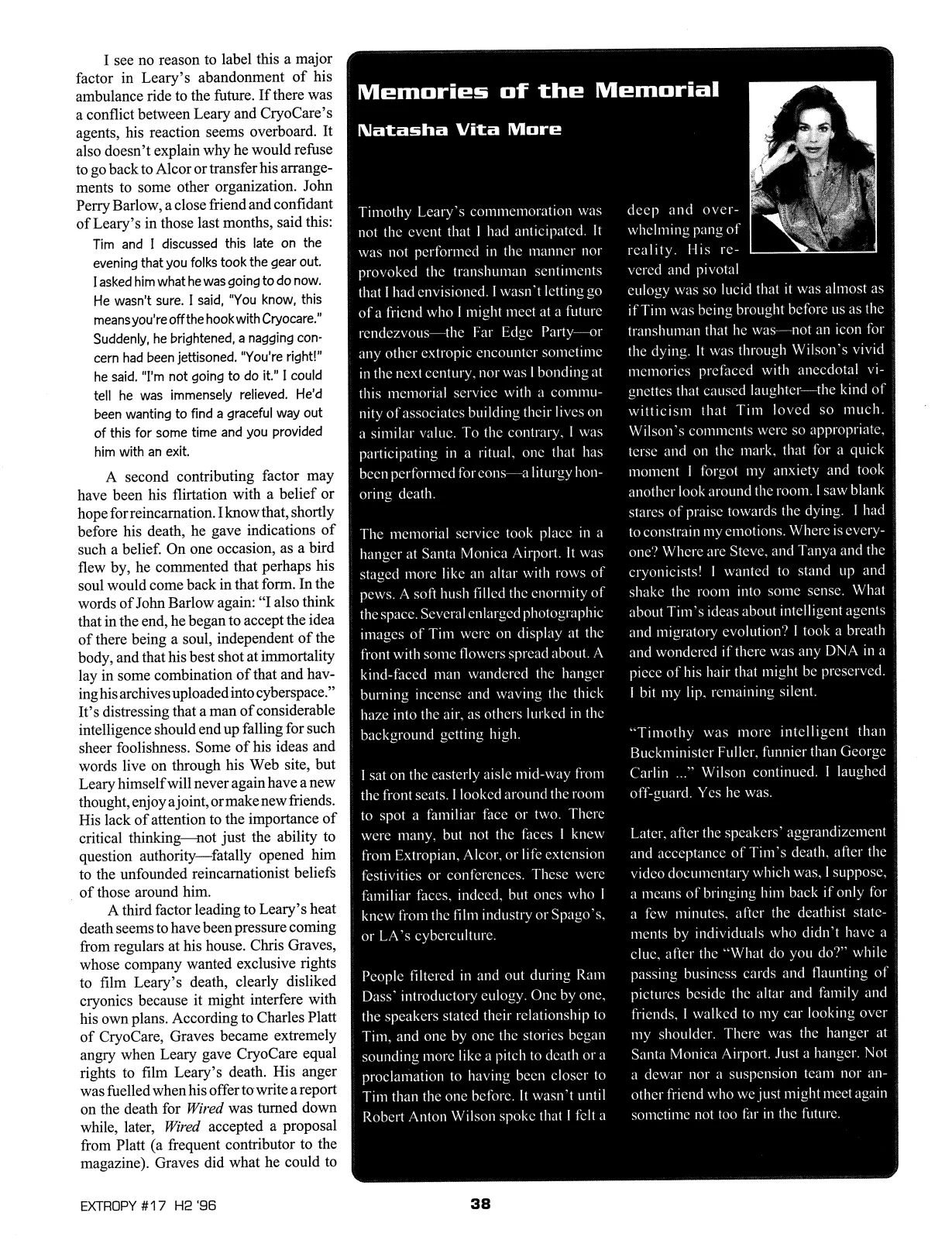
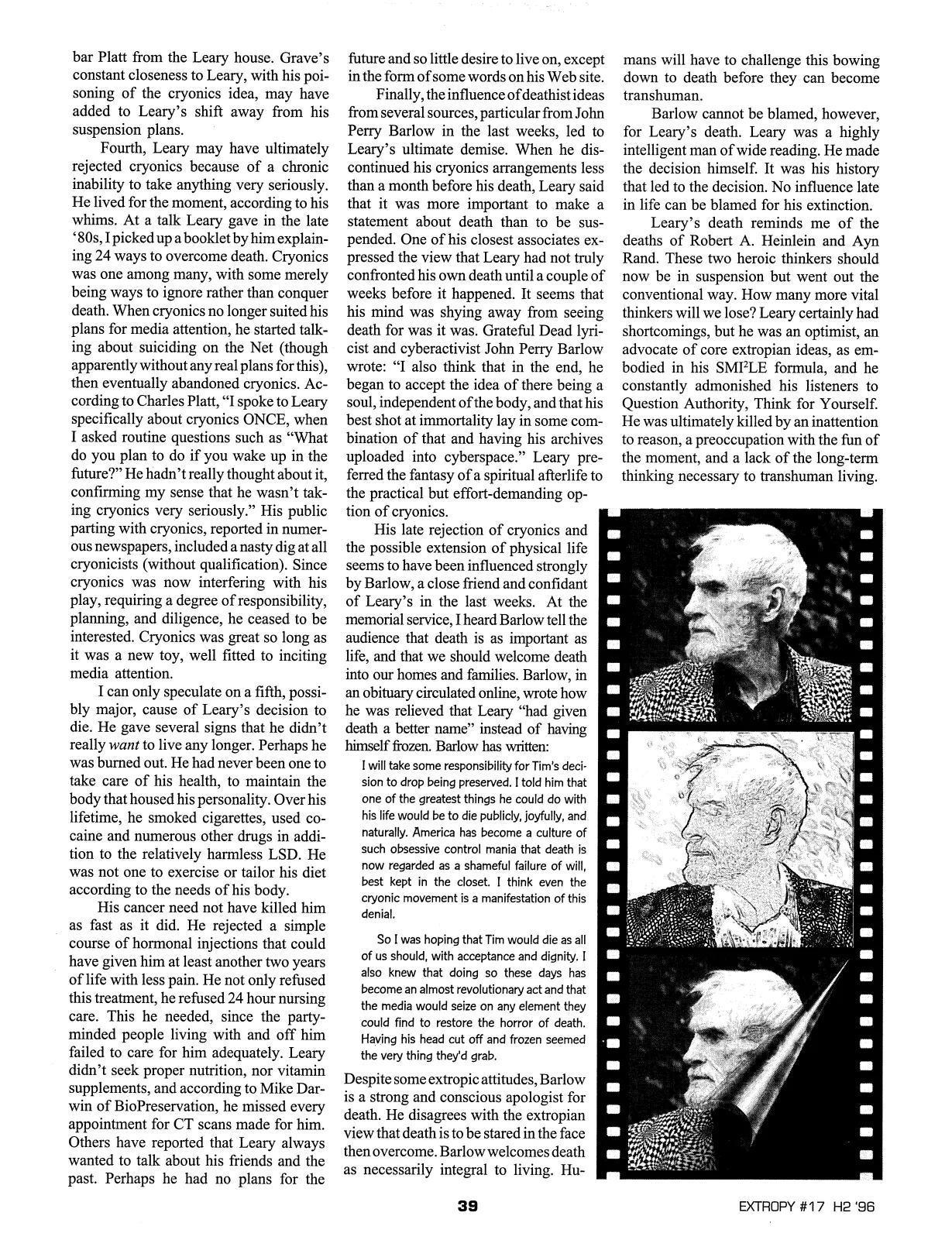
* ‘The Strange Case of Timothy Leary.’ If anyone wants a copy of the print version (with three photographs illustrating it) they should email Carlotta Pengelley 103070.2314@compuserve.com.
I see no reason to label this a major factor in Leary’s abandonment of his ambulance ride to the future. If there was a conflict between Leary and CryoCare’s agents, his reaction seems overboard. It also doesn’t explain why he would refuse to go back to Alcor or transfer his arrangements to some other organization. John Perry Barlow, a close friend and confidant of Leary’s in those last months, said this:
Tim and I discussed this late on the evening that you folks took the gear out. I asked him what he was going to do now. He wasn’t sure. I said, ‘You know, this means you’re off the hook with Cryocare.’ Suddenly, he brightened, a nagging concern had been jettisoned. ‘You’re right!’ he said. ‘I’m not going to do it.’ I could tell he was immensely relieved. He’d been wanting to find a graceful way out of this for some time and you provided him with an exit.
A second contributing factor may have been his flirtation with a belief or hope for reincarnation. I know that, shortly before his death, he gave indications of such a belief. On one occasion, as a bird flew by, he commented that perhaps his soul would come back in that form. In the words of John Barlow again: ‘I also think that in the end, he began to accept the idea of there being a soul, independent of the body, and that his best shot at immortality lay in some combination of that and having his archives uploaded into cyberspace.’ It’s distressing that a man of considerable intelligence should end up falling for such sheer foolishness. Some of his ideas and words live on through his Web site, but Leary himself will never again have a new thought, enjoy a joint, or make new friends. His lack of attention to the importance of critical thinking—not just the ability to question authority—fatally opened him to the unfounded reincarnationist beliefs of those around him.
A third factor leading to Leary’s heat death seems to have been pressure coming from regulars at his house. Chris Graves, whose company wanted exclusive rights to film Leary’s death, clearly disliked cryonics because it might interfere with his own plans. According to Charles Platt of CryoCare, Graves became extremely angry when Leary gave CryoCare equal rights to film Leary’s death. His anger was fuelled when his offer to write a report on the death for Wired was turned down while, later, Wired accepted a proposal from Platt (a frequent contributor to the magazine). Graves did what he could to
Memories of the Memorial
Natasha Vita More
Timothy Leary’s commemoration was not the event that I had anticipated. It was not performed in the manner nor provoked the transhuman sentiments that I had envisioned. I wasn’t letting go of a friend who I might meet at a future rendezvous—the Far Edge Party—or any other extropic encounter sometime in the next century, nor was I bonding at this memorial service with a community of associates building their lives on a similar value. To the contrary, I was participating in a ritual, one that has been performed for eons—a liturgy honoring death.
The memorial service took place in a hanger at Santa Monica Airport. It was staged more like an altar with rows of pews. A soft hush filled the enormity of the space. Several enlarged photographic images of Tim were on display at the front with some flowers spread about. A kind-faced man wandered the hanger burning incense and waving the thick haze into the air, as others lurked in the background getting high.
I sat on the easterly aisle mid-way from the front seats. I looked around the room to spot a familiar face or two. There were many, but not the faces I knew from Extropian, Alcor, or life extension festivities or conferences. These were familiar faces, indeed, but ones who I knew from the film industry or Spago’s, or LA’s cyberculture.
People filtered in and out during Ram Dass’ introductory eulogy. One by one, the speakers stated their relationship to Tim, and one by one the stories began sounding more like a pitch to death or a proclamation to having been closer to Tim than the one before. It wasn’t until Robert Anton Wilson spoke that I felt a deep and overwhelming pang of reality. His revered and pivotal eulogy was so lucid that it was almost as if Tim was being brought before us as the transhuman that he was—not an icon for the dying. It was through Wilson’s vivid memories prefaced with anecdotal vignettes that caused laughter—the kind of witticism that Tim loved so much. Wilson’s comments were so appropriate, terse and on the mark, that for a quick moment I forgot my anxiety and took another look around the room. I saw blank stares of praise towards the dying. I had to constrain my emotions. Where is everyone? Where are Steve, and Tanya and the cryonicists! I wanted to stand up and shake the room into some sense. What about Tim’s ideas about intelligent agents and migratory evolution? I took a breath and wondered if there was any DNA in a piece of his hair that might be preserved. I bit my lip, remaining silent.
‘Timothy was more intelligent than Buckminster Fuller, funnier than George Carlin …’ Wilson continued. I laughed off-guard. Yes he was.
Later, after the speakers’ aggrandizement and acceptance of Tim’s death, after the video documentary which was, I suppose, a means of bringing him back if only for a few minutes, after the deathist statements by individuals who didn’t have a clue, after the ‘What do you do?’ while passing business cards and flaunting of pictures beside the altar and family and friends, I walked to my car looking over my shoulder. There was the hanger at Santa Monica Airport. Just a hanger. Not a dewar nor a suspension team nor another friend who we just might meet again sometime not too far in the future.
bar Platt from the Leary house. Grave’s constant closeness to Leary, with his poisoning of the cryonics idea, may have added to Leary’s shift away from his suspension plans.
Fourth, Leary may have ultimately rejected cryonics because of a chronic inability to take anything very seriously. He lived for the moment, according to his whims. At a talk Leary gave in the late ’80s, I picked up a booklet by him explaining 24 ways to overcome death. Cryonics was one among many, with some merely being ways to ignore rather than conquer death. When cryonics no longer suited his plans for media attention, he started talking about suiciding on the Net (though apparently without any real plans for this), then eventually abandoned cryonics. According to Charles Platt, ‘I spoke to Leary specifically about cryonics ONCE, when I asked routine questions such as ‘What do you plan to do if you wake up in the future?’ He hadn’t really thought about it, confirming my sense that he wasn’t taking cryonics very seriously.’ His public parting with cryonics, reported in numerous newspapers, included a nasty dig at all cryonicists (without qualification). Since cryonics was now interfering with his play, requiring a degree of responsibility, planning, and diligence, he ceased to be interested. Cryonics was great so long as it was a new toy, well fitted to inciting media attention.
I can only speculate on a fifth, possibly major, cause of Leary’s decision to die. He gave several signs that he didn’t really want to live any longer. Perhaps he was burned out. He had never been one to take care of his health, to maintain the body that housed his personality. Over his lifetime, he smoked cigarettes, used cocaine and numerous other drugs in addition to the relatively harmless LSD. He was not one to exercise or tailor his diet according to the needs of his body.
His cancer need not have killed him as fast as it did. He rejected a simple course of hormonal injections that could have given him at least another two years of life with less pain. He not only refused this treatment, he refused 24 hour nursing care. This he needed, since the party-minded people living with and off him failed to care for him adequately. Leary didn’t seek proper nutrition, nor vitamin supplements, and according to Mike Darwin of BioPreservation, he missed every appointment for CT scans made for him. Others have reported that Leary always wanted to talk about his friends and the past. Perhaps he had no plans for the future and so little desire to live on, except in the form of some words on his Web site.
Finally, the influence of deathist ideas from several sources, particular from John Perry Barlow in the last weeks, led to Leary’s ultimate demise. When he discontinued his cryonics arrangements less than a month before his death, Leary said that it was more important to make a statement about death than to be suspended. One of his closest associates expressed the view that Leary had not truly confronted his own death until a couple of weeks before it happened. It seems that his mind was shying away from seeing death for was it was. Grateful Dead lyricist and cyberactivist John Perry Barlow wrote: ‘I also think that in the end, he began to accept the idea of there being a soul, independent of the body, and that his best shot at immortality lay in some combination of that and having his archives uploaded into cyberspace.’ Leary preferred the fantasy of a spiritual afterlife to the practical but effort-demanding option of cryonics.
His late rejection of cryonics and the possible extension of physical life seems to have been influenced strongly by Barlow, a close friend and confidant of Leary’s in the last weeks. At the memorial service, I heard Barlow tell the audience that death is as important as life, and that we should welcome death into our homes and families. Barlow, in an obituary circulated online, wrote how he was relieved that Leary ‘had given death a better name’ instead of having himself frozen. Barlow has written:
I will take some responsibility for Tim’s decision to drop being preserved. I told him that one of the greatest things he could do with his life would be to die publicly, joyfully, and naturally. America has become a culture of such obsessive control mania that death is now regarded as a shameful failure of will, best kept in the closet. I think even the cryonic movement is a manifestation of this denial.
So I was hoping that Tim would die as all of us should, with acceptance and dignity. I also knew that doing so these days has become an almost revolutionary act and that the media would seize on any element they could find to restore the horror of death. Having his head cut off and frozen seemed the very thing they’d grab.
Despite some extropic attitudes, Barlow is a strong and conscious apologist for death. He disagrees with the extropian view that death is to be stared in the face then overcome. Barlow welcomes death as necessarily integral to living. Hu-humans will have to challenge this bowing down to death before they can become transhuman.
Barlow cannot be blamed, however, for Leary’s death. Leary was a highly intelligent man of wide reading. He made the decision himself. It was his history that led to the decision. No influence late in life can be blamed for his extinction.
Leary’s death reminds me of the deaths of Robert A. Heinlein and Ayn Rand. These two heroic thinkers should now be in suspension but went out the conventional way. How many more vital thinkers will we lose? Leary certainly had shortcomings, but he was an optimist, an advocate of core extropian ideas, as embodied in his SMFLE formula, and he constantly admonished his listeners to Question Authority, Think for Yourself. He was ultimately killed by an inattention to reason, a preoccupation with the fun of the moment, and a lack of the long-term thinking necessary to transhuman living.
VIEW ORIGINAL SCAN (3 pages)