Issue: EXTROPY #17 · Second Half 1996
Author: Dr. Ray Sahelian
Pages: 38–41 · 4 scanned pages
Bio-Enhancement Update: Beyond Prozac, DHEA, Creatine
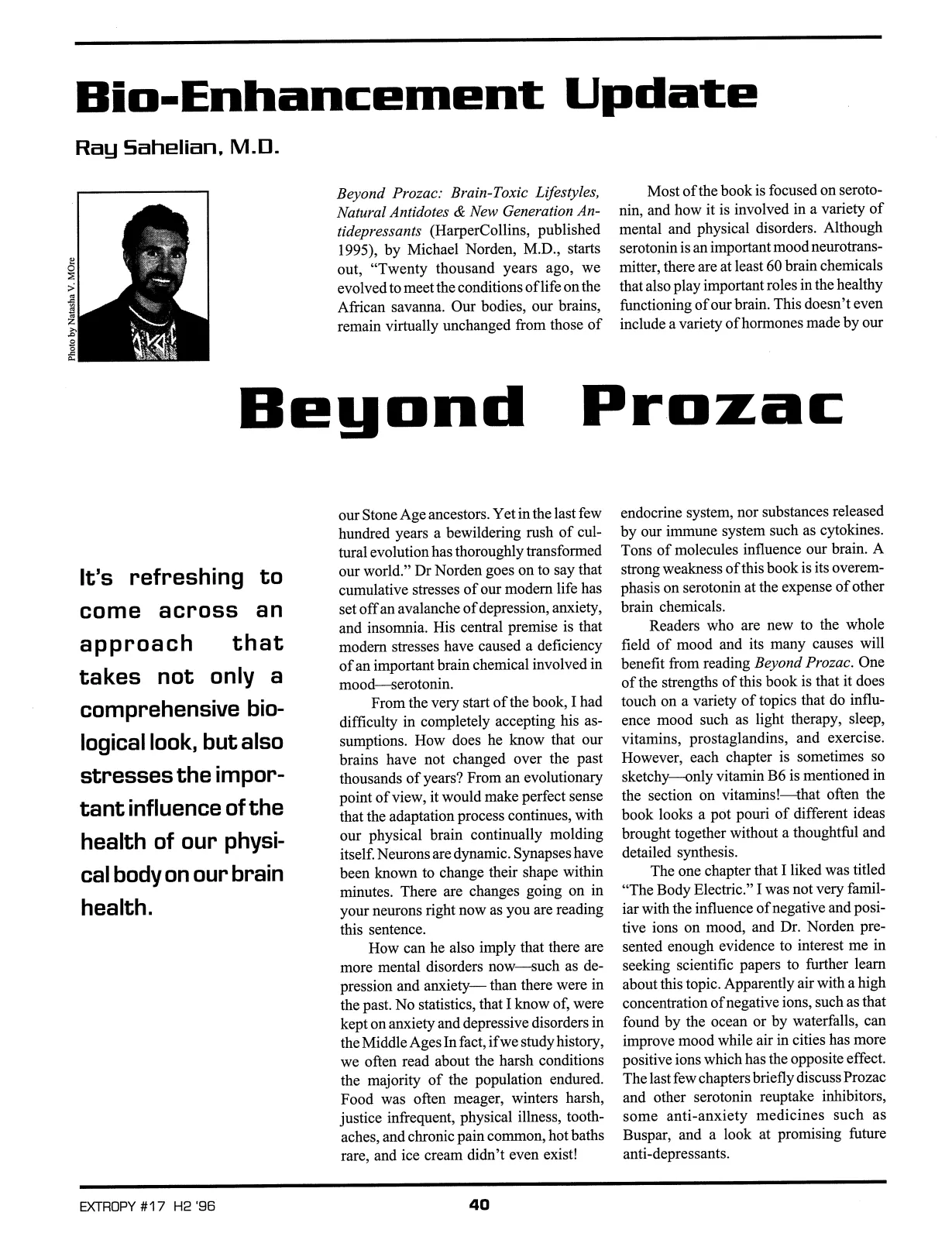
Bio-Enhancement Update
Ray Sahelian, M.D.
Photo by Natasha V. MOze
Beyond Prozac: Brain-Toxic Lifestyles, Natural Antidotes & New Generation Antidepressants (HarperCollins, published 1995), by Michael Norden, M.D., starts out, “Twenty thousand years ago, we evolved to meet the conditions of life on the African savanna. Our bodies, our brains, remain virtually unchanged from those of
Most of the book is focused on serotonin, and how it is involved in a variety of mental and physical disorders. Although serotonin is an important mood neurotransmitter, there are at least 60 brain chemicals that also play important roles in the healthy functioning of our brain. This doesn’t even include a variety of hormones made by our
Beyond Prozac
It’s refreshing to come across an approach that takes not only a comprehensive biological look, but also stresses the important influence of the health of our physical body on our brain health.
our Stone Age ancestors. Yet in the last few hundred years a bewildering rush of cultural evolution has thoroughly transformed our world.” Dr Norden goes on to say that cumulative stresses of our modern life has set off an avalanche of depression, anxiety, and insomnia. His central premise is that modern stresses have caused a deficiency of an important brain chemical involved in mood—serotonin.
From the very start of the book, I had difficulty in completely accepting his assumptions. How does he know that our brains have not changed over the past thousands of years? From an evolutionary point of view, it would make perfect sense that the adaptation process continues, with our physical brain continually molding itself. Neurons are dynamic. Synapses have been known to change their shape within minutes. There are changes going on in your neurons right now as you are reading this sentence.
How can he also imply that there are more mental disorders now—such as depression and anxiety—than there were in the past. No statistics, that I know of, were kept on anxiety and depressive disorders in the Middle Ages In fact, if we study history, we often read about the harsh conditions the majority of the population endured. Food was often meager, winters harsh, justice infrequent, physical illness, toothaches, and chronic pain common, hot baths rare, and ice cream didn’t even exist!
endocrine system, nor substances released by our immune system such as cytokines. Tons of molecules influence our brain. A strong weakness of this book is its overemphasis on serotonin at the expense of other brain chemicals.
Readers who are new to the whole field of mood and its many causes will benefit from reading Beyond Prozac. One of the strengths of this book is that it does touch on a variety of topics that do influence mood such as light therapy, sleep, vitamins, prostaglandins, and exercise. However, each chapter is sometimes so sketchy—only vitamin B6 is mentioned in the section on vitamins!—that often the book looks a pot pouri of different ideas brought together without a thoughtful and detailed synthesis.
The one chapter that I liked was titled “The Body Electric.” I was not very familiar with the influence of negative and positive ions on mood, and Dr. Norden presented enough evidence to interest me in seeking scientific papers to further learn about this topic. Apparently air with a high concentration of negative ions, such as that found by the ocean or by waterfalls, can improve mood while air in cities has more positive ions which has the opposite effect. The last few chapters briefly discuss Prozac and other serotonin reuptake inhibitors, some anti-anxiety medicines such as Buspar, and a look at promising future anti-depressants.
The book market is flooded with books that promise to quick-fix our mood. Many are written by self-styled psychologists who advocate an, “All-you-have-to-do-is-change-your-attitude,” approach to curing all our psychological problems. It’s refreshing to come across an approach that takes not only a comprehensive biological look, but also stresses the important influence of the health of our physical body on our brain health.
Overall, Beyond Prozac is a worthwhile read for most everyone. You may not agree with everything in the book, and many of Dr. Norden’s opinions and assumptions may turn out not to be completely accurate, but there are, nevertheless, enough interesting thoughts and suggestions to give up a night or two of watching Roseanne, Home Improvement, and America’s Funniest Home Videos.
http://www.primenet.com/~sahelian
New Web site includes
- The first chapter of every book written by Dr. Sahelian
- Latest studies on pregnenolone, DHEA, melatonin, creatine
- Upcoming media events
The ABCs of Creatine
Excerpted from Chapter 1 of Creatine: The Muscle Builder by Ray Sahelian, M.D. & Dave Tuttle
Whether you’re an accomplished athlete or you’ve just started an exercise program, you need to know about creatine. Many supplements touted over the years as performance enhancers have come and gone, but creatine is here to stay. We predict that it will be one of the most popular muscle-building nutrients ever made available to you. Why? Because it works. Yes, it really works.
What is Creatine?
When we told our friends that we were writing a book on creatine, some of them had quizzical responses. “You’re writing on creating? Creating what?” “Is it an herb?” “A book on croutons. How interesting!”
Creatine is not an herb, mineral, vitamin, hormone, or steroid. It’s not those bread cubes that you scatter over your salad, either. Creatine is a natural nutrient found in our bodies and the bodies of most animals. Approximately 95% of the body’s creatine supply is found in the skeletal muscles. The remaining 5% is scattered throughout the rest of the body, with the highest concentrations in the heart, brain and testes. (Sperm is chock-full of creatine!)
The human body gets most of the creatine it needs from food or dietary supplements. Creatine is easily absorbed from the intestinal tract into the bloodstream. When dietary consumption is inadequate to meet the body’s needs, a limited supply can be synthesized from the amino acids arginine, glycine and methionine. This creatine production occurs in the liver, pancreas and kidneys.
How Does Creatine Work?
Creatine is an essential player in the primary energy source used for muscle contraction. It exists in two different forms within the muscle fiber: as free (chemically-unbound) creatine and as creatine phosphate. This later form of creatine makes up two-thirds of the total creatine supply. When your muscles contract, the initial fuel for this movement is a compound called ATP. ATP provides its energy by releasing one of its phosphate molecules. It then becomes a different compound called ADP. Unfortunately, there is only enough ATP to provide energy for about 10 seconds, so for muscle contraction to continue, more ATP must be produced. Creatine phosphate comes to the rescue by giving up its phosphate molecule to ADP, recreating ATP. This ATP can then be “burned” again as fuel for more muscle contraction. (We’ll discuss all this in greater detail in Chapter Six.)
The bottom line is that your ability to regenerate ATP depends on your supply of creatine. More creatine, more ATP remade, and more ability to train your muscles to their maximum potential. It’s that simple. This greater ATP synthesis also keeps your body from relying on another energy system called glycolysis, which has lactic acid as a by-product. This lactic acid creates the burning sensation you feel during intense exercise. If the amount of acid becomes too great, muscle movement stops. But if you keep on using ATP because of all the creatine you have, you can minimize the amount of lactic acid produced and actually exercise longer and harder. This helps you gain strength, power and muscle size; and you won’t get fatigued as easily.
Creatine has also been shown to enhance your body’s ability to make proteins, especially the proteins within the muscle fibers. Two of these proteins, actin and myosin, are essential to all muscle contraction. So when you build up your supply of these contractile proteins, you actually increase your muscle’s ability to perform physical work. And the more work you do (whether it’s lifting weights or running 100-meter dashes), the stronger you become over time.
How Much Creatine Is In My Body?
The amount of creatine you have in your body depends mostly on the amount of muscle you have. (There is no creatine in body fat.) The average 70kg. (155 pound) person has a total of about 120 grams (4.2 ounces) of creatine in their body at any one time. Pound for pound, women may actually have somewhat more creatine than men. Vegetarians by and large have lower creatine levels than meat-eaters. The average sedentary person uses up about two grams of creatine per day (Walker, 1979). This creatine is broken down into a waste product called creatinine, which is collected by the kidneys and excreted in the urine. Athletes use up much more than two grams per day, with the exact amount depending on the type of sport, intensity level, and muscle mass.
Can I Get Enough Creatine From My Diet?
The average person consumes about one gram of creatine per day (Lykken, 1980).
Creatine is found in moderate amounts in most meats and fish, which are, after all, skeletal muscles. Good sources of dietary creatine include tuna, cod, salmon, herring, beef and pork. Tiny amounts are found in milk an even cranberries. While it would seem logical that chicken and turkey have creatine as well, we were unable to confirm this from the available research studies. Cooking destroys some or much of the creatine that exists in these foods.
An important thing to remember is that meats and fish contain a lot more than creatine. All animal flesh contains relatively high amounts of cholesterol. Most meats, especially beef and pork, also contain high quantities of fat. One kilogram (2.2 pounds) of raw round steak contains only four grams of creatine, but 119 grams of fat. Porterhouse steak has a bit less creatine, but 325 grams of fat per kilo! Needless to say, you won’t live very long if you clog your arteries with the cholesterol from meat or even fish to get the amount of creatine you need to improve your strength and power. What you need
In 1912, researchers found that ingesting creatine can dramatically boost the creatine content of muscle. Then, in 1927, Fiske and Subbarow discovered creatine phosphate. That led to the realization that creatine is a key player in the metabolism of skeletal muscle.
Since then, there have been literally thousands of studies published on creatine. However, most of the studies focusing on creatine and sports performance have only been done since the early 1990’s. It is these studies that we will focus on in this book.
Who Can Benefit From Creatine?
Although the research on creatine and exercise performance is relatively new, so far it appears that the greatest benefits occur in those sports which involve short, intense bursts of energy. That is because these sports rely most heavily on ATP as an energy source. Athletes in bodybuilding, powerlifting, sprinting, track and field events such as javelin and shot-put, wrestling, swimming, football, hockey, basketball, tennis and soccer would be creatine either does not help or may actually hurt. The difficulty in these situations appears to center on the increased muscle mass which creatine provides. While that’s great if you’re a bodybuilder or wrestler, it can be a detriment if you have to carry all that weight around during a marathon or triathlon. It becomes a tradeoff between the increased strength you get from creatine and the increased muscle mass. Further research will provide us with more definitive answers as to what role creatine supplementation can play in endurance-type sports.
Is Creatine Safe?
Experiments with the administration of creatine to humans have been going on for over a century. Dr. Paul Balsom of the Karolinska Institute in Stockholm, Sweden, is one of the world’s leading experts on creatine. He states in a review article published in 1994 in Sports Medicine that “to the best of our knowledge, the only documented adverse effect that has been associated with creatine supplementation is an increase in body mass.”
We suspect that most athletes will gladly accept this “adverse effect.”
One caution we’d like to make is that the studies which used high dosages of creatine, such as 20 grams per day, were only a month or less in duration. As a result, we do not have controlled, scientific studies which indicate exactly what happens to athletes taking large amounts of creatine for many months or even years. The only long-term study on creatine to date provided one gram per day to patients with gyrate atrophy, an eye disorder (Sipila, 1981). Creatine helped the condition. Therefore, we do not yet fully know the consequences of high dose, long-term supplementation.
As part of our research process for this book, we distributed a detailed survey to nine gyms and four track teams/clubs. Personal interviews with athletes who have used creatine for over a year did not show any long-term side effects which one would be concerned about. Nor is there a particular reason to think that there should be a problem, given the way in which creatine is synthesized and excreted from the body. The only short-term side effect mentioned was diarrhea, which some athletes said occurred when they took dosages greater than those recommended in this book. The diarrhea went away when the dosage was reduced.
is a non-fat, non-cholesterol supplement called creatine monohydrate.
Is Creatine Something New That Scientists Have Discovered?
While researching the scientific information published about this nutrient, we were surprised to learn that creatine was first discovered in 1832 by the French scientist Chevreul (Balsom, 1994). This was way before barbells were invented! Creatine was first found in meats, and later, in 1847, a sharp observer noticed that the meat from foxes killed in the wild had ten times as much creatine as the meat from inactive, domesticated foxes. He concluded that creatine accumulates in muscles as a consequence of physical activity.
In the early 20th century, it was discovered that not all of the creatine consumed by humans was excreted in the urine. This led to the recognition that creatine is, in fact, stored within the body.
most likely to improve their strength and sports performance with creatine. We doubt that creatine will be of any benefit for people who comfortably cruise on a cart around the golf course and occasionally get up to putt. Other sports where creatine is not likely to be of any significant benefit include baseball, archery, skeet shooting, and certainly billiards.
It is still unclear whether athletes involved in endurance activities such as long-distance running or bicycling will benefit from creatine supplementation. There have been anecdotal reports that people in these sports may benefit (Stroud, 1994), although other studies show that
Dave Tuttle, co-author of Creatine: The Muscle Builder, writes for Iron Man and Muscle and Fitness. His first book was Forever Natural: How to Excel in Sports Drug Free ironbooks@aol.com
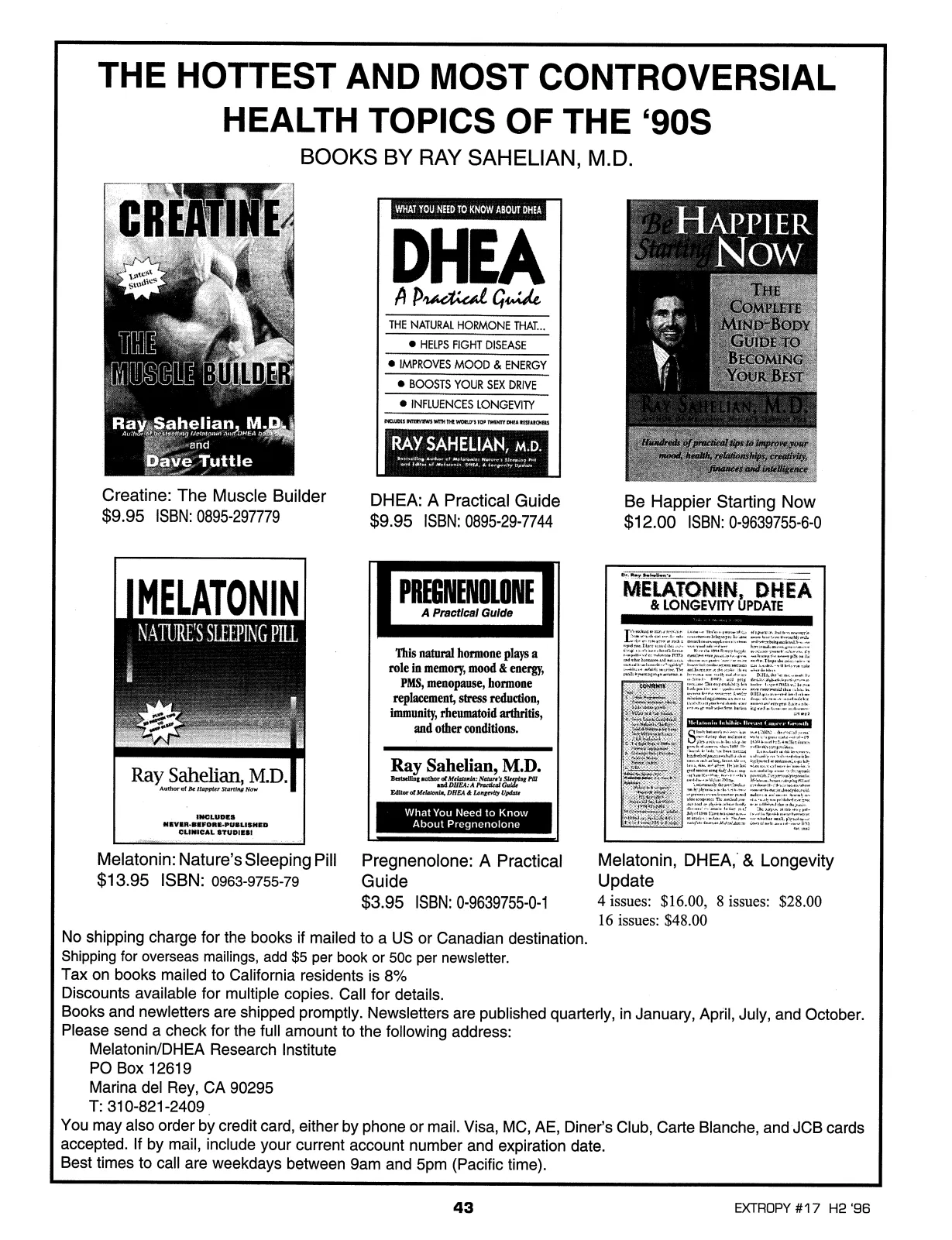
THE HOTTEST AND MOST CONTROVERSIAL HEALTH TOPICS OF THE ‘90S
BOOKS BY RAY SAHELIAN, M.D.
Creatine: The Muscle Builder $9.95 ISBN: 0895-297779
DHEA: A Practical Guide $9.95 ISBN: 0895-29-7744
Be Happier Starting Now $12.00 ISBN: 0-9639755-6-0
Melatonin: Nature’s Sleeping Pill $13.95 ISBN: 0963-9755-79
Pregnenolone: A Practical Guide $3.95 ISBN: 0-9639755-0-1
Melatonin, DHEA, & Longevity Update
4 issues: $16.00, 8 issues: $28.00 16 issues: $48.00
No shipping charge for the books if mailed to a US or Canadian destination.
Shipping for overseas mailings, add $5 per book or 50c per newsletter.
Tax on books mailed to California residents is 8%
Discounts available for multiple copies. Call for details.
Books and newsletters are shipped promptly. Newsletters are published quarterly, in January, April, July, and October.
Please send a check for the full amount to the following address:
Melatonin/DHEA Research Institute
PO Box 12619
Marina del Rey, CA 90295
T: 310-821-2409
You may also order by credit card, either by phone or mail. Visa, MC, AE, Diner’s Club, Carte Blanche, and JCB cards accepted. If by mail, include your current account number and expiration date.
Best times to call are weekdays between 9am and 5pm (Pacific time).
VIEW ORIGINAL SCAN (4 pages)