Issue: EXTROPY #17 · Second Half 1996
Author: Max More
Pages: 31–34 · 4 scanned pages
Performance and Legal Theory: An Interview with Prof. Michael Shapiro
PERFORMANCE
and Legal Theory
An interview with Prof. Michael Shapiro
by Max More, Ph.D.
Michael Shapiro is a professor of law at the University of Southern California.
MM: Which performance enhancement technologies do you think will raise the most interesting or problematic legal and ethical issues?
MS: Some technologies emerging from the research being done now will follow a disorder model. Let me make a comment about disorder models. The terms “enhancement” and “augmentation” are problematic—not meaningless, but hard to interpret. You can set up the problem in the following way: There are lots of things that we do to improve ourselves that don’t seem troublesome to most people because we can place these processes within a justificatory model based on remedying disorder, trauma, or the like. Models are, roughly, abstract guides to action or analysis. The model has axioms of the form: If X has disease Y, then X can use therapy Z to rectify the situation. This leaves out various qualifications we can ignore. We don’t have to deal with whether the person can be forced to be treated. But when readers of Extropy think about enhancement, they’re certainly not confining themselves to matters of controlling disorder—they may not even think of the latter as true enhancement.
In an article I wrote on performance enhancement in the USC Law Review, I started off with some examples to illustrate the distinction between enhancement and therapy. Kirk Gibson used cortisone for a bad knee and hit a home run that helped win the opening game of the 1988 World Series for the Dodgers. On the other hand, in the same year, Ben Johnson ran in the Olympics but was found to have taken steroids and the Olympic officials nullified his victory.
Then there are situations that are somewhat more ambiguous. The steroid problem inspired some statutes. They were meant to deal with these two different justificatory models [disorder and augmentation]. For example, in Florida, there’s a statute that says, “prescribing, natural. Nature has some kind of moral force linked to it, or so some argue. But what you’re doing when you give them steroids is to try to raise them above their natural baseline.
But suppose someone with a lot of athletic talent is born with a predisposition for chronic arthritis, and finally is given cortisone as an adult. This person never had a prior “normal” baseline. The most you can say is that there is a rough ideal normal baseline—that is, normal to the human species—that the person has ordering, dispensing, administering, supplying, selling, or giving growth hormones, testosterone, or its analogs, human chorionic gonadotropin, or other hormones for the purpose of muscle building or to enhance athletic performance” [are grounds for discipline]. For purposes of this subsection, the term ‘muscle building’ does not include the treatment of injured muscle.”
Well, of course, one puzzle is that if you treat injured muscle, or fix broken bones, or give cortisone for a bad knee, you’re improving performance.
But, you might say, it’s bringing a person up to a previous baseline, so it’s always fallen short of. It’s still a disorder model that’s invoked to treat the arthritis.
What about people who take caffeine for headaches? If I take commercial aspirin, containing caffeine, it may improve my performance both by relieving the headache and by the stimulant effect. Sometimes musical performers will use beta blockers to keep their hands from trembling or to steady their voices. Substances which are generally thought to be performance dampers may be performance enhancers, depending upon the function. For example, people who are in rifle competitions may drink an alcoholic beverage. It can reduce their tremors and calm them down. So, you have to sort out exactly what is being done for what purpose and consider what system of justification we’re talking about—and whether that justifying model should make any difference.
The last point should be stressed. The very basis for distinguishing disorder from augmentation models is seriously in question, quite apart from the expectable difficulty of drawing boundaries between them.
To focus more on your question about legal and ethical issues: Think about human growth hormone. There are people with diseases of the pituitary who are acceptable. For example: I was going down the hall and one of our visiting professors was walking in my direction. He had a cup of coffee in each hand. I said ‘TWO cups of coffee?’ And he said ‘Gotta be sharp!’ But few people worry about this—side effects aside—except in specific situations like athletic competition. There’s no disorder model at work, but the augmentation is fairly modest.
In the case of performance enhancement in sports, games, and contests—we might call admission to universities contests—I’ve divided up the analysis into several overlapping categories. It applies both to physical and mental enhanc-
I’ll say some more about moral category arguments later.
There are also arguments based upon harm and coercion. Of course these are also moral arguments and make for legal arguments too. They appear to be less fixed and are often made in a less formalistic way. They gain some additional force where the technology is very risky—but of course traditional training can be risky too. It’s not always clear what the incremental risk is when the technology is used properly.
Then there are arguments I call sports coherence arguments. People will say things like: you cannot have performance enhancement in contests because it defeats the entire purpose of the game. In some forms these arguments make no sense because they assume to start with that enhancement is prohibited. The real question concerns the situation where there is no prohibition, but competitors might be required to disclose what they’re using. With nondisclosure, you’d have a different kind of game that you might not want, but it wouldn’t be incoherent.
Finally, a set of arguments called normative-systemic arguments—they might be called institutional arguments—which seem to me to be the only arguments that make any sense. But they aren’t overwhelming.
Suppose, for example, you have a performance enhancement technology that is extremely risky. There was a poll taken—how credible I can’t tell—reported in Reuters in 1988, in which Olympic athletes were asked something like: ‘If you knew you could take this drug and you knew it would guarantee you a gold medal but would kill you five years later, would you take it?’ Supposedly half of them said yes, but who knows whether they’d actually do it when confronted with it?
Now, here’s a thought experiment to illustrate the argument: I have an eight-year-old and a four-year-old. Do I want them to think it’s okay to take such risks? Is it that important to get a gold medal, at the price of dying at an early age? That seems to me to be bizarre. Under some moral theories, it would be wrong. Still, if some people already have that preference, there are autonomy-based reasons letting extremely short. I think many would agree that it’s okay to give them human growth hormone—maybe even obligatory—provided we satisfy ourselves about the risks. We can leave aside for the time being the question of the child’s current preferences.
But suppose you’re just at the short end of what seems like normal variation in the bell curve of height. You’re just very short—say, an adult male who’s less than 5 feet tall—and you have trouble reaching the gas pedal on a car, people are always bumping into you or falling over you, you can’t get dates, and perhaps you don’t advance in your career. What do we say here? You can try to replace this with a handicap model instead of a disorder model—that is, the person is operationally impaired compared to the species norm. But is this just replacing the disease model with an augmentation model invoked mainly to get to the baseline, not necessarily to rise above it?
One difficulty in condemning enhancement is that we all accept it in some form—even technological—as part of our shifting baseline of what’s normal and ment. There are arguments based on certain moral categories that appear to be well-defined—but they aren’t—and purport to tell you in an algorithmic way what you can and can’t do—but they don’t. The reason I’ve got these moral category arguments categorized like this is that they are often used in a ham-fisted, formalistic way.
The moral category arguments include overlapping sub-arguments like arguments from nature, arguments from identity, from merit, and from external influence. The natural/unnatural distinction lacks power here. Nature is often thought to be morally weighted. But this moral weight, if any, is pretty attenuated. You can often take what is natural—assuming you can define it at all—as a default guide to something that works. But it often isn’t: it’s not natural to take antibiotics. What people mean by natural or unnatural I think is whether or not it conforms to what has become part of normal baseline for human beings—such as wearing clothes. In this sense, it’s natural for us to put clothes on, but obviously it’s unnatural in some other sense.
them go ahead with it, although there are counter-arguments. But the question here is: can and should we control the acquisition of these preferences in the first place? That sort of risk-taking will look to many like an assault on the value of life. But people—including children—learn from what they see. Athletic competitions may be particularly effective social learning mechanisms: “Everything I needed to know in life I learned from baseball”—that sort of thing. So this is a social learning argument. The spectacle of an open practice in which people take enormous risks with their health or their life in order to get a prize tends to reinforce value systems that may acceptable in a society if a few have them, but not if many do. It may be OK in a complete warrior state, but not here. If an external observer came down from another quadrant, how would they measure the value we assign to life under a win- and-die system? But these are empirical claims that are hard to confirm or disconfirm. And current enhancement techniques usually won’t kill you if used right.
The other argument-from-social-learning is that if you perceive performance enhancement as getting a return disproportionate to your efforts, then it conveys the idea of getting something for nothing. It promotes a sort of welfare ethic. If this is the general view, which in the case of steroids is quite mistaken, you take a pill and swell up or get stronger and faster and you can lift the continental shelf or win the decathlon. If people see it this way, they see competitors getting something for nothing, which weakens values of diligence, fortitude, and so on.
MM: But they don’t seem to actually work that way. It just means everybody just has to push harder. The other guy is going to be using it too!
MS: Yeah, that’s right. If everybody used it, of course, and if it improved everyone by the same absolute increment, you would be shifting the bell-shaped curve to the right. You would be improving absolute
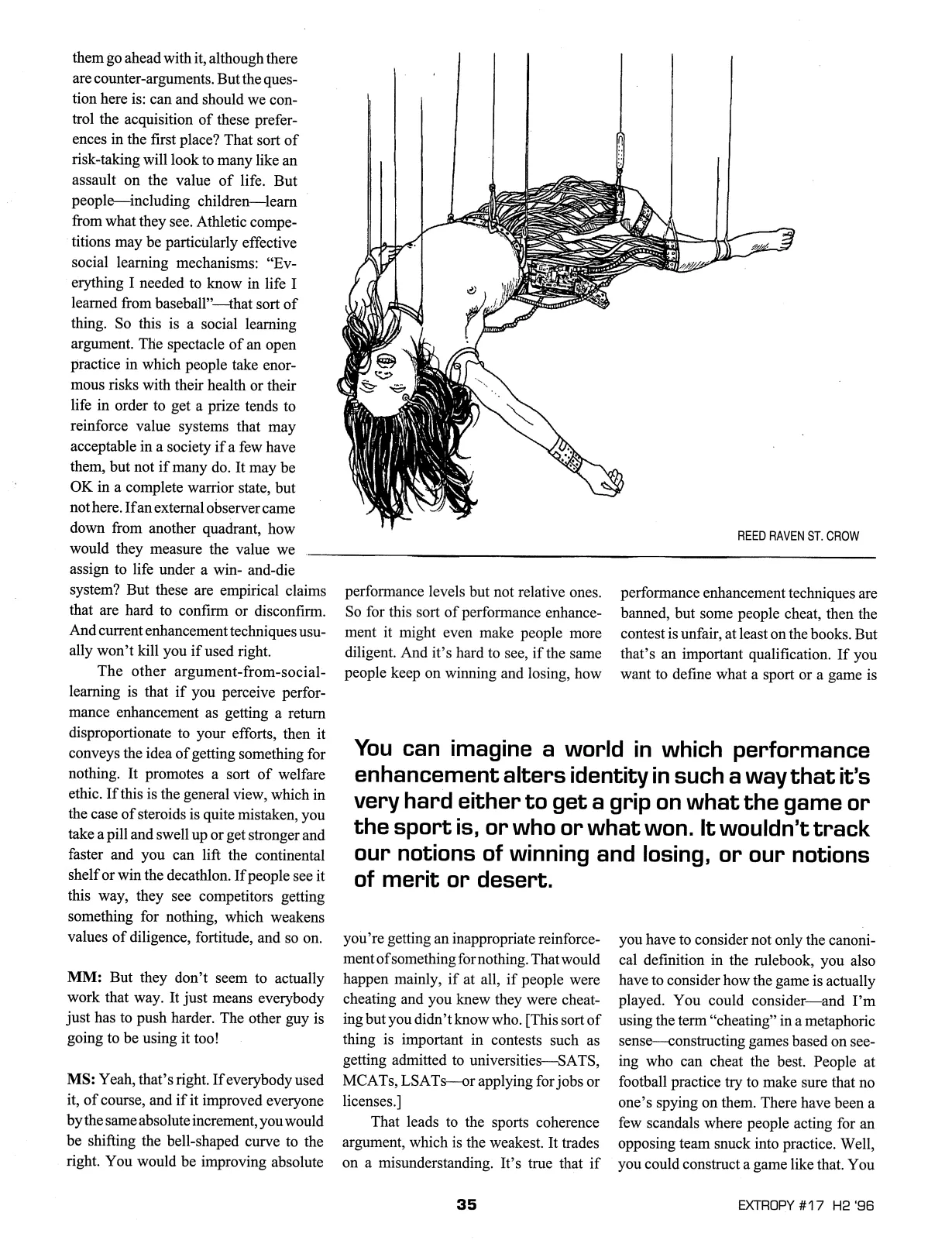
REED RAVEN ST. CROW performance levels but not relative ones. So for this sort of performance enhancement it might even make people more diligent. And it’s hard to see, if the same people keep on winning and losing, how performance enhancement techniques are banned, but some people cheat, then the contest is unfair, at least on the books. But that’s an important qualification. If you want to define what a sport or a game is you’re getting an inappropriate reinforcement of something for nothing. That would happen mainly, if at all, if people were cheating and you knew they were cheating but you didn’t know who. [This sort of thing is important in contests such as getting admitted to universities—SATS, MCATs, LSATs—or applying for jobs or licenses.]
That leads to the sports coherence argument, which is the weakest. It trades on a misunderstanding. It’s true that if you have to consider not only the canonical definition in the rulebook, you also have to consider how the game is actually played. You could consider—and I’m using the term “cheating” in a metaphoric sense—constructing games based on seeing who can cheat the best. People at football practice try to make sure that no one’s spying on them. There have been a few scandals where people acting for an opposing team snuck into practice. Well, you could construct a game like that. You could have a total, complete contest in which you not only play football but you spy, do psychological warfare, kidnap the opposing quarterback, and so on. Some may think this is unfair. But you could construct a game where those are the rules applying to everyone. Why don’t we have games defined like this—at least at present? Games like this are coherent, but people may think it promotes adverse learning. I mean, you don’t want kids in high school to play football and think it’s okay to kidnap and kill the opposing quarterback. I certainly don’t want to live in a society like that. And we’re not quite there yet.
But in a less fanciful situation, if you permit performance enhancement but require disclosure, the game is not incoherent.
Some of the authors [in the Journal of the Philosophy of Sports] protest that if you allow steroids and certain other enhancers then what you are doing is not really testing talent, effort, skill, or diligence. What you are testing is how the body reacts to a certain chemical, or some other technology. This is unpersuasive because, number one, you could also argue that what we are now testing is how one’s body responds to lifting heavy objects, going on special diets, or training generally. We’re testing arbitrary differences among persons, like variations in the genome. Even the capacity to try hard is affected, though not limited, by genetics. I’m pretty clumsy. Should I protest: Why am I being judged against somebody else who’s got better body control, better anti-clumsy genes? Does that make any more sense than saying you’re simply being tested to see how your system reacts to steroids?
[I’m skipping over the coherence of using what might be called supplements and implements—better track shoes and running tracks. But there are also devices that form part of a contest’s definitional core—poles in vaulting, autos in auto racing. Better poles are a kind of performance booster. But if it were electromechanically contrived to allow people to jump forty feet, we’d have a different—but not incoherent—game. So you can see, again, that the concept of performance mance enhancement is entirely clear.]
Back to moral category arguments. Performance enhancement sometimes gets people to thinking about questions like: are we sure just who performing? There was a paragraph by H.L.A. Hart in an article that he wrote in the Harvard Law Review in 1958 in which he imagined a world in which we all changed traits constantly in a way that, on any theory, there has been a change of identity. You took a pill and it increased your mental and physical abilities enormously. What does it mean to say you won?
You can imagine a world in which performance enhancement alters identity in such a way that it’s very hard either to get a grip on what the game or the sport is, or who or what won. It wouldn’t track our notions of winning and losing, or our notions of merit or desert.
But as things are now, it’s very difficult to see how any current performance enhancement agents compromise identity. We can anticipate technologies in the next generation such as drugs that remind one of steroids but don’t have serious adverse effects and are established to be effective. Suppose performance enhancement with these drugs were accepted and regulated (if that happened, there would probably be fewer harmful ‘side effects’). There’s no identity crisis here. [There isn’t even that serious an identity crisis with the Mentats in Frank Herbert’s Dune novels: they all enhance their mental abilities with the spice. But there are contexts in which we might not care that much about identity: enhanced scientists finding cancer cures (but what do we do when Nobel Prize time comes around)?; Mentats as tools to defend the feudal house.]
Of course, there are some merit problems even now. Who gets credit for winning a football game? The team, the quarterback, the coach, the trainer, Mom and Dad? It’s an interesting question, but not one to agonize over. But there’s nothing incoherent about dividing up credit, as long as you specify what the credit is for. The question is admittedly more vivid with technological enhancement. Who gets the credit for enhanced performance through germ line engineering? We have already genetically engineered larger mice by incorporating rat growth hormone genes into mice embryos. If germ line engineering produces a tall person who succeeds in the NBA, to whom do you give credit? The basketball player, the person who engineered the genes, the parents who decided to do this? The answer is yes—but credit for what? But again, we ask that now. Who gets credit for Hideo Nomo? His parents produced him, nurtured him, he was trained by his Japanese baseball team, he’s been trained by the Dodgers.
[Finally, there are access-distribution problems. It’s one thing to complain that not everyone can get a Rolls-Royce. But if you could generate major changes in mental and physical ability, you may sharply and irreversibly increase social stratification. Enhancement technologies don’t come free. Whatever the conceptual difficulties, we think of them as affecting merit attributes, which themselves are the bases for distributions. If you’re very smart, you might deserve some commodities and rewards more than others. But when these commodities are themselves mechanisms to enhance merit itself—well, Who merits merit?]
Publications in this area:
—The Technology of Perfection: Performance Enhancement and the Control of Attributes, 65 S.Cal.L.Rev. 11 (1991).
—Who Merits Merit? Some Problems in Distributive Justice Posed by the New Biology, 48 S.Cal.L.Rev. 318-370 (1974).
—The Technology of Success [remarks on physical and mental performance enhancement], L.A. Daily Journal [County Legal Newspaper], Jan. 17, 1989, p. 7, col. 1.
—The Genetics of Perfection, L.A. Daily Journal [County Legal Newspaper], Mar. 8, 1989, p. 7, col. 1.
VIEW ORIGINAL SCAN (4 pages)