Issue: EXTROPY #17 · Second Half 1996
Author: Bart Kosko
Pages: 63 · 1 scanned page
Social Choice and the Fuzzy Tax Form
SOCIAL CHOICE AND THE FUZZY TAX FORM¹
Bart Kosko, Ph.D.
Signal and Image Processing Institute
Electrical Engineering Department
University of Southern California
Los Angeles, California 90089-2564
Here is one way to cure AIDS: Give $10 billion to the first person who finds a cure. If that does not work give
$100 billion. Such a prize would motivate scientists far more than would the pay raise that might come from landing a large research contract. The question is how to pay for such research bounties.
A fuzzy tax form is one way. Just check off the box for the AIDS bounty. A fuzzy tax form is not a flat tax or a higher or lower tax. It is revenue neutral. It lets you say where some of your tax monies go.
The tax form would work this way at the state or federal level. Right now you pay taxes and the state spends the money on what it wants. All tax money goes into “general revenues.” That need not be all or none. It can be a fuzzy matter of degree.
Suppose just half the money goes to general revenues. Then the other half goes to some degree to ten or more categories like basic research, AIDS research, smart cars, debt relief, help for the homeless, or environmental clean-up. You fill in the fuzzy percentages. You may want 20% to go to debt relief, 30% to build more court houses, and 50% to help cure AIDS. The percentages must sum to no more than 100%.
¹ An earlier version of this article appeared in the 17 April 1995 issue of the Los Angeles Daily News.
Prof. Kosko discusses this issue more fully in his new Broadway/Bantam book, Heaven in a Chip.
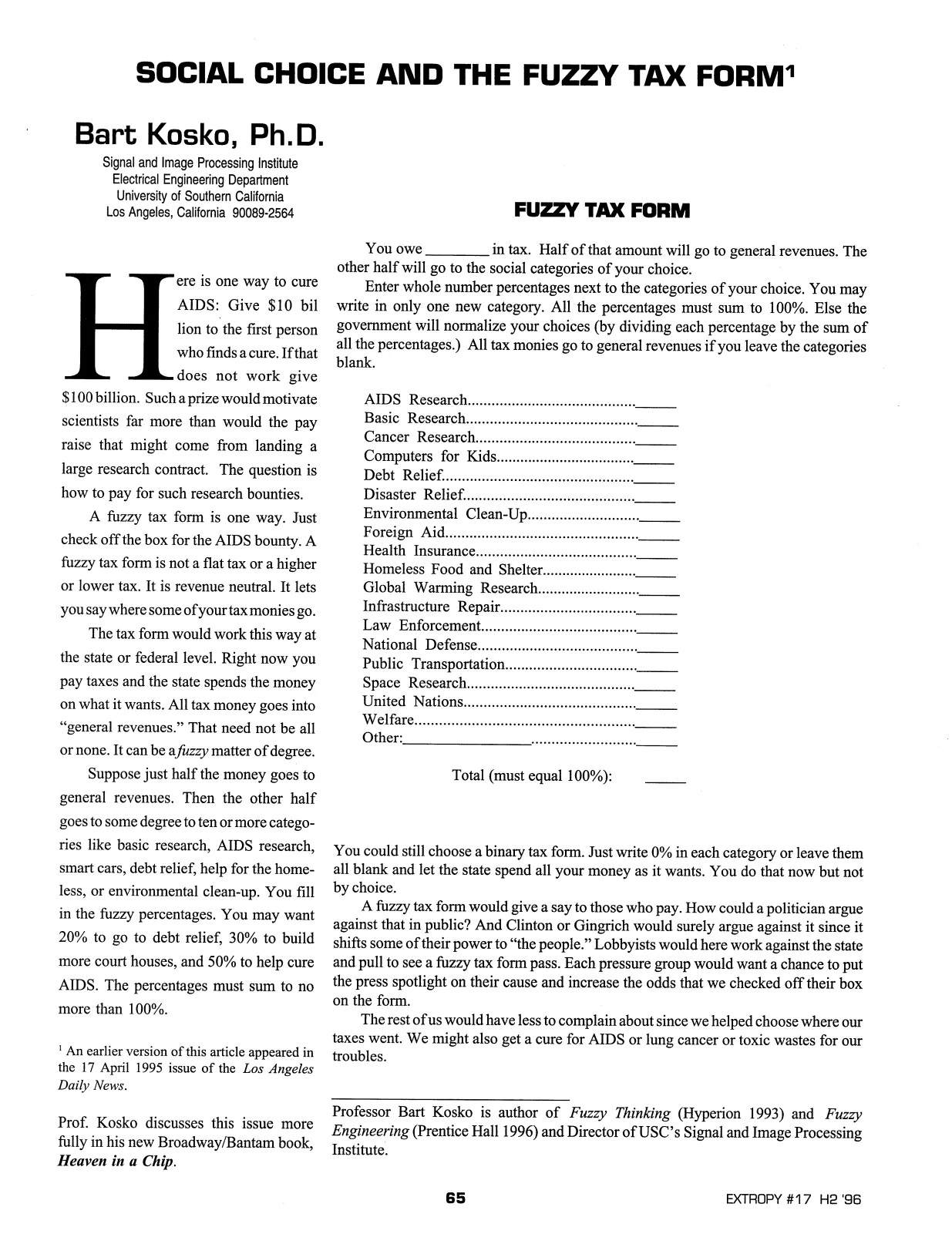
FUZZY TAX FORM
You owe _______ in tax. Half of that amount will go to general revenues. The other half will go to the social categories of your choice.
Enter whole number percentages next to the categories of your choice. You may write in only one new category. All the percentages must sum to 100%. Else the government will normalize your choices (by dividing each percentage by the sum of all the percentages.) All tax monies go to general revenues if you leave the categories blank.
-
AIDS Research
-
Basic Research
-
Cancer Research
-
Computers for Kids
-
Debt Relief
-
Disaster Relief
-
Environmental Clean-Up
-
Foreign Aid
-
Health Insurance
-
Homeless Food and Shelter
-
Global Warming Research
-
Infrastructure Repair
-
Law Enforcement
-
National Defense
-
Public Transportation
-
Space Research
-
United Nations
-
Welfare
-
Other:
Total (must equal 100%): _______
You could still choose a binary tax form. Just write 0% in each category or leave them all blank and let the state spend all your money as it wants. You do that now but not by choice.
A fuzzy tax form would give a say to those who pay. How could a politician argue against that in public? And Clinton or Gingrich would surely argue against it since it shifts some of their power to “the people.” Lobbyists would here work against the state and pull to see a fuzzy tax form pass. Each pressure group would want a chance to put the press spotlight on their cause and increase the odds that we checked off their box on the form.
The rest of us would have less to complain about since we helped choose where our taxes went. We might also get a cure for AIDS or lung cancer or toxic wastes for our troubles.
Professor Bart Kosko is author of Fuzzy Thinking (Hyperion 1993) and Fuzzy Engineering (Prentice Hall 1996) and Director of USC’s Signal and Image Processing Institute.
VIEW ORIGINAL SCAN (1 pages)