Issue: EXTROPY #17 · Second Half 1996
Author: Mark J.P. Wolf
Pages: 64–65 · 2 scanned pages
Enigma: Fractal Mazes (+ Murder at the Liar's Club: Solution)
MURDER AT THE LIAR’S CLUB: SOLUTION
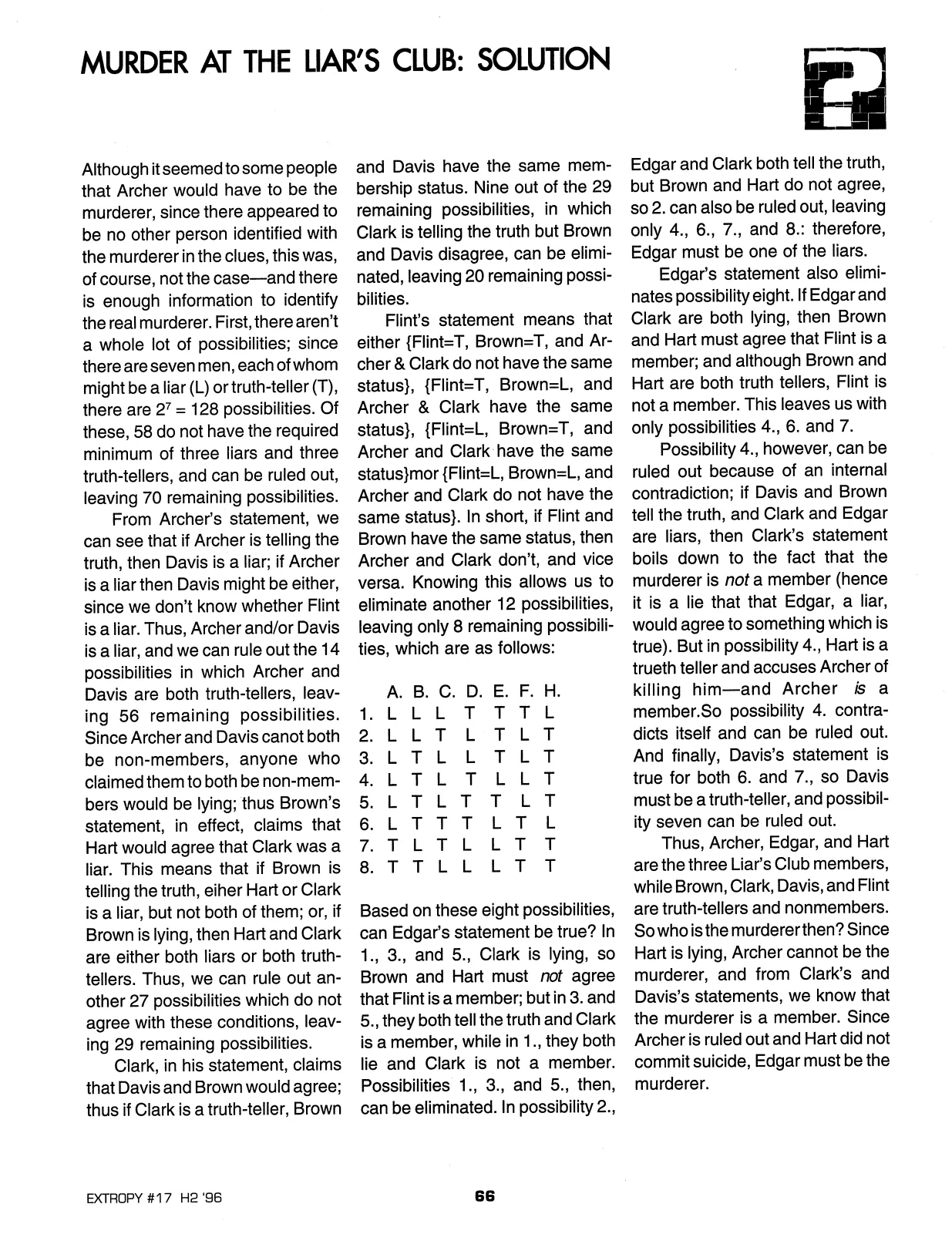
Although it seemed to some people that Archer would have to be the murderer, since there appeared to be no other person identified with the murderer in the clues, this was, of course, not the case—and there is enough information to identify the real murderer. First, there aren’t a whole lot of possibilities; since there are seven men, each of whom might be a liar (L) or truth-teller (T), there are 2⁷ = 128 possibilities. Of these, 58 do not have the required minimum of three liars and three truth-tellers, and can be ruled out, leaving 70 remaining possibilities.
From Archer’s statement, we can see that if Archer is telling the truth, then Davis is a liar; if Archer is a liar then Davis might be either, since we don’t know whether Flint is a liar. Thus, Archer and/or Davis is a liar, and we can rule out the 14 possibilities in which Archer and Davis are both truth-tellers, leaving 56 remaining possibilities. Since Archer and Davis cannot both be non-members, anyone who claimed them to both be non-members would be lying; thus Brown’s statement, in effect, claims that Hart would agree that Clark was a liar. This means that if Brown is telling the truth, either Hart or Clark is a liar, but not both of them; or, if Brown is lying, then Hart and Clark are either both liars or both truth-tellers. Thus, we can rule out another 27 possibilities which do not agree with these conditions, leaving 29 remaining possibilities.
Clark, in his statement, claims that Davis and Brown would agree; thus if Clark is a truth-teller, Brown and Davis have the same membership status. Nine out of the 29 remaining possibilities, in which Clark is telling the truth but Brown and Davis disagree, can be eliminated, leaving 20 remaining possibilities.
Flint’s statement means that either {Flint=T, Brown=T, and Archer & Clark do not have the same status}, {Flint=T, Brown=L, and Archer & Clark have the same status}, {Flint=L, Brown=T, and Archer and Clark have the same status}nor {Flint=L, Brown=L, and Archer and Clark do not have the same status}. In short, if Flint and Brown have the same status, then Archer and Clark don’t, and vice versa. Knowing this allows us to eliminate another 12 possibilities, leaving only 8 remaining possibilities, which are as follows:
| A. | B. | C. | D. | E. | F. | H. | |
|---|---|---|---|---|---|---|---|
| 1. | L | L | L | T | T | T | L |
| 2. | L | L | T | L | T | L | T |
| 3. | L | T | L | L | T | L | T |
| 4. | L | T | L | T | L | L | T |
| 5. | L | T | L | T | T | L | T |
| 6. | L | T | T | T | L | T | L |
| 7. | T | L | T | L | L | T | T |
| 8. | T | T | L | L | L | T | T |
Based on these eight possibilities, can Edgar’s statement be true? In 1., 3., and 5., Clark is lying, so Brown and Hart must not agree that Flint is a member; but in 3. and 5., they both tell the truth and Clark is a member, while in 1., they both lie and Clark is not a member. Possibilities 1., 3., and 5., then, can be eliminated. In possibility 2.,
Edgar and Clark both tell the truth, but Brown and Hart do not agree, so 2. can also be ruled out, leaving only 4., 6., 7., and 8.: therefore, Edgar must be one of the liars.
Edgar’s statement also eliminates possibility eight. If Edgar and Clark are both lying, then Brown and Hart must agree that Flint is a member; and although Brown and Hart are both truth tellers, Flint is not a member. This leaves us with only possibilities 4., 6. and 7.
Possibility 4., however, can be ruled out because of an internal contradiction; if Davis and Brown tell the truth, and Clark and Edgar are liars, then Clark’s statement boils down to the fact that the murderer is not a member (hence it is a lie that that Edgar, a liar, would agree to something which is true). But in possibility 4., Hart is a trueth teller and accuses Archer of killing him—and Archer is a member. So possibility 4. contradicts itself and can be ruled out. And finally, Davis’s statement is true for both 6. and 7., so Davis must be a truth-teller, and possibility seven can be ruled out.
Thus, Archer, Edgar, and Hart are the three Liar’s Club members, while Brown, Clark, Davis, and Flint are truth-tellers and nonmembers. So who is the murderer then? Since Hart is lying, Archer cannot be the murderer, and from Clark’s and Davis’s statements, we know that the murderer is a member. Since Archer is ruled out and Hart did not commit suicide, Edgar must be the murderer.
E N I G M A
FRACTAL MAZES
by Mark J. P. Wolf
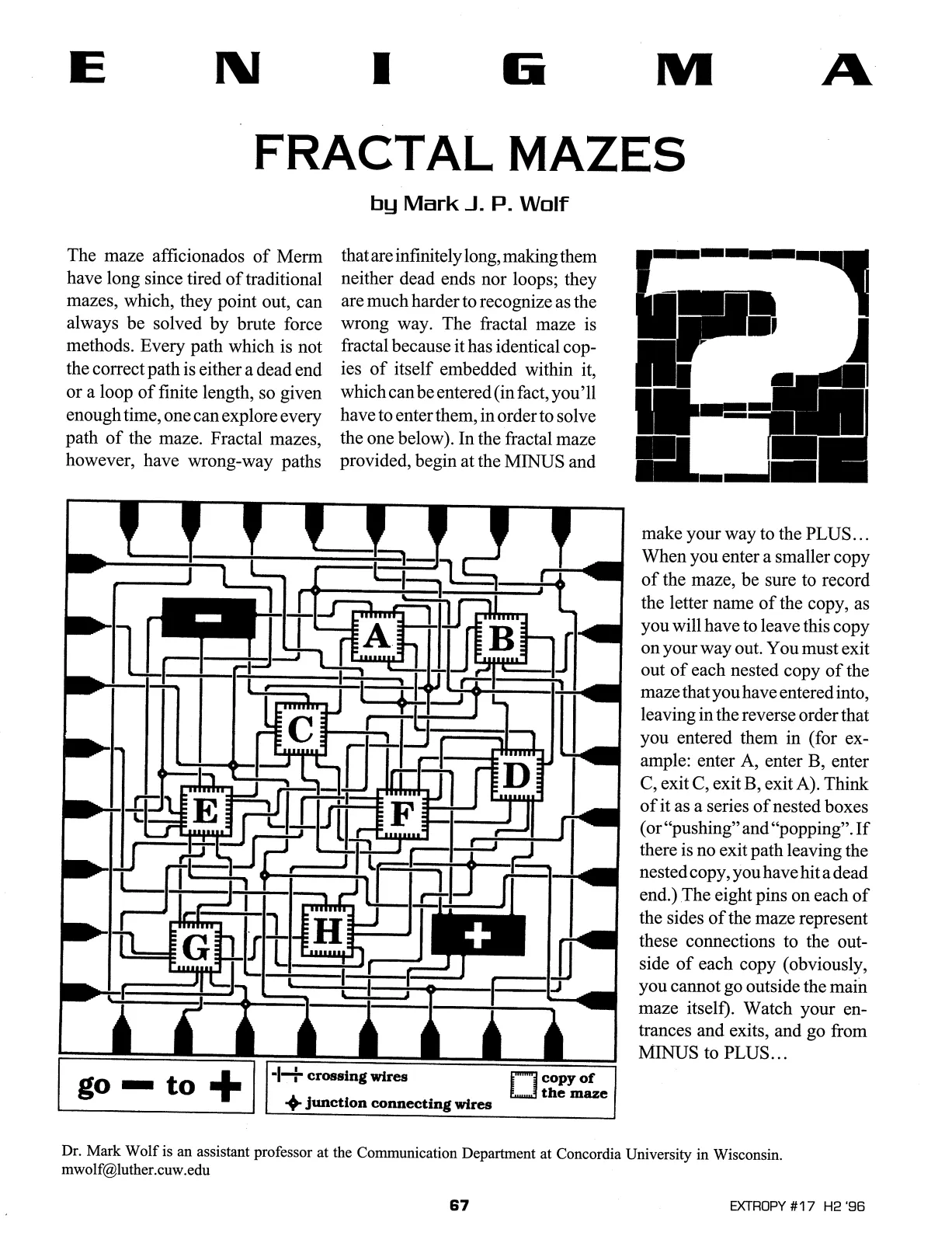
The maze afficionados of Merm have long since tired of traditional mazes, which, they point out, can always be solved by brute force methods. Every path which is not the correct path is either a dead end or a loop of finite length, so given enough time, one can explore every path of the maze. Fractal mazes, however, have wrong-way paths that are infinitely long, making them neither dead ends nor loops; they are much harder to recognize as the wrong way. The fractal maze is fractal because it has identical copies of itself embedded within it, which can be entered (in fact, you’ll have to enter them, in order to solve the one below). In the fractal maze provided, begin at the MINUS and make your way to the PLUS… When you enter a smaller copy of the maze, be sure to record the letter name of the copy, as you will have to leave this copy on your way out. You must exit out of each nested copy of the maze that you have entered into, leaving in the reverse order that you entered them in (for example: enter A, enter B, enter C, exit C, exit B, exit A). Think of it as a series of nested boxes (or “pushing” and “popping”. If there is no exit path leaving the nested copy, you have hit a dead end.) The eight pins on each of the sides of the maze represent these connections to the outside of each copy (obviously, you cannot go outside the main maze itself). Watch your entrances and exits, and go from MINUS to PLUS…
Dr. Mark Wolf is an assistant professor at the Communication Department at Concordia University in Wisconsin. mwolf@luther.cuw.edu
VIEW ORIGINAL SCAN (2 pages)