Issue: EXTROPY #17 · Second Half 1996
Author: Various
Pages: 49–60 · 12 scanned pages
Discriminator: Reviews (Engine of Reason, Six Pillars of Self-Esteem, Why Government Doesn't Work, Out of Control, Synthetic Pleasures)
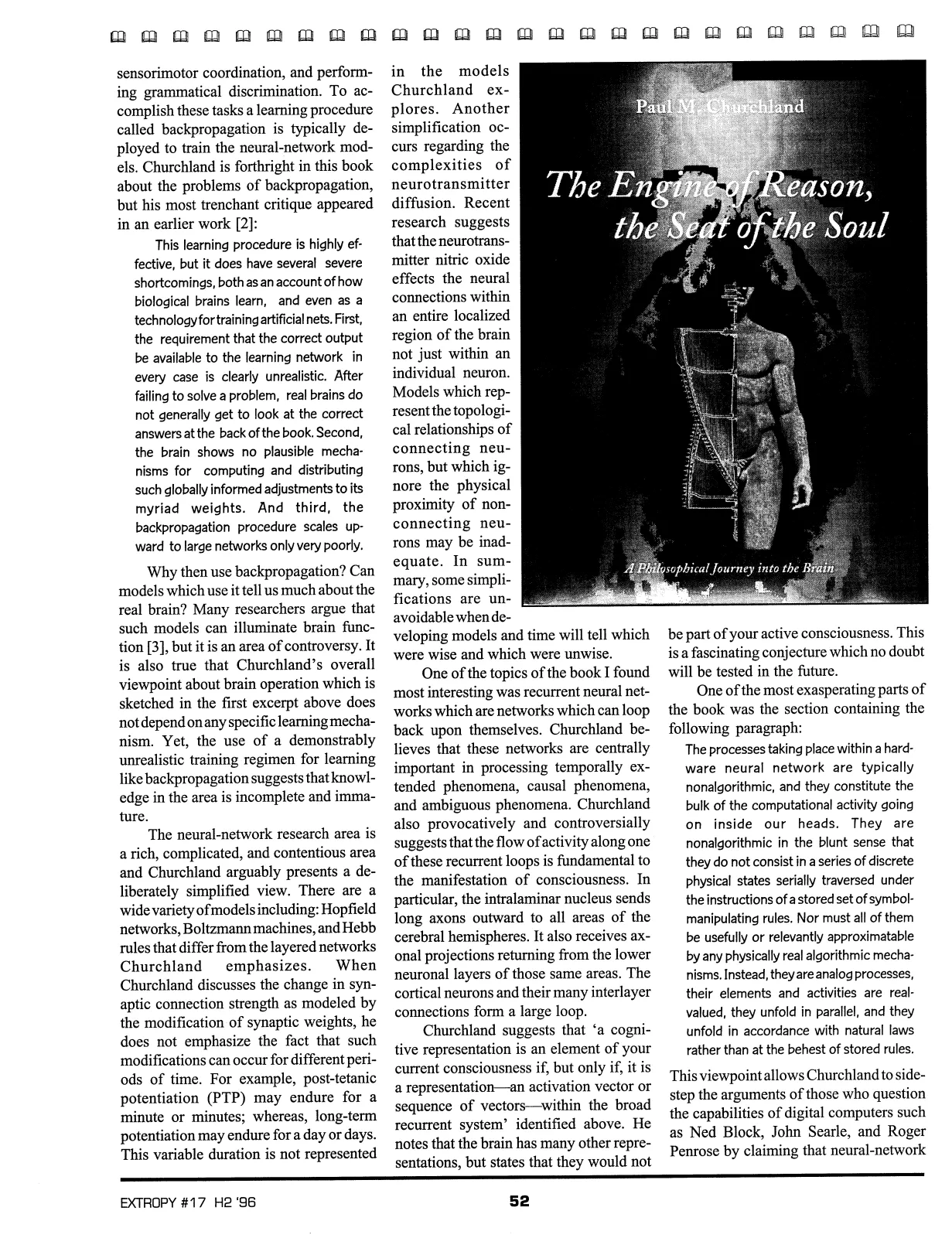
The Engine of Reason, the Seat of the Soul: A Philosophical Journey into the Brain
Paul M. Churchland
MIT Press, 1995.
329pp, list price $29.95 ISBN 0-262-03224-4
Reviewed by Gregory F. Sullivan
Aristotle suggested that the primary purpose of the brain was to temper the heat and seething of the heart, i.e., to cool the blood [1]. The baffling organ which inspired Aristotle’s quirkily comical theory is at last yielding to a phalanx of new scientific and computational brain researchers. The philosopher Paul Churchland has written an intriguing and ambitious book in which he attempts to explain how the brain works and discusses the implications of this new understanding. His explanation of brain operation is primarily based on current research work in neural-network modeling.
One might criticize this approach by saying that the explanations proffered simply represent an incomplete snapshot of a still rapidly developing field, and therefore the approach provides a poor foundation for philosophical inquiry. However, Churchland contends that although many details of brain operation currently remain unclear, the main outlines are discernible even now. He summarizes his view as follows:
In humans, and in animals generally, are carefully and lucidly explained by Churchland. In addition, multiple well chosen and well motivated examples are used to illustrate the concepts. Overall, Churchland presents the powerful neural-network framework using an accessible and compelling style. Longtime Extropy readers will already have been exposed to parts of this framework by the series of articles on neurocomputation by Simon D. Levy.
Churchland is an impressive philosopher who clearly wishes to develop a philosophical perspective that is informed by the latest and best scientific thought. When studying consciousness and the brain he does not rely solely on introspection or oddly constructed puzzle-type problems. Instead, he reads the scientific literature and engages members of the community such as Francis Crick, Terry Sejnowski, Antonio Damasio, Hanna Damasio, and his wife Patricia Churchland. This approach allows Churchland to productively attempt to integrate insights from a large number of viewpoints including neurocomputation, neuropathology, neuit is now modestly plain that the basic unit of cognition is the ‘activation vector’. It is now fairly clear that the basic unit of computation is the ‘vector-to-vector transformation’. And it is now evident that the basic unit of memory is the ‘synaptic weight configuration’.
Although this summary description appears to be fairly technical, the book is aimed at a wide audience, and the concepts needed to understand the terms above rophysiology, and neuroanatomy.
The reader should be aware, however, that some of the ideas about neural-networks expounded by Churchland face substantial criticism. Churchland discusses networks capable of performing well on a variety of tasks such as: mapping letter sequences to phoneme sequences, distinguishing between sonar echoes of mines and rocks, achieving face recognition, performing stereoscopic vision, carrying out
REVIEWS OF EXTROPIAN INTEREST
sensorimotor coordination, and performing grammatical discrimination. To accomplish these tasks a learning procedure called backpropagation is typically deployed to train the neural-network models. Churchland is forthright in this book about the problems of backpropagation, but his most trenchant critique appeared in an earlier work [2]:
This learning procedure is highly effective, but it does have several severe shortcomings, both as an account of how biological brains learn, and even as a technology for training artificial nets. First, the requirement that the correct output be available to the learning network in every case is clearly unrealistic. After failing to solve a problem, real brains do not generally get to look at the correct answers at the back of the book. Second, the brain shows no plausible mechanisms for computing and distributing such globally informed adjustments to its myriad weights. And third, the backpropagation procedure scales upward to large networks only very poorly.
Why then use backpropagation? Can models which use it tell us much about the real brain? Many researchers argue that such models can illuminate brain function [3], but it is an area of controversy. It is also true that Churchland’s overall viewpoint about brain operation which is sketched in the first excerpt above does not depend on any specific learning mechanism. Yet, the use of a demonstrably unrealistic training regimen for learning like backpropagation suggests that knowledge in the area is incomplete and immature.
The neural-network research area is a rich, complicated, and contentious area and Churchland arguably presents a deliberately simplified view. There are a wide variety of models including: Hopfield networks, Boltzmann machines, and Hebb rules that differ from the layered networks Churchland emphasizes. When Churchland discusses the change in synaptic connection strength as modeled by the modification of synaptic weights, he does not emphasize the fact that such modifications can occur for different periods of time. For example, post-tetanic potentiation (PTP) may endure for a minute or minutes; whereas, long-term potentiation may endure for a day or days. This variable duration is not represented in the models Churchland explores. Another simplification occurs regarding the complexities of neurotransmitter diffusion. Recent research suggests that the neurotransmitter nitric oxide effects the neural connections within an entire localized region of the brain not just within an individual neuron. Models which represent the topological relationships of connecting neurons, but which ignore the physical proximity of nonconnecting neurons may be inadequate. In summary, some simplifications are unavoidable when de veloping models and time will tell which were wise and which were unwise.
One of the topics of the book I found most interesting was recurrent neural networks which are networks which can loop back upon themselves. Churchland believes that these networks are centrally important in processing temporally extended phenomena, causal phenomena, and ambiguous phenomena. Churchland also provocatively and controversially suggests that the flow of activity along one of these recurrent loops is fundamental to the manifestation of consciousness. In particular, the intralaminar nucleus sends long axons outward to all areas of the cerebral hemispheres. It also receives axonal projections returning from the lower neuronal layers of those same areas. The cortical neurons and their many interlayer connections form a large loop.
Churchland suggests that ‘a cognitive representation is an element of your current consciousness if, but only if, it is a representation—an activation vector or sequence of vectors—within the broad recurrent system’ identified above. He notes that the brain has many other representations, but states that they would not be part of your active consciousness. This is a fascinating conjecture which no doubt will be tested in the future.
One of the most exasperating parts of the book was the section containing the following paragraph:
The processes taking place within a hardware neural network are typically nonalgorithmic, and they constitute the bulk of the computational activity going on inside our heads. They are nonalgorithmic in the blunt sense that they do not consist in a series of discrete physical states serially traversed under the instructions of a stored set of symbol-manipulating rules. Nor must all of them be usefully or relevantly approximatable by any physically real algorithmic mechanisms. Instead, they are analog processes, their elements and activities are real-valued, they unfold in parallel, and they unfold in accordance with natural laws rather than at the behest of stored rules.
This viewpoint allows Churchland to sidestep the arguments of those who question the capabilities of digital computers such as Ned Block, John Searle, and Roger Penrose by claiming that neural-network models are ‘nonalgorithmic’ and therefore need not suffer from the supposed limitations of algorithmic models. I question Churchland’s position because I believe that he is not properly comparing the computational powers of brains, neural-network models, and digital computers.
Let us first consider the so called ‘analog’ nature of neuronal processes. It is true that many neural-network models use real-valued parameters and real-valued functions. For example, a synaptic weight which models the ‘strength’ of a synaptic connection is typically a real number. But is this an essential part of the neural-network model and does it accurately reflect the behavior of actual neurons? Note that, an actual individual neuron can be thought of as a bag which contains a finite number of chemical constituents.
This bag is clearly subjected to perturbations in temperature and pressure. It is exposed to a changing mixture of chemicals that flow or diffuse through the brain. Blood pressure can change, and the mixture and concentrations of endocrine molecules that interact with receptors on the neuronal cell surface can fluctuate. Imagine a delicate brain computation that relies on the unbounded precision supposedly embodied in neurons. Would this computation ‘malfunction’ because an individual steps outside in cold weather and induces a minuscule variation in neuronal temperature? What if an individual climbs some stairs and induces a small variation in blood pressure? How is this supposed infinite precision physically encoded in a neuron?
There is an alternative viewpoint that holds that real numbers and infinite precision are not needed and are not realistic. Instead, finite precision and approximation is adequate. For example, Moravec suggests using 10 binary bits of precision per synapse weight [4]. Indeed, digital computations which usefully approximate the answers to real valued models have been performed for years by computer scientists. An entire field called Numerical Analysis is dedicated to solving problems which are expressed with real and complex numbers using finite precision computers.
Now, consider the parallel nature of neuronal processes. It is well known to computer scientists that a wide variety of parallel computing models can be simulated with serial computers. For example, a PRAM (parallel random access machine) machine can be simulated with a serial computation and a cellular automata can also be simulated. The principle neural-network model in the book is another example of a parallel model which can be approximately simulated using a serial computation. In fact, many of the numerous examples of neural-network applications which form a key part of Churchland’s justification for taking neural networks seriously as a model for brain activity were actually simulated using conventional digital computers. The splendid results given for trained neural networks were not actually obtained for parallel analog neural networks they were for neural networks simulated using conventional computers.
Consider the assertion that the brain does not use a stored set of symbol-manipulating rules. This appears to be true, but does it mean that neural-network processes are nonalgorithmic? Note, the simulations mentioned immediately above certainly use a stored set of symbol-manipulating rules. I think Churchland is underestimating the power and flexibility of such systems. An orbiting planet does not use symbol-manipulating rules, but such rules can be used to approximate the orbit with great precision.
Pragmatically, it may turn out that the best way to build a brain-like device involves using analog hardware components and a highly-parallel architecture. This strategy might yield the fastest brain-like device and speed is quite prized. The chess computer Deep Blue which recently played Gary Kasparov uses 256 digital processors running in parallel. But from a philosophical perspective this possible pragmatic fact does not engage the arguments of Ned Block, John Searle, and Roger Penrose. These philosophers do not argue that digital computers would yield excruciatingly slow forms of consciousness through simulation. Instead, they argue that consciousness is impossible to implement with a digital computer. I believe that they are wrong and I am disappointed that Churchland largely sidesteps their arguments using the poorly formulated argument outlined in the excerpt presented earlier. At this point, let me recommend the refreshingly different viewpoint of Ralph Merkle in his Extropy article on uploading consciousness from a brain to a computer [5].
In the latter sections of the book Churchland investigates the ramifications of his beliefs about brain function in a wide-ranging collection of areas including psychiatry, linguistics, artificial intelligence, and law. Much of this material is intriguing, provocative and worth reading. Here I will comment on one area in which I have some disagreements with Churchland, and in which the difficulties of applying knowledge about brain function become clear. Churchland suggests that the legal and scientific definition of human death should be refined as we learn more about brain operations and consciousness. While I agree with this sentiment I believe that the task is more complicated then Churchland apparently does.
Currently, most states in the U.S. have adopted a notion of ‘brain death’ in which an EEG (electroencephalograph) is used to determine if a cessation of brain activity has occurred. When an individual is declared brain dead efforts to maintain the body may be stopped and the body may be allowed to perish. Churchland believes that this is a humane policy, and he would like to see the notion of brain death expanded. For example, if an individual becomes comatose and medical investigation reveals that there has been ‘massive cell destruction to the patients thalamus at the center of the brain, and in particular, to the intralaminar nucleus’ then Churchland contends that ‘the valued self is wholly and irretrievably lost.’ Thus, even if the EEG shows some neural activity the body need not be maintained and should be allowed to perish. Another example in which an individual is ‘irretrievably lost’ according to Churchland occurs during the progression of Alzheimer’s disease. This debilitating degenerative disease causes networks of cells in the brain to be transformed into neuritic plaques and neurofibrillary tangles which are unable to carry on the tasks of the healthy cell networks.
My main objection to this line of reasoning is based on the recognition that a person who appears irretrievably lost using current scientific and technological capabilities may actually be retrievable using future capabilities. Imagine a patient in a coma with a brain lesion that prevents consciousness. Perhaps the lesion severs some neurons which are necessary for carrying signals in the recurrent network that Churchland postulates is necessary for consciousness. However, the lesion does not destroy major portions of the brain that encode the long-term memories of the patient. Imagine further that this patient would be able to survive in a coma for several additional years using current life-support technology. Is this patient irretrievably lost?
Future technology may allow extraordinary interventions. In Extropy #16 there is an interview [6] with Ted Berger, Professor of Biomedical Engineering and Neurobiology at the University of Southern California, who speculates on the future possibility of replacing parts of the brain that are damaged. The replacement would utilize computer chips and specially designed interface electrodes. Perhaps such a implant could revive a comatose patient, and allow that patient to access the still intact long-term memories.
In the cryonics literature the notion of ‘information theoretic death’ has been developed. An individual is dead only when ‘the structures in the brain that encode memory and personality have been so disrupted that it is no longer possible in principle to restore them to an appropriate functional state’ [7]. The phrase ‘in principle’ entails consideration of such speculative possibilities as the cryonic preservation of an individual, and the use of molecular nanotechnology to rebuild a brain or to extract information from a brain. If the notion of brain death evolves over time I think it should evolve toward the notion of information theoretic death [8][9].
In summation, Churchland’s sharp intellect and fine expository style makes for exceptionally satisfying reading. The progress in brain theory recounted is exciting and compelling, and I look forward to Churchland’s next report from the moving battleground of knowledge and thought.
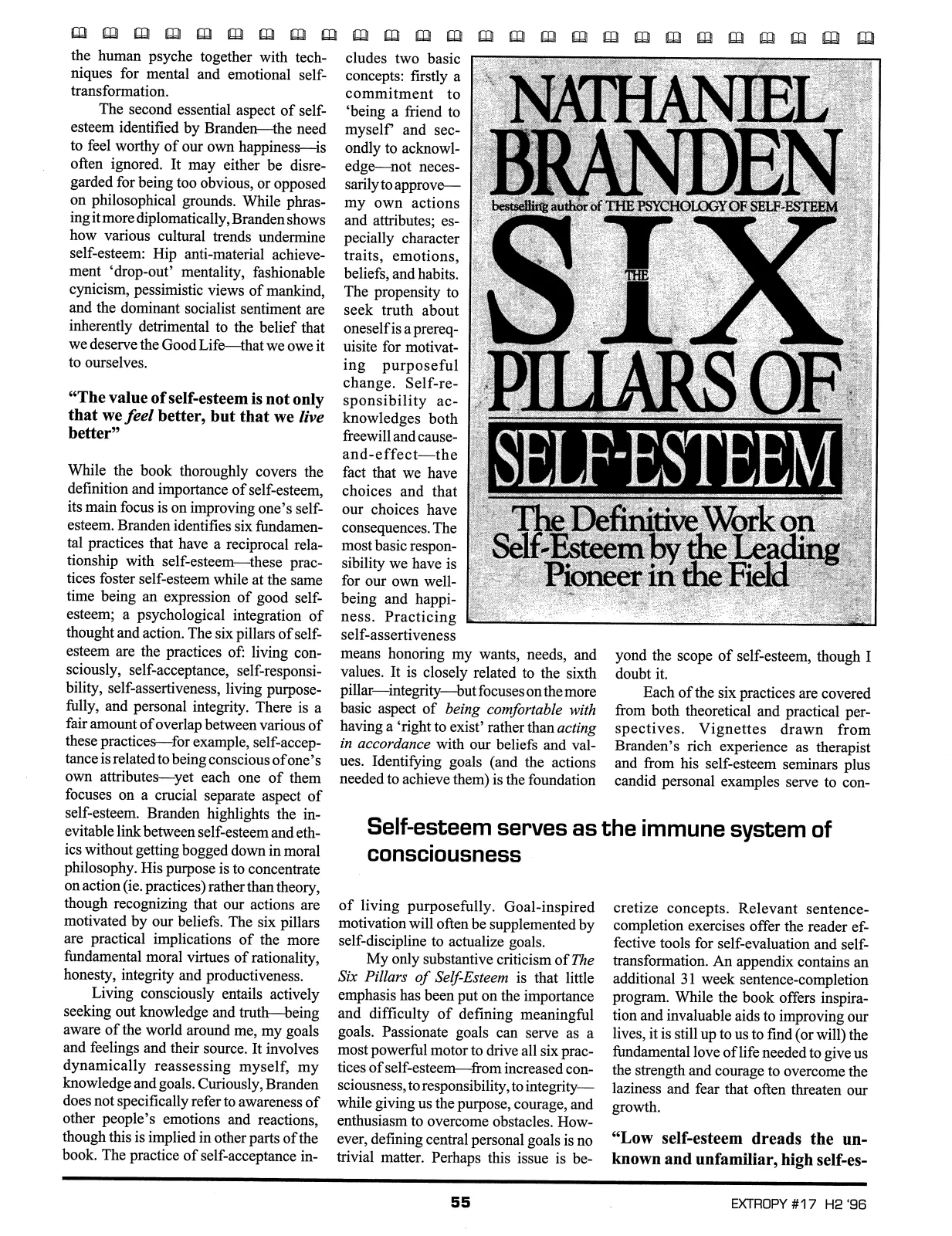
The Six Pillars of Self-Esteem
by Nathaniel Branden Bantam Books, New York, 1995
346 pages; $22.95 hd (also in pb) ISBN 0-553-09529-3
Reviewed by Peter Voss (p.voss@ix.netcom.com)
“Of all the judgments we pass in life, none is as important as the one we pass on ourselves”
The extropian value of self-transformation expresses in part our desire to improve our knowledge, cognitive ability, emotional well-being and general mental effectiveness—in short, our ability not just to cope with life, but to optimize it. In spite of an abundance of self-help books, there is a real shortage of practical, yet theoretically sound texts. The Six Pillars of Self-Esteem more than meets this challenge. It offers a rational, coherent theory of self-esteem while exploring implications in personal and family life, education, work, and society. Moreover, Six Pillars goes far beyond the theoretical framework. Practical examples and exercises make this book a most comprehensive tool not just for understanding self-esteem, but for improving it.
Branden starts the book with the essential task of defining self-esteem and contrasting his views from the muddle of various popular (mis-)conceptions of (pseudo-)self-esteem. His definition: “Self-esteem is the disposition to experience oneself as competent to cope with the basic challenges of life and as worthy of happiness”. Self-esteem serves as the immune system of consciousness. Self-esteem is a deep personal conviction that we are, in spite of any specific limitations or hardships, fit for living—and flourishing. While self-esteem has always been an essential human need, modern life dramatically escalates its importance. Faced with a plethora of choices and an ever increasing rate of change, coping with the ‘basic challenges of life’ is anything but trivial and by no means automatic.
Self-esteem is our basic confidence that we are, in principle, able to cope with life. It is not concerned with any specific competence or skill that we may or may not have. Yet, clearly, this confidence cannot be divorced from actual ability. Branden resolves this paradox by equating improved self-esteem with establishing ‘a good reputation’ with ourselves. As we become more aware and increasingly act in accordance with our beliefs and goals, so we initiate a self-enhancing cycle of improved self-esteem—irrespective of how great or limited our specific skills may be. Self-esteem is how we judge ourselves—not against others—but by our own appropriate standards. The emerging science of psychology provides an additional string to our bow of life competency: improved knowledge of
[1] Aristotle, ‘On the Parts of Animals’, 350 B.C., translated by William Ogle. URL: http://nifty.bookstore.uidaho.edu/Philosophy/Aristotle/On_the_Parts_of_Animals/2.htm
[2] Paul M. Churchland, A Neurocomputational Perspective, MIT Press, Cambridge, 1989, pages 243-244.
[3] Patricia S. Churchland and Terrence J. Sejnowski, The Computational Brain, MIT Press, Cambridge, 1992, pages 130-137.
[4] Hans Moravec, Mind Children, Harvard University Press, Cambridge, 1988, page 61.
[5] Ralph C. Merkle, ‘Uploading: Transferring Consciousness from Brain to Computer’ Extropy #11, (2nd Half, 1993) pages 5-8.
[6] ‘Building Brains: a profile interview with Ted Berger’,
Extropy #16 (1st Quarter 1996), pages 18-21.
[7] Ralph C. Merkle, ‘The Molecular Repair of the Brain’ Cryonics, Vol. 15 No’s 1 and 2, January and April 1994. URL: http://merkle.com/merkleDir/techFeas.html.
[8] Max More, The Diachronic Self: Identity, Continuity, Transformation, Ph.D. Thesis, University of Southern California. URL: http://www.primenet.com/~maxmore/disscont.htm. This thesis provides many important and valuable insights. Chapter 2 is particularly relevant to the issues raised by the definition of ‘death’.
[9] James J. Hughes, ‘Brain Death and Technological Change’, Second International Symposium on Brain Death, Havana Cuba, February 27-March 1. URL: http://ccme-mac4.bsd.uchicago.edu/CCMEFaculty/Hughes/Hughes.html authors homepage. Interesting perspective from a bioethicist.
the human psyche together with techniques for mental and emotional self-transformation.
The second essential aspect of self-esteem identified by Branden—the need to feel worthy of our own happiness—is often ignored. It may either be disregarded for being too obvious, or opposed on philosophical grounds. While phrasing it more diplomatically, Branden shows how various cultural trends undermine self-esteem: Hip anti-material achievement ‘drop-out’ mentality, fashionable cynicism, pessimistic views of mankind, and the dominant socialist sentiment are inherently detrimental to the belief that we deserve the Good Life—that we owe it to ourselves.
“The value of self-esteem is not only that we feel better, but that we live better”
While the book thoroughly covers the definition and importance of self-esteem, its main focus is on improving one’s self-esteem. Branden identifies six fundamental practices that have a reciprocal relationship with self-esteem—these practices foster self-esteem while at the same time being an expression of good self-esteem; a psychological integration of thought and action. The six pillars of self-esteem are the practices of: living consciously, self-acceptance, self-responsibility, self-assertiveness, living purposefully, and personal integrity. There is a fair amount of overlap between various of these practices—for example, self-acceptance is related to being conscious of one’s own attributes—yet each one of them focuses on a crucial separate aspect of self-esteem. Branden highlights the inevitable link between self-esteem and ethics without getting bogged down in moral philosophy. His purpose is to concentrate on action (ie. practices) rather than theory, though recognizing that our actions are motivated by our beliefs. The six pillars are practical implications of the more fundamental moral virtues of rationality, honesty, integrity and productiveness.
Living consciously entails actively seeking out knowledge and truth—being aware of the world around me, my goals and feelings and their source. It involves dynamically reassessing myself, my knowledge and goals. Curiously, Branden does not specifically refer to awareness of other people’s emotions and reactions, though this is implied in other parts of the book. The practice of self-acceptance includes two basic concepts: firstly a commitment to ‘being a friend to myself’ and secondly to acknowledge—not necessarily to approve—my own actions and attributes; especially character traits, emotions, beliefs, and habits. The propensity to seek truth about oneself is a prerequisite for motivating purposeful change. Self-responsibility acknowledges both freewill and cause-and-effect—the fact that we have choices and that our choices have consequences. The most basic responsibility we have is for our own well-being and happiness. Practicing self-assertiveness means honoring my wants, needs, and values. It is closely related to the sixth pillar—integrity—but focuses on the more basic aspect of being comfortable with having a ‘right to exist’ rather than acting in accordance with our beliefs and values. Identifying goals (and the actions needed to achieve them) is the foundation
Self-esteem serves as the immune system of consciousness
of living purposefully. Goal-inspired motivation will often be supplemented by self-discipline to actualize goals.
My only substantive criticism of The Six Pillars of Self-Esteem is that little emphasis has been put on the importance and difficulty of defining meaningful goals. Passionate goals can serve as a most powerful motor to drive all six practices of self-esteem—from increased consciousness, to responsibility, to integrity—while giving us the purpose, courage, and enthusiasm to overcome obstacles. However, defining central personal goals is no trivial matter. Perhaps this issue is beyond the scope of self-esteem, though I doubt it.
Each of the six practices are covered from both theoretical and practical perspectives. Vignettes drawn from Branden’s rich experience as therapist and from his self-esteem seminars plus candid personal examples serve to concretize concepts. Relevant sentence-completion exercises offer the reader effective tools for self-evaluation and self-transformation. An appendix contains an additional 31 week sentence-completion program. While the book offers inspiration and invaluable aids to improving our lives, it is still up to us to find (or will) the fundamental love of life needed to give us the strength and courage to overcome the laziness and fear that often threaten our growth.
“Low self-esteem dreads the unknown and unfamiliar, high self-esteem seeks new frontiers”
I was thrilled about Branden’s return to philosophical roots he planted in The Psychology of Self-Esteem 25 years ago. Six Pillars tackles many controversial philosophical, ethical, socio-political aspects and implications of self-esteem in a most skillful and tactful manner. However, it will undoubtedly offend some religious people and various collectivists. In the third part of the book Branden explores nurturing self-esteem in children (at home and at school), the role of self-esteem at the workplace (including management styles and future employment challenges) and self-esteem in psychotherapy. He politely but forcefully exposes the flaws and dangers in the popular view held by many leading psychologists and educators that self-esteem is primarily an externally generated or social phenomenon. Branden identifies this as pseudo self-esteem.
The final section is the most philosophical and covers the relationship between self-esteem and culture. It specifically denounces relativistic and subjective views of the nature and value of self-esteem—a common approach in today’s ‘politically correct’ multi-cultural, non-judgmental atmosphere. Branden touches on various historic and present cultures and religions identifying their inherent support or opposition to specific aspects of self-esteem and consequences of those beliefs. Extropianism wasn’t evaluated, but I guess its principles would rate highly pro self-esteem.
Six Pillars is well-written, organized, and referenced and makes for easy reading—though not necessarily for easy execution of advice. Acquiring and improving the six habits of self-esteem will take substantial motivation and self-discipline. Positive results, while inevitable, may be too slow for the impatient. This book is no general quick fix, though it can provide immediate life-changing insights. The book is by no means limited to self-esteem basket cases. Indeed, medium to high self-esteem individuals are likely to benefit substantially from it by their ability to assess themselves more objectively and from better discipline to do the exercises. I highly recommend this book—especially as a reference book that is regularly reviewed. As futurists we are particularly attuned to the dynamics of life and eagerly seek great tools like The Six Pillars of Self-Esteem to help us optimize surfing the Future-Shock Wave.
Why Government Doesn’t Work
Harry Browne
St. Martin’s Press: New York, 1995
ISBN 0-312-13623-4
Reviewed by Eric Watt Forste
Ah, it’s 1996, and in the United States yet another libertarian presidential candidate has written yet another campaign book. But this one surpasses the previous examples of this genre in style, taste, and feeling: whether or not it will surpass them in political effectiveness remains to be seen.
Part One, which bears the same title as the whole book, begins with several chapters stating and restating various economic and ethical arguments against the use of coercion to redistribute resources. The arguments, which are simple and familiar to most readers of Extropy, are restated in a variety of perspectives and nomenclatures, and are illustrated with examples taken from the histories of various US Federal government programs in the twentieth century. Those very familiar with these arguments may feel that Browne is repeating himself, but such repetition is necessary to persuade those who are unfamiliar with these ideas, and the effort to present the repetitions as wholly different perspectives on the same problem is well thought through.
Part One continues by arguing that the “Founding Fathers” had an accurate general understanding of the ills of legitimized coercion, derived from the seventeenth-century struggle between the (at the time, relatively libertarian) English Parliament and the absolutist Stuart kings. Like Hayek, Browne understands the American Revolution to be a (classical) liberal resistance to the emergence of governmental absolutism within the ranks of Parliament itself. Browne asserts that the authors of the American Constitution deliberately restricted most governmental powers to the States because they understood that the Federal guarantees of free trade and migration among the States would punish those States whose governments preferred authoritarian policies. The “brain drain” from Europe to the
United States during the mid twentieth century illustrates something of the phenomenon invoked. This is why Browne feels that he can mount an effective campaign for liberty from the single Federal office of President; if he can effectively restrain Federal powers, market forces unleashed by freedom of trade and migration among the states of the US will probably keep the local governments in line.
Part One closes with a historical summary of the slipping away of American liberties. He chronicles this in a succession of four major periods of unconstitutional growth in the power of the Federal government: the Civil War, the “Progressive” Era, the New Deal, and the Great Society (which Browne dates from 1961 to 1975). I could find no false assertions of fact in Browne’s historical summary, and the simplicity, calmness, and clarity with which Browne makes and defends controversial historical assertions impressed me. (And yes, the book does list reference materials used for evidence, chapter by chapter, in an appendix.) Finally, Browne presents an overview of the state of the people’s liberties and the Federal government’s power in the present day, leading into his program statement.
Part Two, “Solving Today’s Social & Political Problems,” contains few surprises for most libertarians. It is tailored to the office for which Browne is running: Federal President. His answer to most social and political problems is to cut federal spending, cut federal taxes, and let either the state governments or the people acting through voluntary association or both act to solve the problem. Browne devotes two chapters each to health care and national defense and one chapter each to education, welfare, social security, crime, regulation, and “family values” (the last is devoted to arguing for a separation between legislation and mo-
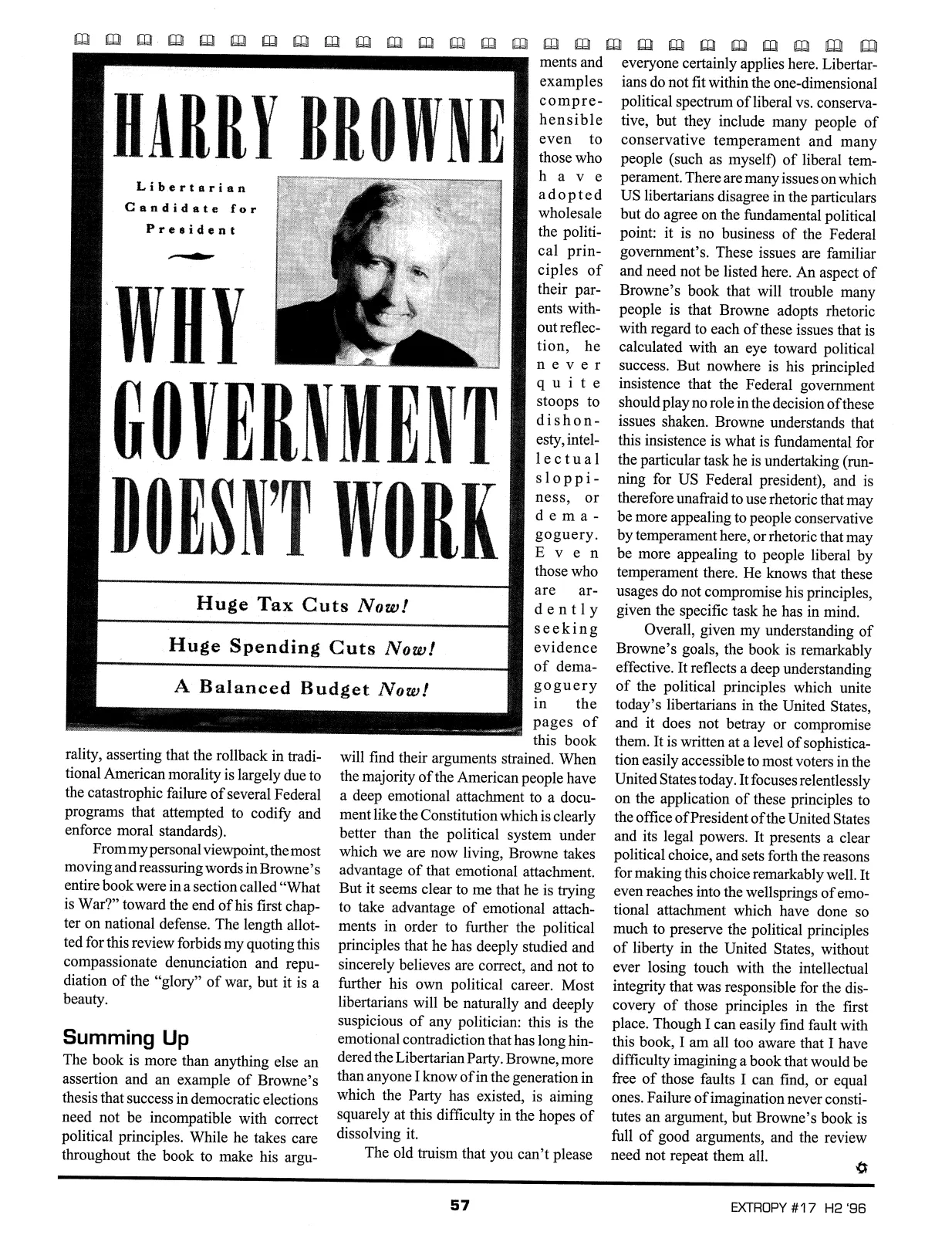
HARRY BROWNE
Libertarian Candidate for President
WHY
GOVERNMENT
DOESN’T WORK
Huge Tax Cuts Now!
Huge Spending Cuts Now!
A Balanced Budget Now!
rality, asserting that the rollback in traditional American morality is largely due to the catastrophic failure of several Federal programs that attempted to codify and enforce moral standards).
From my personal viewpoint, the most moving and reassuring words in Browne’s entire book were in a section called “What is War?” toward the end of his first chapter on national defense. The length allotted for this review forbids my quoting this compassionate denunciation and repudiation of the “glory” of war, but it is a beauty.
Summing Up
The book is more than anything else an assertion and an example of Browne’s thesis that success in democratic elections need not be incompatible with correct political principles. While he takes care throughout the book to make his arguwill find their arguments strained. When the majority of the American people have a deep emotional attachment to a document like the Constitution which is clearly better than the political system under which we are now living, Browne takes advantage of that emotional attachment. But it seems clear to me that he is trying to take advantage of emotional attachments in order to further the political principles that he has deeply studied and sincerely believes are correct, and not to further his own political career. Most libertarians will be naturally and deeply suspicious of any politician: this is the emotional contradiction that has long hindered the Libertarian Party. Browne, more than anyone I know of in the generation in which the Party has existed, is aiming squarely at this difficulty in the hopes of dissolving it.
The old truism that you can’t please ments and examples comprehensible even to those who have adopted wholesale the political principles of their parents without reflection, he never quite stoops to dishonesty, intellectual sloppiness, or demagoguery. Even those who are ardently seeking evidence of demagoguery in the pages of this book everyone certainly applies here. Libertarians do not fit within the one-dimensional political spectrum of liberal vs. conservative, but they include many people of conservative temperament and many people (such as myself) of liberal temperament. There are many issues on which US libertarians disagree in the particulars but do agree on the fundamental political point: it is no business of the Federal government’s. These issues are familiar and need not be listed here. An aspect of Browne’s book that will trouble many people is that Browne adopts rhetoric with regard to each of these issues that is calculated with an eye toward political success. But nowhere is his principled insistence that the Federal government should play no role in the decision of these issues shaken. Browne understands that this insistence is what is fundamental for the particular task he is undertaking (running for US Federal president), and is therefore unafraid to use rhetoric that may be more appealing to people conservative by temperament here, or rhetoric that may be more appealing to people liberal by temperament there. He knows that these usages do not compromise his principles, given the specific task he has in mind.
Overall, given my understanding of Browne’s goals, the book is remarkably effective. It reflects a deep understanding of the political principles which unite today’s libertarians in the United States, and it does not betray or compromise them. It is written at a level of sophistication easily accessible to most voters in the United States today. It focuses relentlessly on the application of these principles to the office of President of the United States and its legal powers. It presents a clear political choice, and sets forth the reasons for making this choice remarkably well. It even reaches into the wellsprings of emotional attachment which have done so much to preserve the political principles of liberty in the United States, without ever losing touch with the intellectual integrity that was responsible for the discovery of those principles in the first place. Though I can easily find fault with this book, I am all too aware that I have difficulty imagining a book that would be free of those faults I can find, or equal ones. Failure of imagination never constitutes an argument, but Browne’s book is full of good arguments, and the review need not repeat them all.
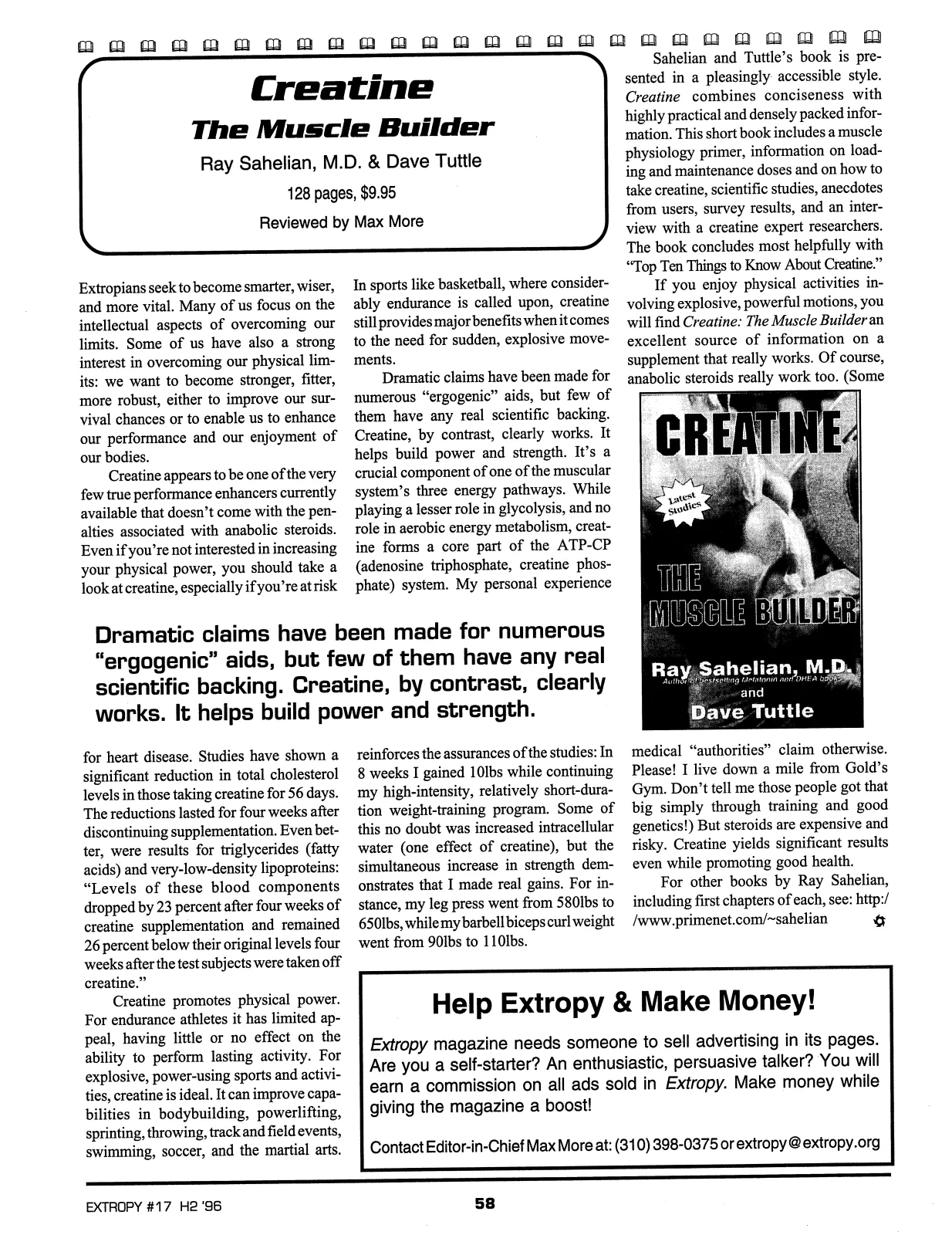
Creatine
The Muscle Builder
Ray Sahelian, M.D. & Dave Tuttle
128 pages, $9.95
Reviewed by Max More
Extropians seek to become smarter, wiser, and more vital. Many of us focus on the intellectual aspects of overcoming our limits. Some of us have also a strong interest in overcoming our physical limits: we want to become stronger, fitter, more robust, either to improve our survival chances or to enable us to enhance our performance and our enjoyment of our bodies.
Creatine appears to be one of the very few true performance enhancers currently available that doesn’t come with the penalties associated with anabolic steroids. Even if you’re not interested in increasing your physical power, you should take a look at creatine, especially if you’re at risk
In sports like basketball, where considerably endurance is called upon, creatine still provides major benefits when it comes to the need for sudden, explosive movements.
Dramatic claims have been made for numerous “ergogenic” aids, but few of them have any real scientific backing. Creatine, by contrast, clearly works. It helps build power and strength. It’s a crucial component of one of the muscular system’s three energy pathways. While playing a lesser role in glycolysis, and no role in aerobic energy metabolism, creatine forms a core part of the ATP-CP (adenosine triphosphate, creatine phosphate) system. My personal experience for heart disease. Studies have shown a significant reduction in total cholesterol levels in those taking creatine for 56 days. The reductions lasted for four weeks after discontinuing supplementation. Even better, were results for triglycerides (fatty acids) and very-low-density lipoproteins: “Levels of these blood components dropped by 23 percent after four weeks of creatine supplementation and remained 26 percent below their original levels four weeks after the test subjects were taken off creatine.”
Creatine promotes physical power. For endurance athletes it has limited appeal, having little or no effect on the ability to perform lasting activity. For explosive, power-using sports and activities, creatine is ideal. It can improve capabilities in bodybuilding, powerlifting, sprinting, throwing, track and field events, swimming, soccer, and the martial arts.
reinforces the assurances of the studies: In 8 weeks I gained 10lbs while continuing my high-intensity, relatively short-duration weight-training program. Some of this no doubt was increased intracellular water (one effect of creatine), but the simultaneous increase in strength demonstrates that I made real gains. For instance, my leg press went from 580lbs to 650lbs, while my barbell biceps curl weight went from 90lbs to 110lbs.
Sahelian and Tuttle’s book is presented in a pleasingly accessible style. Creatine combines conciseness with highly practical and densely packed information. This short book includes a muscle physiology primer, information on loading and maintenance doses and on how to take creatine, scientific studies, anecdotes from users, survey results, and an interview with a creatine expert researchers. The book concludes most helpfully with “Top Ten Things to Know About Creatine.”
If you enjoy physical activities involving explosive, powerful motions, you will find Creatine: The Muscle Builder an excellent source of information on a supplement that really works. Of course, anabolic steroids really work too. (Some medical “authorities” claim otherwise. Please! I live down a mile from Gold’s Gym. Don’t tell me those people got that big simply through training and good genetics!) But steroids are expensive and risky. Creatine yields significant results even while promoting good health.
For other books by Ray Sahelian, including first chapters of each, see: http://www.primenet.com/~sahelian
Help Extropy & Make Money!
Extropy magazine needs someone to sell advertising in its pages. Are you a self-starter? An enthusiastic, persuasive talker? You will earn a commission on all ads sold in Extropy. Make money while giving the magazine a boost!
Contact Editor-in-Chief Max More at: (310) 398-0375 or extropy@extropy.org
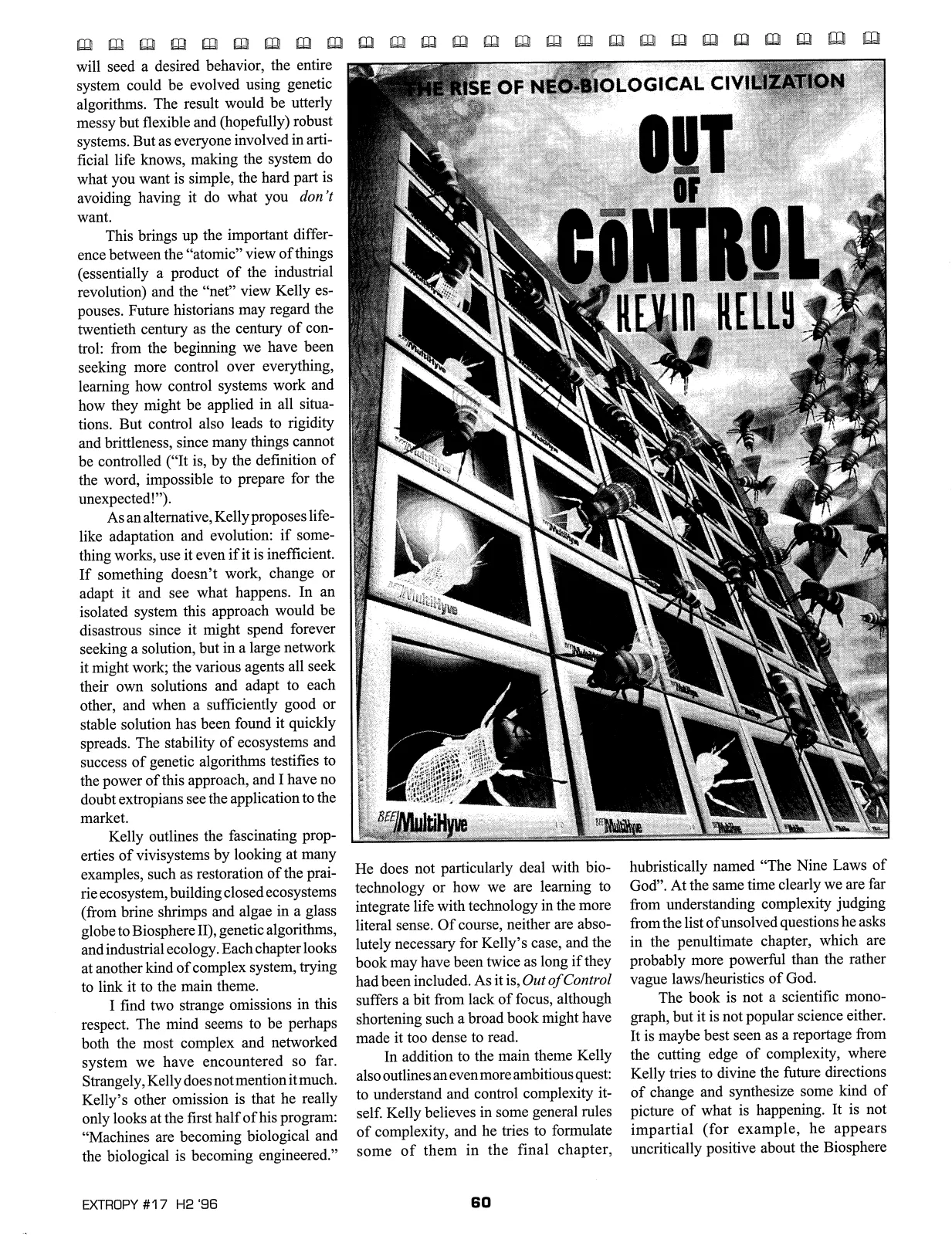
Out of Control:
The Rise of Neo-
Biological Civilization
by Kevin Kelly
Addison-Wesley Publishing Company, 1994
521 pages, $28, ISBN: 0-201-57793-3
Reviewed by Anders Sandberg
For more than a decade, the FAA has been working to replace this antiquated system. Sadly, the alternative, the Advanced Automation System with its million-plus lines of code written since the early 1980s, is riddled with bugs. And six years late. Computer scientists from two leading universities have had to comb through it to see if any code is salvageable. Faced with software that’s too unreliable to trust in life-and-death situations, the FAA must rely instead on its old and collapsing (but well understood) air-traffic-control system.
(From the December 1995 issue of BYTE magazine)
A William Patrick Book
Publication Date: June 21, 1994
Price: $ 28.00/hardcover/527 pages
ISBN 0-201-57793-3
Networks of the world, unite!
A specter is haunting the world—the specter of complexity. Some lament it and long for the good old days when everything was linear and predictable, others enthusiastically proclaim the new age of the Net and want to surf the chaos. Kevin Kelly clearly belongs in the latter group with his much hyped book Out of Control; a reviewer in the Swedish magazine Fri Teknik even went so far to call the book the Das Kapital of the 21st century.
Kelly’s book covers a tremendous range of subjects, from ecology and genetics over artificial life and evolutionary theory to virtual reality, cybernetics and digital cash, linked together in the same nonlinear networked way that Kelly sees as the symbol of the new age. One is reminded of the hypertextlike structure of Marvin Minsky’s The Society of Mind where each chapter in some sense is independent of the others and still linked to many of them; the real subject emerges from the parts (see? the buzzwords are catching).
The central theme of Out of Control relates how we are moving towards a technology, economy, and society dominated by vivisystems—networked, complex, lifelike systems where strict control and predictability are sacrificed for flexibility, robustness and decentralization. Kelly finds examples of this tendency in many places: in the growth of the Internet, in the theory of genetic algorithms, neural nets, subsumption architectures in robotics, artificial life, and digital cash. As he writes on page 1: “The realm of the born—all that is nature—and the realm of the made—all that is humanly constructed—are becoming one. Machines are becoming biological and the biological is becoming engineered.”
The main problem with the design of large systems is that they easily become unstable and brittle. So far we have built devices, programs and systems attempting to make them as specific and simple as possible, since we need to keep their complexity manageable. As systems grow larger, we have to modularize them to keep up with the growing complexity, but at the same time the probability of bugs increases, and even the most modular program will become unstable due to bugs and logical errors. The larger the system, the more brittle and unstable it becomes. But we need large systems and depend on them:
What Kelly (and others) propose as a solution is to let go. Instead of trying to understand the entire system and build it as a whole, let it start as simple units and grow itself into a whole.
Here is the generic recipe for distributed control that Brook’s mobot lab developed. It can be applied to most creations:
- Do simple things first.
- Learn to do the flawlessly.
- Add new layers of activity over the results of the simple tasks.
- Don’t change the simple things.
- Make the new layer work as flawlessly as the simple.
- Repeat, ad infinitum.
This is not as revolutionary as it may seem, the bottom-up programming paradigm has been taught in introductory computer science courses for years. But Kelly acknowledges something important: as systems become complex they will exhibit new and unexpected emergent behaviors, it cannot be avoided so we will have to live with it. “The old cameras were easy to fail, and easy to repair. The new cameras fail creatively.”
A more far reaching vision involves the widespread use of evolutionary algorithms to create complex systems. Instead of trying to come up with simple units that
Now reduced print in The (Libertarian) Connection, open-forum magazine since 1968. Subscribers may insert two pages/issue free, unedited. Lots of stimulating conversation. Eight issues (year) $20. 101 South Whiting #700X, Alexandria, VA 22304.
classifieds
will seed a desired behavior, the entire system could be evolved using genetic algorithms. The result would be utterly messy but flexible and (hopefully) robust systems. But as everyone involved in artificial life knows, making the system do what you want is simple, the hard part is avoiding having it do what you don’t want.
This brings up the important difference between the “atomic” view of things (essentially a product of the industrial revolution) and the “net” view Kelly espouses. Future historians may regard the twentieth century as the century of control: from the beginning we have been seeking more control over everything, learning how control systems work and how they might be applied in all situations. But control also leads to rigidity and brittleness, since many things cannot be controlled (“It is, by the definition of the word, impossible to prepare for the unexpected!”).
As an alternative, Kelly proposes life-like adaptation and evolution: if something works, use it even if it is inefficient. If something doesn’t work, change or adapt it and see what happens. In an isolated system this approach would be disastrous since it might spend forever seeking a solution, but in a large network it might work; the various agents all seek their own solutions and adapt to each other, and when a sufficiently good or stable solution has been found it quickly spreads. The stability of ecosystems and success of genetic algorithms testifies to the power of this approach, and I have no doubt extropians see the application to the market.
Kelly outlines the fascinating properties of vivisystems by looking at many examples, such as restoration of the prairie ecosystem, building closed ecosystems (from brine shrimps and algae in a glass globe to Biosphere II), genetic algorithms, and industrial ecology. Each chapter looks at another kind of complex system, trying to link it to the main theme.
I find two strange omissions in this respect. The mind seems to be perhaps both the most complex and networked system we have encountered so far. Strangely, Kelly does not mention it much. Kelly’s other omission is that he really only looks at the first half of his program: “Machines are becoming biological and the biological is becoming engineered.”
He does not particularly deal with biotechnology or how we are learning to integrate life with technology in the more literal sense. Of course, neither are absolutely necessary for Kelly’s case, and the book may have been twice as long if they had been included. As it is, Out of Control suffers a bit from lack of focus, although shortening such a broad book might have made it too dense to read.
In addition to the main theme Kelly also outlines an even more ambitious quest: to understand and control complexity itself. Kelly believes in some general rules of complexity, and he tries to formulate some of them in the final chapter, hubristically named “The Nine Laws of God”. At the same time clearly we are far from understanding complexity judging from the list of unsolved questions he asks in the penultimate chapter, which are probably more powerful than the rather vague laws/heuristics of God.
The book is not a scientific monograph, but it is not popular science either. It is maybe best seen as a reportage from the cutting edge of complexity, where Kelly tries to divine the future directions of change and synthesize some kind of picture of what is happening. It is not impartial (for example, he appears uncritically positive about the Biosphere
II project) or all-inclusive, but that does not seem to be its goal. Kelly appears to be more interested in sharing his enthusiasm (it is very catching) and fascination for the various subjects with the reader.
The most readable chapters are those describing concrete phenomena or organizations, such as the chapters about ecological restoration, the Biosphere II project, Survival Research Laboratories and digital cash. When Kelly turns to the more abstract or esoteric problems of complexity, neodarwinism and artificial life he tends to become philosophical, with a tendency for mysticism. The chapter about how evolution may evolve suffers from a tendency to anthropomorphize evolution itself, but is also one of the most stimulating from a transhuman point of view:
Organisms, memes, biomes—the whole ball of wax—is only evolution’s way to keep evolving. What evolution really wants—that is, where it is headed—is to uncover (or create) a mechanism that will most quickly uncover (or create) possible forms, things, ideas, processes in the universe. Its ultimate goal is not only to create forms, things, and ideas, but to create new ways in which new things are found or created. Hyperevolution does this by bootstrapping itself into a layered strategy that continually increases its reach, continually creates new libraries of possible places to explore, and continually searches for better, more creative ways to create.
Kelly might not have a messiah complex, but he probably wouldn’t mind being a prophet. His style tends towards aphorism, which creates many quotable sentences like
“As computers become assistants, toasters become pets.”
“It seems to be an universal property of life that all successful systems attract parasites.”
“IBM and E. Coli both see the world in the same way.”
“A system is anything that talks to itself”
I have little doubt that many of his aphorisms will become used for a long time. Unfortunately many of them just sound wise, being really semantically empty or just elaborating on simple facts, like the last example. That does of course not lessen their memetic impact.
Hype aside, I found Out of Control readable and inspirational, a book that gives a grand vision of a very different future. Its real strength lies in that it covers so much ground while trying to link it together into some kind of wholeness. It might not succeed perfectly, but is certain to expand the mental network of the reader.
SuperShift!
Claim your sovereignty with one action word that links and cross stitches the philosophy of life, the philosophy of freedom, the philosophy of wealth, and the philosophy of happiness together. It simplifies and ennobles your life. It streamlines your lifestyle. Lets you shed unwanted, unneeded psychological baggage. Suddenly, you are doing more than you thought possible. Become your own best friend. Be the final authority of your being. Become the sovereign of your soul! Become master of your destiny! Streamline your life!
Build a power matrix from Aristotle’s five classic branches of philosophy: Metaphysics, Epistemology, Ethics, Politics, and Aesthetics. Add other matrices to build a comparative. Use the action word in the proper branch of philosophy and watch the comparative burst into life. With this one forgotten branch, irrational elitists abuse, miss use, or never use, you can shuck the veil of mysticism. Mysticism that is the barrier to your freedom, success, happiness, romantic love, and youthful longevity; e.g., reality!
Discover the action word. Apply it to the Comparative Matrix then add one more matrix. Viola! It expands synergistically into nebulae of startling integrations. Then another matrix suggests itself. Join me to explore the comparative together. Integration after integration expand across the pages of my manuscript: The SuperShift Enigma. Use the comparative to hold it all in focus. See how missing puzzle pieces leap from its pages begging for attention. Experience the big bang finale at the Shift Event. Discover the surprise bonus phenomenon: SuperThink! Journey with me through (140 pages and more of) The SuperShift Enigma. This is an intellectual, psychological, and spiritual journey you will not want to miss. Seek the treasure trove of one hundred three original integrations.
Claim your spiritual sovereignty today! Be your own best friend! Become the authority of you! Become the streamlined person you want to be! Order The SuperShift Enigma! Send your name and address with check or money order for $38.45 (US funds) to AQUILLO INT’L, P.O. Box 231X, Waterford, WI 53185. Wisconsin residents add 5% sales tax. Order my manuscript only if you are willing to increase your potential and only if you think yourself worthy of freedom, wealth, romantic love, happiness, and success! Use SuperShift for your selfish interests. Become the best within you! Be ye proud! Be Zon!
Synthetic Pleasures
Reviewed by Susie Hollywood
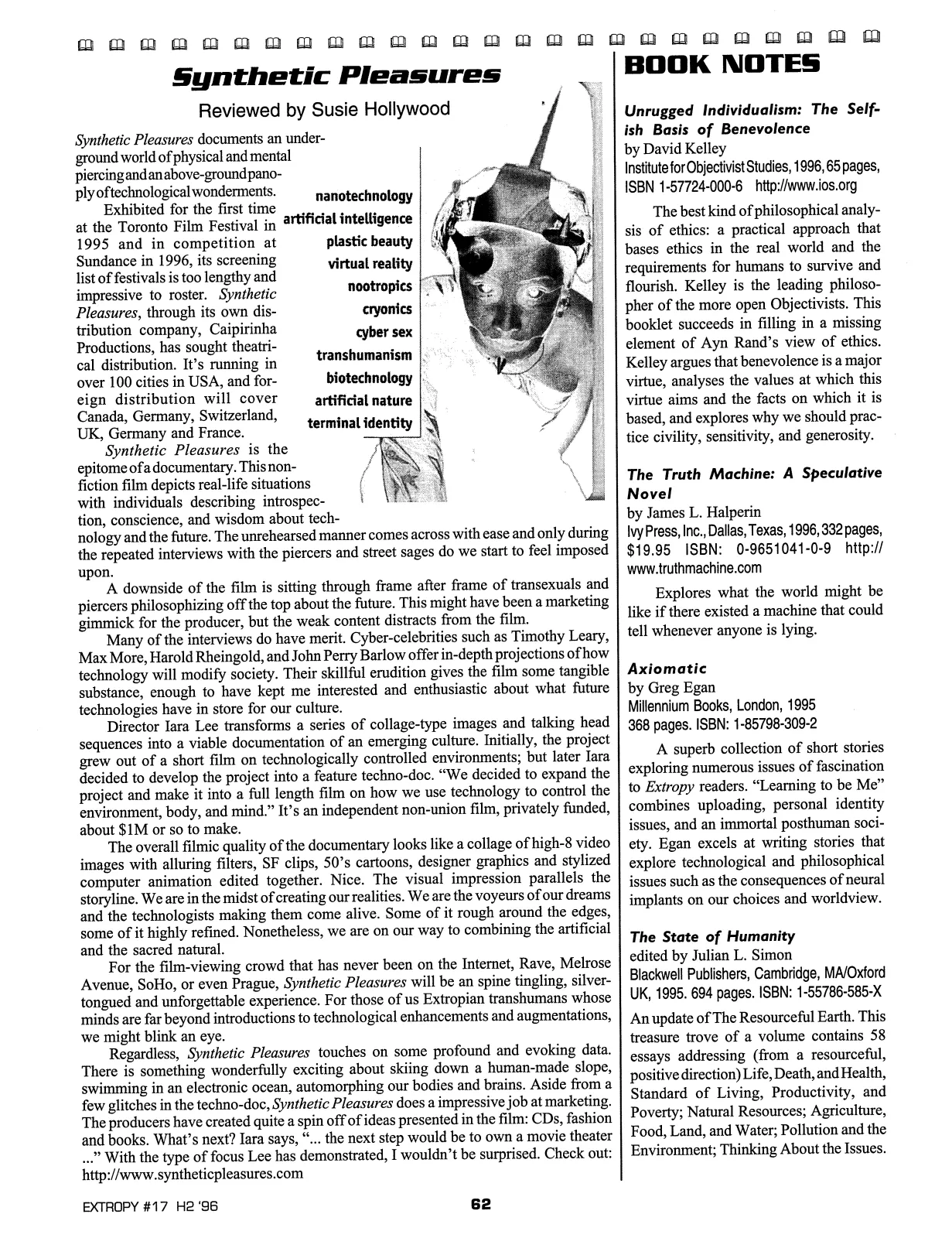
Synthetic Pleasures documents an underground world of physical and mental piercing and an above-ground panoply of technological wonderments.
Exhibited for the first time at the Toronto Film Festival in 1995 and in competition at Sundance in 1996, its screening list of festivals is too lengthy and impressive to roster. Synthetic Pleasures, through its own distribution company, Caipirinha Productions, has sought theatrical distribution. It’s running in over 100 cities in USA, and foreign distribution will cover Canada, Germany, Switzerland, UK, Germany and France.
Synthetic Pleasures is the epitome of a documentary. This non-fiction film depicts real-life situations with individuals describing introspection, conscience, and wisdom about technology and the future. The unrehearsed manner comes across with ease and only during the repeated interviews with the piercers and street sages do we start to feel imposed upon.
A downside of the film is sitting through frame after frame of transexuals and piercers philosophizing off the top about the future. This might have been a marketing gimmick for the producer, but the weak content distracts from the film.
Many of the interviews do have merit. Cyber-celebrities such as Timothy Leary, Max More, Harold Rheingold, and John Perry Barlow offer in-depth projections of how technology will modify society. Their skillful erudition gives the film some tangible substance, enough to have kept me interested and enthusiastic about what future technologies have in store for our culture.
Director Iara Lee transforms a series of collage-type images and talking head sequences into a viable documentation of an emerging culture. Initially, the project grew out of a short film on technologically controlled environments; but later Iara decided to develop the project into a feature techno-doc. “We decided to expand the project and make it into a full length film on how we use technology to control the environment, body, and mind.” It’s an independent non-union film, privately funded, about $1M or so to make.
The overall filmic quality of the documentary looks like a collage of high-8 video images with alluring filters, SF clips, 50’s cartoons, designer graphics and stylized computer animation edited together. Nice. The visual impression parallels the storyline. We are in the midst of creating our realities. We are the voyeurs of our dreams and the technologists making them come alive. Some of it rough around the edges, some of it highly refined. Nonetheless, we are on our way to combining the artificial and the sacred natural.
For the film-viewing crowd that has never been on the Internet, Rave, Melrose Avenue, SoHo, or even Prague, Synthetic Pleasures will be an spine tingling, silver-tongued and unforgettable experience. For those of us Extropian transhumans whose minds are far beyond introductions to technological enhancements and augmentations, we might blink an eye.
Regardless, Synthetic Pleasures touches on some profound and evoking data. There is something wonderfully exciting about skiing down a human-made slope, swimming in an electronic ocean, automorphing our bodies and brains. Aside from a few glitches in the techno-doc, Synthetic Pleasures does a impressive job at marketing. The producers have created quite a spin off of ideas presented in the film: CDs, fashion and books. What’s next? Iara says, ”… the next step would be to own a movie theater …” With the type of focus Lee has demonstrated, I wouldn’t be surprised. Check out: http://www.syntheticpleasures.com nanotechnology artificial intelligence plastic beauty virtual reality nootropics cryonics cyber sex transhumanism biotechnology artificial nature terminal identity
BOOK NOTES
Unrugged Individualism: The Selfish Basis of Benevolence by David Kelley
Institute for Objectivist Studies, 1996, 65 pages, ISBN 1-57724-000-6 http://www.ios.org
The best kind of philosophical analysis of ethics: a practical approach that bases ethics in the real world and the requirements for humans to survive and flourish. Kelley is the leading philosopher of the more open Objectivists. This booklet succeeds in filling in a missing element of Ayn Rand’s view of ethics. Kelley argues that benevolence is a major virtue, analyses the values at which this virtue aims and the facts on which it is based, and explores why we should practice civility, sensitivity, and generosity.
The Truth Machine: A Speculative Novel by James L. Halperin
Ivy Press, Inc., Dallas, Texas, 1996, 332 pages, $19.95 ISBN: 0-9651041-0-9 http://www.truthmachine.com
Explores what the world might be like if there existed a machine that could tell whenever anyone is lying.
Axiomatic by Greg Egan
Millennium Books, London, 1995
368 pages. ISBN: 1-85798-309-2
A superb collection of short stories exploring numerous issues of fascination to Extropy readers. “Learning to be Me” combines uploading, personal identity issues, and an immortal posthuman society. Egan excels at writing stories that explore technological and philosophical issues such as the consequences of neural implants on our choices and worldview.
The State of Humanity edited by Julian L. Simon
Blackwell Publishers, Cambridge, MA/Oxford UK, 1995. 694 pages. ISBN: 1-55786-585-X
An update of The Resourceful Earth. This treasure trove of a volume contains 58 essays addressing (from a resourceful, positive direction) Life, Death, and Health, Standard of Living, Productivity, and Poverty; Natural Resources; Agriculture, Food, Land, and Water; Pollution and the Environment; Thinking About the Issues.
VIEW ORIGINAL SCAN (12 pages)