Issue: EXTROPY #14 · First Quarter 1995
Author: David Krieger with Max More
Pages: 12–17 · 6 scanned pages
Methuselah's Kitchen: An Interview with Roy Walford, M.D. (Pt. 1)
An Interview with Roy Walford, M.D. (Part One)
by David Krieger with Max More
At 69, Roy Walford, M.D., is the author of two prior best-selling books, Maximum Life Span (1983) and The 120-Year Diet (1988). He received his M.D. degree from the University of Chicago in 1948 and has been professor of pathology at the UCLA School of Medicine since 1966. Author of over 250 scientific articles, Walford was a delegate to the last White House Conference on Aging, is a member of the National Academy of Sciences Committee on Aging, and is considered to be one of our leading gerontology experts.
For more than 20 years, Walford’s life work has been studying the effect of low-calorie, nutrient-rich diets in animals at his UCLA lab. In 1993 he completed two straight years of studying the effects of diet on aging in humans in Biosphere 2, a sealed environmental laboratory for the study of micro- and artificial ecologies, located in the Arizona desert. The goal of Biosphere 2, funded by controversial Texas billionaire Ed Bass, is to improve humanity’s knowledge of managing ecosystems in preparation for the habitation of space. The results of Dr. Walford’s Biosphere studies have been published in Proceedings of the National Academy of Sciences.
In The Anti-Aging Plan, Walford and his daughter, chef Lisa Walford, present an easier, more convenient cookbook and menu guide for humans who want to prolong their enjoyment of food. Max More and I interviewed Dr. Walford in his Venice, California, residence. We started by talking about the book-signing by him and Lisa that I had attended two days earlier, at A Clean Well-Lighted Place for Books in Cupertino, California:
The previous night we had the weirdest book-signing that I’ve done so far on this tour. We went to a place called the Grain Walks Café, which had asked for a book-signing, which the publisher set up. I was thinking it was like a combination of a Starbuck’s and a bookstore. When we got there, it was just a kind of hippie café on Folsom Street in San Francisco—a bunch of people sitting around in apache haircuts and things like that, and eating French-fried potatoes and ketchup; so Lisa and I walked in and thought, “What are we doing here?”
At one end there was a microphone on a stand, with a trio up there playing a guitar and singing. And we thought, “What are we doing here? This is a weird book signing.” There was no bookstore or anything. We went over to the guy who was running it, and he said, “Well, you know, maybe I should have set this up in a bookstore someplace.” And then some people were there who had been there the previous night because they had the date wrong, because they announced it wrong in the newspaper. Finally, somebody came in that I’d known in the ’60’s from the Living Theatre, Mel Clay, who’s running a theater here; so we had a nice conversation. Finally, the singers were done; the owner gets up and says, “Everybody be quiet now. And the next act is Roy and Lisa Walford.” [laughs] So I stood on up there at this microphone, like I’m supposed to be a stand-up comedian.
But actually, it went pretty well. Everybody quieted down. I thought, “Well, I don’t have any jokes, so I’ll just smile and talk informally.” It went over quite well, actually. But it was just strange.
Max: You didn’t start criticizing the French fries and the stuff they were eating?
Yeah, I did. “Oh, look what that person’s eating,” as the waiter brought it in, and stuff like that. It went over real well.
So what were the circumstances leading up to the new book, and what was the motivation for the revision?
The main motivation was that the menus and recipes in The 120-Year Diet were just too difficult. You had to spend too much time in the kitchen, so I got a lot of complaints about it. We thought we’d write a book that just dealt with that. It was supposed to be just a cookbook originally, but it then got extended into updating some of the other items, mainly because the publisher wanted them updated; but then the Biospherian experience came along, so that was worth putting in. But, still, the main idea was to make it feasible—
Something that’s more realistic for more people?
Yes. So that’s the main emphasis; the rest is secondary.
Well, they’re showing the same things that I found in the Biosphere. That is, primates behave the same way, so far, as mice and rats, on a low-calorie, nutrient-dense diet, and so do humans. They go hand-in-hand. The best primate colony is at the University of Wisconsin, which is run by Weindruch who got his Ph.D. under me, then was about 8 or 10 years with me at UCLA, and then went off and was two years at the NIH, as an administrator, and then went to be an associate professor at the University of Wisconsin. So he has, I think, the best primate colony. The other primate colony is at the NIA, which I think is not as good because they don’t seem to be restricting them very much. But they’re also finding some results.
Max: How long have they been doing those experiments?
I think a total of about five years. They’re using rhesus monkeys and squirrel monkeys. Rhesus monkeys have a maximum lifespan of 30-35 years, and squirrel monkeys 18 years. So, it’s still long-term, but they’ll get results sooner than humans.
Max: Were these studies before puberty or afterwards?
Afterwards.
The preliminary results are based on things like biomarkers of aging?
Yes.
**You talk a little bit less in this book than in your previous
books about supplementation. Has there been anything new since The 120-Year Diet on specific nutrients that you feel more inclined or disinclined to recommend? For example, DHEA. I believe in Maximum Life Span, you said that DHEA might be the mechanism by which the high-low diet produces its effects. Do you think that DHEA supplementation is worthwhile at this time?**
Well, the problem with all of the supplementation is that nobody has extended maximum life span by any kind of supplementation. Until somebody does that, I think it’s much less ideal than calorie limitation, which does extend maximum life span. You can make all sorts of plausibility arguments for DHEA and antioxidants and everything else, but when you actually try to do it in animals, not very much happens. I think they may be healthier, but they don’t live longer. I’ve never seen a survival curve with any kind of supplementation that is in any way comparable to what you can get with calorie limitation.
Including deprenyl?
Yeah.
Max: Coenzyme Q10? I know comparisons have shown all the animals that have had it, compared to animals that haven’t, are doing very well.
Well, they looked better, but they didn’t live longer, actually. You got a more squared survival curve, but finally they died off. That [experiment]‘s worth repeating; maybe they just died off by accident, the CoQ10 animals; but nevertheless, there still is not, to this day, a real good survival curve.
Max: Just to clarify about DHEA, you say that that failed to extend lifespan, or it hasn’t really been tried yet?
No, it hasn’t been tried. I think Richard Weindruch tried it, and didn’t get much. The main thing that he was doing with that was that it interfered with how much they were eating. They couldn’t quite tell whether the extension was due to their eating less because they were on DHEA, or a DHEA effect.
DHEA was suppressing appetite?
In that experiment, which Weindruch did. So, as I say, you can make a lot of plausibility arguments, but nobody really does the critical experiments; in part because it’s very difficult to get funded with something as straightforward as that.
You mentioned that caloric restriction has been getting a lot more mainstream attention; you said that you’re going to be
the keynote speaker at an upcoming meeting of the American Society for Gerontology. Why do you think the acceptance has been so hesitant? You mentioned some of the comparison to societal attitudes in Star Trek at your talk the other night; why do you think people aren’t more excited, or, specifically, the medical and research establishment, aren’t more excited about these results, or haven’t been until now?
Well, they’re just getting to be excited. They haven’t been, for one thing, because the nutrition community is kind of a closed community; they don’t like people doing nutrition studies if you’re not of that community, and this whole area has been developed by gerontologists. So for some reason, the nutrition community has never paid any attention to it, even though it has now kind of a vast literature, and obviously deals with nutrition. If we go in the other room, I can show you some great big thick nutrition books, and there isn’t a mention of any of this work in, I think, any big modern textbook of nutrition—and I’ve seen nutritional reviews, not directed to this subject, in which it’s listed, if they discuss it at all, under malnutrition.
The nutritional community has a fixed idea that if you don’t get what they call the RDA of calories, then it’s malnutrition. But the response to that is, if it extends lifespan and prevents disease and keeps all the physiological parameters better, then it’s nonsense to call it malnutrition. But they can’t get that out of their heads; they haven’t been able to. I think that’s changing, but that’s been a problem in the past.
It’s almost encoded in their terminology; they use ‘food value’ as a synonym for caloric content.
Yeah, a lot, yes. And of course, most low-calorie diets, in countries where there’s not enough food, they’re also malnourished; [the nutritionists] mix the two up.
At what age did you begin having your interest in studying aging and the prevention of aging? What experiences led you to adopt that as your goal?
Seventeen. I was just interested in a lot of things, and I thought I wanted to live longer to do them all or experience them all. You could call it the sophomoric approach of a young person, but that was how it started. I wrote an article on it in the high school magazine, The Literary Parade, so I have proof that I was interested at a young age. Then I went to CalTech and was torn between going into physics and math and philosophy as a package, or into biology and aging; I’m not quite sure why I went one way instead of the other.
Well, I’m not aware of it in detail, not in sufficient depth to have a real opinion.
younger and middle-aged birds. So it seem, if they were old and feeble or whatever, they’d have a higher death rate with the larger birds, but that isn’t the observation.
So there’s quite a few animals that don’t seem to age. If that’s the case then, in a sense, there’s no reason why we have to age, or other animals; it’s some kind of a mechanism that’s evolutionarily advantageous to preservation of the species, but not to our individual desire.
I don’t know the answer to that yet.
Do you feel that we’ll ever be able to completely conquer aging and, essentially, live as long as we want to?
Well, I don’t see why not. There are two answers to that. One answer is that it’s now known, if you look at Caleb Finch’s book¹, which spells it out well, that not all animals age. It was thought for a long time that, except for maybe one-celled organisms or something like that, that everything aged, but that’s not true. One example is lobsters; they just keep getting bigger and bigger. They don’t undergo reproductive senescence, which would be a criterion of aging. They get bigger and they have more and more eggs; there’s no decline in egg production. They finally get too big for their ecological niche; they get picked off then by accident, I suppose, but they don’t undergo any fundamental aging. The other animal that doesn’t seem to age are pelagic birds. The reason that that’s thought to be the case is that, if you band them, and they fly off around the world and then come back, and you look at the banding, the older birds have not sustained a higher death rate than the
Well, their rate of aging from then on will be retarded, so that depends on what kind of shape they’re at when they’re 60. It’s that beneficial, at least.
Second, some things that they have will be reversed, like arteriosclerosis. It’s reversible if you go on the right diet. The Biospherian cholesterol got down to 123. If you get it that low, you reverse arteriosclerosis. So I think anybody who’s facing bypass surgery is kind of foolish not to go on this kind of diet. For one thing, with bypass surgery, after the surgery, if they don’t substantially modify their eating habits, it just comes back. The new graft, or whatever, also becomes arteriosclerotic, so in about five years they’re back where they started. So you can reverse arteriosclerosis.
You probably can mitigate auto-immune disease substantially; and, I don’t think you can cure, but you can keep diabetes under considerable control. That isn’t rejuvenescence, but it’s a very positive effect on disease parameters. So it can retard the rate of aging, and very possibly affect disease parameters, at age 60 or at any age.
I will eventually write a book called The Long-Living Society, because I think that when that happens it will be a kind of social revolution, and nobody’s written a book about that yet.
Please elaborate; what kind of differences do you think will exist?
Well, I think values will increase quite a bit. The reason for that is that, on the whole, people who are very old are much more value-oriented and independent. I think they’ll be harder to be controlled by government; and I suspect this will carry over when people are simply long-lived, even though they’re not necessarily functionally old. My best story about that is the oldest man convicted for marijuana possession, in Miami. He was convicted, but the judge let him off because of his age. He didn’t get sentenced or anything. The old guy’s comment on it as he left courtroom, at least as reported in the newspapers, was ‘To hell with them and their laws.’ This is an attitude that you find in very old people; they figure, ‘Fuck it,’ and they’re very uncontrollable. They are controllable because they’re feeble, or sick and poor, but they’re not controllable, a lot of them, in terms of—
Their will being dominated.
—yeah, being dominated by the media and by this, that, and the other, so I think that, as people reach those ages but are still functionally intact, they’ll be less controllable by the brainwashing tech-techniques of the government and the media. That will induce a lot of changes. Perhaps, in a way, I think we’ll be much more ecologically oriented. If you live long, and you actually see what’s going on, then people become more interested in the environment.
The knowledge that it will be you as well as your grandchildren who’s going to have to deal with the consequences.
And there are other changes, because, if people really live that long, they’ll be changing careers, and you really have to get reeducated about every thirty years if you’re going to make it, as I am now doing in the whole video/multimedia technology. I didn’t grow up like most kids do nowadays, tapping away on a computer when you’re seven, so I have to make a considerable effort to get on top of all that exploding technology. In the course of doing that, that also throws me in with a lot of kids and others that are doing it. So there’s kind of a disappearance of the generation gap.
Max: What is the Reality Club?
The agent, John Brockman, who’s the agent for a lot of scientists who write books—he’s pretty much cornered the market on popular science writing in terms of the literary agency—he decided to form a ‘Reality Club,’ which is mainly a bunch of New York intellectuals, beginning with the people he knows, and once a month they meet someplace and somebody gives a talk. It might be at the New York Academy of Sciences or whatever. It’s kind of a revolving social club, and to be a member of the club, you have to give a talk there.
It’s not necessarily limited to New York; I gave a talk there once, so I’m now a member of the club. If I happen to be in New York when they’re having a session, I may go to the club, but most of the people who’ve written successful popular science books, I think, are members of the club.
Max: Lynn Margulis, the biologist, is a member, I think.
And Drexler, of course.
Out of that, he decided to publish something called The Reality Club—a series of books². Other members include Mary Catherine Bateson, William Calvin, Gerald Feinberg, Dorian Sagan, Stewart Brand, and Benoit Mandelbrot.
Nicole Clark
Well, I think it’s feasible, certainly, because I freeze individual lymphocytes in my own laboratory and keep them for years and years and years on liquid nitrogen. My father died in 1962, but I’ve still got his cells frozen, so I can say he’s not quite dead. So there’s nothing the matter with it in concept, in theory.
I don’t quite buy the concept that the people who are frozen now are going to be revived; I think they’ve had an awful lot of protein damage, because you can’t freeze a whole organ very effectively. I think if you want to take the attitude that science eventually can unscramble an egg, then okay. I don’t have any objection to it or comment on it.
So, in principle, I think cryobiology is fine, and we will eventually be able to do it very smoothly and successfully, and put humans or other complicated animals to sleep and wake them up and so forth. That has nothing to do with the accident deal, though, because when the people are awake, or even when they’re frozen, there’s going to be a certain incidence of accidents that will affect the survival curve. The survival curve is not going to be completely horizontal at 100%; it’s going to be a downside which you can calculate, by accidents, it’ll have that kind of a slope [draws a monotonically-decreasing asymptote in the air], like the fate of restaurant drinking glasses.
gone too far… so I think they’re too conservative.
More broadly, do you think that government agencies try a little too hard to take care of people, more than perhaps is good for them?
[Thoughtful pause.] Well, not necessarily. I think one would have to be more specific about that.
Some of the cyberpunk writers. Roger Zelazny, too, although he’s not a cyberpunk writer. William Gibson, Ursula K. LeGuin. I haven’t read too much lately; I’ve just been too occupied. So I’m behind there.
The Star Trek example is a further illustration of something that I experienced about five years ago. I went to the IMAX theater in San Diego. Just by chance, I went in to see the movie, about space travel 500 years from now—even beyond Star Trek. And people were going out on these weird spaceships to other galaxies, and the voice-over said these people were very courageous and self-sacrificing in starting out, because it was only their children’s children’s children and so forth who would get to the other end—that they’d only be living 80 to 90 years. And I thought, “That’s really crazy. Why don’t they imagine that the biology of aging would get something done in 500 years?” [chuckles] It never occurred to them. People have this weird blank.
And then, I was thinking about two months ago, that Star Trek illustrates the same thing. But it’s more dynamic, and everybody’s experienced it. I think that, of just about everybody that I’ve talked to, anyway, it’s never occurred to them that this is kind of an anomaly, that Captain Kirk ages at the same rate, and the other people in the series, as we do now.
I think they actively resist it because of the culture that, for thousands of years, has had to deal with the inevitability of death, and has found various reasons for not thinking about it, or thinking about it in some unrealistic way like most religions, promising life after death. That takes care of it—if you’re going to heaven, then you don’t have to worry about aging and death. And then the philosophers have done different numbers with it. The Stoics maintained that life would get boring if you lived too long, and so forth. I think these are just reactions to not being able to do anything about it. If you look through literature, there are two schools; some of them really treat aging in a bad way, and others deal with it in a more realistic way. The Grimm brothers treat it badly; Andersen does pretty
Well, that’ll lower the incidence of fatal accidents.
Max: Is biostasis or cryonic suspension something you’ve considered for yourself—
[Smiles.] Not at the moment.
Max: No, I mean when you might need it.
No, I know what you’re saying. No, I haven’t signed up for it. I don’t think it’s advanced enough that I want to do that.
I think they’re too conservative. Certainly, in terms of the aging area, they’re too conservative, because they prevent people from getting things that you can get in Europe very readily. And they’re not harmful, particularly. They’ve made too much out of thalidomide; that’s justified their whole actions since that time, and that’s
result of bringing the government in: “I’m from Washington; I’m here to help you” is one of the things people dread…
I think that has to be settled issue by issue, so I don’t have an overall opinion on that. I don’t know what I think about health care, for example. It’s pretty universal in Europe, and it seems to work fairly well; I don’t know why it’s such a big problem here. So it depends on the issue.
If the government doesn’t take care of the environment a little bit, there won’t be any logs left in the whole country, so I think they should probably be more aggressive about preventing the logging industry from stripping all the logs away. So it’s an issue problem.
I don’t read a lot of it, but I read some.
Who are your favorite authors in that field?
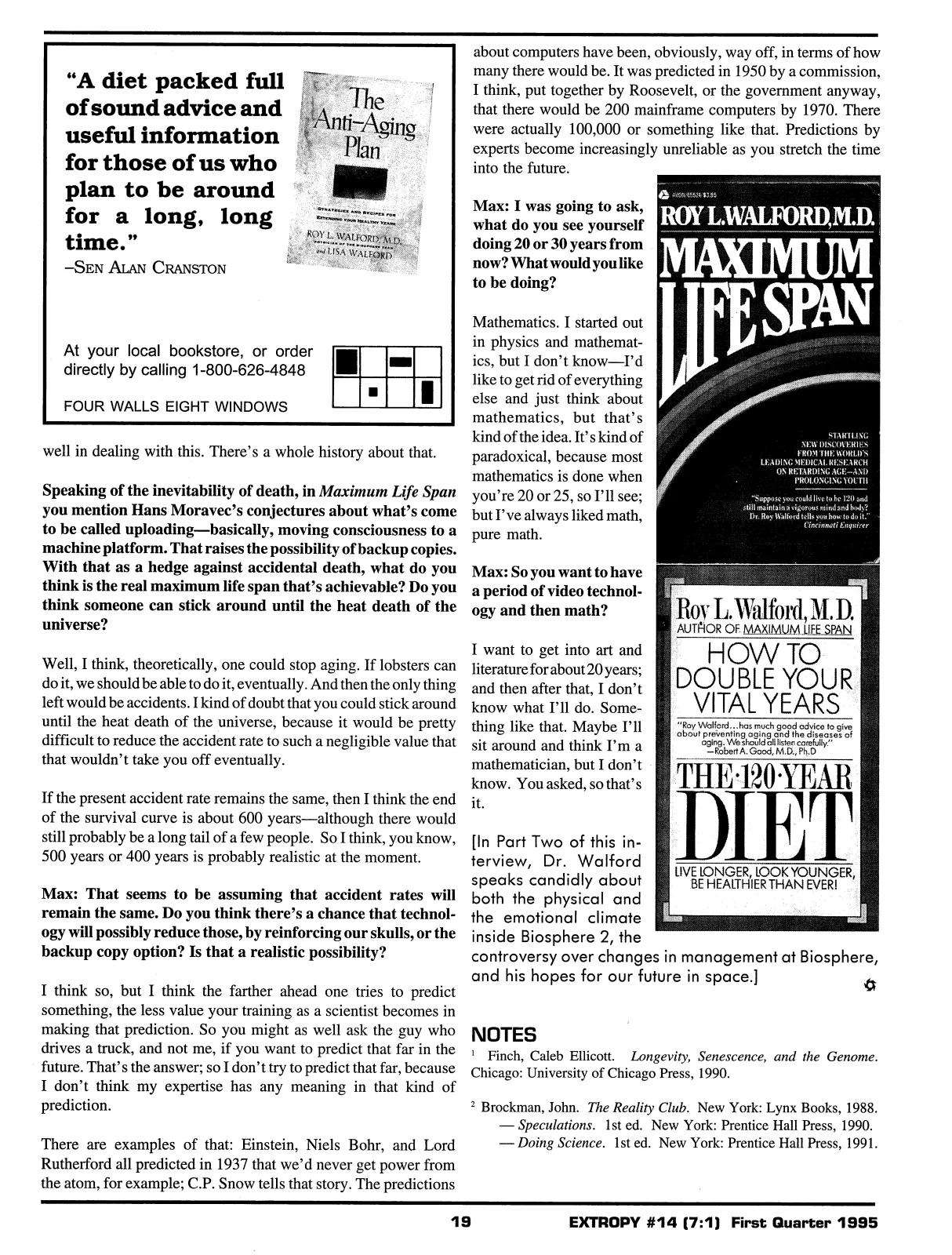
“A diet packed full of sound advice and useful information for those of us who plan to be around for a long, long time.”
-SEN ALAN CRANSTON
At your local bookstore, or order directly by calling 1-800-626-4848
FOUR WALLS EIGHT WINDOWS well in dealing with this. There’s a whole history about that.
Speaking of the inevitability of death, in Maximum Life Span you mention Hans Moravec’s conjectures about what’s come to be called uploading—basically, moving consciousness to a machine platform. That raises the possibility of backup copies. With that as a hedge against accidental death, what do you think is the real maximum life span that’s achievable? Do you think someone can stick around until the heat death of the universe?
Well, I think, theoretically, one could stop aging. If lobsters can do it, we should be able to do it, eventually. And then the only thing left would be accidents. I kind of doubt that you could stick around until the heat death of the universe, because it would be pretty difficult to reduce the accident rate to such a negligible value that that wouldn’t take you off eventually.
If the present accident rate remains the same, then I think the end of the survival curve is about 600 years—although there would still probably be a long tail of a few people. So I think, you know, 500 years or 400 years is probably realistic at the moment.
Max: That seems to be assuming that accident rates will remain the same. Do you think there’s a chance that technology will possibly reduce those, by reinforcing our skulls, or the backup copy option? Is that a realistic possibility?
I think so, but I think the farther ahead one tries to predict something, the less value your training as a scientist becomes in making that prediction. So you might as well ask the guy who drives a truck, and not me, if you want to predict that far in the future. That’s the answer; so I don’t try to predict that far, because I don’t think my expertise has any meaning in that kind of prediction.
There are examples of that: Einstein, Niels Bohr, and Lord Rutherford all predicted in 1937 that we’d never get power from the atom, for example; C.P. Snow tells that story. The predictions about computers have been, obviously, way off, in terms of how many there would be. It was predicted in 1950 by a commission, I think, put together by Roosevelt, or the government anyway, that there would be 200 mainframe computers by 1970. There were actually 100,000 or something like that. Predictions by experts become increasingly unreliable as you stretch the time into the future.
Max: I was going to ask, what do you see yourself doing 20 or 30 years from now? What would you like to be doing?
Mathematics. I started out in physics and mathematics, but I don’t know—I’d like to get rid of everything else and just think about mathematics, but that’s kind of the idea. It’s kind of paradoxical, because most mathematics is done when you’re 20 or 25, so I’ll see; but I’ve always liked math, pure math.
Max: So you want to have a period of video technology and then math?
I want to get into art and literature for about 20 years; and then after that, I don’t know what I’ll do. Something like that. Maybe I’ll sit around and think I’m a mathematician, but I don’t know. You asked, so that’s it.
[In Part Two of this interview, Dr. Walford speaks candidly about both the physical and the emotional climate inside Biosphere 2, the controversy over changes in management at Biosphere, and his hopes for our future in space.]
NOTES
1 Finch, Caleb Ellicott. Longevity, Senescence, and the Genome. Chicago: University of Chicago Press, 1990.
2 Brockman, John. The Reality Club. New York: Lynx Books, 1988. — Speculations. 1st ed. New York: Prentice Hall Press, 1990. — Doing Science. 1st ed. New York: Prentice Hall Press, 1991.
VIEW ORIGINAL SCAN (6 pages)