Issue: EXTROPY #14 · First Quarter 1995
Author: Fred Stitt
Pages: 19–26 · 8 scanned pages
Evolutionary Architecture and Extropian Consciousness
Evolutionary Architecture
and
Extropian Consciousness
Fred A. Stitt
Director, San Francisco Institute of Architecture
We will live in an age in which our buildings are grown rather than built.
They’ll react actively to resist damaging forces such as weather, fire, and earthquakes.
Some will float; some will fly; some will be grown beneath the sea.
Some will be on other planets and some will be starships.
Some will be permeated with sensory devices and biorobots; every component will anticipate and respond to human direction.
All these buildings will maintain a degree of conscious intelligence and the ability to quickly adapt and change in whole or in part.
This new architecture will be the inevitable result of technical competence, particularly in biotechnology and nanotechnology. Much of it doesn’t have to wait for the more far-reaching technologies; much of it is achievable today.
But if the design of these buildings is left in the hands of today’s architectural elite, there will be no aesthetic competence.
The buildings born of brilliant technology will be lifeless lumps, neither inspired nor inspiring.
In terms of enhancing human life, they’ll be better left unborn.
There is a choice…
Like no building that ever existed…
Imagine waking up one morning in your brand new home — a home unlike any ever seen on the planet.
As you move from space to space, you’re surrounded by intensely beautiful forms and patterns. The experience is more like being inside a piece of music than being in a building.
As you make the morning transition from sleep to wake to work, everything in your home is your helper. Light appears where you need it. The things you need are where you need them as you need them. There’s a pervasive logic underlying and surrounding everything you see and do — the home is a perfect extension of yourself.
Your home wards off distractions, discomforts, and functional irrationalities. It helps you focus your mind. It raises your consciousness. It inspires. When you sit down to work, your home actively helps you find and express the best that’s within you.
When you step outside, you look back to see the totality of your home — an imaginative extension of the landscape. It seems to grow from the earth like a natural object but also reveals the most advanced construction technologies.
Above all, the home is yours and yours alone in plan, concept, and expression. Most houses are expressions of fear of being different from the neighbors. Your home has been designed by you and your architect to express and enhance the most unique aspects of your personality, life, and work. It’s individual because you’re individual, and it’s unique in the same ways you are.
Most important, your home is designed to support, enhance, and reward your consciousness. Unlike the houses where you were raised, the schools you attended, the workplaces you’ve labored in … this building makes it a pleasure to be awake and alive.
A nice picture… Does it really exist?
Remarkably, it does. Dozens of architects are creating buildings like this. And at the San Francisco Institute of Architecture, we’re training many more young architects who will be creating the greatest buildings of the next century.
A new architecture, with old political enemies
This architecture is all the more remarkable because it exists despite the efforts of hundreds of architecture schools, dozens of critics, and thousands of architects to make it not exist. It may seem crazy to the readers of this journal; there are a lot of architects and educators who despise the very idea of the kind of environment I’ve just described.
I taught architecture during the late ‘80’s and early ‘90’s at UC Berkeley. I have taught and lectured widely to architects and students across the country, and I can say flatly that almost any student of architecture who tries to design creative, inspiring, architecture will be discouraged from doing so. If the student persists in trying to learn how do such work, he or she will most likely be flunked in design classes and will eventually be thrown out of school.
Yes, it’s just like The Fountainhead. Fountainhead opens with the dean of the architecture school telling Howard Roark that he had better lay off, bend a little, and do buildings that look like everybody else’s work or he’s going to be kicked out. The dean was making a political statement, and when Roark refused to bow down, he made a very basic self-affirming state-statement in response.
As an architect who is very much in touch with the profession, I can say The Fountainhead was amazingly accurate in its depiction of the architectural profession. It was accurate when it was written in the 1930’s, and it’s still on target. Nothing has changed as far as architectural politics, education, and professional standards go. In fact, in many ways, things are worse.
That doesn’t mean there isn’t some great work being done. It just means that the best architects and their clients manage to do their best work despite widespread ignorance and resistance.
The ideological schism described in The Fountainhead is still real. Today’s most influential architects and critics are typically mystics, subjectivists, and collectivists. Some of the most influential in this century such as Le Corbusier, Philip Johnson, and today’s dominant aesthetic theorists, were supporters or collaborators with the Nazis. The dominant philosophy in today’s most fashionable architecture schools is Deconstructionism. Heidegger, a philosopher midwife for Deconstructionism, considered Nazism to be the highest social expression of his world view and was an active Nazi for most of his adult life. The architectural expressions of Deconstructionism, are, as you might expect, not especially rational, humane, or exciting.
By contrast, the finest advocates of our most humane and creative architecture, such as Frank Lloyd Wright (the model for the fictional Howard Roark), have been uncompromising standard bearers of reason in philosophy, freedom in human affairs, and innovation in architectural design and technology.
Why good architects are hard to find
Frank Lloyd Wright was the most rational and inspired architect of our time … and was also the most despised by other architects. Eventually they ended up reluctantly imitating superficial aspects of his work and discarding the most important parts. These imitations became the movement of bare-bones, glass-box Modern Architecture.
There isn’t space here to describe how Frank Lloyd Wright designed his buildings. But you should know that he evolved a method of design that was totally divergent from what most architects are ever taught or ever heard of. They can’t understand his work, or the work of those of similar mind, because they can’t grasp the principles of creativity and organic, evolutionary design.
In terms of creativity; most architects are trained to design by copying existing buildings. They were trained that way one- and two-hundred years ago, and they’re still trained that way. If you ever wondered at the sameness and lack of originality in most buildings you see; that’s the root reason. As copyists, they never experience a full-blown creative act. They never experience what it’s like to create a totally original solution to a problem. After enough years of this, they don’t even think about such a thing as being desirable or possible. To them, an original creative architect is an inexplicable freak of nature, to be wondered at, perhaps feared, but certainly not to be understood.
In terms of judgment, most architects are taught to bow to the judgment of others. In school, their designs — if original and exploratory — are trashed by guest critics, instructors, and other students. Usually they’re too young to know how to respond to the jargon of the older faculty and students and gradually relinquish independent judgement. They learn to mouth the same jargon in the same way about the same things. It’s terribly sad to see.
The buildings of Frank Lloyd Wright and those who have followed are called ‘Organic.’ The word is applied because the buildings are so intricately organized — every part relates to the whole as the whole relates to the part — like great, complex symphonic music. ‘Organic’ is used in the sense of integrated: buildings integrated to their purpose and the physical and psychological needs of their users; integrated with the site and surroundings; integrated within in terms of materials and engineering systems; integrated in terms of uninhibited expression of the highest values of their owners and designers.
Since the word ‘organic’ has so much common identification with compost piles, veggie gardens, and curvilinear forms, some architects prefer words like Evolutionary, Visionary, or Futurist to name their work.
Education towards a new architecture
By its nature, Organic or Evolutionary architecture is usually highly original. Originality is not the goal, it’s part of the means to create the best solutions to unique problems. And since one of the goals of such architecture is to stimulate the conscious awareness and creativity of its users, innovation is a natural part of the values being expressed as well as part of the process of expression.
The making of a creative school of architecture is similar to making this kind of architecture.
It’s fairly easy to create a great new school. Much of it is just to do the opposite of the existing schools. Where traditional schools repress self-directed consciousness and creativity, reward it instead. Where schools set up endless regulations and roadblocks to learning; eliminate the roadblocks. Provide open enrollment, reasonable fees, and an education that respects the student’s time and intelligence. This may be unusual, but as I discovered in establishing the San Francisco Institute of Architecture, it’s the reasonable and, hence, fairly simple thing to do. (Of course, if you were in a situation where you had to ask permission from higher authorities to do such things, that would be a different story.)
Above all, for a school to be functional, it must enhance human consciousness by rewarding it. When minds are rewarded, they open up, they function. The processing power of the frontal cortex is only dimly comprehended, but calculations I have accepted put it on the order of four quadrillion bits of data per second.
This immense processing power is applied by most people in pursuing dysfunctional concepts, dead-end belief systems, mind-numbing superstitions and religions, and general self-repression.
Self repression is learned in school — public education — that provides what is essentially one year of education spread out over ten or twelve years of trivia, distraction, withholding of data, and abject boredom that makes learning synonymous with torture. Students learn early on to repress their own immense intellectual potential or they’re subjected to every kind of emotional torment from professional educators.
The public school situation is a macrocosm of the circumstance of children who were liberated from mental hospitals years ago under the Reagan administration in California. Many of the children, when objectively tested before their release, were found to have intelligence that was far above average. They had been confined to institutions because their intellectual behavior was frightening to their ‘normal’ parents. Many of them adapted to what was expected of them at the institutions, learning to mimic the behavior of imbeciles because that was the behavior that would be accepted and rewarded by their keepers.
neither can people perceive that which is not already structurally encoded in the brain. On the sensate level, for example, certain layers of nervous tissue towards the back of the visual cortex are activated only by the experience of attributes of vertical and horizontal lines and edges. If the vertical receptor layer is cut out, for example, the nervous system cannot perceive vertical images.
The nervous system contains such an enormous complex of linked memories, structured data processing, integrated sensates and percepts … that it responds, with pleasure, to experiences with external structures that match human internal organization. Thus the pleasures of math-
Architecture that rewards consciousness
The most fundamental reward of Organic/Evolutionary architecture, is that it enhances consciousness by rewarding it. The more enjoyable a work of art, the more you activate your consciousness to take it in; and the more you activate your consciousness, the more pleasure you experience just in the simple act of being more conscious.
People shut down large parts of their nervous systems when consciousness only brings them ugliness and pain. The mind recoils from grinding visual and audio noise, from confusion, bleakness, and boredom.
Conversely the human nervous system opens up to receive music, drama, scenes of natural beauty… The internal structures of such art reflect the internal logic of human neural activity.
Just as a drug can’t have an effect if it can’t find internal molecular receptors that complement and match the drug, ematics, creating new ideas, poetry, and fantasizing. (The schools, of course, manage to turn the natural childhood pleasure of such activity into pain… that’s their job.)
Similarly, each individual develops a hierarchy of values, a set of beliefs of what is good or bad for his or her existence, and every person responds emotionally when those values are affirmed or threatened.
Art is the preeminent mode of value expression. Art is treasured for the powerful emotional pleasure or pain it can induce. In addition to value expression, an art work has to be integrated enough to be experienced as a totality, and often the skill and complexity of that integration offers an esthetic experience in itself. Aside from simple integration, if there’s no value expression to connect with, there’s no emotional impact. The expression has to be through symbol, metaphor, or analogy or the expression will just be literal — a statement of the artist’s likes and dislikes, instead of a showing that bypasses analysis and gets right to the emotions. (The literal statement: ‘I admire genius”, can be greeted with a nod or a shrug; but the literary dramatization as in Fountainhead or Atlas Shrugged reaches much deeper into the nervous system.)
Buildings as expressions of abstract values
As in all the arts, there’s a hierarchy of intellectual and emotional satisfaction in the experience of man-made environments.
A building that is just a functional shell like a typical warehouse discount store for example, can be appreciated if not thrilled to, for its plain efficiency. A theater, can be appreciated for technical expertise in distributing sound and for design competence in enhancing the stage performances. Such a building can be satisfactory as a well-done background, if not as a major emotional thriller in itself.
But every now and then a building does so much more than satisfy functional needs that it attracts people by the thousands as an art object. The famed Falling Water, the house on the waterfall by Frank Lloyd Wright is one such building. So is the Guggenheim Museum (a great building despite it having been much reduced in scope and quality by a corrupt New York City building department). So are the ancient temples of Karnak, the Parthenon, and Pantheon; the Gothic Cathedrals of Europe; and so on.
The sensory/emotional experiences of these buildings are not unlike that of full perceptual openness triggered by natural settings. When on the ocean and experiencing the totality of fluid rhythms, wave sounds, and the feel and smell of the sea winds — that’s a dynamic, integrated (organic) experience that opens up the senses and the mind. People experience much the same when skiing, hiking through mountain vistas, resting at country streams, strolling in the woods … The senses are rewarded, receptors open up, and the experience of opening is accompanied by pleasurable endorphin flow.
When experiencing non-natural, albeit great artificial environments, there’s the added sense of pleasure that these are the creations of human beings; a reminder that people can do great things. For those to whom human potential is a high value, this is a source of intense emotional pleasure.
One may disdain the irrational impulses behind the religious buildings of the world but the greatest of these buildings were designed to uplift the human spirit as promotions of their particular religions. They do the job. From Japan to India to Iran, they offer concentrated experiences of aesthetic pleasure that move people to tears whether they’re religious or non-religious. Many people believe the aesthetic experience they’re having has a supernatural origin, many others know better, but that doesn’t diminish the pleasure of being engulfed by beautiful environments.
It’s recent in history that great architecture became affordable by people other than aristocracy or priesthoods. Now many hundreds and eventually thousands and millions of individuals will live and work in their own concentrated experiences of aesthetic pleasure.
The Extropian connection
Some of the greatest architecture to come will be virtual — full experiential compositions that engage every audio, visual, and tactile receptor in the body.
Some will be portable and variable — grown, used, and recycled as needed — by mechano- or bio-nanotechnology environmental fabricators. (To a degree, this potential already exists in that buildings, ships, and virtually any other object can be grown and shaped to any purpose in sea water by means of mineral attraction to wire mesh that is charged with low-voltage current. The electrolytic accretion growth can be reversed too, just reverse the current and the cemented molecules will dissipate.)
Nanotechnology will create opportunities in environmental control so extraordinary that most human imaginations I know, and I know the best, still can’t grasp all the implications. But there’s one implication that’s rather frightening.
If nano replicators and “make anything” machines aren’t designed with built-in aesthetic integrators, the objects they make may be profoundly ugly, disorganized, and boring.
There’s an interesting warning of what can happen in Japanese architectural history. Japanese houses were designed and built by carpenters who followed quite special principles of design, proportion, composition, and construction (similar in many ways to those of Frank Lloyd Wright and the Organics). The result was a nation of homes that were amazingly beautiful and ennobling, no matter how small or humble.
In the 19th century, the Japanese switched to an imitation of Western architectural education and sent their young architects to Europe to learn imitative classical architecture. Carpenters stopped designing the houses and the aesthetic principles were forgotten. The result has been generations of western-style architecture that is appallingly clumsy, disorganized, and brutal compared to the serene beauty of what was discarded.
It was the SYSTEM that was discarded and that’s where the new Japanese buildings fell apart experientially. Similarly, if there are no fundamental organizing principles to organize the appearance of nano-made objects and environments, we’ll have a universe of the ugliest stuff you’ve ever seen. Of course many who haven’t enjoyed the mind-expanding pleasure of aesthetic experience will say: “So what!” Which is the whole point and the whole problem. Like freedom and creativity, those who don’t know what it is, can’t value it or appreciate what it means NOT to have it. The loss to future generations could be incalculable.
An album of organic and evolutionary architects
The drawings that follow illustrate a few works of the many architects who provide teaching, consulting, and moral support to the San Francisco Institute of Architecture
For more information about the San Francisco Institute of Architecture, write to SFIA, Box 749, Orinda, CA 94563. 510-254-9395. Fax 510-254-9397
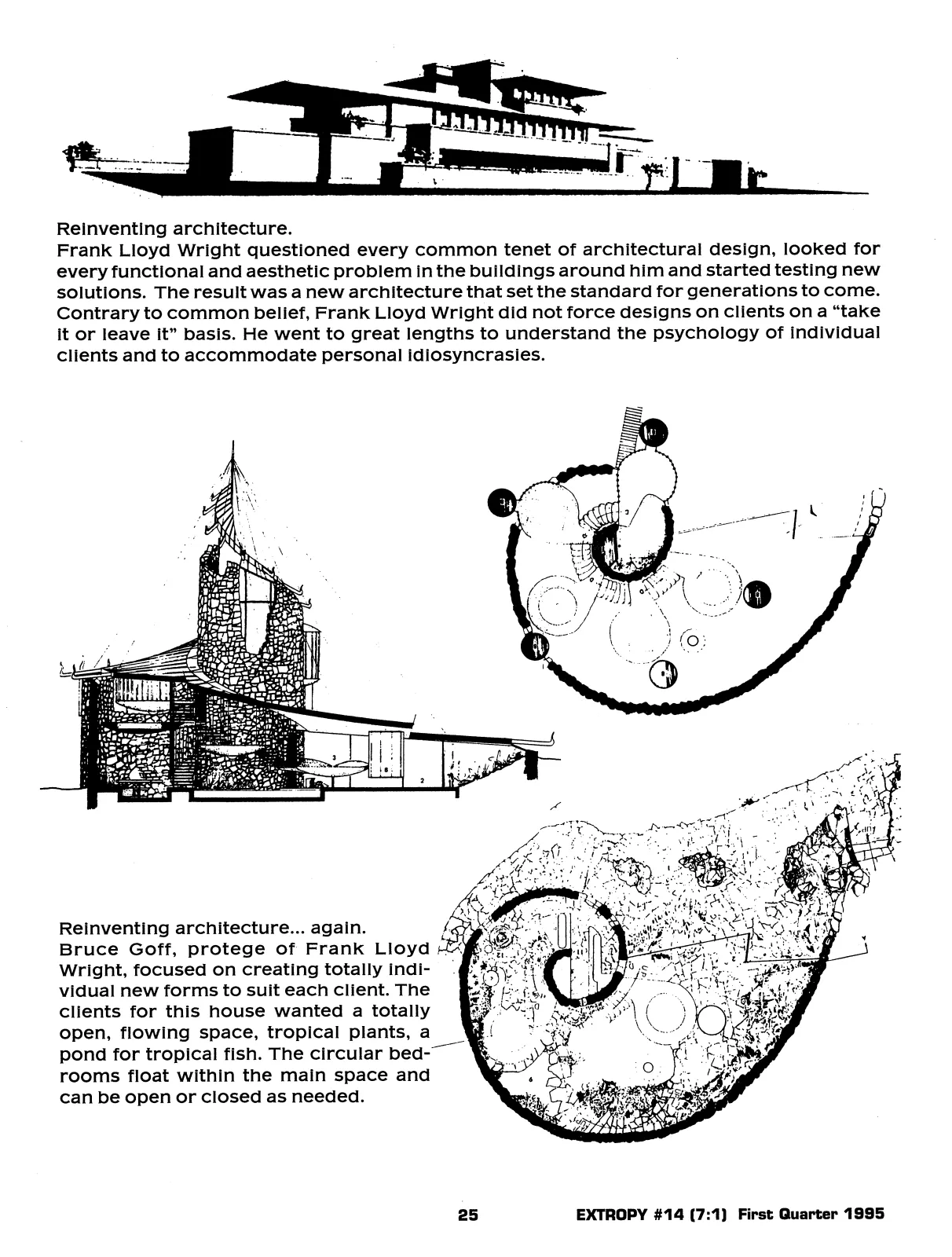
Reinventing architecture.
Frank Lloyd Wright questioned every common tenet of architectural design, looked for every functional and aesthetic problem in the buildings around him and started testing new solutions. The result was a new architecture that set the standard for generations to come. Contrary to common belief, Frank Lloyd Wright did not force designs on clients on a “take it or leave it” basis. He went to great lengths to understand the psychology of individual clients and to accommodate personal idiosyncrasies.
Reinventing architecture… again.
Bruce Goff, protege of Frank Lloyd Wright, focused on creating totally individual new forms to suit each client. The clients for this house wanted a totally open, flowing space, tropical plants, a pond for tropical fish. The circular bedrooms float within the main space and can be open or closed as needed.
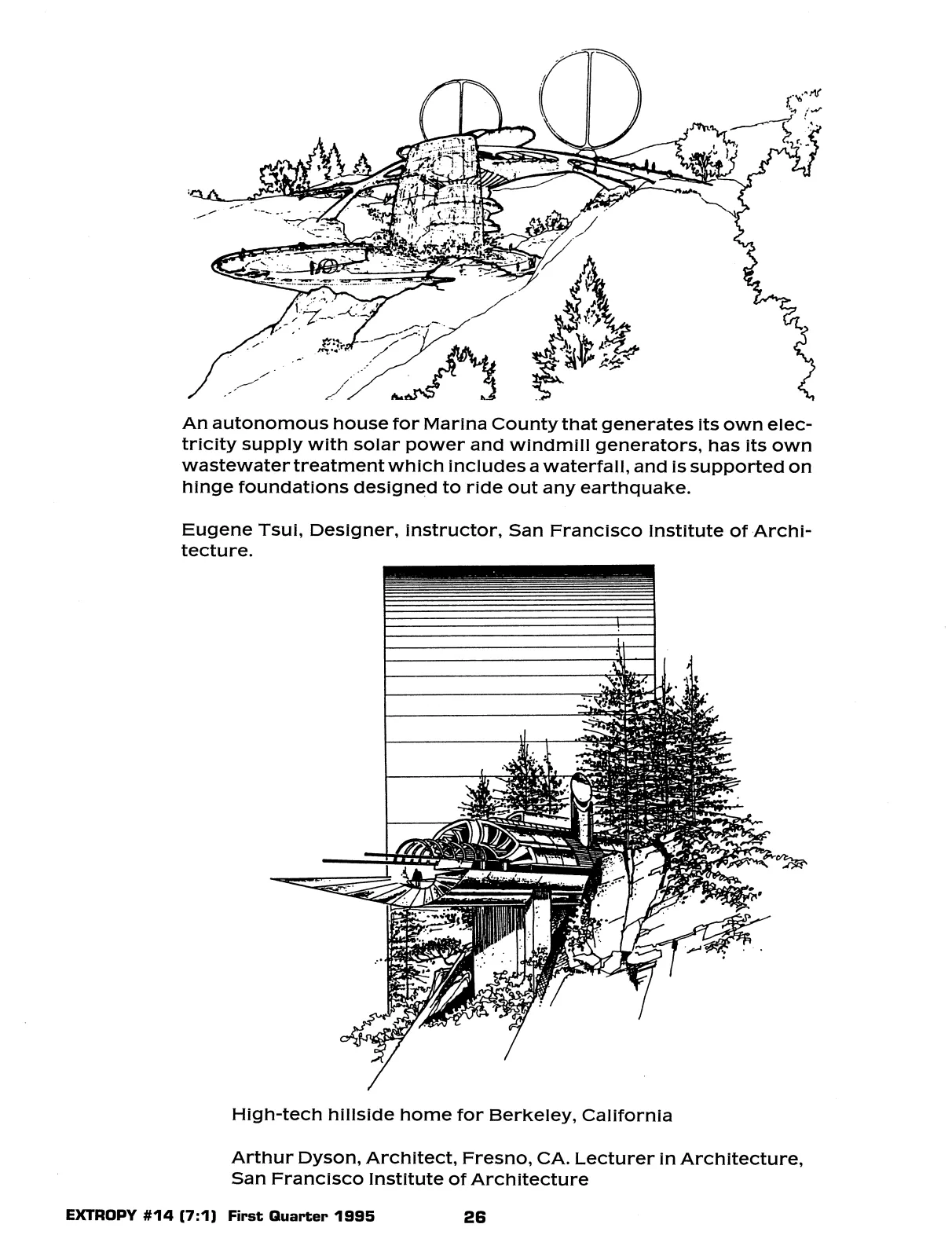
An autonomous house for Marina County that generates its own electricity supply with solar power and windmill generators, has its own wastewater treatment which includes a waterfall, and is supported on hinge foundations designed to ride out any earthquake.
Eugene Tsui, Designer, instructor, San Francisco Institute of Architecture.
High-tech hillside home for Berkeley, California
Arthur Dyson, Architect, Fresno, CA. Lecturer in Architecture, San Francisco Institute of Architecture
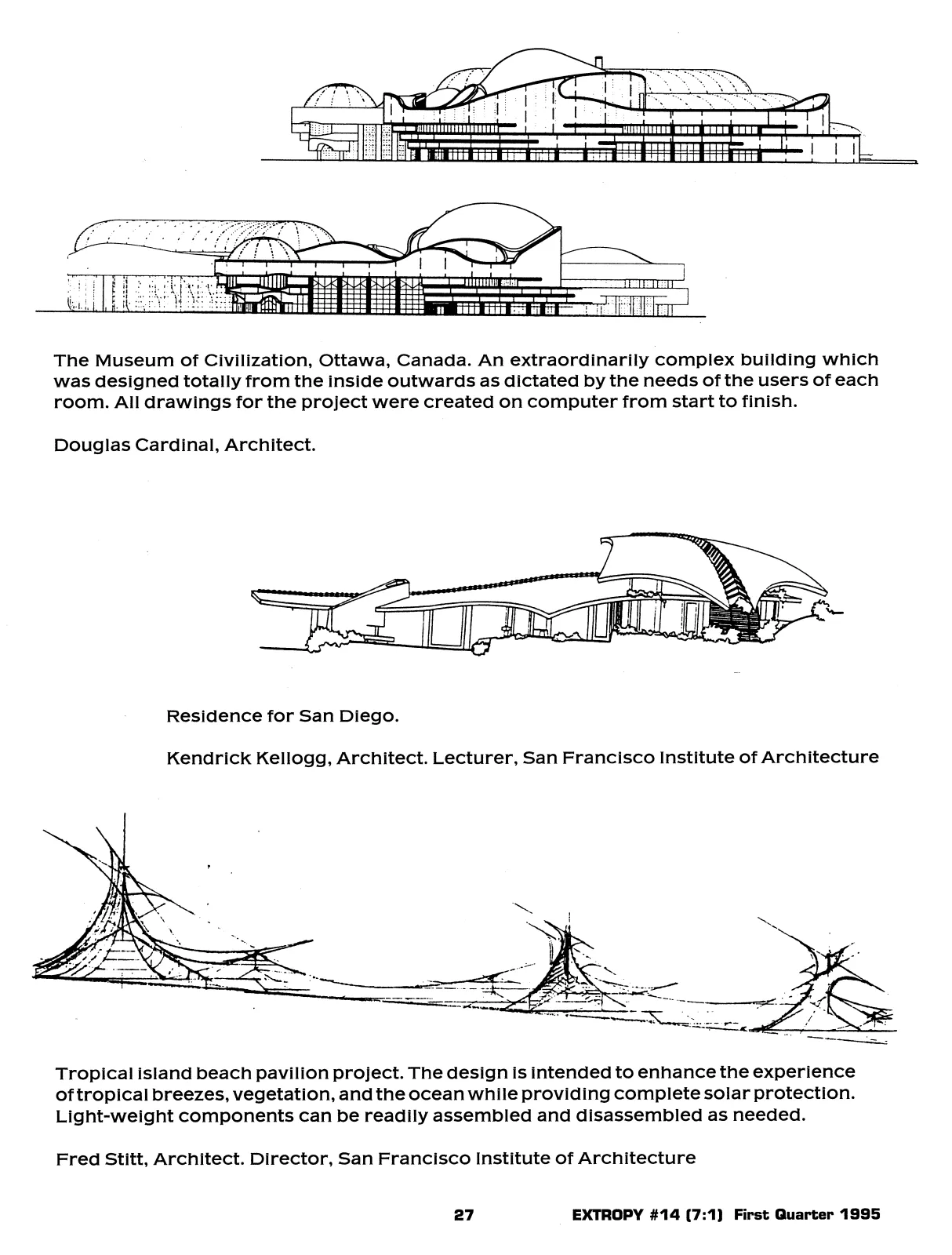
The Museum of Civilization, Ottawa, Canada. An extraordinarily complex building which was designed totally from the inside outwards as dictated by the needs of the users of each room. All drawings for the project were created on computer from start to finish.
Douglas Cardinal, Architect.
Residence for San Diego.
Kendrick Kellogg, Architect. Lecturer, San Francisco Institute of Architecture
Tropical island beach pavilion project. The design is intended to enhance the experience of tropical breezes, vegetation, and the ocean while providing complete solar protection. Light-weight components can be readily assembled and disassembled as needed.
Fred Stitt, Architect. Director, San Francisco Institute of Architecture
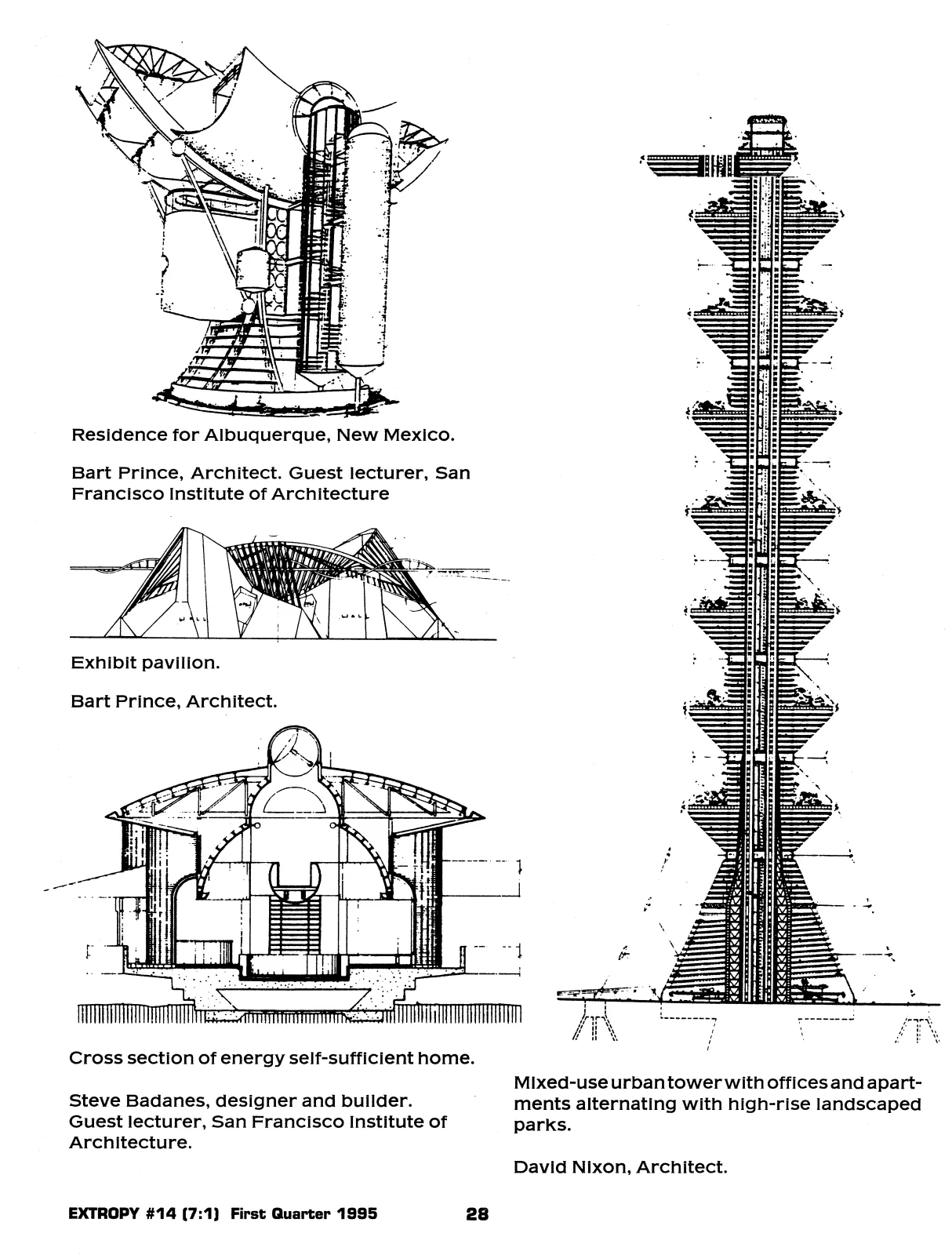
Residence for Albuquerque, New Mexico.
Bart Prince, Architect. Guest lecturer, San Francisco Institute of Architecture
Exhibit pavilion.
Bart Prince, Architect.
Cross section of energy self-sufficient home.
Steve Badanes, designer and builder. Guest lecturer, San Francisco Institute of Architecture.
Mixed-use urban tower with offices and apartments alternating with high-rise landscaped parks.
David Nixon, Architect.
VIEW ORIGINAL SCAN (8 pages)