Issue: EXTROPY #14 · First Quarter 1995
Author: J. Storrs Hall
Pages: 5–11 · 7 scanned pages
Utility Fog, Part Two
N A N O T E C H N O L O G Y
UTILITY FOG
Part Two
Copyright ©1994
J. Storrs Hall, Ph.D.
To recapitulate Part One:
Active, polymorphic material (“Utility Fog”) can be designed as a conglomeration of 100-micron robotic cells (“foglets”). Such robots could be built with the techniques of molecular nanotechnology. An appropriate mass of Utility Fog can be programmed to simulate most of the physical properties of any macroscopic object (including air and water), to roughly the same precision those properties are measured by human senses. The major exceptions are taste, smell, and transparency.
The computing power represented by Fog is sufficient for uploading into a relatively small batch, by most estimates. An intelligence uploaded into Fog could take on any physical form it pleased, and vary that form at will. In an environment filled with Fog, objects (including intelligent ones) can have virtual existence, moving as patterns instead of existing as a collection of specific Foglets.
Foglets and Fog
Compared with a true molecular assembler, a Foglet will be huge and overpowered, able to control its motions to no better than a tenth of a micron instead of a tenth of a nanometer. It will have an armspread on the order of microns or more. A 10 micron armspread is about as small as it would be feasible to make a Foglet. There is no obvious upper bound on size, except to reduce the resolution and verisimilitude of the simulation. ‘Foglets’ whose appearance didn’t matter and which were simply to manipulate objects, could be on the order of inches or even feet. It would probably be workable to have Foglets 10 or even 100 times as large as the design presented here, and would simplify some of the engineering problems. They would be visible to the naked eye, if you looked closely, but then so are the pixels on your television.
Most currently proposed nanotechnological designs are based on carbon. Carbon is a marvelous atom for structural purposes, forming a crystal (diamond) which is very stiff and strong. However, a Fog built of diamond would have a problem which nanomechanical designs of a more conventional form do not pose: The Fog has so much surface area exposed to the air that if it were largely diamond, especially on the surface, it would amount to a “fuel-air explosive”.
Therefore the Foglet is designed so that its structural elements, forming the major component of its mass, could be made of aluminum oxide and/or quartz, refractory compounds using common elements. The structural elements form an exoskeleton, which besides being a good mechanical design allows us to have an evacuated interior in which more sensitive
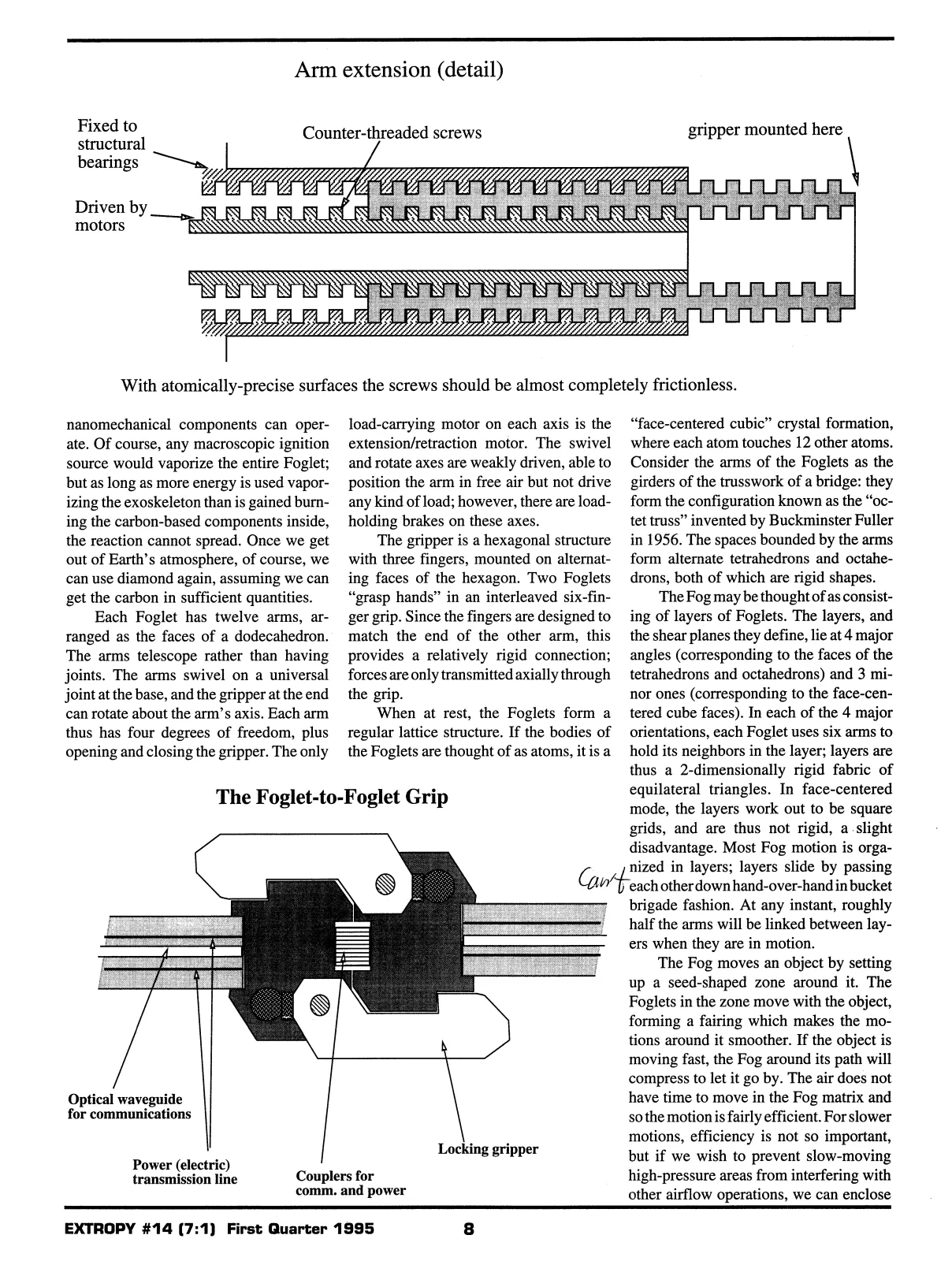
Arm extension (detail)
With atomically-precise surfaces the screws should be almost completely frictionless.
nanomechanical components can operate. Of course, any macroscopic ignition source would vaporize the entire Foglet; but as long as more energy is used vaporizing the exoskeleton than is gained burning the carbon-based components inside, the reaction cannot spread. Once we get out of Earth’s atmosphere, of course, we can use diamond again, assuming we can get the carbon in sufficient quantities.
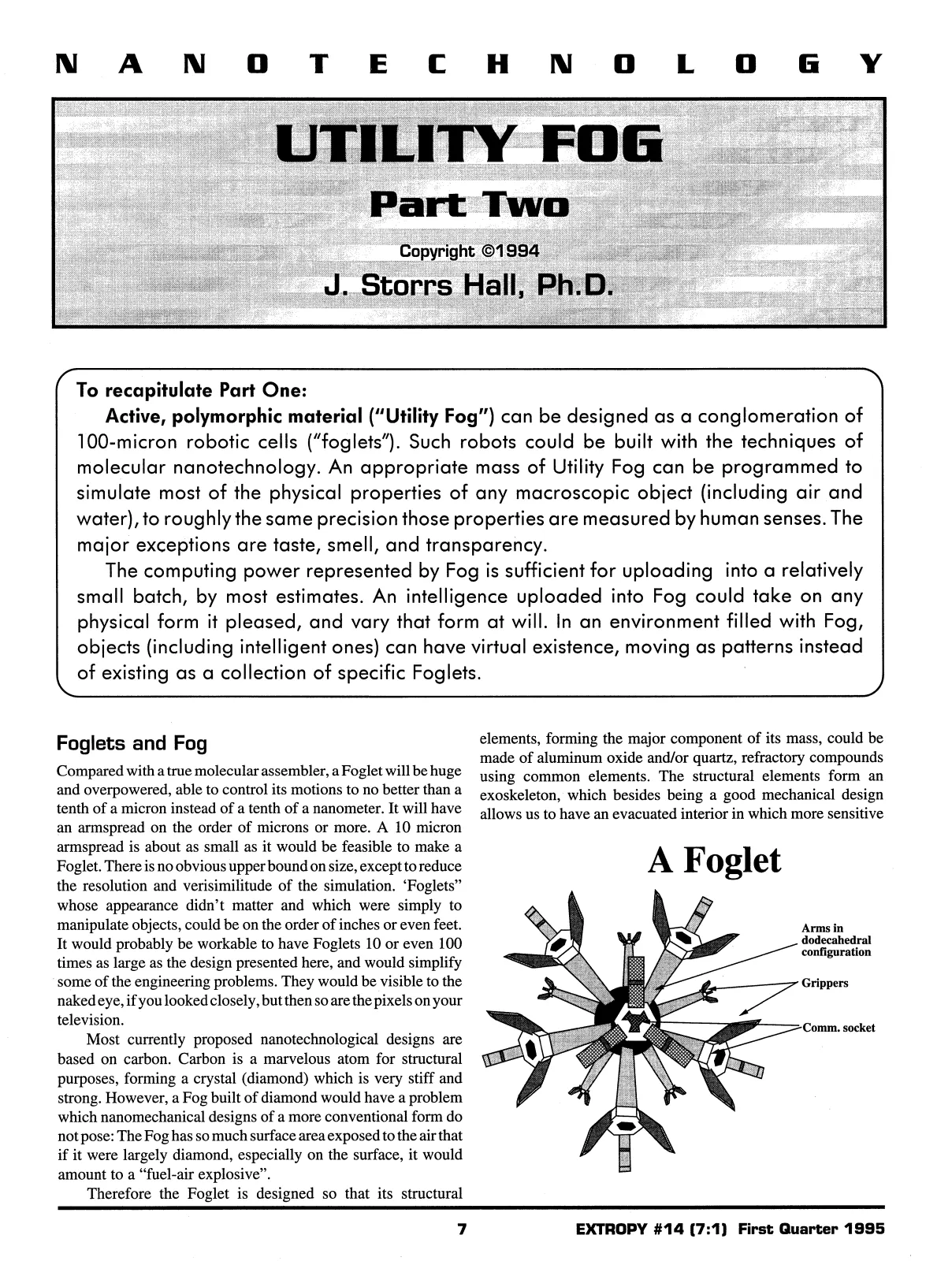
Each Foglet has twelve arms, arranged as the faces of a dodecahedron. The arms telescope rather than having joints. The arms swivel on a universal joint at the base, and the gripper at the end can rotate about the arm’s axis. Each arm thus has four degrees of freedom, plus opening and closing the gripper. The only load-carrying motor on each axis is the extension/retraction motor. The swivel and rotate axes are weakly driven, able to position the arm in free air but not drive any kind of load; however, there are load-holding brakes on these axes.
The gripper is a hexagonal structure with three fingers, mounted on alternating faces of the hexagon. Two Foglets “grasp hands” in an interleaved six-finger grip. Since the fingers are designed to match the end of the other arm, this provides a relatively rigid connection; forces are only transmitted axially through the grip.
When at rest, the Foglets form a regular lattice structure. If the bodies of the Foglets are thought of as atoms, it is a
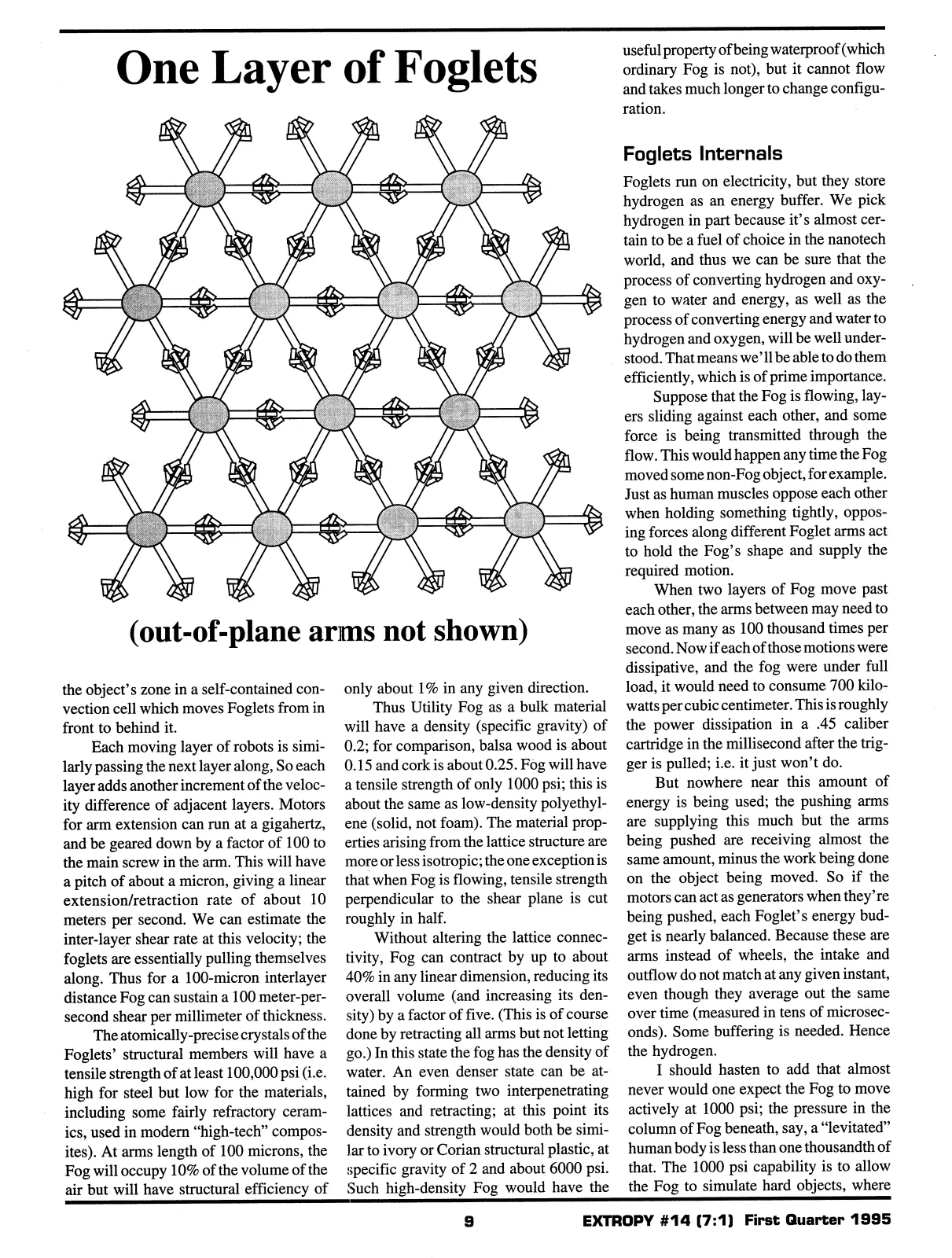
“face-centered cubic” crystal formation, where each atom touches 12 other atoms. Consider the arms of the Foglets as the girders of the trusswork of a bridge: they form the configuration known as the “octet truss” invented by Buckminster Fuller in 1956. The spaces bounded by the arms form alternate tetrahedrons and octahedrons, both of which are rigid shapes.
The Fog may be thought of as consisting of layers of Foglets. The layers, and the shear planes they define, lie at 4 major angles (corresponding to the faces of the tetrahedrons and octahedrons) and 3 minor ones (corresponding to the face-centered cube faces). In each of the 4 major orientations, each Foglet uses six arms to hold its neighbors in the layer; layers are thus a 2-dimensionally rigid fabric of equilateral triangles. In face-centered mode, the layers work out to be square grids, and are thus not rigid, a slight disadvantage. Most Fog motion is organized in layers; layers slide by passing each other down hand-over-hand in bucket brigade fashion. At any instant, roughly half the arms will be linked between layers when they are in motion.
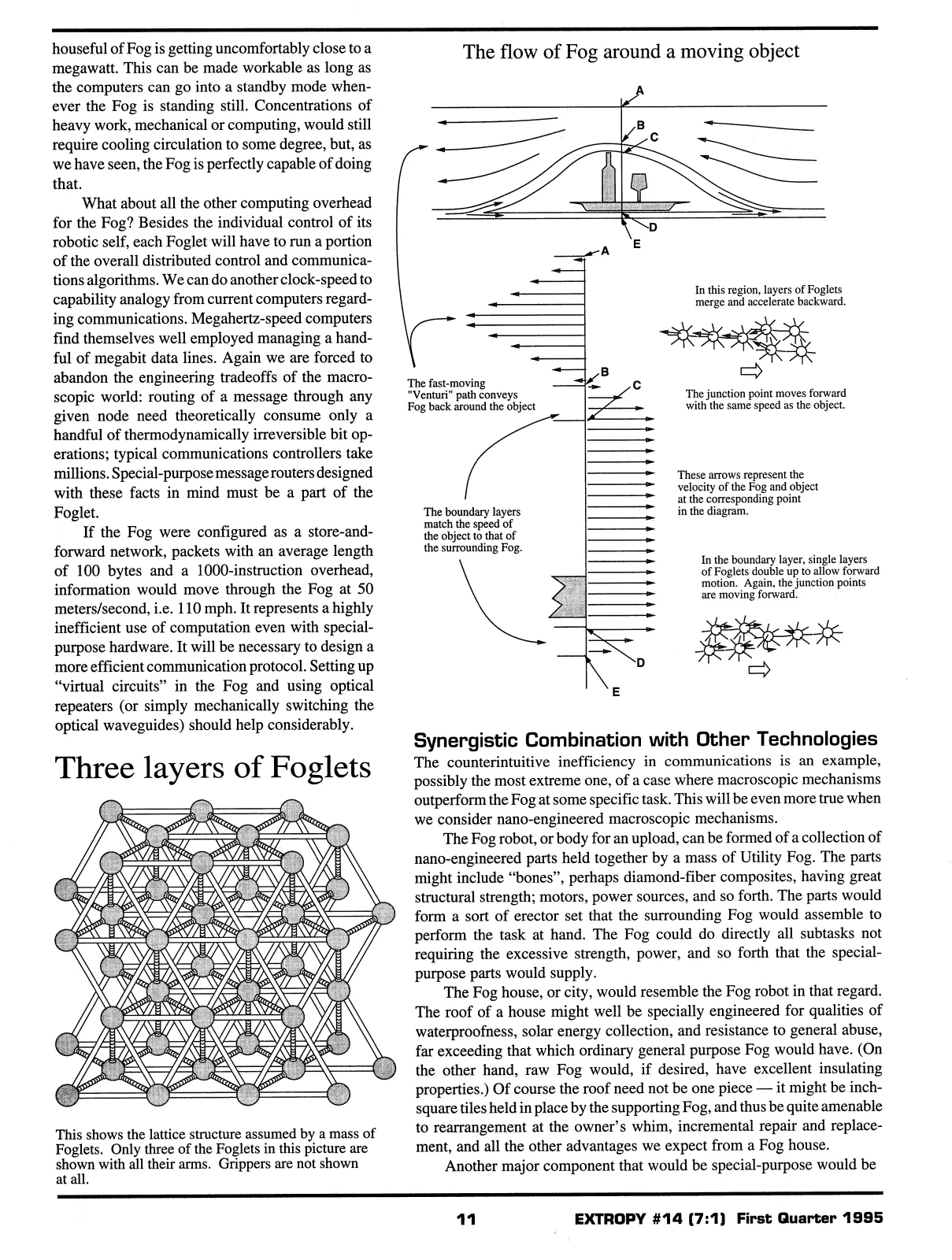
The Fog moves an object by setting up a seed-shaped zone around it. The Foglets in the zone move with the object, forming a fairing which makes the motions around it smoother. If the object is moving fast, the Fog around its path will compress to let it go by. The air does not have time to move in the Fog matrix and so the motion is fairly efficient. For slower motions, efficiency is not so important, but if we wish to prevent slow-moving high-pressure areas from interfering with other airflow operations, we can enclose
The Foglet-to-Foglet Grip
One Layer of Foglets
(out-of-plane arms not shown)
the object’s zone in a self-contained convection cell which moves Foglets from in front to behind it.
Each moving layer of robots is similarly passing the next layer along. So each layer adds another increment of the velocity difference of adjacent layers. Motors for arm extension can run at a gigahertz, and be geared down by a factor of 100 to the main screw in the arm. This will have a pitch of about a micron, giving a linear extension/retraction rate of about 10 meters per second. We can estimate the inter-layer shear rate at this velocity; the foglets are essentially pulling themselves along. Thus for a 100-micron interlayer distance Fog can sustain a 100 meter-per-second shear per millimeter of thickness.
The atomically-precise crystals of the Foglets’ structural members will have a tensile strength of at least 100,000 psi (i.e. high for steel but low for the materials, including some fairly refractory ceramics, used in modern ‘high-tech’ composites). At arms length of 100 microns, the Fog will occupy 10% of the volume of the air but will have structural efficiency of only about 1% in any given direction.
Thus Utility Fog as a bulk material will have a density (specific gravity) of 0.2; for comparison, balsa wood is about 0.15 and cork is about 0.25. Fog will have a tensile strength of only 1000 psi; this is about the same as low-density polyethylene (solid, not foam). The material properties arising from the lattice structure are more or less isotropic; the one exception is that when Fog is flowing, tensile strength perpendicular to the shear plane is cut roughly in half.
Without altering the lattice connectivity, Fog can contract by up to about 40% in any linear dimension, reducing its overall volume (and increasing its density) by a factor of five. (This is of course done by retracting all arms but not letting go.) In this state the fog has the density of water. An even denser state can be attained by forming two interpenetrating lattices and retracting; at this point its density and strength would both be similar to ivory or Corian structural plastic, at specific gravity of 2 and about 6000 psi. Such high-density Fog would have the useful property of being waterproof (which ordinary Fog is not), but it cannot flow and takes much longer to change configuration.
Foglets Internals
Foglets run on electricity, but they store hydrogen as an energy buffer. We pick hydrogen in part because it’s almost certain to be a fuel of choice in the nanotech world, and thus we can be sure that the process of converting hydrogen and oxygen to water and energy, as well as the process of converting energy and water to hydrogen and oxygen, will be well understood. That means we’ll be able to do them efficiently, which is of prime importance.
Suppose that the Fog is flowing, layers sliding against each other, and some force is being transmitted through the flow. This would happen any time the Fog moved some non-Fog object, for example. Just as human muscles oppose each other when holding something tightly, opposing forces along different Foglet arms act to hold the Fog’s shape and supply the required motion.
When two layers of Fog move past each other, the arms between may need to move as many as 100 thousand times per second. Now if each of those motions were dissipative, and the fog were under full load, it would need to consume 700 kilowatts per cubic centimeter. This is roughly the power dissipation in a .45 caliber cartridge in the millisecond after the trigger is pulled; i.e. it just won’t do.
But nowhere near this amount of energy is being used; the pushing arms are supplying this much but the arms being pushed are receiving almost the same amount, minus the work being done on the object being moved. So if the motors can act as generators when they’re being pushed, each Foglet’s energy budget is nearly balanced. Because these are arms instead of wheels, the intake and outflow do not match at any given instant, even though they average out the same over time (measured in tens of microseconds). Some buffering is needed. Hence the hydrogen.
I should hasten to add that almost never would one expect the Fog to move actively at 1000 psi; the pressure in the column of Fog beneath, say, a ‘levitated’ human body is less than one thousandth of that. The 1000 psi capability is to allow the Fog to simulate hard objects, where forces can be concentrated into very small areas. Even so, current exploratory engineering designs for electric motors have power conversion densities up to a billion watts per cubic centimeter, and dissipative inefficiencies in the 10 parts per million range. This means that if the Empire State Building were being floated around on a column of Fog, the Fog would dissipate less than a watt per cubic centimeter.
Moving Fog will dissipate energy by air turbulence and viscous drag. In the large, air will be entrained in the layers of moving Fog and forced into laminar flow. Energy consumed in this regime may be properly thought of as necessary for the desired motion no matter how it was done. As for the waving of the arms between layers, the Reynolds number decreases linearly with the size of the arm. Since the absolute velocity of the arms is low, i.e. 1 m/s, the Reynolds number should be well below the “lower critical” value, and the arms should be operating in a perfectly viscous regime with no turbulence. The remaining effect, viscous drag (on the waving arms) comes to a few watts per square meter of shear plane per layer.
There will certainly be some waste heat generated by Fog at work that will need to be dissipated. This and other applications for heat pumps, such as heating or cooling people (no need to heat the whole house, especially since some people prefer different temperatures), can be done simply by running a flow of Fog through a pipe-like volume which changes in area, compressing and expanding the entrained air at the appropriate places.
Communications and Control
In the macroscopic world, microcomputer-based controllers (e.g. the widely used Intel 8051 series microcontrollers) typically run on a clock speed of about 10 MHz. They emit control signals, at most, on the order of 10 KHz (usually less), and control motions in robots that are at most 10 Hz, i.e. a complete motion taking one analysis (in Nanosystems) shows that it is possible to build mechanical nanocomputers with gigahertz clock rates. Thus we can immediately expect to build a nanocontroller which can direct a 10 kilohertz robot. However, we can do better.
Since the early microcontrollers were developed, computer architecture has advanced. The 8051’s do 1 instruction per 6, 12, or 18 clock cycles; modern RISC architectures execute 1 instruction per cycle. So far, nobody has bothered to build a RISC microcontroller, since they already have more computing power than they need. Furthermore, RISC designs are
The Fog robot, or body for an upload, can be formed of a collection of nano-engineered parts held together by a mass of Utility Fog. The parts might include “bones”, perhaps diamond-fiber composites, having great structural strength; motors, power sources, and so forth.
tenth of a second. This million-clocks-per-action is not strictly necessary, of course; but it gives us some concept of the action rate we might expect for a given computer clock rate in a digitally controlled nanorobot.
Eric Drexler’s carefully detailed efficient in hardware as well as time; one early RISC was implemented on a 10,000-gate gate array. This design could be translated into rod logic in less than one tenth of one percent of a cubic micron.
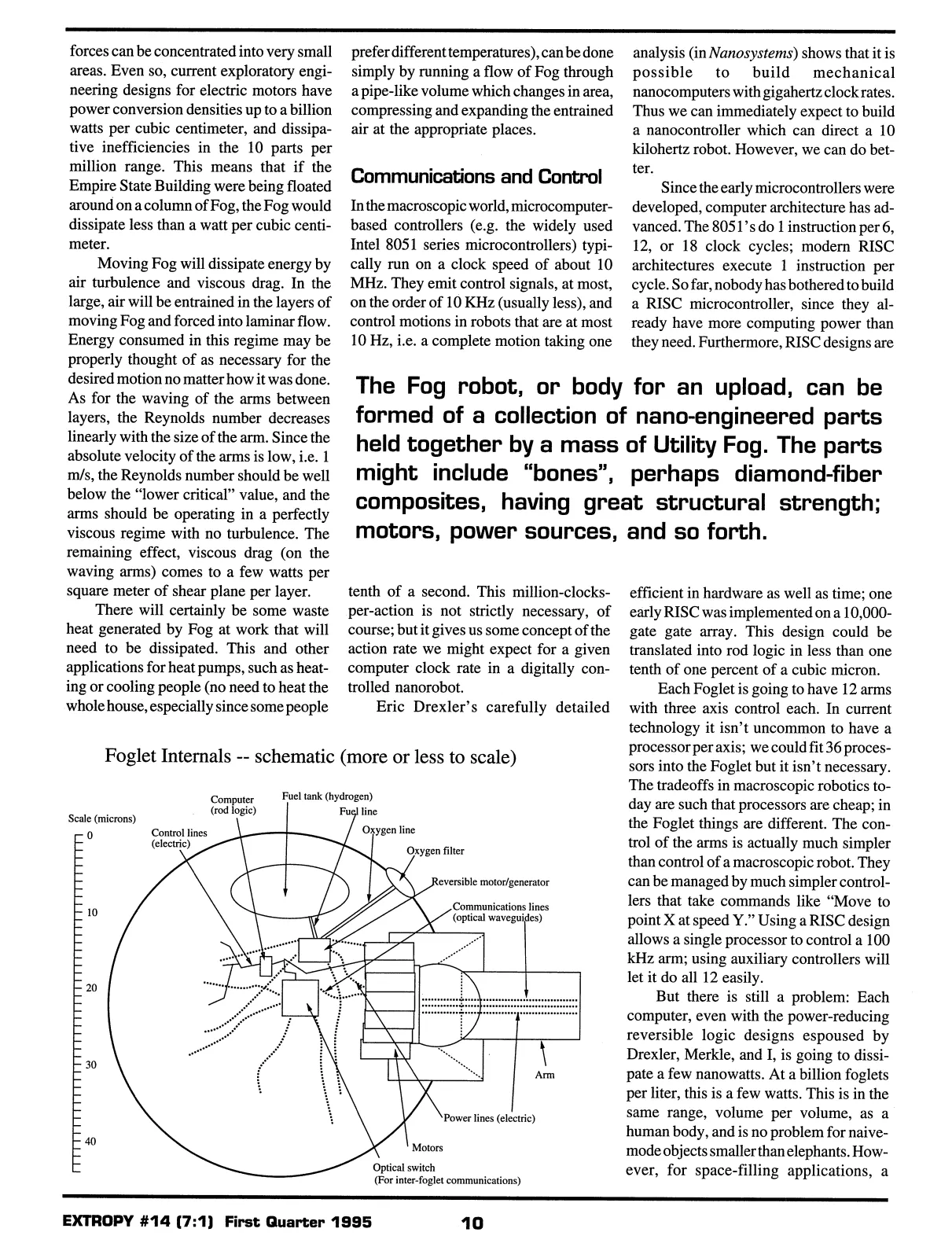
Each Foglet is going to have 12 arms with three axis control each. In current technology it isn’t uncommon to have a processor per axis; we could fit 36 processors into the Foglet but it isn’t necessary. The tradeoffs in macroscopic robotics today are such that processors are cheap; in the Foglet things are different. The control of the arms is actually much simpler than control of a macroscopic robot. They can be managed by much simpler controllers that take commands like “Move to point X at speed Y.” Using a RISC design allows a single processor to control a 100 kHz arm; using auxiliary controllers will let it do all 12 easily.
But there is still a problem: Each computer, even with the power-reducing reversible logic designs espoused by Drexler, Merkle, and I, is going to dissipate a few nanowatts. At a billion foglets per liter, this is a few watts. This is in the same range, volume per volume, as a human body, and is no problem for naive-mode objects smaller than elephants. However, for space-filling applications, a
Foglet Internals — schematic (more or less to scale)
houseful of Fog is getting uncomfortably close to a megawatt. This can be made workable as long as the computers can go into a standby mode whenever the Fog is standing still. Concentrations of heavy work, mechanical or computing, would still require cooling circulation to some degree, but, as we have seen, the Fog is perfectly capable of doing that.
What about all the other computing overhead for the Fog? Besides the individual control of its robotic self, each Foglet will have to run a portion of the overall distributed control and communications algorithms. We can do another clock-speed to capability analogy from current computers regarding communications. Megahertz-speed computers find themselves well employed managing a handful of megabit data lines. Again we are forced to abandon the engineering tradeoffs of the macroscopic world: routing of a message through any given node need theoretically consume only a handful of thermodynamically irreversible bit operations; typical communications controllers take millions. Special-purpose message routers designed with these facts in mind must be a part of the Foglet.
If the Fog were configured as a store-and-forward network, packets with an average length of 100 bytes and a 1000-instruction overhead, information would move through the Fog at 50 meters/second, i.e. 110 mph. It represents a highly inefficient use of computation even with special-purpose hardware. It will be necessary to design a more efficient communication protocol. Setting up “virtual circuits” in the Fog and using optical repeaters (or simply mechanically switching the optical waveguides) should help considerably.
Three layers of Foglets
This shows the lattice structure assumed by a mass of Foglets. Only three of the Foglets in this picture are shown with all their arms. Grippers are not shown at all.
The flow of Fog around a moving object
Synergistic Combination with Other Technologies
The counterintuitive inefficiency in communications is an example, possibly the most extreme one, of a case where macroscopic mechanisms outperform the Fog at some specific task. This will be even more true when we consider nano-engineered macroscopic mechanisms.
The Fog robot, or body for an upload, can be formed of a collection of nano-engineered parts held together by a mass of Utility Fog. The parts might include “bones”, perhaps diamond-fiber composites, having great structural strength; motors, power sources, and so forth. The parts would form a sort of erector set that the surrounding Fog would assemble to perform the task at hand. The Fog could do directly all subtasks not requiring the excessive strength, power, and so forth that the special-purpose parts would supply.
The Fog house, or city, would resemble the Fog robot in that regard. The roof of a house might well be specially engineered for qualities of waterproofness, solar energy collection, and resistance to general abuse, far exceeding that which ordinary general purpose Fog would have. (On the other hand, raw Fog would, if desired, have excellent insulating properties.) Of course the roof need not be one piece — it might be inch-square tiles held in place by the supporting Fog, and thus be quite amenable to rearrangement at the owner’s whim, incremental repair and replacement, and all the other advantages we expect from a Fog house.
Another major component that would be special-purpose would be
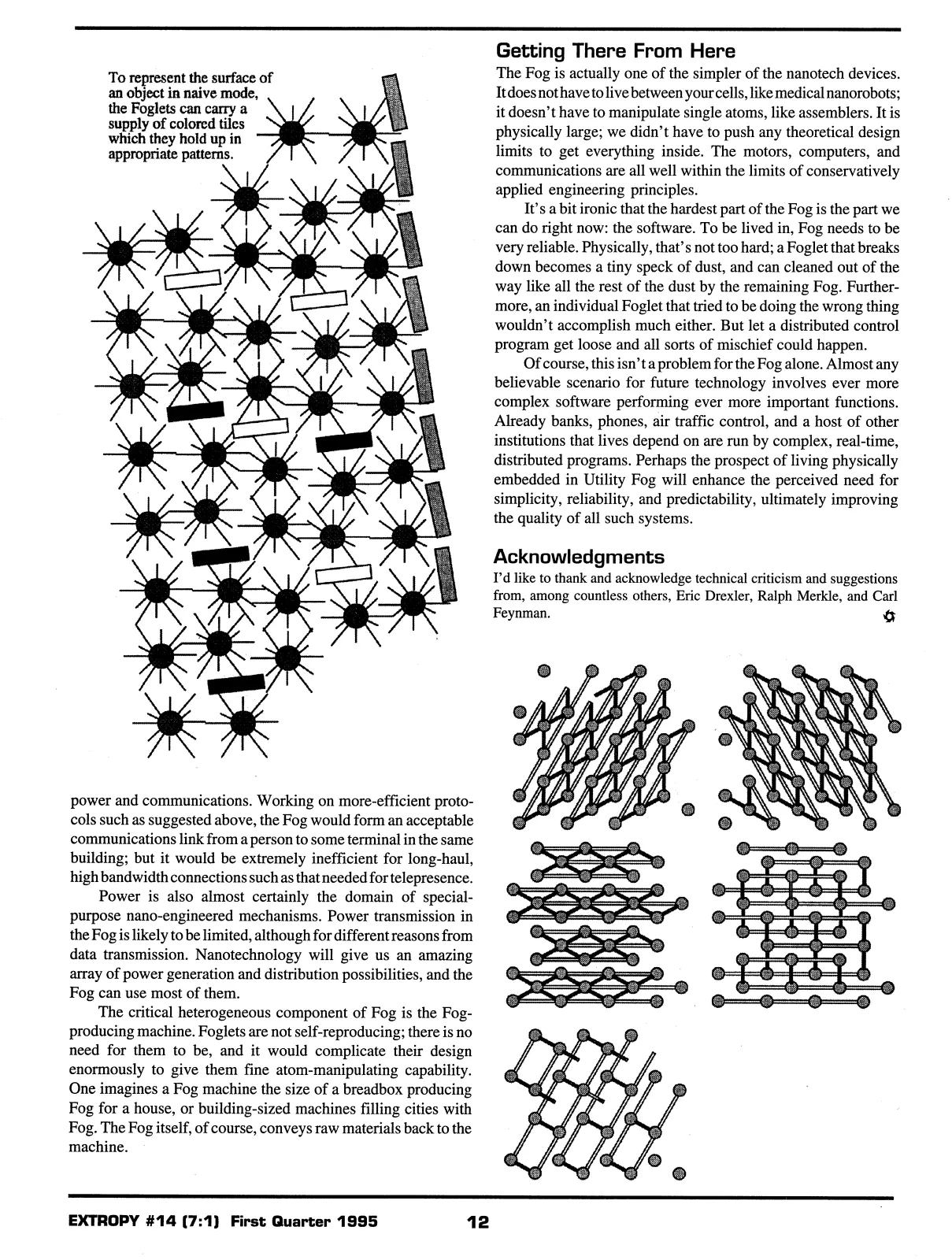
To represent the surface of an object in naive mode, the Foglets can carry a supply of colored tiles which they hold up in appropriate patterns.
power and communications. Working on more-efficient protocols such as suggested above, the Fog would form an acceptable communications link from a person to some terminal in the same building; but it would be extremely inefficient for long-haul, high bandwidth connections such as that needed for telepresence.
Power is also almost certainly the domain of special-purpose nano-engineered mechanisms. Power transmission in the Fog is likely to be limited, although for different reasons from data transmission. Nanotechnology will give us an amazing array of power generation and distribution possibilities, and the Fog can use most of them.
The critical heterogeneous component of Fog is the Fog-producing machine. Foglets are not self-reproducing; there is no need for them to be, and it would complicate their design enormously to give them fine atom-manipulating capability. One imagines a Fog machine the size of a breadbox producing Fog for a house, or building-sized machines filling cities with Fog. The Fog itself, of course, conveys raw materials back to the machine.
Getting There From Here
The Fog is actually one of the simpler of the nanotech devices. It does not have to live between your cells, like medical nanorobots; it doesn’t have to manipulate single atoms, like assemblers. It is physically large; we didn’t have to push any theoretical design limits to get everything inside. The motors, computers, and communications are all well within the limits of conservatively applied engineering principles.
It’s a bit ironic that the hardest part of the Fog is the part we can do right now: the software. To be lived in, Fog needs to be very reliable. Physically, that’s not too hard; a Foglet that breaks down becomes a tiny speck of dust, and can cleaned out of the way like all the rest of the dust by the remaining Fog. Furthermore, an individual Foglet that tried to be doing the wrong thing wouldn’t accomplish much either. But let a distributed control program get loose and all sorts of mischief could happen.
Of course, this isn’t a problem for the Fog alone. Almost any believable scenario for future technology involves ever more complex software performing ever more important functions. Already banks, phones, air traffic control, and a host of other institutions that lives depend on are run by complex, real-time, distributed programs. Perhaps the prospect of living physically embedded in Utility Fog will enhance the perceived need for simplicity, reliability, and predictability, ultimately improving the quality of all such systems.
Acknowledgments
I’d like to thank and acknowledge technical criticism and suggestions from, among countless others, Eric Drexler, Ralph Merkle, and Carl Feynman.
This IS an advertisement!
VIEW ORIGINAL SCAN (7 pages)