Issue: EXTROPY #4 · Summer 1989
Author: Mark E. Potts & Max T. O'Connor
Pages: 29–31 · 3 scanned pages
Two Reviews of FM-2030's 'Are You a Transhuman?'
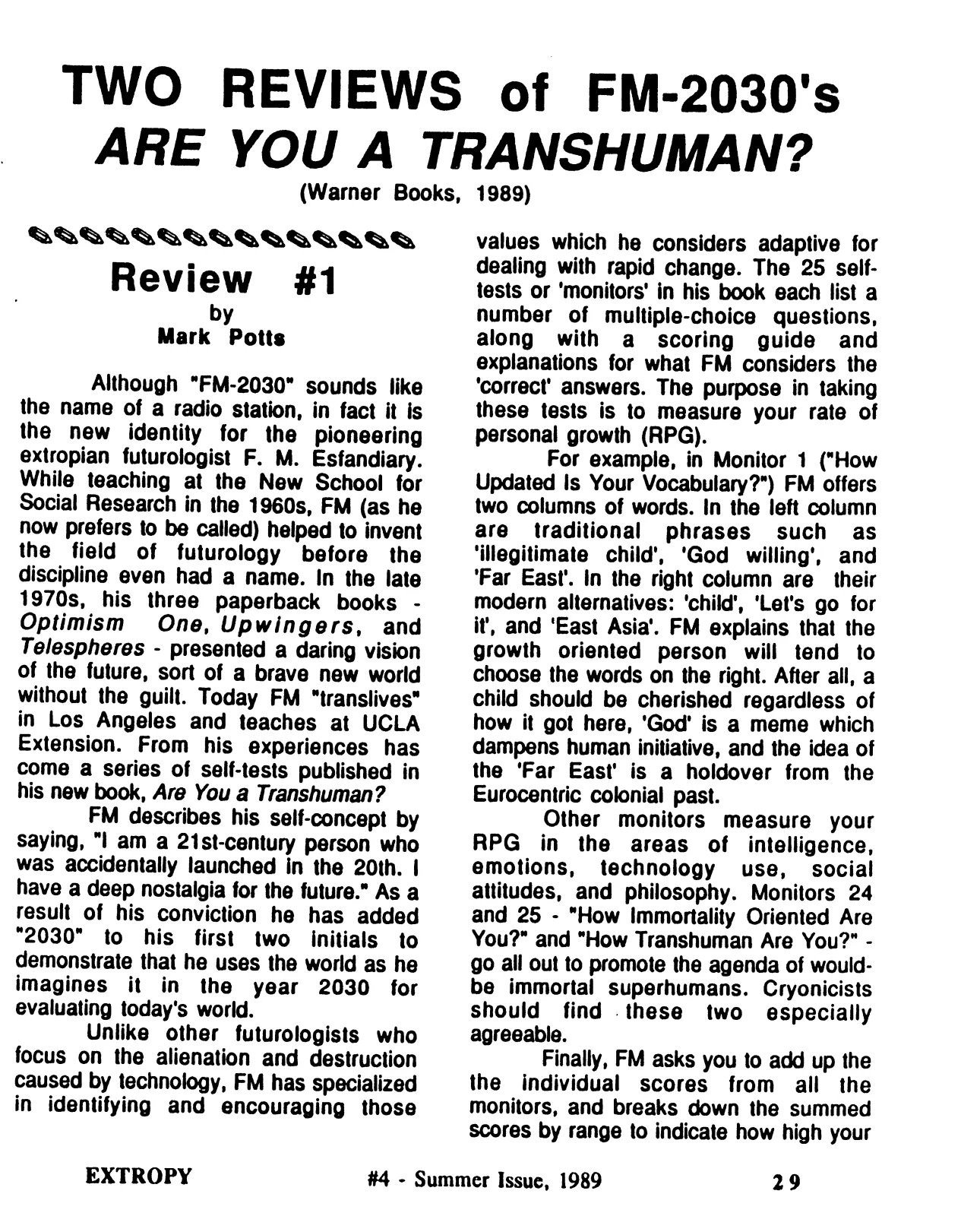
TWO REVIEWS of FM-2030’s ARE YOU A TRANSHUMAN?
(Warner Books, 1989)
Review #1
Mark Potts
Although ‘FM-2030’ sounds like the name of a radio station, in fact it is the new identity for the pioneering extropian futurologist F. M. Esfandiary. While teaching at the New School for Social Research in the 1960s, FM (as he now prefers to be called) helped to invent the field of futurology before the discipline even had a name. In the late 1970s, his three paperback books - Optimism One, Upwingers, and Telespheres - presented a daring vision of the future, sort of a brave new world without the guilt. Today FM ‘translives’ in Los Angeles and teaches at UCLA Extension. From his experiences has come a series of self-tests published in his new book, Are You a Transhuman?
FM describes his self-concept by saying, ‘I am a 21st-century person who was accidentally launched in the 20th. I have a deep nostalgia for the future.’ As a result of his conviction he has added ‘2030’ to his first two initials to demonstrate that he uses the world as he imagines it in the year 2030 for evaluating today’s world.
Unlike other futurologists who focus on the alienation and destruction caused by technology, FM has specialized in identifying and encouraging those values which he considers adaptive for dealing with rapid change. The 25 self-tests or ‘monitors’ in his book each list a number of multiple-choice questions, along with a scoring guide and explanations for what FM considers the ‘correct’ answers. The purpose in taking these tests is to measure your rate of personal growth (RPG).
For example, in Monitor 1 (‘How Updated Is Your Vocabulary?’) FM offers two columns of words. In the left column are traditional phrases such as ‘illegitimate child’, ‘God willing’, and ‘Far East’. In the right column are their modern alternatives: ‘child’, ‘Let’s go for it’, and ‘East Asia’. FM explains that the growth oriented person will tend to choose the words on the right. After all, a child should be cherished regardless of how it got here, ‘God’ is a meme which dampens human initiative, and the idea of the ‘Far East’ is a holdover from the Eurocentric colonial past.
Other monitors measure your RPG in the areas of intelligence, emotions, technology use, social attitudes, and philosophy. Monitors 24 and 25 - ‘How Immortality Oriented Are You?’ and ‘How Transhuman Are You?’ - go all out to promote the agenda of would-be immortal superhumans. Cryonicists should find these two especially agreeable.
Finally, FM asks you to add up the the individual scores from all the monitors, and breaks down the summed scores by range to indicate how high your
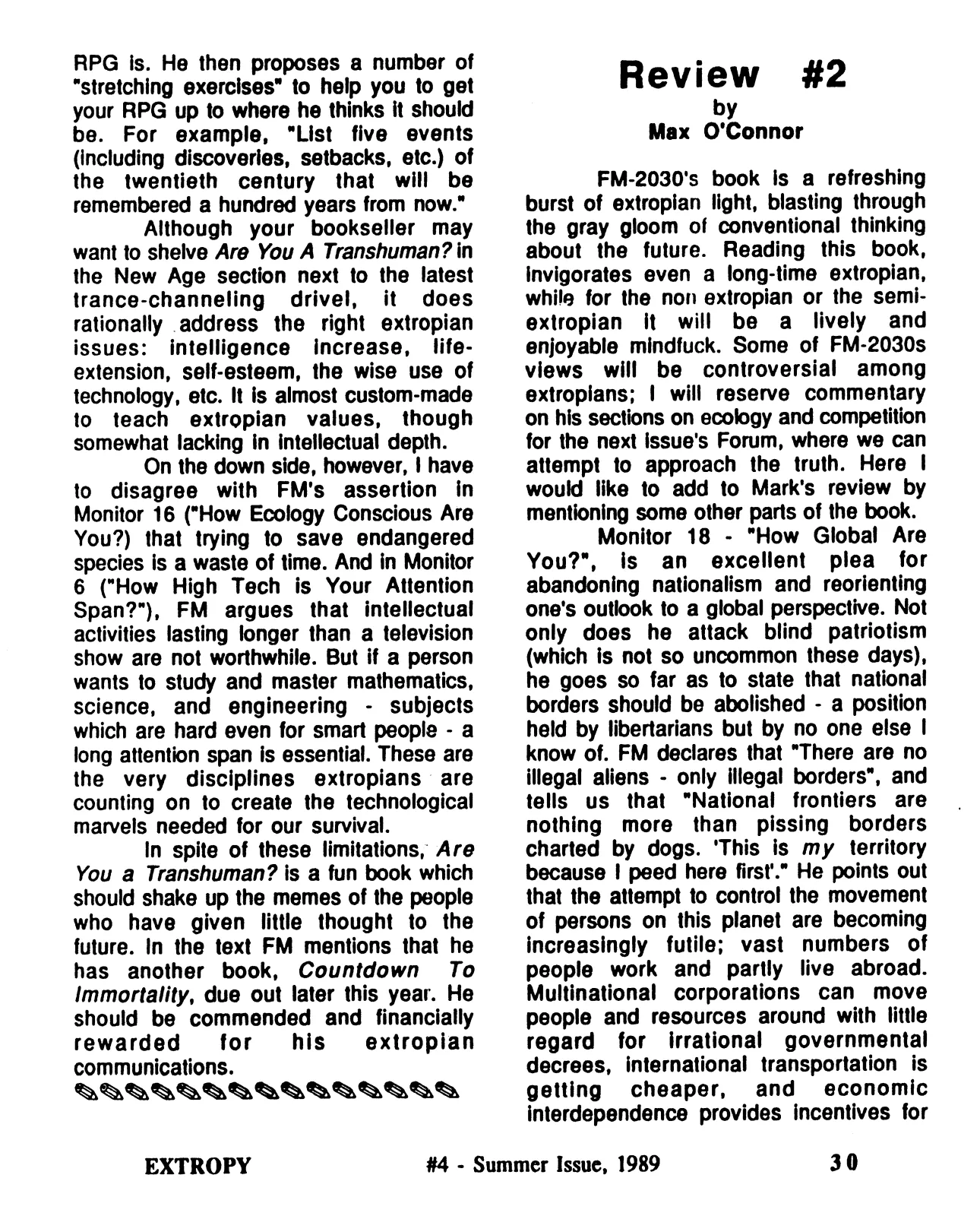
RPG is. He then proposes a number of ‘stretching exercises’ to help you to get your RPG up to where he thinks it should be. For example, ‘List five events (including discoveries, setbacks, etc.) of the twentieth century that will be remembered a hundred years from now.’
Although your bookseller may want to shelve Are You A Transhuman? in the New Age section next to the latest trance-channeling drivel, it does rationally address the right extropian issues: intelligence increase, life-extension, self-esteem, the wise use of technology, etc. It is almost custom-made to teach extropian values, though somewhat lacking in intellectual depth.
On the down side, however, I have to disagree with FM’s assertion in Monitor 16 (‘How Ecology Conscious Are You?) that trying to save endangered species is a waste of time. And in Monitor 6 (‘How High Tech is Your Attention Span?’), FM argues that intellectual activities lasting longer than a television show are not worthwhile. But if a person wants to study and master mathematics, science, and engineering - subjects which are hard even for smart people - a long attention span is essential. These are the very disciplines extropians are counting on to create the technological marvels needed for our survival.
In spite of these limitations, Are You a Transhuman? is a fun book which should shake up the memes of the people who have given little thought to the future. In the text FM mentions that he has another book, Countdown To Immortality, due out later this year. He should be commended and financially rewarded for his extropian communications.
Review #2
Max O’Connor
FM-2030’s book is a refreshing burst of extropian light, blasting through the gray gloom of conventional thinking about the future. Reading this book, invigorates even a long-time extropian, while for the non-extropian or the semi-extropian it will be a lively and enjoyable mindfuck. Some of FM-2030s views will be controversial among extropians; I will reserve commentary on his sections on ecology and competition for the next issue’s Forum, where we can attempt to approach the truth. Here I would like to add to Mark’s review by mentioning some other parts of the book.
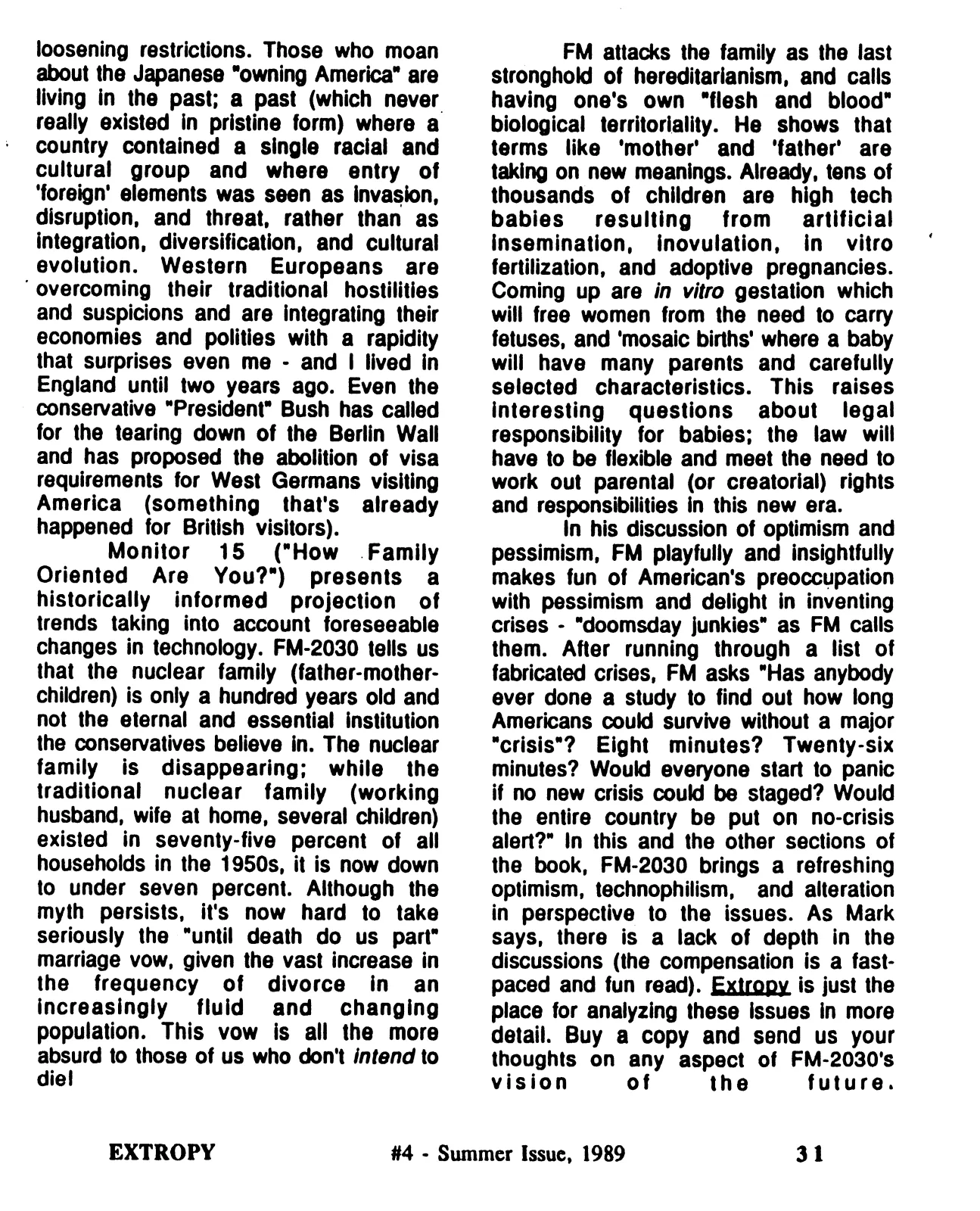
Monitor 18 - ‘How Global Are You?’, is an excellent plea for abandoning nationalism and reorienting one’s outlook to a global perspective. Not only does he attack blind patriotism (which is not so uncommon these days), he goes so far as to state that national borders should be abolished - a position held by libertarians but by no one else I know of. FM declares that ‘There are no illegal aliens - only illegal borders’, and tells us that ‘National frontiers are nothing more than pissing borders charted by dogs. ‘This is my territory because I peed here first.” He points out that the attempt to control the movement of persons on this planet are becoming increasingly futile; vast numbers of people work and partly live abroad. Multinational corporations can move people and resources around with little regard for irrational governmental decrees, international transportation is getting cheaper, and economic interdependence provides incentives for loosening restrictions. Those who moan about the Japanese ‘owning America’ are living in the past; a past (which never really existed in pristine form) where a country contained a single racial and cultural group and where entry of ‘foreign’ elements was seen as invasion, disruption, and threat, rather than as integration, diversification, and cultural evolution. Western Europeans are overcoming their traditional hostilities and suspicions and are integrating their economies and polities with a rapidity that surprises even me - and I lived in England until two years ago. Even the conservative ‘President’ Bush has called for the tearing down of the Berlin Wall and has proposed the abolition of visa requirements for West Germans visiting America (something that’s already happened for British visitors).
Monitor 15 (‘How Family Oriented Are You?’) presents a historically informed projection of trends taking into account foreseeable changes in technology. FM-2030 tells us that the nuclear family (father-mother-children) is only a hundred years old and not the eternal and essential institution the conservatives believe in. The nuclear family is disappearing; while the traditional nuclear family (working husband, wife at home, several children) existed in seventy-five percent of all households in the 1950s, it is now down to under seven percent. Although the myth persists, it’s now hard to take seriously the ‘until death do us part’ marriage vow, given the vast increase in the frequency of divorce in an increasingly fluid and changing population. This vow is all the more absurd to those of us who don’t intend to die!
FM attacks the family as the last stronghold of hereditarianism, and calls having one’s own ‘flesh and blood’ biological territoriality. He shows that terms like ‘mother’ and ‘father’ are taking on new meanings. Already, tens of thousands of children are high tech babies resulting from artificial insemination, inoculation, in vitro fertilization, and adoptive pregnancies. Coming up are in vitro gestation which will free women from the need to carry fetuses, and ‘mosaic births’ where a baby will have many parents and carefully selected characteristics. This raises interesting questions about legal responsibility for babies; the law will have to be flexible and meet the need to work out parental (or creatorial) rights and responsibilities in this new era.
In his discussion of optimism and pessimism, FM playfully and insightfully makes fun of American’s preoccupation with pessimism and delight in inventing crises - ‘doomsday junkies’ as FM calls them. After running through a list of fabricated crises, FM asks ‘Has anybody ever done a study to find out how long Americans could survive without a major ‘crisis’? Eight minutes? Twenty-six minutes? Would everyone start to panic if no new crisis could be staged? Would the entire country be put on no-crisis alert?’ In this and the other sections of the book, FM-2030 brings a refreshing optimism, technophilism, and alteration in perspective to the issues. As Mark says, there is a lack of depth in the discussions (the compensation is a fast-paced and fun read). Extropy is just the place for analyzing these issues in more detail. Buy a copy and send us your thoughts on any aspect of FM-2030’s vision of the future.
VIEW ORIGINAL SCAN (3 pages)