Issue: EXTROPY #4 · Summer 1989
Author: Max T. O'Connor
Pages: 20–28 · 9 scanned pages
What's Wrong With Death?
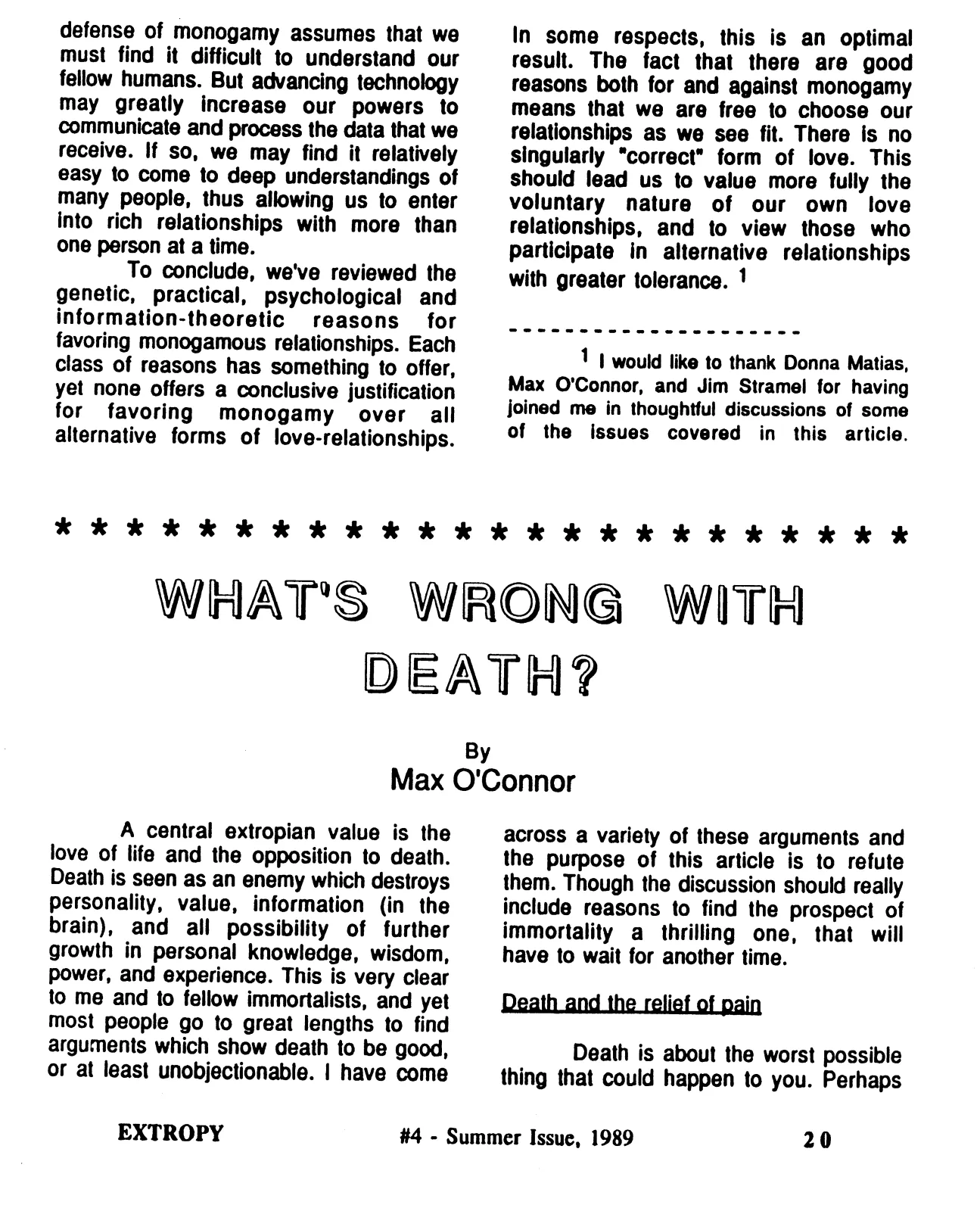
defense of monogamy assumes that we must find it difficult to understand our fellow humans. But advancing technology may greatly increase our powers to communicate and process the data that we receive. If so, we may find it relatively easy to come to deep understandings of many people, thus allowing us to enter into rich relationships with more than one person at a time.
To conclude, we’ve reviewed the genetic, practical, psychological and information-theoretic reasons for favoring monogamous relationships. Each class of reasons has something to offer, yet none offers a conclusive justification for favoring monogamy over all alternative forms of love-relationships.
In some respects, this is an optimal result. The fact that there are good reasons both for and against monogamy means that we are free to choose our relationships as we see fit. There is no singularly ‘correct’ form of love. This should lead us to value more fully the voluntary nature of our own love relationships, and to view those who participate in alternative relationships with greater tolerance. 1
1 I would like to thank Donna Matias, Max O’Connor, and Jim Stramel for having joined me in thoughtful discussions of some of the issues covered in this article.
WHAT’S WRONG WITH DEATH?
Max O’Connor
A central extropian value is the love of life and the opposition to death. Death is seen as an enemy which destroys personality, value, information (in the brain), and all possibility of further growth in personal knowledge, wisdom, power, and experience. This is very clear to me and to fellow immortalists, and yet most people go to great lengths to find arguments which show death to be good, or at least unobjectionable. I have come across a variety of these arguments and the purpose of this article is to refute them. Though the discussion should really include reasons to find the prospect of immortality a thrilling one, that will have to wait for another time.
Death and the relief of pain
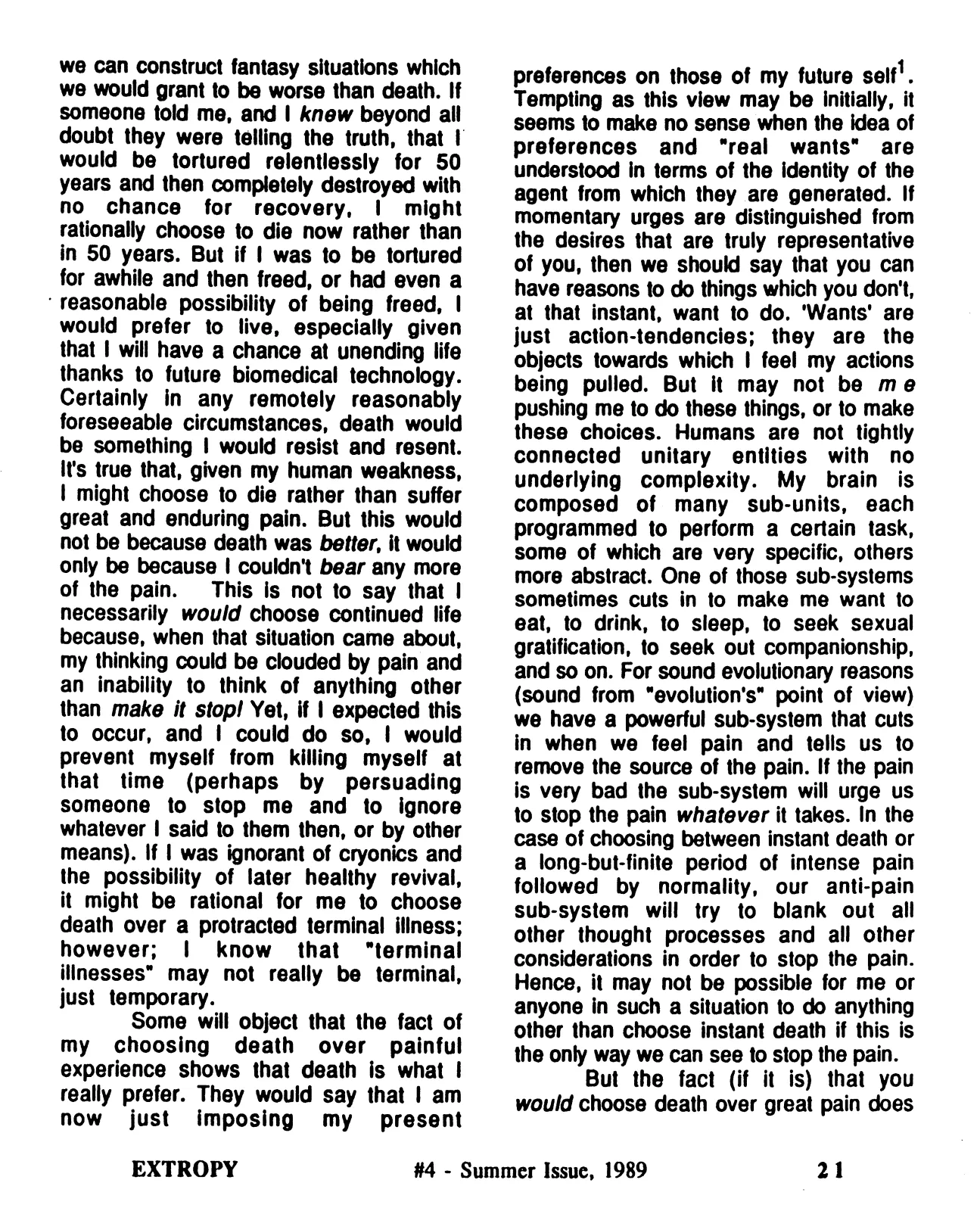
Death is about the worst possible thing that could happen to you. Perhaps we can construct fantasy situations which we would grant to be worse than death. If someone told me, and I knew beyond all doubt they were telling the truth, that I would be tortured relentlessly for 50 years and then completely destroyed with no chance for recovery, I might rationally choose to die now rather than in 50 years. But if I was to be tortured for awhile and then freed, or had even a reasonable possibility of being freed, I would prefer to live, especially given that I will have a chance at unending life thanks to future biomedical technology. Certainly in any remotely reasonably foreseeable circumstances, death would be something I would resist and resent. It’s true that, given my human weakness, I might choose to die rather than suffer great and enduring pain. But this would not be because death was better, it would only be because I couldn’t bear any more of the pain. This is not to say that I necessarily would choose continued life because, when that situation came about, my thinking could be clouded by pain and an inability to think of anything other than make it stop! Yet, if I expected this to occur, and I could do so, I would prevent myself from killing myself at that time (perhaps by persuading someone to stop me and to ignore whatever I said to them then, or by other means). If I was ignorant of cryonics and the possibility of later healthy revival, it might be rational for me to choose death over a protracted terminal illness; however; I know that ‘terminal illnesses’ may not really be terminal, just temporary.
Some will object that the fact of my choosing death over painful experience shows that death is what I really prefer. They would say that I am now just imposing my present preferences on those of my future self¹. Tempting as this view may be initially, it seems to make no sense when the idea of preferences and ‘real wants’ are understood in terms of the identity of the agent from which they are generated. If momentary urges are distinguished from the desires that are truly representative of you, then we should say that you can have reasons to do things which you don’t, at that instant, want to do. ‘Wants’ are just action-tendencies; they are the objects towards which I feel my actions being pulled. But it may not be me pushing me to do these things, or to make these choices. Humans are not tightly connected unitary entities with no underlying complexity. My brain is composed of many sub-units, each programmed to perform a certain task, some of which are very specific, others more abstract. One of those sub-systems sometimes cuts in to make me want to eat, to drink, to sleep, to seek sexual gratification, to seek out companionship, and so on. For sound evolutionary reasons (sound from ‘evolution’s’ point of view) we have a powerful sub-system that cuts in when we feel pain and tells us to remove the source of the pain. If the pain is very bad the sub-system will urge us to stop the pain whatever it takes. In the case of choosing between instant death or a long-but-finite period of intense pain followed by normality, our anti-pain sub-system will try to blank out all other thought processes and all other considerations in order to stop the pain. Hence, it may not be possible for me or anyone in such a situation to do anything other than choose instant death if this is the only way we can see to stop the pain.
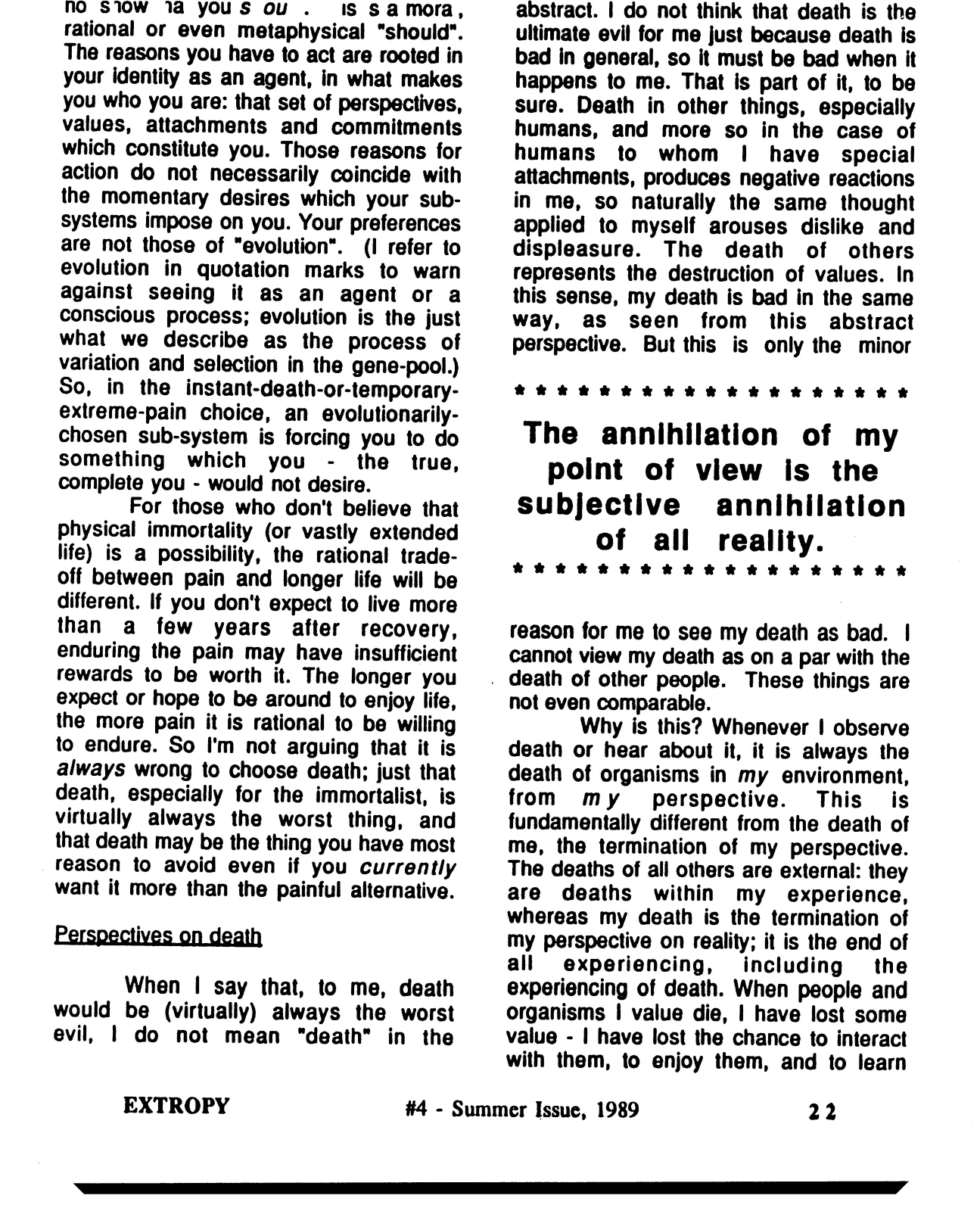
But the fact (if it is) that you would choose death over great pain does no show ‘la you’s ou’. is a moral, rational or even metaphysical ‘should’. The reasons you have to act are rooted in your identity as an agent, in what makes you who you are: that set of perspectives, values, attachments and commitments which constitute you. Those reasons for action do not necessarily coincide with the momentary desires which your sub-systems impose on you. Your preferences are not those of ‘evolution’. (I refer to evolution in quotation marks to warn against seeing it as an agent or a conscious process; evolution is the just what we describe as the process of variation and selection in the gene-pool.) So, in the instant-death-or-temporary-extreme-pain choice, an evolutionarily-chosen sub-system is forcing you to do something which you - the true, complete you - would not desire.
For those who don’t believe that physical immortality (or vastly extended life) is a possibility, the rational trade-off between pain and longer life will be different. If you don’t expect to live more than a few years after recovery, enduring the pain may have insufficient rewards to be worth it. The longer you expect or hope to be around to enjoy life, the more pain it is rational to be willing to endure. So I’m not arguing that it is always wrong to choose death; just that death, especially for the immortalist, is virtually always the worst thing, and that death may be the thing you have most reason to avoid even if you currently want it more than the painful alternative.
Perspectives on death
When I say that, to me, death would be (virtually) always the worst evil, I do not mean ‘death’ in the abstract. I do not think that death is the ultimate evil for me just because death is bad in general, so it must be bad when it happens to me. That is part of it, to be sure. Death in other things, especially humans, and more so in the case of humans to whom I have special attachments, produces negative reactions in me, so naturally the same thought applied to myself arouses dislike and displeasure. The death of others represents the destruction of values. In this sense, my death is bad in the same way, as seen from this abstract perspective. But this is only the minor reason for me to see my death as bad. I cannot view my death as on a par with the death of other people. These things are not even comparable.
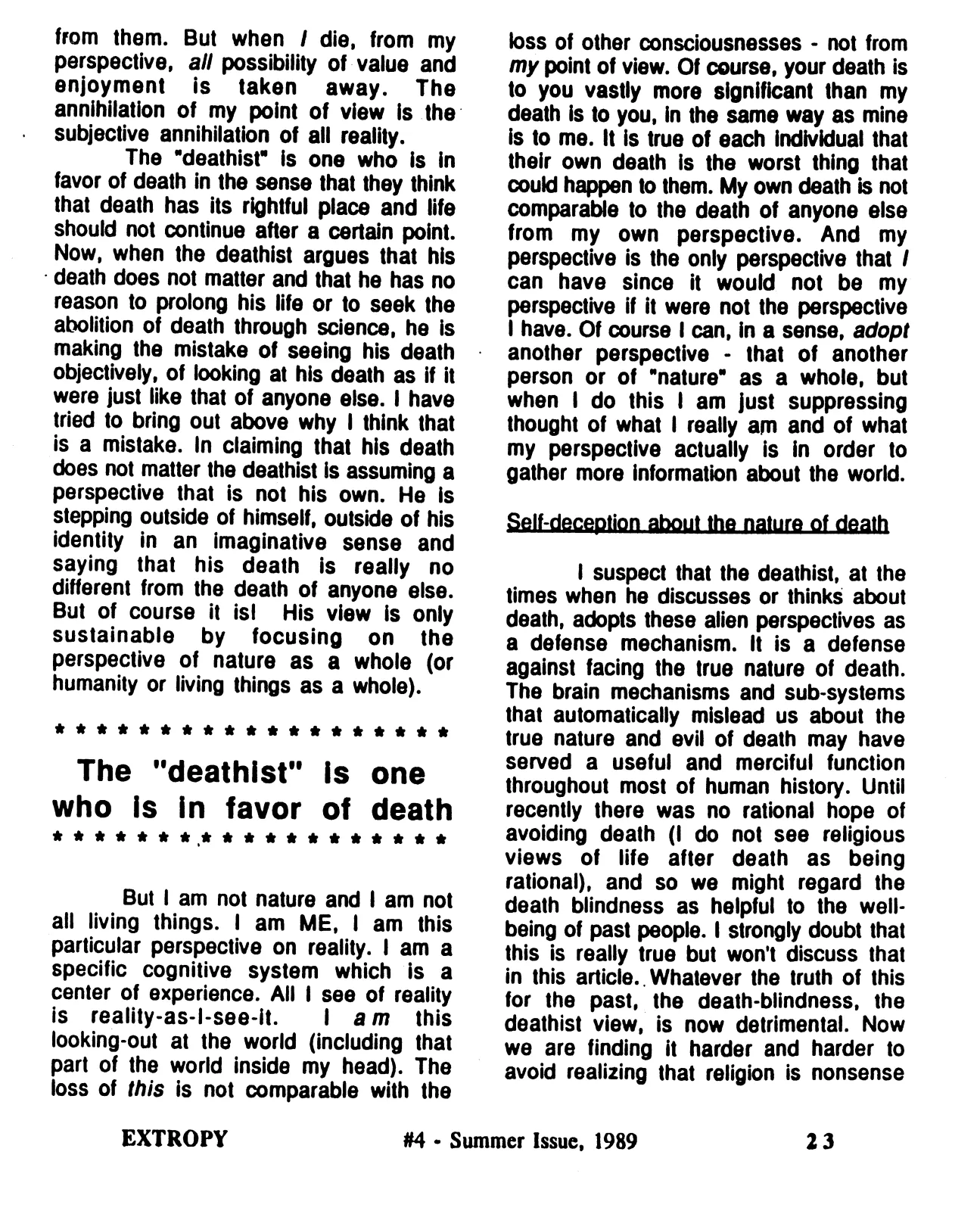
Why is this? Whenever I observe death or hear about it, it is always the death of organisms in my environment, from my perspective. This is fundamentally different from the death of me, the termination of my perspective. The deaths of all others are external: they are deaths within my experience, whereas my death is the termination of my perspective on reality; it is the end of all experiencing, including the experiencing of death. When people and organisms I value die, I have lost some value - I have lost the chance to interact with them, to enjoy them, and to learn from them. But when I die, from my perspective, all possibility of value and enjoyment is taken away. The annihilation of my point of view is the subjective annihilation of all reality.
The “deathist” is one who is in favor of death in the sense that they think that death has its rightful place and life should not continue after a certain point. Now, when the deathist argues that his death does not matter and that he has no reason to prolong his life or to seek the abolition of death through science, he is making the mistake of seeing his death objectively, of looking at his death as if it were just like that of anyone else. I have tried to bring out above why I think that is a mistake. In claiming that his death does not matter the deathist is assuming a perspective that is not his own. He is stepping outside of himself, outside of his identity in an imaginative sense and saying that his death is really no different from the death of anyone else. But of course it is! His view is only sustainable by focusing on the perspective of nature as a whole (or humanity or living things as a whole).
The “deathist” is one who is in favor of death
But I am not nature and I am not all living things. I am ME, I am this particular perspective on reality. I am a specific cognitive system which is a center of experience. All I see of reality is reality-as-I-see-it. I am this looking-out at the world (including that part of the world inside my head). The loss of this is not comparable with the loss of other consciousnesses - not from my point of view. Of course, your death is to you vastly more significant than my death is to you, in the same way as mine is to me. It is true of each individual that their own death is the worst thing that could happen to them. My own death is not comparable to the death of anyone else from my own perspective. And my perspective is the only perspective that I can have since it would not be my perspective if it were not the perspective I have. Of course I can, in a sense, adopt another perspective - that of another person or of “nature” as a whole, but when I do this I am just suppressing thought of what I really am and of what my perspective actually is in order to gather more information about the world.
Self-deception about the nature of death
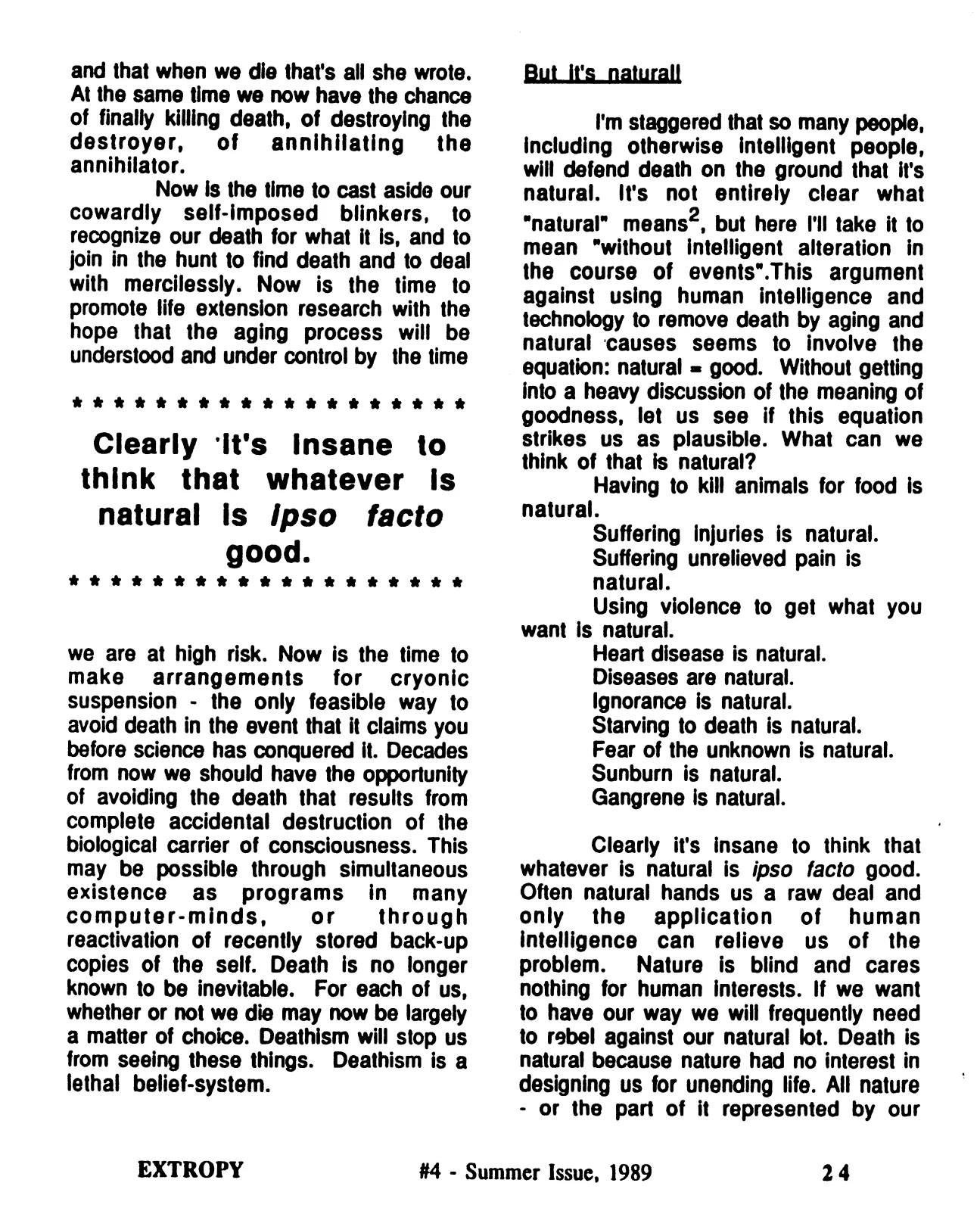
I suspect that the deathist, at the times when he discusses or thinks about death, adopts these alien perspectives as a defense mechanism. It is a defense against facing the true nature of death. The brain mechanisms and sub-systems that automatically mislead us about the true nature and evil of death may have served a useful and merciful function throughout most of human history. Until recently there was no rational hope of avoiding death (I do not see religious views of life after death as being rational), and so we might regard the death blindness as helpful to the well-being of past people. I strongly doubt that this is really true but won’t discuss that in this article. Whatever the truth of this for the past, the death-blindness, the deathist view, is now detrimental. Now we are finding it harder and harder to avoid realizing that religion is nonsense and that when we die that’s all she wrote. At the same time we now have the chance of finally killing death, of destroying the destroyer, of annihilating the annihilator.
Now is the time to cast aside our cowardly self-imposed blinkers, to recognize our death for what it is, and to join in the hunt to find death and to deal with mercilessly. Now is the time to promote life extension research with the hope that the aging process will be understood and under control by the time we are at high risk. Now is the time to make arrangements for cryonic suspension - the only feasible way to avoid death in the event that it claims you before science has conquered it. Decades from now we should have the opportunity of avoiding the death that results from complete accidental destruction of the biological carrier of consciousness. This may be possible through simultaneous existence as programs in many computer-minds, or through reactivation of recently stored back-up copies of the self. Death is no longer known to be inevitable. For each of us, whether or not we die may now be largely a matter of choice. Deathism will stop us from seeing these things. Deathism is a lethal belief-system.
But it’s natural!
I’m staggered that so many people, including otherwise intelligent people, will defend death on the ground that it’s natural. It’s not entirely clear what ‘natural’ means², but here I’ll take it to mean ‘without intelligent alteration in the course of events’. This argument against using human intelligence and technology to remove death by aging and natural causes seems to involve the equation: natural = good. Without getting into a heavy discussion of the meaning of goodness, let us see if this equation strikes us as plausible. What can we think of that is natural?
Having to kill animals for food is natural.
Suffering injuries is natural.
Suffering unrelieved pain is natural.
Using violence to get what you want is natural.
Heart disease is natural.
Diseases are natural.
Ignorance is natural.
Starving to death is natural.
Fear of the unknown is natural.
Sunburn is natural.
Gangrene is natural.
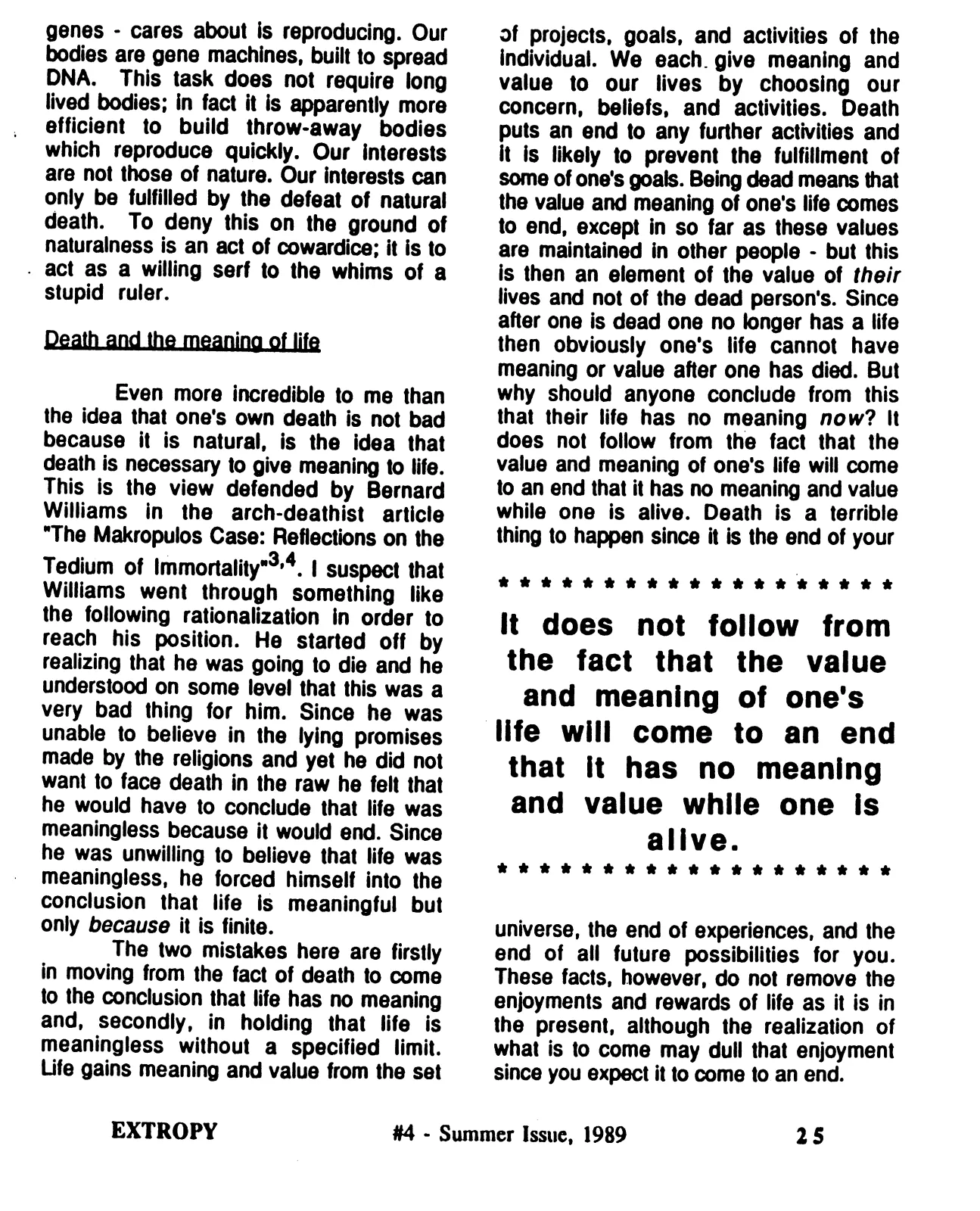
Clearly it’s insane to think that whatever is natural is ipso facto good. Often natural hands us a raw deal and only the application of human intelligence can relieve us of the problem. Nature is blind and cares nothing for human interests. If we want to have our way we will frequently need to rebel against our natural lot. Death is natural because nature had no interest in designing us for unending life. All nature - or the part of it represented by our genes - cares about is reproducing. Our bodies are gene machines, built to spread DNA. This task does not require long lived bodies; in fact it is apparently more efficient to build throw-away bodies which reproduce quickly. Our interests are not those of nature. Our interests can only be fulfilled by the defeat of natural death. To deny this on the ground of naturalness is an act of cowardice; it is to act as a willing serf to the whims of a stupid ruler.
Death and the meaning of life
Even more incredible to me than the idea that one’s own death is not bad because it is natural, is the idea that death is necessary to give meaning to life. This is the view defended by Bernard Williams in the arch-deathist article ‘The Makropulos Case: Reflections on the Tedium of Immortality’³,⁴. I suspect that Williams went through something like the following rationalization in order to reach his position. He started off by realizing that he was going to die and he understood on some level that this was a very bad thing for him. Since he was unable to believe in the lying promises made by the religions and yet he did not want to face death in the raw he felt that he would have to conclude that life was meaningless because it would end. Since he was unwilling to believe that life was meaningless, he forced himself into the conclusion that life is meaningful but only because it is finite.
The two mistakes here are firstly in moving from the fact of death to come to the conclusion that life has no meaning and, secondly, in holding that life is meaningless without a specified limit. Life gains meaning and value from the set of projects, goals, and activities of the individual. We each give meaning and value to our lives by choosing our concern, beliefs, and activities. Death puts an end to any further activities and it is likely to prevent the fulfillment of some of one’s goals. Being dead means that the value and meaning of one’s life comes to end, except in so far as these values are maintained in other people - but this is then an element of the value of their lives and not of the dead person’s. Since after one is dead one no longer has a life then obviously one’s life cannot have meaning or value after one has died. But why should anyone conclude from this that their life has no meaning now? It does not follow from the fact that the value and meaning of one’s life will come to an end that it has no meaning and value while one is alive. Death is a terrible thing to happen since it is the end of your universe, the end of experiences, and the end of all future possibilities for you. These facts, however, do not remove the enjoyments and rewards of life as it is in the present, although the realization of what is to come may dull that enjoyment since you expect it to come to an end.
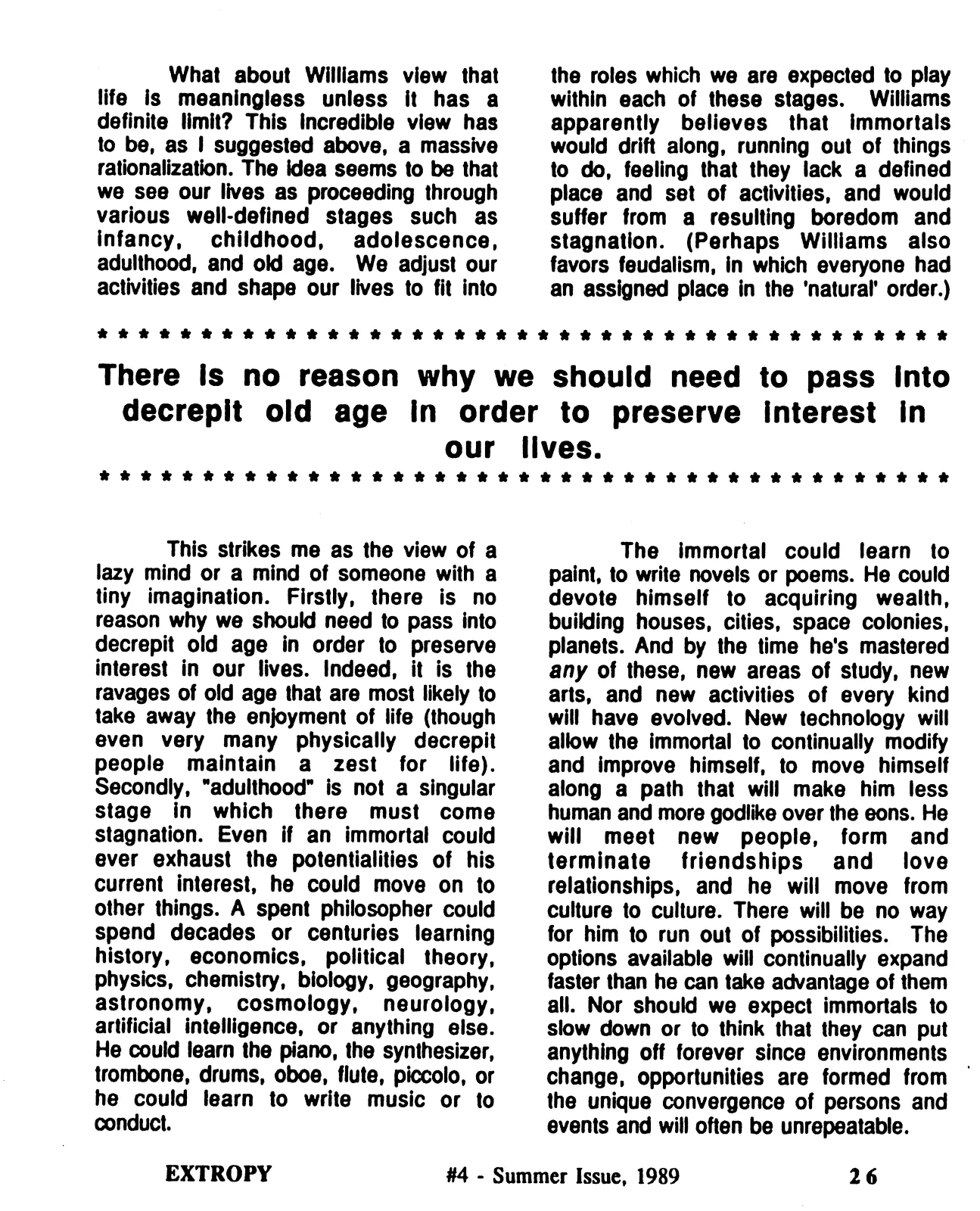
What about Williams view that life is meaningless unless it has a definite limit? This incredible view has to be, as I suggested above, a massive rationalization. The idea seems to be that we see our lives as proceeding through various well-defined stages such as infancy, childhood, adolescence, adulthood, and old age. We adjust our activities and shape our lives to fit into the roles which we are expected to play within each of these stages. Williams apparently believes that immortals would drift along, running out of things to do, feeling that they lack a defined place and set of activities, and would suffer from a resulting boredom and stagnation. (Perhaps Williams also favors feudalism, in which everyone had an assigned place in the ‘natural’ order.)
There is no reason why we should need to pass into decrepit old age in order to preserve interest in our lives.
This strikes me as the view of a lazy mind or a mind of someone with a tiny imagination. Firstly, there is no reason why we should need to pass into decrepit old age in order to preserve interest in our lives. Indeed, it is the ravages of old age that are most likely to take away the enjoyment of life (though even very many physically decrepit people maintain a zest for life). Secondly, “adulthood” is not a singular stage in which there must come stagnation. Even if an immortal could ever exhaust the potentialities of his current interest, he could move on to other things. A spent philosopher could spend decades or centuries learning history, economics, political theory, physics, chemistry, biology, geography, astronomy, cosmology, neurology, artificial intelligence, or anything else. He could learn the piano, the synthesizer, trombone, drums, oboe, flute, piccolo, or he could learn to write music or to conduct.
The immortal could learn to paint, to write novels or poems. He could devote himself to acquiring wealth, building houses, cities, space colonies, planets. And by the time he’s mastered any of these, new areas of study, new arts, and new activities of every kind will have evolved. New technology will allow the immortal to continually modify and improve himself, to move himself along a path that will make him less human and more godlike over the eons. He will meet new people, form and terminate friendships and love relationships, and he will move from culture to culture. There will be no way for him to run out of possibilities. The options available will continually expand faster than he can take advantage of them all. Nor should we expect immortals to slow down or to think that they can put anything off forever since environments change, opportunities are formed from the unique convergence of persons and events and will often be unrepeatable.
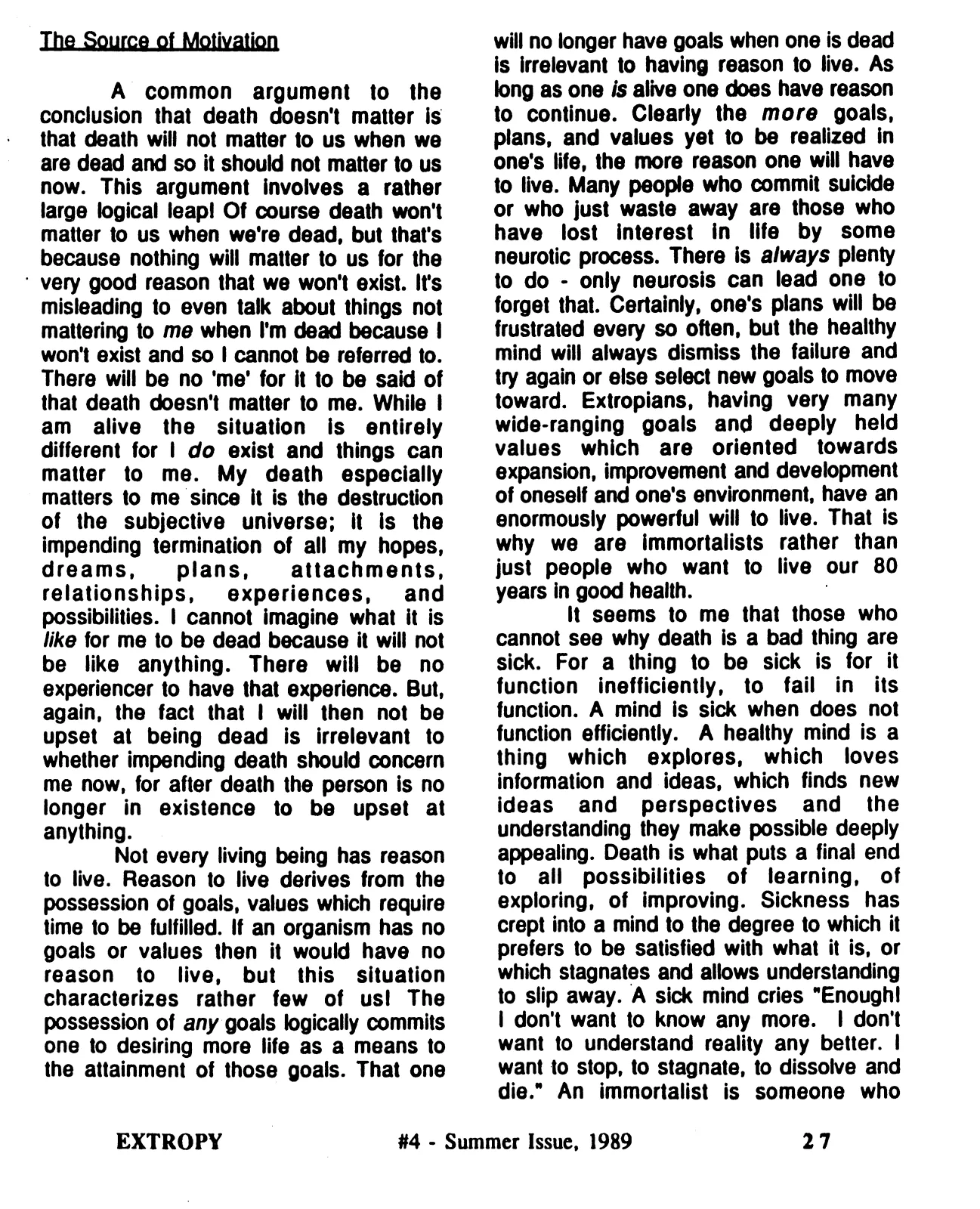
The Source of Motivation
A common argument to the conclusion that death doesn’t matter is that death will not matter to us when we are dead and so it should not matter to us now. This argument involves a rather large logical leap! Of course death won’t matter to us when we’re dead, but that’s because nothing will matter to us for the very good reason that we won’t exist. It’s misleading to even talk about things not mattering to me when I’m dead because I won’t exist and so I cannot be referred to. There will be no ‘me’ for it to be said of that death doesn’t matter to me. While I am alive the situation is entirely different for I do exist and things can matter to me. My death especially matters to me since it is the destruction of the subjective universe; it is the impending termination of all my hopes, dreams, plans, attachments, relationships, experiences, and possibilities. I cannot imagine what it is like for me to be dead because it will not be like anything. There will be no experiencer to have that experience. But, again, the fact that I will then not be upset at being dead is irrelevant to whether impending death should concern me now, for after death the person is no longer in existence to be upset at anything.
Not every living being has reason to live. Reason to live derives from the possession of goals, values which require time to be fulfilled. If an organism has no goals or values then it would have no reason to live, but this situation characterizes rather few of us! The possession of any goals logically commits one to desiring more life as a means to the attainment of those goals. That one will no longer have goals when one is dead is irrelevant to having reason to live. As long as one is alive one does have reason to continue. Clearly the more goals, plans, and values yet to be realized in one’s life, the more reason one will have to live. Many people who commit suicide or who just waste away are those who have lost interest in life by some neurotic process. There is always plenty to do - only neurosis can lead one to forget that. Certainly, one’s plans will be frustrated every so often, but the healthy mind will always dismiss the failure and try again or else select new goals to move toward. Extropians, having very many wide-ranging goals and deeply held values which are oriented towards expansion, improvement and development of oneself and one’s environment, have an enormously powerful will to live. That is why we are immortalists rather than just people who want to live our 80 years in good health.
It seems to me that those who cannot see why death is a bad thing are sick. For a thing to be sick is for it function inefficiently, to fail in its function. A mind is sick when does not function efficiently. A healthy mind is a thing which explores, which loves information and ideas, which finds new ideas and perspectives and the understanding they make possible deeply appealing. Death is what puts a final end to all possibilities of learning, of exploring, of improving. Sickness has crept into a mind to the degree to which it prefers to be satisfied with what it is, or which stagnates and allows understanding to slip away. A sick mind cries ‘Enough! I don’t want to know any more. I don’t want to understand reality any better. I want to stop, to stagnate, to dissolve and die.’ An immortalist is someone who understands that physical death is the end of existence as far as he or she is concerned. The immortalist loves the process of living and learning and so regards death as the ultimate enemy who has to be avoided or hunted down and exterminated by protecting against all possible causes of destruction of the self.
I hope to have dispelled some confusions surrounding the nature of death and to have shown that it is something about which we should be very concerned. If you were already in agreement with this view when you started, perhaps you will find that you’ve acquired additional insight into the deathists’ views and feel more equipped to pull them apart. Deathism threatens not only those who believe it but also those of us who are already immortalists. Deathism must be challenged and extirpated if we are to ensure our own survival. The more people who we can get to see the light, the more lives will be saved from the endless black pit of death.
Footnotes
¹See the excellent discussion in Derek Parfit, Reasons and Persons, (Oxford University Press, 1984).
²I intend to deal with the issue of natural/unnatural in the next issue, from a variety of angles. The ‘it’s not natural’ argument (if it can be called that) is used to promote entropy in many contexts.
³Bernard Williams, ‘The Makropulos Case: Reflections on the Tedium of Immortality’, in Problems of the Self, (Cambridge University Press, 1973).
⁴For a philosopher with a much healthier attitude, see Thomas Nagel, The Subjective View, (Oxford University Press, 1986), pp 223-231. Nagel says ‘…given the simple choice between living for another week and dying in five minutes I would always choose to live for another week; and by a version of mathematical induction I conclude that I would be glad to live forever. Perhaps I shall eventually tire of life, but at the moment I can’t imagine it, nor can I understand those many distinguished and otherwise reasonable persons who sincerely assert that they don’t regard their own mortality as a misfortune.’ Of Williams he asks, ‘Can it be that he is more easily bored than I?’.
VIEW ORIGINAL SCAN (9 pages)