Issue: EXTROPY #4 · Summer 1989
Author: Max T. O'Connor
Pages: 32–35 · 4 scanned pages
Postscript to 'Morality or Reality'
‘MORALITY OR REALITY’
Max O’Connor
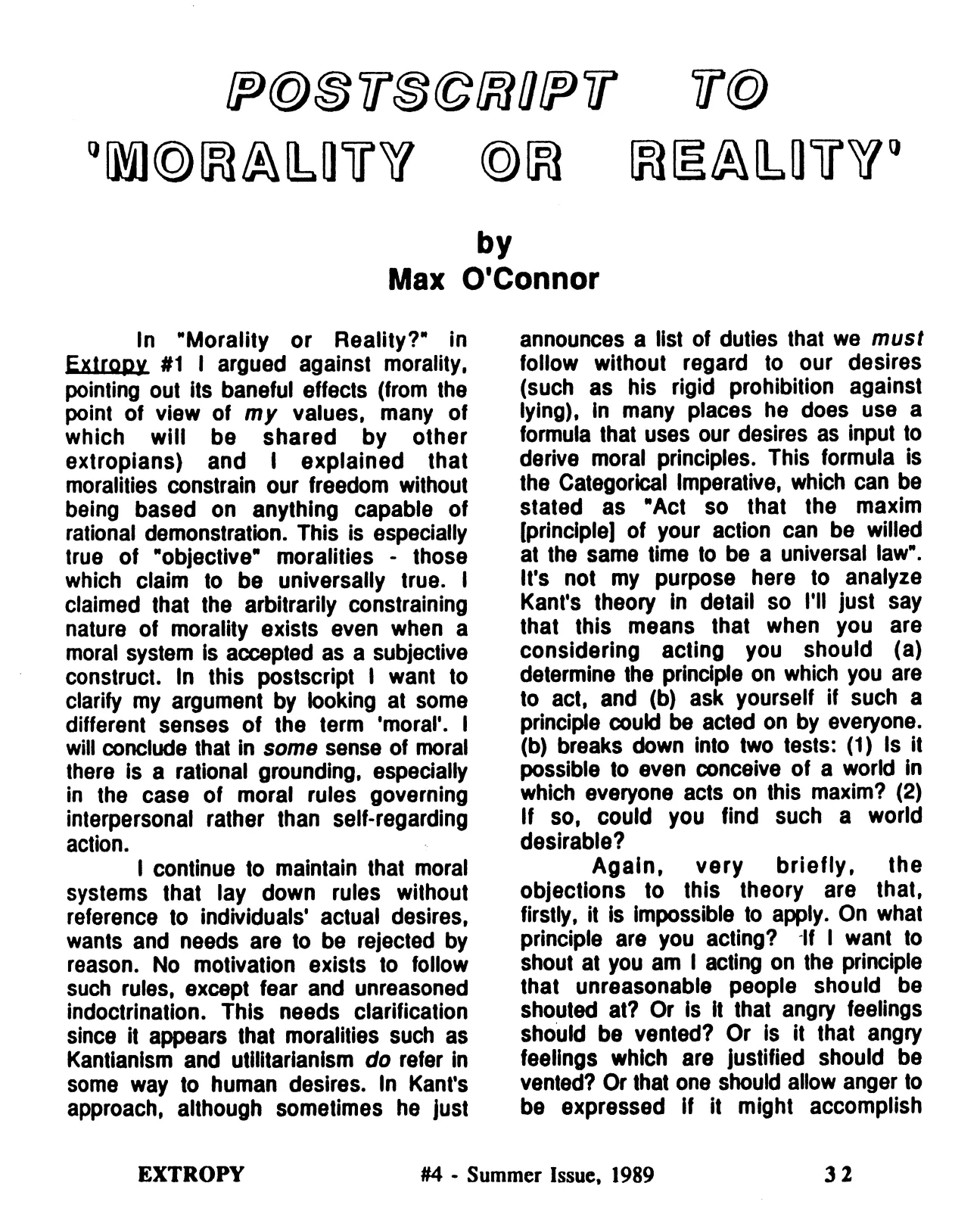
In ‘Morality or Reality?’ in Extropy #1 I argued against morality, pointing out its baneful effects (from the point of view of my values, many of which will be shared by other extropians) and I explained that moralities constrain our freedom without being based on anything capable of rational demonstration. This is especially true of ‘objective’ moralities - those which claim to be universally true. I claimed that the arbitrarily constraining nature of morality exists even when a moral system is accepted as a subjective construct. In this postscript I want to clarify my argument by looking at some different senses of the term ‘moral’. I will conclude that in some sense of moral there is a rational grounding, especially in the case of moral rules governing interpersonal rather than self-regarding action.
I continue to maintain that moral systems that lay down rules without reference to individuals’ actual desires, wants and needs are to be rejected by reason. No motivation exists to follow such rules, except fear and unreasoned indoctrination. This needs clarification since it appears that moralities such as Kantianism and utilitarianism do refer in some way to human desires. In Kant’s approach, although sometimes he just announces a list of duties that we must follow without regard to our desires (such as his rigid prohibition against lying), in many places he does use a formula that uses our desires as input to derive moral principles. This formula is the Categorical Imperative, which can be stated as ‘Act so that the maxim [principle] of your action can be willed at the same time to be a universal law’. It’s not my purpose here to analyze Kant’s theory in detail so I’ll just say that this means that when you are considering acting you should (a) determine the principle on which you are to act, and (b) ask yourself if such a principle could be acted on by everyone. (b) breaks down into two tests: (1) Is it possible to even conceive of a world in which everyone acts on this maxim? (2) If so, could you find such a world desirable?
Again, very briefly, the objections to this theory are that, firstly, it is impossible to apply. On what principle are you acting? If I want to shout at you am I acting on the principle that unreasonable people should be shouted at? Or is it that angry feelings should be vented? Or is it that angry feelings which are justified should be vented? Or that one should allow anger to be expressed if it might accomplish something useful? Or that one should be spontaneous? A indefinite number of principles are compatible with the action, so it seems that Kant’s theory provides no guidance. Secondly, why should I universalize my principle? Most people are not in my situation. Many of those who are will have a different set of preferences and desires; why should I expect them to act like me? What is the relevance, even if I could establish the effects, of the fact that I wouldn’t like the result if everyone acted this way in similar situations? Others won’t act the same way since they are not me.
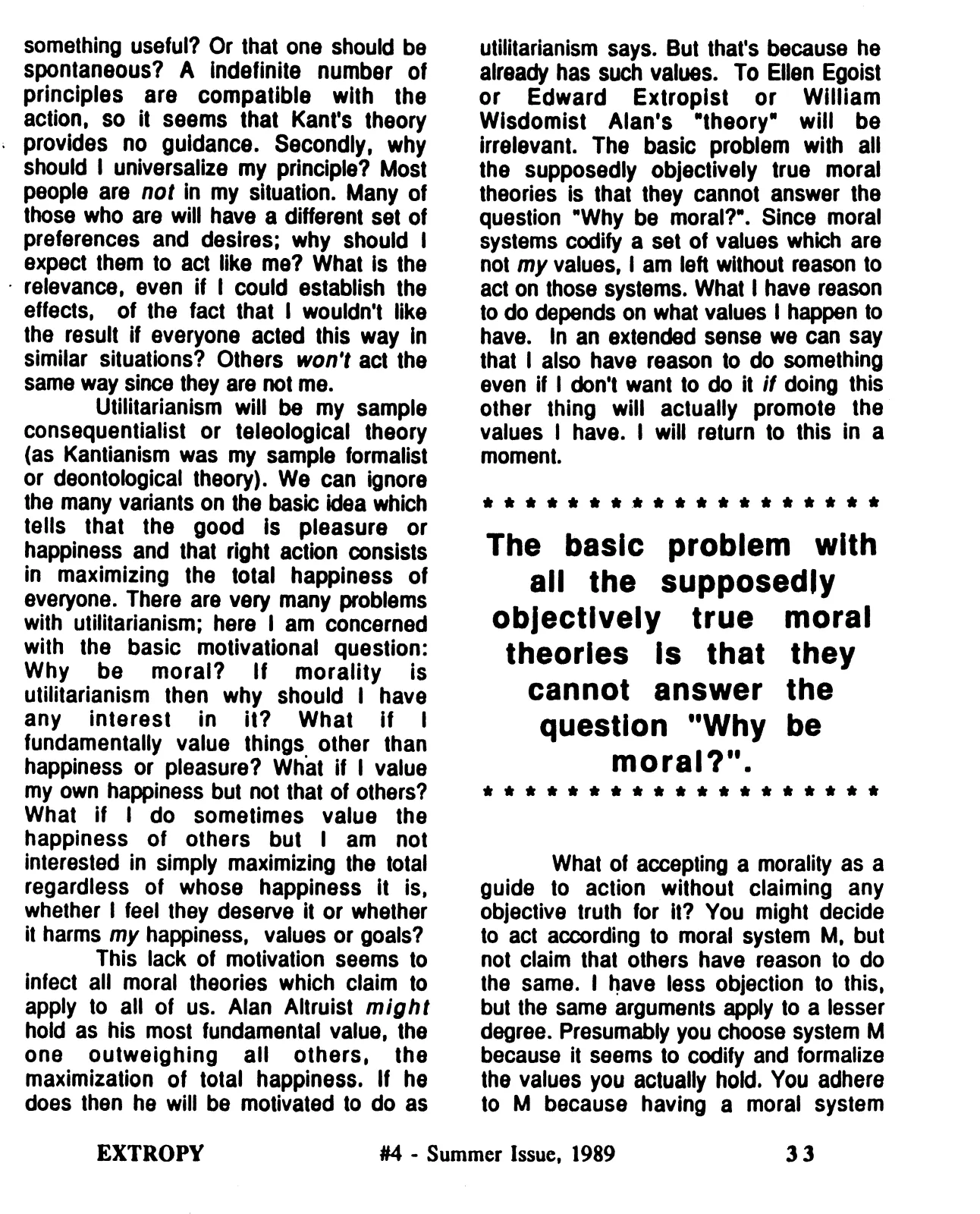
Utilitarianism will be my sample consequentialist or teleological theory (as Kantianism was my sample formalist or deontological theory). We can ignore the many variants on the basic idea which tells that the good is pleasure or happiness and that right action consists in maximizing the total happiness of everyone. There are very many problems with utilitarianism; here I am concerned with the basic motivational question: Why be moral? If morality is utilitarianism then why should I have any interest in it? What if I fundamentally value things other than happiness or pleasure? What if I value my own happiness but not that of others? What if I do sometimes value the happiness of others but I am not interested in simply maximizing the total regardless of whose happiness it is, whether I feel they deserve it or whether it harms my happiness, values or goals?
This lack of motivation seems to infect all moral theories which claim to apply to all of us. Alan Altruist might hold as his most fundamental value, the one outweighing all others, the maximization of total happiness. If he does then he will be motivated to do as utilitarianism says. But that’s because he already has such values. To Ellen Egoist or Edward Extropist or William Wisdomist Alan’s ‘theory’ will be irrelevant. The basic problem with all the supposedly objectively true moral theories is that they cannot answer the question ‘Why be moral?’. Since moral systems codify a set of values which are not my values, I am left without reason to act on those systems. What I have reason to do depends on what values I happen to have. In an extended sense we can say that I also have reason to do something even if I don’t want to do it if doing this other thing will actually promote the values I have. I will return to this in a moment.
What of accepting a morality as a guide to action without claiming any objective truth for it? You might decide to act according to moral system M, but not claim that others have reason to do the same. I have less objection to this, but the same arguments apply to a lesser degree. Presumably you choose system M because it seems to codify and formalize the values you actually hold. You adhere to M because having a moral system makes it easier to remember what action you should take, given the values you have, on occasions when you have insufficient time to deliberate. But if you really sees M as a system then as your values change, as they inevitably will, M will push you into doing things that it is no longer rational to do. Again, by ‘rational’ I must mean the action which will best promote your values, whatever they are.
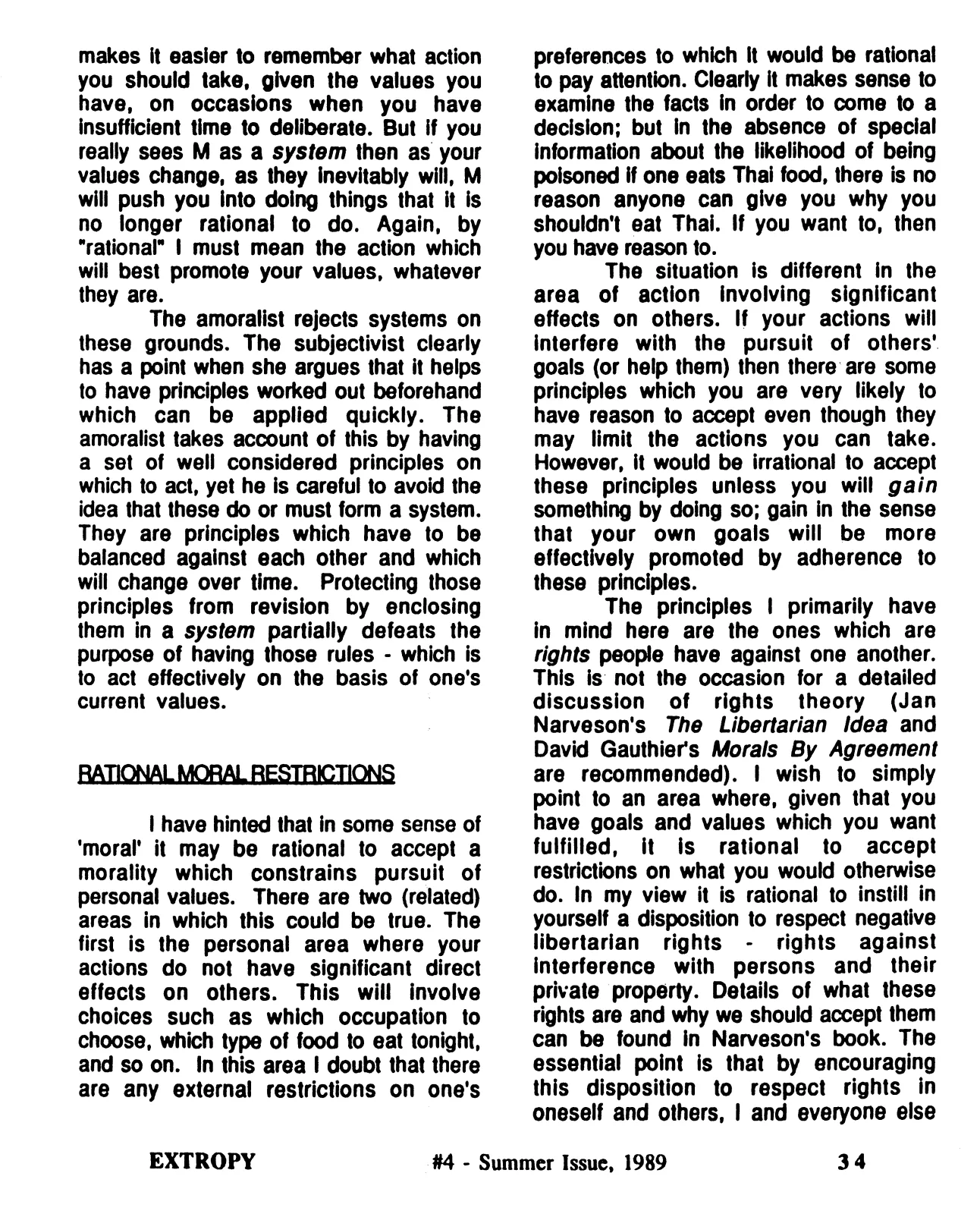
The amoralist rejects systems on these grounds. The subjectivist clearly has a point when she argues that it helps to have principles worked out beforehand which can be applied quickly. The amoralist takes account of this by having a set of well considered principles on which to act, yet he is careful to avoid the idea that these do or must form a system. They are principles which have to be balanced against each other and which will change over time. Protecting those principles from revision by enclosing them in a system partially defeats the purpose of having those rules - which is to act effectively on the basis of one’s current values.
RATIONAL MORAL RESTRICTIONS
I have hinted that in some sense of ‘moral’ it may be rational to accept a morality which constrains pursuit of personal values. There are two (related) areas in which this could be true. The first is the personal area where your actions do not have significant direct effects on others. This will involve choices such as which occupation to choose, which type of food to eat tonight, and so on. In this area I doubt that there are any external restrictions on one’s preferences to which it would be rational to pay attention. Clearly it makes sense to examine the facts in order to come to a decision; but in the absence of special information about the likelihood of being poisoned if one eats Thai food, there is no reason anyone can give you why you shouldn’t eat Thai. If you want to, then you have reason to.
The situation is different in the area of action involving significant effects on others. If your actions will interfere with the pursuit of others’ goals (or help them) then there are some principles which you are very likely to have reason to accept even though they may limit the actions you can take. However, it would be irrational to accept these principles unless you will gain something by doing so; gain in the sense that your own goals will be more effectively promoted by adherence to these principles.
The principles I primarily have in mind here are the ones which are rights people have against one another. This is not the occasion for a detailed discussion of rights theory (Jan Narveson’s The Libertarian Idea and David Gauthier’s Morals By Agreement are recommended). I wish to simply point to an area where, given that you have goals and values which you want fulfilled, it is rational to accept restrictions on what you would otherwise do. In my view it is rational to instill in yourself a disposition to respect negative libertarian rights - rights against interference with persons and their private property. Details of what these rights are and why we should accept them can be found in Narveson’s book. The essential point is that by encouraging this disposition to respect rights in oneself and others, I and everyone else will better achieve our goals. We will increase our overall freedom to pursue our values and to live our lives as we wish. If a society of people exists in which they have justified confidence that they can deal with people with little or no fear of physical assault, theft or fraud, then each person can save the resources that must otherwise go into protection against these likely contingencies and would be able to reap large gains from cooperation. Not all these principles will have the status of rights (which are enforceable claims). A disposition to keep promises or to be honest may be things that are rational even though you had no prior desire for them.
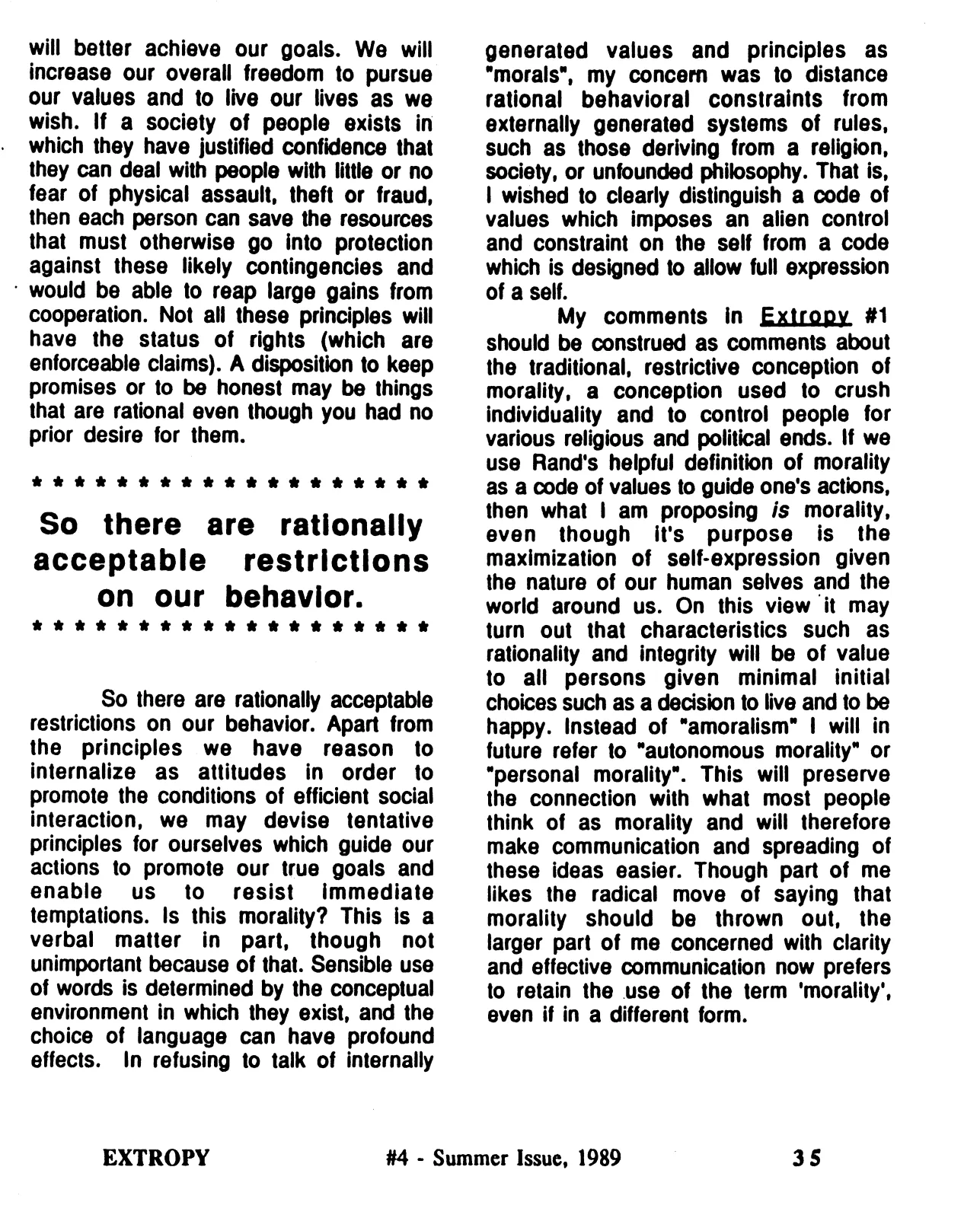
So there are rationally acceptable restrictions on our behavior. Apart from the principles we have reason to internalize as attitudes in order to promote the conditions of efficient social interaction, we may devise tentative principles for ourselves which guide our actions to promote our true goals and enable us to resist immediate temptations. Is this morality? This is a verbal matter in part, though not unimportant because of that. Sensible use of words is determined by the conceptual environment in which they exist, and the choice of language can have profound effects. In refusing to talk of internally generated values and principles as ‘morals’, my concern was to distance rational behavioral constraints from externally generated systems of rules, such as those deriving from a religion, society, or unfounded philosophy. That is, I wished to clearly distinguish a code of values which imposes an alien control and constraint on the self from a code which is designed to allow full expression of a self.
My comments in Extropy #1 should be construed as comments about the traditional, restrictive conception of morality, a conception used to crush individuality and to control people for various religious and political ends. If we use Rand’s helpful definition of morality as a code of values to guide one’s actions, then what I am proposing is morality, even though it’s purpose is the maximization of self-expression given the nature of our human selves and the world around us. On this view it may turn out that characteristics such as rationality and integrity will be of value to all persons given minimal initial choices such as a decision to live and to be happy. Instead of ‘amoralism’ I will in future refer to ‘autonomous morality’ or ‘personal morality’. This will preserve the connection with what most people think of as morality and will therefore make communication and spreading of these ideas easier. Though part of me likes the radical move of saying that morality should be thrown out, the larger part of me concerned with clarity and effective communication now prefers to retain the use of the term ‘morality’, even if in a different form.
VIEW ORIGINAL SCAN (4 pages)