Issue: EXTROPY #4 · Summer 1989
Author: Tom W. Bell
Pages: 36–40 · 5 scanned pages
Efficient Aesthetics
Efficient
Aesthetics
by Tom W. Bell
Beauty! We long to experience it, to create it, to become it. We lust beauty. How can we satisfy this lust? That’s a question for aesthetics, the study of the nature of beauty. By revealing beauty’s underlying principles, aesthetics will show us how to bring more joy, grace, and wonder to our lives.
The Scope of Our Enquiry
Because we have a practical interest in aesthetics, I’ll be discussing a particular sort of beauty: the beauty we find in the presentation of works of art.
We must limit the scope of our investigation because the principles of aesthetics apply to all of the many things we call “beautiful”: the clear night sky, a woman’s lines, Van Gogh’s “Sunflowers”, … Humans have the power to consciously create only some of these beautiful things, however: those which we call “works of art”. Art is artifact. It is not natural; it comes only from human culture. Since we’re interested in learning how to make our lives more beautiful, then, I’ll limit the current discussion to the aesthetics of art.
I’ll limit the discussion in another respect, as well. Art can be beautiful thanks to either its content or its means of presentation. Consider Constable’s “Country Lane”: we might call it beautiful because we love country scenes, or because we admire his skill in rendering the shadows of an impending storm. It is only the latter sort of beauty that I’ll discuss here. While beauty-as-content plays a large role in most people’s aesthetic evaluations, it depends too heavily on subjective values to admit an objective investigation. I know of atheists, for example, who look upon Michelangelo’s “Creation of Adam” as an ugly bit of Christian propaganda.
The beauty of an artwork’s presentation, on the other hand, concerns art per se, independent of its content. We can evaluate this sort of beauty somewhat more objectively, allowing us to find the universal aesthetic principles we seek.
Keep in mind, then, that when I speak of “beauty” in what follows, I mean the beauty of the presentation of works of art.
A Hypothetical Definition of Beauty
Art is a means of transmitting information.
Be they painters, musicians, dancers, or otherwise, artists aim to communicate their ideas to an audience.
They are skilled technicians who observe the world, both internal and external, and convey their experiences to us. This description by no means discounts the importance of creativity, however. To the contrary, it takes great imagination to choose the most effective means of conveying information. One might argue, in fact, that art’s most imaginative leaps have been those that have carried it from old to new modes of expression — consider the introduction of pointillism, cubism, atonality, or constructivism.
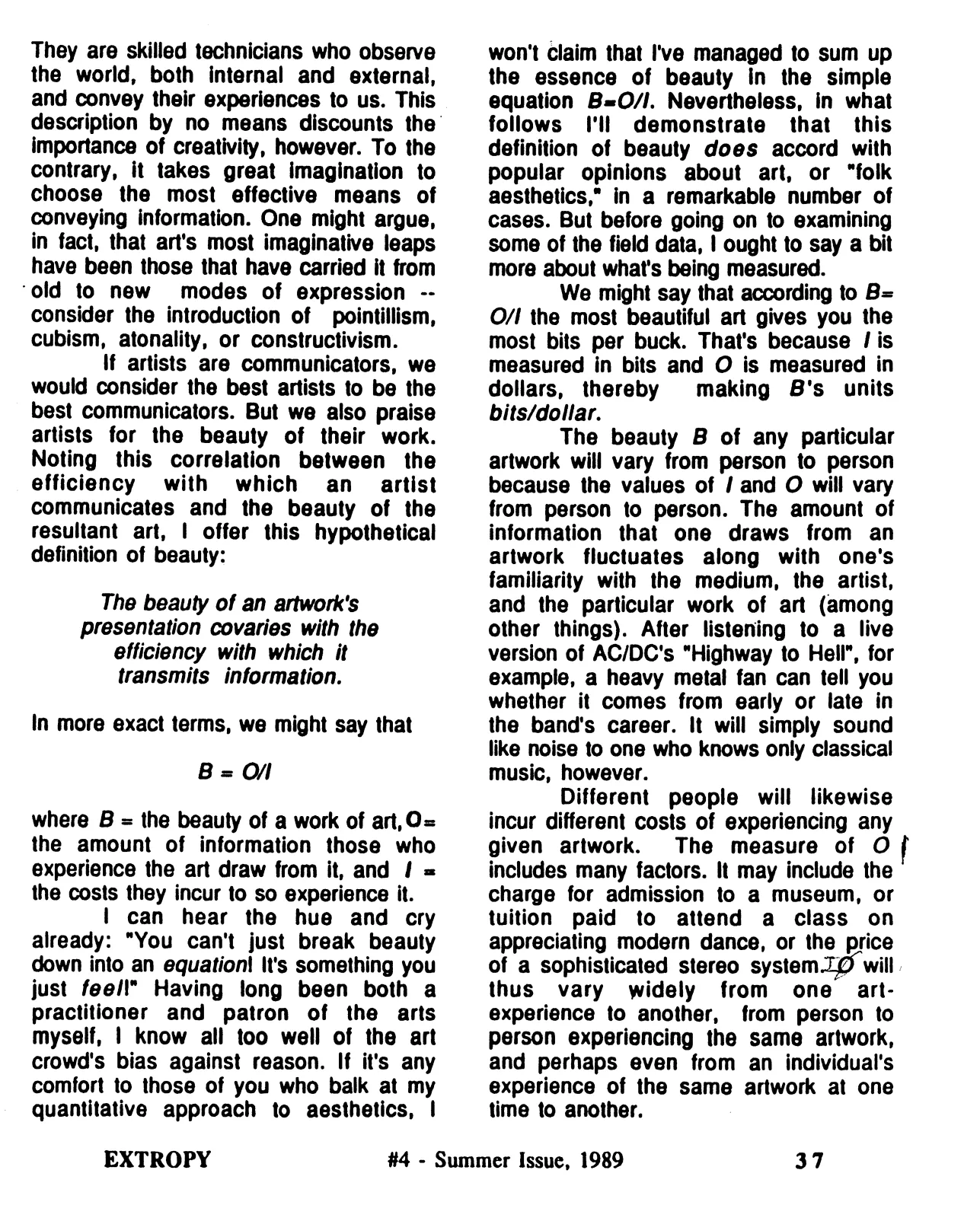
If artists are communicators, we would consider the best artists to be the best communicators. But we also praise artists for the beauty of their work. Noting this correlation between the efficiency with which an artist communicates and the beauty of the resultant art, I offer this hypothetical definition of beauty:
The beauty of an artwork’s presentation covaries with the efficiency with which it transmits information.
In more exact terms, we might say that
I can hear the hue and cry already: ‘You can’t just break beauty down into an equation! It’s something you just feel!’ Having long been both a practitioner and patron of the arts myself, I know all too well of the art crowd’s bias against reason. If it’s any comfort to those of you who balk at my quantitative approach to aesthetics, I won’t claim that I’ve managed to sum up the essence of beauty in the simple equation $B=O/I$. Nevertheless, in what follows I’ll demonstrate that this definition of beauty does accord with popular opinions about art, or ‘folk aesthetics,’ in a remarkable number of cases. But before going on to examining some of the field data, I ought to say a bit more about what’s being measured.
We might say that according to $B=O/I$ the most beautiful art gives you the most bits per buck. That’s because I is measured in bits and O is measured in dollars, thereby making B’s units bits/dollar.
The beauty B of any particular artwork will vary from person to person because the values of I and O will vary from person to person. The amount of information that one draws from an artwork fluctuates along with one’s familiarity with the medium, the artist, and the particular work of art (among other things). After listening to a live version of AC/DC’s ‘Highway to Hell’, for example, a heavy metal fan can tell you whether it comes from early or late in the band’s career. It will simply sound like noise to one who knows only classical music, however.
Different people will likewise incur different costs of experiencing any given artwork. The measure of O includes many factors. It may include the charge for admission to a museum, or tuition paid to attend a class on appreciating modern dance, or the price of a sophisticated stereo system. I will thus vary widely from one art-experience to another, from person to person experiencing the same artwork, and perhaps even from an individual’s experience of the same artwork at one time to another.
The fact that the B of an artwork varies widely across different people and times does not mean that beauty is subjective — it means only that beauty is instance-specific. Given enough knowledge of the workings of the human brain and the economics of art appreciation, we could calculate the exact value of B for any person’s experience of any artwork at any time. We would not have to depend on a subjective claim like, ‘Yeah, it was a jammin’ concert.’
In the following applications of the B=O/I formula, I’ll be ignoring individual and temporal variations in the value of B, instead imagining that we have calculated B for each instance the artwork has been observed and taken an average of these figures. With this in mind, then, let’s see how well B=O/I fits our commonsense aesthetic evaluations.
Confirming Evidence
This information-theoretic definition of beauty agrees with widely-held aesthetic judgements in a remarkable number of cases. In a very general sense, this can hardly help but be true. The successful transmission of information is at least a necessary condition for beautiful art — how could you appreciate beautiful music without hearing it, or a beautiful painting without seeing it? But the correlation between efficiency of information transfer and beauty runs much deeper than this.
If B=O/I holds true, then we would expect that as artists condensed more information into their art their artwork would be judged more beautiful (all else being equal). And this indeed seems to be the case. Consider the popularity of finely detailed art like the
‘The Book of Hours,’ or of miniature such as Tiffany eggs, or of Arabic horror vacui architecture.
Intellectuals tend to favor another means of increasing the information density of art: ‘multiple encoding’. Artists multiple encode by loading a single symbol with more than one meaning — thus the viewer gets two (or more) references for the price of one. Consider the value placed on ‘heavy’ art, that is, art with deep symbolic import. Magritte’s paintings provide a good example: technically speaking they’re rather primitive, and their subjects aren’t particularly attractive (men in bowlers? fish with legs?!). Nonetheless, we appreciate Magritte’s work because it symbolically conveys a feast of ideas. Or consider Swift’s Gulliver’s Travels. Most people know it as simply a fine tale, but it is esteemed as art because it hides subtle political satire.
We see multiple encoding at work in much of Shakespeare’s writing, as well. He’s infamous for his punning. He even makes puns about puns! Referring both to the etymological derivation of ‘pun’ from ‘hammer’, and the merciless oneupmanship of highbrow wordplay, he has Theristes, in Trollius and Cressida, say ‘He would pun thee into shivers with his fist.’ Shakespeare knew that a good pun helps to load in more meanings per reference: ‘I moralize two meanings in one word.’ he explains through Richard III.
In addition to dense-packing information, artists can increase the beauty of their art by making it easier to recall. Originally, poets wrote their rhymes in verse for just this reason; before the written word, a bard had only his memory to rely on, and a good rhyme could ease his task. To a lesser degree, non-rhyming metered verse accomplishes the same thing. That’s why Shakespeare wrote in iambic pentameter: it helped his actors to remember their lines. Rhymes and rhythms increase art’s O/I ratio by ensuring that it will be reproduced and re-experienced. For the cost of listening to well written verse a few times, we can freely recall it, again and again, to enjoy at our leisure.
Musicians especially favor increasing the beauty of their art by making it easier to remember. Pop artists search for the best ‘hook’: that little bit of a tune that sticks in your head, the part you can’t stop humming. Great classical music has the same effect — who can’t recall the opening bars of Beethoven’s ‘Symphony Number 5 in C Minor’? This is meme engineering at its best! One exposure and you’re infected, becoming a carrier of ‘Bum Bum Bum Bummmmm,’ singing it aloud and infecting others. Clearly, such efficient music maximizes O/I.
What does a good musician communicate so efficiently? The abstract nature of music precludes a specific message. Good music captures the state of mind of its composer. By expertly expressing what she feels when she composes music, a musician can let us share her thoughts. She’ll write memetically efficient music when she records her most pleasant thoughts — those are ones we’re most willing to experience ourselves. But sometimes humans feel sad, or reflective, or angry. Musicians have written beautiful music for these moods, as well — beautiful because we empathize with it, we understand it.
The Theory’s Explanatory Power
A good theory not only jibes with the field data, it solves old puzzles. Consider how this theory of ‘efficient aesthetics’ accounts for abstract art.
Abstract art remains a mystery to most people. They can’t understand what it is supposed to mean. They don’t see its beauty. The more they study abstract art, the less they see.
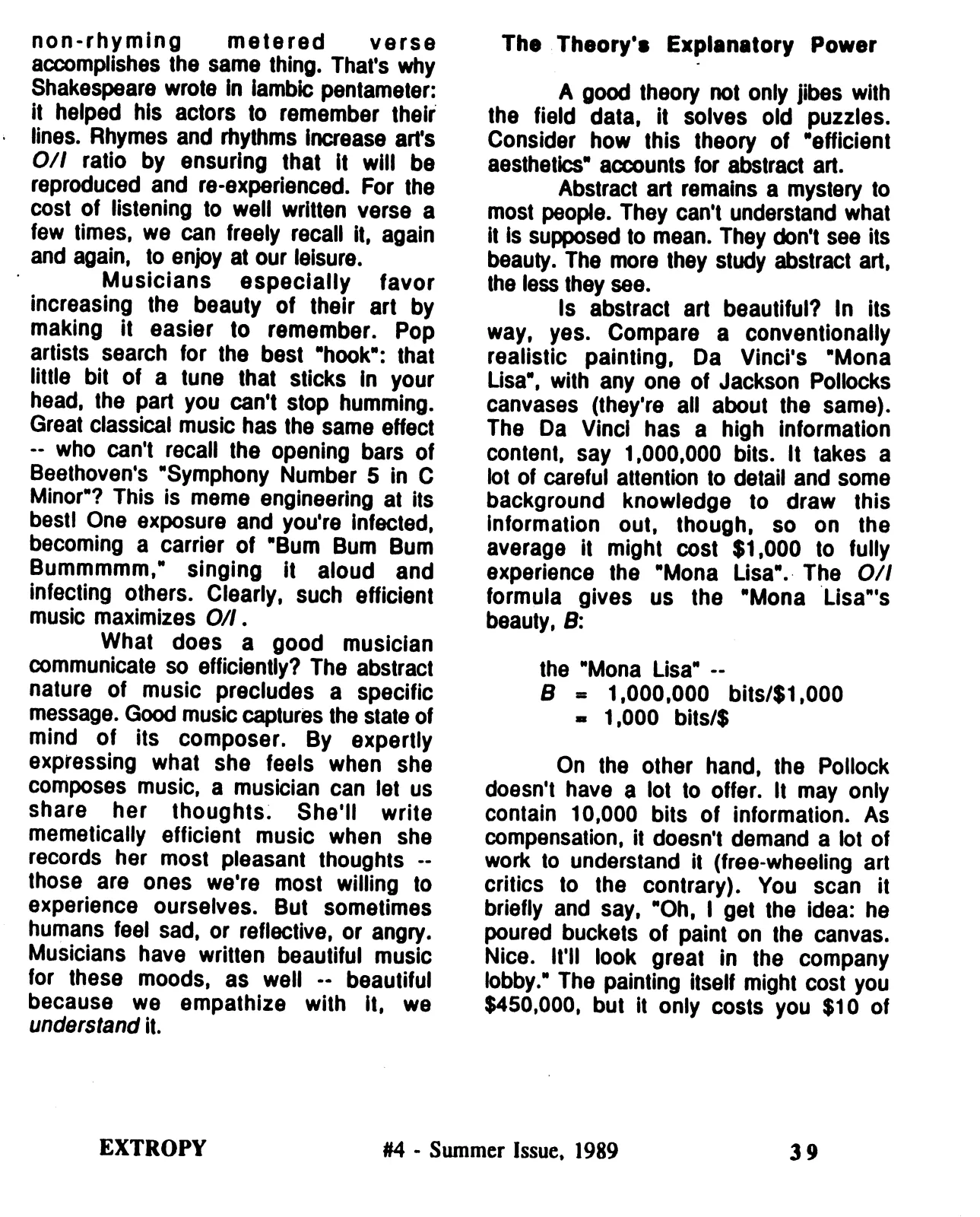
Is abstract art beautiful? In its way, yes. Compare a conventionally realistic painting, Da Vinci’s ‘Mona Lisa’, with any one of Jackson Pollocks canvases (they’re all about the same). The Da Vinci has a high information content, say 1,000,000 bits. It takes a lot of careful attention to detail and some background knowledge to draw this information out, though, so on the average it might cost $1,000 to fully experience the ‘Mona Lisa’. The O/I formula gives us the ‘Mona Lisa’s beauty, B:
the ‘Mona Lisa’ —
B = 1,000,000 bits / $1,000
= 1,000 bits / $
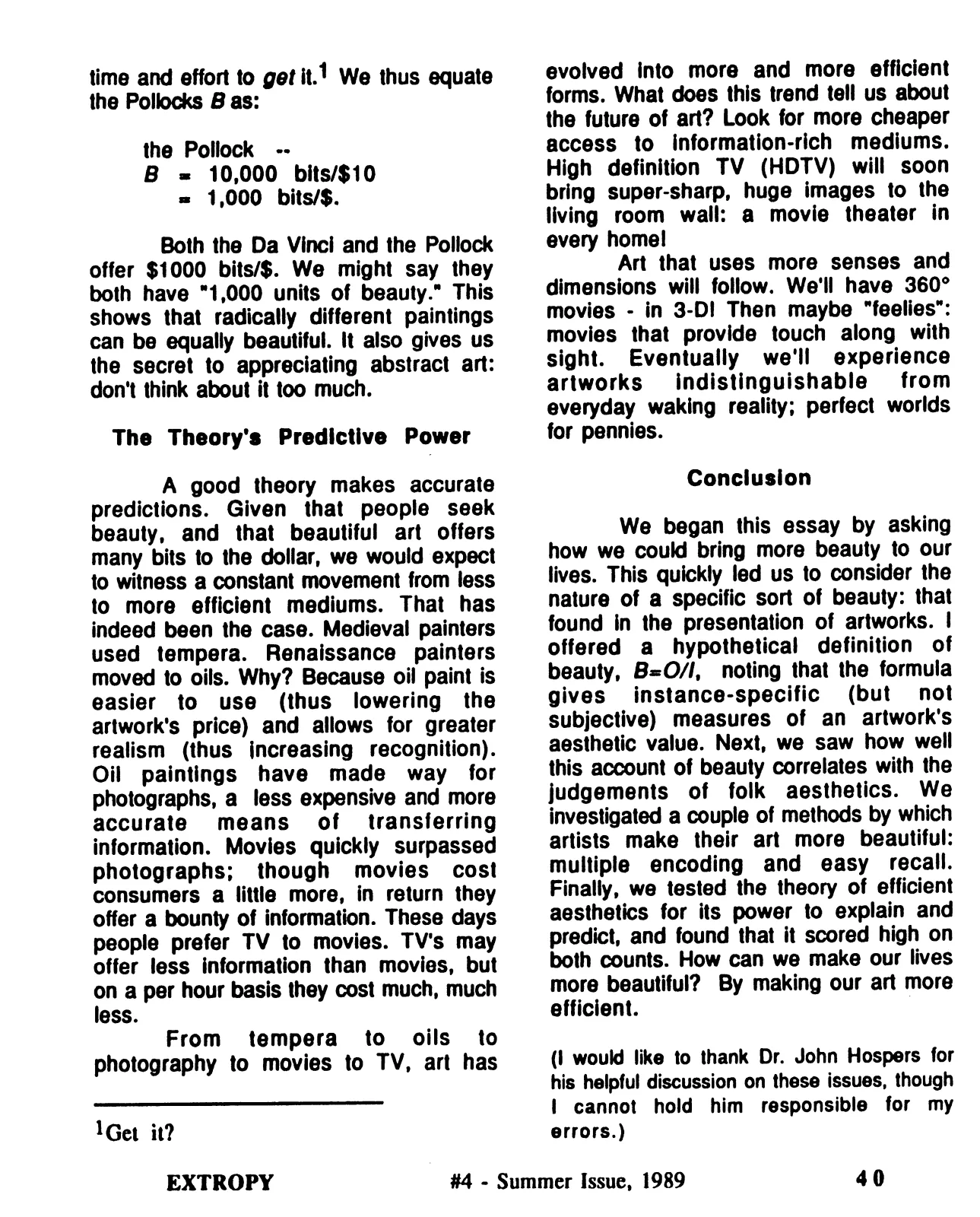
On the other hand, the Pollock doesn’t have a lot to offer. It may only contain 10,000 bits of information. As compensation, it doesn’t demand a lot of work to understand it (free-wheeling art critics to the contrary). You scan it briefly and say, ‘Oh, I get the idea: he poured buckets of paint on the canvas. Nice. It’ll look great in the company lobby.’ The painting itself might cost you $450,000, but it only costs you $10 of time and effort to get it.¹ We thus equate the Pollocks B as:
the Pollock —
B = 10,000 bits/$10
= 1,000 bits/$.
Both the Da Vinci and the Pollock offer $1000 bits/$. We might say they both have ‘1,000 units of beauty.’ This shows that radically different paintings can be equally beautiful. It also gives us the secret to appreciating abstract art: don’t think about it too much.
The Theory’s Predictive Power
A good theory makes accurate predictions. Given that people seek beauty, and that beautiful art offers many bits to the dollar, we would expect to witness a constant movement from less to more efficient mediums. That has indeed been the case. Medieval painters used tempera. Renaissance painters moved to oils. Why? Because oil paint is easier to use (thus lowering the artwork’s price) and allows for greater realism (thus increasing recognition). Oil paintings have made way for photographs, a less expensive and more accurate means of transferring information. Movies quickly surpassed photographs; though movies cost consumers a little more, in return they offer a bounty of information. These days people prefer TV to movies. TV’s may offer less information than movies, but on a per hour basis they cost much, much less.
From tempera to oils to photography to movies to TV, art has evolved into more and more efficient forms. What does this trend tell us about the future of art? Look for more cheaper access to information-rich mediums. High definition TV (HDTV) will soon bring super-sharp, huge images to the living room wall: a movie theater in every home!
Art that uses more senses and dimensions will follow. We’ll have 360° movies - in 3-D! Then maybe ‘feelies’: movies that provide touch along with sight. Eventually we’ll experience artworks indistinguishable from everyday waking reality; perfect worlds for pennies.
Conclusion
We began this essay by asking how we could bring more beauty to our lives. This quickly led us to consider the nature of a specific sort of beauty: that found in the presentation of artworks. I offered a hypothetical definition of beauty, B=O/I, noting that the formula gives instance-specific (but not subjective) measures of an artwork’s aesthetic value. Next, we saw how well this account of beauty correlates with the judgements of folk aesthetics. We investigated a couple of methods by which artists make their art more beautiful: multiple encoding and easy recall. Finally, we tested the theory of efficient aesthetics for its power to explain and predict, and found that it scored high on both counts. How can we make our lives more beautiful? By making our art more efficient.
(I would like to thank Dr. John Hospers for his helpful discussion on these issues, though I cannot hold him responsible for my errors.)
¹Get it?
VIEW ORIGINAL SCAN (5 pages)