Issue: EXTROPY #17 · Second Half 1996
Author: Ralph Merkle
Pages: 43–44 · 2 scanned pages
The Fourth Foresight Conference on Molecular Nanotechnology
The Fourth Foresight Conference on Molecular Nanotechnology,
held in November of 1995, now exists in the memories of those who attended and on the web at http://nano.xerox.com/nanotech/nano4.html.
by Ralph Merkle
Nanotechnology is moving onto the WWW, and the Foresight conferences are no exception. Abstracts for the talks are available from the conference page, and many of the papers related to the talks themselves are already on the web. We’re still collecting talks in digital form and putting them on the web as this is being written, and going through the refereeing process for publication in the special conference issue of Nanotechnology (which itself is moving onto the web).
One thing we’ve always been concerned about was the ability of attendees models of structures from Nanosystems on the web, courtesy of Construct. Would you like to spin a Stewart platform around and look at it from different angles? Get a VRML-equipped browser, go to the conference page, and look for the VRML demo item. Not many people have used VRML yet, but its growth is expected to be meteoritic—a boon to nanotechnologists who want to describe complex three dimensional structures.
Stoddart to network with each other. This time, we’ve put the attendees names, affiliations and e-mail addresses on the web; linked from the conference page. Conference talks are available both in audio tape and video tape and—yep, you guessed it—ordering information is available from the conference page. The concepts involved in molecular manufacturing often involve complex three dimensional shapes—and we’ve now got a few VRML
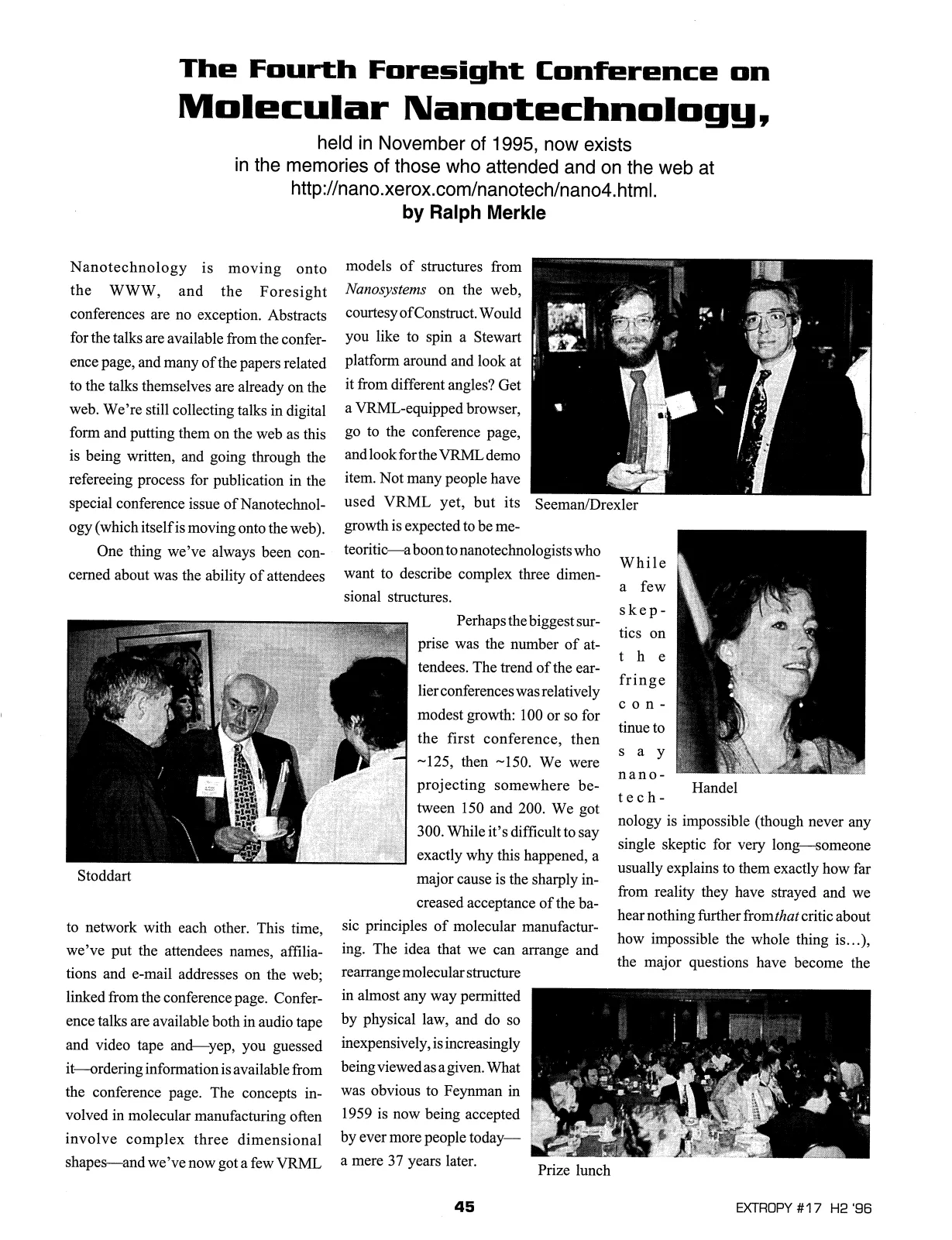
Perhaps the biggest surprise was the number of attendees. The trend of the earlier conferences was relatively modest growth: 100 or so for the first conference, then ~125, then ~150. We were projecting somewhere between 150 and 200. We got 300. While it’s difficult to say exactly why this happened, a major cause is the sharply increased acceptance of the basic principles of molecular manufacturing. The idea that we can arrange and rearrange molecular structure in almost any way permitted by physical law, and do so inexpensively, is increasingly being viewed as a given. What was obvious to Feynman in 1959 is now being accepted by ever more people today—a mere 37 years later.
Seeman/Drexler
While a few skep- tics on the fringe con- tinue to say nano- tech-
Handel nology is impossible (though never any single skeptic for very long—someone usually explains to them exactly how far from reality they have strayed and we hear nothing further from that critic about how impossible the whole thing is…), the major questions have become the
Prize lunch
Smalley fused about positional control—the idea of actually holding a molecule is somehow taboo to some chemists—but this confusion is breaking down under the combined influence of both theoretical and experi-
Goddard obvious: how do we do it? How long will it take? What approach should we pursue?
Self assembly? Scanning probe microscopy? AFM? STM? Theoretical work?
Experimental work? Computational modeling? While there is a tendency for specialists to assume that their own field is, of course, the most important, it’s really quite difficult to say which approaches will be fastest and which fields are the most critical. Right now, the answer is “All these fields are important.”
Stephanie
That isn’t to say that there isn’t a great deal of confusion and misunderstanding floating around. There is. The most coherent and well thought out proposals for molecular manufacturing—indeed, the only coherent and well thought out proposals for molecular manufacturing—are based on the proposals by Drexler. And in all of those proposals, positional control and self replication play an important role.
Researchers involved with chemistry, supra-molecular chemistry and self-assembly are still sometimes con-mental work that shows quite clearly that this is feasible. (Interestingly, the computational chemists seem to be least inhibited in their exploration of positional control. Perhaps this is because a computational chemist can model a positionally controlled reaction with the same or even greater ease than modeling molecules banging around at random).
The STM and AFM researchers have no problem with the idea of positional control — they view it as obvious and often can’t see how any other approach could even be considered! But these artificial self-replicating systems… Maybe designing such systems is just too complex, too hard, and, well, maybe mere humans just weren’t
Seeman meant to do it. No matter that the entire planet is covered with self-replicating systems—they don’t count! After all, the artificial self-replicating systems being proposed are different. Very non-biological. Very mechanical. Involving positional devices. Robotic arms grabbing molecules, synthesizing that ultimately non-biological stuff: diamond! How can we possibly argue that such artificial self-replicating systems are feasible just because the biological kind of systems exist?
Strictly speaking, we can’t. The fact that a duck can fly is not, after all, proof that a 747 will be able to fly. Which is what makes the literature on artificial self-replicating systems (dating back to von Neumann in the 1940’s) of such interest. Again, little by little, the obvious feasibility of self-replicating systems in general and the more recent work—mostly theoretical this time—showing that artificial self-replicating systems designed for manufacturing present no design challenges beyond our current design abilities, is slowly being accepted.
The picture that emerges is one of continued but gradually decreasing confusion. Which is, after all, what research is all about.
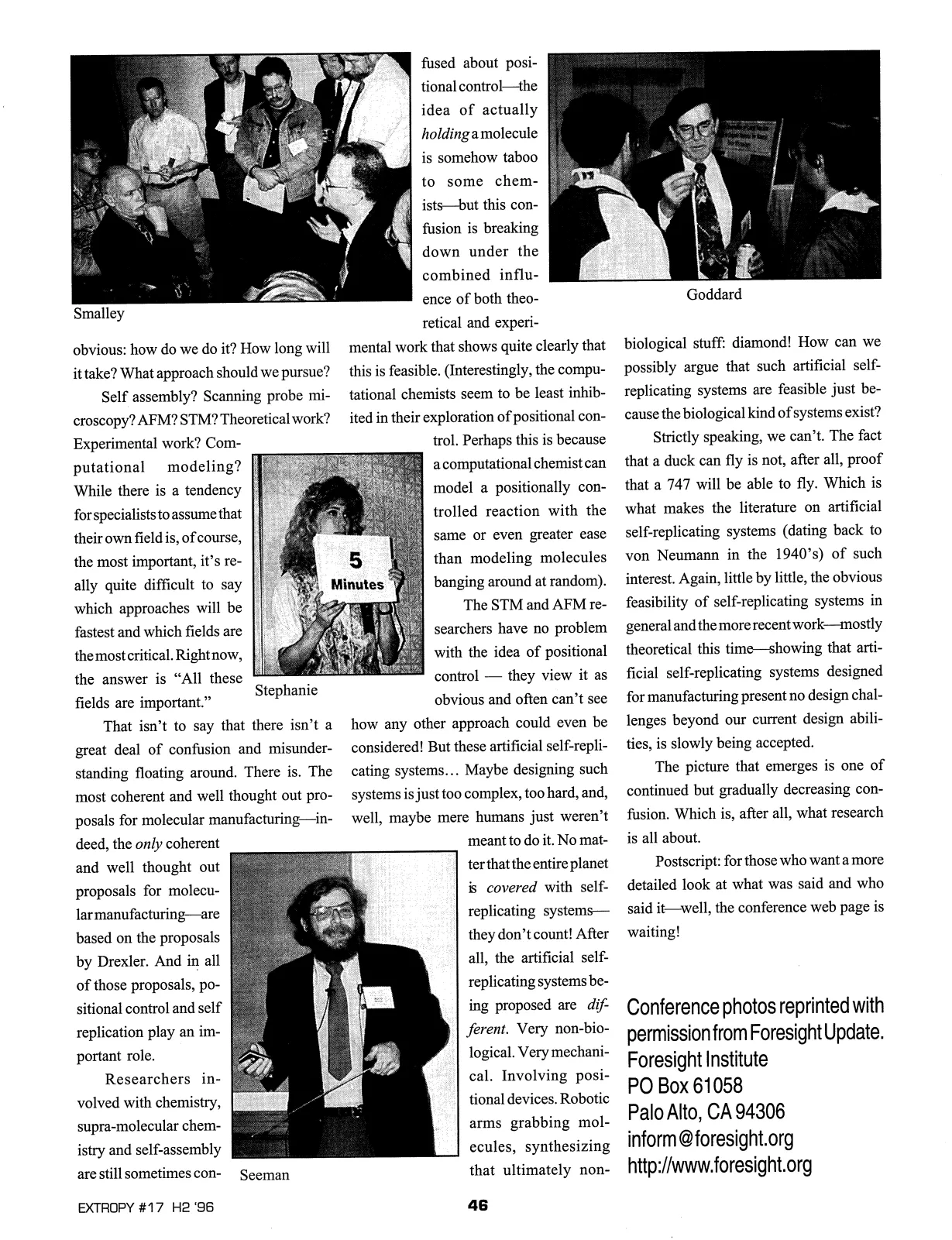
Postscript: for those who want a more detailed look at what was said and who said it—well, the conference web page is waiting!
Conference photos reprinted with permission from Foresight Update.
Foresight Institute
PO Box 61058
Palo Alto, CA 94306 inform@foresight.org http://www.foresight.org
VIEW ORIGINAL SCAN (2 pages)