Issue: EXTROPY #16 · First Quarter 1996
Author: The Editors
Pages: 37–38 · 2 scanned pages
Extropy Institute Update & Extropian Principles v2.5
Extropy Institute (ExI) was incorporated in 1992 as an educational, tax-exempt organization. Like the Extropians e-mail list, ExI was an outgrowth of Extropy (founded in 1988 by Max More and Tom Morrow). We created ExI in order to provide a structure and network that would facilitate the spread and evolution of extropic ideas, values, and culture.
Awareness of extropian ideas and their significance has spread rapidly. The current (November ‘95) issue of SPIN magazine (a special issue on the future) has a guest editorial by VR pioneer Jaron Lanier. Lanier says:
“I think I now have a sense of what the drama of the next 50 years is going to be like. There will be a struggle between two competing ways of thinking about the world, and this struggle will replace the old Left/Right struggle that defined the twentieth century. The new divide is between what I’ll call the Extropians and Stewards… Stewards speak a language of what’s already here, like human beings and rocks, while Extropians believe that everything here is going to be replaced by new, evolving things anyway.”
Lanier is among those recognizing the obsolescence of old worldviews and the central place Extropian perspectives will have in shaping the ideas and practices of the future. Extropy Institute is the foremost organization developing and disseminating these ideas.
This organizational mission encompasses two aspects which together explain all our activities: (a) Within our existing Extropian culture refining and developing our ideas, working together to transform ourselves into “posthumans” and to evolve a radically new culture free of the irrationalities and limitations of the past. (b) To clearly and persuasively communicate our philosophy of life even to those who are not already attuned to the same ideas and attitudes, in order to influence the broader culture in more extropic directions.
ExI pursues these transhumanist goals in several ways. Complementing our primary publication, Extropy, is our members’ newsletter, Exponent. Exponent carries shorter articles, membership information such as forthcoming meetings, reports on progress of projects, new media coverage, and discussion of organization questions.
We hold a variety of meetings, including Idea Forum discussion meetings and dinner gatherings, lunch meetings, and impromptu celebrations and outings with extropic themes. As membership grows, local events across the country and abroad are taking place. Spring ‘94 saw an important new development: EXTRO¹ heralded the start of a series of annual conferences where ideas can be explored in depth, and bounced off persons of many different specialities and perspectives. (The main talks from each session can found in the Proceedings volume. SEE BACK COVER)
As befits a transhumanist, high-tech subculture, supplementing printed publications and physical meetings is the on-line Extropian virtual community. The Extropian cyber-community continues to expand, encompassing the main Extropians e-mail list (now in its 4th year), the ExI Essay list, five local e-mail lists for arranging meetings, parties, and
EXTROPY INSTITUTE
13428 MAXELLA AVENUE, #273
MARINA DEL REY, CA 90292
310-398-0375 EXI-INFO@EXTROPY.ORG
For details of membership rates, see p.2, lower right.
other joint activities, a newsgroup, and an Extropian presence on the World Wide Web. To join the main Extropians e-mail list, send a request to: e x t r o p i a n s - request@extropy.org Eric Watt Forste maintains a Web site with plenty of
Extropy Institute
Extropian information: http://www.c2.org/~arkuat/
If this issue is your first real contact with extropian ideas, the short version of The Extropian Principles (p.40) will help clarify our shared values and goals. (The full text appeared in Extropy #11) The Principles is intended not as a detailed statement or final word on any topic, but as a codification of some of our shared values and attitudes.
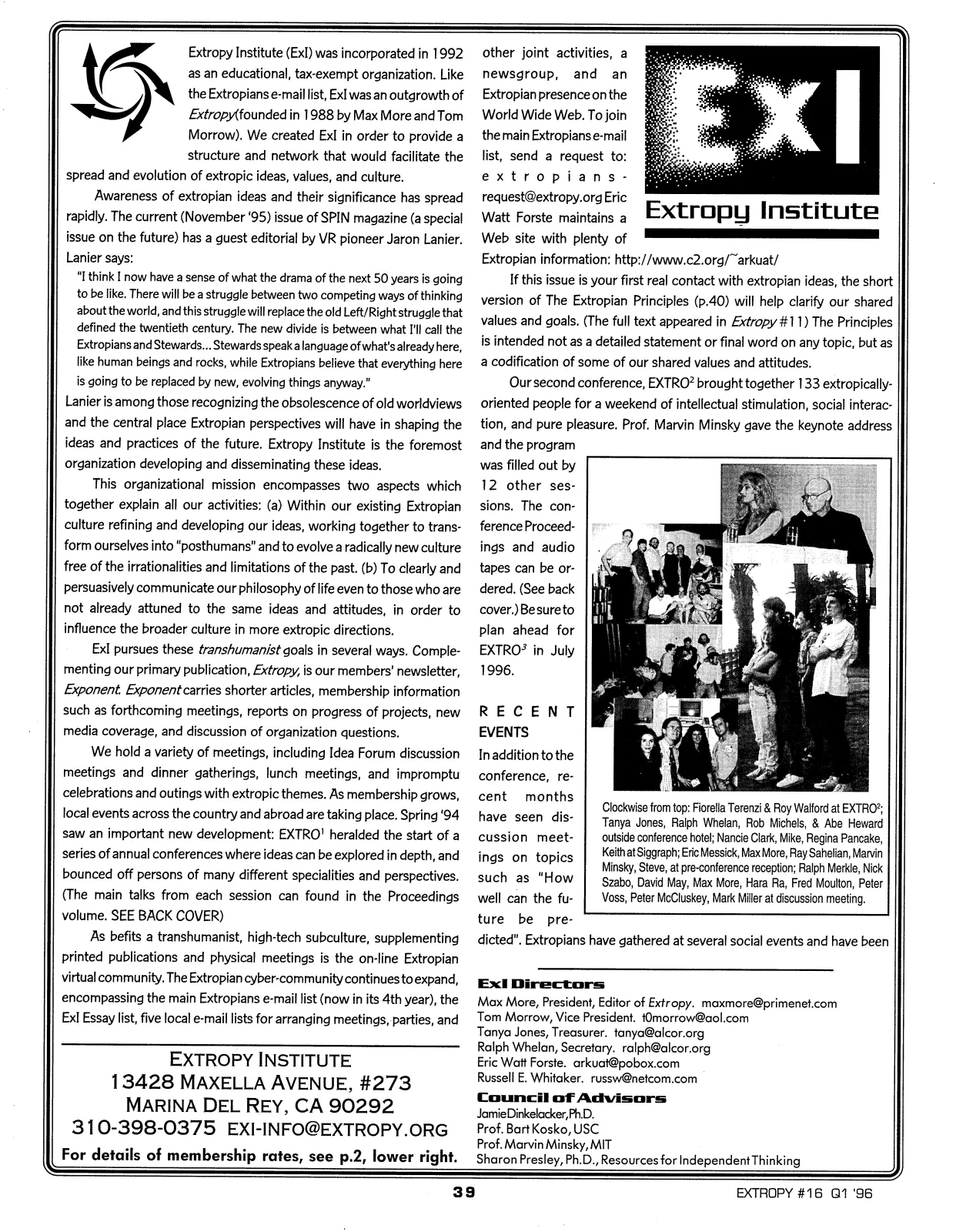
Our second conference, EXTRO² brought together 133 extropically-oriented people for a weekend of intellectual stimulation, social interaction, and pure pleasure. Prof. Marvin Minsky gave the keynote address and the program was filled out by 12 other sessions. The conference Proceedings and audio tapes can be ordered. (See back cover.) Be sure to plan ahead for EXTRO³ in July 1996.
R E C E N T
EVENTS
In addition to the conference, recent months have seen discussion meetings on topics such as “How well can the future be pre-
Clockwise from top: Fiorella Terenzi & Roy Walford at EXTRO³; Tanya Jones, Ralph Whelan, Rob Michels, & Abe Heward outside conference hotel; Nancie Clark, Mike, Regina Pancake, Keith at Siggraph; Eric Messick, Max More, Ray Sahelian, Marvin Minsky, Steve, at pre-conference reception; Ralph Merkle, Nick Szabo, David May, Max More, Hara Ra, Fred Moulton, Peter Voss, Peter McCluskey, Mark Miller at discussion meeting.
dicted”. Extropians have gathered at several social events and have been
ExI Directors
Max More, President, Editor of Extropy. maxmore@primenet.com
Tom Morrow, Vice President. tbmorrow@aol.com
Tanya Jones, Treasurer. tanya@alcor.org
Ralph Whelan, Secretary. ralph@alcor.org
Eric Watt Forste. arkuat@pobox.com
Russell E. Whitaker. russw@netcom.com
Council of Advisors
Jamie Dinkelacker, Ph.D.
Prof. Bart Kosko, USC
Prof. Marvin Minsky, MIT
Sharon Presley, Ph.D., Resources for Independent Thinking
“This is a philosophy of boundless expansion, of upward- and outwardness, of fantastic superabundance. It’s a doctrine of self-transformation, of extremely advanced technology, and of dedicated, immovable optimism. Most of all, it’s a philosophy of freedom from limitations of any kind.”
Ed Regis, “Meet the Extropians”, Wired, October 1994.
“Extropians remain die-hard rationalists, resistant to revealed truth of any kind, even if it’s the truth of their own predictions… The Extropians’ is a libertarianism of rare sophistication… [their] vision could turned out to be our best guide through the strange eons to follow.”
Village Voice, December 1994.
found at events such as Siggraph ‘95 in Los Angeles, the opening of Resources for Independent Thinking (run by Exl Advisor Dr. Sharon Presley), and the Bionomics Conference in October.
We are fostering the growth of more local discussion groups and international chapters of Exl, and we will continue to develop our network of communication and action. We look forward to the continued development of the Extropians cyberculture, especially on the World Wide Web. We will continue to build cooperation with other organizations for shared goals and make contact with more scientists, technologists, philosophers, and artists to strengthen our network.
We hope you will join us as an active participant in the Extropian movement. (See p.2 for membership information.) Help shape the future!
Upward and Outward!
Max More
President
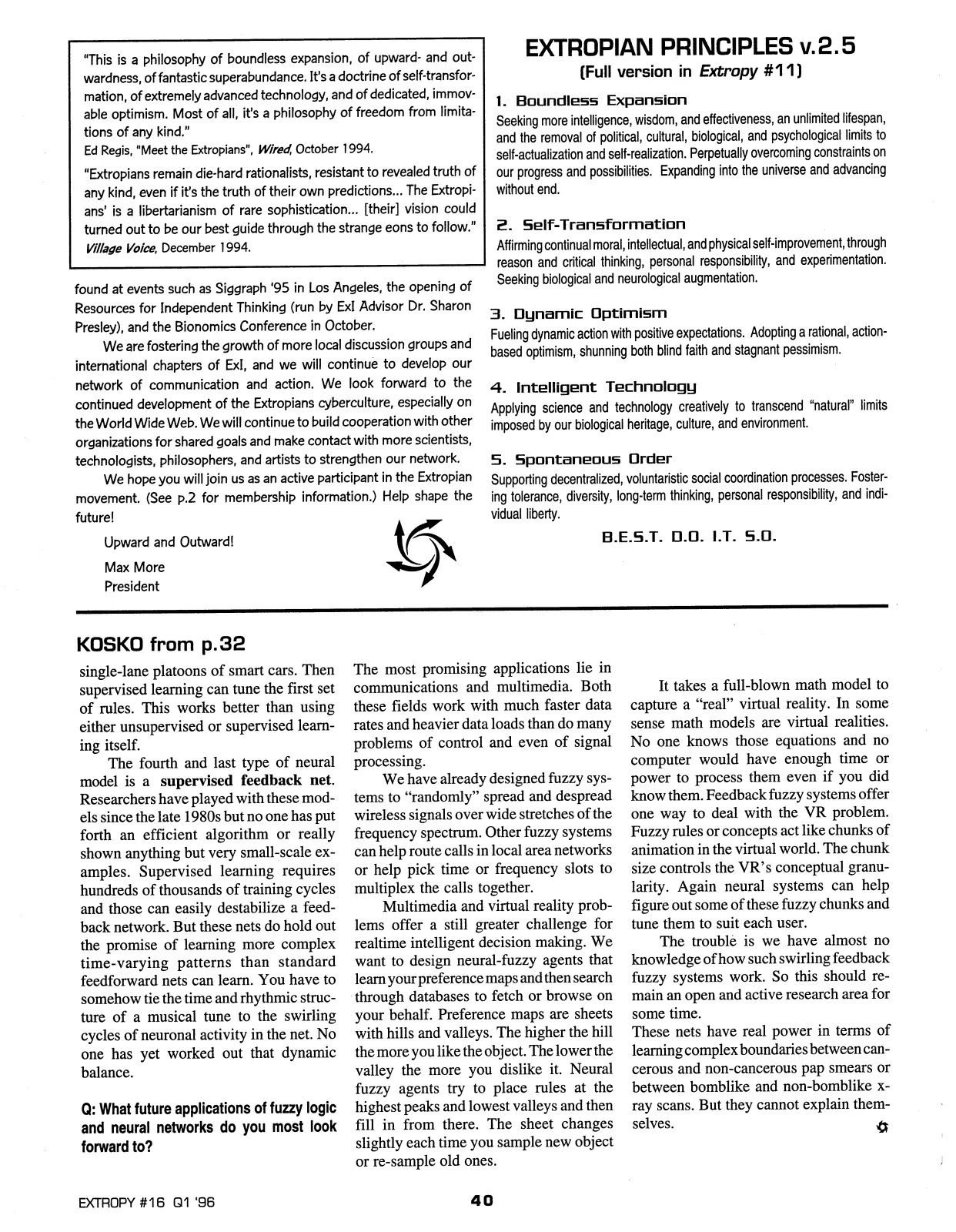
EXTROPIAN PRINCIPLES v.2.5
(Full version in Extropy #11)
1. Boundless Expansion
Seeking more intelligence, wisdom, and effectiveness, an unlimited lifespan, and the removal of political, cultural, biological, and psychological limits to self-actualization and self-realization. Perpetually overcoming constraints on our progress and possibilities. Expanding into the universe and advancing without end.
2. Self-Transformation
Affirming continual moral, intellectual, and physical self-improvement, through reason and critical thinking, personal responsibility, and experimentation. Seeking biological and neurological augmentation.
3. Dynamic Optimism
Fueling dynamic action with positive expectations. Adopting a rational, action-based optimism, shunning both blind faith and stagnant pessimism.
4. Intelligent Technology
Applying science and technology creatively to transcend “natural” limits imposed by our biological heritage, culture, and environment.
5. Spontaneous Order
Supporting decentralized, voluntaristic social coordination processes. Fostering tolerance, diversity, long-term thinking, personal responsibility, and individual liberty.
B.E.S.T. D.O. I.T. S.O.
KOSKO from p.32
single-lane platoons of smart cars. Then supervised learning can tune the first set of rules. This works better than using either unsupervised or supervised learning itself.
The fourth and last type of neural model is a supervised feedback net. Researchers have played with these models since the late 1980s but no one has put forth an efficient algorithm or really shown anything but very small-scale examples. Supervised learning requires hundreds of thousands of training cycles and those can easily destabilize a feedback network. But these nets do hold out the promise of learning more complex time-varying patterns than standard feedforward nets can learn. You have to somehow tie the time and rhythmic structure of a musical tune to the swirling cycles of neuronal activity in the net. No one has yet worked out that dynamic balance.
Q: What future applications of fuzzy logic and neural networks do you most look forward to?
The most promising applications lie in communications and multimedia. Both these fields work with much faster data rates and heavier data loads than do many problems of control and even of signal processing.
We have already designed fuzzy systems to “randomly” spread and despread wireless signals over wide stretches of the frequency spectrum. Other fuzzy systems can help route calls in local area networks or help pick time or frequency slots to multiplex the calls together.
Multimedia and virtual reality problems offer a still greater challenge for realtime intelligent decision making. We want to design neural-fuzzy agents that learn your preference maps and then search through databases to fetch or browse on your behalf. Preference maps are sheets with hills and valleys. The higher the hill the more you like the object. The lower the valley the more you dislike it. Neural fuzzy agents try to place rules at the highest peaks and lowest valleys and then fill in from there. The sheet changes slightly each time you sample new object or re-sample old ones.
It takes a full-blown math model to capture a “real” virtual reality. In some sense math models are virtual realities. No one knows those equations and no computer would have enough time or power to process them even if you did know them. Feedback fuzzy systems offer one way to deal with the VR problem. Fuzzy rules or concepts act like chunks of animation in the virtual world. The chunk size controls the VR’s conceptual granularity. Again neural systems can help figure out some of these fuzzy chunks and tune them to suit each user.
The trouble is we have almost no knowledge of how such swirling feedback fuzzy systems work. So this should remain an open and active research area for some time.
These nets have real power in terms of learning complex boundaries between cancerous and non-cancerous pap smears or between bomblike and non-bomblike x-ray scans. But they cannot explain themselves.
VIEW ORIGINAL SCAN (2 pages)