Issue: EXTROPY #15 · 2nd/3rd Quarter 1995
Author: Max More
Pages: 26–28 · 3 scanned pages
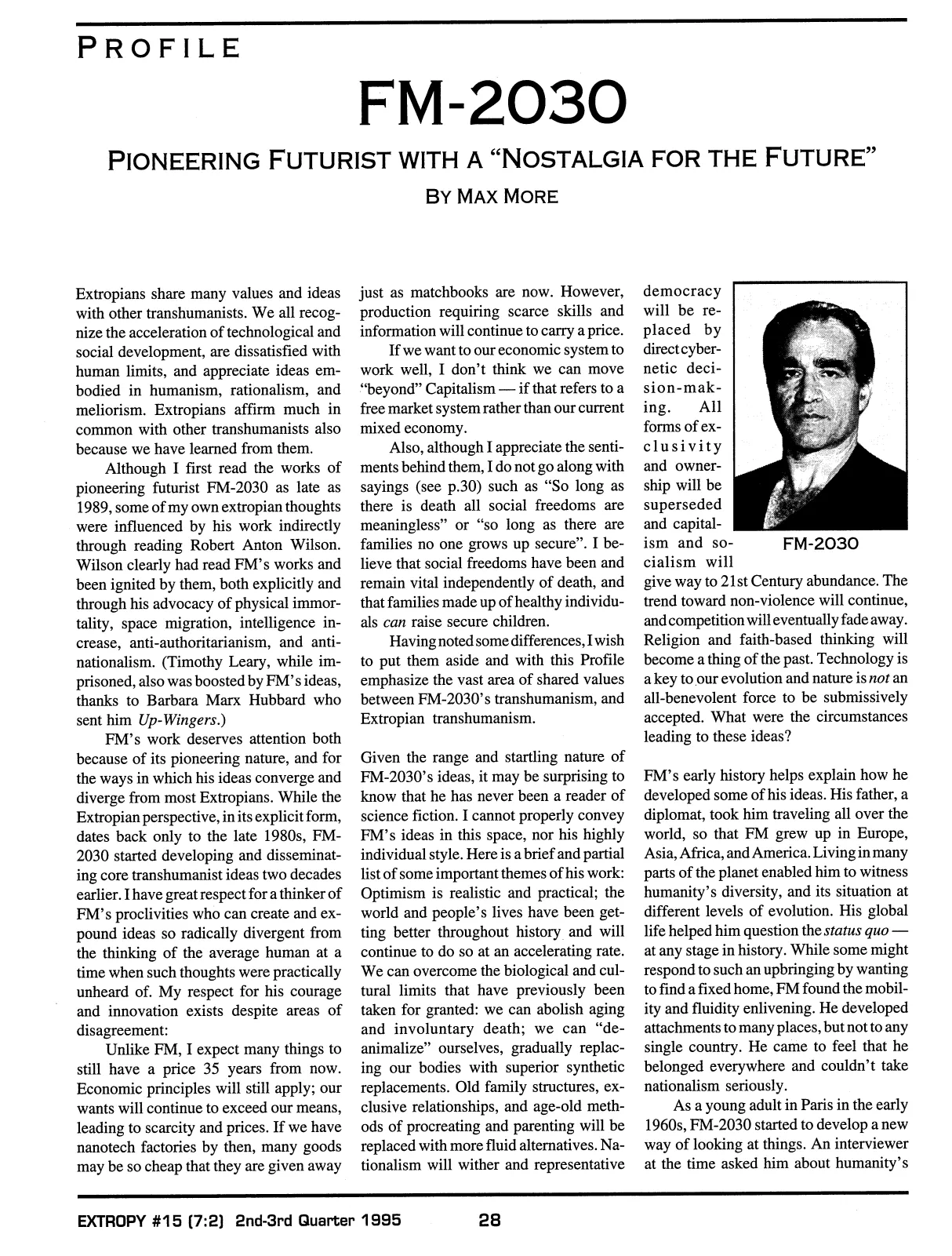
Profile: FM-2030 — Pioneering Futurist with a 'Nostalgia for the Future'
PROFILE
FM-2030
PIONEERING FUTURIST WITH A “NOSTALGIA FOR THE FUTURE”
BY MAX MORE
Extropians share many values and ideas with other transhumanists. We all recognize the acceleration of technological and social development, are dissatisfied with human limits, and appreciate ideas embodied in humanism, rationalism, and meliorism. Extropians affirm much in common with other transhumanists also because we have learned from them.
Although I first read the works of pioneering futurist FM-2030 as late as 1989, some of my own extropian thoughts were influenced by his work indirectly through reading Robert Anton Wilson. Wilson clearly had read FM’s works and been ignited by them, both explicitly and through his advocacy of physical immortality, space migration, intelligence increase, anti-authoritarianism, and anti-nationalism. (Timothy Leary, while imprisoned, also was boosted by FM’s ideas, thanks to Barbara Marx Hubbard who sent him Up-Wingers.)
FM’s work deserves attention both because of its pioneering nature, and for the ways in which his ideas converge and diverge from most Extropians. While the Extropian perspective, in its explicit form, dates back only to the late 1980s, FM-2030 started developing and disseminating core transhumanist ideas two decades earlier. I have great respect for a thinker of FM’s proclivities who can create and expound ideas so radically divergent from the thinking of the average human at a time when such thoughts were practically unheard of. My respect for his courage and innovation exists despite areas of disagreement:
Unlike FM, I expect many things to still have a price 35 years from now. Economic principles will still apply; our wants will continue to exceed our means, leading to scarcity and prices. If we have nanotech factories by then, many goods may be so cheap that they are given away just as matchbooks are now. However, production requiring scarce skills and information will continue to carry a price.
If we want to our economic system to work well, I don’t think we can move “beyond” Capitalism — if that refers to a free market system rather than our current mixed economy.
Also, although I appreciate the sentiments behind them, I do not go along with sayings (see p.30) such as “So long as there is death all social freedoms are meaningless” or “so long as there are families no one grows up secure”. I believe that social freedoms have been and remain vital independently of death, and that families made up of healthy individuals can raise secure children.
Having noted some differences, I wish to put them aside and with this Profile emphasize the vast area of shared values between FM-2030’s transhumanism, and Extropian transhumanism.
Given the range and startling nature of FM-2030’s ideas, it may be surprising to know that he has never been a reader of science fiction. I cannot properly convey FM’s ideas in this space, nor his highly individual style. Here is a brief and partial list of some important themes of his work: Optimism is realistic and practical; the world and people’s lives have been getting better throughout history and will continue to do so at an accelerating rate. We can overcome the biological and cultural limits that have previously been taken for granted: we can abolish aging and involuntary death; we can “de-animalize” ourselves, gradually replacing our bodies with superior synthetic replacements. Old family structures, exclusive relationships, and age-old methods of procreating and parenting will be replaced with more fluid alternatives. Nationalism will wither and representative democracy will be replaced by direct cybernetic decision-making. All forms of exclusivity and ownership will be superseded and capitalism and socialism will
FM-2030 give way to 21st Century abundance. The trend toward non-violence will continue, and competition will eventually fade away. Religion and faith-based thinking will become a thing of the past. Technology is a key to our evolution and nature is not an all-benevolent force to be submissively accepted. What were the circumstances leading to these ideas?
FM’s early history helps explain how he developed some of his ideas. His father, a diplomat, took him traveling all over the world, so that FM grew up in Europe, Asia, Africa, and America. Living in many parts of the planet enabled him to witness humanity’s diversity, and its situation at different levels of evolution. His global life helped him question the status quo — at any stage in history. While some might respond to such an upbringing by wanting to find a fixed home, FM found the mobility and fluidity enlivening. He developed attachments to many places, but not to any single country. He came to feel that he belonged everywhere and couldn’t take nationalism seriously.
As a young adult in Paris in the early 1960s, FM-2030 started to develop a new way of looking at things. An interviewer at the time asked him about humanity’s
“tragic situation”. FM, amused, asked “What tragic situation?” and explained he foresaw humanity overcoming all limits, including death. Even thinkers generally optimistic about the prospects for humanity couldn’t see a way around death, but FM saw that optimism need not be blunted by this entropic fate. FM spent considerable time thinking about the challenge of defeating death at the same time that others were breaking spatial limits with the Apollo moon adventures. If we can develop technology to break out of the confines of Earth’s gravity, why not also break free of the body’s limits? FM’s ideas about the possibility and desirability of tures, this was the first course on futurism. Teaching these classes to bright adult students, from 1965 to 1980, helped FM’s ideas take form and develop depth. His first course was “New Concepts of the Human”. The course examined the evolutionary transformations of humanity.
From the mid-1970s, FM became bi-coastal, continuing to teach in New York, but now conducting classes at UCLA as well. The appeal of California to futurist-minded people soon became evident: While his New School classes never grew larger than 30 or 40 people, the UCLA classes grew to 200. His classes were demanding and intellectually stretching, future not only through his classes but also through several books and numerous articles. FM-2030 first used the term “transhuman” in print in his essay “Transhuman 2000” which appeared in the 1972 anthology, Woman: Year 2000. He had used this term earlier, in courses in the mid-’60s.
The first of his books dealing with his vision of the transhuman future was Optimism One, published in 1970, followed by Up-Wingers in 1972. Telespheres, finished in 1974, was published in 1977. These three books, now out of print but found in many libraries, he wrote under the name FM Esfandiary. His most recent book, Are You A Transhuman, was published in 1989, and regrettably recently went out of print. He has finished a new book, Countdown to Immortality, and is working on another that develops and updates the ideas in Up-Wingers and Telespheres.
physical immortality developed in the early ’60s, partly stimulated by discussions with friends in Paris. He didn’t yet know how death could be overcome, but was convinced that this was both possible and desirable.
In the mid-60’s, FM-2030 returned to the United States. His book Identity Card was published by Grove Press—the publishers of radical, revolutionary writers of the time. Identity Card dramatized the irrelevance of national boundaries and identities. His Marxist editor at Grove Press, Harry Braverman, would talk with FM in New York, telling him his ideas were crazy but provocative. Certainly he had a hard time dealing with FM’s declaration that both the political right and left were part of an old context. Nevertheless, Braverman encouraged FM to teach, helping him by contacting the New School for Social Research—an avant-garde university in New York, a hot-bed of revolutionaries. The philosophy department didn’t know what to do with him. Lester Singer, who decided what courses would be offered, liked FM’s revolutionary optimism and made a niche for him. Aside, perhaps from Buckminster Fuller’s lecand soon attracted many pioneering people from places like JPL and NASA. He has also taught at the Anderson Graduate School of Management at UCLA, and does many seminars for companies and other groups such as designers, business executives, and psychiatrists.
Intriguingly, he says over the last 10-12 years he has done more seminars for architects than for any other group. The kind of people who have shown interest in FM’s ideas can be surprising: One of his UCLA classes was attended by police executive Diane Harbor. She related some of what she had heard to C. L. Cronkite, former L.A. Deputy Chief of Police. He phoned FM, wanting to help police executives get more tuned in to the trends taking us into the future. FM told the five top cops who came to talk with him at an oceanside cafe that they needed “a more humanized police force”. These officers started L.A. 2000, which invited speakers, including Gene Roddenberry. A few years later they called and asked FM to give a series of seminars to California decision-making officers.
Over the last 30 years, FM has been spreading his ideas about our transhuman
Biographical note from FM-2030’s last book, Are You a Transhuman?:
Born with a conventional name, FM-2030 (twenty-thirty) changed both his first and last names to reflect his confidence in the future. As he explains, “conventional names define a person’s past: ancestry, ethnicity, nationality, religion. Long ago I outgrew such territorialities. I am not who I was ten years ago and certainly not who I will be in twenty years. I would rather be defined by my future—my hopes and dreams. The name 2030 reflects my conviction that the years leading to 2030 will be a magical time. The solar system will be alive with people linking in and out of planets and moons and orbital communities. In 2030 we will be ageless and everyone will have an excellent chance to live forever. 2030 is a dream and a goal.
I am a 21st Century person who was accidentally launched in the 20th. I have a deep nostalgia for the future.” FM-2030
EXCERPTS FROM FM-2030’S WRITINGS
“Something new is unfolding in the human condition—something unprecedented—something beyond historical knowledge—something potentially full of hope… Suddenly humankind’s situation is not circumscribed or limited… we are no longer confined to this tiny planet. Soon we will no longer be confined to our fragile mortal bodies. We are on our way to becoming universal and immortal… This is precisely the distinction between the new optimism and the optimism of the past… These evolutionary breakthroughs mark ours as the First Age of Optimism—WE ARE AT OPTIMISM ONE.‘
Up-Wingers
‘The 21st Century will look back with revulsion on many of our institutions: family – marriage – school – prison – hospital – city – money – government – nation.
Oppression is still all around us—although less brutal than in the past:
The child who has one set of parents is unprotected and unfree.
The person who possesses or needs to be possessed is enslaved.
The child who spends twelve years festering in classrooms suffers from child abuse.
The person who works eight hours a day five days a week is trapped in modern serfdom.
So long as there are families no one grows up secure.
So long as there are schools no one is well informed.
So long as there are hospitals no one is safe.
So long as there are prisons no one is free.
So long as there are leaders there is no democracy.
So long as there is death all social freedoms are meaningless.‘
Telespheres
‘The day will come soon when the death of a single human being will be so rare and tragic that the news flashed across the planet will stun humanity.‘
Optimism One
‘Transhumans (Trans) are a new kind of being crystallizing from the monumental breakthroughs of the late 20th Century… Trans can no longer be considered specifically human because the premises of biological terrestrial life that have always defined the human no longer fully apply… Trans are transitional beings—forerunners of the posthumans who will surely evolve later in the 21st Century.’
Are You a Transhuman?
LOOMPANICS unlimited
FREE SPACE! Real Alternatives for Reaching Outer Space by B. Alexander Howerton
The next round in the space race won’t be run by NASA. This time, it will be private companies building space stations and shooting payloads to the planets. Science fiction, you say? Take another look. This book opens with an explosive critique of NASA — the government behemoth that put a man on the Moon and has been grounded ever since. The second half of the book contains capsule descriptions of ten companies that are preparing for space travel today. Run by NASA/aerospace alumni, they have the know-how and the money to make it real. Find out how they’ll open the heavens to commercial travel in the coming decade. B. Alexander Howerton has interviewed all of the principal players in these companies. Free Space! contains private communications, rare illustrations and photos not available anywhere else. Paperback, 5½ x 8½, 160 pp, illustrated, $19.95 postpaid. Now accepting VISA and Mastercard.
LOOMPANICS UNLIMITED • PO Box 1197 • Port Townsend, WA 98368
Please send Free Space! to me at the address below. I have enclosed $19.95.
Name _____
Address _____
City/State/Zip _____
For credit card orders only, call 1-800-320-2230, 9 am to 4 pm PST
EXT95
VIEW ORIGINAL SCAN (3 pages)