Issue: EXTROPY #15 · 2nd/3rd Quarter 1995
Author: David Krieger with Max More
Pages: 19–24 · 6 scanned pages
Biosphere 2: Ecological Experiments, Space Habitats & Long Life — An Interview
Ecological Experiments, Space Habitats, & Long Life An Interview with Roy Walford, M.D. (Part Two)
by David Krieger with Max More
At 69, Roy Walford, M.D., is the author of two prior best-selling books, Maximum Life Span (1983) and The 120-Year Diet (1988). He received his M.D. degree from the University of Chicago in 1948 and has been professor of pathology at the UCLA School of Medicine since 1966. Author of over 250 scientific articles, Walford was a delegate to the last White House Conference on Aging, is a member of the National Academy of Sciences Committee on Aging, and is considered to be one of our leading gerontology experts.
For more than 20 years, Walford’s life work has been studying the effect of low-calorie, nutrient-rich diets in animals at his UCLA lab. In 1993 he completed two straight years of studying the effects of diet on aging in humans in Biosphere 2, a sealed environmental laboratory for the study of micro- and artificial ecologies, located in the Arizona desert. The goal of Biosphere 2, funded by controversial Texas billionaire Ed Bass, is to improve humanity’s knowledge of managing ecosystems in preparation for the habitation of space. The results of Dr. Walford’s Biosphere studies have been published in Proceedings of the National Academy of Sciences.
In The Anti-Aging Plan, Walford and his daughter, chef Lisa Walford, present an easier, more convenient cookbook and menu guide for humans who want to prolong their enjoyment of food. Max More and I interviewed Dr. Walford in his Venice, California, residence. In Part One of this interview, we discussed Dr. Walford’s longevity research and hopes for the future; in Part Two, we talk about the Biosphere 2 experience:
Let’s talk a bit more about the Biosphere. I had a chance to visit the facility recently; it’s very impressive. What do you think has been the major change in your life as a result of having been involved in that?
I guess I’ve gotten more involved in human values than I was; I’m not interested in being on such a merry-go-round. Although at the moment, I’m back on the merry-go-round, I’m getting off in 1995; I’m really tired of it.
What do you mean by ‘merry-go-round’?
Giving talks all over; being keynote speakers and banquet speakers and grants and that whole trip, and not having enough time to do some of the video and art and other technology that I’m trying to get into but haven’t; I can’t do it because I’ve got myself tied up. So I’m getting off of that. 1995 is the year of saying no.
How do you feel about the science that’s come out of Biosphere?
Well, I don’t think much has come out except for what I’ve done, in the Proceedings of the National Academy of Sciences—so far, but I think it will come out. Virtually nothing has come out; there are a number of papers that have been written, and there’s one in Bioscience, that are all descriptions of potentiality. I think more will be coming out, because now that the cult people have been kicked out by the financial backer, Ed Bass, they have good management—and the scientific community, which had drifted away in disgust at the hierarchical, authoritarian, arrogant nature of the previous management, is now coming back. The Smithsonian is back, working with them; the Yale School of Forestry is back; the Lamont Geological Laboratory is back—all of those people said, ‘To hell with it; we can’t work with you,’ and left. And other people are coming back; so I think it’ll be back on track and regain its credibility.
What qualities of the prior management gave it the characteristic of being cultish?
Well, it was a typical cultish characteristic, if you just look at a book on cults. For example: a charismatic guru whose word was law. In ‘thought reform’ programs you do a number of things, and this is very typical of all the cults. One: Keep everybody so busy that they can’t think for themselves—either busy working or busy engaged in what are ostensibly recreational programs, like putting on theatre plays and things like that, but really, the purpose of which is to keep everybody busy, doing something constantly. Every night, we had something going on after dinner, whatever, so it was a full-time occupation.
Separating people from their families or friends, children—breaking up all those ties—they’ve got everything centered around the group. Those are some of them.
After the change in management, there was an incident with a couple of your fellow Biospherians who broke the seal on the second group as a protest. Have you been in communication with them; do you know what their motivation was, and what they hoped to accomplish by that?
I haven’t been in communication with them, but I know, or surmise, the motivation for everything. This is just a guess. First of all, among the eight Biospherians there were four who were loyal to the old cult management, or, basically, part of what has been called a cult. I don’t think I quite want to say that, because I don’t want to get sued.
Anyway, four were brainwashed, loyal to the old management, and then four of us, some had never been in it. I was never in it, although I was around it and could see it. Another person, Linda [Leigh], was not really in it, and then Jane [Poynter] and Taber [MacCallum] had deprogrammed themselves about a year before going in, so there were four in and four not in [the cult]. The only thing that held everybody together was that everybody was very determined to make it work.
The funny side—not funny, but the side that illustrates that, is that I could never get a psychological evaluation done, which should have been done, because the psychology of isolated, confined environments is a big area—Antarctica, NASA, and space—it’s a big area in the study of psychology, and obviously, the Biospherians should have been analyzed by good psychometric testing. But I couldn’t get this done, because obviously management didn’t want psychologists meddling with their cult system.
They didn’t want it to be a ‘Sociosphere,’ just a Biosphere.
Yeah. So, two or three months before the end, I did manage to prevail, and got a good guy from the University of Arizona to do some evaluations and interviews and run the MMPI² and stuff like that. We were writing a paper together on biospheric medicine, but what he found—I thought that maybe he’d find that half the people were nuts and the rest of us were sane, something like that, but that isn’t actually what he found. That didn’t show up so much.
What showed up was that everybody was so achievement-oriented, that was unheard of. He said he couldn’t find a control group. He tried airline pilots, and they were completely wiped out, so he’s looking for astronaut figures now. The fact is, we’re so bulldog determined to make it work, in some high achievement stuff, that we would have overrun any kind of psychological problems, and that’s basically what we did. Or physical problems—I really fucked up my back inside, overworking—two or three hours a day of heavy duty agriculture and field labor, for six days a week, for two years, was kind of like having had back surgery.
Anyway, that’s why it worked. But the four were still in the cult afterwards, and when Ed Bass marched in and kicked everybody out—that is, the prior management—two of them came back from where they were in Japan, and sneaked in up the back road, and opened the doors and stuff like that, and did some moderate damage inside.
I can only guess the reason for that, because it didn’t really do that much damage and it was kind of a pointless gesture; it didn’t invalidate anything. The amount of air exchanged was not very much. But I think the reason was, they thought that some of the present people inside would come out if they were told to come out, because they had also, to some extent, at one time, been under the influence of the cult guru, John Allen. And if they had walked, it would have been like the Biospherians voting with their feet against the new management.
ment.
But in the end, they wouldn’t come out; so the people who opened the door were left holding the bag. It didn’t work that way. The woman is up for a felony trial, and the man was up for it, but he got off.
That was Abigail [Alling], and who was the man?
Mark van Thillo.
Kevin Kelly wrote an article in Whole Earth Review after the first year of the first Biosphere experiment and pointed out that there have been a lot of public misconceptions about the purpose and the achievement, the fact that there had to be oxygen supplementation and some additional supplies brought in and so forth. Could you comment on the real goals of the experiment?
I think the experiment was quite successful in terms of staying more or less closed for the two years and being almost totally self-sustaining, so that, if you’re trying to make the Mars base—or something that will eventually become a Mars base, much modified—it was very successful. We did stay in for two years. There wasn’t any extra food brought in. As far as the oxygen was concerned, there was some oxygen brought in, but that didn’t make that much difference; it was just liquid oxygen that was brought in and allowed to fill up the oxygen that disappeared.
The falling oxygen was due to a management blunder. They had been told by the agricultural consultants to put in soil that was six to eight percent rich in organic matter; and, in their naive way, management thought, “Well, we want things to grow, so the richer soil the better.” So they brought in soil that was about 30%—I’m not sure of the exact figure—in organic matter.
What happened then was that soil bacteria, in this super-rich soil, produced more carbon dioxide than the plants could deal with. Then, cement, which is calcium hydroxide, will take up carbon dioxide to form calcium carbonate. This is a mild problem in the cement industry, but in the Biosphere, because the carbon dioxide went up to 3500 or so instead of the normal 300 parts per million in our environment, that drove that reaction forward, and the cement sucked up a lot of the carbon dioxide, and the oxygen it contained, into the cement, acting as a sink. The oxygen went down. Finally, when it got down to 14 percent, as opposed to the outside 20 percent, we were having considerable breathing problems, and as the medical officer, I had to tell them to bring in oxygen, which they did.
But I don’t think that invalidated anything; it illustrated the stupidity of management for setting that up against good scientific advice in the beginning.
You mentioned that the Biosphere is preparation for living in space. Do you think that more people should consider migration into space more seriously than it’s being considered today? How important do you think that is to the future of humanity?
I think it’s important to the eventual future. I don’t know when—Now is a good time to do it. I don’t have any firm opinion. I think it’s a serious mistake to wait till all the problems on Earth are solved before we go into space, because in that case we’ll never get there. So I think we should, the sooner the better.
Max: If you’re around 30 years from now, do you want to go into space?
I’d like to go up now. If I can ever get in the shuttle, I’ll give it a whirl. I think I’ll try to get on, after I finish giving all these speeches and everything else, and doing some writing—
Jane and Taber are into, at the moment, making small closed ecosystems. The first ecosystems were made by Clara Folsom at University of Hawaii; they’re basically glass, about ten inches in diameter, and he put pond water from different places around Hawaii in there and then sealed them up. And as long as they got the right amount of sunlight, they stayed alive, and they’d circulate in a sustainable system. The longest one has been going like that since 1968. There are a whole number of those—Folsom died, then, but his flasks were still living at the Biosphere. You may have seen them if you were over there; they’re often included in the tour.
So Jane and Taber and Linda and others are now working on getting somewhat larger ecospheres; they’re studying smaller closed ecological spaces like that. If they can get some, I suggested it would be fun to put some up in the shuttle and just stick them out in space—having given due thought to what they’d have to sustain in terms of too much sunlight and cosmic radiation and incorporate those thoughts into how to build them. So I’ve said, if they make them, I’ll try to get up and put them into space. So, yes, the answer is yes.
Max: Do you think that when there are a large number of people living in space, a space civilization—Do you think that will change the way we live, the way we organize our societies?
Yeah, I think it would, substantially. Our experience was that it changed everything, in the Biosphere. In a sense, you become disconnected from the outside world. While we were in, we had TV and radio and telephone and fax, but what was going on outside, in a sense lost its importance. The Russian empire fell, one day, and the same day the goats had kids. They were sort of comparable. So I think it’ll change…
The other thing that will change a lot is, there’ll be a lot of interconnection between space colonies and Earth, in a sense, in terms of art interaction, I think, because it isn’t very much fun to do art projects if you’re only doing them for six people. I don’t want to write a poem that’s only going to be read by six people; I don’t want to even do it. So you need to have a two-way communication like that.
I was doing an art project with Barbara Smith, a performance artist, called A 21st-Century Odyssey, in which she was a female Odysseus, traveling around the world doing ecological performance art in different localities, such as Kathmandu, Australia, and Norway, and I was a male Penelope inside the Biosphere. So we were communicating by videophone. So I was doing some art things inside, but I think if I couldn’t have shown them outside it wouldn’t have made much sense; it wouldn’t have been satisfying.
So if people are living in space, I think they’ll need intercultural interaction with a larger population. So that’s a different culture, that’s the Internet culture, but expanded through multimedia—electronic culture.
How much do you use Internet communications? Are you a “nethead”?
No, not very much. I haven’t had time since I’ve been out. I do some via CompuServe; I’m on the Well, but I don’t use it very much. What I am getting into is multimedia and video technology, because I’ve got about 80 hours of inside High-8 video and 4000 photographs. I’m working that into some art pieces; so I have a lot of technology left to learn. That’s what I plan to do in ‘95.
What kinds of projects do you have in mind for those? CD-ROMs?
Well, we’ve been talking about doing a CD-ROM about the Biosphere. I want to do a nine-channel video installation using a bunch of photographs and the video that I took inside.
[Dr. Walford showed us part of his video diary of his two years in Biosphere 2.]
Do you know the people at the Electronic Café in Santa Monica?
Oh, sure. They were the connecting link for all of this stuff that Barbara Smith and I were doing; it went through the Electronic Café—from her to the Electronic
kinds of things really don’t travel well over the wire?
Well, I think people are freer in their speech, with electronic communication—less shy, or something like that—so that kind of verbal interaction travels well. I don’t know what doesn’t travel well—touching people; physical communication, which I think is quite different.
What kinds of changes do you hope for in society, with the chance to start new societies in space? What kinds of changes would you like to see?
Well, it’s hard to say, but, as the Biosphere experience was so fractured—I thought that, hopefully, the eight people liked it so much in there, they overgrew everything—they overgrew the whole rainforest; the space frame was covered with them; they hung from all the trees, and they grew across the rainforest floor. So we had to get in there and spend endless hours cutting them out; they just went crazy. A few other things did, too, like the Australian cockroaches. They decided they liked it.
You have a very wide range of interests. What fields in which you’re currently not doing work do you find most interesting? What have you been reading and following lately?
I’m not doing work in theater now; I think that’s interesting. I used to hang around with the Living Theatre; I’ve traveled with them and lived with them a little bit. And I wrote theatre criticism for the Los Angeles Free Press, but I’m not doing anything in that now, but I’m still trying to keep up on it.
Other fields… I’m not doing any work in molecular genetics, because I’m trying to get into another career, basically; to get out of this heavy scientific career. I’ve written in all my books that you should change careers two or three times, but I haven’t been a very good example; I really haven’t disengaged from the heavy-duty science career, but I want to do that. Therefore, I’m not really up on the cutting edge of, say, molecular genetics.
Max: Do you see any possible problems with the emergence of very long-lived people? Do you think there could be, for instance, people who are a couple hundred years old in control of things and younger people not having much of a chance to catch up, or do think there’ll be ways around that, by restructuring the way we organize?
I think there’s a danger of that, but I don’t think it’s any more dangerous than what’s going on. Hitler was not very old when he got control of everything, so, no, I don’t think that’s more dangerous than it is at present. Maybe less, if people are living long enough; as I say, I think their sense of values increases, finally.
You also mentioned the ecological attitudes of people that expect long life; to what extent do you consider yourself an environmentalist, and what do you think is the best course for maintaining the sustainability of Biosphere 1?
Well, the best course for maintaining the
Café to me, and from me to the Electronic Café to her, and anybody else who wanted to sit in the Electronic Café and watch the interaction.
Max: I was there one day when you were sending pictures of the butt paintings. [These artworks, made inside the Biosphere, were based on the same principle as finger paintings—but effected with blunter utensils.]
Yeah, they’re right up there [points high on the wall], some of them, up above.
During the sequence in one of the lungs [constant-pressure air reservoirs of Biosphere], you used the terms ‘Prisoners of Mars’ to describe the extra-terrestrial look of the scene. Was there much claustrophobia going on during that time?
No, there was no claustrophobia. It’s big enough you can see above and below ground, and it’s not… [that’s] one thing that nobody had problems with.
What qualitative difference do you think there is between electronic communication and face-to-face communication? You mentioned the isolation of space colonies and things like the Biosphere. To what extent can electronic communication really address that kind isolation, and what
would go in and form their own society, which was disconnected from outside—but in the event, the outside management kind of reached in, since they had thought control over four of the people, so we didn’t really get to have the kind of experience that I thought might be happening.
A greater development of intimacy, and things like that, I think will come about in smaller societies, if you start out with the right people; but the whole thing is also like a chaos dynamics situation. You can change one person and the whole thing will be quite different. That means a real careful selection, if one knows how to select.
The Biosphere was very chaos-dynamic—not only like that, in terms of the social situation. There were other people that were supposed to go in and didn’t go in, so the choice of the Biospherians changed a number of times as to who was going in. I know that with some of the people that were supposed to go in but then didn’t get in, the whole scene would have been totally different, instead of this four-and-four fiasco.
The other thing that went on, in terms of chaos situations—before closure, we put in two tiny morning-glory vines, about as big as my thumb, on the cliff wall. They sustainability is to have fewer children, or to reduce the birth rate, which is exponential now. I think that’s really the main problem. Beyond that, people are becoming increasingly aware of the environmental crisis. Mankind has a big block about looking ahead for twenty years or 25 years, which is why people don’t stop smoking; at 20 or 30 years old, people are still smoking because they can’t imagine that they’re going to get cancer when they’re 55 or 60; and the same thing is true with the environmental problem. I think that’s kind of an innate human problem that has to be faced and counteracted, I guess by education. Yes, I think the environment is a critical situation. It’s kind of
So, they’ve tried to do that at each of their installations, and that’s good. I certainly agree with that, and everybody does. The problem with the cult is that, on top of this ecologically worthy goal, they put this cult mentality, so that kind of destroyed everything.
What do you think is the best future direction for Biosphere-like research? You mentioned some of the microenvironments that Taber and Linda have been working with; what are some of the other interesting areas that you would like to see more research done in future, following on to this area of research?
Well, they need more well-controlled
a race between science and madness at the moment, as far as the environment is concerned.
Do you think that the role of governments is helping or hindering the present drive for taking better care of the environment?
Well, it depends on the government—certainly the Soviet government didn’t help at all, because they were interested in production. It’s a toss-up. I think the government is interested in helping the ecology, but there are countervailing forces that deal with full employment, exploitation and money-making that are also in play, so there’s a balance between those which is now not very good, actually.
The only positive thing about the [Biosphere] cult was that they were honestly interested in a sound ecology and had the conviction that you can’t save the Earth by putting everything off-limits, by making vast stretches of the place where nobody can go, or putting Oregon off-limits, but by developing sustained agriculture that’s not damaging. To that purpose, they have, for example, a 300,000-acre ranch in Western Australia which had been overgrazed by sheep; they’ve now made it into a working cattle ranch and they’re bringing back the environment.
closed ecological spaces that are probably smaller than the Biosphere, where the different spaces are exactly the same but vary in small ways, so you can isolate what’s going on. That’s not what’s happening in the Biosphere. Ecology in the Biosphere is like ecology on the Earth; it’s not very well isolated. It’s just more isolated than it is on the Earth. The top is this big glass bubble, and underneath there’s a stainless-steel plate, so everything is inside. Other things like the Biosphere will be, for a while, smaller, but duplicated enclosed spaces where the variation is more limited so they can study that. I think that’s going on in one other place that I know of, I think by NASA. So I think that’s part of the package. And, of course, it’s much too big to shoot up to Mars, so…
The capability to build O’Neil-style colonies isn’t quite realistic yet, either.
Yeah.
NOTES
¹in the December 1992 issue.
²Minnesota Multiphasic Personality Inventory, a standard psychometric examination.
‘Life Piled Upon Life’
From Dr. Walford’s introduction to The Anti-Aging Plan:
The science of gerontology has been jokingly referred to as of interest primarily to biologists approaching retirement. This was not true in my case. In 1941 I published an article in my high school magazine, The Literary Parade, in which I deplored the brevity of life. To me, even a fairly long life seemed far too short to explore the world’s outward wonders and humankind’s inner realms, to walk all the strange pathways of society’s subcultures, to read all the books, hear all the music, climb the mountains and dive the seas, to be present at least at the early stages of the age of space.
Does this sound sophomoric? Maybe so. But I still feel that way. ‘Life piled on life were all too little,’ to quote ‘Ulysses,’ a poem by Tennyson. And curiously enough, as my daughter and I finished writing this book, fifty-three years after the dreams and fantasies of high school days, I was engaged at all levels in a sort of ‘Anti-Aging Odyssey.’ Sealed inside Biosphere 2 in the Arizona desert along with seven others, I saw how ‘Life piled on life’ makes living a greatly extended healthy life an attractive option.
I confess that at first gerontology seemed just a means to an end. I simply wanted to live longer, to have it all and do it all. As an honors student entering the California Institute of Technology (CalTech), I was more into mathematics and philosophy. But Descartes, who was pre-eminent in both of these fields, died at fifty-two. That would be awful, I figured. And so I set out not to die at fifty-two, or even twice that. And I was determined to have a great, productive, zestful time of it, for all of that time.
But a deep interest in biology began to push itself forward, until … but here I must tell you a story.
I was a 19-year-old student at
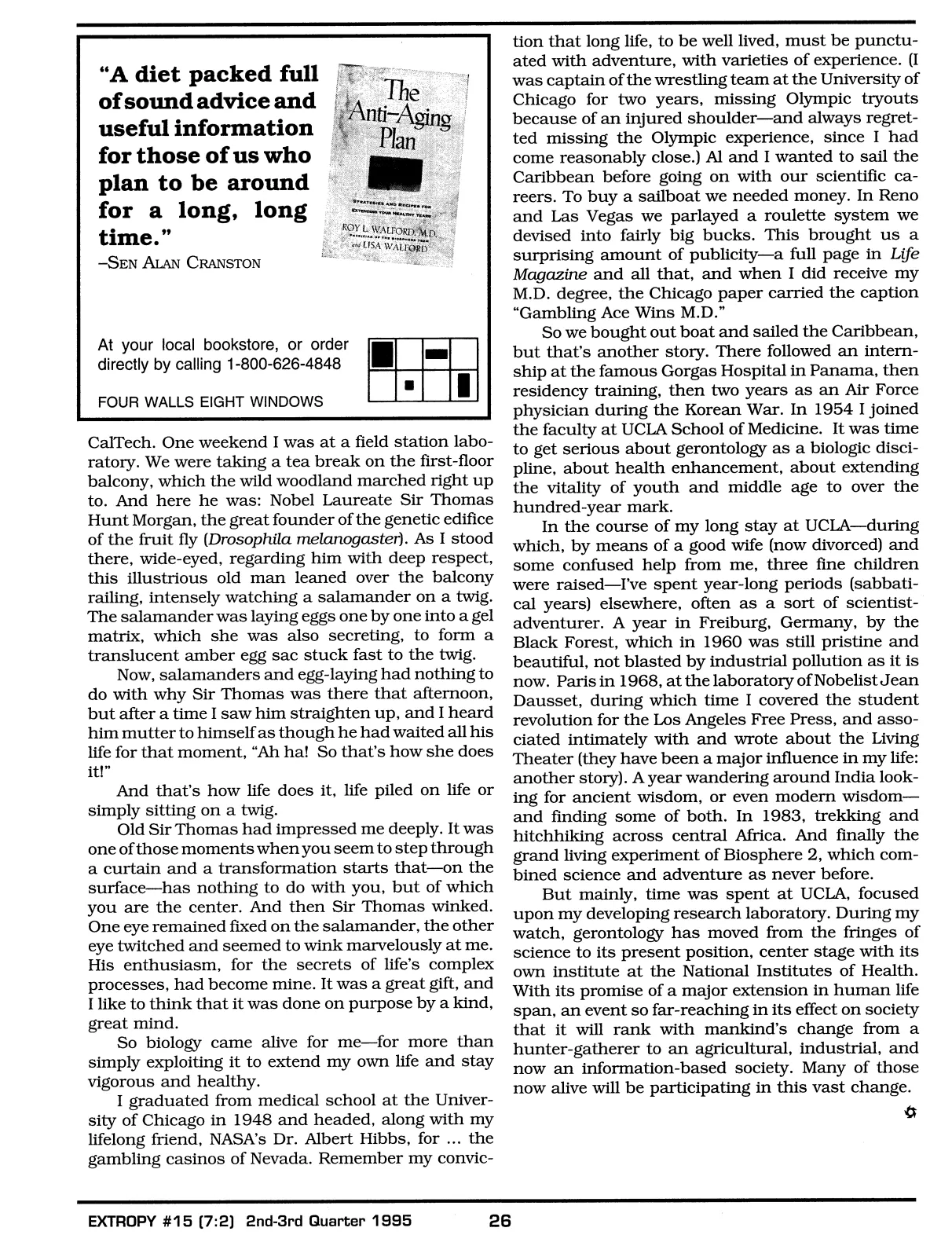
‘A diet packed full of sound advice and useful information for those of us who plan to be around for a long, long time.’
—SEN ALAN CRANSTON
At your local bookstore, or order directly by calling 1-800-626-4848
FOUR WALLS EIGHT WINDOWS
CalTech. One weekend I was at a field station laboratory. We were taking a tea break on the first-floor balcony, which the wild woodland marched right up to. And here he was: Nobel Laureate Sir Thomas Hunt Morgan, the great founder of the genetic edifice of the fruit fly (Drosophila melanogaster). As I stood there, wide-eyed, regarding him with deep respect, this illustrious old man leaned over the balcony railing, intensely watching a salamander on a twig. The salamander was laying eggs one by one into a gel matrix, which she was also secreting, to form a translucent amber egg sac stuck fast to the twig.
Now, salamanders and egg-laying had nothing to do with why Sir Thomas was there that afternoon, but after a time I saw him straighten up, and I heard him mutter to himself as though he had waited all his life for that moment, ‘Ah ha! So that’s how she does it!’
And that’s how life does it, life piled on life or simply sitting on a twig.
Old Sir Thomas had impressed me deeply. It was one of those moments when you seem to step through a curtain and a transformation starts that—on the surface—has nothing to do with you, but of which you are the center. And then Sir Thomas winked. One eye remained fixed on the salamander, the other eye twitched and seemed to wink marvelously at me. His enthusiasm, for the secrets of life’s complex processes, had become mine. It was a great gift, and I like to think that it was done on purpose by a kind, great mind.
So biology came alive for me—for more than simply exploiting it to extend my own life and stay vigorous and healthy.
I graduated from medical school at the University of Chicago in 1948 and headed, along with my lifelong friend, NASA’s Dr. Albert Hibbs, for … the gambling casinos of Nevada. Remember my conviction tion that long life, to be well lived, must be punctuated with adventure, with varieties of experience. (I was captain of the wrestling team at the University of Chicago for two years, missing Olympic tryouts because of an injured shoulder—and always regretted missing the Olympic experience, since I had come reasonably close.) Al and I wanted to sail the Caribbean before going on with our scientific careers. To buy a sailboat we needed money. In Reno and Las Vegas we parlayed a roulette system we devised into fairly big bucks. This brought us a surprising amount of publicity—a full page in Life Magazine and all that, and when I did receive my M.D. degree, the Chicago paper carried the caption ‘Gambling Ace Wins M.D.’
So we bought out boat and sailed the Caribbean, but that’s another story. There followed an internship at the famous Gorgas Hospital in Panama, then residency training, then two years as an Air Force physician during the Korean War. In 1954 I joined the faculty at UCLA School of Medicine. It was time to get serious about gerontology as a biologic discipline, about health enhancement, about extending the vitality of youth and middle age to over the hundred-year mark.
In the course of my long stay at UCLA—during which, by means of a good wife (now divorced) and some confused help from me, three fine children were raised—I’ve spent year-long periods (sabbatical years) elsewhere, often as a sort of scientist-adventurer. A year in Freiburg, Germany, by the Black Forest, which in 1960 was still pristine and beautiful, not blasted by industrial pollution as it is now. Paris in 1968, at the laboratory of Nobelist Jean Dausset, during which time I covered the student revolution for the Los Angeles Free Press, and associated intimately with and wrote about the Living Theater (they have been a major influence in my life: another story). A year wandering around India looking for ancient wisdom, or even modern wisdom—and finding some of both. In 1983, trekking and hitchhiking across central Africa. And finally the grand living experiment of Biosphere 2, which combined science and adventure as never before.
But mainly, time was spent at UCLA, focused upon my developing research laboratory. During my watch, gerontology has moved from the fringes of science to its present position, center stage with its own institute at the National Institutes of Health. With its promise of a major extension in human life span, an event so far-reaching in its effect on society that it will rank with mankind’s change from a hunter-gatherer to an agricultural, industrial, and now an information-based society. Many of those now alive will be participating in this vast change.
VIEW ORIGINAL SCAN (6 pages)