Issue: EXTROPY #13 · Third Quarter 1994
Author: Reilly Jones & Max More
Pages: 38–43 · 6 scanned pages
The Transhuman Taste: Reviews (The Origins of Order, Good Mood)
The Transhuman Taste
REVIEWS OF EXTROPIAN INTEREST
The Origins of Order:
Self-Organization and Selection in Evolution
by Stuart Kauffman Oxford University Press, New York, 1993. 709 pages, ISBN 0-19-505811-9
Reviewed by Reilly Jones
This is a landmark book, encompassing daring new holistic ideas about living systems. Stuart Kauffman is Professor of Biochemistry and Biophysics at the School of Medicine, Univ. of Pennsylvania, and External Professor at the Santa Fe Institute. The application of the mathematics of complexity theory to specialized branches of natural science is progressing rapidly. Kauffman’s is the first comprehensive effort to apply complexity to the theory of evolution by placing evolution within a larger biophysical framework of potential universal laws.
By looking at evolution in such a new, over-arching way, Kauffman has placed himself at a considerable distance from established reductionists in developmental biology. He will doubtless be proven wrong in many of the details he covers, but by being bold, general and asking questions arising from new graphical computer modeling techniques, he points in many different directions for fruitful research.
The book begins with an introduction containing the contemporary theory of evolution and some of the peripheral challenges to it, along with Kauffman’s effort to place Darwinism within a larger framework of biophysics. Part I is entitled “Adaptation on the Edge of Chaos” and deals with fitness landscapes and adaptation in sequence spaces (protein and DNA). Some bold hypotheses on construction requirements of complex evolving ecosystems are presented based on novel modeling techniques and the technological promise of Adaptive Molecular Evolution is outlined. Part II is entitled “The Crystallization of Life” and deals with the origins of life, metabolism and coding. Chapter 10 on random grammar models is a gem all by itself; it contains open-system analog modeling techniques of biological, economic, technological and cultural systems. Part III is entitled “Order and Ontogeny” and deals with cell differentiation and morphology. This section reads more like a textbook than the earlier sections, it contains much collected research material but no conclusions on the relative influence of spontaneous order in within-cell versus between-cell genetic regulation.
The first two sections of the book are written for general science readership although some familiarity with complexity theory would be of help. The last section is more of interest to the developmental biologists. The combination of complexity and evolution brings forth new concepts such as ecosystem attractors, extinction and speciation power laws, and frequent definitions of ‘spaces’ (what we used naively to call “systems”). In fact, there is such an abundance of ‘spaces’ throughout the book that Kauffman could be characterized as ‘space’-happy.¹ He frequently uses ‘If/then statements’ typical of much of biology (as opposed to empirical laws typical of physics). For example, “If it is the case that systems poised between order and chaos are indeed the natural culmination of selective evolution, we shall have found deep laws indeed.”
He clearly is aware of the new ground he is breaking with his holistic point of view, but throughout the book shows deep respect for the body of knowledge containing reductionist microphysics at the cellular level. In his own words: “The theories presented are merely the beginnings of a new area of thought and investigation in biology, chemistry, and physics — perhaps even in economics and other areas of social sciences. The spirit of all the ideas discussed… is a kind of unrepentant holism and a sense of synthetic biology rather than the familiar reductionistic analytic mold.”
His search for universals, or what he terms the “physics of biology” leads him to conclude that, “Biology is surely harder than physics.” He proposes some very broad potential universal laws that have direct relevance to Extropian principles of directed self-transformation and boundless expansion. The broadest law of all is of great interest towards development of more complex selection systems than mere survival; it involves the possibility of evolutionary feedback. ”…The capacity to evolve is itself subject to evolution and may have its own lawful properties. The construction principles permitting adaptation, too, may emerge as universals.”
These construction principles will be profound. What theory of morphology would enable us to predict features of organisms that would evolve on any planet, in any environment? What forms of life are highly unlikely to evolve and how does selection work to achieve new families of forms? How does such a universal theory of forms fit the empirical facts of our own past and what part does random drift play in the speed at which forms evolve? These questions are of vital interest to potential development of new biological ecosystems or desired alterations of pre-existing systems.
An important hypothesis that Kauffman reaches strikes me as a description of self-interested (myopic) individuals interacting in a free market. “In coevolution, organisms adapt under natural selection via a metadynamics where each organism myopically alters the structure of its fitness landscape and the extent to which that landscape is deformed by the adaptive moves of other organisms, such that, as if by an invisible hand, the entire ecosystem coevolves to a poised state at the edge of chaos.” He even treads the dangerous ground of social science when he examines “What is a functional whole and how does it transform when its components are altered?” He finds features in technological, economic and cultural systems that are phase transitions between finite and potentially infinite growth.
We can relate self-transformation to his concept of “evolvability” and boundless expansion to his concept of “sustained fitness.” There are potential biophysical laws that govern what paths our future evolution can take such that we can choose our destiny and transform ourselves faster in more complex ways than we safely could have without these models. ”…Proper evolutionary tuning of mutation rate, population size, and landscape structure might simultaneously optimize both evolvability and sustained fitness.”
Kauffman explores the possibility of genetic design rules. One design consideration is the amount of DNA needed to generate novel cell types. For example, if we wanted to add cell types to boost the complexity of our consciousness or to produce regenerative neurons to increase longevity, we would need a hefty increase in the amount of DNA in our chromosomes. ‘Junk’ DNA may support the complexity of cell types in a functionally whole way that will not reduce down to function codon by codon. It is, in fact, possible that much of large-scale order in genetic design “is a direct reflection of fundamental features of polymer chemistry.”
Kauffman discusses an epistemological boundary we should keep in mind when working with complex design considerations in genomic or immune regulatory systems. He points out that these systems are so fluid that they “are dancing away from us faster than we may ever be able to grasp them. …We may never to be able to carry out the reductionistic dream of complete analysis but will want nevertheless to understand how these systems work.”
While he doesn’t use the terminology of memetic evolution, he does interpret results of his models as showing how meaning and learning arise in complex organisms. Meaning does not arise in his digital, Boolean models but does arise in his random grammar models through modular interactions exhibiting their functional couplings within an evolving system. The appearance of meaning in this model is structurally similar to theories of human meaning arising from embodiment of the mind and social interactions.² We should be able to model how meaning will change in the future with accelerating self-transformation and more complex social interactions. Learning is characterized as “a walk in synaptic weight space seeking good attractors. Learning itself may be the fundamental mechanism which converts chaotic attractors to orderly ones.” This is similar to current theories of memory formation through nitrous oxide cellular diffusion within statistical ensembles of neurons.³ The unit of selection is the individual cell but appears to be a group selection because of the mechanisms of the attractor.
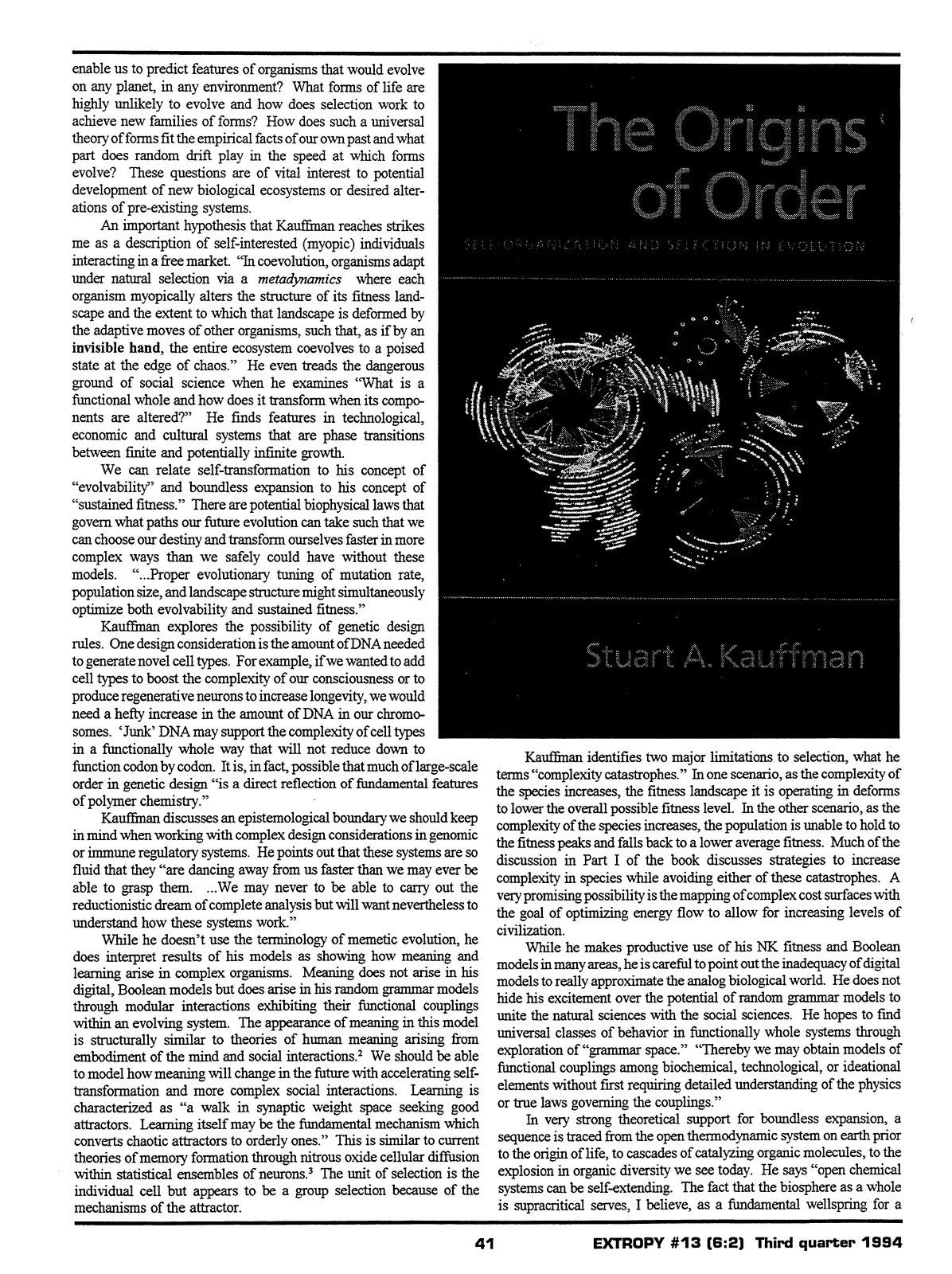
The Origins of Order
SELF-ORGANIZATION AND SELECTION IN EVOLUTION
Stuart A. Kauffman
Kauffman identifies two major limitations to selection, what he terms “complexity catastrophes.” In one scenario, as the complexity of the species increases, the fitness landscape it is operating in deforms to lower the overall possible fitness level. In the other scenario, as the complexity of the species increases, the population is unable to hold to the fitness peaks and falls back to a lower average fitness. Much of the discussion in Part I of the book discusses strategies to increase complexity in species while avoiding either of these catastrophes. A very promising possibility is the mapping of complex cost surfaces with the goal of optimizing energy flow to allow for increasing levels of civilization.
While he makes productive use of his NK fitness and Boolean models in many areas, he is careful to point out the inadequacy of digital models to really approximate the analog biological world. He does not hide his excitement over the potential of random grammar models to unite the natural sciences with the social sciences. He hopes to find universal classes of behavior in functionally whole systems through exploration of “grammar space.” “Thereby we may obtain models of functional couplings among biochemical, technological, or ideational elements without first requiring detailed understanding of the physics or true laws governing the couplings.”
In very strong theoretical support for boundless expansion, a sequence is traced from the open thermodynamic system on earth prior to the origin of life, to cascades of catalyzing organic molecules, to the explosion in organic diversity we see today. He says “open chemical systems can be self-extending. The fact that the biosphere as a whole is supracritical serves, I believe, as a fundamental wellspring for a persistent increase in molecular diversity.” As an aside, I could not help but reflect that recent pictures of the large-scale structure of galaxies in the universe look remarkably similar to what Kauffman calls “flagreed fog” random grammar end-states.⁴ He then makes a random grammar model connection between bounded physical systems such as thermodynamic constraints in chemistry and budget constraints in economics, and “the worlds of ideas, myths, scientific creations, cultural transformations, and so on” that are unbounded.
Two very interesting results from these models are of particular note. The first is that we model each other’s potential behavior (analogous to trust) in such a way that society tends towards a poised state at the edge of chaos. In essence, high degrees of trust (the most complex, discriminating models) will lead to decreased trust while low degrees of trust (the most brute, simple ‘tit-for-tat’ models) will lead to increased trust. While everyone knows that familiarity breeds contempt, it is also true that contempt breeds familiarity. The second result is that: “The extent to which the planner looks into the future governs whether the economy grows at all, slowly, or rapidly.
…Technological growth is strongly correlated with the capacity to see its implications… If the consumer places little value on the future, diversity of goods and services remains small.” The clear implication of this is that the Extropian principles, if adopted, will by themselves be self-fulfilling. There is good reason for dynamic optimism: It works!
Spontaneous order in the absence of outside work is found throughout biology in the form of small attractors. These attractors represent cell types, immune responses, etc. and are easily attained by natural selection to produce stable structures. However, in a strongly counter-intuitive finding, as the complexity of systems increases, natural “selection cannot avoid the order exhibited by most members of the ensemble. Therefore, such order is present not because of selection but despite it.”
This finding of such an inseparable relationship between self-organization and selection that varies with the scale of the parts and the whole is typical of the holism found throughout this book. Other major examples of functional wholes include the idea of autocatalytic polymers being ‘chicken-and-egg.’ There is a lengthy outline of ‘knower-and-known’ systems where representation of and interaction between entities in their environment depends on stability of both the entities and the environment. “In a phrase, organisms have internal models of their worlds which compress information and allow action.” Also, proper growth of organisms depends on a control system of ‘map-and-interpretation.’ ”…The entire genomic system is, in reality, a single coupled system whose attractors constitute both map and interpretation at once.” This holism of Kauffman’s seems akin to the ‘undivided universe’ ontological interpretation of quantum mechanics by physicist David Bohm based on experimental results of non-locality.⁵ I am also reminded of the position of the English philosopher Frances Bradley: “And what I repudiate is the separation of feeling from the felt, or of the desired from desire, or of what is thought from thinking, or the division of anything from anything else. For judgment is the differentiation of a complex whole, and hence always is analysis and synthesis in one.”⁶
Technology is being developed that will allow experimentation in areas that have the responses.
Finally, Kauffman uses artificial life researcher Thomas Ray’s Tierra model ecosystem to show how closely artificial extinction patterns obey the same power law that has been recorded in Earth’s fossil record. The artificially-generated graph is a close match with the actual graph. I bring this up because Ray’s latest paper references Kauffman and discusses “ecological attractors” at length.⁷ Ray also confirms the superiority of analog models to digital models for realism and even references Hans Moravecs’ article “Pigs in Cyberspace” in Extropy #10.
Kauffman’s deepest insight is a direct challenge to the current view of our lives as being merely the result of a series of frozen accidents. “I have made bold to suggest that much of the order seen in organisms is precisely the spontaneous order in the systems of which we are composed. Such order has beauty and elegance, casting an image of permanence and underlying law over biology. Evolution is not just ‘chance caught on the wing.’ It is not just a tinkering of the ad hoc, of bricolage, of contraption. It is emergent order honored and honed by selection.”
This book is a challenging read for those interested in shaping spontaneously ordered living systems towards increased complexity and meaning. The search for a “physics of biology” to help minimize tragic and time-consuming trial-and-error methods of human-directed evolution is brought to the forefront of scientific priorities by Kauffman’s bold thinking.
potential of transforming society. Kauffman proposes that we create life anew. He notes that function must be extremely redundant in DNA and protein sequence space, and therefore, life is created far more easily than we have previously thought. “Life is an expected, collectively self-organized property of catalytic polymers. …Self-reproduction and homeostasis, basic features of organisms, are natural collective expressions of polymer chemistry.” The experiments must risk a complexity sufficient to achieve catalytic closure, but once accomplished, the path is open to make empirical tests on coding mechanisms to help understand why DNA coding is so prevalent today.
Kauffman is seeking patents in a field of molecular nanotechnology that he calls “Applied Molecular Evolution.” There is a finite number of enzymes that will catalyze all polymer reactions. The drive is on to explore DNA, RNA and protein sequence space to custom design for any function desired at all. The potential for individualized drug treatment is promising in immunology and cancer research. ”…Using antibodies from an infected individual, it becomes possible, in principle, to find vaccines for diseases where the pathogen is not yet even known!” Such a powerful technology must be available on the private market for commercial uses and consumer benefits. The military potential for rapid development of customized, biological offensive weapons and equally rapid defenses against them is enormous. Biological warfare may not be plague versus plague, but highly accurate, targeted strikes and selected defense
Notes:
1: Phenotypic space, morphospace, protein space, sequence space, trait spaces, genotype space, complex fitness spaces, RNA space, catalytic task space, shape space, space of biological systems, state space, synaptic weight space, local strategy space, action space, space of symbol strings, peptide space, space of possible polymers, open state space, fixed state space, grammar space, composition space, parameter space. 2: Lakoff, G. Women, Fire, and Dangerous Things: What Categories Reveal About the Mind. Chicago: Univ. of Chicago Press, 1987. Johnson, M. The Body in the Mind: The Bodily Basis of Meaning, Imagination, and Reason. Chicago: Univ. of Chicago Press, 1987. 3: Edelman, G. Bright Air, Brilliant Fire: On the Matter of the Mind. New York: BasicBooks, 1992. Schuman, E. & Madison, D. “Locally Distributed Synaptic Potentiation in the Hippocampus.” Science 28 January 1994: 532. 4: Travis, J. “Cosmic Structures Fill Southern Sky.” Science 25 March 1994: 1684. 5: Bohm, D. & Hiley, B.J. The Undivided Universe: An Ontological Interpretation of Quantum Theory. London: Routledge, 1993. 6: Bradley, F.H. Appearance and Reality. 2nd ed., Oxford, 1897. 7: Ray, T. In press. “An evolutionary approach to synthetic biology, Zen and the art of creating life.” Artificial Life 1(1): xx-xx. MIT Press. I found this paper in the AI Expert Forum Library on Compuserve, dated 21 October 1993.
‘Life is hard,’ someone said to Voltaire. ‘Compared to what?’ Voltaire answered.
Good Mood will appeal to and benefit many persons who are not and have not been genuinely depressed, as well as proving invaluable to depressives. Typically, those of us who think of ourselves as extropian in our values and goals, like to choose our emotional states so as to remove blockages to effective thinking and action. Being deeply attracted to positive self-transformation and the persistent sculpting of a new and superior self, we seek enhanced self-awareness and new tools for self-control and self-definition. Simon’s approach to the understanding and treatment of depression (easily extended to anger, anxiety, dread, and apathy) — Self-Comparisons Analysis — builds on the foundation provided by modern cognitive psychology and its applications to therapy. According to cognitive therapy, whether it be Aaron’s Beck’s, Albert Ellis’s Rational-Emotive Therapy, or aspects of Branden’s self-esteem psychology, our emotions are largely determined by our thinking and are not completely inexplicable forces fully distinct from our cognition. By changing habitual thinking patterns we can leave behind depression, anxiety, apathy, and inappropriate anger, choosing more effective emotional states.
Apart from its value in teaching us how to become more self-aware and self-understanding, Good Mood addresses problems common among persons with exceptionally high standards for achievement, intellect, and behavior. The more we wish to achieve, the more intelligent and wise we wish to be, the grander our goals for ourselves, the stronger the emotional problem that can result when such ambition is combined with certain self-defeating cognitive patterns. The more we want, expect, or demand of ourselves the worse we potentially can feel if we believe we are failing our ideal standards. How do we make ourselves sad, depressed, anxious, or angry, and how can we avoid such self-frustration, whether it be occasional or chronic, mild or acute?
Simon presents the essence of his approach in the form of a ‘mood ratio’, according to which:
Negative self-comparisons (or ‘neg-comps’) result in a Rotten Ratio where we conceive of our actual situation to be worse than some benchmark standard. Your benchmark state of affairs may be one that you were accustomed to and enjoyed, but which has gone; it may be something you expected to happen, such a promotion, a marriage, or getting a book published, but which never came about; it may be something that you had hoped for; it may be something that you feel obligated to do but are
GOOD MOOD:
The New Psychology of Overcoming Depression
by Julian L. Simon
Open Court, La Salle, Illinois, 1993.
Reviewed by Max More not doing; or it may be the achievement of a significant goal that you sought but failed to accomplish.
Negative self-comparisons cannot, alone, cause depression, or anxiety, anger, or dread, Simon explains. Neg-comps lead to depression, for instance, when they are accompanied by a sense of helplessness to change your situation. Sadness results from this assessment of helplessness. If a neg-comp combines with something other than helplessness, the result may be anger or determination. If the sadness produced by a neg comp plus helplessness persists, it becomes depression.
The healthy, effective response to negative self-comparisons and the emotional distress they engender is to launch into changing the circumstances involved in the neg-comp. Responding with anger not only masks the pain (so long as the anger continues to be experienced) but can galvanize you into an attempt to change the situation. Whereas, in depression, a person has lost hope and assumes they can do nothing to improve matters, anger arises where they feel frustrated in their efforts to remove the source of distress. A third possible response involves lying to yourself so as to banish the emotional pain. When lying about one’s personal situation takes over from other responses the result can be schizophrenia or paranoia.
As we can see from this, Simon’s cognitive model of depression allows us to understand the mechanisms producing many moods other than depression. We can see anxiety as produced by a neg-comp where the numerator of the mood ratio is an anticipated or feared outcome. Whereas the depressed person feels the feared outcome to be unavoidable, the anxious person feels uncertain of the outcome, and may feel a little less helpless about the situation. Depression, being past or present-oriented, drains energy with sadness, but anxiety causes a higher level of arousal as the sufferer dwells on the lack of certainty of the future state of affairs.
Mania can be seen as ‘the condition in which the comparison between actual and benchmark states seems to be very large and positive, and often it is a condition in which the person believes that he or she is able to
control the situation.’ [54] Apathy takes hold if a person responds to their painful neg-comps by giving up goals. Without goals there can be no failure; but neither can there be the thrill of the chase and the joy of achievement. Finally, in terms of this approach, various ‘positive feelings arise when the person is hopeful about improving the situation — changing the neg-comp into a more positive comparison — and is actively striving to do so.’ [55]
The theoretical approach of Simon’s self-comparisons analysis and values therapy yields a diverse array of practical means of tackling depression (or milder forms of sadness) or, appropriate modifications being made, apathy, anger, or anxiety. Leaving aside detail and example, these routes to good mood can be summarized as follows:
‘These are the possible tactics: 1. Improve the numerator in your Mood Ratio, by getting rid of misconceptions about yourself, or by learning that your capacities to influence events in a desirable direction are greater than you thought. 2. Alter your denominator to make it less formidable, by changing the benchmarks against which you compare your actual state of affairs. 3. Change the dimensions on which you habitually compare yourself. 4. Retrain yourself so that you seem to yourself more competent and less helpless. 5. Reduce the number of comparisons you make each day, by immersing yourself in work or altruistic activity, or by recourse to meditation or related devices. 6. Examine your basic values to learn what is important to you that may influence your wanting to be depressed or not wanting to be depressed.’ [244]
This last tactic, that of examining your values and reordering them, differs from strategies involving changing your numerator and denominator. Simon devotes several chapters to this especially philosophical approach to mood control, including discussion of Victor Frankl’s logotherapy and the effects of religious conversion on depression. Cognitive therapies, including Simon’s variant, naturally see a place for philosophical analysis in psychology: Since emotional responses involve judgments (usually largely unconscious), the clarification of values and adjustment of perspective can alter our feelings and dispositions.
Does this anti-depression tactic seem more like philosophy than psychology? Choose the label that you like. But more and more, the wisest psychologists have come to view many (though not all) depressions as philosophical in origin, and therefore as requiring a change of philosophy for a cure; some philosophers have known this for thousands of years…Ellis and Harper put the matter bluntly: ‘For effecting permanent and deep-seated emotional changes, philosophic changes appear virtually necessary.’ [157]
The method of improving your denominator by counting your blessings and adjusting your focus ties in neatly with some elements of the extropian attitude of dynamic optimism.¹ In my explication of dynamic optimism, the first of eight characteristics listed was ‘selective focus’. This recommends ignoring unpleasant, painful, frustrating things unless attention to them is of the right kind (active problem solving rather than gloomy reflection) and can yield results. D.O. also suggests both content and context reframing in which you place a more positive, empowering interpretation on an event (content reframe) or you alter the context in which the event is seen. An example from Simon of what amounts to a content reframe would be where ‘Instead of comparing your minor arthritis with perfect and painless freedom of movement, you shift to comparing yourself with a paralytic.’ [157] A dynamically optimistic change of focus would involve something more active than comparing your situation to a worse possible situation; it would involve selectively focusing on lessons to be learned from a difficulty, and ways of moving forward from where you are.
Of course there’s more to values therapy than changing your denominator. In common with life management approaches like that of Stephen Covey or Alan Lakein², values therapy requires the participant to systematically analyze their desires and goals so that they can be coherently ordered. Such a procedure involves 1. asking yourself what you want in life; 2. ranking these desires in accordance to their personal importance; 3. asking yourself if you have missed any truly important desires; 4. looking for conflicts in your list of wants; 5. taking ‘steps to resolve the conflicts between higher-order and lower-order values in such manner that higher-order values requiring you not to be depressed are put in control’. [220] In common with the rest of Simon’s approach, values therapy offers not a quick fix but an effective method that requires attention and perseverance. Discovering the structure of your wants is harder than it sounds, requiring contemplation to come up with a comprehensive list of wants and analysis to determine their relative importance to you, all things considered.
We can best discover our wants by looking inside ourselves, suggests Simon, and not by searching for something universal in humanity. Unlike Maslow or Selye, who agree that our basic values are based in our biology (but who disagree over what those values are!), Simon thinks it more plausible that there is a wide range of basic values. This individualistic approach, though unsatisfying to formalists, seems to me to encourage genuine self-discovery over constructing dubious theories about human nature. Even if there are basic, biologically-grounded wants common to all humans, we might best uncover them by each examining our individual natures.
Given the importance of self-transformation³ to Extropians, we may be especially interested in Simon’s view of how good mood relates to a focus on yourself and your wants or on wants or values outside the self. Simon emphasizes the value of contributing to the good of others, a recommendation that we find in practically all writers on the subject. Personal fulfilment, it is said, comes from looking beyond your
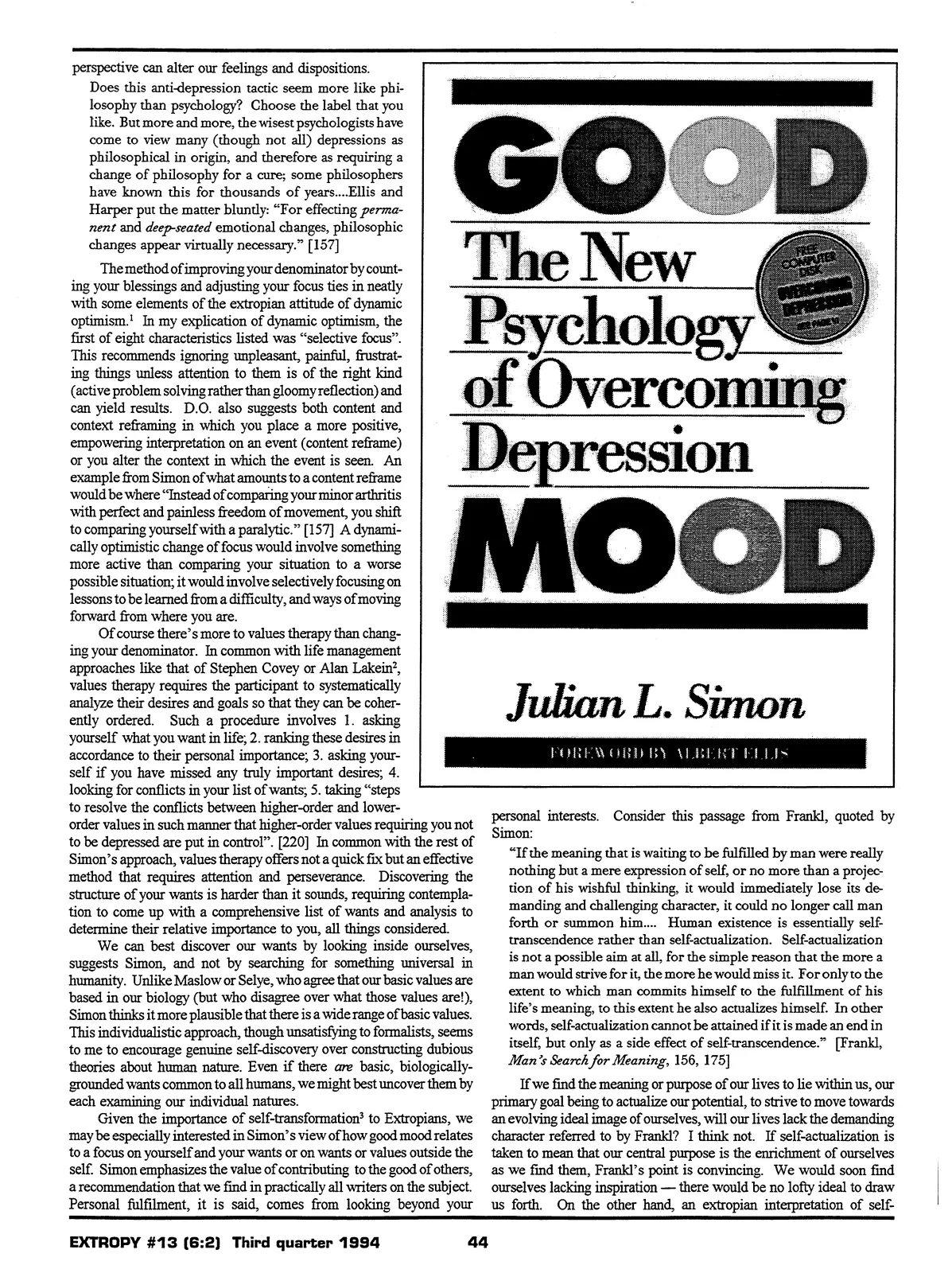
GOOD
The New Psychology of Overcoming Depression
MOOD
Julian L. Simon
FOREWORD BY ALBERT ELLIS personal interests. Consider this passage from Frankl, quoted by Simon:
‘If the meaning that is waiting to be fulfilled by man were really nothing but a mere expression of self, or no more than a projection of his wishful thinking, it would immediately lose its demanding and challenging character, it could no longer call man forth or summon him… Human existence is essentially self-transcendence rather than self-actualization. Self-actualization is not a possible aim at all, for the simple reason that the more a man would strive for it, the more he would miss it. For only to the extent to which man commits himself to the fulfillment of his life’s meaning, to this extent he also actualizes himself. In other words, self-actualization cannot be attained if it is made an end in itself, but only as a side effect of self-transcendence.’ [Frankl, Man’s Search for Meaning, 156, 175]
If we find the meaning or purpose of our lives to lie within us, our primary goal being to actualize our potential, to strive to move towards an evolving ideal image of ourselves, will our lives lack the demanding character referred to by Frankl? I think not. If self-actualization is taken to mean that our central purpose is the enrichment of ourselves as we find them, Frankl’s point is convincing. We would soon find ourselves lacking inspiration — there would be no lofty ideal to draw us forth. On the other hand, an extropian interpretation of self-actualization as self-overcoming, as self-augmentation, clearly has this summoning power.
Terminology can be confusing here: Some Extropians have suggested that the principle of Self-Transformation be renamed “Self-Transcendence”. Self-transcendence has two meanings: (a) Going outside ourselves to find purpose in contributing to others and to abstract goals; (b) Seeking to develop beyond the limits of our current self-stage towards an image of our ideal self. In the second sense, the principle of Self-Transformation embodies a commitment to self-transcendence but doesn’t require service to others or to causes beyond ourselves as a primary goal.
Frankl does have an important point though. If we spend most of our time focusing on ourselves, we will sharply narrow our opportunities for self-improvement. An outward-looking attention to the well-being and growth of other persons and a deeply involved contribution to causes that go beyond our immediate self-interest are necessary for us to fully develop and to exercise our talents and virtues. Benevolence, generosity, and lack of excessive preoccupation with self are certainly healthy and good for us. However, putting self-transcendence ahead of self-actualization, in the senses given them by Frankl and endorsed by Simon, subjects us to the danger of self-sacrifice and manipulation by others who want to use as tools to promote their ends.
As Simon notes, “Values Therapy is especially appropriate when a person complains that life has lost its meaning — the most philosophical of depressions.” [217] “Values therapy may be thought of as a systematic and understandable form of what used to be called ‘changing one’s philosophy of life’. It operates directly on the person’s view of the world and himself.” [229] This suggests to me that the development and promulgation of Extropian ideas may be seen as a kind of cultural value therapy, preparing people for the coming time when aging will be a thing of the past. Most people, confronted with the prospect of extreme longevity and possible physical immortality, express the fear that life will lose its meaning. Such persons are used to conceiving of their lives in the well-established pattern of infancy, childhood, adolescence, adulthood, old age, and death. They ask how anyone could keep working at the same job for millennia, they expect to run out of stimulating things to do and learn, and they imaginatively project their current human forms into their limitless future. Perhaps we can understand part of our task as Extropians to be taking the initiative in acting as cultural psychotherapists, preparing the world for the tremendous changes ahead.
Good Mood, as I suggested at the beginning, is not just for individuals with clinical depression. Apart from supplementing our arsenal as cultural psychotherapists, most of us, some of the time, and to some degree, suffer from the self-defeating thinking patterns dragged into the light by this book. Why do many non-depressives have trouble getting down to the tasks “that they know they ‘should’ undertake for their own good? You know the answers: a. They prefer leisure to exertion. […] b. They convince themselves that not doing the task really won’t be very harmful, and doing it will not be very beneficial. c. They fool themselves that they are just postponing the task for a short time, and keep repeating the procrastination. d. They start the task then give up because they lose patience.” [131] These patterns are shared by the depressive, just in an exaggerated, darker form. The techniques and cognitive discipline recommended in Good Mood therefore can be of benefit to all of us who are not perfectly motivated.
Julian Simon’s new book may come as a surprise to readers familiar with his fine works in population and resource economics⁴ or his more recent work developing resampling in statistics. Simon exemplifies the kind of intellectual that readers of this journal usually appreciate: One who is able to apply his intellectual acuity not only in his native field of economics, but also in the quite distinct areas of statistics and psychology (not to mention business administration). Furthermore, in each of these fields his thinking has challenged conventional thinking and helped clear the way to boundless expansion, improved thinking, and greater effectiveness. It may be that Simon’s advance in the cognitive treatment of mood disorders can be attributed to his multidisciplinary mind, especially his economics background. Economists typically think about values and wants and their trade-offs in a highly analytical manner.
Glum cyberheads will be happy to know that, for a nominal charge, software (“Overcoming Depression 3.0”) is available to accompany the book. The program provides both lessons derived from the book and interactive tutorials that help you identify and modify self-defeating thinking patterns.
NOTES
¹See my “Dynamic Optimism: Epistemological Psychology for Extropians”, esp. the first section, in Extropy #8, (vol.3 no.2, Winter 1991-92).
²Stephen Covey, The Seven Habits of Highly Effective People, Alan Lakein, How to Get Control of Your Time and Your Life. Both of these books have been reviewed in Exponent, the Extropy Institute members’ newsletter.
³See my essay “Technological Self-transformation” in Extropy #10 (vol.4, no.2), Winter/Spring 1993.
⁴For example, The Ultimate Resource.
classifieds
[Classifieds are 40c per word]
Now unreduced print in The (Libertarian) Connection, open-forum magazines since 1968. Subscribers may insert two pages/issue free, unedited. Lots of stimulating conversation. Eight issues (year) $20. 101 South Whiting #700X, Alexandria, VA 22304.
VIEW ORIGINAL SCAN (6 pages)