Issue: EXTROPY #13 · Third Quarter 1994
Author: Max More
Pages: 2 · 1 scanned page
Editorial
EDITORIAL
There is beauty in space, and it is orderly. There is no weather, and there is regularity. It is predictable… Everything in space obeys the laws of physics. If you know these laws and obey them, space will treat you kindly. And don’t tell me man doesn’t belong out there. Man belongs wherever he wants to go.
— Werner Von Braun
The sky is no longer the limit.
— Richard M. Nixon
Even politicians can understand some breakthroughs. Nixon may not have been farsighted enough to have had himself frozen but he did appreciate at least some of the importance of humanity’s expansion into space. We Extropians also appreciate how vital it is to promote space development. Boundless expansion, limitless lifespans, and the spontaneous ordering of experimental communities requires the room and resources to be found off-Earth.
Until now (apart from the introductory section in #1), Extropy has been missing a direct discussion of space technologies and cultural possibilities. With Nick Szabo’s ‘Boundless Constellations: The Emergence of Celestial Civilization’, we begin to rectify this omission. Expect to see more coverage of space issues in future issues and at next year’s EXTRO conference. Nick presents an alternative to the centralized, state-controlled approach.
The idea of ‘uploading’ human consciousness from brains to faster and more powerful hardware is something of a theme this issue. Robin Hanson’s ‘If Uploads Come First’ gives us a hardheaded, economic analysis of the effects of uploaded persons on economy and society. Part Two of Dave Krieger’s interview with David Ross presents more of Ross’s unorthodox thinking, and encourages us to think about the similarities and differences between the religious concept of a soul and the technologically-based idea of self as embodied software.
J. Storrs Hall examines a fascinating future nanotechnology tool known as utility fog. Uploading is only one of the diverse applications made possible by this technology – a technology that blurs the boundary between virtual reality and standard physical reality. Going from future to current tech, Simon! D. Levy continues his series of introductory articles on neurocomputing, this time explaining the workings of sequential neural nets.
Charles Platt (whose interview with me – ‘Taking the N Out of Entropy’ – appears in the current issue of Science Fiction Eye) raises ‘Two Questions for Extropians’ to which I offer brief responses. The first question – regarding how we are to view the idea of ‘pure intellect’ and whether it is separable from or superior to the inherited structure of
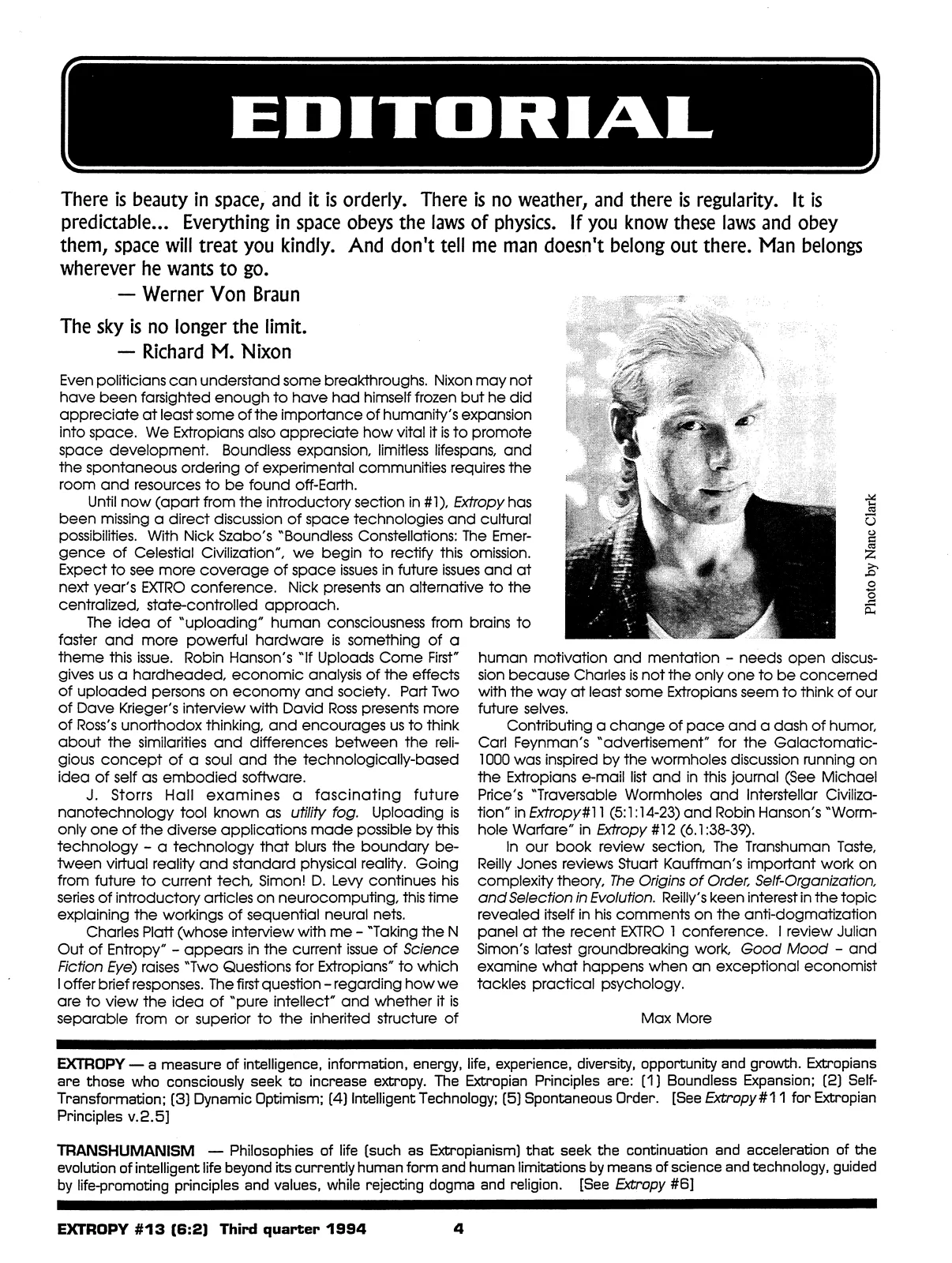
Photo by Nanc Clark human motivation and mentation – needs open discussion because Charles is not the only one to be concerned with the way at least some Extropians seem to think of our future selves.
Contributing a change of pace and a dash of humor, Carl Feynman’s ‘advertisement’ for the Galactomatic-1000 was inspired by the wormholes discussion running on the Extropians e-mail list and in this journal (See Michael Price’s ‘Traversable Wormholes and Interstellar Civilization’ in Extropy #11 (5:1:14-23) and Robin Hanson’s ‘Wormhole Warfare’ in Extropy #12 (6:1:38-39).
In our book review section, The Transhuman Taste, Reilly Jones reviews Stuart Kauffman’s important work on complexity theory, The Origins of Order, Self-Organization, and Selection in Evolution. Reilly’s keen interest in the topic revealed itself in his comments on the anti-dogmatization panel at the recent EXTRO 1 conference. I review Julian Simon’s latest groundbreaking work, Good Mood – and examine what happens when an exceptional economist tackles practical psychology.
Max More
EXTROPY — a measure of intelligence, information, energy, life, experience, diversity, opportunity and growth. Extropians are those who consciously seek to increase extropy. The Extropian Principles are: (1) Boundless Expansion; (2) Self-Transformation; (3) Dynamic Optimism; (4) Intelligent Technology; (5) Spontaneous Order. [See Extropy #11 for Extropian Principles v.2.5]
TRANSHUMANISM — Philosophies of life (such as Extropianism) that seek the continuation and acceleration of the evolution of intelligent life beyond its currently human form and human limitations by means of science and technology, guided by life-promoting principles and values, while rejecting dogma and religion. [See Extropy #6]
VIEW ORIGINAL SCAN (1 pages)