Issue: EXTROPY #13 · Third Quarter 1994
Author: Nick Szabo
Pages: 3–7 · 5 scanned pages
Boundless Constellations: The Emergence of Celestial Civilization
Boundless Constellations
The Emergence of Celestial Civilization
Copyright ©1994 by
Nick Szabo
Illustrations by Nancie Clark
In tsarist Russia, Konstantin Tsiolkovsky first calculated and articulated the Extropian dream of boundless expansion through the cosmos. In free space, his “mansion-conservatories”, far grander than paltry cottages like Versailles, would not collapse under their own weight. Vast fluxes of solar energy streaming through space could be tapped by gossamer-thin parabolic reflectors. Elaborations on space colony designs since Tsiolkovsky include science fiction’s wide variety of imaginative but often fanciful space stations, planetary colonies, and pioneer ships, Dandridge Cole’s bubbled-asteroid colonies in the 1960’s, and Gerard O’Neill’s sleek manufactured suburbias in the 1970’s.
But attempts to implement space habitats, even tiny dependent space stations, have crumbled into disarray. We’ve seen the continued failure of government agencies and their obsolete plans for space stations and planetary bases. Saturn rusts; the Shuttle and Energia production lines have been shut down. Out of the ashes of this failure springs a new vision, where the solar system is recognized to have potential for far more than mere re-creations of Earth, where central planning and narrow goals are replaced by a wide diversity of means and ends. Out of this vision will emerge a celestial civilization far greater than that for which any human can plan.
Constellations
The NASA approach, the Von Braun vision of “next logical steps” for “the space program,” is exemplified by the Shuttle and Space Station “Freedom” (SSF). These projects failed to meet their targets by a wide margin. The military and commercial users took most of their payloads off the Shuttle after wasting much effort to customize their satellites for that vehicle, and SSF has failed in a jumble of disorganization and miscommunication. Over $50 billion has been spent on these two projects with no reduction in launch costs and no improvement in commercial space industrialization. Russia’s space stations have consumed similarly large sums with little to show for the effort. Meanwhile, military and commercial users have come up with a superior strategy for space development: the constellation.
One fundamental problem with the concept of a space station is that a large “stepping stone” or “centerpiece” of “the space program” will by its very nature be in the wrong orbit. If we choose 28.5 degrees, we lock out participation by the Russian launch sites and the largest users of space, our military in polar orbit. If we put it at 50 degrees the penalty for using it as a “way station” to Clarke (24-hour) orbit, the Moon, Mars, or asteroids is prohibitive. In turn, 28.5 degrees still puts a significant penalty over going straight to Clarke orbit, the Moon or Mars. If we put it in polar orbit, it is useful for the military, useless as a way station, and we can’t get to it from the world’s main spaceport, the USAF’s Canaveral launch site.
In the new approach, different functions are broken down into different constellations placed in the optimal orbit for each function: thus we have the GPS/Navstar constellation in 12-hour orbits, comsats in Clarke and Molniya orbits, etc. Secondly, a task is distributed amongst several spacecraft in a constellation, providing for redundancy and full coverage where needed. SSF’s different functions — satellite repair, life sciences research, space manufacturing research, etc. — require quite different environments and orbits. For example, by far the largest market for spacecraft servicing is in Clarke orbit. For a tiny fraction of the cost of a large station in the wrong orbit, we can put up a fleet of small teleoperated robots and small test satellites on which ground engineers can practice their skills. Once in place, robots can pry stuck solar arrays and antennas, attach solar battery power packs, inject fuel, and take on more sophisticated tasks as experience is gained and AI improves. Once the fleet is working, it can be spun off to commercial companies, who can work with the comsat companies to develop comsat replaceable module standards.
Space travel is expensive. $500 buys a ticket to the other side of the planet, but it costs over $10 million for a cut-rate, subsidized ride on the Russian low-Earth-orbiting space station. Automation and miniaturization are improving far faster than launcher and space habitat technology, so it will remain much cheaper to travel in space by robot proxy. In the first decades of the 21st century, instead of Mars bases with domed bubbles and spacesuited astronauts, we will see hundreds of insect-sized robots equipped for telepresence. Our entire solar system will be saturated by instruments: cheap, legion, and everywhere. Virtual reality will be less expensive and more effective than space suit reality.
To get around time lags of seconds (the moon), minutes (Mars), or hours (the outer planets), highly realistic virtual colonies will be built on Earth, starting with high-resolution, fractally enhanced 3D maps of planetary surfaces, created from data returned by tiny spacecraft. A teleprogramming protocol will be used to reduce the time-lag problem to a lag in transmitting corrections to simulation errors.
We will work and play in many virtual space colonies before we get around to building any real ones. Automated space tourism will live nicely beside automated science, prospecting, and mining.
Boundless Expansion
The solar system provides an impressive venue for expansion. Astrophysicist David Criswell (Finney & Jones, 1985) notes that we could use space to sustain a 20% per year growth in our use of bulk materials for many centuries to come. At this rate asteroids would be upgraded by 2140, and Jupiter taken apart and converted to space colonies between 2200-2400. This is only a tentative first step. If Sol’s outer layers could be taken off, we could turn it into 15 white dwarf stars, each with an expected life of over 20 trillion years. Alternatively, some of the mass could go into building further space colonies, once Jupiter has been upgraded. Lifting solar plasma from the surface might be accomplished by Criswell’s planet-sized, sun-straddling magnetohydrodynamic machines. These require 1.9e14 (hundred trillion) joules of energy per ton, and providing 10% of the solar flux for this task permits an upgrade rate of 6.5e18 (million trillion) tons per year.
At this rate it would take 300 million years to convert the sun to a collection of white dwarfs and more cool matter for space colonies. Building only one white dwarf would leave a distribution of life-forming elements from this upgraded matter sufficient to make 6,650 biospheres the size of Earth’s every year for 300 million years. Alternatively, most of this mass could be used to build nanomachines or to make additional white dwarfs. We can take solar decentralization even further; once we master the art of confining hot dense plasmas in magnetic bottles, we can subdivide the sun to as fine a granularity as we like.
The sun currently emits 81 trillion kilowatts per person, while the “wasteful” developed countries consume only 20 kilowatts per person. Thus, we can increase some combination of population and energy consumption by up to a factor of 4 trillion within our own solar system. Gossamer mirrors in microgravity can concentrate thermal energy with orders of magnitude less mass and pollution than energy production on Earth, so there is also short-term economic incentive to tap into this resource.
Unfortunately, converting sunlight to electric power is inefficient and requires a gargantuan investment of capital. A much cheaper source of near-term electric power may come from tapping Jupiter’s magnetic field, a dynamo 19,000 times stronger than the Earth’s, with electrodynamic tethers. Metis is the innermost known moon of Jupiter, probably a captured asteroid dusted with sulfur from Jupiter’s famous volcanic moon, Io. Traveling through the magnetic fields and inner Van Allen belts of Jupiter at 9,100 meters per second, Metis creates an electric potential of .68 volts per meter. Io, which generates 400,000 volts across its surface out where the magnetic field is weaker, sweeps up enough plasma to create a 5 million amp flux tube though the plasma between itself and Jupiter’s poles. A tether with a good plasma collector may be able to tap 1 million amps at Metis, giving 10,000 kilometers of conducting cable, or the same generating capacity as 680 large nuclear plants on Earth. Generating electricity at Jupiter is almost as simple as laying down the cable, making it by far the cheapest source of electric power in the solar system.
Ultimately we would be tapping the orbital energy of Metis, which is enough for us to generate 1 billion megawatts for 630 years, before Metis falls into Jupiter. Similar amounts of energy await in Metis’ neighbor moons, Amalthea, Thebes, and Andrastea. Furthermore, we can arrange to perturb asteroids and comets so that they are captured into retrograde Jupiter orbit. In this orbit, the power generated per meter of cable would be over ten times the power generated at Metis, because the orbit is traveling against instead of with Jupiter’s rotating magnetic field.
The sun currently emits 81 trillion kilowatts per person, while the “wasteful” developed countries consume only 20 kilowatts per person. Thus, we can increase some combination of population and energy consumption by up to a factor of 4 trillion within our own solar system.
With its copious supply of volatiles and organics, the ability to capture metal asteroids, and its cheap electric power supply, Jupiter may become the industrial center of the solar system. With cheap power we can transmute elements, make antimatter, perform kilometer-scale arc welding, electroplating, vapor and plasma deposition, and much else. Laser beams based at Jupiter might power interstellar spacecraft or transmit power to various points around the solar system.
Not only can we tap cheap energy, we can also reduce the energy cost to travel around the solar system to nearly zero. Elevators use counterweights so that only frictional energy is expended in taking people to the proper floor; we can use the same principle to transport cargo between orbits.
One energy-conserving system is called the reciprocating mass driver. These electromagnetic catapults not only launch payloads, but also catch payloads and slow them down, tapping their energy to accelerate other payloads in the opposite direction. The movement of payloads around the solar system can be scheduled so that momentum and energy are conserved at each station. Any inefficiencies in the solar system mass driver net work can be made up by launching payloads with excess velocity at energy-rich Jupiter.
Are there any ultimate limits in our potential use of the solar system? Freeman Dyson notes that the rate of energy metabolism falls with the square of the temperature. This has the consequence that, in an expanding universe, life of any fixed degree of complexity can survive forever upon a finite store of energy. Cold environments are fundamentally more hospitable to complex forms of life than hot environments. Life depends less on an abundant supply of energy than on a good signal-to-noise ratio. It is easier to keep warm on Pluto than cold on Venus. Dyson has calculated that the total energy reserve contained in the sun would be sufficient to support forever a society with a complexity 10 trillion times greater than our own.
Crossing the Product Desert
Thus we see the vast potential for expansion in the solar system, in the intermediate term by first industrializing and then dismantling Jupiter, and in the long term by upgrading the sun itself. But how can we get there from here? Future technology has been described as a “product space”, full of metaphorical mountains, deserts, fertile valleys, and oases. Many long-range visions, from nanotechnology to space colonization, suffer from a “product desert” between current art and future potential. Business is not willing to invest in the long-range vision, and there is a dearth of intermediate profitable businesses. How can we cross the product desert between ourselves and the vast celestial communities we want to build?
Today the biggest commercial space business worldwide is communications: between $4 billion and $20 billion per year, depending on whether you choose to count military consats, ground stations, and the like. The industry has grown at 10% annually during a
Solar soil worldwide recession. Despite continued predictions of its imminent doom at the hands of fiber optics, stocks like Comsat are trading at all-time highs. Communications satellites are moving into niches quite different than those served by fiber, and their throughput has improved almost as rapidly as that of fiber. Former billboard salesman Ted Turner found the ultimate billboards, TV transmitters in Clarke orbit to beam advertisements, and incidentally great propaganda for capitalism in general, across the globe. Did a billboard salesman topple the Soviet empire?
Space tourism has been widely touted, but the Russians manage less than $30 million in revenue a year (from other governments), a small fraction of the cost of the Mir program, and only 1% of the projected annual cost of NASA’s space station. Automated, virtual tourism is possible but will be a similarly small market. Militaries will continue to play a leading role in space with their automated systems, but they may cost as much in bureaucratic obstacles as they provide in capabilities. Solar power satellites require $10’s of billions in high-risk investment while offering no substantial cost reductions. However, there are many intermediate uses for solar power: energy for weapons, space factories, high-power communications, emergency power or light delivered to specific locations on Earth, etc.
Microgravity promises many long-term advantages. On Earth, every activity involving large weights is dominated by the cranes, rails, engines, and other machinery needed to handle heavy objects in Earth-normal gravity. The energy/capital ratio of solar energy collectors in microgravity can be many orders of magnitude lower than any thermal power source on Earth. We can build kilometer-sized gossamer structures, mix materials without convection or separation of immiscible phases, manipulate vast volumes of plasma, etc. Single crystals can be ten or twenty times as strong for their size as the same materials in less ordered form. Several separation processes, such as electrophoresis, work much better in free space.
Unfortunately at launch costs of $8,000 per kilo to even the lowest orbit, industry is far from being able to afford to take advantage of such possibilities. The chance of large industries along these lines is small unless the cost of raw materials in orbit is reduced by several orders of magnitude. Asteroids have long been known to contain vast quantities of elemental iron and nickel for steel and could serve as a source of petrochemicals as good as oil shale. One recently suggest source is volatile ice (water, methane, ammonia, etc.) delivered via ice rocket from Jupiter-family comets, those with elliptical orbits between Earth and Jupiter.
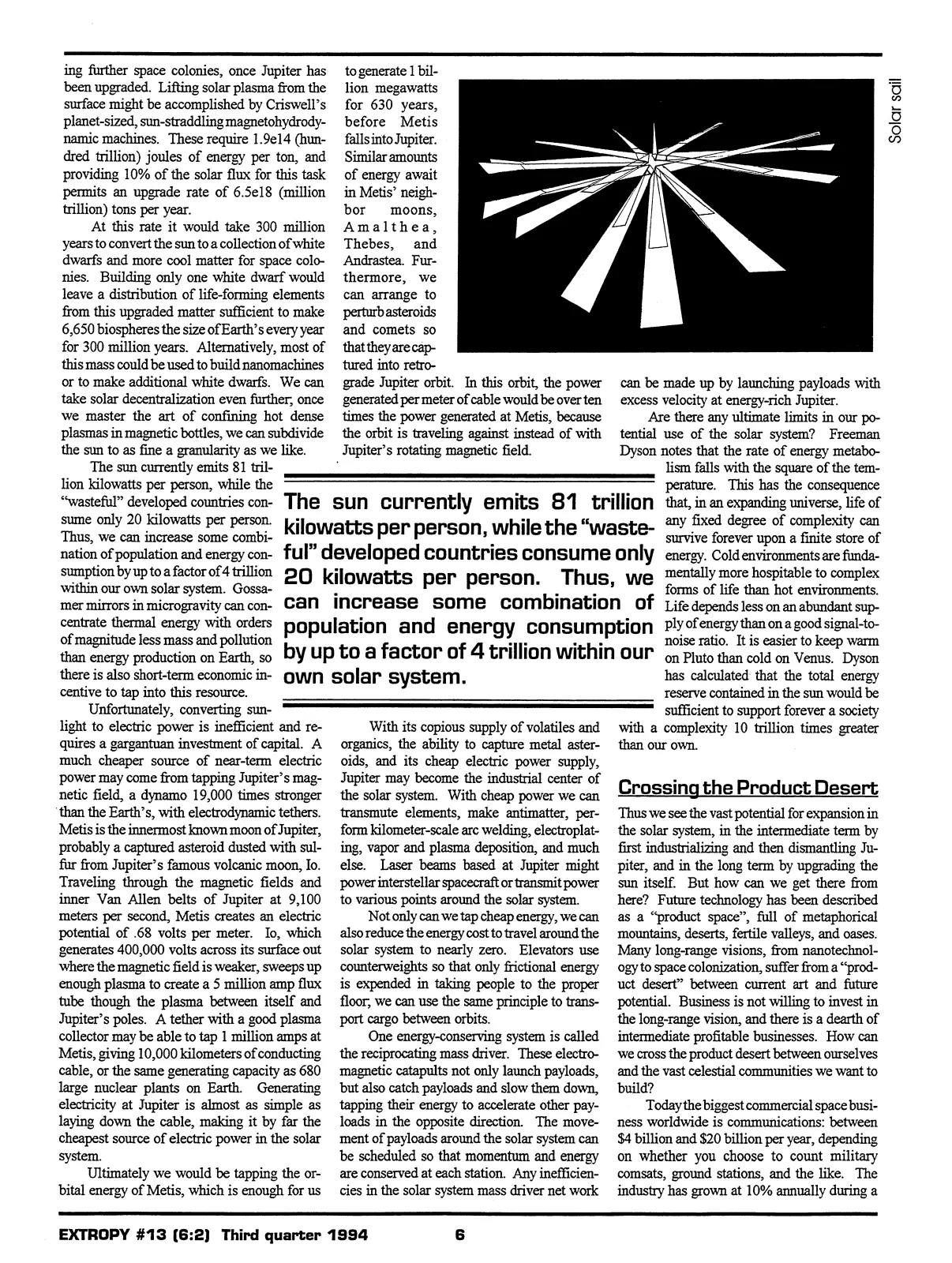
An ice rocket consists of a long cylinder about the same size and shape as a Space Shuttle’s solid rocket booster, but made out of ice and coated with a thin insulating paint. To this is attached a tiny thermal rocket, about the size of a fist, and a tiny nuclear reactor, or few square meters of mirror, which concentrates sunlight on the rocket engine. The engine slowly eats the ice, converting it into a high-velocity vapor exhaust. The rocket engine is small and simple, so that dozens of them can be built and launched on a commercial budget at launch costs not much lower than today’s.
To mass-produce the ice rockets we melt cometary ice and purify it with a centrifuge. We form the ice cylinder in two steps. First we freeze a thin shell by wetting a large, cold cylindrical form. As this ice gets thicker, it freezes further layers more slowly, so we start squirting small spheres across a shaded vacuum. These spheres freeze on the outside, then accumulate on the inside of the cylinder. Soon the cylinder is filled with partly frozen water, which will continue to freeze over several years while the rocket travels towards its destination.
The ice maker is the most important part of the system. It must produce a very high ratio of ice mass to equipment mass, and it must be automated and reliable; think of a tiny auto-maintained sewage treatment plant. Other parts of the comet (organics, dirt, etc.) can be gathered and attached as payload. The cylinder is then attached to the small rocket engine, whose tiny thrust over the course of two or three years delivers the payload to a variety of destinations: orbits around the Earth, Jupiter, or Mars, the surface of Earth’s Moon, or to asteroids. To get to high Earth orbit we must exhaust about 90% of the ice, or 80% if we take a couple extra years to use a gravity assist. We might also find ice hidden in some Earth-crossing asteroids, in Martian moons, or at the lunar poles, in which case more than 10% can be obtained.
If the output of the ice maker is high, even 10% of the original mass can be orders of magnitude cheaper than launching stuff from
Earth. This allows bootstrapping: the cheap ice can be used to propel more equipment out to the comets, which can return more ice to Earth orbit, etc. Today the cost of propellant in Clarke orbit, the most important commercial orbit, is fifty thousand dollars per kilogram. The first native ice mission might reduce this to a hundred dollars, and to a few cents after two or three bootstrapping cycles.
The cost of other materials for space industries would also be drastically reduced. Besides vacuum and microgravity industries, one industry with a vast market — recreational and other officially unapproved drugs — gains a substantial, little noticed advantage from operating in space. The military has been smuggling information through space for years. It flies over enemy airspace, shooting photos, dropping them in film cartridges or transmitting them home. It beams through Clarke orbit and around the planet a wide variety of data. Some say memetic warfare via comsat played a major role in bringing down the Soviet Union.
Just as a spy satellite knows no border, so a reentry vehicle knows no border guards. Just as it has proved difficult to defend against even small numbers of incoming nuclear war-heads, so it may be prohibitive to strike down large numbers of cheap, disposable reentry vehicles, sintered from lunar or asteroid regolith, sometimes as decoys and sometimes carrying their vital payload directly to the local distributor, anywhere on the planet. Within minutes of its detection by NORAD, a reentry vehicle has arrived at its exact location and its valuable (>$1,000/kg) payload taken away by the local dealers. In return, the dealers finance resupply launches to the space industries via an encrypted digital black market, perhaps fronting as a legal space pharmaceuticals manufacturer.
Cheap water and organics are essential to drug manufacture. Jupiter-family comets are the leading potential source. Such volatiles may also be available at the lunar poles, Mars’ moons, or certain Earth-crossing asteroids. Alternatively, the crops can be grown in large bubbles on Mars itself. A Mars-fueled shuttle combined with an ice rocket makes cargo shipment to Earth very cheap, a few dollars per kilogram.
Once the volatiles and organics have been separated, they are fed to a series of chemical microreactors and converted to essential nutrients and construction materials for greenhouses. Greenhouses are made in a very simple, automated fashion, for example by pumping air into liquid polymer spheres which are then solidified and filled with nutrients and trellises for the crop. The crops grow not only drugs, but also fiber and resins to provide structural strength for further greenhouses, and genetically engineered enzymes are extracted and used in the chemical microreactors. Early nanotechnology, in the form of ‘techno-ribosomes’ or assemblers might also help to construct the greenhouse and reactors. This self-replicating greenhouse system might expand exponentially across the volatiles of the inner solar system, converting them into drugs and reentry vehicles for delivery to Earth.
At final approach to Earth, the cargo vessel makes last-minute adjustments and screams down to its destination, until the last minute when high-g parachutes brake the cargo to a gentle landing. At the same time other elements of the ‘meteor shower’, decoys, rain down at various nearby locations, diluting law enforcement resources in the area. For further stealth, the deliveries might be timed to correspond with actual meteor showers.
This business might be large, in the $10’s to $100’s of billions of dollars per year, but there will also be political pressure to stamp it out. It is not clear how this will be accomplished. By the terms of the Outer Space Treaty, no nation can claim any region of outer space. Except for treaties specifically regulating certain regions, e.g. Clarke orbit, space is an anarchy. From space, national boundaries are shown to be a mere figment of Earth-bound culture, and we can decide anew whether to take these coercive organizations with us into space.
Most of the tech needed for self-sufficient space colonies is developed in the self-replicating greenhouse system for growing crops. Interestingly, recreational drugs also dominated the settlement of our last great frontier, the Americas. Most of the early English new world colonies were started to make tobacco or rum.
Another major New World export was precious metals. Might we find quality ores in space? Many iron meteors, and by extension metallic asteroids, have platinum ores of higher grade than any found on Earth, but unfortunately the capital costs are high and the market ($3 billion/year) is small.
Mars in its ancient state of volcanism and running water may have formed many valuable ores. Mars Observer may have started returning its 1.5 meter resolution pix of Mars by the time you are reading this. Gold deposits of the same quality as those which once existed on prehistoric Earth could trigger a bobonanza; the gold mining market is over $10 billion per year.
Several authors have proposed making CH₄/O₂ propellant from Mars atmosphere. This procedure is even simpler than ice mining: simply draw CO₂ from the atmosphere and react it with hydrogen to form methane and oxygen. Hydrogen can be shipped from Earth or extracted from Martian ice. The propellant can power rovers, mines, and single-stages surface/orbit shuttles. These boost the ore off the planet, and ice rockets ship it back to Earth. If we find high quality ore (nuggets, à la Sutter’s Mill) a start-up automated gold mining operation could be cheaper than NASA’s proposed grandiose astronaut mission. Unlike NASA, the project could bring in an impressive 30% annual return, assuming only conservative launch cost reductions at Earth. After the ice rockets, Mars SSTOs, and automated greenhouses are in place, people can travel to and live on Mars for years or even lifetimes, and earn massive salaries tending the burgeoning greenhouse and mining industries located there or in orbit above.
New Visions
The traditional scenario involved mining the Moon to build kilometer-scale colonies and solar power satellites (SPS), but the capital costs are enormous, SPS would probably be more expensive than second-generation nuclear and natural gas plants on Earth, and the Moon probably lacks the volatiles and organic materials essential to life and industry. The mining of comets and asteroids, bootstrapping ice rockets and self-replicating greenhouses to supply a large number of big markets, allows a different path to space colonies, and more diverse markets for funding them. If space industry infrastructure can be established by a different business, and costs come in significantly lower than Earth-based sources, the electricity market is very large (>$500 billion/ year globally) and might provide a vast long-term space colony export market.
Mars and free-space colonies will likely compete for attracting colonists. Both kinds will initially resemble grim, Antarctic-style outposts, but as nanotechnology matures it can take advantage of the vast material and energy in space to build vast biospheres and cities unparalleled on Earth. Space will move from being an outpost for hardy workers to being a venue for pioneers wishing to vastly expand their capabilities. Jupiter may end up as the epicenter of space colonization, with cities both in orbit and on the Galilean moons. Eventually, Jupiter itself will be upgraded, turned into thousands of celestial cities strung around Sun.
Freeman Dyson’s vision of affordable space colonies starts with genetic engineering to enable colonies of plants and animals to grow and spread in alien environments, and advanced automation or AI to allow machines to go out ahead of life and prepare the ground for life’s settlement. His Martian potato lives deep underground, its roots penetrating layers of subterranean ice while its shoots gather carbon dioxide and sunlight on the surface under the protection of a self-generated greenhouse. A comet creeper is a warm-blooded vine which spreads like a weed over the surface of comets and keeps itself warm with a super-insulating fur as soft as sable.
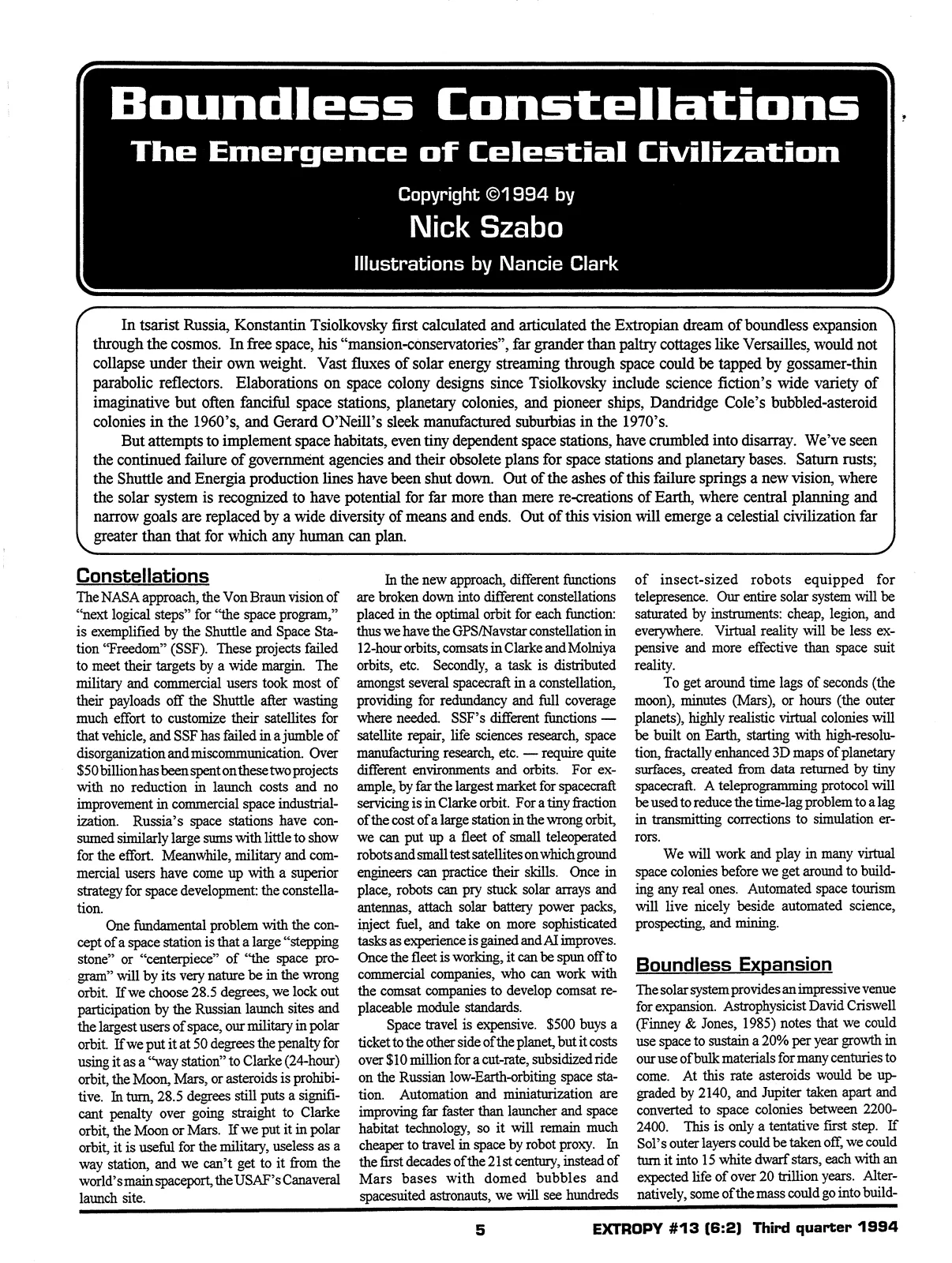
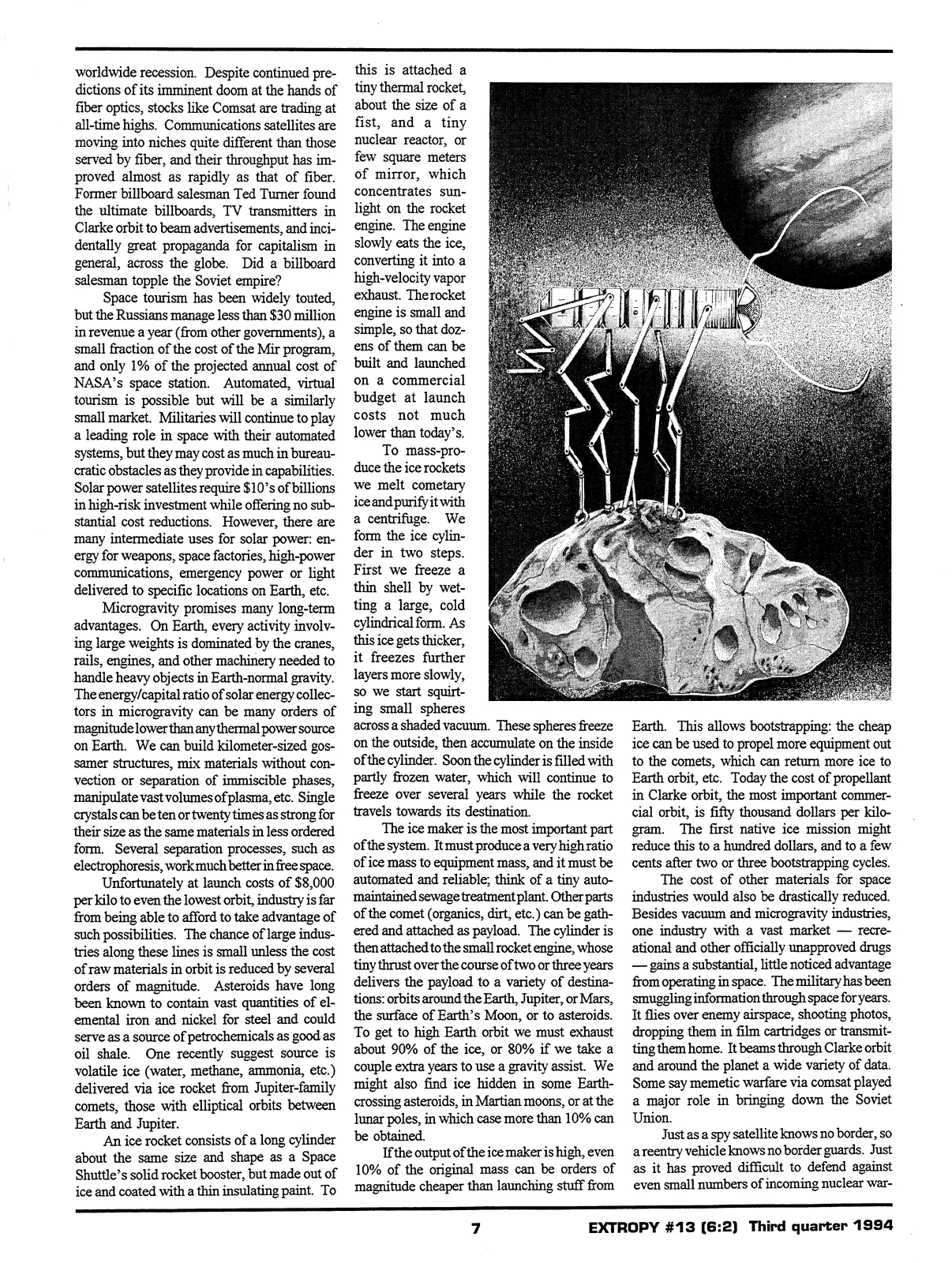
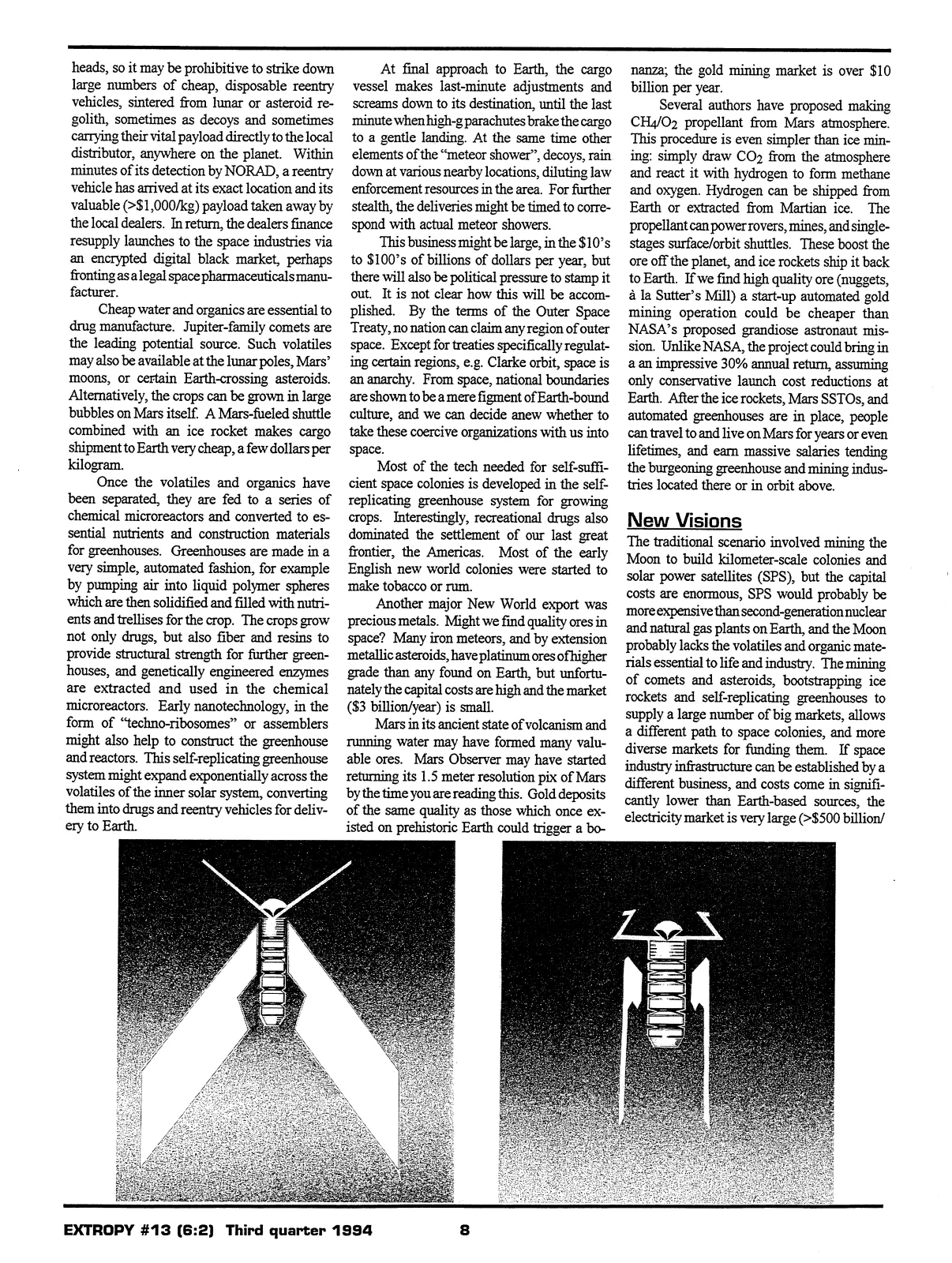
The space butterfly, is fed on Earth like a caterpillar, launched into space like a chrysalis, and metamorphoses itself in space like a butterfly. It will sprout solar sails instead of wings, grow telescopic eyes to see where it is going, gossamer-fine antennae for receiving and transmitting radio signals, long springy legs for landing and walking on the smaller asteroids, chemical sensors for tasting the asteroidal minerals and the solar wind, electric-current generating organs for orienting its wings in the interplanetary magnetic field, and a high-quality brain enabling it to coordinate its activities, navigate to its destination, and report its observations back to Earth. The butterfly might also have a chemical rocket. To refuel itself, it first navigates to a comet or planetary ring and browses there, eating ice and hydrocarbons and replenishing its supply of propellant. If one ring tastes bad it can try another, moving around until it finds a supply of nutrients with the right chemistry for its needs. After eating its fill, it will use internal metabolic processes with the input of energy from sunlight to covert the food into chemical fuels. [See illustrations.]
Dyson envisions small Mayflower-style settlement expeditions to the asteroid belt. Settlers might finance their cyborg tool set with small niche businesses that thrive on isolation, like purebred breeding and genetic engineering. In the long run the gossamer mirrors built by these space dwellers form a complete Dyson sphere around the sun, lest
GLOSSARY
Clarke orbit: An equatorial orbit with a period equal to the planet’s rotation, so that satellites in this orbit appear fixed in the sky from the planet’s surface. Also called ‘geosynchronous orbit’ (GEO), it is the home of most communications satellites.
Molniya orbit: High-inclination, 12-hour orbit. Satellites in Molniya orbit spend most of their time over the north or south pole, so this orbit is used for satellites linking extreme northern or southern latitudes.
Jupiter-family comets: Comets that have been captured by Jupiter into orbits resembling Earth-Jupiter transfer orbits, with periods between four and six years.
Transfer orbit: Elliptical orbit tangent to two circular orbits, which the spacecraft follows when boosting from the first circular orbit to the second.
SSTO: Single-stage-to-orbit rocket.
Reciprocating mass driver: Electromagnetic catapult combined with an electromagnetic deceleration tube that recovers energy from incoming payloads.
Upgrade: Convert a planet or sun’s mass into useful form (massive computers, space habitats, etc.)
any of its photons go to waste. Unlike O’Neill’s cylindrical space colony or Larry Niven’s Ringworld, Dyson’s sphere is an emergent structure, not a preplanned construction. The Dyson sphere coalesces out of millions of space colonists trading surface-area real estate in a peaceful celestial market. Going beyond Dyson and O’Neill, extropian visionaries have conceived of space colonies as electronic posthuman communities, shucking biospheres for vast computer brains manufactured in space. In space, semiconductor manufacturing processes can be scaled up by factors of a million or more. After conquering the solar system with self-replicating nano-assemblers, spores for transmitting stations are shot across the galaxy and the immortal explorers beam themselves from star to star, eventually meeting on the far side of the galaxy for the greatest Extropian party of them all. At the same time, many Extropians might choose ‘boundless implosion’, seeking ever small computers and ever faster transmission times, until the very bottom of physics, if such a bottom exists, is reached. With currently known physics, Hans Moravec estimates our solar system could contain more than 10²⁰ (1 million trillion trillion) cities, each providing brain storage to a million posthumans (see ‘Pigs In Cyberspace’, Extropy #10).
Conclusion
From Konstantin Tsiolkovsky to Freeman Dyson and beyond, visions of space have fired our imagination. Space offers a vast field of future boundless expansion. Space is not a dire necessity; we can obtain the resource and liberties we need to be posthuman here on Earth. But in the long run we need not limit ourselves to one tiny nugget of the solar system. Space is useful in bits and pieces now, and becoming more so. Most of the technology needed for future space efforts is being developed now for use on Earth. Space colonization will emerge from the work we do now to make Earth a free and prosperous place, an extropian planet.
Bibliography:
Dyson, Freeman, Infinite in All Directions, Harper & Row 1988.
Finney, Ben and Jones, Eric eds. Interstellar Migration and the Human Experience, University of California Press 1985.
Hobbs, David, An Illustrated Guide to Space Warfare, Prentice Hall 1986.
Lewis, John & Ruth, Space Resources: Breaking the Bonds of Earth, Columbia University Press 1987.
McDougall, Walter, The Heavens and the Earth: A Political History of the Space Age, Basic Books 1985.
O’Neill, Gerard, The High Frontier, Bantam Books 1976.
Wertz, James and Larson, Wiley, Space Mission Analysis and Design, Kluwer Academic Publishers.
VIEW ORIGINAL SCAN (5 pages)