Issue: EXTROPY #12 · First Quarter 1994
Author: Bill Eichman
Pages: 3–11 · 9 scanned pages
Ocean Colonization: A Practical Approach
Ocean Colonization
A Practical Approach
by Bill Eichman copyright ©1993
The Dream
- Colonization of the Oceans — The perennial dream of the red-blooded, raised-on-frontier-stories, post-moonwalk, orbit-denied, SF-reading, technology-loving, adventure-hungry, (ex)nerd.
- The chance to face and develop a truly challenging frontier.
- Trillions of cubic feet of low-cost “real estate”.
- “Free Oceania”, and the opportunity to start an entirely new nation.
- Freedom (hopefully) from the control of governments. (Not from their influence — this is a planet made small by the jet and rocket engine.)
- The chance to build a new, dramatically more sophisticated society, relatively free of the territorial, economic, personal, and religious tyrannies of our ancestors.
- The chance to live drunk on freedom; the freedom of the frontier. The chance to live as a human being, away from the smell of obedience. The chance to make fortunes.
The Reality
- The most corrosive environment on the planet.
- The most violent weather on the planet.
- Death by drowning an ever-present possibility.
- Rapid vertical pressure change.
- Political & Legal vulnerability. Military vulnerability.
- Extremely expensive infrastructure. High start-up cost.
- Extensive specialized knowledge and skills required.
- Psychologically threatening and physiologically sickening (sea sickness, etc.).
I’m an ocean colonization hobbyist. I “waste” my leisure time tinkering with the complicated social and engineering puzzle of living on and under the planet’s oceans. I’m qualified to write for Extropy on the topic of ocean colonization primarily by default; for there exist no ocean colonization professionals.
The topic of ocean colonization seems inextricably mixed with the “Start your own Country” movements and projects. This creates some very messy problems, in which law, politics, common sense, engineering, and economic imperatives combine to trip up the unwary social dreamer.
Let me make my prejudices clear. I do not believe that it is practically possible to “Start Your Own Country”; not, at least in the ways that are described in Strauss’s book of a similar name, or are suggested in the “Oceania” advertisements that are appearing in the libertarian community. I would argue that the basic idea presented by the “Start Your Own Country” proponents is flawed at the root. “Start Your Own Country” enthusiasts appear to be operating from the axiom that if they can establish a new physical and political territory, that they can then take advantage of that frontier to become wealthy and powerful; whereas I think that the evidence of history is that the opposite is true, that is, that if a people becomes wealthy and powerful, then they can define and defend a new territory, and thus create for themselves a new country.
If it were feasible and possible to easily and openly start a new, independent country, why aren’t the multinational corporations and multi-millionaires and billionaires already doing it? Wouldn’t the tax benefits alone be irresistible?
For all practical purposes, no attempt to form a new country will be allowed to stand, either legally or physically, by the existing gangs of nations. It is intrinsically against the interests of the existing countries to allow any new competitors to enter the “Government Protection Racket”. There are only two things that matter in the game of nations — real wealth, in terms of resources, information, trained workers, and liquid capital; and effective military force and an effective weapons technology and industry.
If you want to start a country, you must start by amassing a fortune, and building a credible army. Anything less, including a move to “International Waters”, is essentially an exercise in eccentricity that will be disassembled immediately if it ever becomes a source of irritation for a genuine wealth-controlling, armed and armored nation. (I’ll leave for another time discussions about new forms of wealth and new types of military supremacy — possibly the rapid and sweeping technological changes engulfing our planet will make country-starting more feasible. Certainly I hope so; I’m as interested as the next fellow in escaping the totalitarian thugs who have effectively co-opted our planet’s governments, even if I’m entirely skeptical of the current “Start Your Own Country” movement and the concept of a “Free Oceania”.)
However, it would definitely be possible to increase the relative freedom from government interference in one’s life by living at the very fringes of one’s “Nation”. Many taxes could be avoided, and many regulations circumvented, simply by living in a area and in a way which makes government enforcement difficult, expensive, and inconsequential. This is true if you choose to live in Northern Mexico or the Appalachian backwoods, and it would be doubly true if your home was a mobile ocean platform. As long as you avoid attracting large scale media attention, the odds are extremely high that you would simply be ignored by the government.
The big problem with this relative freedom approach to ocean colonization is that it may not make much sense to try to establish a safe floating ocean dwelling, which is likely to cost hundreds of thousands of dollars and still be quite spartan, when that same money spent in Northern Mexico or the North American backwoods could build a fairly substantial estate — an estate with no worries about drowning, or sharks, or storms, or corrosion, which are every bit as real and dangerous an adversary as the taxman.
As far as I can determine, after many years of hobbyist study of ocean colonization, there can be only one really plausible reason to pursue the realization of ocean living at this time; and that is the personal love for the idea, for the oceans, and for the frontier. To do it for the pleasure of it, out of curiosity, and a desire to live a genuinely wild and unusual lifestyle.
Please notice the disclaimer “…at this time.” We can easily predict that increasing population pressures and mounting competition for natural resources might make ocean colonization a virtual necessity over the course of the next five hundred years. It’s possible that getting in on the ground floor of ocean colonization now could leave hobbyist ocean colonizers in possession of extremely valuable technical know-how in the future. Still, unless you have a genuine love for the dream of ocean colonization, you would probably be wiser to invest your money in real estate, or mutual funds. There is however one possibility, which I describe in the section “What can Extropians do?”, which combines, in a way, investment in real estate with ocean colonization, and this might prove to be a real moneymaker within a few short decades.
Can the Dream be Realized?
If ocean colonization is such a good idea, why aren’t the rich industrialists already doing it? They’ve got the giant ships, the subs, the drilling platforms, floating factory complexes, the whole works — why aren’t they colonizing already?
That’s a good and important question. Clearly, the answer is that there’s not enough profit in it.
Even a very cursory examination of the topic of ocean colonization will reveal its be profitably carried out within an ocean colonization program. An ocean colony is unlikely to compete effectively by mining manganese or oil, or harvesting fish, because the existing industrial base, established as it is in landside ports, can carry out the whole process of harvesting, processing, and bringing the product to market at a lower infrastructure and capital cost than that required to build an equivalently productive ocean colony. In almost all cases, ocean living technology is going to be significantly more expensive per cubic foot of dry living-and-work-space than even the most extravagant of land-based buildings, homes, and factories. However, the picture is not entirely grim. As expensive as ocean living is likely to be, there may still exist economic opportunities which could fund and support certain scales of ocean colonies.
Examples of such potential economic opportunities include pharmaceuticals, medical care and technologies which are illegal or hard to obtain, the sale of ocean information and ocean telemetry, biotechnology, and perhaps most importantly, especially in the early stages of ocean colonization, tourism. Other possibilities, of which I am somewhat more doubtful, revolve around data-banking, data-piracy, tax-haven banking, and privacy and security services. (I’m doubtful of the utility of these “piracy” strategies because if they are not mercilessly persecuted, they will tend to become almost ubiquitous. Any ne’er-do-well with a computer and a cellular modem would be able to provide these services at a fraction of the overhead that an ocean colony would require.)
There is one other possibility which should at least be mentioned, and that is the business of organized crime; especially, of course, the multi-billion-dollar industry of manufacturing and smuggling illicit drugs. This is a proven money maker, and the type of manufacturing involved could practically be carried out in an ocean-technology environment. However, it would require enormous cleverness, organization, and guts (or enormous stupidity) to build such a criminal empire, and the distribution network for such a business — which would of course have to operate on land — would be a potentially fatal weak link. The organized crime approach to ocean colonization is either the most hard-headedly realistic, with its billions in profit potential, or the most ludicrously science-fictional of schemes.
None of these economic potentials, with the exception of tourism, can be quickly and easily implemented. All of them will require a considerable investment in equipment, trained specialists, infrastructural support, and marketing. None of them (with the possible major weakness. Put simply, there are few, if any, economic incentives to live full time in the ocean environment. The current needs of industry, science, and politics are fairly well met through the use of our sophisticated fleets of ships and submarines. Only insatiable human curiosity, political desperation, and an appreciation of the needs of future centuries appear to justify ocean colonization efforts in the next few decades; there is unlikely to be much money to be made through ocean colonization that cannot be more easily and efficiently made through the use of our existing ocean technology of ships and drilling platforms.
Note that I am saying that it is unlikely that there is enough money to be made to justify ocean colonization. What this means is that there are few existing industrial resource-gathering or manufacturing processes that can
The industrialists are the economic equivalent of the frontier “treasure hunters” Cortez, Pizarro, and Ponce De Leon. They’re seeking the treasures of oil, manganese, and fish, and as a side effect, they open the doors for settlers, farmers, and manufacturers to come in and homestead.
It took a hundred years for Europeans to start settling the new world, after its discovery by adventurers and mercenaries. Two hundred more for the industrial revolution to turn the resource rich, frontier-mentality new world into a planetary superpower.
We would be unrealistically optimistic if we didn’t expect a similar time curve for ocean colonization (adjusted for the modern engineering innovation curve, of course).
exception of pharmaceuticals extracted from ocean animals and plants, and, again, tourism) gain any special benefit from being carried out in an ocean colony.
This is the harsh reality which faces the prospective ocean colonizer. Unless this basic question of profit drivers can be resolved successfully, ocean colonization is doomed to the scrapheap of impractical and unrealized dreams.
What Can Extropians Do?
With this basic picture of some of the pros and cons (mostly cons) of ocean colonization, the question becomes: What should Extropians and Extropy Institute do with the idea?
Certainly, it would be a mistake to adopt a whole-hearted support for the ocean colonization topic, and especially for the idea of a “Free Oceania”. This would place us squarely in the wacko camp.
However, if we present the idea cautiously, skeptically, with the attitude that it makes for an interesting ‘hobby’ or research project, it might have a level of “memetic appeal” that could attract a number of bright, innovative minds to an extropian philosophy. And then, if it works, and makes money, at least enough to be self supporting, so much the better.
To my mind, there is one specific route which is clearly the most practical, cost-effective, and desirable, and that is the route of “Tourism and Education”, and it is this route which I could unreservedly recommend for Extropian consideration and investment. In this plan, Extropian entrepreneurs would build a “model” ocean colony which would serve primarily as a resort for paying customers, secondarily as an education-for-profit school and production studio, and tertiarily as a serious ocean colonization research center.
Here are some suggestions as to what a realistic and effective Extropian Ocean Colonization Program—ExOCol [?]—might look like:
Short Term Plans
An Extropian Resort, doubling as an Ocean Colonization Research Center. Rented on long term lease, or purchased. Possibly near the US Virgins, to take advantage of the educational and communications facilities on St. John and Puerto Rico.
Project funded by paying vacationers, and Infotainment Productions. Other funding and income sources as they become available/possible.
Investment in boats and boatbuilding facilities, computers, communications, recording equipment, laboratory equipment, and other hard assets that can be used to provide services for the resort, and for infotainment production, and for other projects if the research for ocean colonization proves to be a failure, or resold (choose equipment for depreciation resistance), or used to generate alternative incomes.
Carrying out basic research. Possibly running a leisure-learning vacation ‘college’, where vacationer-students of all ages could participate in experiments and help in gathering data.
The Turning Point
All practical accomplishments will depend on a minimum of two factors:
(1) The results of basic research, which will tell us what is feasible.
(2) The discovery, through human cleverness, of the “profit drivers”, the untapped resources and markets, that will fund the relatively expensive floating and undersea structures that would provide the infrastructure for an independent economy.
Without an independent economy and infrastructure, Seacolony efforts will be drastically limited; their best use might be for recreation, creative-logjam-breaking, and as ‘hermitages’ for artists, software writers, and the like.
Long Term Possibilities
(some topics for research)
The construction of larger complexes. The continuing search for profit drivers
Providing medical services to the third world, or to any other profitable market.
Consulting in ocean engineering, agriculture, transportation, ecology, telemetry, etc. (Sale of ocean-adapted engineered goods? Specialized manufacturing?)
Ocean mining, high-return ocean harvest.
Disposal of toxics and nuclear waste in stable clay beds.
Sale of pharmaceuticals harvested from ocean flora and fauna and/or patented(?) synthetics based on oceanic biological mother compounds.
Biotechnological research and manufacturing.
Summary
The dream of ocean colonization is seductive, and, perhaps because of the ‘space race’, and perhaps because of movies and television and print fictions, it has captured the imagination of thousands. Yet, it remains a dream, for, like the colonization of space, it requires extraordinary efforts and extraordinary expenses.
The greatest obstacle to realizing that dream, or of putting it to rest with the other follies of youth, is specialized knowledge. We simply do not know whether ocean colonization is practical, achievable, or even desirable.
The second greatest obstacle to practical ocean colonization is a lack of existing profitable business and industries which could support the great expense of building an ocean-living infrastructure.
The first thing to be done, then, is to organize and carry out the basic research which is required before even the most rudimentary realistic attempts at ocean colonization can be attempted. If we’re clever enough, even this ‘research & development’ expense of basic research can be managed in a way that produces an immediate profit, through the marketing of tourism and the sale of infotainment and education.
This is the test of tests. If we’re so smart, can we realize our intelligence, by becoming rich?
Floating Platform
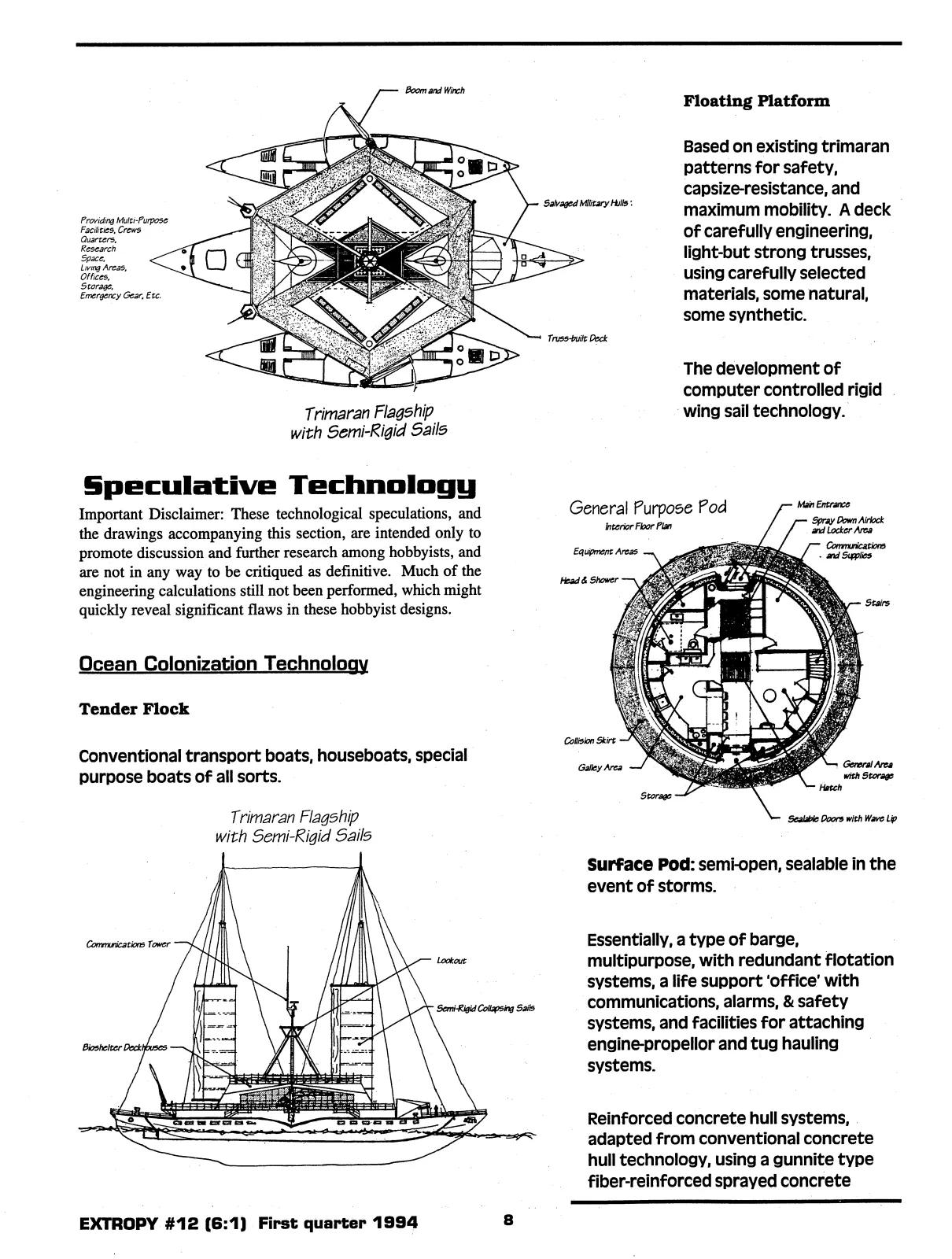
Based on existing trimaran patterns for safety, capsize-resistance, and maximum mobility. A deck of carefully engineering, light-but strong trusses, using carefully selected materials, some natural, some synthetic.
The development of computer controlled rigid wing sail technology.
Speculative Technology
Important Disclaimer: These technological speculations, and the drawings accompanying this section, are intended only to promote discussion and further research among hobbyists, and are not in any way to be critiqued as definitive. Much of the engineering calculations still not been performed, which might quickly reveal significant flaws in these hobbyist designs.
Ocean Colonization Technology
Tender Flock
Conventional transport boats, houseboats, special purpose boats of all sorts.
Surface Pod: semi-open, sealable in the event of storms.
Essentially, a type of barge, multipurpose, with redundant flotation systems, a life support ‘office’ with communications, alarms, & safety systems, and facilities for attaching engine-propellor and tug hauling systems.
Reinforced concrete hull systems, adapted from conventional concrete hull technology, using a gunnite type fiber-reinforced sprayed concrete
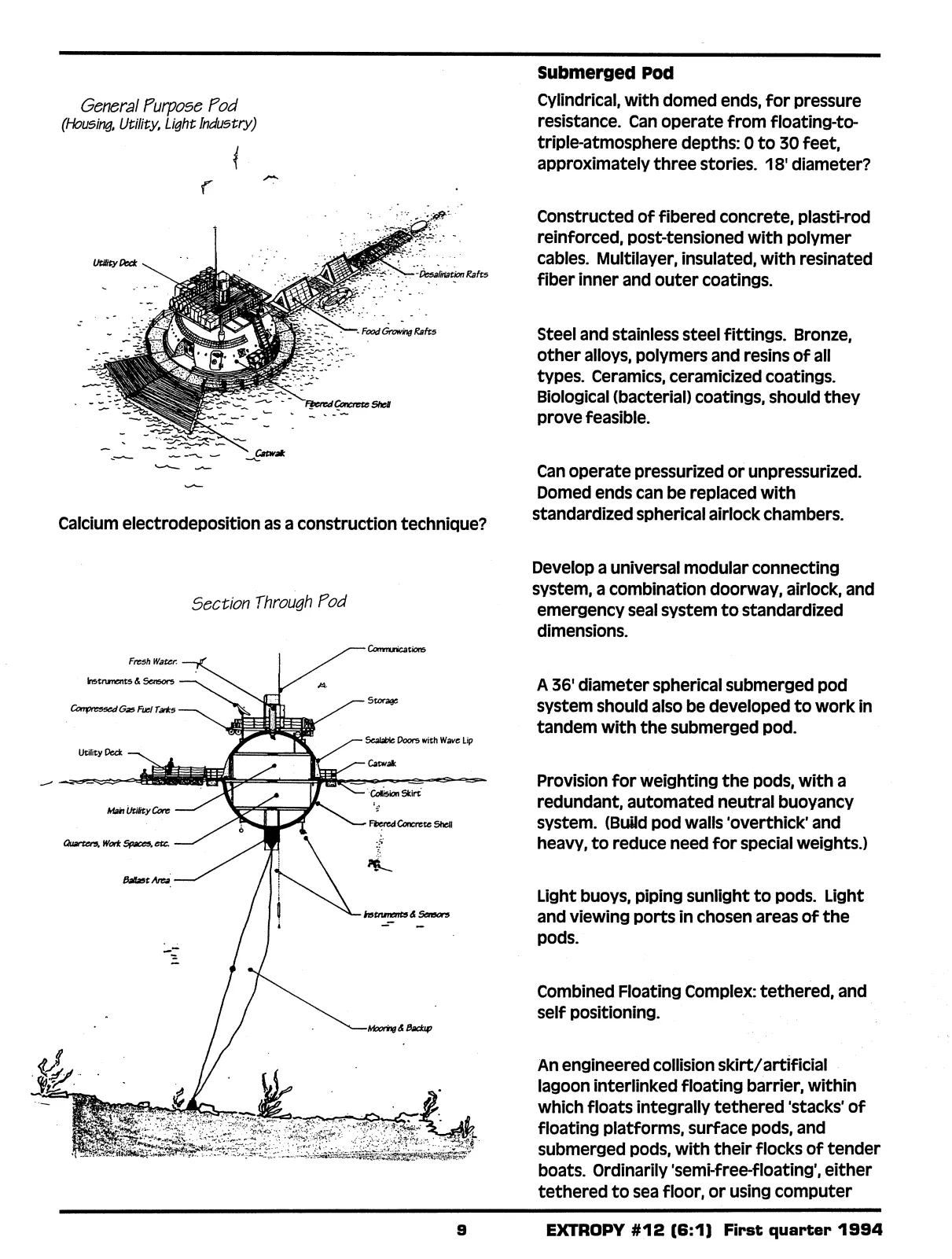
General Purpose Pod (Housing, Utility, Light Industry)
Calcium electrodeposition as a construction technique?
Section Through Pod
Submerged Pod
Cylindrical, with domed ends, for pressure resistance. Can operate from floating-to-triple-atmosphere depths: 0 to 30 feet, approximately three stories. 18’ diameter?
Constructed of fibered concrete, plasti-rod reinforced, post-tensioned with polymer cables. Multilayer, insulated, with resinated fiber inner and outer coatings.
Steel and stainless steel fittings. Bronze, other alloys, polymers and resins of all types. Ceramics, ceramicized coatings. Biological (bacterial) coatings, should they prove feasible.
Can operate pressurized or unpressurized. Domed ends can be replaced with standardized spherical airlock chambers.
Develop a universal modular connecting system, a combination doorway, airlock, and emergency seal system to standardized dimensions.
A 36’ diameter spherical submerged pod system should also be developed to work in tandem with the submerged pod.
Provision for weighting the pods, with a redundant, automated neutral buoyancy system. (Build pod walls ‘overthick’ and heavy, to reduce need for special weights.)
Light buoys, piping sunlight to pods. Light and viewing ports in chosen areas of the pods.
Combined Floating Complex: tethered, and self positioning.
An engineered collision skirt/artificial lagoon interlinked floating barrier, within which floats integrally tethered ‘stacks’ of floating platforms, surface pods, and submerged pods, with their flocks of tender boats. Ordinarily ‘semi-free-floating’, either tethered to sea floor, or using computer
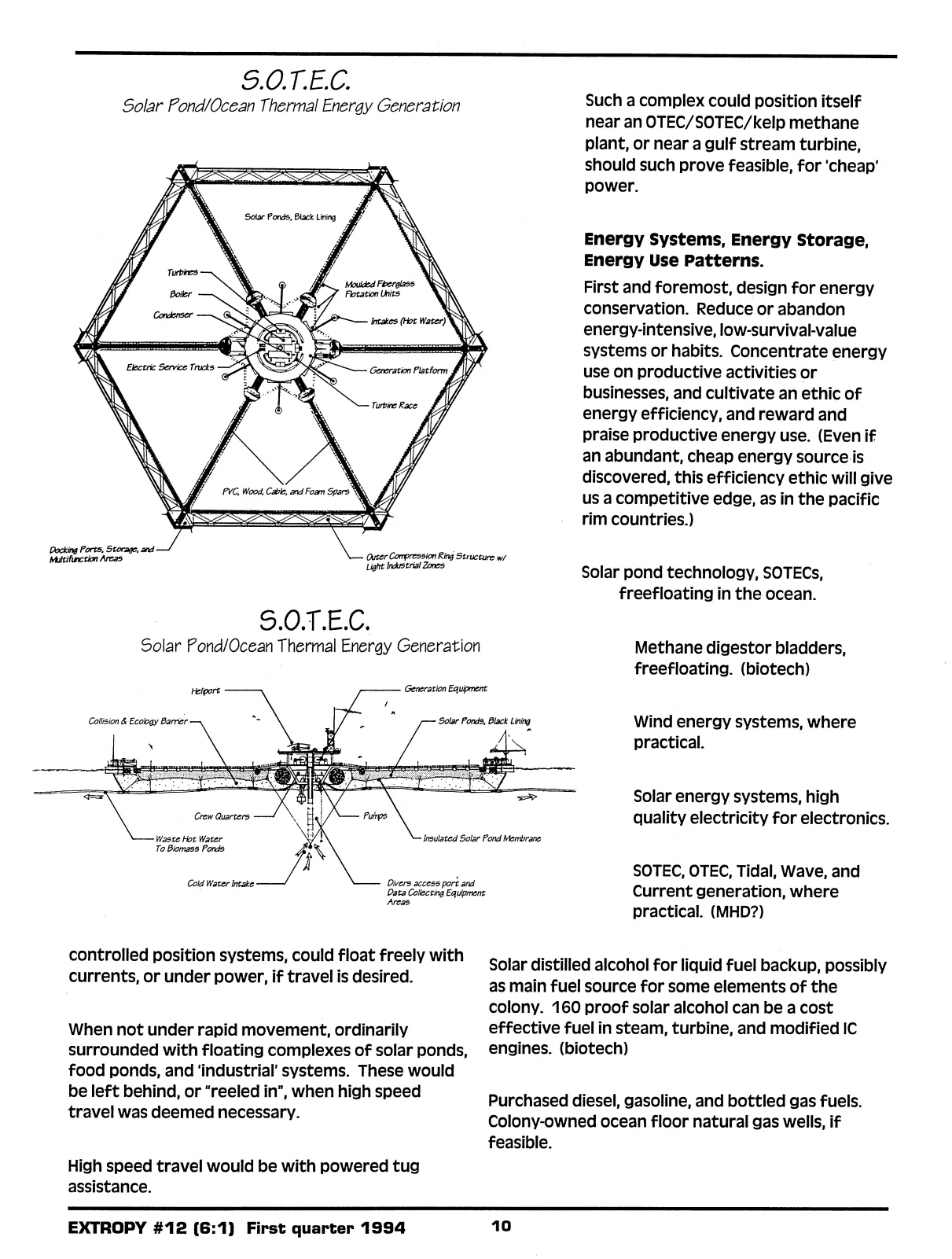
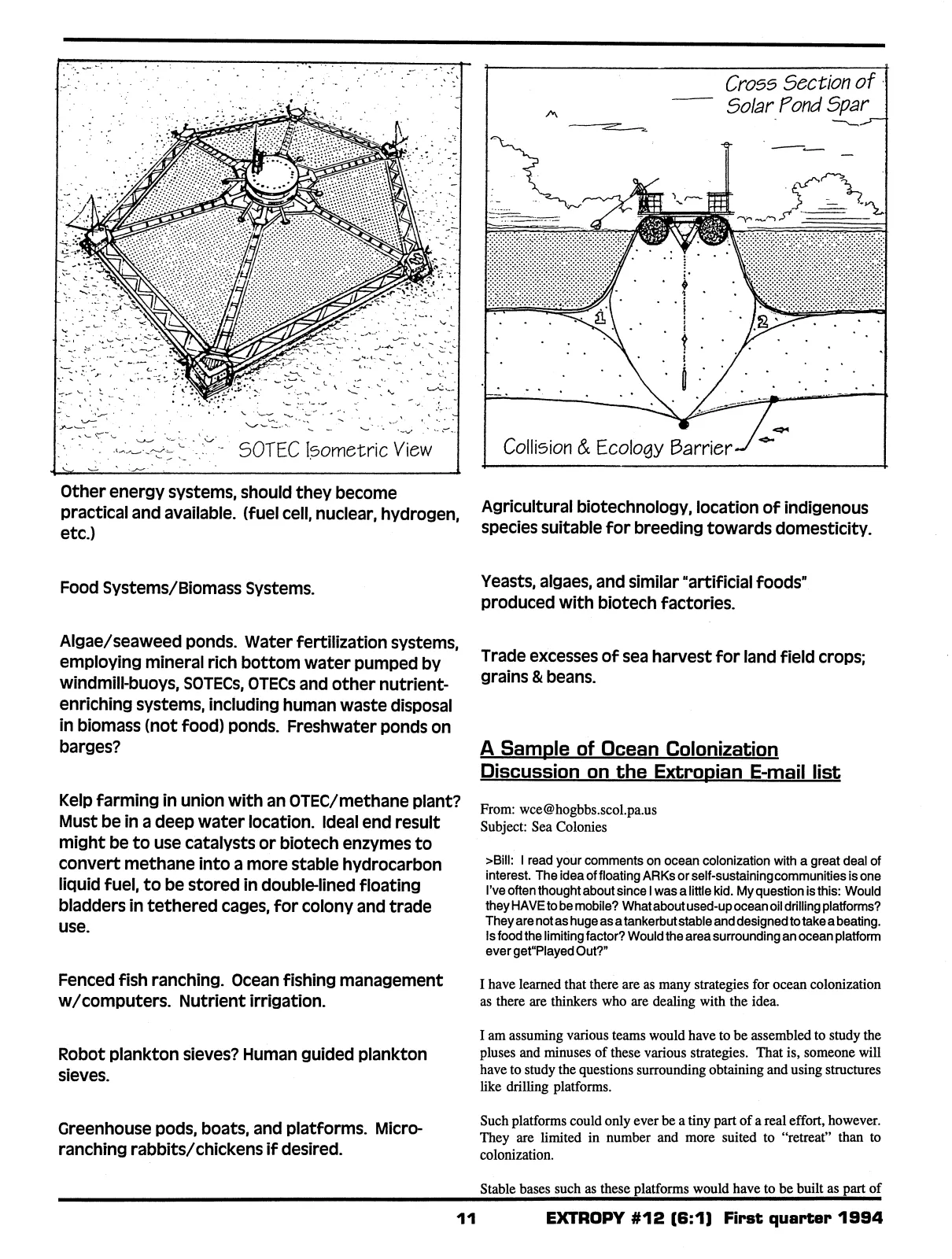
S.O.T.E.C.
Solar Pond/Ocean Thermal Energy Generation
S.O.T.E.C.
Solar Pond/Ocean Thermal Energy Generation controlled position systems, could float freely with currents, or under power, if travel is desired.
When not under rapid movement, ordinarily surrounded with floating complexes of solar ponds, food ponds, and ‘industrial’ systems. These would be left behind, or “reeled in”, when high speed travel was deemed necessary.
High speed travel would be with powered tug assistance.
Such a complex could position itself near an OTEC/SOTEC/kelp methane plant, or near a gulf stream turbine, should such prove feasible, for ‘cheap’ power.
Energy Systems, Energy Storage, Energy Use Patterns.
First and foremost, design for energy conservation. Reduce or abandon energy-intensive, low-survival-value systems or habits. Concentrate energy use on productive activities or businesses, and cultivate an ethic of energy efficiency, and reward and praise productive energy use. (Even if an abundant, cheap energy source is discovered, this efficiency ethic will give us a competitive edge, as in the pacific rim countries.)
Solar pond technology, SOTECs, freefloating in the ocean.
Methane digestor bladders, freefloating. (biotech)
Wind energy systems, where practical.
Solar energy systems, high quality electricity for electronics.
SOTEC, OTEC, Tidal, Wave, and Current generation, where practical. (MHD?)
Solar distilled alcohol for liquid fuel backup, possibly as main fuel source for some elements of the colony. 160 proof solar alcohol can be a cost effective fuel in steam, turbine, and modified IC engines. (biotech)
Purchased diesel, gasoline, and bottled gas fuels. Colony-owned ocean floor natural gas wells, if feasible.
Other energy systems, should they become practical and available. (fuel cell, nuclear, hydrogen, etc.)
Food Systems/Biomass Systems.
Algae/seaweed ponds. Water fertilization systems, employing mineral rich bottom water pumped by windmill-buoys, SOTECs, OTECs and other nutrient-enriching systems, including human waste disposal in biomass (not food) ponds. Freshwater ponds on barges?
Kelp farming in union with an OTEC/methane plant? Must be in a deep water location. Ideal end result might be to use catalysts or biotech enzymes to convert methane into a more stable hydrocarbon liquid fuel, to be stored in double-lined floating bladders in tethered cages, for colony and trade use.
Fenced fish ranching. Ocean fishing management w/computers. Nutrient irrigation.
Robot plankton sieves? Human guided plankton sieves.
Greenhouse pods, boats, and platforms. Micro-ranching rabbits/chickens if desired.
Agricultural biotechnology, location of indigenous species suitable for breeding towards domesticity.
Yeasts, algaes, and similar “artificial foods” produced with biotech factories.
Trade excesses of sea harvest for land field crops; grains & beans.
A Sample of Ocean Colonization Discussion on the Extropian E-mail list
From: wce@hogbbs.scol.pa.us Subject: Sea Colonies
Bill: I read your comments on ocean colonization with a great deal of interest. The idea of floating ARKs or self-sustaining communities is one I’ve often thought about since I was a little kid. My question is this: Would they HAVE to be mobile? What about used-up ocean oil drilling platforms? They are not as huge as a tanker but stable and designed to take a beating. Is food the limiting factor? Would the area surrounding an ocean platform ever get “Played Out?”
I have learned that there are as many strategies for ocean colonization as there are thinkers who are dealing with the idea.
I am assuming various teams would have to be assembled to study the pluses and minuses of these various strategies. That is, someone will have to study the questions surrounding obtaining and using structures like drilling platforms.
Such platforms could only ever be a tiny part of a real effort, however. They are limited in number and more suited to “retreat” than to colonization.
Stable bases such as these platforms would have to be built as part of
a colonization effort, I would say. These stable bases would be designed as “servers” for a variety of other permutations of colony.
I concentrate more, for now, on shallow water colonization — I haven’t studied stilted sea platforms, so, really, I just don’t know.
Have you given thought to the effects of storms/hurricanes on a floating colony?
No one who looks at the idea seriously can fail to give a lot of thought to questions of weather, corrosion, and so forth. The sea is much more dangerous than the land.
I think these problems are solved using multiple strategies, including the following…
Some places are better than others… leeward of islands, and naturally calm regions, will be colonized first.
Breakwater and artificial lagoon technologies, as T. Starr suggests.
High-quality satellite tracking and communications, combined with various degrees of mobility. Sea colonies would be designed to shut down and lock up tight in the face of bad weather.
Structural designing that takes into account the 100-year storms, with combinations of strengthened cores and breakaway peripherals.
The ultimate protection against storms is found, of course, by going down. Twenty feet down, a region of comparative stability is found. To my mind, real ocean colonization, as opposed to occupation or hunt-and-gather harvesting, is dependent on achieving an undersea living technology.
Just as with the colonization of the new world, I expect the process to start with the adventurers and the desperate. They will gather enough information to arm the entrepreneurs.
Just as is occurring with ‘space colonization’ right now… ocean colonization is a ‘poor man’s alternative’ to orbital industry and LaGrange colonies.
What I’m proposing, primarily, is the process of initial R&D. I expect that initial R&D to be salable, even if all we have to sell are warnings, and entertainment for the jaded millions.
I want to emphasize that I am not promoting ocean colonization in and of itself. I feel pretty aware of how tough real colonization is going to be. What I’m suggesting is the very practical and real establishment of an ocean colonization research center, somewhere in the Caribbean, within the upcoming 5 to 25 year time frame.
I don’t think we know enough, or have the right businesses ready, to make ocean colonization at all practical anytime within the next 25 to 40 years. It’s another profit desert to be crossed.
But, based on quite a bit of study, I think we could make an ocean colonization Research Center profitable immediately, by selling infotainment, while doing the basic research that will lead to patents and future, larger profits.
I see it as a ‘doable’ experiment in independent science. Most R&D is the province of state controlled or influenced universities or corporate laboratories — which can be fine establishments, but they need competition to keep their bureaucracies and administrations honest. I think there’s profit to be made in an independent, capitalist, science-as-business.
An ocean colonization research center can be just the sort of wild collision-of-ideas places that keeps the creative juices flowing. And, it can be a place to explore the huge third world market. (I think it was Charlie Stross who talked about leapfrogging wires and marketing cellular phones in Bangladesh — it’s pretty clear to me that this is just the tip of the iceberg of the trillions to be made in using our cleverness to design, manufacture, and sell products that are high profit and focused directly at the third world market.)
So, this is the slant I’m taking with this ocean colonization thread; I don’t know if ocean colonization is feasible, I don’t know if we could build even a miniature floating/undersea ‘Hong Kong’, but I do know that I personally expect to be moving to the Caribbean and trying to set up an ocean colonization center as a part of my retirement.
The thing to do is to rent an inexpensive dock and a cluster of buildings on some 10 to 50 acre piece of land, presumably somewhere in the Caribbean. We set up solar and other desalinators, and start collecting data on their performance as we let cisterns fill with fresh water. And we set up a small marina, a boatbuilding business, and experiment with buildings on the island and on boat platforms, working towards building a first larger ‘flagship’ platform trimaran that would hold the central computer labs, biotech labs, communications equipment, and the other essentials of the research center.
All through this period we are exploring, doing underwater photography and video for later sale, and studying the profit potentials of the region.
While the onsite people are looking for regional profit, the teams still “back home” in the mainstream study & develop ways that the ocean center’s material can be marketed as infotainment for profit. I’m assuming that some combination of education/tourism package would be sold, in which wealthy yuppies pay to visit and play with submarines, and students pay for credits, as one of the cornerstones of the first 25 year’s income possibilities. Whatever else, in the form of tapes, magazines, books, stereo VR simulations, etc, etc, will be decided by assessing the possibilities at the time — but I’m assuming we’d have to market ourselves aggressively from day one, as opposed to counting on grants and patronage.
I think I’m most interested in working on the following:
Water desalination and purification devices, potentially salable throughout the undeveloped countries, based on solar or osmotic filter technology.
A boatbuilding plant (automated?) to produce the functional equivalent of the one family house, in the form of a ‘smart’ trimaran houseboat, out of resinated organic fibers. The “Model T” of the ocean lifestyle and economy.
Intensive studies of the local biology and ecology, looking especially for chemical compounds with pharmacological and industrial uses, and also for ‘agricultural’ breeding stock. Gathering baseline data so we can assess ecological impact accurately years later.
An intensive calcium electrodeposition study.
A study of coatings, starting with the best data we can gather from the existing oceanographic engineering experts.
And so on — pretty humble stuff, actually. It can be done with at first tens, then hundreds of thousands of dollars, which is a capitalization that is within my reach. There is, of course, a tremendous amount of advance work and preparation that has to be done for something like this — we can’t afford to waste a drop of energy reinventing the wheel, meaning that we need to be up-to-date on the subject and the literature, and we have to be skilled with the video, computer, and lab equipment, so that we avoid the common business hassle of trying to start a business and learn how to use the equipment at the same time.
As far as something like data piracy or free banking or suchlike, it seems pretty clear that your basic 80 to 240 ft refitted commercial ship, running under a protective flag and docked in a protective country, would be your best bet. (Although, it occurs to me that a factory to produce a “delivery truck” style of submersible could revolutionize smuggling.) Mobility and invisibility is your best protection against the organized killers and torturers (soldiers and police) that the government will turn against you once it becomes aware of you. Assuming you want to get involved in such a thing, which I don’t.
Well, this is way long, so I’ll just stop here, leaving questions unanswered. As far as I know, there are no definitive texts on ocean colonization, and I’ve learned about it by reading bits and pieces from a hundred incidental sources.
I’m going to work on assembling some files about it, and I’m working on a comic book exposition of the ocean colonization idea, though that goes slowly so far. I think it’s a potent fantasy/meme, getting ripe for harvest.
Later, Bill wce@hogbbs.scol.pa.us
And more discussion of ocean colonization from the Autopia mail list.
From hlr@lems.brown.edu (Henry Robinson) Subject: Some info I have found…
Bill Eichman writes: These are some of the things that need to be done first, imho.
(1) Survey the literature, scan the relevant articles into files, and build a database for education, research, and to attract expertise. …The place to start is at your local university library…
I’ve been searching for information and have found a very good reference. It’s the 2 volume proceedings of a symposium during 1985 called
Ocean Space Utilization ‘85. It was held at Nihon University in Tokyo, Japan. Within its 1400 pages the sessions cover the engineering and economics of a seabased village, structural mechanics of ocean structures, dynamic response due to wind and waves, OTEC resources and wave energy design, materials and construction, concrete durability, and corrosion just to name a few relevant topics. J.P.Craven of Univ. of Hawaii wrote the first article titled “A Seabased Village” and mentions Buckminster Fuller, Paolo Soleri, and Kyonori Kitutake in Japan. I just built a gopher client and have been “travelling around” to University Libraries to see what I could find.
At the Univ. of Hawaii:
TITLE(s): Floating marine community : research report of the Department of Architecture, University of Hawaii, for Marine Programs, State of Hawaii, Honolulu, Hawaii/Craven … [et al. ; Hugh Burgess, editor, Cynthia Ai, assistant editor].
Honolulu : The Department, c1972.49 p. :ill; 22 x 35 cm.
OTHER ENTRIES: Hawaii’s Floating City Development Program. Offshore structures Design and construction. Craven, John P. Burgess, Hugh. Ai, Cynthia. University of Hawaii at Manoa. Dept. of Architecture.
TITLE(s): Floating city 2 / [compiled by] Masanobu Kosugi.
- 1 v. (various pagings): ill.; 28 cm. P. 14.
Caption title: Floating city 2: data for floating city programs in the state of Hawaii. Photocopies of papers and articles by J.R. Stewart, Kyonori Kikutake, Eduard Anahory and others. Compiled for Prof. H. Burgess, Architecture 488, Winter 1971.
OTHER ENTRIES: Hawaii’s Floating City Development Program. Offshore structures Design and construction. Kosugi, Masanobu. Kikutake, Kyonori, 1928-
Note: Many references to Japan being very interested in this and funding studies due to the land shortage there. Studies are ongoing in three areas. 1) Ocean Communications City (OCC) which would be built “scores of kilometers off the mouth of Tokyo Bay” with four levels of decks. the overall size would be 5 km. by 5 km. for a total 25 sq.km./deck or 100 sq.km. total living space. It includes a international airport on the roof. It would be supported by 10,000 pillars on the seabed. Est. Population: 1/2 to 1 million. 2) Man-made Islands and land extension. Japan is now building a airport and industrial complex on fill by levelling some near-by mountains gaining space on both sides of the equation. 3)
Floating Villages positioned in the deep ocean areas. This area involves studying ocean dynamics and structures. OTEC power plants form the basis of abundant power and economic viability. The Pacific Ocean off-shore from Japan requires stability in the form of a floating platform type structure such as oil rigs. A large portion of the symposium dealt with corrosion and tests of long term stability of metals and concrete. Also, the dynamics of a long OTEC pipe is studied.
Bill also says: (in response to the amount of energy to bring up the deep ocean water)… The theory is interesting, but the experiments have to be done before we can be sure. The construction, weight, and stability of the intake tube, and the actual power requirements of pumping, may result in more problems than we might expect. It may, or may not, work as well as we would like. The same is true of solar desalinization, and small scale osmotic desalinization. Everything starts with the experiments — and the experiments start with a detailed survey of existing literature.
60 gallons/minute per horsepower. 4 deg.C. water is 1000 meters deep. I want to correct a error I made earlier about the possibility of fresh water due to the ice caps in deep water thermoclines. ENNNK! Not in the tropics. Oceanographic Surveys in the Sargasso Sea region show that the salinity does not change with depth and temperature.
Some of what I have read to date has changed my opinion about the reinforcement of the concrete. Traditional iron and steel reinforcement will corrode and expand causing the concrete to crack. Other materials should be evaluated. Surrounding the structures with fresh water reservoirs using a plastic barrier would have the added effect of providing fresh water for non-indigenous water fowl and fresh-water fish. This requires a benevolent place to have any chance. Does anybody know of any other calm spots in the oceans similar to the Sargasso Sea in the North Atlantic? El Nino?
VIEW ORIGINAL SCAN (9 pages)