Issue: EXTROPY #12 · First Quarter 1994
Author: Max More
Pages: 2 · 1 scanned page
Editorial
EDITORIAL
What do you believe in? — In this: that all things must be determined anew.
Friedrich Nietzsche, The Gay Science (1882, 1887)
The Extropian way of living is all about breaking barriers, moving ahead, challenging dogmas and limits of all kinds. Late in the last century Friedrich Nietzsche — one of the greatest (and most frustrating) thinkers of all time — stood out from the common run of philosophers, throwing down a gauntlet before humanity. Nietzsche introduced the concept of the übermensch (overman), a concept overlapping the Extropian conception of the transhuman. Those who would become übermensch, declared Nietzsche, must first undergo a radical process of investigation and reassessment of all the beliefs, ideals, values, and practices around them — a “revaluation of all values”.
Extropians are the torch-bearers of Nietzsche’s radical program of reassessment and self-constitution. The übermenschean ideal finds expression in the Extropian Principle of Self-Transformation. However, the ability to question everything, to hold up to the bright light of reason every supposition, assumption, and dogma, requires more than just the will to do so. We also require intelligent technology to assist us in this Promethean task.
One of the most promising informational tools, already available in an early form, is hypertext. In “The Open Society and its Media”, Mark Miller, Dean Tribble, Ravi Pandya, and Marc Stiegler provide an overview of the essential features of a mature hypertext information system. Hypertext, combined with massively-interconnected electronic networks, knowbots (personalized information-retrieval software agents), and the digitizing of practically all (articulate) knowledge, should immensely help us in checking our cognitive models of the world.
Overcoming limits and exploring new paths can be frustrated or constrained by the political, legal, and cultural environment. Boundless expansion and unhampered self-transformation therefore require, some will argue, new environments and cultures located in entirely new locations. Extropy has and will continue to explore the potential for such spaces to be established in cyberspace and off-Earth. In this issue, Bill Eichman examines the feasibility of growing new societies on or under the oceans. T. O. Morrow contributes his research on the international law of the sea.
In “Logical Languages: A Path to Posthuman Rationality?”, regular contributor Simon D. Levy investigates some fascinating methods for cognitive self-transformation and Nietzsche’s task of determining all things anew. Complementing Simon’s look at constructed and modified
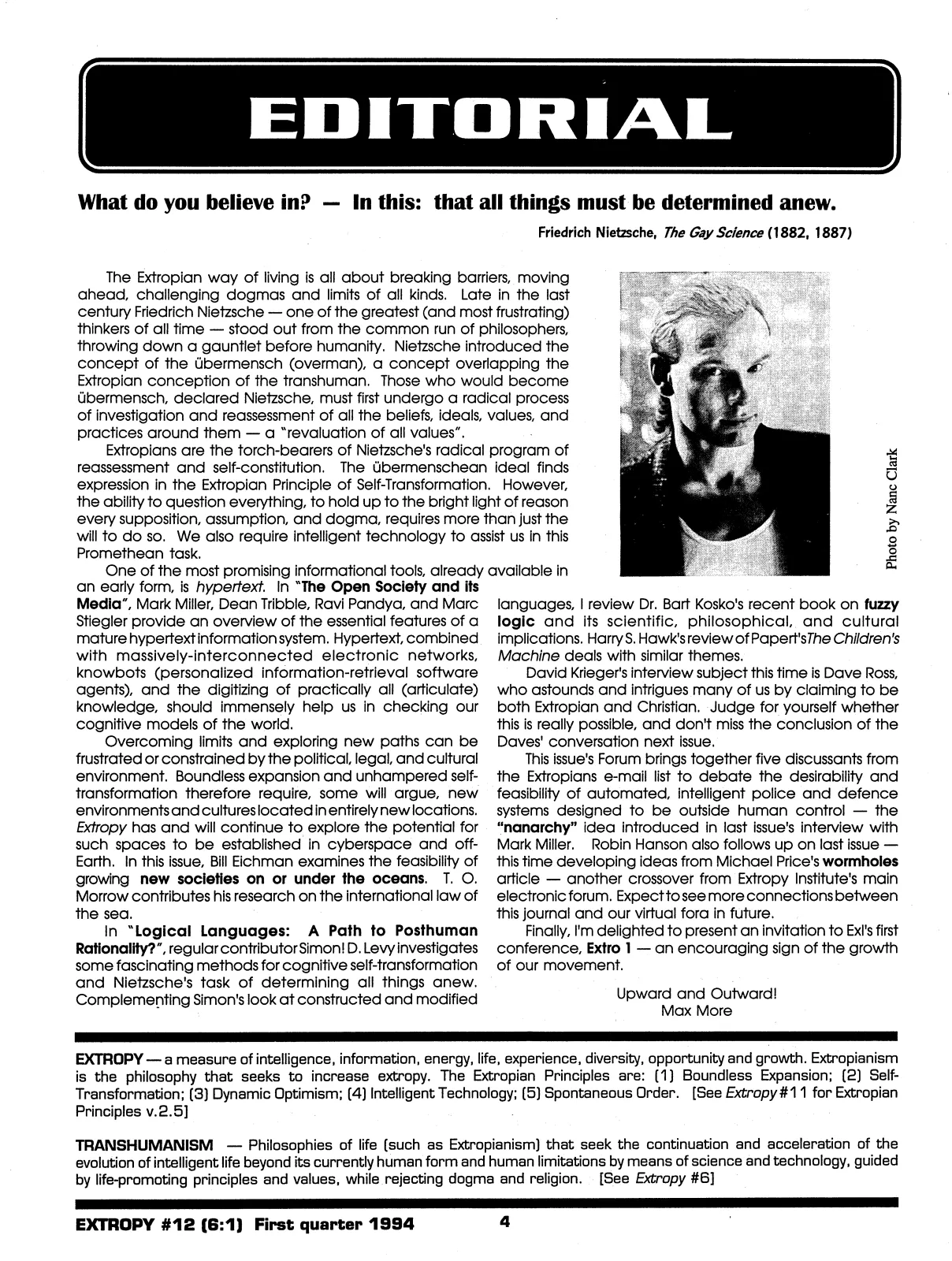
Photo by Nanc Clark languages, I review Dr. Bart Kosko’s recent book on fuzzy logic and its scientific, philosophical, and cultural implications. Harry S. Hawk’s review of Paper’s The Children’s Machine deals with similar themes.
David Krieger’s interview subject this time is Dave Ross, who astounds and intrigues many of us by claiming to be both Extropian and Christian. Judge for yourself whether this is really possible, and don’t miss the conclusion of the Daves’ conversation next issue.
This issue’s Forum brings together five discussants from the Extropians e-mail list to debate the desirability and feasibility of automated, intelligent police and defence systems designed to be outside human control — the “nanarchy” idea introduced in last issue’s interview with Mark Miller. Robin Hanson also follows up on last issue — this time developing ideas from Michael Price’s wormholes article — another crossover from Extropy Institute’s main electronic forum. Expect to see more connections between this journal and our virtual fora in future.
Finally, I’m delighted to present an invitation to Exi’s first conference, Extro 1 — an encouraging sign of the growth of our movement.
Upward and Outward!
Max More
EXTROPY — a measure of intelligence, information, energy, life, experience, diversity, opportunity and growth. Extropianism is the philosophy that seeks to increase extropy. The Extropian Principles are: (1) Boundless Expansion; (2) Self-Transformation; (3) Dynamic Optimism; (4) Intelligent Technology; (5) Spontaneous Order. [See Extropy #11 for Extropian Principles v.2.5]
TRANSHUMANISM — Philosophies of life (such as Extropianism) that seek the continuation and acceleration of the evolution of intelligent life beyond its currently human form and human limitations by means of science and technology, guided by life-promoting principles and values, while rejecting dogma and religion. [See Extropy #6]
VIEW ORIGINAL SCAN (1 pages)