Issue: EXTROPY #12 · First Quarter 1994
Author: David Krieger with Gayle Pergamit
Pages: 22–29 · 8 scanned pages
God and Man at Yale: A Conversation with Dave Ross (Pt. 1)
God and Man at Yale
A Conversation With Dave Ross
by David Krieger with Gayle Pergamit
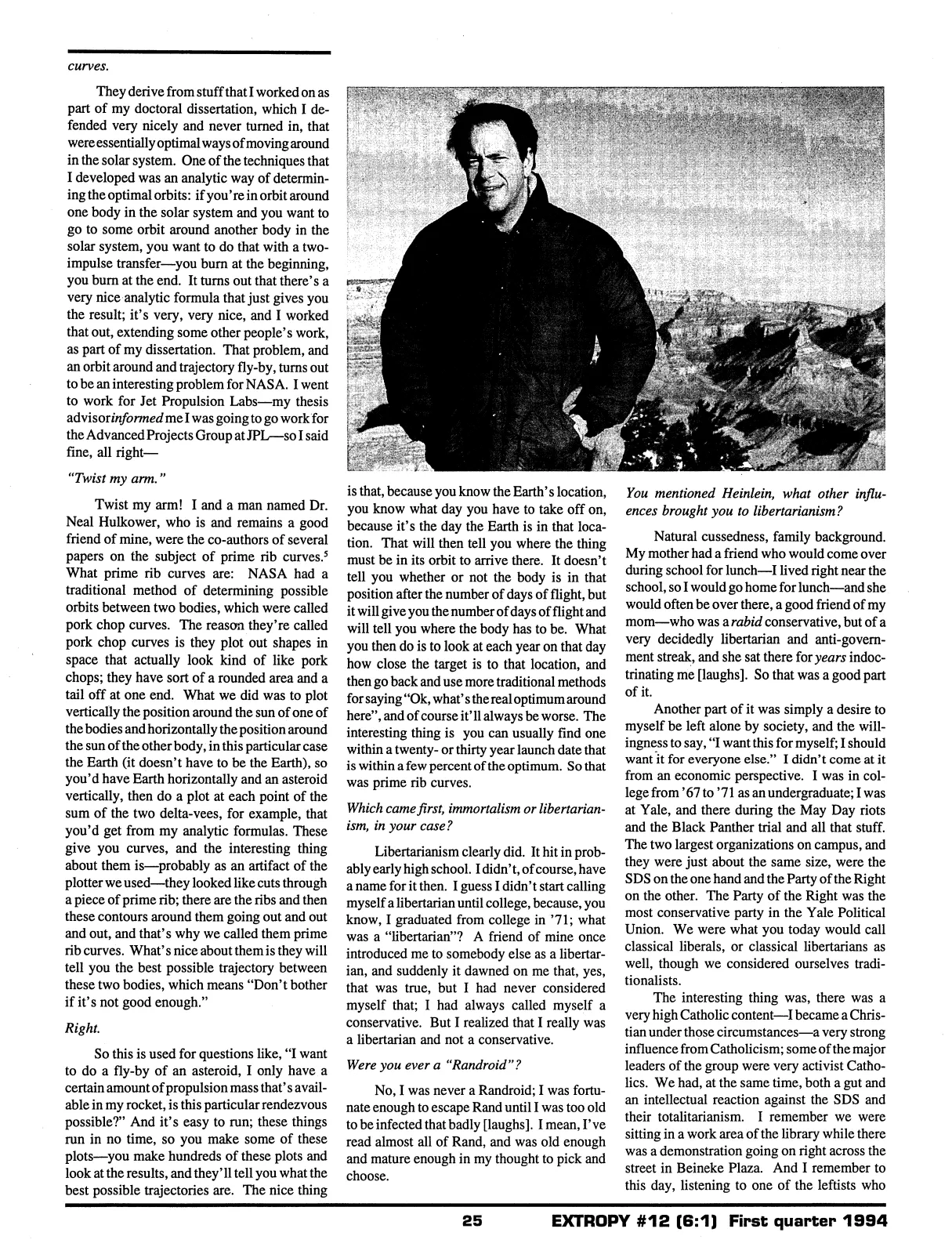
Dave Ross founds companies for a living. He co-founded Palantir Corporation, which became Calera Recognition Systems, the longtime leader in optical character recognition software. He also founded Arkenstone, a non-profit corporation which makes reading machines for the blind, and his current venture, RAF Technologies. Previously, at NASA’s Jet Propulsion Laboratory, he formulated the “prime rib” technique of selecting orbital rendezvous trajectories, still the standard method for planning solar system missions. In 1992, Dave presented his talk “Seven Paths to Immortality” to the annual Eris Conference in Aspen, Colorado, in which he talked about longevity technologies, uploading, cryonics, and how he views these technologies from a Christian perspective. Later in 1992, I interviewed Dave at the home of Gayle Pergamit, co-author of Unbounding the Future and co-founder, with her husband, economist Phil Salin, of the American Information Exchange online information marketplace.
I guess we could start with the question “How did you get this way, and what are you planning to do about it, if anything?”
Reading way too much Robert Heinlein as a teenager probably started it… like it did for almost all of us, I think. It gave me a healthy dose of libertarianism. Growing up… my father was a bootlegger, among other things, during Prohibition, so I have, shall we say, a little bit of anarchy in my blood. So that probably is the origin of some of it.
Gayle: Was everybody’s father involved in anarchy?
Certainly my children’s father…never mind. I got interested, I guess, because of an overdose of science fiction in the “space biz,” and sort of followed the traditional lines that all of us, I guess, of Gayle’s and my generation did, which was: space in the Seventies and Eighties, computers and nanotechnology in the Nineties. That’s how I met most of the people in the “Palo Alto School of Applied Austrian Economics,” through the space biz. I had an undergraduate degree in physics—at which point I spent four years in the Navy as a legal officer, which made as much sense as anything else in the Navy did—and then went to graduate school in aerospace engineering. From there I went to Jet Propulsion Lab, and from there I was hired by Gary Hudson to do rockets. I had connected up with Gayle at a space colonization class; I worked for Gerry O’Neill in the summer of ‘77 doing a NASA-Ames space study. My doctoral work is in orbital mechanics; I was doing the orbital mechanics for asteroid retrieval for the ‘77 summer study. Went to Jet Propulsion Labs and did pretty much the same thing, mission design and mission analysis stuff. That’s where Gary Hudson showed up while I was inebriated at a Christmas party, proceeded to interview me, and the rest was history—I went to work doing rockets.
Gayle: Actually, the tradition of filling someone full of alcohol and interviewing them for a job—they wake up, employed and on the high seas—
dV/dt: That’s a long and venerable tradition.
I believe the term is shanghaied, yes. He didn’t even have to administer the alcohol. I worked for a while for Hudson on the Percheron rocket; when I later left, [Hudson] blew up. I was in charge of the test facility and the guy that was second was Jim Fruchterman. He and I and another guy, Eric Hannah, with whom I had written papers on space settlement, started what is today Calera Recognition Systems (it used to be Palantir Corporation), doing optical character recognition, which seems like a long step from rockets. It’s not quite as long a step as it sounds, because my degrees are really in applied math and algorithm design; I did that stuff at JPL, and algorithms for space flight and algorithms for character recognition, though different, are not different in kind, just different in degree.
So we did that, and I was there for a long time. I got more and more interested in computer science—that was starting around 1981, ‘82—I hit the computer wave at that point and got to thinking about machine intelligence because we were making algorithms to do things that I do not consider artificial intelligence but that traditionally have been considered “intelligent acts”—recognition. That got me to thinking more and more about “What are the potentials for, and the problems with, traditional concepts of artificial intelligence?” That, and the evolution of this group of people, thinking more about manipulating things on very small scales, as with nanotechnology, and the potential of an unbounded future for humanity off the planet from the rocket phase. Both fields are unbounded, from the point of view of what you can do with limited resources and the possibility that your resources may be almost limitless. This got me thinking about future things more and more, and coming to the conclusion, after thinking about it, that though the problems of making machines think are very, very, very hard, they’re not impossible, and that we are liable, if current trends continue, to see within even our “normal” lifespans, our own creations beginning to rival us and in some danger of surpassing us in intelligence, and this got me increasingly to thinking, “Well, that’s very nice, what do we do about it?”
And, of course, I read all the “usual suspect” books: Engines of Creation, Unbounding the Future, Hans Moravec’s Mind Children, and then a lot of the other things: The Emperor’s New Mind by Penrose; Gödel, Escher, Bach; and a bunch of other stuff. Plus, working in what could be called “artificial intelligence” led me to give serious consideration to which way I thought things were going to go, in terms of machine and human intelligence and machine-human alliances and analogues of parasitism and symbiosis and so on. That sort of got me interested in what has come to be called “extropian” ideas. I actually made contact with the Extropians through two almost unrelated channels: first, Jim Bennett said I ought to be on the Extropians [e-mail] list; then just before I got on the Extropians list I ran into Max More at a talk I gave. He asked me to write an article for Extropy, which became the article on human uploading. So, that’s the circuitous path by which I got here.
Was it at the ERIS gathering that you ran into Max?
No, it was at the Nock Forum in Los Angeles.
Before we go on to the farther-out Extropian things, talk a little bit about the “prime rib”
curves.
They derive from stuff that I worked on as part of my doctoral dissertation, which I defended very nicely and never turned in, that were essentially optimal ways of moving around in the solar system. One of the techniques that I developed was an analytic way of determining the optimal orbits: if you’re in orbit around one body in the solar system and you want to go to some orbit around another body in the solar system, you want to do that with a two-impulse transfer—you burn at the beginning, you burn at the end. It turns out that there’s a very nice analytic formula that just gives you the result; it’s very, very nice, and I worked that out, extending some other people’s work, as part of my dissertation. That problem, and an orbit around and trajectory fly-by, turns out to be an interesting problem for NASA. I went to work for Jet Propulsion Labs—my thesis advisor informed me I was going to go work for the Advanced Projects Group at JPL—so I said fine, all right—
“Twist my arm.”
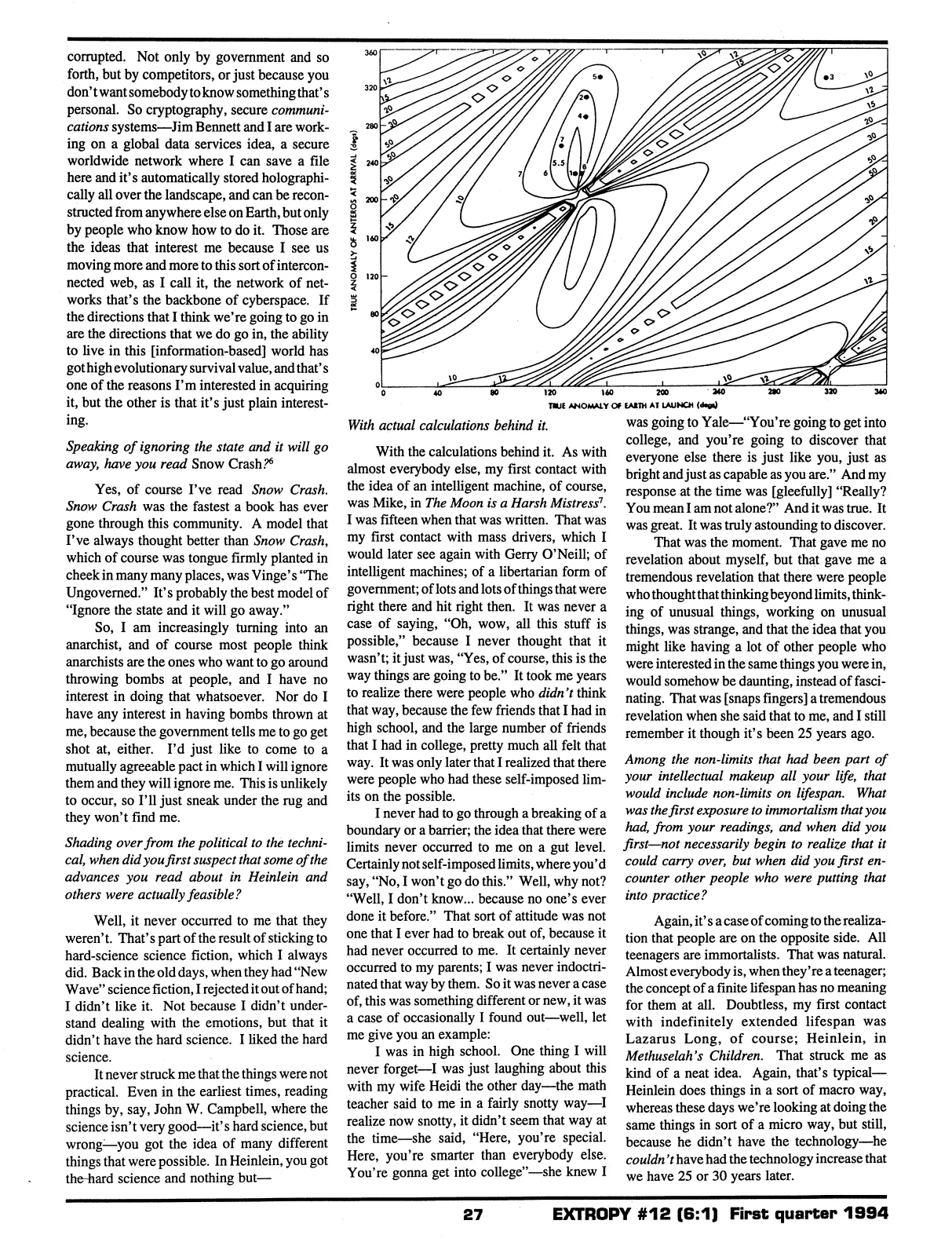
Twist my arm! I and a man named Dr. Neal Hulkower, who is and remains a good friend of mine, were the co-authors of several papers on the subject of prime rib curves. What prime rib curves are: NASA had a traditional method of determining possible orbits between two bodies, which were called pork chop curves. The reason they’re called pork chop curves is they plot out shapes in space that actually look kind of like pork chops; they have sort of a rounded area and a tail off at one end. What we did was to plot vertically the position around the sun of one of the bodies and horizontally the position around the sun of the other body, in this particular case the Earth (it doesn’t have to be the Earth), so you’d have Earth horizontally and an asteroid vertically, then do a plot at each point of the sum of the two delta-vees, for example, that you’d get from my analytic formulas. These give you curves, and the interesting thing about them is—probably as an artifact of the plotter we used—they looked like cuts through a piece of prime rib; there are the ribs and then these contours around them going out and out and out, and that’s why we called them prime rib curves. What’s nice about them is they will tell you the best possible trajectory between these two bodies, which means “Don’t bother if it’s not good enough.”
Right.
So this is used for questions like, “I want to do a fly-by of an asteroid, I only have a certain amount of propulsion mass that’s available in my rocket, is this particular rendezvous possible?” And it’s easy to run; these things run in no time, so you make some of these plots—you make hundreds of these plots and look at the results, and they’ll tell you what the best possible trajectories are. The nice thing is that, because you know the Earth’s location, you know what day you have to take off on, because it’s the day the Earth is in that location. That will then tell you where the thing must be in its orbit to arrive there. It doesn’t tell you whether or not the body is in that position after the number of days of flight, but it will give you the number of days of flight and will tell you where the body has to be. What you then do is to look at each year on that day how close the target is to that location, and then go back and use more traditional methods for saying “Ok, what’s the real optimum around here”, and of course it’ll always be worse. The interesting thing is you can usually find one within a twenty- or thirty year launch date that is within a few percent of the optimum. So that was prime rib curves.
Which came first, immortalism or libertarianism, in your case?
Libertarianism clearly did. It hit in probably early high school. I didn’t, of course, have a name for it then. I guess I didn’t start calling myself a libertarian until college, because, you know, I graduated from college in ‘71; what was a “libertarian”? A friend of mine once introduced me to somebody else as a libertarian, and suddenly it dawned on me that, yes, that was true, but I had never considered myself that; I had always called myself a conservative. But I realized that I really was a libertarian and not a conservative.
Were you ever a “Randroid”?
No, I was never a Randroid; I was fortunate enough to escape Rand until I was too old to be infected that badly [laughs]. I mean, I’ve read almost all of Rand, and was old enough and mature enough in my thought to pick and choose.
You mentioned Heinlein, what other influences brought you to libertarianism?
Natural cussedness, family background. My mother had a friend who would come over during school for lunch—I lived right near the school, so I would go home for lunch—and she would often be over there, a good friend of my mom—who was a rabid conservative, but of a very decidedly libertarian and anti-government streak, and she sat there for years indoctrinating me [laughs]. So that was a good part of it.
Another part of it was simply a desire to myself be left alone by society, and the willingness to say, “I want this for myself; I should want it for everyone else.” I didn’t come at it from an economic perspective. I was in college from ‘67 to ‘71 as an undergraduate; I was at Yale, and there during the May Day riots and the Black Panther trial and all that stuff. The two largest organizations on campus, and they were just about the same size, were the SDS on the one hand and the Party of the Right on the other. The Party of the Right was the most conservative party in the Yale Political Union. We were what you today would call classical liberals, or classical libertarians as well, though we considered ourselves traditionalists.
The interesting thing was, there was a very high Catholic content—I became a Christian under those circumstances—a very strong influence from Catholicism; some of the major leaders of the group were very activist Catholics. We had, at the same time, both a gut and an intellectual reaction against the SDS and their totalitarianism. I remember we were sitting in a work area of the library while there was a demonstration going on right across the street in Beineke Plaza. And I remember to this day, listening to one of the leftists who said, ‘Let’s give ‘em the chant!’ and the crowd went into some chant, and he said, ‘No, the other one!’ and like turning a switch they switched to the other one.
At that moment, it was an apotheosis: ‘This is brain dead! These people’s minds are turned off, and these people’s minds are turned off in something they consider extremely important,’ which seemed like exactly the wrong place.
So the Party of the Right was the main opposition on campus to the Gestapo tactics of the Left. And we did lots of things—removing red flags and getting bottles and rocks thrown at us. A group of students occupied one of the buildings on campus and got expelled for doing so, so the Left put up ‘Reinstate the 45’, and we went with paint cans and painted ‘Repudiate the 45’ and they put back ‘Reinstate the 45,’ so we put ‘Liquidate the 45,’ always believing in performing escalatio on them.
[The Party of the Right] was essentially a large group of people who believed in individual freedom and individual responsibility, being the primary opposition to a group of people who believed in neither. It wasn’t that we were in favor of the war in Vietnam and the SDS was opposed to it; the war in Vietnam was by this point really peripheral. This was just rebellion and anarchy and so forth on campus.
Anarchy in the chaotic sense.
Anarchy in the sense of chaos, not anarchy in the sense of anarchism. I guess I didn’t like the tactics of the left. One example was a man on campus named Alex Spinnard who was head of the Young Socialist Alliance. He was an Austrian, and a Democratic Socialist, which was in those days, as today, a rare thing. He believed very strongly in individual responsibility and individual rights; he happened to be a Socialist, so his economics were screwed up, but his politics weren’t so bad, and he really hated the SDS. He decided that he was going to put out a series of parody pamphlets. Every time the SDS put out a pamphlet, he put out a parody pamphlet. Well, since there were about three Democratic Socialists at Yale, he came to us, because he needed help, he needed people to distribute things, so we said, ‘Heh heh, we’ll sign up for that one!’ They were brilliant; he had an organization called SUDS, instead of SDS, and it was liberating the washing machines in the basements of local colleges. It was one thing after another. The fun point was having to change about three words in an SDS pamphlet to turn it into screaming hilarity.
We of course handed these things out. And of course, where do you go to hand them out for most effect? You go to the college where the SDS is the most powerful. So we would go to their colleges, and we would go around and put them on the dinner tables during the dinner hour. Of course the SDS didn’t like this at all, so they’d follow us around trying to take them back. There’s nothing that will get somebody to read something faster than telling them they can’t. So they would try to take them back, and now they’re getting into fights, but not with us. It was perfect; it was beautiful; it was great.
We had a lot of support from the campus police. I remember we were out removing red flags one night, and I got a call the next morning. A friend and I spent the previous day in the cemetery practicing with bow and arrow. We went and shot an arrow with a thread attached to it over this flagpole that came out from a fifth-floor window; used the thread to hoist a rope, then tied the rope around and broke the flagpole from the ground. Well, while we were breaking the flagpole, the people whose room it was awoke and came out and started throwing bottles at us. We dove into the car a friend of mine had and sped away.
The next morning I got a call from the head of the campus police, asking me to please come see him. So I went over, and he said, ‘You people were out last night,’ and I said, ‘Nice we’re having weather, isn’t it?’ He said, ‘No, no. I want you to know it’s really easy to tell the signature of your group when you people are out. I want you to know that when we have a call and we figure it’s you, we’re going to respond to that call—in a month or two.’ So we had good relations. The university hated us, of course, because Kingman Brewster was busy capitulating to the terrorists and shutting down classes and not letting people go to class, and here we were, a very verbal and vocal opposition. I guess we were trained in street tactics by fighting the Left.
You mentioned that you were a libertarian also on economic grounds—you mentioned that Alex Spinnard was very much on the side of individual responsibility and rights—
But he was not a libertarian.
So at that time were you economically aware?
I was always free-market; I was always fervent for free-market economics—purely at a gut level, rather than from any intellectual basis, through high school anyway—because I didn’t know what was right, but I knew the Keynesian crap we were getting made no sense—but I didn’t have any intellectual basis for challenging it. I was instinctively distrustful of the idea that the government could tune the way society behaved. I saw where it clearly did not work in the political realm, which I understood something about, and it made no sense to me that it could therefore work in the economic realm, not so very distinct from the political.
My understanding of things from a more Hayekian sense came from meeting Phil Salin years later, when I was in graduate school.
Because as an engineer and a would-be entrepreneur, I sort of had a gut understanding of this, but the intellectual basis for it was much more from the political than the economic, which came much later.
You said before we got started that you are on the way from being a libertarian to an anarchist.
Yeah. Libertarians as constitute, in particular, the Libertarian Party, and also as shown by Reason magazine, tend to concentrate on, ‘How can we change society in directions that increase human options and increase freedom, on a more global scale?’ I’m increasingly coming to the conclusion that, at least within a reasonable amount of time, that isn’t the way to go about it. We can’t reform society. You’re not going to get the government to go away, or get smaller, by making the government get smaller; you’re going to make the government go away or get smaller by ignoring it, which is essentially the Soviet model. The state withered away when no one paid any further attention to it.
Harry Browne’s idea of how to find freedom in an unfree world.
Basically. If we all ignore it, it will go away. Of course, it won’t matter if it doesn’t! That’s the nice thing about it. Increasingly, I’ve come to the conclusion that, at least for myself, I have to modify my immediate surroundings to match what my goals are and to do what I want, and I’m not going to successfully change how the world is. I can only deal with the few people around me, my family, myself, and that I can be much more effective doing that—I can be much more effective, from my own point of view, at figuring out how to shelter income than I am at trying to convince the IRS not to try to get it.
Removing yourself from the realm of the government rather than trying to remove the government from your realm.
That’s right.
I’m planning to interview Tim May on crypto-anarchy next in this series. You also said earlier that you’re getting more interested in cryptography.
Yes. I guess, as I’ve become increasingly an anarchist, I’ve gotten interested in it, but it’s not just that. If we’re going to move into a world that’s more cyberspace, that’s more information-based—I don’t mean ‘Information Age,’ that trite stuff, but I mean it really is based on information.
Where information is the structure, or in this case the substance.
In this case, the medium is the message, right? The more that you do that, the more interesting it is to me how you preserve that information from being stolen or copied or corrupted. Not only by government and so forth, but by competitors, or just because you don’t want somebody to know something that’s personal. So cryptography, secure communications systems—Jim Bennett and I are working on a global data services idea, a secure worldwide network where I can save a file here and it’s automatically stored holographically all over the landscape, and can be reconstructed from anywhere else on Earth, but only by people who know how to do it. Those are the ideas that interest me because I see us moving more and more to this sort of interconnected web, as I call it, the network of networks that’s the backbone of cyberspace. If the directions that I think we’re going to go in are the directions that we do go in, the ability to live in this [information-based] world has got high evolutionary survival value, and that’s one of the reasons I’m interested in acquiring it, but the other is that it’s just plain interesting.
*Speaking of ignoring the state and it will go away, have you read Snow Crash?*⁶
Yes, of course I’ve read Snow Crash. Snow Crash was the fastest a book has ever gone through this community. A model that I’ve always thought better than Snow Crash, which of course was tongue firmly planted in cheek in many many places, was Vinge’s ‘The Ungoverned.’ It’s probably the best model of ‘Ignore the state and it will go away.’
So, I am increasingly turning into an anarchist, and of course most people think anarchists are the ones who want to go around throwing bombs at people, and I have no interest in doing that whatsoever. Nor do I have any interest in having bombs thrown at me, because the government tells me to go get shot at, either. I’d just like to come to a mutually agreeable pact in which I will ignore them and they will ignore me. This is unlikely to occur, so I’ll just sneak under the rug and they won’t find me.
Shading over from the political to the technical, when did you first suspect that some of the advances you read about in Heinlein and others were actually feasible?
Well, it never occurred to me that they weren’t. That’s part of the result of sticking to hard-science fiction, which I always did. Back in the old days, when they had ‘New Wave’ science fiction, I rejected it out of hand; I didn’t like it. Not because I didn’t understand dealing with the emotions, but that it didn’t have the hard science. I liked the hard science.
It never struck me that the things were not practical. Even in the earliest times, reading things by, say, John W. Campbell, where the science isn’t very good—it’s hard science, but wrong—you got the idea of many different things that were possible. In Heinlein, you got the hard science and nothing but—
With actual calculations behind it.
With the calculations behind it. As with almost everybody else, my first contact with the idea of an intelligent machine, of course, was Mike, in The Moon is a Harsh Mistress⁷. I was fifteen when that was written. That was my first contact with mass drivers, which I would later see again with Gerry O’Neill; of intelligent machines; of a libertarian form of government; of lots and lots of things that were right there and hit right then. It was never a case of saying, ‘Oh, wow, all this stuff is possible,’ because I never thought that it wasn’t; it just was, ‘Yes, of course, this is the way things are going to be.’ It took me years to realize there were people who didn’t think that way, because the few friends that I had in high school, and the large number of friends that I had in college, pretty much all felt that way. It was only later that I realized that there were people who had these self-imposed limits on the possible.
I never had to go through a breaking of a boundary or a barrier; the idea that there were limits never occurred to me on a gut level. Certainly not self-imposed limits, where you’d say, ‘No, I won’t go do this.’ Well, why not? ‘Well, I don’t know… because no one’s ever done it before.’ That sort of attitude was not one that I ever had to break out of, because it had never occurred to me. It certainly never occurred to my parents; I was never indoctrinated that way by them. So it was never a case of, this was something different or new, it was a case of occasionally I found out—well, let me give you an example:
I was in high school. One thing I will never forget—I was just laughing about this with my wife Heidi the other day—the math teacher said to me in a fairly snotty way—I realize now snotty, it didn’t seem that way at the time—she said, ‘Here, you’re special. Here, you’re smarter than everybody else. You’re gonna get into college’—she knew I was going to Yale—‘You’re going to get into college, and you’re going to discover that everyone else there is just like you, just as bright and just as capable as you are.’ And my response at the time was [gleefully] ‘Really? You mean I am not alone?’ And it was true. It was great. It was truly astounding to discover.
That was the moment. That gave me no revelation about myself, but that gave me a tremendous revelation that there were people who thought that thinking beyond limits, thinking of unusual things, working on unusual things, was strange, and that the idea that you might like having a lot of other people who were interested in the same things you were in, would somehow be daunting, instead of fascinating. That was [snaps fingers] a tremendous revelation when she said that to me, and I still remember it though it’s been 25 years ago.
Among the non-limits that had been part of your intellectual makeup all your life, that would include non-limits on lifespan. What was the first exposure to immortalism that you had, from your readings, and when did you first—not necessarily begin to realize that it could carry over, but when did you first encounter other people who were putting that into practice?
Again, it’s a case of coming to the realization that people are on the opposite side. All teenagers are immortalists. That was natural. Almost everybody is, when they’re a teenager; the concept of a finite lifespan has no meaning for them at all. Doubtless, my first contact with indefinitely extended lifespan was Lazarus Long, of course; Heinlein, in Methuselah’s Children. That struck me as kind of a neat idea. Again, that’s typical—Heinlein does things in a sort of macro way, whereas these days we’re looking at doing the same things in sort of a micro way, but still, because he didn’t have the technology—he couldn’t have had the technology increase that we have 25 or 30 years later.
I have been for many years an immortalist because I am a Christian. I became a Christian in college, and came to the idea that everyone is immortal anyway; so the idea of living forever, of indefinitely extended lifespan, never struck me as particularly alien. Nor have I ever encountered anywhere (that I felt people were talking sense) the idea that there’s something good about breaking down, getting old, dying. You don’t like it in a car, why should you like it in yourself? It has never made any sense to me that those things oughtn’t to be resisted and fixed and so on. Nor have I ever seen any, nor do I now, see any conflict between physical and spiritual immortality. I don’t believe that immortality is possible in a physical sense, but let’s debate that again in another 10,000 years. [laughs] I would prefer that we be around to debate it in another 10,000 years.
Gayle: Do you mean by that that there are some things staring at us like the heat death of the Universe, that there’s no escape from?
Yes, or just that statistical likelihood of accident is non-zero, and non-zero chance of termination over an infinite amount of time results in certainty. But, being already an immortalist from a spiritual point of view, that doesn’t particularly bother me. One way or the other. I remember saying once, to Mark Miller, that since I already believe that I’m going to live forever, I’m not worried about the other part.
As far as understanding that there were people interested in physical immortality, or at least indefinitely extended physical lifespan, I read Ettinger’s book when it came out. So I was familiar with The Prospects for Immortality when it was published in 1963. I read it then; it’s sitting on my shelf at home, an original edition of it. So I knew about the cryonics movement before there was a cryonics movement, and thought it seemed a quite sensible way of going about it, at least as a short-term solution.
Are you an Alcor member?
No.
Are you contemplating signing up?
[sighs] I have certainly contemplated signing up. It is not a matter of significant concern to me one way or the other. The standard arguments that a person will make regarding whether or not a person should become an Alcor member are utterly useless on me, because I completely agree with all of the reasons that most people give [for signing up]. It is a personal decision that I must come to on the basis of my Christianity, because I’m looking at it from a very different perspective, and it’s very difficult to give me insight on that particular front. So I am not an Alcor member, though I certainly—obviously—have nothing but admiration for Alcor’s intents and goals. An Alcor sympathizer.
I am clearly an Alcor sympathizer, yes. You became a Christian as an adult, rather than being raised in it. Your family was—?
Nor have I ever seen any, nor do I now, see any conflict between physical and spiritual immortality. I don’t believe that immortality is possible in a physical sense, but let’s debate that again in another 10,000 years. I would prefer that we be around to debate it in another 10,000 years.
My family was nominally Christian; my parents are no longer nominal Christians, they are full-fledged Christians. They probably always were, at least my mom, but I grew up in the First Church of the Well-Dressed; and was confirmed because that’s what everybody in the town did, and didn’t particularly believe—at 14, it was compartmentalized, and by 17 it was gone. A good healthy dose of Heinleinian agnosticism—decidedly not atheism; atheism never made any more sense to me than any other form of absolutism, and as Heinlein himself pointed out, it’s an absolutism based on negative proof, and I’m a good enough scientist and mathematician to know that negative proof is, although not impossible, extremely difficult.
I was raised in a nominally Christian background—we went to church most of the time, not all of the time; the church was not particularly edifying and certainly not anything that would be called a quote “Bible-believing, spirit-filled,” whatever, church.
The usual kinds of complaints that people have about organized, quote-unquote, religion—it’s observance of the outward forms and not so much—
Right. “I don’t belong to any organized religion; I’m an Episcopalian.” Actually, I’m not an Episcopalian. Yeah, it was outward form, and whether or not there was any inward belief, it didn’t communicate to me. When I went to Yale, as I said before, a good number of the people who were in the Party of the Right—let me explain for a moment the Yale Political Union. In those days, there were such things as liberals who believed in freedom of speech—this has pretty nearly vanished—but in those days, the Political Union was a debating organization that also had speakers. It was rapidly becoming a speaker’s bureau, but its emphasis was still on debate, and a lot of it. Some, like the Party of the Right, which had elected membership for life at least, was purely a debate organization. There was the Party of the Right, a Conservative Party; at various times, a Progressive Party and a Federalist
Party, a Liberal Party, and sometimes a Party of the Left. There would be debates as well. There would be speakers in the whole forum, but the Party of the Right was purely debate-oriented in their own caucuses.
The Party of the Right was usually the largest or second to the Liberals or sometimes occasionally third to the Conservatives, but all pretty large parties in the Union. Plus, the Party of the Right had this whole bunch that the Yale Daily News called “the interlocking directorate of the Right.” We controlled, at various times, the Young Americans for Freedom chapter, the Young Republicans, and the Young Democrats. Of course, the Young Socialists were very closely allied with us, which was because they were democratic. Plus, we had the Calliopean Society, and we had the Coalition for a Free Campus, we had ad hoc organizations that the SDS would have been proud to have been able to conjure up for as many different reasons as we did.
A lot of the people who were in that were members of an organization called the Ultramontane Society. The Ultramontane Society was, is a traditionalist Catholic organization. “Ultramontane” is the concept of the Papal authority sent over the mountains, out of Italy, into the political realm in Europe, during the late Medieval and early Renaissance times. Many of the leaders in that group were very strongly based in Thomistic and other Medieval philosophical strata. This was the first time I had seen that beliefs of any kind could be systematized. Probably, from that origin, is why I am a libertarian, why I am a free market person, why I can now express that in philosophical terms. What were previously gut reactions became intellectual, because that was the first time I had seen knowledge systematized. I’d never been exposed to that in high school. Mathematics, yes, but that was very different. Even there, it wasn’t presented as a base of systematized knowledge, even though of course it clearly is. So that was the first time I had encountered knowledge systematized, and the interesting thing is that it was knowledge systematized in a realm I had not given much thought to, namely the spiritual realm.
What I saw there, in looking at the philosophy of Thomas Aquinas, a bit of Anselm and Augustine and so on, was a philosophical basis that held together and made sense. A philosophy must have two driving things, at least: it must make sense internally, and it must connect to the real world in terms of axioms verified. At that point, I was willing to say that Christianity, at least as extended with Thomistic and Platonic philosophies, had the systematized base, whether or not it had the legs that held it up as being pinned to data in the real world. As time went on, I came to believe that that was also true, and became a Christian accordingly when I did that, probably one of the few people in the history of the world to become a Christian from purely intellectual reasons.
I am a Christian because I believe that Christianity is true. I am a Hayekian because I believe that Austrian free-market economics is true, i.e., is that it corresponds to the real world.
It’s a system with predictive value.
It’s a system with predictive value, exactly. And that influenced my thoughts on a lot of things—obviously on immortalism, but also—if you’ve got a philosophical problem that you want to embrace, the question may be Extropiatism in general, it may be Randian philosophy, it may be ‘How do you deal with a market? How do people exchange ideas and verify ideas as good or bad? How do you organize a group to accomplish a set of ends?’—All of those things could be approached from the point of view of systematized knowledge. Not that we know everything; not that we’ve incorporated everything that can ever be incorporated, but that there are tools we use. We know that ad hoc ‘I feel this way, I want it to be this way’ notions are bad ways of approaching those problems, and there are instead evolved systems that have been developed by other people that give you good rules of thumb sometimes, good absolute rules other times, to approach things—that’s a much more reasonable and much more rational approach to use for solving a whole wide range of problems. And I first got that systematic approach from the Thomistic and Catholic philosophy. Now, I’m not a Catholic, and I never have been. That isn’t what I got out of it. I didn’t get the specifics; I got the general.
Do you consider yourself to belong to any specific denomination?
No. The church I go to is Presbyterian; the church I was raised in was Dutch Reformed, which might as well have been Presbyterian in terms of it was presbyterian in the sense of an organization—a presbytery is a group of people who run the church, so it’s a presbyterian organization in that. Insofar as the religious beliefs of the Dutch Reforms are apparent, they are similar to the Presbyterians, but no, I go to the church that happens to be one that I like and that is in my opinion teaching the Bible and is alive, in that the faith of the believers who are in the church means something—they do things with that faith, it’s not a dead church. I try not to go to dead churches. But I don’t particularly care about the denomination; I’ll go to charismatic Catholic services; I’ll go to Baptist churches and Pentecostal churches and so on. I try to avoid stepping on the toes of the denominations that don’t agree with each other, so, for example, I won’t take communion in the Catholic church because they don’t want to offer it to me, not because I think there’s anything wrong with it; but that’s fine, that’s their right.
You became a Christian for intellectual reasons, because you saw evidence of the truth of Christianity in the world. How do you reconcile that with the idea that proof denies faith?
I tend to agree far more with St. Augustine, which is that reason bolsters faith, rather than the opposite. It is a philosophical truism that you cannot believe something that you have proof is true. That’s like saying you can’t have a door that’s both open and closed at the same time; there’s no emotional content to that statement, it’s simply a true statement. There is a wonderful line in a book by Morris West who wrote The Shoes of the Fisherman; the book is called The Clowns of God, and in it, a person shows up who is asked, ‘Are you a believer? Are you a Christian believer?’ And he makes the statement that, ‘That option is impossible for me.’ They, of course, take it that he’s an atheist.
It turns out that the person that they’re talking to is Christ, and the option of faith is denied him; you cannot have faith in what you know to be true. So in that sense, of course, proof denies faith; but so what? It does not bother me in the least that there are many things—nothing to do with religion—that I believe to be true that I can’t prove. I believe my wife to be faithful—I cannot prove it, but I will nonetheless live as though that were the case, because to the best of my evidence, it is. It makes far more sense based on the evidence that I have than the opposite does, or any other variant of it does, and yet I can’t prove it. So, in that sense, were I to prove it, I would no longer require the faith. But faith is sufficient for those things, and there are many, many areas of life, not just religion, where there are things that you or I believe to be true, and act on that belief—faith is more than just belief—in other words, put my trust in that belief, because I cannot have proof.
If you encountered an open-minded person—they’re rare these days, but there are a few—to whom you were interested in offering the evidence that made you a Christian, what proof in the world would you present to someone to demonstrate to them the truth of the Christian faith?
Of course, this is a topic for hours and hours and hours of discussion; I can go into it in several different directions. Understand that I am necessarily summarizing. They are several directions. We have to go back for a moment and consider what a person is. I don’t mean what makes a person an individual, but I mean what a human being is, what a human being is like. As a scientist, I am very familiar with the mindset that is very common among scientists, that the side of the human that is purely rational, deductive, axiomatic, linear, is all that there is to the person. We all know that that isn’t true, but it is a very common mind-set among scientists. It’s also a very common mind-set among technoids, whether or not they themselves are scientists. It’s a common mind-set; I believe that that mindset is often followed both by scientists, for more well-understood (by them) reasons; and by technoids, for more intuitive reasons, that the opposite, which is, ‘No, everything is touchy-feely,’ is repulsive to them, and in fact is a lousy way to go about the world. If the choice is between cold reason and squishy ‘feelingism’, I will stick with the cold reason, thank you very much. The problem is, a lot of people—myself included, for some number of years—get into making that a dichotomy, and that’s not a dichotomy. Humans are far more than the sum of the molecules that make them up; in particular, they’re the organization of those molecules, which is not itself a material thing.
So, as far as evidence in the world, I see in the world things that are inexplicable by standard reason/science-based arguments. I see, for example, the idea, very common, and well-shared among societies as a whole, that there exists a standard of behavior that humans ought to follow and do not follow. Both of those things seem to go hand in hand. And, having looked at it from many, many, many different points of view—religions, philosophies, cultures, and times—those core things are extremely similar across all of humanity, which is weird, because I can see that there would be consistency of actual behavior—evolved reasons why actual behavior matches—but why there should be consistency of ought-to-be-followed-but-aren’t-followed behavior, is a bit more of a mystery. As a scientist, it is a complete mystery to me.
You don’t believe that in a sense that’s a spontaneous order, in that these are a set of rules that work best, and they emerge through a process of variation and selection?
No, I don’t agree with that, for two reasons. First of all, I don’t agree that it’s a spontaneous order, and second of all, I don’t believe that they’re the rules that work best, so the answer is no on both counts. I believe that there are many things that it is possible to account for in a lot of different ways. The fact that you can account for them in different ways doesn’t make any of those ways true; it makes the observation correct, or at least it grounds the observation. An order may be spontaneous or an order may be caused; if you can’t see the cause, you can’t tell them apart.
I’m a very strong believer in evolved systems, but I believe evolved systems are caused. They may not be intentional—please understand the difference—they may not be intentional, but they are caused, in the sense that there are active agents producing things, and maybe unintentional consequences. But the point is that, even if they are intentionally caused, it’s very, very often difficult to tell, by looking at it from the outside, which of the two is going on, and it’s dangerous to make too much of a statement about what’s going on underneath. That’s not what I mean by it not being a spontaneous order.
Human beings generally have a why behind even the spontaneous orders that have grown up. It may be the one you alluded to, “Because this makes society function better.” Well, one, “It may make society function better, but why should I care?” Two, “Why should I ever, not as an ideal, but ever, involve in behavior that results in my death?” and yet throughout history, throughout the ideals of culture after culture after culture, there are plenty of ideals that say, “Under these circumstances, it is worthwhile to die for somebody else.” It may be “Greater love than this hath no man, that he lay down his life for his friends,” or it may be the fireman who rushes into the building to save a trapped child at grave risk of his life; he’s not doing that because it’s going to protect his genes, because it won’t. In no rational sense will it protect his genes, and the idea that somehow this is going to increase the likelihood that somewhere else, someone’s going to rush into a building and save his genes, is so unlikely and so far-fetched that I find that real hard to believe. I prefer to say, no, it’s in some sense, like much else that evolves, a manifestation of physical law.
The process of evolution says nothing about the driving forces of evolution. Evolution proceeds the way that it does because it is constrained in the way that it can proceed by the physical laws that are running underneath. It may have many, many, many different ways it can go; but it also has many, many, many ways it cannot go. We cannot evolve a system of antigravity as a natural process of nonthinking creatures, because it violates physical law, or at least it appears to. You can’t evolve that, however much you shake things around, there are things you cannot evolve. I’m not so much interested in the mechanism of how things go or which direction they may have gone, as I am, as a scientist, in what the underlying structure is. I see, therefore, these behaviors that are not explainable anywhere else; I have a belief that things don’t come from nowhere. Organization may come from nowhere—I don’t even belief that’s really true; I think it’s a manifestation of underlying physical law even when it’s spontaneous order. That’s what I meant by “caused,” that evolution is caused, even in non-rational systems.
I’m trying to clarify in my own mind what you mean by that. The results of the spontaneous order are—I hate to say pre-determined—but there is an agent that is producing the results,
I have a belief that things don’t come from nowhere. Organization may come from nowhere — I don’t even belief that’s really true; I think it’s a manifestation of underlying physical law even when it’s spontaneous order. That’s what I meant by “caused,” that evolution is caused, even in non-rational systems.
even though the mechanism is spontaneous order?
There are two different things occurring. In a case where there are rational agents operating, they’re all intending things, they’re intending consequences. The fact that they can’t see all the results of their intentions doesn’t stop the fact that there are things being intended, and in that sense, what happens is caused, but not intended. In the case of non-rational things, like for example, ice melting, clearly there’s nobody there to have an intent. What I meant there by “the process is caused,” water evaporating from a puddle is caused in the sense that it’s consistent with physical law, not that I mean that there’s rational behavior on the part of the individual molecules. There’s statistical behavior in accordance with physical law. As a scientist, I’m interested in what the physical law is. So I look for explanations.
I look at the radical materialists, and I see no explanation that makes any sense to me. I hear them stating that there are explanations, but I do not hear them stating explanations that make sense to me. I look at the concept that “the world is the way it is because it was constructed that way,” and—
That’s a tautology.
Well, if you believe it was constructed. My house is the way that it is because it was constructed that way, so at least the model makes some sense; I can make analogies that make some sense. My house is not a spontaneous order, it was designed. It has multitudes of examples of spontaneous order in that design, but that makes it no less designed. To me as a scientist, the world looks far more like a construct than it looks like something that just happened. I also see other things—besides what people call moral behavior versus what they actually do, and the fact that they know that there’s a conflict—I see the existence of something called love, that is unrelated or at least need not be attached to reproduction, to family, even to presence of the other person.
And I see no materialist reason for this. I can rationalize it away, and say, “It’s hormones; it’s trained behavior; it’s all of those things,” but when I look at it, any order is more than the sum of its parts. It is, among other things, the order, itself, which wouldn’t be there—you wouldn’t talk about a spontaneous order forming from the parts if the parts were the order. So there’s more to it than that. And I see no place where that can come from; it looks to me much more “caused”—it’s something in the substratum of the Universe, rather than an illusion. Even illusions have substratum causes.
So I see that, and over and over and over again I see causes of that. Those are sort of external. I also know, as a scientist, that creating an explanation for something, that holds together, is extremely difficult. Creating a new scientific theory is very, very, very hard, and creating one that holds together as well as Newtonian gravitation or general relativity is one of those things that occurs a few times in the history of humanity. It’s a very, very hard thing to do. The fact that a theory—for example, Newtonian gravitation—holds together, regardless of attachment to externals, is itself a very powerful argument for its truth, because it’s very hard to do. I make the distinction between self-consistency and axioms that connect to the real world, but that’s really a false dichotomy. The two are very much tangled together and it’s not as clean a cut as that.
Because our notion of self-consistency is largely shaped by our experiences in the real world.
Exactly. So, when I see philosophical structural systems that have been pounded on for a thousand years and still hold together, to my judgment, as self-consistent systems—self-consistent and rich systems; it’s very easy to make a group of three things and make them self-consistent; those are self-consistent but not rich—but to make self-consistent, rich systems is a very, very hard thing to do if there’s nothing plugged into the world holding them into place all over, and of course experiment is what holds scientific theories in place.
Aristotle, trying to reason from whole cloth, or even Kant trying to reason from whole cloth, didn’t come up with relativity. You had to have Maxwell’s equations and the Michelson-Morley experiment and measurements of Lorenz contractions to have the anchors.
Aristotle didn’t even come up with the principle that things fall at the same speed; he thought heavy objects fell faster.
Yes; at some point you’ve got to go out and plug into the real world. Those are, in grotesque summary, the externals. Plus—if I have a friend who has an ailment, and that friend takes a particular nutrient, and takes the nutrient for a period of time, and gets over the ailment, and ascribes the getting over the ailment to having taken the nutrient; if I have the same ailment I’m liable to take that nutrient, not because of anything external, except the fact that, from a history of knowing that person, I believe the person to be honest—again, I have faith that the person is honest; I can’t prove it, but I can give many examples. Giving an infinite number of examples is not the same thing as proving—but nonetheless I have faith that the person is honest.
The proposition that the person is honest is consistent with all your available evidence.
That’s correct. And again, that’s a perfect example of a non-falsifiable, but verifiable, circumstance. You can see it over and over; you’re verifying it, but you can never guarantee that you can falsify it based on finite evidence. You may—a single false example will prove that it’s wrong—but you may never get that false example. And yet—just because you can’t prove it false, you’re picking up bits and pieces of verification, and that’s pretty good. Even if occasionally you do falsify it, that doesn’t really change it.
Do you subscribe to Popperian kinds of epistemology?
As a scientist my approach to most theories is, ‘Theories have to be falsifiable.’ But I will go beyond that and state that there are things that are not falsifiable that are verifiable. I am willing to accept the idea that there are ways of looking at things that may not be falsifiable, for many reasons. For example, the theory that the universe is going to end in the next hundred thousand years is unlikely to be falsifiable by me. I still don’t believe it’s true, and I will live accordingly, that I do not believe it’s true, but it is not falsifiable, by me, because it’s unlikely that I’ll be here in a hundred thousand years to tell. It may be falsifiable, but I have no way of knowing that, and yet I have to live consistently with that.
Now I’m going to go into more of the sort of internal [evidence]. I see other people that I have faith in, that I believe when they tell me things to be true. I saw—I see—in friends who are Christians, who would tell me of the changes that took place internally, of the things that happened to them when they became a Christian. They were people whose honesty and low likelihood of self-delusion I had quite a bit of faith in, though obviously I couldn’t prove anything.
But you had seen many examples.
I had seen plenty of examples of it, in a large number of people. Between those two, was sufficient cause for me to say ‘I believe these things are true,’ with a lot of other things—evidence from eye-witness accounts of the Resurrection, people who then later were killed because of their beliefs and because of what they were saying, and from the observation that though I had never met these people, I had met plenty of people who it seems unlikely would be killed for a known fraud. Lots of things along those lines said, ‘Okay, I believe.’ And have seen in myself the same changes, the same phenomena—the same answered prayers—that I had seen and that my friends had told me about before. So, from an internal perspective, I have seen phenomena that are consistent with phenomena that I had been told about, and that are internally verifiable.
Because Christianity is a matter of faith, there will never be, this side of eternity, proof. There will never be, this side of eternity, proof of a scientific theory, either. That doesn’t stop me—I would rather continue improving scientific theories, even if the theory is wrong in some parts—in some sense, Newtonian gravitational theory is completely wrong. And yet it’s certainly practical for sending rockets to the moon, and if what I want to do is send a rocket to the moon, it’s quite sufficient. The fact that I may not understand the wrinkles and how things work, on an absolute level, either from a physical or from a spiritual point of view, doesn’t mean that I have any excuse for not casting my bets with what I believe to be the truth. So I do as a scientist, and so I do as Christian.
You mentioned earlier that when, for example, a moral code that appears to be global and emerges in widely-separated societies, emerges over and over again, in the sense that if it comes out of a process of evolution, you seem to imply that it was inherent in the physical principles that underlie the process of evolution. In that sense, is the Invisible Hand the Hand of God?
In some sense, the Invisible Hand is the Hand of God, because of course I believe that God created the universe and gave it the structure that it has, insofar as things that evolve are constrained by physical law, then, yes, in that sense, it is. What I’m not saying is that any particular social or political or economic system is developing with direct manipulation by God or anything of the sort. I do believe that God acts in everyday life and through individuals and so on. I also believe in miracles. But I don’t believe that God is such a poor carpenter that He needed to set up a system of physical law that He tinkers with continuously. But, because I believe in first causes, and I believe that God is the First Cause of the universe, in that sense, yes, your statement is true, the Invisible Hand is the Hand of God. I do believe in the scriptural verse that says, ‘Where the spirit of the Lord is, there is liberty.’ In that sense, I definitely think it’s properly called the Hand of God.
The interesting thing is, literally the only place besides the Church that I have found a consistent group of people who live moral lives is libertarians/anarchists. They consistently live moral lives. After all, the only political or economic system that I’ve ever seen that I consider moral at its core is capitalism. The very idea that I’m going to spend my life attempting to create things because you want them—that’s a wonderfully altruistic system at its core. ‘I’m not producing things because I want them, I’m producing them because I think you do.’ That’s wonderful. It’s not a zero-sum game; we can all get rich. I think that’s a very wonderful thing.
There’s another direction in this, and this is something that I’ve been thinking about very recently, and was of course the origin of my talk at Eris this year: looking more at what a human being is, and tying together the Extropian things, from life extension through cryonics through human uploading and all of that, in the Christian viewpoint.
In Part Two, Dave tells me about the ‘Seven Paths to Immortality’—how Extropian technologies like life extension, cryonics, virtual worlds, and uploading, are seen from the Christian viewpoint—as well as the anthropic cosmology of Teilhard de Chardin, the meaning of the Singularity, why Extropians change jobs so frequently, and who gets the ‘essence’ when three philosophers share an artichoke. Stay tuned.
¹O’Neill, Gerard K. High Frontier. New York: Bantam, 1978.
²Penrose, Roger. The Emperor’s New Mind. New York: Penguin, 1989.
³Hofstadter, Douglas R. Gödel, Escher, Bach: An Eternal Golden Braid. New York: Vintage Books, 1980.
⁴Ross, David J. ‘Persons, Programs, and Uploading Consciousness,’ in Extropy #9 (Summer 1992).
⁵For example: Hulkower, Neal D., and Ross, David Justin. ‘Missions to the asteroid Anteros and the space of true anomalies.’ Acta Astronautica, Vol. 10, No. 3, pp. 133-141, 1983.
⁶Stephenson, Neal. Snow Crash. New York: Bantam, 1992.
⁷Heinlein, Robert A. The Moon is a Harsh Mistress. New York: Berkley, 1968.
⁸West, Morris L. The Shoes of the Fisherman. New York: Dell, 1964; The Clowns of God. New York: St. Martin’s Press, 1981.
VIEW ORIGINAL SCAN (8 pages)