Issue: EXTROPY #12 · First Quarter 1994
Author: Hanson, Finney, Szabo, Drexler & Dinkelacker
Pages: 30–34 · 5 scanned pages
Forum: Nanarchy (Automated Police & Defense Systems)
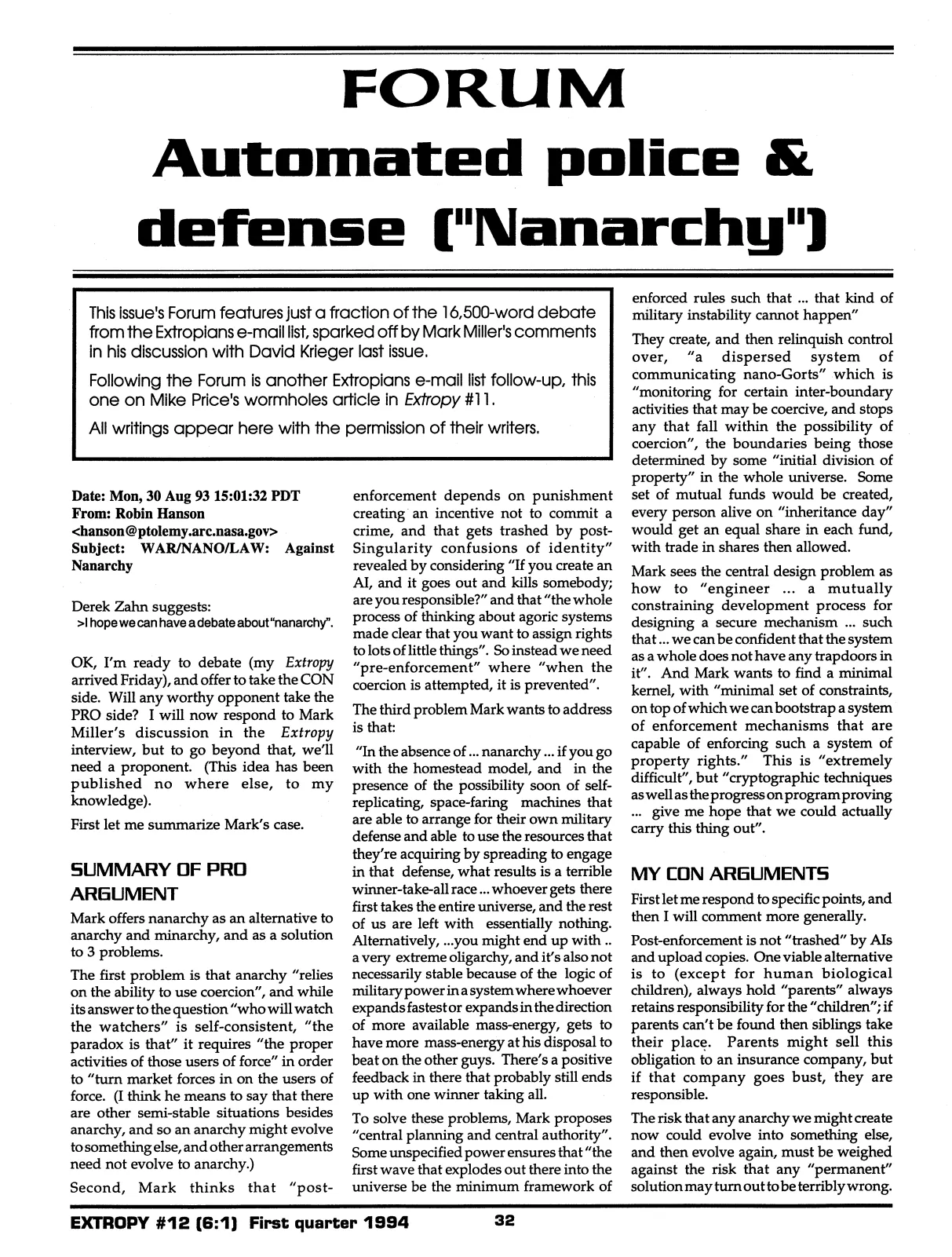
FORUM
Automated police &
defense (“Nanarchy”)
This issue’s Forum features just a fraction of the 16,500-word debate from the Extropians e-mail list, sparked off by Mark Miller’s comments in his discussion with David Krieger last issue.
Following the Forum is another Extropians e-mail list follow-up, this one on Mike Price’s wormholes article in Extropy #11.
All writings appear here with the permission of their writers.
Date: Mon, 30 Aug 93 15:01:32 PDT
From: Robin Hanson
Subject: WAR/NANO/LAW: Against
Nanarchy
Derek Zahn suggests:
I hope we can have a debate about “nanarchy”.
OK, I’m ready to debate (my Extropy arrived Friday), and offer to take the CON side. Will any worthy opponent take the PRO side? I will now respond to Mark Miller’s discussion in the Extropy interview, but to go beyond that, we’ll need a proponent. (This idea has been published no where else, to my knowledge).
First let me summarize Mark’s case.
SUMMARY OF PRO ARGUMENT
Mark offers nanarchy as an alternative to anarchy and minarchy, and as a solution to 3 problems.
The first problem is that anarchy “relies on the ability to use coercion”, and while its answer to the question “who will watch the watchers” is self-consistent, “the paradox is that” it requires “the proper activities of those users of force” in order to “turn market forces in on the users of force. (I think he means to say that there are other semi-stable situations besides anarchy, and so an anarchy might evolve to something else, and other arrangements need not evolve to anarchy.)
Second, Mark thinks that “post-enforcement depends on punishment creating an incentive not to commit a crime, and that gets trashed by post-Singularity confusions of identity” revealed by considering “If you create an AI, and it goes out and kills somebody; are you responsible?” and that “the whole process of thinking about agoric systems made clear that you want to assign rights to lots of little things”. So instead we need “pre-enforcement” where “when the coercion is attempted, it is prevented”.
The third problem Mark wants to address is that:
“In the absence of … nanarchy … if you go with the homestead model, and in the presence of the possibility soon of self-replicating, space-faring machines that are able to arrange for their own military defense and able to use the resources that they’re acquiring by spreading to engage in that defense, what results is a terrible winner-take-all race … whoever gets there first takes the entire universe, and the rest of us are left with essentially nothing. Alternatively, …you might end up with .. a very extreme oligarchy, and it’s also not necessarily stable because of the logic of military power in a system where whoever expands fastest or expands in the direction of more available mass-energy, gets to have more mass-energy at his disposal to beat on the other guys. There’s a positive feedback in there that probably still ends up with one winner taking all.
To solve these problems, Mark proposes “central planning and central authority”. Some unspecified power ensures that “the first wave that explodes out there into the universe be the minimum framework of enforced rules such that … that kind of military instability cannot happen”
They create, and then relinquish control over, “a dispersed system of communicating nano-Gorts” which is “monitoring for certain inter-boundary activities that may be coercive, and stops any that fall within the possibility of coercion”, the boundaries being those determined by some “initial division of property” in the whole universe. Some set of mutual funds would be created, every person alive on “inheritance day” would get an equal share in each fund, with trade in shares then allowed.
Mark sees the central design problem as how to “engineer … a mutually constraining development process for designing a secure mechanism … such that … we can be confident that the system as a whole does not have any trapdoors in it”. And Mark wants to find a minimal kernel, with “minimal set of constraints, on top of which we can bootstrap a system of enforcement mechanisms that are capable of enforcing such a system of property rights.” This is “extremely difficult”, but “cryptographic techniques as well as the progress on program proving … give me hope that we could actually carry this thing out”.
MY CON ARGUMENTS
First let me respond to specific points, and then I will comment more generally.
Post-enforcement is not “trashed” by AIs and upload copies. One viable alternative is to (except for human biological children), always hold “parents” always retains responsibility for the “children”; if parents can’t be found then siblings take their place. Parents might sell this obligation to an insurance company, but if that company goes bust, they are responsible.
The risk that any anarchy we might create now could evolve into something else, and then evolve again, must be weighed against the risk that any “permanent” solution may turn out to be terribly wrong.
Unless the permanent solution is clearly better than the ‘average’ expected future political regimes, risk averse folks should prefer the mixture.
If we are considering whether to offer our political support to some growing ‘movement’ in favor of nanarchy, we must consider the possibility that this movement will get out of hand, implementing something that looks to most people like nanarchy, but not to us.
If this nanarchy must be designed and implemented, and a global political consensus formed in its favor, all before the first wave of intersellar colonization, there is likely not enough time left.
If technology continues to improve, it’s not clear how a nanarchy built on old technology could prevent more advanced attempts at ‘coercion’. If technological improvement must ‘run out’ before nanarchy, then this seems unlikely before the first intersellar colonization.
A nanarchy trying to implement tradable universe shares would have to be able to tell who was the ‘rightful’ owner of some shares. If these rights could be split arbitrarily, the task of the nano-Gorts in detecting and preventing all violations could quickly become impossible. So nanarchy would have to be limited to enforcing some limited and clear concept of ‘coercion’, and I’m not sure there is a natural choice here.
Now let’s get to the central point. Mark clearly thinks that colonization of the universe naturally leads to a single military power, and this seems the primary reason to create a single power now, and ‘do it right’. However, this central point is not so much poorly defended as hardly defended at all. Sure, ‘whoever expands fastest … gets to have more mass-energy at his disposal to beat on the other guys’. But the same could be said of ordinary economic growth, yet few argue this implies a single power.
The question is: why would a power controlling more mass tend to grow at a faster percentage rate, or find it in their interest to wage war? I would actually be most convinced by a board game, plausibly modeling the colonization process; where I could play and see that a single power was the natural result.
If at least one of the largest expanding powers were ‘open’, allowing us all to buy shares in it, or to immigrate into it, then there is little risk that the universe will be shut off from us.
Mark says he developed most of these ideas with Eric Drexler years ago, but only now does he have ‘a community to say these things to.’ But they need not only to talk, but also to listen. I encourage one or both of them to now submit their ideas, in detail, for critical scrutiny by a larger community.
Robin Hanson hanson@ptolemy.arc.nasa.gov 415-604-3361 MS-269-2, NASA Ames Research Center, Moffett Field, CA 94035 510-651-7483 47164 Male Terrace, Fremont, CA 94539-7921
Date: Tue, 31 Aug 93 22:46:07 PDT
From: hfinney@shell.portal.com
Subject: WAR/NANO/LAW: Against Nanarchy
I will take issue with some of Robin’s points, but I cannot support Mark Miller’s vision of nanarchy. I agree with Robin’s criticism that nanarchy would not be possible, because of the difficulty of anticipating and preventing all forms of coercion which may ever be developed. I think that the universe is too complex to be able to anticipate things as fully as this. Godel’s theorem and the related computer-science proofs of the impossibility of solving the halting problem both point to the limitations of any finite decision-making process in the face of the full range of complexity which nature may create.
However, I do think that Miller’s criticisms of a non-nanarchy future have more validity than Robin suggests.
The risk that any anarchy we might create now could evolve into something else, and then evolve again, must be weighed against the risk that any ‘permanent’ solution may turn out to be terribly wrong. Unless the permanent solution is clearly better than the ‘average’ expected future political regimes, risk averse folks should prefer the mixture.
The difference between anarchy and nanarchy in this context is that the first is inherently fluid and capable of shifting to other states. Nanarchy, on the other hand, is designed not to be capable of such shifts. We might even say that nanarchy is DEFINED to be a stable, self-enforcing political system which provides minimal guarantees against coercion.
It is not clear how such a system could be terribly wrong; in fact, it would appear that such a system would be inherently right. In fact, it could be said to be a ‘libertarian utopia’, a universe where libertarian principles are in effect part of the laws of nature, as Miller says.
This is the main attraction of the nanarchy concept, that we would have once and for all a guarantee of a non-coercive universe.
With even a Friedman-type anarchy system, there is always the danger that the anarchy might be unstable, that some group of protection agencies could form a secret coalition, and in a surprise move destroy their competition. It is not at all clear that this would be impossible. Nanarchy is an attempt to make this impossible.
If we are considering whether to offer our political support to some growing ‘movement’ in favor of nanarchy, we must consider the possibility that this movement will get out of hand, implementing something that looks to most people like nanarchy, but not to us.
This is a valid practical consideration, but IMO it should be considered only after we settle the question of whether nanarchy, if successfully implemented, would be a superior system. I presume from Robin’s comments that he does not think that it would be.
Now let’s get to the central point. Mark clearly thinks that colonization of the universe naturally leads to a single military power, and this seems the primary reason to create a single power now, and ‘do it right’. However, this central point is not so much poorly defended as hardly defended at all. Sure, ‘whoever expands fastest … gets to have more mass-energy at his disposal to beat on the other guys’. But the same could be said of ordinary economic growth, yet few argue this implies a single power.
I do believe that this could easily occur, because of the speed and ease with which nanotech self-reproducing machines could expand from star system to star system. The standard scenario involves small nano-seeds entering a star system and touching down on some asteroids. They start building copies of themselves, including seed launchers for nearby stars. They also start building detection equipment and weaponry to destroy rival seeds which attempt to enter the same system.
Using this approach, the first seeds to enter a system, if they beat their rivals by only a few years or perhaps even a few months, would end up with full possession of the planetary resources of that system. They would then be in a position to expand outward all the faster. You would have an initial wave of exponential growth (which would settle down to third-power growth) and in such a framework an initial head start could become a numerically overwhelming advantage.
(Our intuition of how growth works, based on experience with biology, does not fit a model with such easy growth. A better model would be a super-saturated solution into which you drop a few seed crystals.)
Harder to defend is the notion that the possessor of the majority of star systems in some region would be able to use his numerical majority effectively against his smaller rivals in order to steal possession of their planetary systems. We don’t know enough about interstellar war to judge! But it is certainly plausible, and even without this effect I think the initial exponential growth phase, when all that is going on is claim-staking and colonization, is going to allow only a very small number of competitors.
Perhaps we could agree that, given enough of a head start, one agent could effectively take permanent possession of all non-Solar star systems. Then if we agreed on that, we might discuss how much of a head start is needed, and whether such a head start was likely to occur.
If at least one of the largest expanding powers were “open”, allowing us all to buy shares in it, or to immigrate into it, then there is little risk that the universe will be shut off from us.
It is not clear why such a power would allow us to do this. What would our bargaining position be to encourage it to allow us such access? What can we offer a power which expects to gain possession of a decent fraction of a whole Universe?
I for one don’t buy Miller’s argument that owning 10¹⁰ of the universe is 5% as good as owning the entire universe. I am astonished that most people supposedly feel that this is true (at least according to Miller). This simply shows a failure of imagination, in my book, like the people who think that if they keep buying lottery tickets they’re bound to hit the jackpot one of these days.
Assuming these expanding powers think like this (which seems valid since people who think like this would be most likely to try the expansion strategy, just as people who want to make zillions of copies of themselves will be among the first to try uploading), then I don’t think any of them are going to cheerfully sell off shares.
In sum, I think it is all too likely that a nanotech race for possession of the universe will occur. I don’t think nanarchy will work, but if it did it might be better than what will happen without it.
(It’s also worth noting the many structural parallels between this debate and the ‘grey goo’ issue, with nanarchy playing the part of Drexler’s ‘active shields’ from EoC. Despite the revisionist thinking which suggests that grey goo will not be a problem because of the presumed difficulty of its creation, I think these arguments only suggest that it might come five years later than was first thought.)
Date: Wed, 1 Sep 93 0:03:23 PDT From: szabo@netcom.com (Nick Szabo) Subject: WAR/NANO/LAW: Against Nanarchy
Robin Hanson:
Sure, “whoever expands fastest … gets to have more mass-energy at his disposal to beat on the other guys”.
This might be, well, immaterial. A better strategy could be to spend cycles on increasing computing mem*cycles with
10¹⁰ of the universe is 5% as good as owning the entire universe.
The fraction of the universe owned will likely be unimportant compared to how well one can put it to use.
Initial definition of property rights raises many of the same bound-rationality problems as central planning of economies. Only much worse: in this case the planners must forecast both future technology changes and the actions of agents not just as smart as themselves, but quadrillions of times smarter. Imagine, for example, defining property rights for the radio spectrum in the 18th century.
Nick Szabo szabo@netcom.com
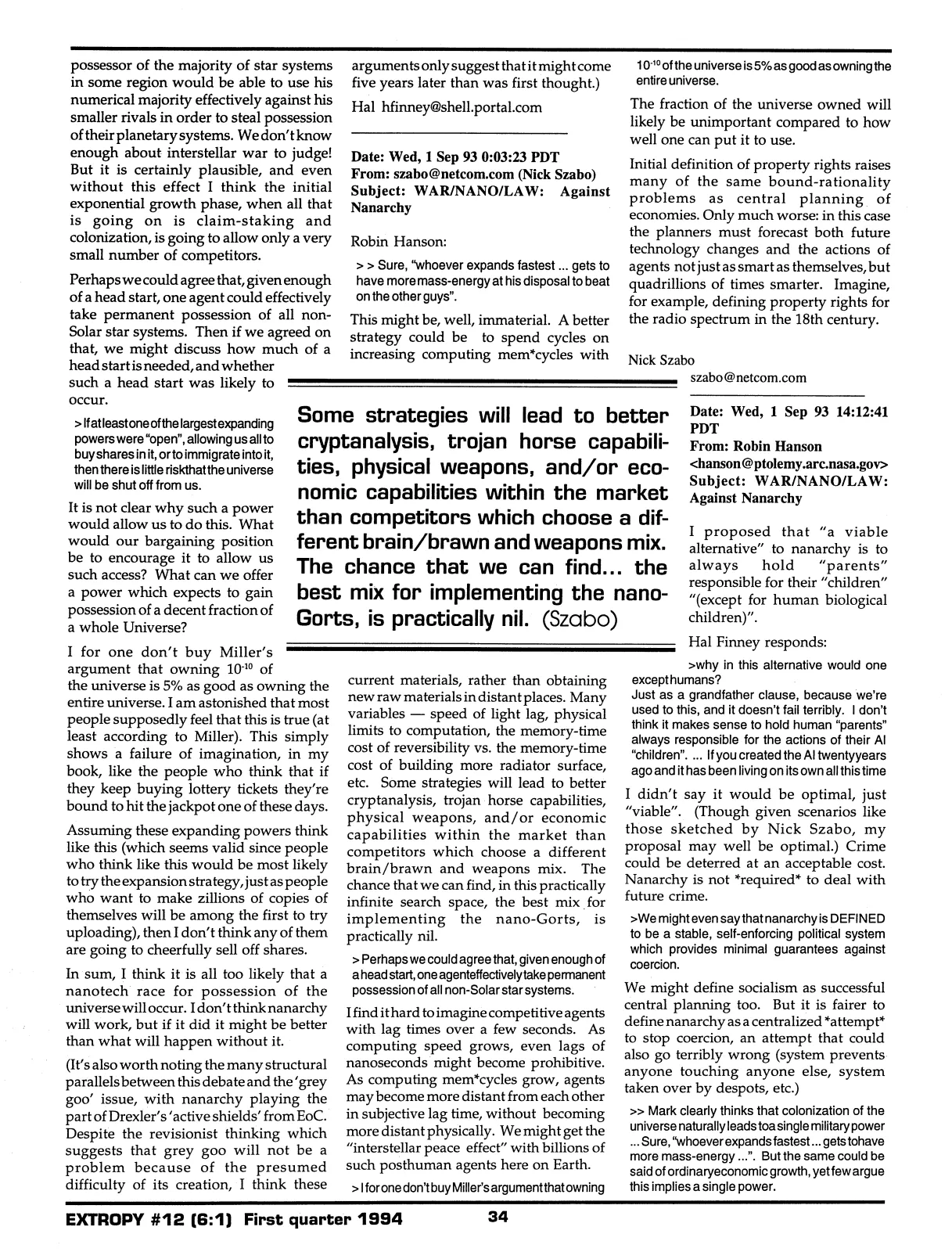
Some strategies will lead to better cryptanalysis, trojan horse capabilities, physical weapons, and/or economic capabilities within the market than competitors which choose a different brain/brown and weapons mix. The chance that we can find… the best mix for implementing the nano-Gorts, is practically nil. (Szabo)
current materials, rather than obtaining new raw materials in distant places. Many variables — speed of light lag, physical limits to computation, the memory-time cost of reversibility vs. the memory-time cost of building more radiator surface, etc. Some strategies will lead to better cryptanalysis, trojan horse capabilities, physical weapons, and/or economic capabilities within the market than competitors which choose a different brain/brown and weapons mix. The chance that we can find, in this practically infinite search space, the best mix for implementing the nano-Gorts, is practically nil.
Perhaps we could agree that, given enough of a head start, one agent effectively take permanent possession of all non-Solar star systems.
I find it hard to imagine competitive agents with lag times over a few seconds. As computing speed grows, even lags of nanoseconds might become prohibitive. As computing mem*cycles grow, agents may become more distant from each other in subjective lag time, without becoming more distant physically. We might get the “interstellar peace effect” with billions of such posthuman agents here on Earth.
I for one don’t buy Miller’s argument that owning
Date: Wed, 1 Sep 93 14:12:41 PDT
From: Robin Hanson
hanson@ptolemy.arc.nasa.gov/hanson@ptolemy.arc.nasa.gov
Subject: WAR/NANO/LAW: Against Nanarchy
I proposed that “a viable alternative” to nanarchy is to always hold “parents” responsible for their “children” “(except for human biological children)”.
Hal Finney responds:
why in this alternative would one except humans?
Just as a grandfather clause, because we’re used to this, and it doesn’t fail terribly. I don’t think it makes sense to hold human “parents” always responsible for the actions of their AI “children”. … If you created the AI twenty years ago and it has been living on its own all this time
I didn’t say it would be optimal, just “viable”. (Though given scenarios like those sketched by Nick Szabo, my proposal may well be optimal.) Crime could be deterred at an acceptable cost. Nanarchy is not “required” to deal with future crime.
We might even say that nanarchy is DEFINED to be a stable, self-enforcing political system which provides minimal guarantees against coercion.
We might define socialism as successful central planning too. But it is fairer to define nanarchy as a centralized “attempt” to stop coercion, an attempt that could also go terribly wrong (system prevents anyone touching anyone else, system taken over by despots, etc.)
Mark clearly thinks that colonization of the universe naturally leads to a single military power … Sure, “whoever expands fastest … gets to have more mass-energy …”. But the same could be said of ordinary economic growth, yet few argue this implies a single power.
I do believe that this could easily occur … nanotech self-reproducing machines could expand from star system to star system. the first seeds to enter a system … would end up with full possession of … that system. They would then be in a position to expand outward all the faster. You would have an initial wave of exponential growth (which would settle down to third-power growth) and in such a framework an initial head start could become a numerically overwhelming advantage … I think the initial exponential growth phase, when all that is going on is claim-staking and colonization, is going to allow only a very small number of competitors.
This makes no sense. With two exponential growing things, it is the one with the larger exponent (time derivative of log of amount) that grows to be biggest. If the exponents are the same the ratio between the two is constant. So I ask again, why should the first colonizer have the biggest exponent? And ordinary economic growth is (at least) exponential, so why doesn’t this argument apply to that?
As Nick points out, technological innovation may not run out, so those who stay closer to the center of innovation, and then expand later may grow faster, by using more advanced technology.
If at least one of the largest expanding powers were ‘open’, allowing us all to buy shares in it, or to immigrate into it, then there is little risk that the universe will be shut off from us. It is not clear why such a power would allow us to do this.
For the same reason that the U.S. should allow immigrants and foreign investors; because they help us grow faster.
Robin Hanson
Date: Thu, 2 Sep 93 23:15:10 -0700
From: drexler@netcom.com (K. Eric Drexler)
Subject: WAR/NANO/LAW, ‘nanarchy’
Some comments regarding Robin Hanson’s recent message regarding ‘nanarchy’:
On terminology: ‘nanarchy’ is a cute but misleading term. I didn’t originate it and haven’t been using it, so please don’t blame it on me.
An idea that I think worth exploring is the use of automated systems to provide a stable framework for security (in a military sense and perhaps a police sense). In the absence of some idea of how a future political system could legitimately decide to violate certain basic principles, one might attempt to build those principles into the system and then throw away the key. These ideas are touched on, rather gingerly, in Engines of Creation.
Some specific responses to Robin’s comments:
The risk that any anarchy we might create now could evolve into something else, and then evolve again, must be weighed against the risk that any ‘permanent’ solution may turn out to be terribly wrong. Unless the permanent solution is clearly better than the ‘average’ expected future political regimes, risk averse folks should prefer the mixture.
If we are in a biological (predation-based) rather than a market (trade-based) ecology, major evolutionary steps are likely to kill us. A risk-averse person might prefer enforcement of conditions that stabilize a market ecology, for example, suppressing the transfer of resources by forcible seizure.
If we are considering whether to offer our political support to some growing ‘movement’ in favor of nanarchy, we must consider the possibility that this movement will get out of hand, implementing something that looks to most people like nanarchy, but not to us.
If technological means emerge for projecting military and police power with highly automated systems, then it is likely that they will be used in some manner. It seems prudent to formulate a picture of how they might be used beneficially, or at least less destructively than when military and police power has been subject to discretionary political control.
If this nanarchy must be designed and implemented, and a global political consensus formed in its favor, all before the first wave of interstellar colonization, there is likely not enough time left.
My expectation is that some political entity will (for a time) be able to dominate the world, and will be terrified of the consequences of not doing so, because of the risks associated with an arms race arising in a more symmetrical situation. If this happens, then it would be desirable to have a clear understanding of how this power could be relinquished without turning it over to potential enemies.
If technology continues to improve, it’s not clear how a nanarchy built on old technology could prevent more advanced attempts at ‘coercion’. If technological improvement must ‘run out’ before nanarchy, then this seems unlikely before the first interstellar colonization.
If machine intelligence systems can perform a million years of R&D per calendar year (and it seems they can), then it may well be that a good understanding of the limits of military technology can be developed rather quickly.
Now let’s get to the central point. Mark clearly thinks that colonization of the universe naturally leads to a single military power…
We will seemingly face a time when multiple technological capabilities will expand by orders of magnitude, quite rapidly, and in a world closely coupled by transportation systems. Why did tiny Britain rule so much of the Earth in the late 1800s? Largely because it had ships and was first out the starting gate in the Industrial Revolution — a relatively slow and small transition in technology. To understand what may be ahead, imagine a history in which the Industrial Revolution had faster payoffs: in which Britain had built aircraft carriers and a substantial nuclear arsenal (and so forth) before other nations managed to build a steam locomotive. Dominance by a single power (or coalition) during the next revolution is not certain, but would be unsurprising.
If at least one of the largest expanding powers were ‘open’, allowing us all to buy shares in it, or to immigrate into it, then there is little risk that the universe will be shut off from us.
Yes indeed: if the dice fall the right way, there is (then) little risk.
Encourage one or both of them to now submit their ideas, in detail, for critical scrutiny by a larger community.
Actually, the ideas are insufficiently detailed, at present, to be submitted in detail to anyone. I’ve spent much of the last ten years trying to explain simple molecular machines, to provide a basis for understanding just how large the coming jump in technology will be. I sympathize with the view that large jumps should be discounted based on historical experience and the prevalence of false alarms (‘Boys have cried wolf.’), but I am persuaded that, this time, we face one. I would encourage Robin to present ideas for addressing issues of short-term and long-term military stability during and after a rather abrupt transition to a world with molecular manufacturing and machine intelligence, without begging the question by assuming that the effects of this transition will necessarily be small or gradual.
To restate a basic motivating problem:
It is plausible that a political entity or coalition will achieve unilateral military dominance based on a technology so different from today’s that past military experience provides no basis for predicting the stability of a multilateral competition. With this (absolutely corrupting) power in hand, how can that political entity or coalition relinquish its power safely? Who could it trust?
To state a motivating question:
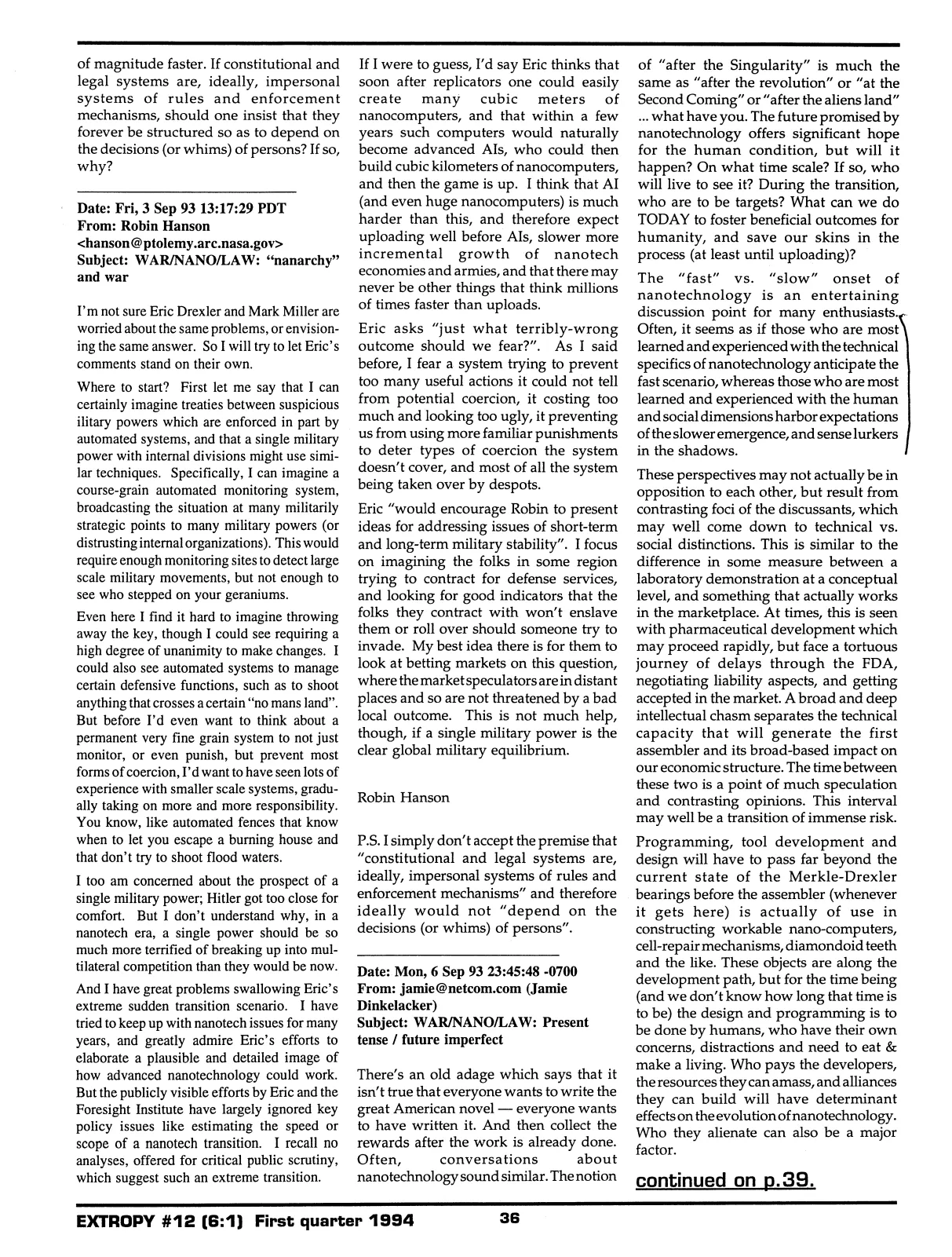
Assume that one favors constitutions and law over dicta and force. Assume that we will find ourselves in a world containing entities far more stable and predictable than human beings and able to think orders of magnitude faster. If constitutional and legal systems are, ideally, impersonal systems of rules and enforcement mechanisms, should one insist that they forever be structured so as to depend on the decisions (or whims) of persons? If so, why?
Date: Fri, 3 Sep 93 13:17:29 PDT
From: Robin Hanson
Subject: WAR/NANO/LAW: ‘nanarchy’ and war
I’m not sure Eric Drexler and Mark Miller are worried about the same problems, or envisioning the same answer. So I will try to let Eric’s comments stand on their own.
Where to start? First let me say that I can certainly imagine treaties between suspicious military powers which are enforced in part by automated systems, and that a single military power with internal divisions might use similar techniques. Specifically, I can imagine a course-grain automated monitoring system, broadcasting the situation at many militarily strategic points to many military powers (or distrusting internal organizations). This would require enough monitoring sites to detect large scale military movements, but not enough to see who stepped on your geraniums.
Even here I find it hard to imagine throwing away the key, though I could see requiring a high degree of unanimity to make changes. I could also see automated systems to manage certain defensive functions, such as to shoot anything that crosses a certain ‘no mans land’. But before I’d even want to think about a permanent very fine grain system to not just monitor, or even punish, but prevent most forms of coercion, I’d want to have seen lots of experience with smaller scale systems, gradually taking on more and more responsibility. You know, like automated fences that know when to let you escape a burning house and that don’t try to shoot flood waters.
I too am concerned about the prospect of a single military power; Hitler got too close for comfort. But I don’t understand why, in a nanotech era, a single power should be so much more terrified of breaking up into multilateral competition than they would be now.
And I have great problems swallowing Eric’s extreme sudden transition scenario. I have tried to keep up with nanotech issues for many years, and greatly admire Eric’s efforts to elaborate a plausible and detailed image of how advanced nanotechnology could work. But the publicly visible efforts by Eric and the Foresight Institute have largely ignored key policy issues like estimating the speed or scope of a nanotech transition. I recall no analyses, offered for critical public scrutiny, which suggest such an extreme transition.
If I were to guess, I’d say Eric thinks that soon after replicators one could easily create many cubic meters of nanocomputers, and that within a few years such computers would naturally become advanced AIs, who could then build cubic kilometers of nanocomputers, and then the game is up. I think that AI (and even huge nanocomputers) is much harder than this, and therefore expect uploading well before AIs, slower more incremental growth of nanotech economies and armies, and that there may never be other things that think millions of times faster than uploads.
Eric asks ‘just what terribly-wrong outcome should we fear?’. As I said before, I fear a system trying to prevent too many useful actions it could not tell from potential coercion, it costing too much and looking too ugly, it preventing us from using more familiar punishments to deter types of coercion the system doesn’t cover, and most of all the system being taken over by despots.
Eric ‘would encourage Robin to present ideas for addressing issues of short-term and long-term military stability’. I focus on imagining the folks in some region trying to contract for defense services, and looking for good indicators that the folks they contract with won’t enslave them or roll over should someone try to invade. My best idea there is for them to look at betting markets on this question, where the market speculators are in distant places and so are not threatened by a bad local outcome. This is not much help, though, if a single military power is the clear global military equilibrium.
Robin Hanson
P.S. I simply don’t accept the premise that ‘constitutional and legal systems are, ideally, impersonal systems of rules and enforcement mechanisms’ and therefore ideally would not ‘depend on the decisions (or whims) of persons’.
Date: Mon, 6 Sep 93 23:45:48 -0700
From: jamie@netcom.com (Jamie Dinkelacker)
Subject: WAR/NANO/LAW: Present tense / future imperfect
There’s an old adage which says that it isn’t true that everyone wants to write the great American novel — everyone wants to have written it. And then collect the rewards after the work is already done. Often, conversations about nanotechnology sound similar. The notion of ‘after the Singularity’ is much the same as ‘after the revolution’ or ‘at the Second Coming’ or ‘after the aliens land’ … what have you. The future promised by nanotechnology offers significant hope for the human condition, but will it happen? On what time scale? If so, who will live to see it? During the transition, who are to be targets? What can we do TODAY to foster beneficial outcomes for humanity, and save our skins in the process (at least until uploading)?
The ‘fast’ vs. ‘slow’ onset of nanotechnology is an entertaining discussion point for many enthusiasts. Often, it seems as if those who are most learned and experienced with the technical specifics of nanotechnology anticipate the fast scenario, whereas those who are most learned and experienced with the human and social dimensions harbor expectations of the slower emergence, and sense lurkers in the shadows.
These perspectives may not actually be in opposition to each other, but result from contrasting foci of the discussants, which may well come down to technical vs. social distinctions. This is similar to the difference in some measure between a laboratory demonstration at a conceptual level, and something that actually works in the marketplace. At times, this is seen with pharmaceutical development which may proceed rapidly, but face a tortuous journey of delays through the FDA, negotiating liability aspects, and getting accepted in the market. A broad and deep intellectual chasm separates the technical capacity that will generate the first assembler and its broad-based impact on our economic structure. The time between these two is a point of much speculation and contrasting opinions. This interval may well be a transition of immense risk.
Programming, tool development and design will have to pass far beyond the current state of the Merkle-Drexler bearings before the assembler (whenever it gets here) is actually of use in constructing workable nano-computers, cell-repair mechanisms, diamondoid teeth and the like. These objects are along the development path, but for the time being (and we don’t know how long that time is to be) the design and programming is to be done by humans, who have their own concerns, distractions and need to eat & make a living. Who pays the developers, the resources they can amass, and alliances they can build will have determinant effects on the evolution of nanotechnology. Who they alienate can also be a major factor.
continued on p.39.
36
VIEW ORIGINAL SCAN (5 pages)