Issue: EXTROPY #7 · Winter/Spring 1991
Author: Bruce Harrah-Conforth & Max More
Pages: 41–45 · 5 scanned pages
Forum: Transhumanism and Religion
FORUM:
Transhumanism and Religion
A Response to the Persistence of Religion.
Bruce Harrah-Conforth, Ph.D.
In Max More’s thought-provoking article, “Transhumanism: Towards a Futurist philosophy,” he spends a considerable amount of time discussion the causes of the persistence of religion. The four primary conditions for this state are, according to More: “(a) a pre-scientific system of explanation and technology; (b) a source of meaning, direction, and emotional expression in life; (c) a means of social control; (d) a result of the structure of the brain in pre-conscious humans.” While More’s enumeration may be correct in structure, additional points need to be addressed. In all fairness, since his stated purpose was to “focus on (a) and (b),” he was forced to omit a larger discussion of the entire range of his list. Therefore it is no great error on his part that he addresses the technological efficacy of religious practice with the single line “the overall result has been entropic and anti-progressive since religious technology is ineffective (with the occasional exception of psychosomatic effects).”
While there is absolutely no mistake that More is correct in his statement that “…the apparent strength and resurgence of religion is, I believe, an illusion generated from a limited perspective”, it is important to make extremely clear the distinction between “Religion” and religious practice. The mythic band-aid that “Religion” offers to a people who have been so removed from any source of linkage with either internal or external power is compelling, and at the same time truly entropic.
The sympathetic magic associated with organized “Religion” is merely a means by which individuals feel that they are participating in the control of their lives, while in reality they are relinquishing that control. “Religion,” as a hierarchy of dogma, fits More’s argument well. But religious practice has a technological efficacy and history that is anything but entropic. Indeed, it has all the earmarks of an extropic movement built around contemporary technological means.
More’s mention of Julian Jaynes’ idea that “religion may have had its source in the structure of the brain” is worthy of great attention because it addresses not just the entropic drive I will discuss, but also attempts to answer the chicken or egg question of which came first: religious practice or “Religion.” Based on Jaynes’ argument, my own research, and that of others, I would posit that the former was indeed responsible for the latter, but precisely because it was an effective extropic tool.
Defining religious practice here becomes necessary, and for these purposes I believe a reasonable definition may be stated thus: A religious practice is any experiential undertaking that allows the practitioner to feel, in some way, either spiritually or physically, closer to the ineffable than they felt prior to the experience. Religious practice, by this definition, necessitates an alteration of current consciousness to one in which the ineffable is more readily apparent. Therein lies both the extropic drive and the cause of “Religion”.
The most recent work of Ronald K. Siegel, a research pharmacologist at the UCLA School of Medicine, contends that humans may have a built-in drive to alter their consciousness that is as basic as hunger or thirst. This hardly seems unreasonable since anthropological and archeological evidence points to the fact that psychobotanicals were used as early as the paleolithic era. Since Jaynes’ argument places the origins of modern consciousness at only about 3000 years ago, the use of psychedelics would therefore predate any mindset that would create a “Religion” by at least 7000 years.
Even today, there is little question that the psychedelic experience lends itself to the belief that the user has come into direct contact with the ineffable, ultimate truth/unity. Under such circumstances the user is prone to assume that he/she has had a spiritual experience.
Scientists have, for some time, forwarded the notion that psychedelics duplicate the religious experience. Experimental comparisons between what is accepted as the religious experience and the psychedelic experience have shown that they can be one and the same. Psychiatrist Walter Pahnke administered psilocybin to ten theology students with the result that nine of the ten believed they had had a genuine religious experience.⁷ Comparisons between the great texts on religious experience, such as William James Varieties of Religious Experience and Masters and Houston’s Varieties of the Psychedelic Experience likewise demonstrate overwhelming similarity. Contemporary psychological consensus agrees that there is an overwhelming link between psychedelics and religion, this view being succinctly stated by Walter Clark in his text Chemical Ecstasy: Psychedelic Drugs and Religion:
On the basis of the evidence the conclusion would seem inescapable that an important property of the psychedelic chemicals is their agency as a release of profound experience of an ecstatic and mystical nature.⁸
Given the extremely early use by man of hallucinogenic drugs - when Jaynes and others would say that some thoughts were interpreted as the voices of gods - it is not unreasonable to hypothesize that early man’s contact with psychedelic plants caused “the mighty springboard” which put the idea of God into our brains.”
In an effort to enhance, recreate, or discover alternative means by which the state can be accessed, myriad practices that proved efficacious were developed. I find it impossible to assume, on the basis of what we currently know about the chemistry of the brain, that many of the experiential practices now associated with “Religion” were developed because of organizational dogma. Rather, I think it more likely that they developed because they were proven to be effective methods for inducing this link with the “gods”. And it is precisely because they were links that the dogma developed.
Fasting, for example, is well known to produce hallucinations due to the creation of an imbalance of nicotinic acid in the brain, a similar effect to LSD, which is precisely why niacinamide is used to help bring down trippers who are out of control. Meditation, isolation, chanting, the flickering of lights (as in the candlelight of a church service) even the very postures of prayer have been shown to have a similar effect on brain chemistry. An in-depth look at how this works is to examine the use of music as a brain tool.
Music, aside from psychedelics, is one of the oldest procedures by which people have been able to alter their consciousness. Since the earliest times and for virtually every culture known to man, sound/music was related in some way to the mystic realm. Examples of this can be found in the Indian ragas, the musics of Africa, and the Macumba and Candomble cults of South America. In Polynesia the Gods who created the world are all associated with sound/music. Likewise Tibetan bells and horns have long been used by priests as part of their spiritual induction techniques.
From Gregorian chants, to those of shamans, East or West, a spiritual quality of sound was appreciated and utilized in religious practices. Virtually every religion has incorporated music as part of its ceremonies. It is quite clear that this employment of sound was not merely an aesthetic or dogmatic decision. Our knowledge of psychoacoustics has allowed us to understand how effective sound is in the alteration of consciousness. To speculate that the rhythmic products of these practices induce trance states because of their manipulation and stimulation of a higher order of unity, either neurobiological or
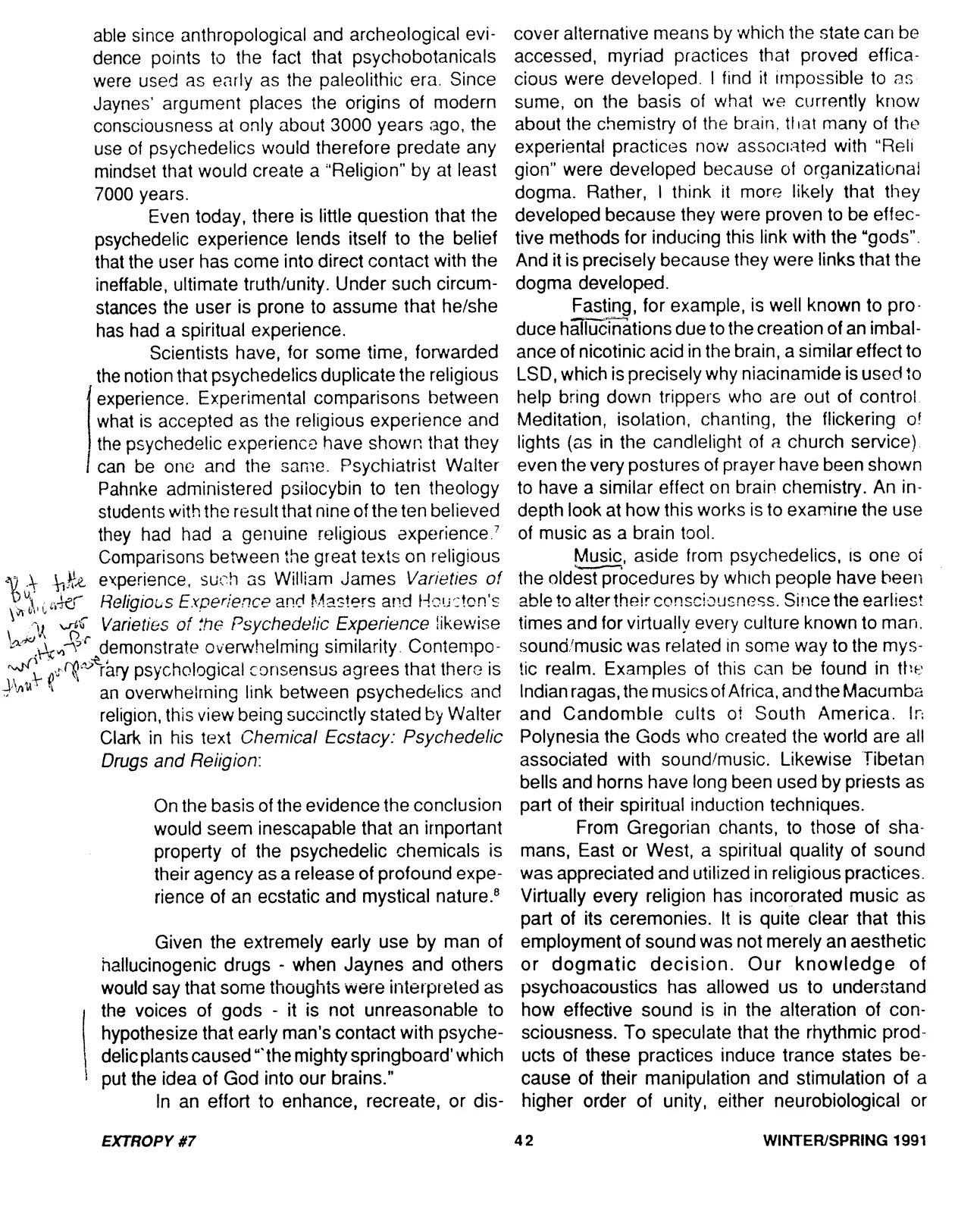
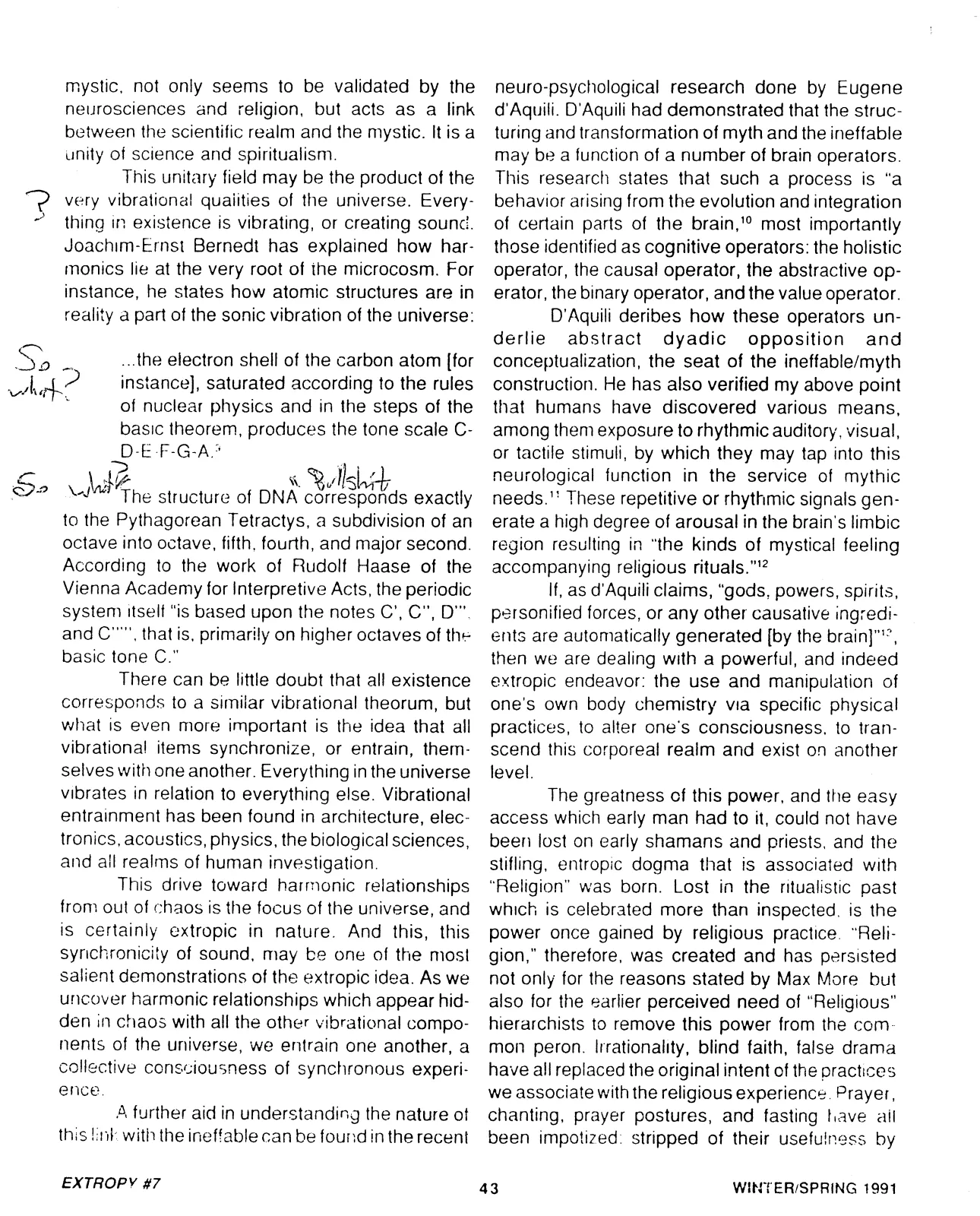
But little indicator book was written for that purpose mystic, not only seems to be validated by the neurosciences and religion, but acts as a link between the scientific realm and the mystic. It is a unity of science and spiritualism.
This unitary field may be the product of the very vibrational qualities of the universe. Everything in existence is vibrating, or creating sound. Joachim-Ernst Bernedt has explained how harmonics lie at the very root of the microcosm. For instance, he states how atomic structures are in reality a part of the sonic vibration of the universe:
…the electron shell of the carbon atom [for instance], saturated according to the rules of nuclear physics and in the steps of the basic theorem, produces the tone scale C-D-E-F-G-A.
The structure of DNA corresponds exactly to the Pythagorean Tetractys, a subdivision of an octave into octave, fifth, fourth, and major second. According to the work of Rudolf Haase of the Vienna Academy for Interpretive Acts, the periodic system itself “is based upon the notes C’, C”, D''', and C'''', that is, primarily on higher octaves of the basic tone C.”
There can be little doubt that all existence corresponds to a similar vibrational theorem, but what is even more important is the idea that all vibrational items synchronize, or entrain, themselves with one another. Everything in the universe vibrates in relation to everything else. Vibrational entrainment has been found in architecture, electronics, acoustics, physics, the biological sciences, and all realms of human investigation.
This drive toward harmonic relationships from out of chaos is the focus of the universe, and is certainly extropic in nature. And this, this synchronicity of sound, may be one of the most salient demonstrations of the extropic idea. As we uncover harmonic relationships which appear hidden in chaos with all the other vibrational components of the universe, we entrain one another, a collective consciousness of synchronous experience.
A further aid in understanding the nature of this link with the ineffable can be found in the recent neuro-psychological research done by Eugene d’Aquili. D’Aquili had demonstrated that the structuring and transformation of myth and the ineffable may be a function of a number of brain operators. This research states that such a process is “a behavior arising from the evolution and integration of certain parts of the brain,” most importantly those identified as cognitive operators: the holistic operator, the causal operator, the abstractive operator, the binary operator, and the value operator.
D’Aquili deribes how these operators underlie abstract dyadic opposition and conceptualization, the seat of the ineffable/myth construction. He has also verified my above point that humans have discovered various means, among them exposure to rhythmic auditory, visual, or tactile stimuli, by which they may tap into this neurological function in the service of mythic needs. These repetitive or rhythmic signals generate a high degree of arousal in the brain’s limbic region resulting in “the kinds of mystical feeling accompanying religious rituals.”
If, as d’Aquili claims, “gods, powers, spirits, personified forces, or any other causative ingredients are automatically generated [by the brain]”, then we are dealing with a powerful, and indeed extropic endeavor: the use and manipulation of one’s own body chemistry via specific physical practices, to alter one’s consciousness, to transcend this corporeal realm and exist on another level.
The greatness of this power, and the easy access which early man had to it, could not have been lost on early shamans and priests, and the stifling, entropic dogma that is associated with “Religion” was born. Lost in the ritualistic past which is celebrated more than inspected, is the power once gained by religious practice. “Religion,” therefore, was created and has persisted not only for the reasons stated by Max More, but also for the earlier perceived need of “Religious” hierarchists to remove this power from the common peron. Irrationality, blind faith, false drama have all replaced the original intent of the practices we associate with the religious experience. Prayer, chanting, prayer postures, and fasting have all been impotized, stripped of their usefulness by
“Religion”. Man’s power to control his own consciousness has, therefore, been replaced with the earlier mentioned band-aid, a crutch for the relinquishment of power.
NOTES
1 Max More, “Transhumanism: Towards a Futurist Philosophy,” EXTROPY #6, Summer 1990, p.6.
2 ibid.
3 More, p.7.
4 More, p.8.
5 More, p.7.
6 Ronald K. Siegel, Intoxication: Life in Pursuit of Artificial Paradise (New York: Dutton, 1989).
7 William Braden, The Private Sea: LSD and the Search for God (Chicago: Quadrange Books, 1967, pp.38-39).
8 Walter Clark, Chemical Ecstasy: Psychedelic Drugs and Religion (New York: Sheed and Ward, 1969), p.90.
9 Joachim-Ernst Berendt, Nada Brahma: The World is Sound (Rochester, Vt: Destiny Books, 1987), p.178.
10 Eugene d’Aquili, “The Myth-Ritual Complex: A biogenic Structural Analysis,” in Zygon, Vol.18, No.3, September 1983, p.247.
11 D’Aquili, 1983, pp.262-263.
12 Richard Schechner, “Magnitudes of Performance,” in The Anthropology of Experience, eds. Victor W. Turner and Edward M. Bruner, (Urbana and Chicago: University of Illinois Press, 1986), p.358.
13 D’Aquili, 1983, p.203.
Religion, Altered States of Consciousness, and Transhumanism.
Max More.
Bruce Harrah-Conforth seems to me to be making two main points: That there is an important difference between “Religion” and religious practice; and that the altered states of consciousness (ASCs) sought through religious practices are the same as (some of) those produced by ingesting psychedelic drugs. I will address these points and the further question of what role these “religious practices” could have in a transhumanist philosophy such as Extropianism.
I agree that a distinction should be made between religion-as-dogma and religious practice. But the distinction cannot be sharp. Part of the problem is that these practices are of several kinds. Many ceremonial practices (such the Catholic eating of “the blood and body”) rather than being separable from a religion are part of its dogmatic creed. Harrah-Conforth focuses on practices aimed at bringing about ASCs. Certainly the methods of attaining such states are not necessarily religious. However, the particular form in which those states are experienced will be strongly influenced by the religious dogma of the person affected and so may then reinforce the dogmatic religion. Practices that induce ASCs such as fasting, dancing, chanting, and organized praying can be powerful methods of bonding a person to a religious system.
Another way in which ASC-inducing religious practices can bolster religious dogma is by bestowing upon the experiencer a special status. While outside of a religious context the pronouncements of people in ASCs tend to be disregarded, within a religion such persons may be revered, exalted, and obeyed as representatives of divine authority.
Yet ASCs need not have anything to do with religion. Millions of people have used psychedelic drugs to have unprecedented experiences without thinking of them according to any religious formula. Such non-religious ASCs can be the “same” as the “religious experience” in that both may be characterized by awe, wonder, delight, ecstasy, and a feeling of being connected to a deeper and broader reality than normal.
Harrah-Conforth defines religious practice as “any experiential undertaking that allows the practitioner to feel, in some way, either spiritually or physically, closer to the ineffable than they felt prior to the experience.” Unfortunately this definition, applying just as much to non-religious ASCs as to “religious experiences” would force us to describe any ASC-inducing practice as “religious”. Because of the connotations of irrational faith and dogma, theism, and anti-physicalism, I would prefer to describe “religious experiences” as religious interpretations of altered states of consciousness, rather than calling ASCs “religious”.
So I agree that altered states of consciousness are one contributory source of religion, but I hold that they are distinct from religion. (Just as official clothing worn by religious functionaries can add authority, but official clothing can be worn for non-religious purposes.)
I am also unhappy with describing ASC experiences as bringing one closer to the ineffable. This description does bias our view towards a faith-based, dogmatic view of the experience: ‘Ineffable’ means ‘too overwhelming to be expressed or described in words; inexpressible’ (Webster’s Unabridged). Interpreted one way this seems unobjectionable - it may well be hard to express such experiences. However, to say that it is inexpressible implies not just ‘difficult to express’ but ‘cannot be expressed’. By thus placing the experience, by definition, outside the realm of intelligibility and communication, the door is left open to dogmatic, unverifiable and unfalsifiable claims - such as ‘this experience is of my personal contact with God.’
Eupraxophies (philosophies of life) such as humanism and transhumanism reject faith and dogma, stressing instead reason and empiricism. If ASCs are to find a place in these philosophies we need to inquire into the value of these experiences. Instead of being used to bolster the dogma of religions, can ASCs be used to promote transhumanist values?
The transhumanist philosophy of Extropianism is (for now) defined by its Principles of Boundless Expansion, Self-Transformation, Dynamic Optimism, and Intelligent Technology.¹ In what ways might the ASCs induced by, say psychedelics, contribute towards these values?
Psychedelics can have a wide range of effects, from enhancing sexual or aesthetic response to increasing the generation of ideas and insights. Perhaps the most valuable potential of these drugs from the Extropian view is that they bring about radical alterations in your perspective on yourself, your life, and others around you, and they allow a powerful though transient window on new modes of living.
MDMA and LSD have enabled many to see themselves more objectively and perceptively. However, after the drug has worn off, the task of making enduring changes based on the insights remains hard work. By facilitating breakthroughs in insight psychedelics may serve as useful catalysts for Self-Transformation and Dynamic Optimism. To make effective use of them requires, of course much care in preparing mental set and external setting.
Another, related, valuable role psychedelic-induced ASCs may play in eupraxophies is enabling us to feel more connected. This is the aspect of the experience most susceptible to mysticism, but it need not be an excuse to abandon comprehensibility. We can understand it as a powerful simultaneous comprehension of our many relations and connections to other persons and to the wider universe. This may well help in establishing a satisfying and meaningful perspective on life, since ‘meaningfulness’ is largely a matter of our connectedness to other entities and processes.²
ASCs, carefully engineered then, can contribute towards personal growth and transformation. But, since some cognitive functions are disrupted by psychedelics, they should be used carefully, and with the understanding that the temporary insightfulness will have to be followed up with hard work on oneself. Eventually psychedelics will be replaced by other substances and implants capable of permanently enhancing intelligence, insights, cognitive energy, creativity and emotional health without any corresponding suppression of other functions. The nootropics such as the pyrrolidones are a first step in this direction. In the future, more powerful substances, still without toxicity, may be expected. In the meantime some transhumanists will continue cautious investigation of the beneficial effects of psychedelics.³
Finally, I wish to note that, as a physicalist, I cannot accept Harrah-Conforth’s description of ASCs as ‘transcend[ing] this corporeal realm and exist[ing] on another level’. Also, in referring to the universe as made of sound, I would stress this to be just a metaphor for the quantum mechanical nature of the universe. These reservations aside, I thank Bruce Harrah-Conforth for his insightful comments and welcome further exchanges.
1 See EXTROPY #6 (Summer 1990).
2 See my ‘Transhumanism: Towards a Futurist Philosophy’ in EXTROPY #6. Also see Robert Nozick, Philosophical Explanations, section 6.
3 This does not amount to a recommendation to experiment for any individual. Before using such drugs it is vital to do your own research and to be confident that you are reasonably mentally stable.
VIEW ORIGINAL SCAN (5 pages)