Issue: EXTROPY #3 · Spring 1989
Author: Tom W. Bell
Pages: 9–13 · 5 scanned pages
Love as a Contractual Relation
LOVE?LOVE!LOVE?LOVE!LOVE?LOVE!LOVE?LO
Want to fall in love? Just sign on the dotted line!
LOVE AS A CONTRACTUAL RELATION
by Tom W. Bell
The hot topic of late among my circle of friends has been a hot topic indeed: love! What is it? Rob Michels, a recovering nihilist, says that love doesn’t exist, that it is an illusion created by culture and self-ignorance. He’s taking a courageous stand, but he takes it alone; no one wants a world without love. Max O’Connor, borrowing from Ayn Rand, claims that love is a response to shared values. This strikes me as a bit too abstract to serve as a guide to romance, however. And as it stands, Max’s definition is far too broad; it would mean that we love everyone who roots for our favorite football team. But you can decide for yourself whether or not you agree with Rob or Max — they have their own articles about love elsewhere in this issue of Extropy. Agree or not, you have to credit them for at least trying to give an account for love. Most people take the easy way out. They proclaim that love is indefinable, and like meteorologists powerless before a hurricane they satisfy themselves with lurid descriptions of its rampages. Come now, let’s not give up so easily! Love is far too important to sacrifice to intellectual laziness.
What Love Is
In a long conversations with Gea Overbeck, one of my brightest students, I came up with the idea that love is not a condition, but a relation. Love holds only between people. It’s not just an arbitrary relation, either. After all, suppose that you’re waiting at a bus stop next to an I.R.S. flunky. He stands to the left relative to you, and you stand to the right relative to him. You therefore share some sort of relation with him. Are you in love with the thug? I think not! Love is a special kind of relation. What kind of relation? Well, that depends on the people involved. Different people like different kinds of love, and will choose the terms of their relationships as suits them. People in love relate only in certain ways: the ways in which they choose to love each other. Love, then, could be called a contractual relation between mutually consenting adults.
Yow! I can hear the objections already. Nothing gets people riled up like a discussion about love. Give me a just minute to lay out some of the consequences of this definition of love, though. I’ll get to the objections later. Promise.
We see, first of all, that love is more than just an extra-strong sort of liking. Given the definition of love set forth here, no one really ‘loves’ ice cream, baseball, the color red, etc., idiomatic expressions to the contrary. Why not? Because you can’t share a contractual relation with an inanimate object.
This definition of love likewise leads us to re-interpret the popular phrase ‘I’m in love.’ As it stands, it sounds rather incomplete. We have to take it to mean ‘I’m in love with (someone),’ or ‘We’re in love with each other.’ Remember, love is a contractual relation between people. ‘It takes two to tango,’ never rang more true.
Understanding love as a contractual relation also makes claims like ‘I love Beth but she doesn’t even know I exist,’ or ‘I still love Curt, even though we’ve broken up,’ sound a bit amiss. If Beth really doesn’t know that you exist, she certainly hasn’t consented to your love! And if you and Curt have really broken up, you share no more consensual relations at all. (Things aren’t usually this clear cut, of course; romance tends to get rather messy. The Beth’s of the world generally know of at least the existence of their suitors, if not their intentions, and Curts often drop by to say ‘Hi!’ now and then. Such real-world relations might or might not be too meagre to support love.)
This definition of love doesn’t, however, stop anyone from saying things like ‘I thought Sue and I were in love - until I found out what she’s really like.’ We often fail to fully understand those we love. But that shouldn’t lead us to say, after discovering our ignorance, that we weren’t in love at all. We can fall in love with our ideal projections of others. We can created the objects of our affections, and insofar as we generate such creations subconsciously, we can consider them separate moral agents, agents we can enter into contractual relations with, agents we can love. At an extreme, we can even love people who don’t exist at all! Ever had dreams like that?
What Love Isn’t
Some people may object that my definition of love is too loose. It seems to call any contractual relation between consenting adults ‘love’. When you prepay for leaded at a gas station, you and the station’s owner enter into a mutually consenting contractual relationship. You promise him legal tender and he promises you gasoline. So are you and the station owner in love? That doesn’t sound very romantic!
O.K., so my definition of love needs some tightening. We can start by determining just what people exchange in loving relationships. In general, they exchange interpersonal goods, rather than material ones (though they may exchange gifts having symbolic value). Different sorts of love entail different sorts of exchanges. Romantic lovers exchange courtship rights (e.g. ‘I won’t date anyone else if you won’t’). Sexual lovers exchange sexual services. Friends exchange psychological support and camaraderie. Family members exchange guidance for obedience, or vice versa. These descriptions aren’t exhaustive, of course, but they serve to delimit the sorts of things that people in love exchange.
‘But,’ other people object, ‘you make love sound so cut-and-dried! You can’t describe love in words; love is just a feeling.’ People who make such claims face a contradiction, however. A good feeling is not a bad feeling, nor is a bad feeling a good one. Good and bad are mutually exclusive terms. Yet sometimes people call love ‘good,’ and sometimes they call it ‘bad.’ So if love were a feeling, it would have to be both good and bad — but that’s impossible. Love is not a good feeling, nor is love a bad feeling. Love is not any sort of feeling at all.
That’s not to say that feelings don’t play an important role in loving relations. The drive to feel good motivates our seeking love in the first place. But we must not confuse the end with the means. We’re all free marketeers, here, aren’t we? Good! Allow me, then, to use an economic analogy: feelings are to love relations as profits are to business relations. People enter into business contracts because they want to make money. The same holds true of love. People enter into to love relations because they want to make themselves feel good. Sometimes they ‘turn a profit’ in love, and end up feeling good. Other times they lose out, and end up growling, ‘love sucks.’ Love can feel good, or love can feel bad, but never is love itself ‘just a feeling.’
Still others object that most people fall in love without ever agreeing to any specific ‘contractual relations’ — love just sort of happens. I admit that few people get explicit about the terms of their love, but if you look hard enough you’ll discover that their love is guided by implicit contracts. Lovers usually borrow roles from their society, thereby taking on ready-made contractual relations. They might adopt the mantles of ‘boyfriend’ and ‘girlfriend,’ for example, and from then on just act as they assume boyfriends and girlfriends should. I’m not saying that this is a good idea, however! In fact, one of the main reasons that I’m arguing for love as a contractual relation is to convince people to make the terms of their love clear. Failing to deal explicitly with the contractual terms of your love opens you up to all sorts of potential troubles. Ever heard this sort of line: ‘But you never told me that you didn’t want me to go out with other guys! How was I supposed to know?’ Maybe it’s true that most people don’t treat love as a contractual relation. That doesn’t show that I’m wrong about love, however; it shows that they are.
Gettin’ Good Lovin’
By now you’re probably wondering, ‘All of this theorizing about love is well and fine, but how far does it get you in the rough-and-tumble world of romance?’ That’s something I’ve wondered about, too. Like most folks, I’ve fallen in and out of romantic love, and I’ve suffered the usual batch of joys and pains. It’s a thrilling ride, but it can sure get rough. Sometimes you get going on a long downhill slide and discover that the only brakes are heartbreaks. We’ll, I’d had enough of love getting the best of me. It seemed like every time I’d fall in love I’d land on my head. I decided it was time to take control of my heart. So I put my theory of love to the test by following these three guidelines:
1) Be explicit
Let your love-partner know what you expect from your relationship, and make it clear what you offer in return. I even suggest putting it into writing. This can be very difficult; you have to define slippery terms (my love and I have defined ‘sexual activity’ as ‘intentional stimulation of the external sexual organs’) and specify what should happen if one of the parties wants out. (Our contract has no sanctions for violating its terms; heartbreak is punishment enough. We did, however, agree to warn each other beforehand if we decided to violate the terms of the contract.) Tough as it is, though, it’s well worth it to make the terms of your love clear. Nothing wrecks a relationship faster than mis-communication.
2) Don’t make promises you can’t keep
‘I’ll love you forever,’ sounds great, but can you really guarantee that you’ll never violate the terms of your love’s contractual relation? If you can’t, then don’t. Likewise, ‘I promise to love you,’ has its problems. Can you promise now to consent to a contractual relation later? If you obligate yourself to agree to the terms of a now-unspecified contract, then you’ve compromised your freedom to consent to that contract. But love is a consensual relation. You can’t be forced to love someone. (There’s more to be said about this, to be sure; it’s a form of the old paradox posed by the question, ‘if one is free, is one free to sell oneself into slavery?’ We’ll skip the subtleties, though.) Be realistic about the terms of your love, or else you’ll find yourself forced to violate them.
3) Nurture trust and respect
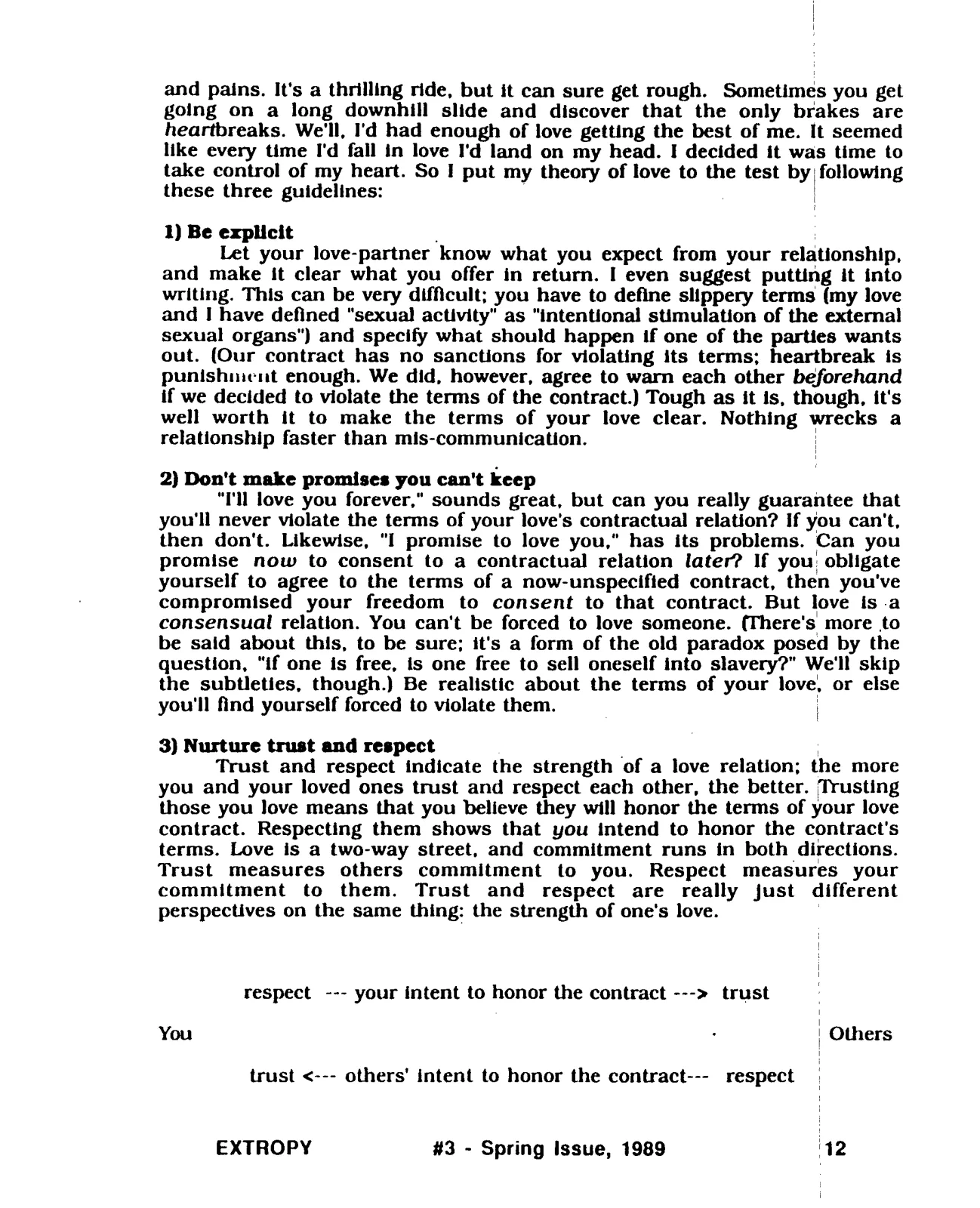
Trust and respect indicate the strength of a love relation; the more you and your loved ones trust and respect each other, the better. Trusting those you love means that you believe they will honor the terms of your love contract. Respecting them shows that you intend to honor the contract’s terms. Love is a two-way street, and commitment runs in both directions. Trust measures others commitment to you. Respect measures your commitment to them. Trust and respect are really just different perspectives on the same thing: the strength of one’s love.
respect --- your intent to honor the contract ---> trust
You
Others trust <--- others’ intent to honor the contract--- respect
Note that you can trust someone without loving them, and vice versa. If you know that they’ll slavishly cater to your every wish, you’ll certainly trust them to honor the terms of your love — they wouldn’t dare to violate them! But you probably won’t respect such a lover very much. Why should you, if the their compliance is guaranteed? Conversely, you could find yourself in a similar situation, respecting someone who you know you can’t trust a whit. Such one-sided loves aren’t very strong. Either the weaker party wises up and gets out, or the stronger party wanders off in search of more challenging prey.
The strongest and most-rewarding love relations mix equal portions of trust and respect. How can you nurture such strength? Well, to reiterate, be explicit — that makes commitment easy to recognize. And don’t make promises you can’t keep — doing so makes you look like someone who can’t be trusted. Most importantly, though, be patient. Trust and respect take a long time to develop. They cannot be given outright; they have to be carefully nurtured for a long, long while. It’s fun work, though, and a good love is well worth the wait.
So has following these rules of thumb improved my love life? I think so. My heart still gets the best of me sometimes, but at least my lover doesn’t. Maybe I’m just lucky to have fallen in love with such a wonderful woman, but I think that treating love as a contractual relation has made our love stronger, happier, and more rewarding.
I can’t claim that describing love as a contractual relation accounts for all of it’s many mysteries, nor can I promise that my theory of love will solve each and every problem that lovers face. But no theory is perfect. We favor a theory simply if it explains more phenomena than contending theories, and if it serves as a better guide to our behavior. Now, while the theory that love is a contractual relation between consenting adults may be imperfect, it dispels more of love’s mysteries than blind cynicism, detached metaphysics, or intellectual laziness. And though my experiments are far from complete, it appears that this theory of love works well in practice, too. Don’t take my word for it, though. Fall in love yourself and try out the theory of love you favor. Whatever you do, though, give love the serious consideration it deserves. Love is far too important to ignore, far too powerful to resist, and far too wonderful to live without.
(I would like to thank Raquel Castellanos, Debbie Leffler, Donna Matias, Rob Michels, Paula Morgan, Max O’Connor, Gea Overbeck, and Jim Stramel, for their help with this essay.)
LOVE?LOVE!LOVE?LOVE!LOVE?LOVE!LOVE?LO
VIEW ORIGINAL SCAN (5 pages)