Issue: EXTROPY #3 · Spring 1989
Author: Various contributors
Pages: 4–8 · 5 scanned pages
Forum
Extropy is edited and published by Tom W. Bell and Max T. O’Connor. Please send articles and letters for publication to:
T. Bell/M. O’Connor
1129 W. 30th St., #8,
Los Angeles, CA 90007.
If we print your article you will receive a complimentary copy of Extropy, or will have your subscription extended by one issue.
Extropy is published four times per year. Subscriptions are $6/yr, or $10/yr for foreign subscriptions. Please make checks payable to Tom Bell or Max O’Connor.
FORUM
Dear Extropy,
I very much enjoyed your last issue. Your idea that perhaps an acceptable system of ethics may be derivable from the single axiom that information should be preserved is an interesting one [see “Wisdomism” by Tom W. Bell, Extropy No.2]. Certainly, general respect for life would follow from the proposition that information preservation is Good, as also would a general ethical prejudice against any act which is (on the whole) destructive.
Of course, there are bound to be problems with defining “information,” and in such an ethical system these problems might be expected to crop up in ethical conflicts whenever loss of one kind of information is balanced against gain of another kind. We might ask, as an example, how much information is destroyed when a laboratory mouse is killed. It can be argued that an inbred lab mouse does not really represent much extra information over and above its genetic information (which remains preserved in the strain), for the simple reason that mice are not very bright and therefore individual animals do not acquire much unique knowledge in a lifetime. Thus, perhaps one could justify destroying individual mice to gain some new scientific information — but could not in the same way justify destroying individual humans. On the other hand, perhaps we fool ourselves. When we get right down to it, there isn’t really any way to know just how much unique information is stored in the brain of a given mouse, for we are after all dealing with a structure that is more complicated than than the biggest computer. One must ask therefore if a bit of information that we can “get at” is to be seen as worth more than a lot of information that we can’t, and if a little information that we are interested in is worth more than a lot of information that we aren’t.
And what happens when we up the ante? Consider the loss of information when we kill not an individual animal, but an entire species of animals. With species extinction, have we finally reached a point where the worth of this loss of genetic information as comparable to the information in a few individual humans? These are not idle philosophical speculations, for such trade-off present themselves whenever we decide whether or not to cut down massive amounts of rain-forest to keep a certain number of humans from starvation, and so on. It certainly appears that an ethical system based on different premises will not immediately solve all of our moral dilemmas.
On the more general subject, it seems to me that part of the attraction of the ideal of an ethics based on ‘information creation and preservation’ comes from a strong human genetic propensity for ‘information respect.’ I believe this propensity to be one of the defining characteristics of our species, though one seldom discussed in exactly these terms. That such an ‘information = pleasure’ brain system historically must have had great survival value seems likely, and there is little doubt that such a system also operates in most people today. Consider, for instance, the source of the entertainment characteristics in the games ‘Jeopardy’ and ‘Trivial Pursuit.’ And consider that most major human hobbies involve combinations of artistic creation, collection, or restoration — all of which are information creation or preservation activities. Note that these same proclivities drive much of technology and science. Scientific research is much like art, and anyone who has ever both written a scientific review paper and participated in the collection and restoration of antiques, will testify to the fact that the satisfactions in both cases are of exactly the same type. I personally believe that the specific ‘information preservation = pleasure’ component is particularly active in the brains of people who become historians, researchers, collectors, cryonicists, and ‘extropians.’ One might fairly characterize Venturism too as the ‘Church of the Information Hound.’
The ancients knew this reverence for information, of course. The Stoic philosophers spoke with awe of the logot spermatikot, the semi-divine seeds of ‘creative force’ (Logos), which served as centers to organize information and order out of the cosmic chaos. Today we know these negative entropy centers better in terms of Prigogines’s ‘dissipative structures’ — structures of increasing complexity and order which arise spontaneously wherever a stream of energy flowing from hot to cold runs through a thermodynamically open system. Life, it appears, is a class of dissipative structure — and so are we. Thus in the universe whenever we find the great onrushing current of heat flow and increasing entropy driving a local entropy decrease in an open system (like here on Earth), that process is what we especially revere. Robert Frost spoke of something of the feeling in the poem ‘West-Running Brook.’ The title refers to the fact that in the Eastern U.S., brooks usually run East to the ocean — but the New England brook in the poem makes a short West-running jog on its way to the sea:
”… The universal cataract of death That spends to nothingness — and unresisted Save by some strange resistance in itself, Not just a swerving, but a throwing back, As if regret were in it and were sacred. It has this throwing backward on itself So that the fall of most of it is always Raising a little, sending up a little. Our life runs down in sending up the clock. The brook runs down in sending up our life. The sun runs down in sending up the brook. And there is something sending up the sun. It is this backward motion toward the source, Against the stream, that most we see ourselves in, The tribute of the current to the source. It is from this in nature we are from. It is most us… .”
Steve Harris, M.D. U.C.L.A. Medical Center
Dear Steve,
As always, you’ve raised interesting and relevant points. I’m amazed that you’ve postulated an “information = pleasure” response in humans; you’ve perfectly summarized the main point of this issue’s article “Sexual Information.” (I hope you’ll take the time to read it, anyway, though!)
You’ve also noted, quite aptly, that Wisdomism doesn’t offer immediate answers to all moral problems. There are two points to remember, though. First of all, Wisdomism doesn’t ask that we maximize the total amount of information in the universe at large. Instead, it defines the Good act for an agent as the act that maximizes that agent’s wisdom. This leads to a sort of enlightened self-interest, where we act not to advance our own bodies and brains, but rather the patterns of information therein. So to solve the moral problems you pose about the fates of lab mice or entire species of animals, we need only determine what would be in the interest of our wisdom — not theirs (except to the extent that we share their information constructs, and therefore identities). This may sound heartless, but hey, it’s a meme-eat-meme world out there!
Secondly, while in practice it may be difficult to determine exactly which act will maximize your wisdom, in theory there is a correct answer. Wisdomism tells us that “total wisdom = knowledge X intelligence X duration X probability.” We may find it difficult to fill in the variables of this equation (at present), however, so we must trust that the natural selection has given us pretty successful memes, and that we can therefore generally trust our gut intuitions.
By the way, these same forces of memetic evolution assure that if each of us seeks only to maximize our own wisdom, the total amount of wisdom in the universe will increase in turn, as the most memetically successful information constructs win out. So even if the grander goal of increasing wisdom universally appeals to you, keep in mind that you’ll probably serve it best by serving yourself.
Tom W. Bell
Dear Extropy,
With regard to the Tree of Knowledge of Good and Evil [see ‘Bad Thoughts’ by T.W.B., Extropy No.2]: looked at a different way, the story is not as bad as you make it out to be. After all (as in Milton’s retelling of the story in Paradise Lost), Adam and Eve were happy in the Garden because they had no notion of good and evil. So, for instance (this from Milton), they had sex without any guilt or shame. My point is that a lot of ‘anti-Christian’ thinkers (e.g., Nietzsche) have come up with similar ideas as goals (see his Beyond Good and Evil, which I admit I haven’t read). I agree that the Biblical story does make Adam and Eve ignorant children, God their omniscient father, and knowledge an undesirable thing. But it is specifically knowledge of GOOD and EVIL that causes suffering, not knowledge of, say, linear algebra, which is neither good nor evil (you might take issue with this last point). Of course, traditional Christianity has turned the issue into the Doctrine of Original Sin, but there are other ways of looking at the story.
University of Connecticut
Dear Extropy,
Thank you for the Jan. 1989 issue of Extropy, and for publishing my letter. New mutations of the Rapture meme are already in the works. (See the enclosed photocopy from the Jan. 1989 issue of Harper’s. For some reason, Tulsa seems to attract Christian end-of-the-world predictors.)
I’m willing to make a prediction of my own. In 1992 the twelve member nations of the European Economic Community (EEC) will throw down their trade barriers to create a unified enterprise zone. The symbol for this new arrangement is twelve stars in a circle. I PREDICT that some Christian writer or broadcaster (perhaps a famous one like Hal Lindsey) will latch onto that as a fulfillment of Revelation 12:1 —‘And there appeared a great wonder in heaven; a woman clothed in the sun, and the moon under her feet, and upon her head a crown of twelve stars.’ (Funny, but when the EEC had only ten members, it was said to be the kingdom of the ‘beast from the sea’ in Revelation 13.)
You heard it here first.
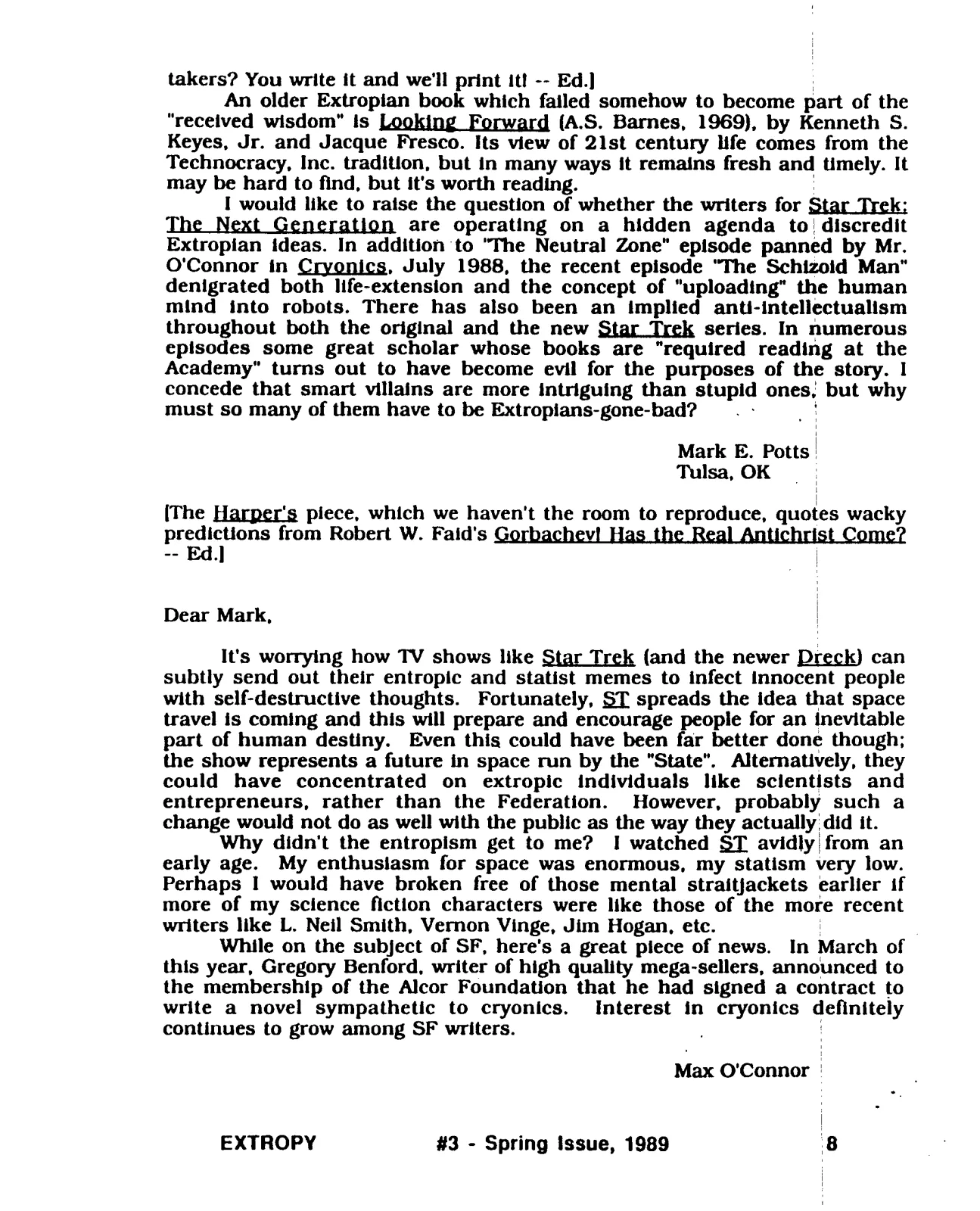
A recent Extropian book of note is from your fellow Angeleno FM-2030 (a.k.a. F.M. Esfandiary), a trade paperback for $6.95 titled Are You A Transhuman? (Warner Books, 1989). It deserves a review in Extropy. [Any takers? You write it and we’ll print it! — Ed.]
An older Extropian book which failed somehow to become part of the ‘received wisdom’ is Looking Forward (A.S. Barnes, 1969), by Kenneth S. Keyes, Jr. and Jacque Fresco. Its view of 21st century life comes from the Technocracy, Inc. tradition, but in many ways it remains fresh and timely. It may be hard to find, but it’s worth reading.
I would like to raise the question of whether the writers for Star Trek: The Next Generation are operating on a hidden agenda to discredit Extropian ideas. In addition to ‘The Neutral Zone’ episode panned by Mr. O’Connor in Cryonics, July 1988, the recent episode ‘The Schizoid Man’ denigrated both life-extension and the concept of ‘uploading’ the human mind into robots. There has also been an implied anti-intellectualism throughout both the original and the new Star Trek series. In numerous episodes some great scholar whose books are ‘required reading at the Academy’ turns out to have become evil for the purposes of the story. I concede that smart villains are more intriguing than stupid ones, but why must so many of them have to be Extropians-gone-bad?
Mark E. Potts Tulsa, OK
[The Harper’s piece, which we haven’t the room to reproduce, quotes wacky predictions from Robert W. Faid’s Gorbachev! Has the Real Antichrist Come? — Ed.]
Dear Mark,
It’s worrying how TV shows like Star Trek (and the newer Dreck) can subtly send out their entropic and statist memes to infect innocent people with self-destructive thoughts. Fortunately, ST spreads the idea that space travel is coming and this will prepare and encourage people for an inevitable part of human destiny. Even this could have been far better done though; the show represents a future in space run by the ‘State’. Alternatively, they could have concentrated on extropic individuals like scientists and entrepreneurs, rather than the Federation. However, probably such a change would not do as well with the public as the way they actually did it.
Why didn’t the entropism get to me? I watched ST avidly from an early age. My enthusiasm for space was enormous, my statism very low. Perhaps I would have broken free of those mental straitjackets earlier if more of my science fiction characters were like those of the more recent writers like L. Neil Smith, Vernon Vinge, Jim Hogan, etc.
While on the subject of SF, here’s a great piece of news. In March of this year, Gregory Benford, writer of high quality mega-sellers, announced to the membership of the Alcor Foundation that he had signed a contract to write a novel sympathetic to cryonics. Interest in cryonics definitely continues to grow among SF writers.
Max O’Connor
VIEW ORIGINAL SCAN (5 pages)