Issue: EXTROPY #1 · Fall 1988
Author: Max T. O'Connor
Pages: 15–21 · 7 scanned pages
Morality or Reality?
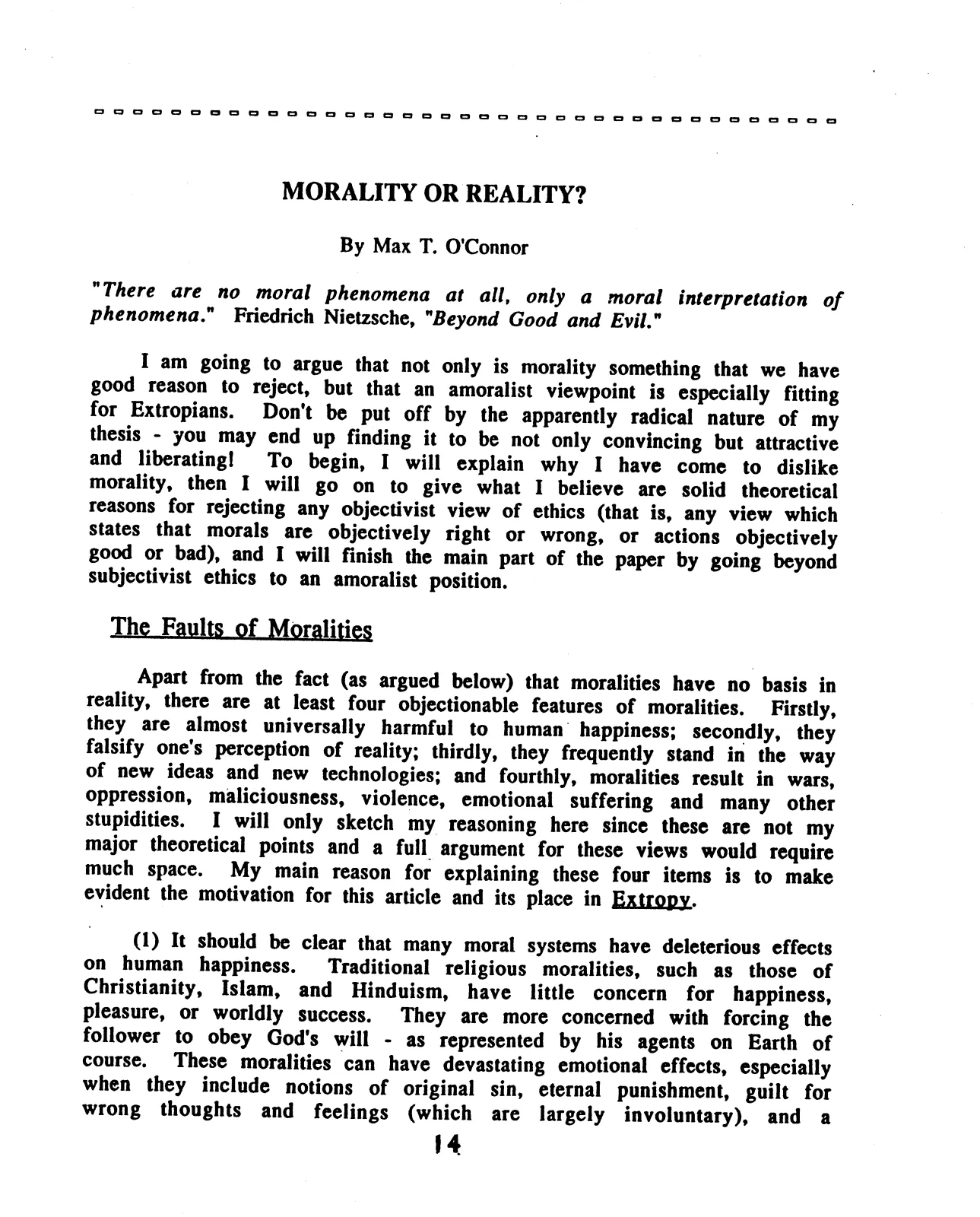
MORALITY OR REALITY?
By Max T. O’Connor
‘There are no moral phenomena at all, only a moral interpretation of phenomena.’ Friedrich Nietzsche, ‘Beyond Good and Evil.’
I am going to argue that not only is morality something that we have good reason to reject, but that an amoralist viewpoint is especially fitting for Extropians. Don’t be put off by the apparently radical nature of my thesis - you may end up finding it to be not only convincing but attractive and liberating! To begin, I will explain why I have come to dislike morality, then I will go on to give what I believe are solid theoretical reasons for rejecting any objectivist view of ethics (that is, any view which states that morals are objectively right or wrong, or actions objectively good or bad), and I will finish the main part of the paper by going beyond subjectivist ethics to an amoralist position.
The Faults of Moralities
Apart from the fact (as argued below) that moralities have no basis in reality, there are at least four objectionable features of moralities. Firstly, they are almost universally harmful to human happiness; secondly, they falsify one’s perception of reality; thirdly, they frequently stand in the way of new ideas and new technologies; and fourthly, moralities result in wars, oppression, maliciousness, violence, emotional suffering and many other stupidities. I will only sketch my reasoning here since these are not my major theoretical points and a full argument for these views would require much space. My main reason for explaining these four items is to make evident the motivation for this article and its place in Extropy.
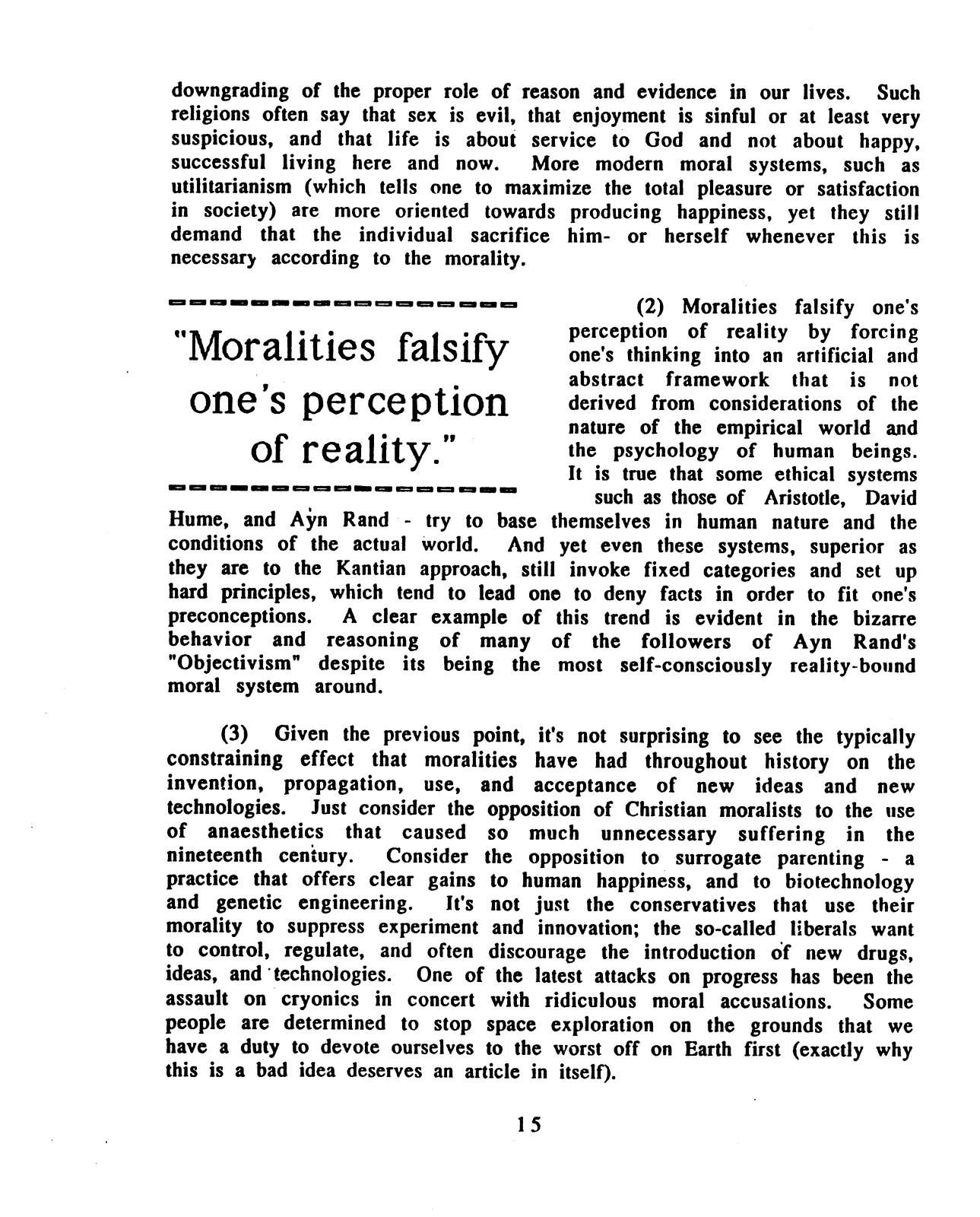
(1) It should be clear that many moral systems have deleterious effects on human happiness. Traditional religious moralities, such as those of Christianity, Islam, and Hinduism, have little concern for happiness, pleasure, or worldly success. They are more concerned with forcing the follower to obey God’s will - as represented by his agents on Earth of course. These moralities can have devastating emotional effects, especially when they include notions of original sin, eternal punishment, guilt for wrong thoughts and feelings (which are largely involuntary), and a downgrading of the proper role of reason and evidence in our lives. Such religions often say that sex is evil, that enjoyment is sinful or at least very suspicious, and that life is about service to God and not about happy, successful living here and now. More modern moral systems, such as utilitarianism (which tells one to maximize the total pleasure or satisfaction in society) are more oriented towards producing happiness, yet they still demand that the individual sacrifice him- or herself whenever this is necessary according to the morality.
(2) Moralities falsify one’s perception of reality by forcing one’s thinking into an artificial and abstract framework that is not derived from considerations of the nature of the empirical world and the psychology of human beings. It is true that some ethical systems such as those of Aristotle, David
Hume, and Ayn Rand - try to base themselves in human nature and the conditions of the actual world. And yet even these systems, superior as they are to the Kantian approach, still invoke fixed categories and set up hard principles, which tend to lead one to deny facts in order to fit one’s preconceptions. A clear example of this trend is evident in the bizarre behavior and reasoning of many of the followers of Ayn Rand’s ‘Objectivism’ despite its being the most self-consciously reality-bound moral system around.
(3) Given the previous point, it’s not surprising to see the typically constraining effect that moralities have had throughout history on the invention, propagation, use, and acceptance of new ideas and new technologies. Just consider the opposition of Christian moralists to the use of anaesthetics that caused so much unnecessary suffering in the nineteenth century. Consider the opposition to surrogate parenting - a practice that offers clear gains to human happiness, and to biotechnology and genetic engineering. It’s not just the conservatives that use their morality to suppress experiment and innovation; the so-called liberals want to control, regulate, and often discourage the introduction of new drugs, ideas, and technologies. One of the latest attacks on progress has been the assault on cryonics in concert with ridiculous moral accusations. Some people are determined to stop space exploration on the grounds that we have a duty to devote ourselves to the worst off on Earth first (exactly why this is a bad idea deserves an article in itself).
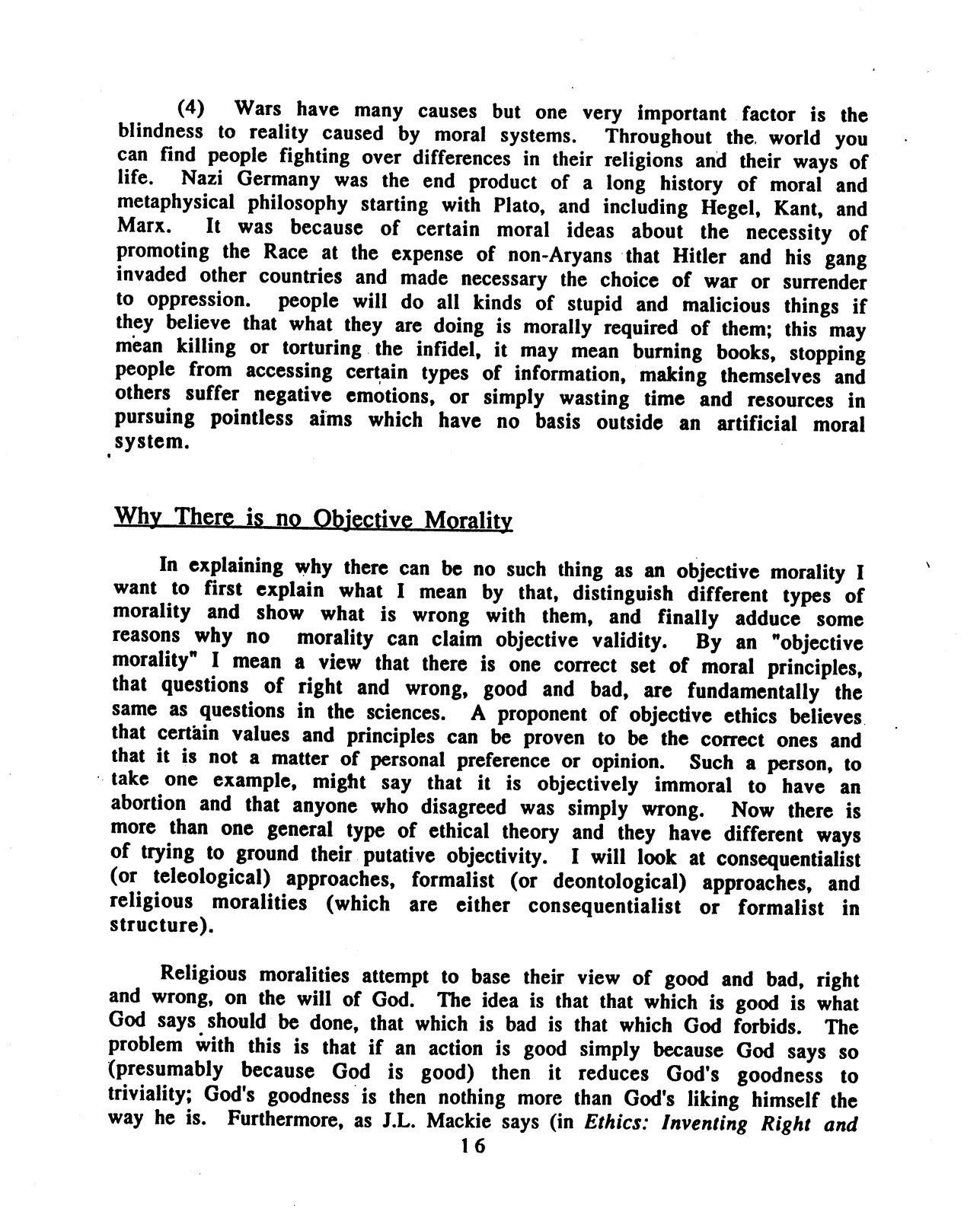
(4) Wars have many causes but one very important factor is the blindness to reality caused by moral systems. Throughout the world you can find people fighting over differences in their religions and their ways of life. Nazi Germany was the end product of a long history of moral and metaphysical philosophy starting with Plato, and including Hegel, Kant, and Marx. It was because of certain moral ideas about the necessity of promoting the Race at the expense of non-Aryans that Hitler and his gang invaded other countries and made necessary the choice of war or surrender to oppression. people will do all kinds of stupid and malicious things if they believe that what they are doing is morally required of them; this may mean killing or torturing the infidel, it may mean burning books, stopping people from accessing certain types of information, making themselves and others suffer negative emotions, or simply wasting time and resources in pursuing pointless aims which have no basis outside an artificial moral system.
Why There is no Objective Morality
In explaining why there can be no such thing as an objective morality I want to first explain what I mean by that, distinguish different types of morality and show what is wrong with them, and finally adduce some reasons why no morality can claim objective validity. By an ‘objective morality’ I mean a view that there is one correct set of moral principles, that questions of right and wrong, good and bad, are fundamentally the same as questions in the sciences. A proponent of objective ethics believes that certain values and principles can be proven to be the correct ones and that it is not a matter of personal preference or opinion. Such a person, to take one example, might say that it is objectively immoral to have an abortion and that anyone who disagreed was simply wrong. Now there is more than one general type of ethical theory and they have different ways of trying to ground their putative objectivity. I will look at consequentialist (or teleological) approaches, formalist (or deontological) approaches, and religious moralities (which are either consequentialist or formalist in structure).
Religious moralities attempt to base their view of good and bad, right and wrong, on the will of God. The idea is that that which is good is what God says should be done, that which is bad is that which God forbids. The problem with this is that if an action is good simply because God says so (presumably because God is good) then it reduces God’s goodness to triviality; God’s goodness is then nothing more than God’s liking himself the way he is. Furthermore, as J.L. Mackie says (in Ethics: Inventing Right and
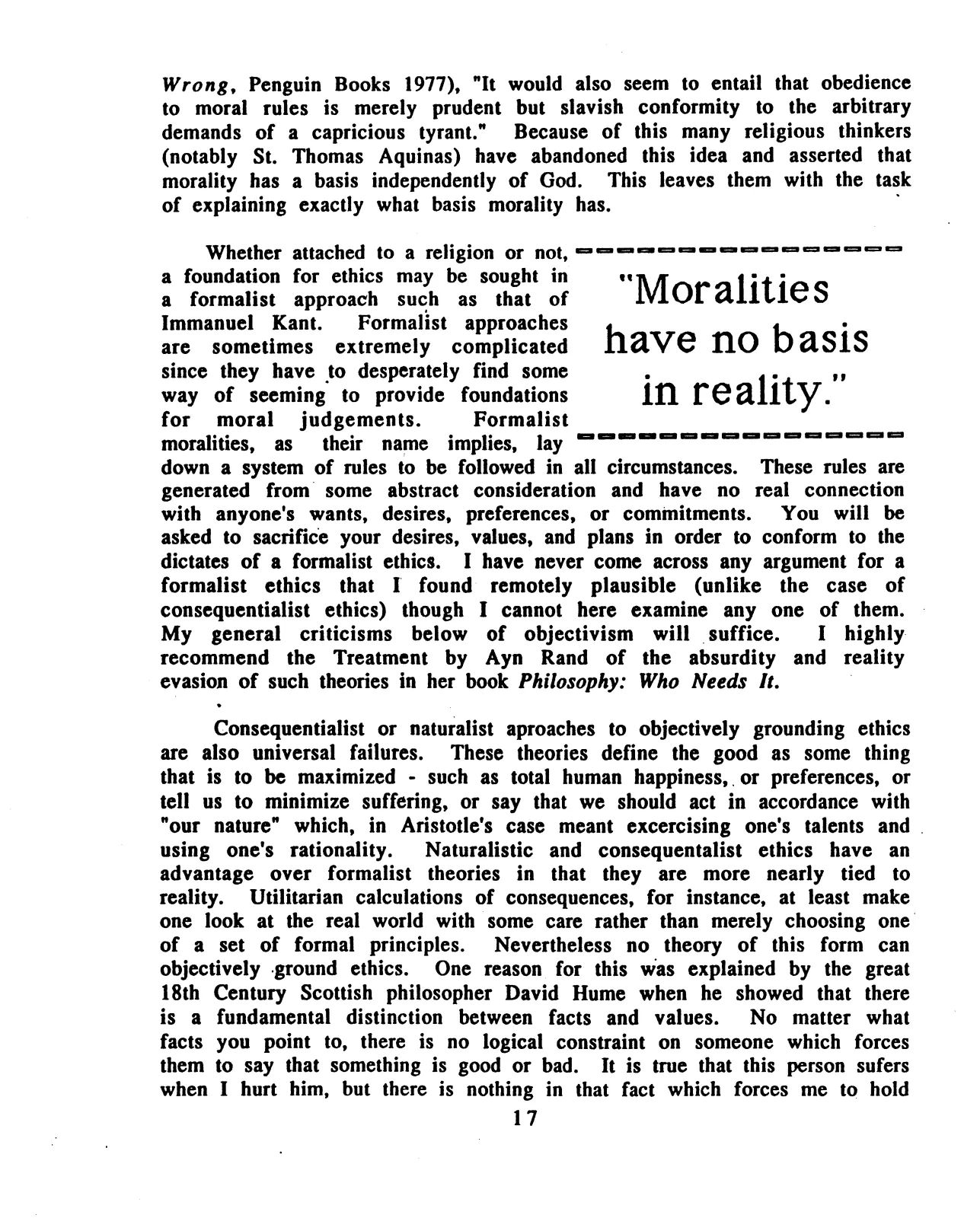
Wrong, Penguin Books 1977), “It would also seem to entail that obedience to moral rules is merely prudent but slavish conformity to the arbitrary demands of a capricious tyrant.” Because of this many religious thinkers (notably St. Thomas Aquinas) have abandoned this idea and asserted that morality has a basis independently of God. This leaves them with the task of explaining exactly what basis morality has.
Whether attached to a religion or not, a foundation for ethics may be sought in a formalist approach such as that of Immanuel Kant. Formalist approaches are sometimes extremely complicated since they have to desperately find some way of seeming to provide foundations for moral judgements. Formalist moralities, as their name implies, lay down a system of rules to be followed in all circumstances. These rules are generated from some abstract consideration and have no real connection with anyone’s wants, desires, preferences, or commitments. You will be asked to sacrifice your desires, values, and plans in order to conform to the dictates of a formalist ethics. I have never come across any argument for a formalist ethics that I found remotely plausible (unlike the case of consequentialist ethics) though I cannot here examine any one of them. My general criticisms below of objectivism will suffice. I highly recommend the Treatment by Ayn Rand of the absurdity and reality evasion of such theories in her book Philosophy: Who Needs It.
“Moralities have no basis in reality.”
Consequentialist or naturalist approaches to objectively grounding ethics are also universal failures. These theories define the good as some thing that is to be maximized - such as total human happiness, or preferences, or tell us to minimize suffering, or say that we should act in accordance with “our nature” which, in Aristotle’s case meant exercising one’s talents and using one’s rationality. Naturalistic and consequentialist ethics have an advantage over formalist theories in that they are more nearly tied to reality. Utilitarian calculations of consequences, for instance, at least make one look at the real world with some care rather than merely choosing one of a set of formal principles. Nevertheless no theory of this form can objectively ground ethics. One reason for this was explained by the great 18th Century Scottish philosopher David Hume when he showed that there is a fundamental distinction between facts and values. No matter what facts you point to, there is no logical constraint on someone which forces them to say that something is good or bad. It is true that this person suffers when I hurt him, but there is nothing in that fact which forces me to hold the infliction of pain to be morally wrong rather than morally neutral or right. Rather than develop Hume’s point in detail I will go on to make general critical points against the possibility of any system of ethics - whether formal or consequentialist - being susceptible of an objective grounding.
The Arguments From Oddness and Relativity
The argument from relativity is based on the obvious variation in the moral codes found in different ages, different societies, and different cultural groups and individuals within a society. Such variations do not, in themselves, prove the relativity of moral values of course. Yet the existence of such widespread differences in moral beliefs make it hard to take seriously the idea that people are just perceiving moral truths in an unclear and confused manner. There is much disagreement at the frontiers of science (though also a continually growing amount of agreement as more areas are deeply explored) but this is because science, when it ventures into relatively new territory, consists of speculative theoretical conjectures and inferences about what is objectively the case based on currently inadequate evidence and testing. It is implausible to construe moral theorizing in the same way for it has been around for thousands of years - what more evidence could turn up to decide these value issues? It seems rather that moral disagreements result not from poor perceptions of an objective realm of values but are absorbed from existing cultures. Thus monogamy is thought to be right because people are raised in a monogamous culture. There are moral reformers and heretics but their views are usually best explained as their belief that the new view is a more consistent extension of existing ethical conceptions.
The argument from oddness is even more telling than the argument from relativity and consists of an epistemological and a metaphysical part. (For those unfamiliar with philosopher’s terminology, metaphysical refers to the study of what kinds of things exist and in what way, while epistemology studies how we know what exists and the conditions for knowledge or rational belief). Metaphysically, objective values would be odd because they would be entities, relations, or qualities of a type unlike anything else that we know of. Because of this we would require some very strange and puzzling means of knowledge to be able to apprehend objective values. We would need some faculty of knowledge other than the senses, reason, and logic which we use for everything else. Many objectivist moralists do not care for G.E. Moore’s ‘non-natural qualities’ and his ‘faculty of moral intuition’ and yet they seem to be committed to these if any sense is to be made of objective morality.
The kind of thing that is needed for objective ethics is something like Plato’s theory of Forms. Knowledge of the Form of the Good both tells the person who knows the good to pursue it and makes him pursue it. An objective goodness would be something that people had to promote once they recognized it simply because it was the good and not because someone wanted or desired the things that goodness was attached to. The oddness of these objective values can be further brought out by asking how it could be that objective moral goodness could be linked with any natural object that ‘has’ that goodness. What exactly is the connection between an action causing unnecessary pain and it being wrong? There is no logical connection here, and we do not sense something that we know to be the property of goodness and then sense its connection to the action. Yet there is supposed to be some kind of connection between them. What could this possibly be? The situation is more much simple and more comprehensible if we do away with objective moral values and replace them with subjective responses which are causally related to one’s noticing certain features of an action or situation.
There are a number of reasons why people tend to objectify their subjective values, but we needn’t go into those here. Let us just recognize the fact that values have their basis in individuals - moral values are simply people’s desires and preferences even if they themselves don’t recognize this. At this point we seem to be left with a conclusion of moral subjectivism. I have no really strong arguments that can intellectually force anyone to go beyond subjectivism to amoralism; my arguments will only appeal to those who share some of my own subjective values. Some of those values are evident from the way in which I began this article. If you also favor liberty, peace, opportunity, diversity, increased information, and rationality, then amoralism should have some appeal for you. Amoralism does not deny the existence of (subjective) moralities. It is merely an attitude towards all of them. It’s an attitude which says: NO THANKS! Let me first make it clear that an amoralist is not someone who rejects all principles of personal conduct. It is not an attitude which says ‘Do whatever you feel like at any time’. That is not amoralism but rather a type of behavioral nihilism,
It should also be stressed that amoralism is not the same as egoism (whether narrow, broad, enlightened, or Aristotelian). Egoism is itself a moral system and imposes strict restrictions on the behavior of individuals. For a well worked out egoist morality (which claims to be objectively true) see Ayn Rand’s The Virtue of Selfishness. Although I have long been inclined to a form of egoism myself and have found it difficult to see how anyone could be attached to any other moral system, I now think that there is no more reason to accept an egoistic ethics than any other if it does not suit your overall set of values, goals, desires, preferences, and projects. It is still the case for me, however, that egoism does pretty efficiently fit my preferences and projects and so I continue to use it as a guideline, but I am now aware of the danger inherent in any moral system, subjective or not. My projects and fundamental preferences may change so that egoism becomes an encumbrance rather than an aid. If, fundamentally, you don’t want to act egoistically then there is no reason why you should. Of course I could point out that you might die, or suffer physical or emotional pain which you wouldn’t if you continued to be an egoist, but these points could only have force for someone who already valued those things.
Amoralism, then, does allow one to have principles regulating personal conduct, and they can be as simple or as complex as one wishes. An amoralist will find it productive to look over the many moral systems that have been invented (this being the correct term!) over the centuries and pick and choose as he or she sees fit. Mixing moral systems will be tricky if you are mixing internally consistent but mutually contradictory systems since you will end up with a system that, being self-contradictory, is not very useful. Beyond that consideration though, it makes good sense to construct a system that best reflects your values. The amoralist always leaves his system open for future revisions and corrections as he inevitably changes. A set of principles to regulate one’s behavior has utility only if it makes day to day decision-making easier. You don’t want to have to work out what to do from first principles every time - a set of principles allows you to maximize the efficiency with which you pursue and realize your subjective values and preferences.
An amoralist is not likely to be interested in building guilt into his system. Guilt is a self-punishing emotional response based on a belief that one has done a ‘bad’ thing. It is counterproductive and unpleasant, and it
VIEW ORIGINAL SCAN (7 pages)