Issue: EXTROPY #1 · Fall 1988
Author: Max T. O'Connor & Tom W. Bell
Pages: 2–14 · 13 scanned pages
Introduction
INTRODUCTION
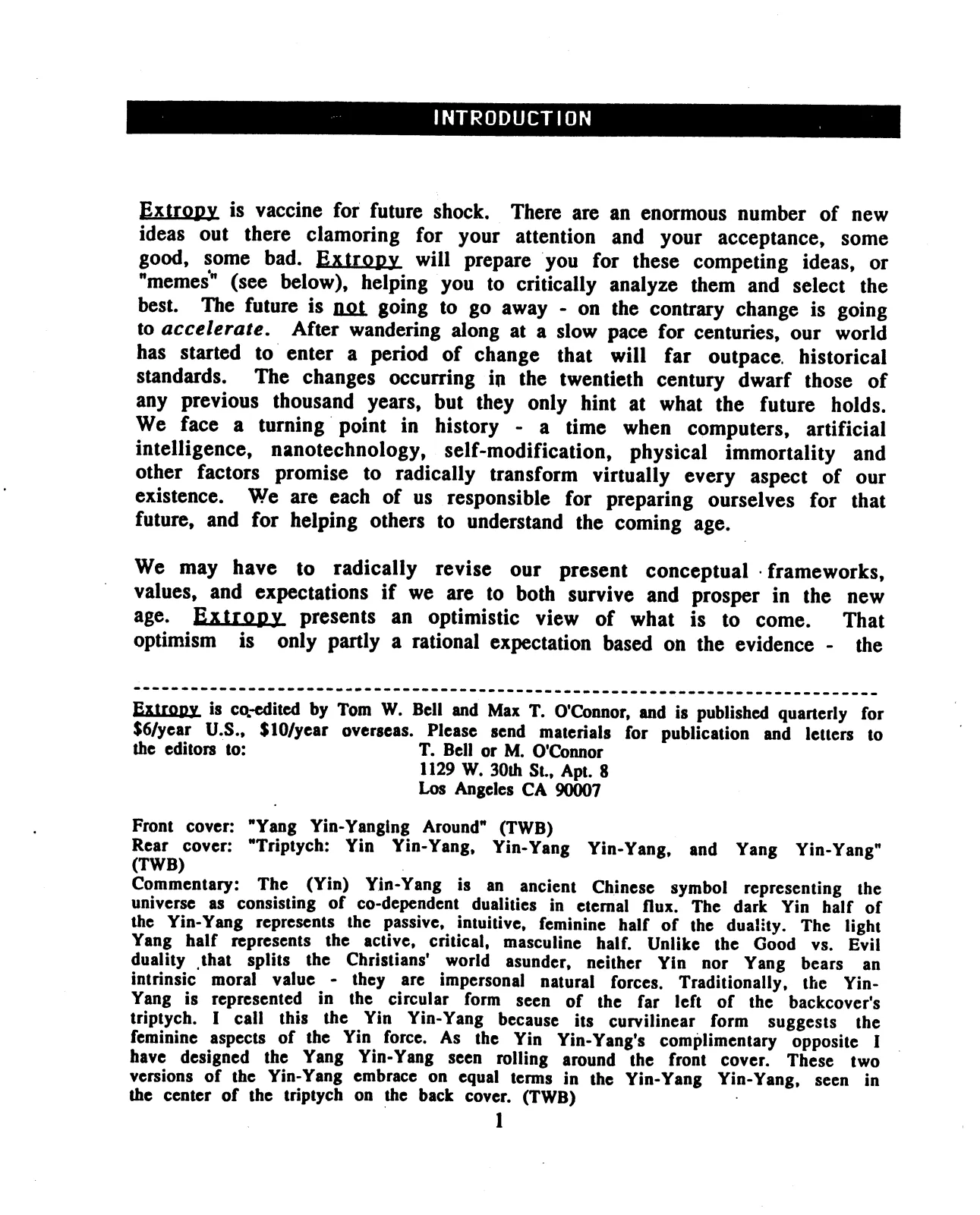
Extropy is vaccine for future shock. There are an enormous number of new ideas out there clamoring for your attention and your acceptance, some good, some bad. Extropy will prepare you for these competing ideas, or ‘memes’ (see below), helping you to critically analyze them and select the best. The future is not going to go away - on the contrary change is going to accelerate. After wandering along at a slow pace for centuries, our world has started to enter a period of change that will far outpace historical standards. The changes occurring in the twentieth century dwarf those of any previous thousand years, but they only hint at what the future holds. We face a turning point in history - a time when computers, artificial intelligence, nanotechnology, self-modification, physical immortality and other factors promise to radically transform virtually every aspect of our existence. We are each of us responsible for preparing ourselves for that future, and for helping others to understand the coming age.
We may have to radically revise our present conceptual frameworks, values, and expectations if we are to both survive and prosper in the new age. Extropy presents an optimistic view of what is to come. That optimism is only partly a rational expectation based on the evidence - the
---Extropy is co-edited by Tom W. Bell and Max T. O’Connor, and is published quarterly for $6/year U.S., $10/year overseas. Please send materials for publication and letters to the editors to:
T. Bell or M. O’Connor
1129 W. 30th St., Apt. 8
Los Angeles CA 90007
Front cover: ‘Yang Yin-Yangling Around’ (TWB)
Rear cover: ‘Triptych: Yin Yin-Yang, Yin-Yang Yin-Yang, and Yang Yin-Yang’ (TWB)
Commentary: The (Yin) Yin-Yang is an ancient Chinese symbol representing the universe as consisting of co-dependent dualities in eternal flux. The dark Yin half of the Yin-Yang represents the passive, intuitive, feminine half of the duality. The light Yang half represents the active, critical, masculine half. Unlike the Good vs. Evil duality that splits the Christians’ world asunder, neither Yin nor Yang bears an intrinsic moral value - they are impersonal natural forces. Traditionally, the Yin-Yang is represented in the circular form seen of the far left of the backcover’s triptych. I call this the Yin Yin-Yang because its curvilinear form suggests the feminine aspects of the Yin force. As the Yin Yin-Yang’s complimentary opposite I have designed the Yang Yin-Yang seen rolling around the front cover. These two versions of the Yin-Yang embrace on equal terms in the Yin-Yang Yin-Yang, seen in the center of the triptych on the back cover. (TWB)
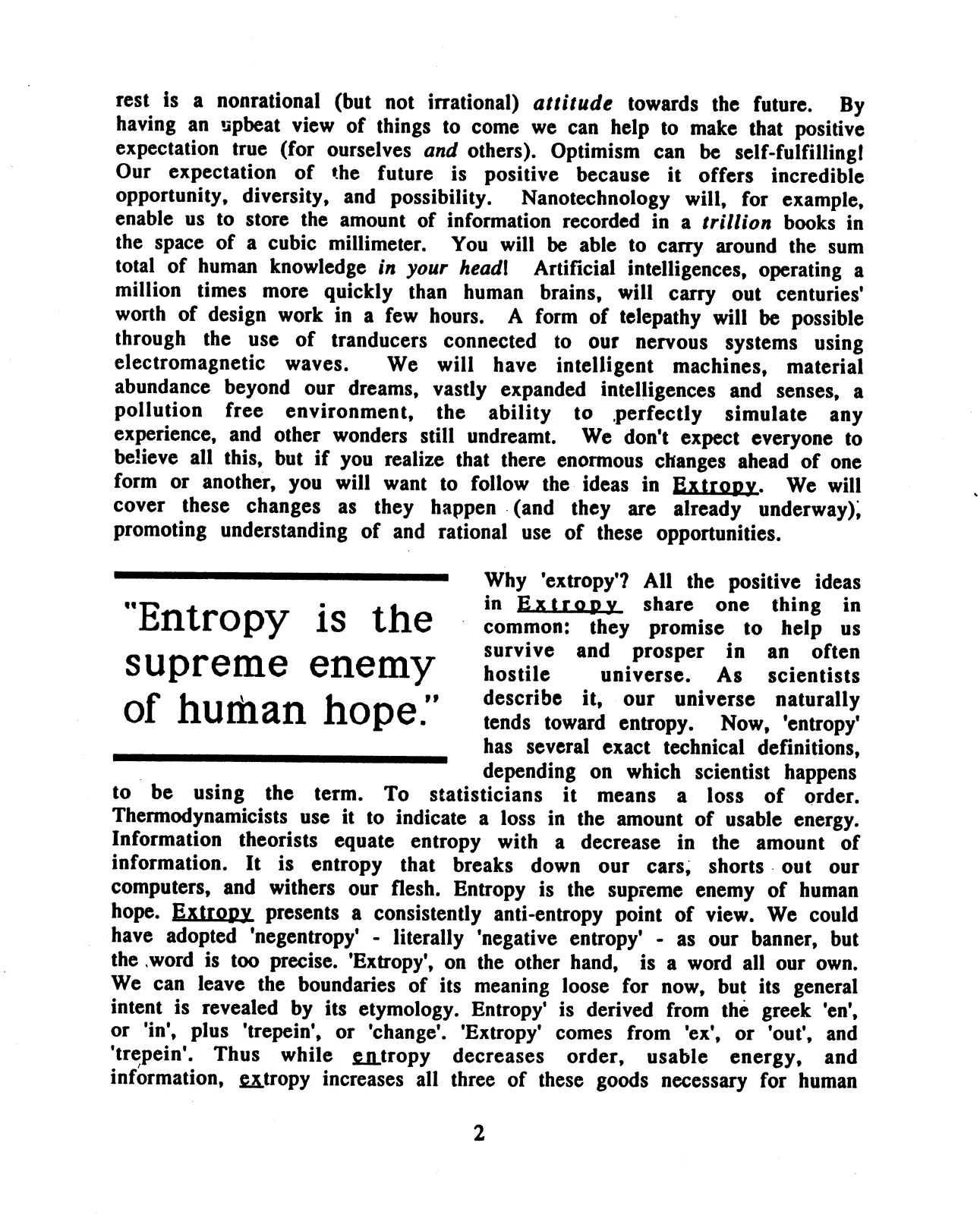
rest is a nonrational (but not irrational) attitude towards the future. By having an upbeat view of things to come we can help to make that positive expectation true (for ourselves and others). Optimism can be self-fulfilling! Our expectation of the future is positive because it offers incredible opportunity, diversity, and possibility. Nanotechnology will, for example, enable us to store the amount of information recorded in a trillion books in the space of a cubic millimeter. You will be able to carry around the sum total of human knowledge in your head! Artificial intelligences, operating a million times more quickly than human brains, will carry out centuries’ worth of design work in a few hours. A form of telepathy will be possible through the use of transducers connected to our nervous systems using electromagnetic waves. We will have intelligent machines, material abundance beyond our dreams, vastly expanded intelligences and senses, a pollution free environment, the ability to perfectly simulate any experience, and other wonders still undreamt. We don’t expect everyone to believe all this, but if you realize that there enormous changes ahead of one form or another, you will want to follow the ideas in Extropy. We will cover these changes as they happen (and they are already underway), promoting understanding of and rational use of these opportunities.
Why ‘extropy’? All the positive ideas in Extropy share one thing in common: they promise to help us survive and prosper in an often hostile universe. As scientists describe it, our universe naturally tends toward entropy. Now, ‘entropy’ has several exact technical definitions, depending on which scientist happens to be using the term. To statisticians it means a loss of order. Thermodynamicists use it to indicate a loss in the amount of usable energy. Information theorists equate entropy with a decrease in the amount of information. It is entropy that breaks down our cars, shorts out our computers, and withers our flesh. Entropy is the supreme enemy of human hope. Extropy presents a consistently anti-entropy point of view. We could have adopted ‘negentropy’ - literally ‘negative entropy’ - as our banner, but the word is too precise. ‘Extropy’, on the other hand, is a word all our own. We can leave the boundaries of its meaning loose for now, but its general intent is revealed by its etymology. ‘Entropy’ is derived from the greek ‘en’, or ‘in’, plus ‘trepein’, or ‘change’. ‘Extropy’ comes from ‘ex’, or ‘out’, and ‘trepein’. Thus while entropy decreases order, usable energy, and information, extropy increases all three of these goods necessary for human well-being. In a universe that blindly threatens to drown us in a rising tide of disorder, extropy offers us safe passage to higher ground.
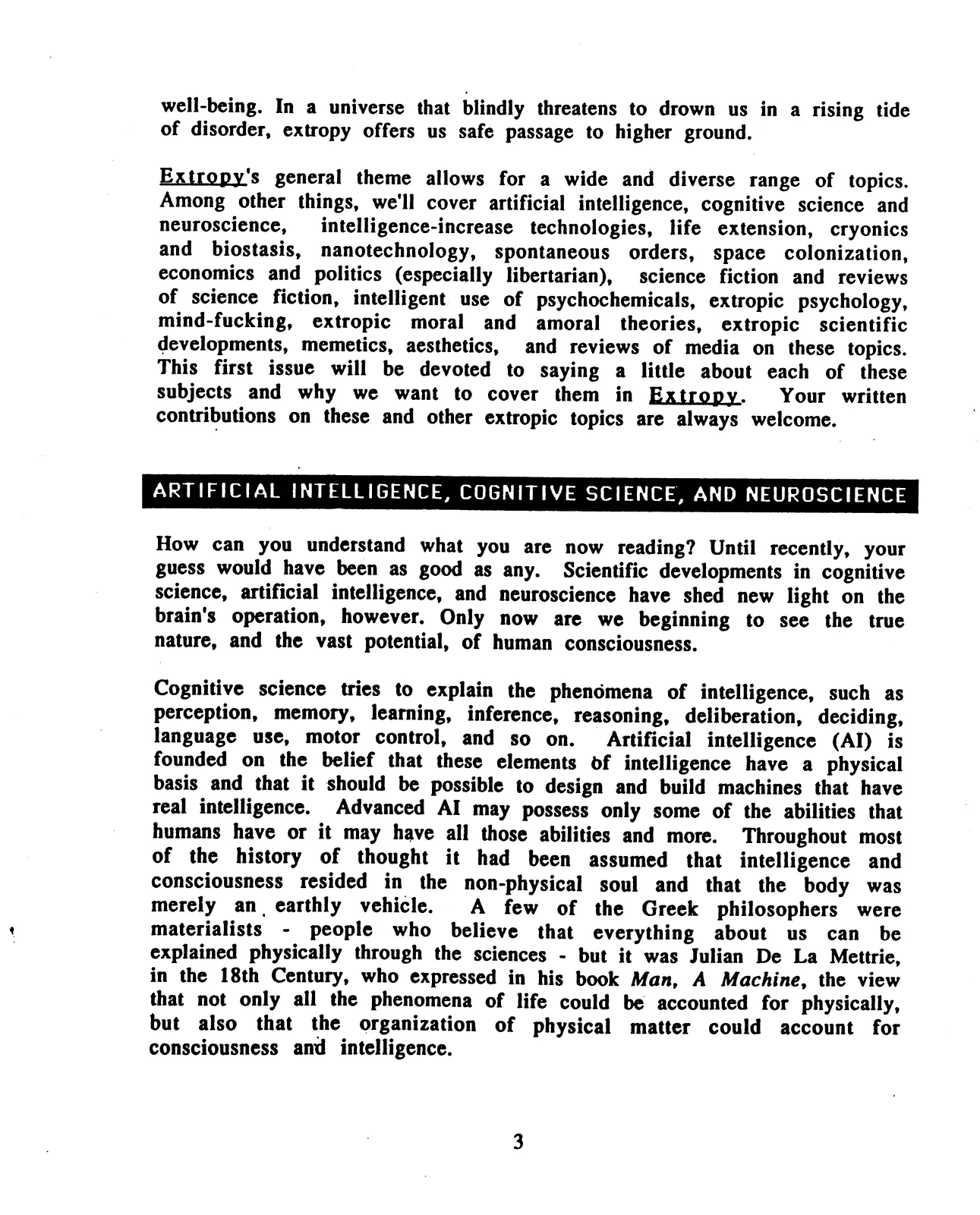
Extropy’s general theme allows for a wide and diverse range of topics. Among other things, we’ll cover artificial intelligence, cognitive science and neuroscience, intelligence-increase technologies, life extension, cryonics and biostasis, nanotechnology, spontaneous orders, space colonization, economics and politics (especially libertarian), science fiction and reviews of science fiction, intelligent use of psychochemicals, extropic psychology, mind-fucking, extropic moral and amoral theories, extropic scientific developments, memetics, aesthetics, and reviews of media on these topics. This first issue will be devoted to saying a little about each of these subjects and why we want to cover them in Extropy. Your written contributions on these and other extropic topics are always welcome.
ARTIFICIAL INTELLIGENCE, COGNITIVE SCIENCE, AND NEUROSCIENCE
How can you understand what you are now reading? Until recently, your guess would have been as good as any. Scientific developments in cognitive science, artificial intelligence, and neuroscience have shed new light on the brain’s operation, however. Only now are we beginning to see the true nature, and the vast potential, of human consciousness.
Cognitive science tries to explain the phenomena of intelligence, such as perception, memory, learning, inference, reasoning, deliberation, deciding, language use, motor control, and so on. Artificial intelligence (AI) is founded on the belief that these elements of intelligence have a physical basis and that it should be possible to design and build machines that have real intelligence. Advanced AI may possess only some of the abilities that humans have or it may have all those abilities and more. Throughout most of the history of thought it had been assumed that intelligence and consciousness resided in the non-physical soul and that the body was merely an earthly vehicle. A few of the Greek philosophers were materialists - people who believe that everything about us can be explained physically through the sciences - but it was Julian De La Mettrie, in the 18th Century, who expressed in his book Man, A Machine, the view that not only all the phenomena of life could be accounted for physically, but also that the organization of physical matter could account for consciousness and intelligence.
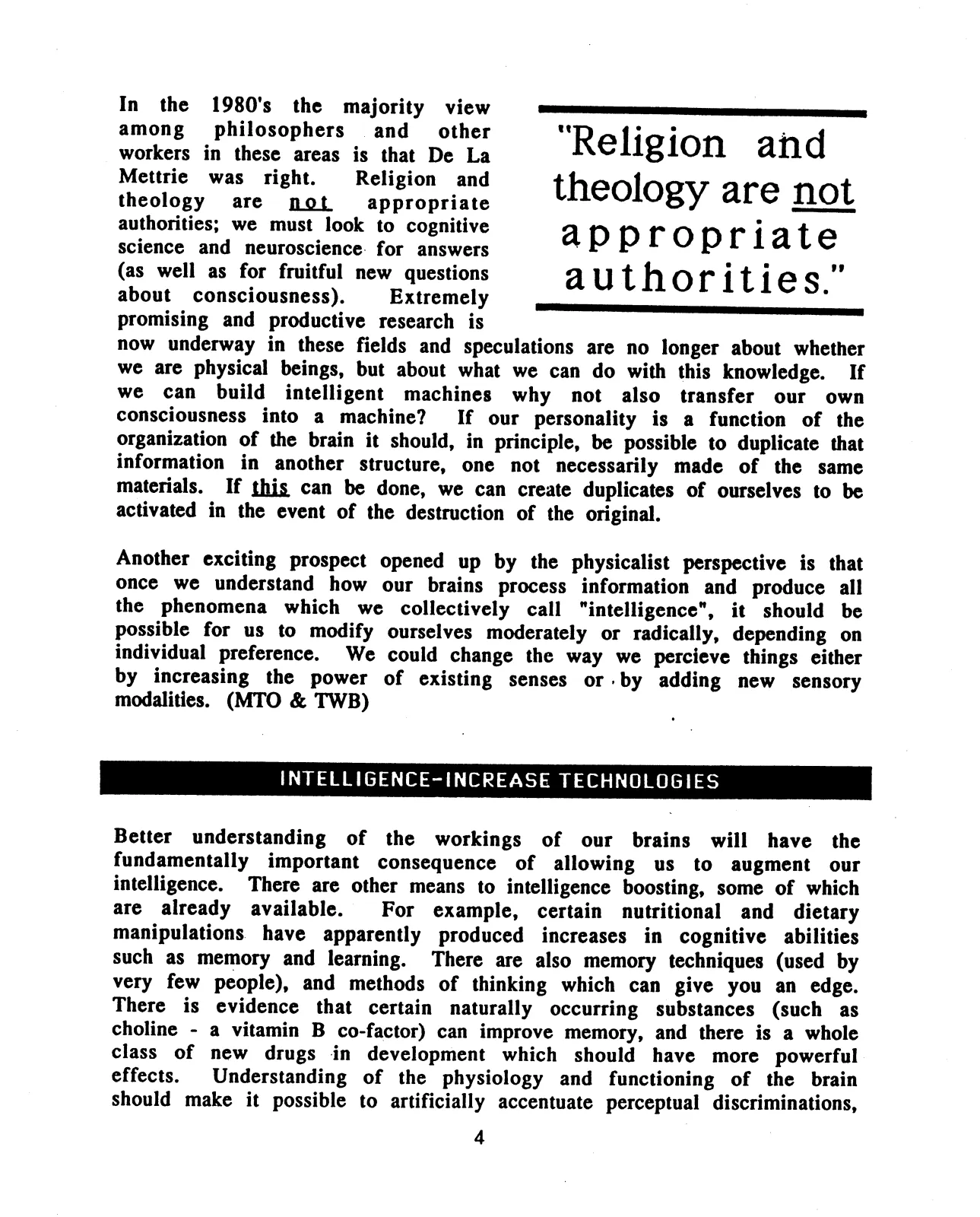
In the 1980’s the majority view among philosophers and other workers in these areas is that De La Mettrie was right. Religion and theology are not appropriate authorities; we must look to cognitive science and neuroscience for answers (as well as for fruitful new questions about consciousness). Extremely promising and productive research is now underway in these fields and speculations are no longer about whether we are physical beings, but about what we can do with this knowledge. If we can build intelligent machines why not also transfer our own consciousness into a machine? If our personality is a function of the organization of the brain it should, in principle, be possible to duplicate that information in another structure, one not necessarily made of the same materials. If this can be done, we can create duplicates of ourselves to be activated in the event of the destruction of the original.
Another exciting prospect opened up by the physicalist perspective is that once we understand how our brains process information and produce all the phenomena which we collectively call “intelligence”, it should be possible for us to modify ourselves moderately or radically, depending on individual preference. We could change the way we perceive things either by increasing the power of existing senses or by adding new sensory modalities. (MTO & TWB)
“Religion and theology are not appropriate authorities.”
INTELLIGENCE-INCREASE TECHNOLOGIES
Better understanding of the workings of our brains will have the fundamentally important consequence of allowing us to augment our intelligence. There are other means to intelligence boosting, some of which are already available. For example, certain nutritional and dietary manipulations have apparently produced increases in cognitive abilities such as memory and learning. There are also memory techniques (used by very few people), and methods of thinking which can give you an edge. There is evidence that certain naturally occurring substances (such as choline - a vitamin B co-factor) can improve memory, and there is a whole class of new drugs in development which should have more powerful effects. Understanding of the physiology and functioning of the brain should make it possible to artificially accentuate perceptual discriminations, improve memory, sharpen concentration, and heighten awareness along other axes of consciousness.
We can increase our intelligences by changing the world outside of our brains as well. Consider ‘hypertext’, a computer-based system for linking text and other information with immediately accessible cross-references. If this was in hypertext, you’d be able to read the original sources we cite now - you wouldn’t have to laboriously track them down in a library. Hypertext will allow us to pursue our intellectual fancies in a database containing the sum of recorded human knowledge - no matter how far afield our interests may wander. What’s more, the interactive nature of hypertext will allow its users to easily add their own comments, critiques and contributions to the database. Like our own brains, hypertext stores data in a dynamic web of interrelations - hence it will in some measure become society’s brain. Such a radical innovation will no doubt make the impact of the printing press seem meagre in comparison.
Still more fantastic is the possibility of ‘mind machines’ that break down the barrier between the brain and the external world. Both of we editors are actively researching already existing mind machines, such as Isolation Tanks, the Relaxman, and the Star Chamber, and we’ll keep Extropy’s reader’s abreast of our experiences. What’s more, Tom will be reporting on the development of his Mindcom device, a mind machine designed to allow direct brain-to-brain communication. Such mind machines promise to not only augment individual intelligences, but to allow them to join into communal ‘super brains’. (TWB & MTO)
LIFE EXTENSION
Over the last 20-30 years there has been an increasing public interest in health and fitness, and during the last decade this has evolved into a more self-conscious interest in life extension. Among a few people this has been taken further into the pursuit of biological immortality - neverending existence in the physical world - the only one we know to exist. This is a highly extropic pursuit since the indefinite preservation of one’s consciousness is the indefinite preservation and expansion of the information uniquely embodied in that consciousness. Under the heading of life extension we want to run articles that not only give little known hints that could extend your life-span, but also philosophical and physiological analysis regarding resistance to the idea of biological immortality, its effects on society and the individual.
The subject of life extension should be an extremely rich one as we reach the end of the Electronic Eighties and enter the Neural Nineties, as breakthroughs accelerate and the idea catches on even more than it has. Relatively little thought has been given to the long-term and recondite effects of physical immortality, and Extropy is a perfect forum for such cogitations. Also, there is an enormous amount of garbage information in this field and it can be very confusing trying to decide what works and what doesn’t. Extropy will act as a meeting place of well-informed individuals with analytical and critical minds able to cut through the nonsense and make well-founded suggestions aimed at the practicing immortalist. (MTO)
CRYONICS AND BIOSTASIS
Cryonics is the practice of treating those declared legally or clinically dead with protective chemicals and then reducing their temperature and storing them at -196° C in the hope that future technology will be able to repair the damage done by the freezing process, cure whatever killed the person, and control aging. Biostasis is a more general term that includes cryonics but which would also cover vitrification and suspended animation. Cryonics has been in the news recently due the controversy surrounding the suspension of Dora Kent by the Alcor Life Extension Foundation (located in Riverside, California). Alcor and other cryonics groups have been expanding as new members join and better explanations and promotion of the ideas of cryonics have been forthcoming.
A number of life extensionists have become involved in cryonics due to the realization that they could die before the aging process has been understood and controlled. Despite enormous advances in the understanding of aging, its study is still in the embryonic stages. It looks like all but the youngest may not make it without cryonics and even the young may not live as long as they hope! Extropy will publish articles on the technical, social, psychological, and organizational sides of the subject. For those interested in the current details, affairs, and debates in the cryonics field, I recommend a subscription to CRYONICS, $20/year from the Alcor Life Extension Foundation, 12327 Doherty St., Riverside, CA 92503. (MTO)
NANOTECHNOLOGY
We now stand on the threshold of the greatest of all technological revolutions: the ability to build molecules atom by atom. If this seems less than astounding, consider some of the benefits that such this new technology, called ‘nanotechnology’, will yield: medical devices small enough to travel the bloodstream and repair single cells, making us perfectly healthy, younger, stronger, and smarter; self-replicating ‘assemblers’ able to build any physically possible structure for no more than the cost of its rawest materials; and artificial brains as complex as human ones, yet only a cubic centimeter large and a million times as fast. These and other of nanotechnology’s many benefits - and dangers - are chronicled in K. Eric Drexler’s Engines of Creation. It’s essential reading for anyone who plans to take full advantage of the future’s possibilities, but if you can’t find the time, Extropy will at least provide the basics, while also keeping you up to date on this rapidly developing science. (TWB)
SPONTANEOUS ORDERS
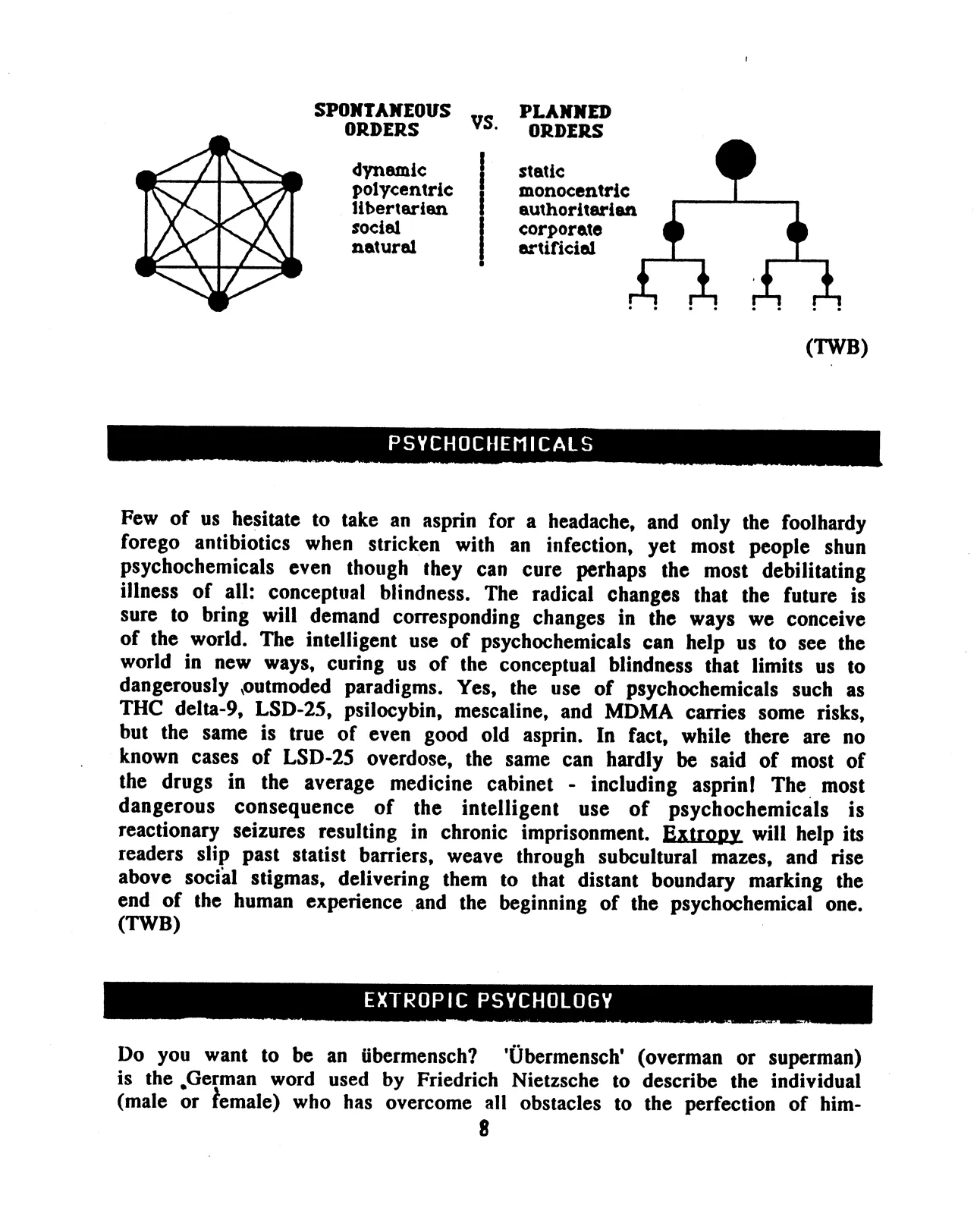
Who invented language? Who thought up money? Who is responsible for our society’s customs? No one - these are all three ‘spontaneous orders’ that have arisen unforeseen through the free actions of individuals seeking their own interests. Spontaneous orders (also known as ‘abstract’, ‘social’, or ‘polycentric’ orders) find their contraries in planned orders (also known as ‘concrete’, ‘corporate’, or ‘monocentric’ orders). Whereas spontaneous orders tend to come about through the voluntary cooperation of all concerned, planned orders tend to be imposed on others by those who take command of their hierarchical structures. All of the most inhumane social institutions have shared the features of planned orders (though planned orders can serve humane ends when manifested in companies that lure employees through solely economic incentives). Spontaneous orders, on the other hand, benefit all who join them. Extropy will more fully delineate the features of these two sorts of order, demonstrating that rather than submitting to the planned orders that now coercively rule so much of our lives, we can more fully enjoy the future’s promise from within cooperative, voluntary spontaneous orders.
PSYCHOCHEMICALS
Few of us hesitate to take an asprin for a headache, and only the foolhardy forego antibiotics when stricken with an infection, yet most people shun psychochemicals even though they can cure perhaps the most debilitating illness of all: conceptual blindness. The radical changes that the future is sure to bring will demand corresponding changes in the ways we conceive of the world. The intelligent use of psychochemicals can help us to see the world in new ways, curing us of the conceptual blindness that limits us to dangerously outmoded paradigms. Yes, the use of psychochemicals such as THC delta-9, LSD-25, psilocybin, mescaline, and MDMA carries some risks, but the same is true of even good old asprin. In fact, while there are no known cases of LSD-25 overdose, the same can hardly be said of most of the drugs in the average medicine cabinet - including asprin! The most dangerous consequence of the intelligent use of psychochemicals is reactionary seizures resulting in chronic imprisonment. Extropy will help its readers slip past statist barriers, weave through subcultural mazes, and rise above social stigmas, delivering them to that distant boundary marking the end of the human experience and the beginning of the psychochemical one. (TWB)
EXTROPIC PSYCHOLOGY
Do you want to be an übermensch? ‘Übermensch’ (overman or superman) is the German word used by Friedrich Nietzsche to describe the individual (male or female) who has overcome all obstacles to the perfection of himor herself. An übermensch is one who has transvaluated all values (again to use Nietzsche’s terminology) - which means examining all the moral and metaphysical ideas on which self and culture operate, then discarding those that make no sense in the pure light of reason, given an understanding of what one really wants out of life. Extropians are individuals who believe in growth, both in their own abilities and intelligence and in their culture. Yet there are numerous forces in our society telling us that we should pursue others’ goals and not our own, that happiness and progress are unrealistic, and that we should not be preoccupied with ourselves.
In Extropy we are going to discuss ways of removing and protecting yourself from these entropic forces. We are going to analyze the ways in which we allow ourselves to be restricted and made unnecessarily stupid in our behavior and thinking. Some of the ideas that we want to present have been put forward by thinkers such as Nathaniel Branden, Peter Breggin, and Harry Browne (in his excellent and liberating book How I Found Freedom in an Unfree World). We’re looking for articles on personal freedom psychology, how to improve intellectual and emotional communication, and on how to develop your particular talents and excellences. Extropians are already special people, in that they reject the common entropic perspective and have the insight and courage to choose the perspectives-expanding extropian paradigm. It is intended that articles in this area will reinforce our ability to live in accordance with this unlimited model of reality and self. If you are already an extropian you can become an übermensch! (MTO)
(A)HORALITY
Along with many new opportunities, the future will bring new choices. We will each no doubt want to choose what is right, but what is right? For who? Why? These are questions that morality, the study of the principles of human conduct, purports to answer. In Extropy we’ll seek the moral principles most appropriate to achieving and enjoying a future free of disease and want, a future of nearly unlimited human potential. Even if we find that no single moral theory can be applied universally (as Max argues in this issue’s ‘Morality or Reality?’), we’ll at least learn how to discover those particular principles that will best serve our own individual interests, however they may be defined. Perhaps just as importantly, we’ll learn to defend ourselves from those who may try to force their moral theories on us, unreasonably limiting our freedoms and forcing us to serve others’ interests. (TWB)
MINDFUCKING
Are you shocked by the term ‘mindfucking’? We hope so! Mindfucking is meant to do just that: lead you along, work you over, freak you out, and fuck you up! Just as one who loves humanity may find it worthwhile to assassinate a tyrant, so too we who abhor entropy find that a little chaos, properly applied, can have wondrous results. Mindfucking, like (and unlike) meditating on Zen koans, tears down old, counterproductive cognitive structures, leaving room for new, extropic ones.
”Mindfucking
is semi-serious and semi-fun.”
By its nature mindfucking is semi-serious and semi-fun. We will therefore be running some weird and amusing stuff in Extropy both to fuck with your mind and to give you tips on how to make more effective love to other minds. The idea of mindfucking is prominent in the magnificent Illuminatus! by Robert
Shea and Robert Anton Wilson (both extropians). In this book Operation Mindfuck is explained and it soon becomes obvious that the book itself is one of the greatest pieces of mindfucking ever. In Extropy we want to explore ways in which mindfucking can be used to open up people’s brains to extropian perspectives. Perhaps we can go beyond simple mindfucking to advanced forms of mental sex. Especially considering the meme idea it seems reasonable to come up with mental foreplay, and to invent theories of mental AIDS (which would be a deficiency in the mental immune system that allows in destructively entropic ideas).
As part of our mindfucking mission we will have a regular feature called Weirdness Watch. This will cover all kinds of unrespectable ideas from the obviously loony and the profoundly unserious (such as the Church of the Sub-Genius) to interesting heresies like Wilhelm Reich’s orgone and Velikovsky’s cosmology. There will also be information on (and possibly excerpts from) bizarre comics and books and anything else that may rudely shake up your preconceptions and show you (accidentally or not) new perspectives. Enlightenment can come from the strangest sources! (MTO &TWB)
SPACE COLONIZATION
Timothy Leary has said that Earth is the womb of the human race. We are currently experiencing the technical, scientific, and social labor pains that indicate that it is time to leave the womb. Even if population is not the problem that many people think it is, many are still attracted to the great spaces out there. Not only is there space, there are massive quantities of resources waiting to be exploited for the purposes of both the spacers and those left on Terra. The asteroids and the planets are waiting to give us their almost unlimited gifts, and beyond them are the other solar systems and galaxies. Extropy can be promoted by the continual outward expansion of human beings (and whatever humans may become), and by the mutations - both physical and psychological - that will ensue.
The vast expanses of space offer us the opportunity to make a fresh start - or as many fresh starts as we like. New frontiers have always excited the imagination. America was seen as a chance to experiment with new social orders, new religions, and new ways of living. To some extent, especially on the West Coast, this spirit is alive and flourishing, but such experiments are severely hampered by existing governments which lay claim to every inch of the planet. As space colonization becomes commonplace it is inevitable that we will see colonies devoted to particular philosophies. Some colonies will attempt to finally create the socialist paradise free of all capitalist contamination. Most space enthusiasts, however, are libertarians of one kind or another, so we will see many experiments in minimal government and free market anarchy. Fundamentalist religions will have their own colonies too, but at least we won’t have to suffer them where we live! No doubts Terran governments will try to stop this diversity and experimentation but their efforts will not succeed for long.
“Earth is the womb of the human race.”
Articles are welcome on any aspect of the space migration, whether it is current governmental and non-governmental attempts to break out of gravity, descriptions of possible future space life-styles, exo-psychology (the study of the effects of living off the planet), or more abstruse speculations about life off the edge. We will no doubt run information on O’Neill’s concept of rotating cylindrical space colonies since everyone should know about these well-developed plans, but discussion will not be limited to the currently familiar. Extropians have a strong interest in promoting and anticipating the off-world revolution because of its enormous effects on diversity, intelligence, and information. Any groups involved in this effort are welcome to write to us and we will print your address and a brief description of your activities. (MTO)
ECONOMICS AND POLITICS
As information processing systems, good economic and political systems must meet the same standards that apply to any of their kind; they must achieve their ends efficiently. Researchers such as Friedrich Hayek have demonstrated that the most efficient economic and political systems are those that exert a minimum of control, allowing spontaneous orders (see above) to flourish. Economic and political systems must furthermore advance human ends. Extropy takes the point of view that these two qualifications are entirely compatible; the most efficient economic and political systems are those that maximize human liberty. Thus the best economic systems are free market, and the best political systems libertarian. (Libertarianism asserts that the state, if one is necessary, should permit all acts except assault, theft and fraud.) Extropy will pursue such free market and libertarian analyses of economic and political systems, working toward the day when economic and political systems serve us, rather than we them. (TWB)
MEMETICS
Memetics is the study of memes (meme rhymes with cream). memes are ideas that can replicate and evolve. Memetics dates from the 1976 publication of Richard Dawkins fascinating book, The Selfish Gene (Oxford University Press) and is a new and potentially fruitful approach to the study of how ideas spread. As Dawkins puts it: ‘examples of memes are tunes, ideas, catch-phrases, clothes fashions, ways of making pots or of building arches. Just as genes spread themselves by leaping from body to body [generation to generation] via sperms or eggs, so memes propagate themselves in the meme pool by leaping from brain to brain via a process which, in the broad sense, can be called imitation.’ Memes can be simple units like catch-phrases or they can be complex systems of thought like philosophical, political, or religious systems.
In Extropy we are interested in information and how it is produced, propagated, and increased. Any approach that may be able to increase our understanding of this process and which may help us spread extropian ideas is important to us and so we want to explore the possibilities raised by the memetic approach. A few articles have been written analyzing, for example, the historically powerful memes of Christianity and Marxism, but it is a new field just waiting to be developed. We are willing to print not only memetic analyses but also evaluations of the approach itself. Some have doubts about the utility of this approach so we will look at questions such as: is the parallel with genes a close enough one to make it productive to apply the principles of transmission genetics to memes? Does it matter that genes are physical while ideas are abstract? The understanding that such research in memetics provides will hopefully help us to spread the extropian meme itself. (MTO)
AESTHETICS
We all know how beauty delights our senses and stimulates our intellects, how we long to possess it and become beautiful ourselves. But what is beauty? That’s a question for aesthetics, the study of the nature of beauty. Clearly, if we are to enjoy our future lives to the fullest potential, we must master the principles of aesthetics. After all, we don’t just want to live long - we want to live well, too! By revealing beauty’s underlying principles, aesthetics will allow us to reproduce it at will.
Aesthetics is a particularly relevant subject for Extropy because beauty is a property particular to transmissions of information. Art - be it painted, sung, danced or otherwise - serves as a means of communication from artist to spectator. Some artists succeed in imparting their messages with something we particularly value: beauty. Could this be efficiency of information transmission, or memetic survivability? Extropy will investigate these and other possible definitions of beauty as it both discusses aesthetics and serves as a lab for art experiments. (TWB)
VIEW ORIGINAL SCAN (13 pages)