Issue: EXTROPY #17 · Second Half 1996
Author: Amara Graps
Pages: 13–19 · 7 scanned pages
Jamming with the Cosmos: A Conversation with Dr. Fiorella Terenzi
JAMMING WITH THE COSMOS
A Conversation with Dr. Fiorella Terenzi
by Amara Graps
Copyright Amara Graps 1996. All rights reserved.
Amara Graps
Multiplex Answers
22724 Majestic Oak Way
Cupertino, California, USA 95014
408-255-6251 agraps@netcom.com, http://www.amara.com/
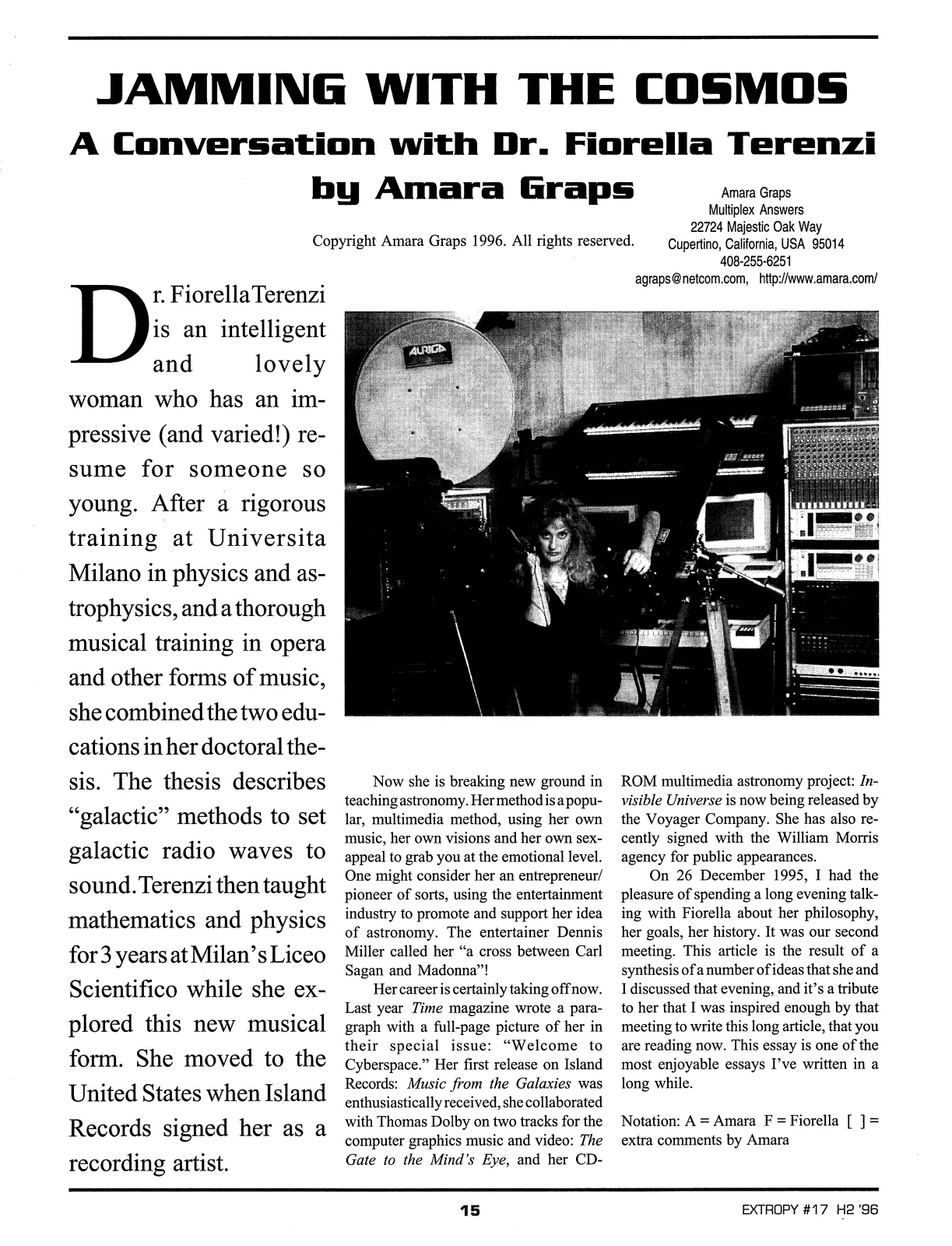
Dr. Fiorella Terenzi is an intelligent and lovely woman who has an impressive (and varied!) resume for someone so young. After a rigorous training at Universita Milano in physics and astrophysics, and a thorough musical training in opera and other forms of music, she combined the two educations in her doctoral thesis. The thesis describes “galactic” methods to set galactic radio waves to sound. Terenzi then taught mathematics and physics for 3 years at Milan’s Liceo Scientifico while she explored this new musical form. She moved to the United States when Island Records signed her as a recording artist.
Now she is breaking new ground in teaching astronomy. Her method is a popular, multimedia method, using her own music, her own visions and her own sex-appeal to grab you at the emotional level. One might consider her an entrepreneur/pioneer of sorts, using the entertainment industry to promote and support her idea of astronomy. The entertainer Dennis Miller called her “a cross between Carl Sagan and Madonna”!
Her career is certainly taking off now. Last year Time magazine wrote a paragraph with a full-page picture of her in their special issue: “Welcome to Cyberspace.” Her first release on Island Records: Music from the Galaxies was enthusiastically received, she collaborated with Thomas Dolby on two tracks for the computer graphics music and video: The Gate to the Mind’s Eye, and her CD-
ROM multimedia astronomy project: Invisible Universe is now being released by the Voyager Company. She has also recently signed with the William Morris agency for public appearances.
On 26 December 1995, I had the pleasure of spending a long evening talking with Fiorella about her philosophy, her goals, her history. It was our second meeting. This article is the result of a synthesis of a number of ideas that she and I discussed that evening, and it’s a tribute to her that I was inspired enough by that meeting to write this long article, that you are reading now. This essay is one of the most enjoyable essays I’ve written in a long while.
Notation: A = Amara F = Fiorella [ ] = extra comments by Amara
PAST, CURRENT, AND FUTURE PROJECTS
A: Tell me about your current projects. F: The current project [available now] is Invisible Universe CD-ROM for Mac and PC.
[I found a copy in January 1996 at a bookstore in the San Francisco Bay area. See my thoughts about it in the Sidebar: THE INVISIBLE UNIVERSE CD-ROM]
A lecture tour is planned, which starts in March 1996. Also, this year I’m writing a book called: The Sensual Universe.
A: And your future projects?
F: As soon as I go back to New York, I will be in the studio with my producer and other musicians to complete my “mainstream” pop album, for which we already have a couple of songs. One of the songs is “Supernovae Amore,” which is also going to be a chapter in the book. These musical pieces are a type of pop, mainstream combination of Enigma-Pink Floyd-Funk-Madonna-like music. Then this winter, a concert tour will start to promote the music. That music and the tour will be my main focus for the end of 1996 and into 1997. I am also having some discussions about a TV entertainment-scientific-musical show. Something fun and up-tempo.
A: How would you like to see science promoted, say, in a popular way?
F: I haven’t seen anything yet that appeals to me. For that reason, I wanted to invent something completely new. I wanted to be the first recording artist that is an astrophysicist. My personal dream is to be the first astrophysicist to receive a Grammy Award, maybe while I’m above as a mission specialist in the Space Shuttle! I wish I could say ‘yes,’ I like how that science promotion is done, but I really haven’t seen it done in a way that I like.
I think I was lucky in that I was at the right time when I was doing my research in acoustic astronomy. [I was lucky] because I was one of the first people to use computer music and relate it to astronomy. In the past, there could have been the right ideas and people, but they didn’t have the tools that I have today. Five years ago, I couldn’t have even imagined putting all of this information: the images, the video, the music, on a CD. So I was able to fuse the latest technology with the latest software. Now I’m doing that with music, animation, video, poetry on a medium that is a CD-ROM. That’s pretty new.
A: What was the title of your thesis?
F: My goodness, it’s so long and in Italian! Let’s see: “Disegno e realizzazione di un sistema integrato MAP/CMUSIC per la composizione di partiture musicale e la sintesi numerica dei suoni.” [Roughly translated: “Design and realization of an integrated MAP/CMUSIC system for the composition of musical scores and the numerical synthesis of sound.”]
A: What galaxy did you use for your thesis?
F: UGC 6697 in Coma Berenices, between Virgo and Leo, 180 million light years away. It’s a very powerful and luminous radio galaxy. That was my first jam-musical-partner, my co-performer!
[UGC 6697 is a pretty interesting feminine view is a point of view that I really want to share with people. I’ll have a chapter of that in my book.
Plus, it took a lot of time to get in touch with that feminine side because I needed to make a name for myself first as a scientist. I actually got in touch with that feminine side through music. Science tended to make me a little “stiffer,” make me more analytical, more rigid. And music is so erotic, so passionate… So through music, I was able to say, “OK, I’m bringing Fiorella to science” and Invisible Universe is a good example of that. In fact, my clothes in my CD-ROM are, in some sense, inspired by the astronomical objects. For example, with the beautiful Andromeda Galaxy, I felt an impulse to wear a red/purple, tight, dress with an open slit because Andromeda is such a astronomical object! I did a little background reading on it, see the Sidebar: RADIO GALAXIES AND UGC 6697]
BRINGING A FEMININE ASPECT TO ASTRONOMY
A: Tell me more about your idea of bringing the feminine aspect into your music and astronomy presentation.
F: These aspects that I’m bringing to my work now, and want to bring into my future work, are probably a sum of events that started when I was a child and continued when I was a student at the physics department at Milan. In order to be accepted, you had to repress your female point of view, your femininity, you had to look like a lot like the other professors. So for me, the discovery of my femininity, and how I can combine it with astronomy is a recent discovery.
I didn’t know until recently that cosmology in the very beginning of human history was a more feminine cosmology. The view of the sky long ago was more feminine, with a “mother goddess.” Then with Christianity, the female perspective was pushed aside, the male deities dominated. So we moved from a feminine cosmology to a male cosmology. So this beautiful object, I wanted to look beautiful while I was talking about this object! But I really believe in the beauty of the cosmos, and I hope to bring it to a lot of people.
[What does it mean to bring the feminine aspect to science? How did the ancient goddesses become dominated by the ancient gods and what other influences did religion have on astronomy? How did religion influence women’s involvement in astronomy? Even though this is a very complicated (volatile!) subject, I write a few thoughts about it in the Sidebar: FEMININE COSMOLOGY]
A: Were women commonplace in your academic environment?
F: Well, in Italy, it’s even worse than other places because it is such a “macho” society. In this society, the men want to dominate, and the only role for women there is to be either a wife or maybe a mistress. My classes started large, but there were almost no women. And by my last year at the University, I was always the only woman attending my cosmology, astrophysics etc. courses. But unfortunately, it was not a situation happening only in Italy.
When I was growing up, and a young girl, perhaps 11 or 12 years old, I looked for (female) role models. I couldn’t find any role models in the city where I was living. So I turned on the TV and saw movies. For example, [I saw] movies made by George Lucas, like Star Wars. The main character was a man. Then I saw Close Encounters of the Third Kind, hoping to find a female leading character—an intelligent, sensual, beautiful woman, that was also a scientist. AGAIN, the main character was a man. All of the movies from America had male leading characters. What was even worse, was that the movies that I liked—sci-fi movies—were dominated by male leading characters. I really love very much the work of George Lucas and Steven Spielberg, but they had an old idea of what women could do for their characters. Maybe they are afraid to do something completely unconventional like having a female as a main character?
So by observing all of these media pictures, I realized that I wanted to get out of the laboratory, I wanted to change my course from being a professor, to that of being an entertainer. I wanted to entertain with science, astronomy, to sing about quantum physics, I wanted to make people dance! I want to reach them in a big way because, for me, one of the most gratifying moments I receive are when I lecture at such places like Santa Monica College, Morrison Planetarium, Griffith Observatory, Orange County, New York, Boston, Philadelphia, etc. and a young girl approaches me and says: “I want to be like you.” That is the most important achievement for me—the main goal, that is to show people what else they can do with their lives. Especially what other women can do with their lives. They see that it’s “cool” to be a biologist, and how glamorous it can be, plus they can see how much power that knowledge can provide. For me, it’s not meaningful to see actresses like Melanie Griffith or Sharon Stone on TV or movies because it doesn’t take anything or effort to be like that. You just need to show off your body while you’re young and that’s it! But knowledge in your head is like power in your hands. You can make judgments, you are faster in your thinking, you can perceive reality in a completely different way. And once you taste that power of knowledge, you can’t go back.
When I lecture, there is a transformation in my character. I start out looking very scientific with a lab coat, hair up, with glasses and slowly I turn into a
THE INVISIBLE UNIVERSE
CD-ROM
by Amara Graps
I had some opportunities to look at (and hear) Fiorella’s astronomy CD-ROM, Invisible Universe, first during the evening of my conversation with her, and then later, after I purchased the CD-ROM at my local bookstore. (Note: you will be able to purchase just the music from Invisible Universe as a separate music CD, if you wish.)
My first impression was ‘Wow!’ She has assembled a stunning collection of images that rivals Timothy Ferris’ images in his classic large-format book: Galaxies. In fact there are a lot of similarities between the two as far as information content goes (Fiorella’s CD-ROM has perhaps twice as much text) and beautiful images goes (roughly the same number).
The difference between the above Galaxies book and Fiorella’s CD-ROM is that Fiorella’s CD-ROM is a much richer learning experience with her music, the hyper-links, her movies and guided tours, maps of the sky, and the astronomy poetry readings by other people. In addition, her CD-ROM covers stars, planets and other celestial objects, not only galaxies.
While I didn’t get a chance to go through all of the information presented, what I did read seemed accurate. Terenzi had the assistance of six UCLA astronomy grad students writing the explanatory text for each of the objects, so it should be up-to-date and accurate.
There was one aspect about her CD-ROM that I found most amusing! It was her Quick-Time movies. She makes her personal appearance in the Quick-Time movies as stunning as the images she discusses. Each of her appearances was a different look: a scholarly look in a business suit, an “evening-night-out” look in a red evening dress, for example. Even though I already knew something about her personal philosophy, (that is, of wanting to express her more feminine side, and that these beautiful celestial objects made her feel even more like expressing that side), I still couldn’t figure out if her QuickTime glamorous personal appearances were an unconscious sensual expression of how these astronomical objects made her feel, or whether she was purposely trying to invoke an emotional response from the viewer!
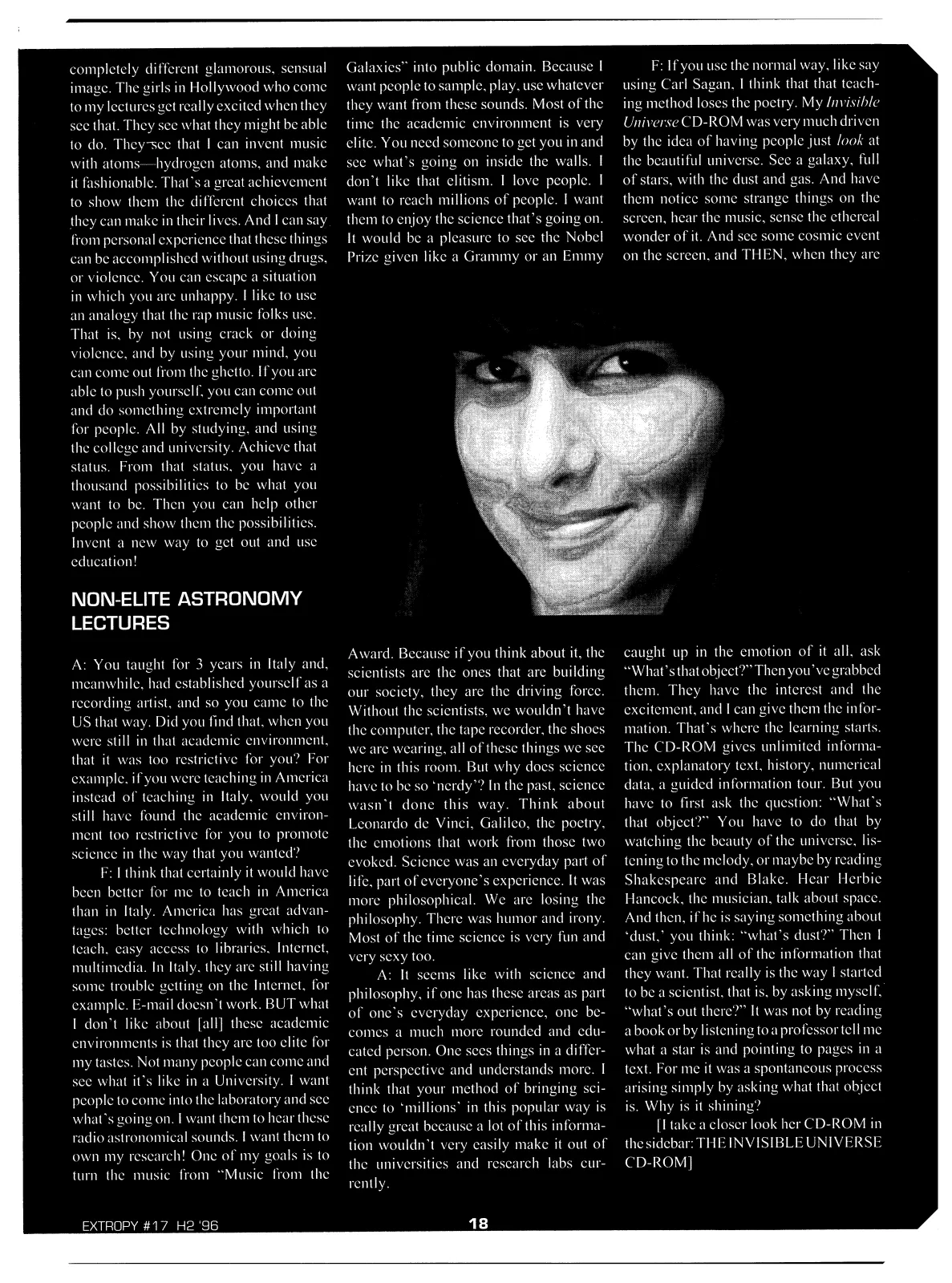
I finally decided NEITHER and BOTH! She was PLAYING! I came to this conclusion after seeing one of her QuickTime movies where she appears as a disembodied head, floating from side-to-side on the computer screen, all the while explaining what was happening in the presented astronomical image. I was giggling the whole time her head was floating around!
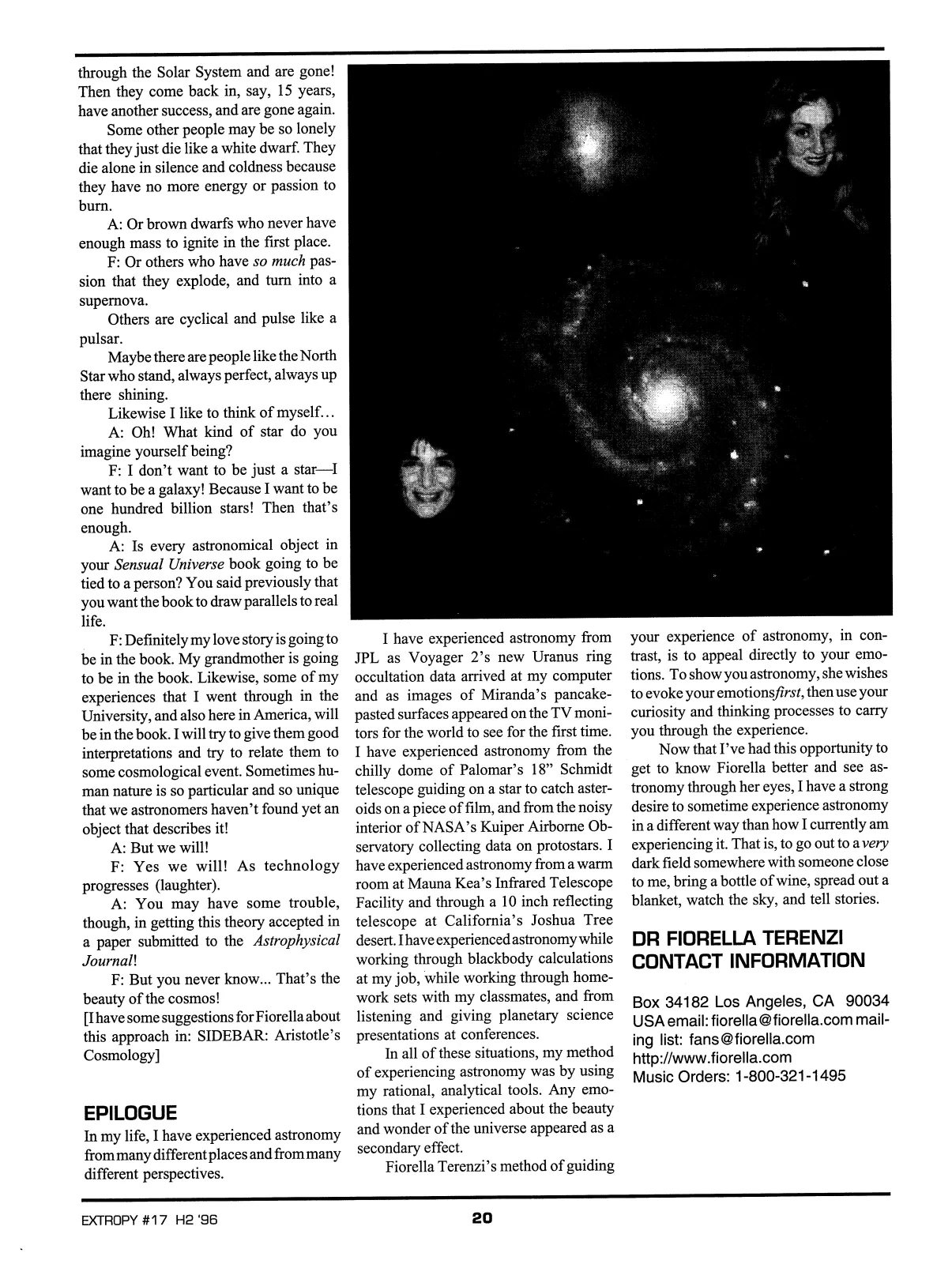
So, in response to Fiorella’s disembodied head in the CD-ROM, I created the picture (p.20). I started with a Polaroid snapshot, taken December 26 of Fiorella and myself, and made us disembodied heads floating in a lovely background picture of the galaxy M51. This is for you, Fiorella!)
completely different glamorous, sensual image. The girls in Hollywood who come to my lectures get really excited when they see that. They see what they might be able to do. They see that I can invent music with atoms—hydrogen atoms, and make it fashionable. That’s a great achievement to show them the different choices that they can make in their lives. And I can say from personal experience that these things can be accomplished without using drugs, or violence. You can escape a situation in which you are unhappy. I like to use an analogy that the rap music folks use. That is, by not using crack or doing violence, and by using your mind, you can come out from the ghetto. If you are able to push yourself, you can come out and do something extremely important for people. All by studying, and using the college and university. Achieve that status. From that status, you have a thousand possibilities to be what you want to be. Then you can help other people and show them the possibilities. Invent a new way to get out and use education!
NON-ELITE ASTRONOMY LECTURES
A: You taught for 3 years in Italy and, meanwhile, had established yourself as a recording artist, and so you came to the US that way. Did you find that, when you were still in that academic environment, that it was too restrictive for you? For example, if you were teaching in America instead of teaching in Italy, would you still have found the academic environment too restrictive for you to promote science in the way that you wanted?
F: I think that certainly it would have been better for me to teach in America than in Italy. America has great advantages: better technology with which to teach, easy access to libraries, Internet, multimedia. In Italy, they are still having some trouble getting on the Internet, for example. E-mail doesn’t work. BUT what I don’t like about [all] these academic environments is that they are too elite for my tastes. Not many people can come and see what it’s like in a University. I want people to come into the laboratory and see what’s going on. I want them to hear these radio astronomical sounds. I want them to own my research! One of my goals is to turn the music from “Music from the
Galaxies” into public domain. Because I want people to sample, play, use whatever they want from these sounds. Most of the time the academic environment is very elite. You need someone to get you in and see what’s going on inside the walls. I don’t like that elitism. I love people. I want to reach millions of people. I want them to enjoy the science that’s going on. It would be a pleasure to see the Nobel Prize given like a Grammy or an Emmy
F: If you use the normal way, like say using Carl Sagan, I think that that teaching method loses the poetry. My Invisible Universe CD-ROM was very much driven by the idea of having people just look at the beautiful universe. See a galaxy, full of stars, with the dust and gas. And have them notice some strange things on the screen, hear the music, sense the ethereal wonder of it. And see some cosmic event on the screen, and THEN, when they are
Award. Because if you think about it, the scientists are the ones that are building our society, they are the driving force. Without the scientists, we wouldn’t have the computer, the tape recorder, the shoes we are wearing, all of these things we see here in this room. But why does science have to be so ‘nerdy’? In the past, science wasn’t done this way. Think about Leonardo de Vinci, Galileo, the poetry, the emotions that work from those two evoked. Science was an everyday part of life, part of everyone’s experience. It was more philosophical. We are losing the philosophy. There was humor and irony. Most of the time science is very fun and very sexy too.
A: It seems like with science and philosophy, if one has these areas as part of one’s everyday experience, one becomes a much more rounded and educated person. One sees things in a different perspective and understands more. I think that your method of bringing science to ‘millions’ in this popular way is really great because a lot of this information wouldn’t very easily make it out of the universities and research labs currently.
caught up in the emotion of it all, ask “What’s that object?” Then you’ve grabbed them. They have the interest and the excitement, and I can give them the information. That’s where the learning starts. The CD-ROM gives unlimited information, explanatory text, history, numerical data, a guided information tour. But you have to first ask the question: “What’s that object?” You have to do that by watching the beauty of the universe, listening to the melody, or maybe by reading Shakespeare and Blake. Hear Herbie Hancock, the musician, talk about space. And then, if he is saying something about ‘dust,’ you think: “what’s dust?” Then I can give them all of the information that they want. That really is the way I started to be a scientist, that is, by asking myself, “what’s out there?” It was not by reading a book or by listening to a professor tell me what a star is and pointing to pages in a text. For me it was a spontaneous process arising simply by asking what that object is. Why is it shining?
[I take a closer look her CD-ROM in the sidebar: THE INVISIBLE UNIVERSE CD-ROM]
USING THE IMAGINATION AND COMMUNICATION ON THE EMOTIONAL LEVEL
A: You told me of the influences that your grandmother had in your curiosity about the sky as a child. How old were you, and how did that happen?
F: Actually now we are going in a direction that I’ve only discovered about myself recently (the last few years). That is, not being afraid of being a scientist in the way I want, that is, to use my fantasies and imagination. Scientists are often afraid, they must be rigorous, they must be very analytical, they must be very correct. But they don’t have to be afraid to use their imagination and fantasies because the way that you communicate with people is very much on an emotional level.
The way I got started asking questions of my grandmother was through an emotional process. My grandmother didn’t know anything about the sky. But I was about 5 or 6 years old, and we were spending summers out in the country outside Milano, close to Crema, where there were big farms and I stayed there. At night, she would say: “Fiorella, let’s go for a walk in the country.” And so we would walk and walk and it was so dark. No light was anywhere. And she would begin to tell me these amazing stories about the universe. Such as, if we continue to walk and walk to far distances we would then reach that star, and she would tell me why the moon was so big and white and the stars so small. These stories were completely based on imagination and fantasy and of course, weren’t correct. Now with the education I have, of course these things are not true, but I appreciated very much all of that fantasy and imagination. The idea of capturing a star, the idea of being a star all led me to want to learn and study. The real true scientists are not afraid to use some of their imagination because it’s very much complementary to the analytical part.
A: Feynman was a classic example of one who uses his imagination..
F: Yes! He was just sparkling and overflowing with ideas… If you take literally some of what he was saying, you would think that he was crazy! But actually there was a big truth to what he was saying. But his passion, [and] emotion just grabbed your imagination.. Feynman was one of the greatest scientists ever. So this other aspect of communication (i.e. imagination) is what I’ve learned recently. Even when I was teaching at Liceo Scientifico, after I got my degree, I was still so afraid of using this other way. In the beginning. Then in time I learned to not be afraid! You will find the same thing too, since you’re interested in doing some teaching. You will see how you progress. In the beginning, you will be afraid to explain what inertia is, you will try to be very scientific and very precise. Then in the second week you will elaborate a little bit on that concept. Then in the third week you will want to tell your students how you discovered that if you cooked spaghetti with the water boiling there is a phenomguy, it is as a kind of cosmological event. I think that we are two galaxies out there, and we attract each other. And of course we are up there in empty space and we look at each other and say, “let’s get together.” Then we make a first approach and start to attract each other and then to gravitate and rotate around each other. We can be either the whole galaxy or a star. Then there is a point when gravity isn’t enough. Some other processes start happening. A big jet of superheated material goes flying Whoomf! off in one direction… shoots right through me. And I respond! And slowly, slowly we fall in love, we get together and we live in perfect harmony. So from two galaxies, we get
A: What kind of star do you imagine yourself being?
F: I don’t want to be just a star—I want to be a galaxy! Because I want to be one hundred billion stars! Then that’s enough.
ena to be observed…
A: Convective processes in the boiling of spaghetti water!
F: But it takes time. Science is hard.
THE SENSUAL UNIVERSE
A: Now what about galaxies falling in love?
F: I’ve been thinking about my book, The Sensual Universe. These days I’m very much in an inspirational mode, spending time almost every week in the studio, composing music. So my imagination is really active now. When I thought about how galaxies sometimes get together, I started to see an analogy with relationships between men and women, here, and galaxies, out there. If I find myself thinking about, say a relationship with some together and form one galaxy with a double nuclei. Like what we observe out there in the Universe.
But sometimes people aren’t so lucky. They are galaxies, they fall in love, attract each other, but they don’t stay together. They pass through each other, they realize that they are not made for each other after all. So poof! They kiss goodbye, one goes in one direction, the other goes in the other direction, and that’s it.
Another galaxy, perhaps in a burning passion of love, cannibalizes some other galaxy and eats the nucleus. Then those two galaxies destroy each other.
So that’s love in the Cosmos and that’s going to be in my book.
Likewise, now I’m beginning to see personalities as being like stars in the cosmos because we are from stars. Some people are like comets, like some artists. They have one great success, and pass through the Solar System and are gone! Then they come back in, say, 15 years, have another success, and are gone again.
Some other people may be so lonely that they just die like a white dwarf. They die alone in silence and coldness because they have no more energy or passion to burn.
A: Or brown dwarfs who never have enough mass to ignite in the first place.
F: Or others who have so much pas- sion that they explode, and turn into a supernova.
Others are cyclical and pulse like a pulsar.
Maybe there are people like the North Star who stand, always perfect, always up there shining.
Likewise I like to think of myself…
A: Oh! What kind of star do you imagine yourself being?
F: I don’t want to be just a star—I want to be a galaxy! Because I want to be one hundred billion stars! Then that’s enough.
A: Is every astronomical object in your Sensual Universe book going to be tied to a person? You said previously that you want the book to draw parallels to real life.
F: Definitely my love story is going to be in the book. My grandmother is going to be in the book. Likewise, some of my experiences that I went through in the University, and also here in America, will be in the book. I will try to give them good interpretations and try to relate them to some cosmological event. Sometimes hu- man nature is so particular and so unique that we astronomers haven’t found yet an object that describes it!
A: But we will!
F: Yes we will! As technology progresses (laughter).
A: You may have some trouble, though, in getting this theory accepted in a paper submitted to the Astrophysical Journal!
F: But you never know… That’s the beauty of the cosmos!
[I have some suggestions for Fiorella about this approach in: SIDEBAR: Aristotle’s Cosmology]
EPILOGUE
In my life, I have experienced astronomy from many different places and from many different perspectives.
I have experienced astronomy from JPL as Voyager 2’s new Uranus ring occultation data arrived at my computer and as images of Miranda’s pancake- pasted surfaces appeared on the TV moni- tors for the world to see for the first time. I have experienced astronomy from the chilly dome of Palomar’s 18” Schmidt telescope guiding on a star to catch aster- oids on a piece of film, and from the noisy interior of NASA’s Kuiper Airborne Ob- servatory collecting data on protostars. I have experienced astronomy from a warm room at Mauna Kea’s Infrared Telescope Facility and through a 10 inch reflecting telescope at California’s Joshua Tree desert. I have experienced astronomy while working through blackbody calculations at my job, while working through home- work sets with my classmates, and from listening and giving planetary science presentations at conferences.
In all of these situations, my method of experiencing astronomy was by using my rational, analytical tools. Any emo- tions that I experienced about the beauty and wonder of the universe appeared as a secondary effect.
Fiorella Terenzi’s method of guiding your experience of astronomy, in con- trast, is to appeal directly to your emo- tions. To show you astronomy, she wishes to evoke your emotions/first, then use your curiosity and thinking processes to carry you through the experience.
Now that I’ve had this opportunity to get to know Fiorella better and see as- tronomy through her eyes, I have a strong desire to sometime experience astronomy in a different way than how I currently am experiencing it. That is, to go out to a very dark field somewhere with someone close to me, bring a bottle of wine, spread out a blanket, watch the sky, and tell stories.
DR FIORELLA TERENZI
CONTACT INFORMATION
Box 34182 Los Angeles, CA 90034 USA email: fiorella@fiorella.com mail- ing list: fans@fiorella.com http://www.fiorella.com Music Orders: 1-800-321-1495
RADIO GALAXIES AND UGC 6697
by Amara Graps
Radio galaxies are among the most intriguing objects in the universe. They are often distinguished by a pair of huge diffuse lobes that pour radio waves forth. The lobes are often associated with a central, compact solar-system-sized radio source. Some think that black holes power the energy at the source of radio galaxies. The source is linked to the lobes via jets which spew material that travels at near light speeds.
UGC (Uppsala General Catalogue of Galaxies) 6697 is a radio source associated with an irregular galaxy Zwicky 97087 in the Abell 1367 Coma Berenices supercluster. The Coma supercluster is a huge cluster of densely-packed (~10,000 in number) galaxies mostly of the lenticular, dust-free, ‘SO’ type and elliptical type, crowded at the supercluster core. UGC 6697 is an usual object in a number of respects and has been extensively studied in all wavelengths in the last 15 years, especially by G. Gavazzi at the Istituto di Fisica Cosmica, Milan, Italy and his colleagues.
From what I gathered from my cursory readings of this object, UGC 6697 is an unusual radio source, whose associated galaxy Zwicky 97087 (and several companion galaxies) seems to be plowing through the Coma supercluster to the supercluster’s center, with gas and dust being stripped in the process and streaming out behind it. This very energetic object emits radiation at almost all wavelengths including X-ray wavelengths. It is also the site of very active star formation and its material isn’t rotating around it’s central core in a typical fashion.
Here are some details of the unusual features of this UGC 6697 radio source:
1.) Radio asymmetries. In the radio wavelengths, the object has a marked asymmetry, which resembles a head-tail source, that, in turn, reflects an intrinsic asymmetry of the parent galaxy Zwicky 97087 (Gavazzi et al., 1984). The Very Large Array Radio telescope HI emission maps confirm that the atomic gas in the cluster (Zwicky 97073, 97079, and 97087) is displaced from its optical centers (Dickey, J.M. and Gavazzi, G., 1991). The researchers take this as evidence that Zwicky 97087 and its neighbors are entering the dense medium of the cluster core for the first time. 2.) Optical asymmetries. The optical morphology of the associated galaxy cluster (Zwicky 97073, 97079, and 97087) is also disturbed. The galaxies are systematically brighter at the side with the sharp radio gradient, and fainter on the opposite side. The parent galaxy Zwicky 97087 also shows a sequence of faint diffuse knots trailing to the northwest behind the bright disk (total extension ~= 60 kpc) with associated radio emission (G. Gavazzi and W. Jaffe, 1985). 3.) Peculiar Rotation Curve of associated galaxy Zwicky 97087 (Gavazzi et al., 1984). The ‘rotation curve’ is a scientific expression for the circular velocity of a test mass as a function of its position in the galactic disk. This information is important for constructing models of the galaxy’s mass distribution, and as a means of interpreting observation data. (Bowers and Demming, 1984.) 4.) High star formation rate. Optical and radio data from this galaxy, as well as some statistical surveys show that it has a much higher than average star formation rate than the other galaxies in the Coma Berenices supercluster (G. Gavazzi and W. Jaffe, 1985). Some have concluded that its enhanced current star formation might occur due to molecular gas collapse stimulated by the ram-pressure mechanism. The ‘ram-pressure’ mechanism is a mechanism for stripping gas from galaxies in rich clusters. The galaxies’ relative motion through the cluster medium is analogous to the wind knocking the hat off of a rapidly pedaling cyclist. (which may explain the “swept-back” look of head-tail radio sources (Shu, F. 1982)). 5.) CO molecular gas distribution is normal for Zwicky 97087. No asymmetries were found (Boselli et al., 1994). If an asymmetry were found, that would be the signature of a tidal interaction, either between the local galaxies or with the Coma Berenices cluster as a whole. An explanation for this distribution and the asymmetries found elsewhere is that ram-pressure is exerted by the hot intergalactic gas. This would explain not only the peculiar atomic gas and star formation distributions, but also the orientation of the radio tails. 6.) UGC 6697 has an associated X-ray source (Fruscione and Gavazzi, 1990).
REFERENCES
Boselli, A.; Gavazzi, G; Combes, F.; Lequeux, J.; Casoli, F. (1994). Astronomy and Astrophysics 285, 69-78.
Bowers, R.L. Deeming, Terry (1984). Astrophysics II: Interstellar Matter and Galaxies, Jones and Bartlett Publ., 542-543.
Dickey, J.M. and Gavazzi, G. (1991). Astrophysical Journal 373, 347-353.
Fruscione, A. and Gavazzi, G. (1990). Astronomy and Astrophysics 230, 293.
G. Gavazzi; Tarenghi, M.; Jaffe, W.; Bokensberg, A.; Butcher, H. (1984), Astronomy and Astrophysics 137, 235-244.
G. Gavazzi and W. Jaffe, (1985), Astrophysical Journal 294 L89-L92.
Shu, Frank (1982). The Physical Universe, University Science Books, p. 347.
VIEW ORIGINAL SCAN (7 pages)