Issue: EXTROPY #16 · First Quarter 1996
Author: Various
Pages: 52–58 · 7 scanned pages
The Transhuman Taste: Reviews (Better Sex Through Chemistry, Nano, River Out of Eden, Diet Planner, Permutation City)
The Transhuman Taste
REVIEWS OF EXTROPIAN INTEREST
Better Sex Through Chemistry
John Morgenthaler & Dan Joy
Smart Publications, PO Box 4667, Petaluma, CA 94955, 1995. 224pp, softbound, $14.95 ISBN 0-9627418-2-5
Reviewed by David Jay Brown
Like immortality and the fountain of eternal youth, every culture since the beginning of time has sought out aphrodisiacs and methods for enhancing the sexual experience. To explore this ancient neurochemical connection between sex and drugs with the beacon of modern pharmacology, John Morgenthaler (co-author of Smart Drugs and Nutrients) teamed up with Dan Joy (editor of many well-known books on psychedelics), and the result —Better Sex Through Chemistry—is a highly readable and practical handbook on how to safely enhance one’s sex life through nutrients and a new class of pharmaceuticals they call “prosexual drugs”.
Chemical treatments for such age-old problems as impotence, premature ejaculation, loss of interest in sex, as well as difficulty achieving erection, sufficient lubrication, and orgasm, are discussed along with dosages, known contraindications, corresponding scientific studies, and personal anecdotes. Also presented are chemical means to increase one’s physical sensitivity and subjective enjoyment of the sexual experience. As is the case with the majority of smart drugs, most of the substances discussed in the book share exceptionally low that has been described therein as possibly having the activity of an “aphrodisiac”. L-Arginine, an amino acid also available in health food stores, has also been shown to increase the frequency of erections by increasing the production of an excitatory neurotransmitter called NO (Nitric Oxide, the only known gaseous neurotransmitter), which is widely recognized as the sole chemical responsible for causing penile erections.
levels of toxicity. Most are extremely safe, remarkably free of side-effects, non-addictive, and in general improve health.
Yohimbe, for example, is an herb available in most health food stores, which has been shown to reliably produce a greater frequency of erections in men. The active component of the herb—yohimbine—is now actually available by prescription, and is the first and only substance to ever appear in the Physicians Desk Reference (PDR, 1994)
I found GHB (precursor to the inhibitory neurotransmitter GABA) the most interesting nutrient discussed. People who have used GHB claim that it lowers their inhibitions, while increasing their tactile sensitivity, the intensity of their orgasms, and their overall interest in and ease of sexual activity. My personal experience with GHB confirmed these properties, and demonstrated the existence of many more extremely pleasant effects as well. GHB seems to be an aphrodisiac, tranquilizer, hallucinogen, mood elevator, communication enhancer, and highly effective sleep aid all rolled into one. If that weren’t enough, this stuff has the secondary effects of increasing dopamine and growth hormone levels, which improve mood and cognitive performance the following day. This extraordinary substance—which is extremely safe if used with the proper precautions—was available in health food stores for years, but the FDA recently banned its sale, due to its use as a “recreational drug”. Although it is illegal to sell GHB, the DEA never scheduled it, so it’s still legal to own and use it, if you can find it.
Deprenyl is the pharmaceutical substance which perked up my attention most. Deprenyl—which works primarily on the dopamine (an excitatory neurotransmitter) system in the brain and is often prescribed for the treatment of Parkinson’s and Alzheimer’s disease—has been shown to increase both sex drive and maximum life span in aging laboratory animals, and many people have verified that at least the elevation in sex drive carries over into the human kingdom. It has been shown to increase maximum life span in laboratory animals by as much as 40%, which is the human equivalent of living to be one hundred and seventy years of age. Interestingly enough, it was those animals that had the highest sex drives which lived the longest.
Better Sex Through Chemistry explores about a dozen other fascinating substances (such as Bromocryptine and L-Dopa) of interest to sexual enthusiasts and biochemical gourmets, along with information on how to obtain them. This assemblage of obscure hard to find information serves as an extremely valuable resource for those of us interested in designing a sexier, smarter, and healthier race of humans.
David Jay Brown is the author of Brainchild (New Falcon Publications, 1988), and is co-author of Mavericks of the Mind (Crossing Press, 1993). His new book Voices from the Edge—which contains extensive interviews with revolutionary thinkers such as Jerry Garcia, Jaron Lanier, Annie Sprinkle, John Allen, and Ram Dass—can be ordered by calling the Crossing Press at: 1-800-777-1048.
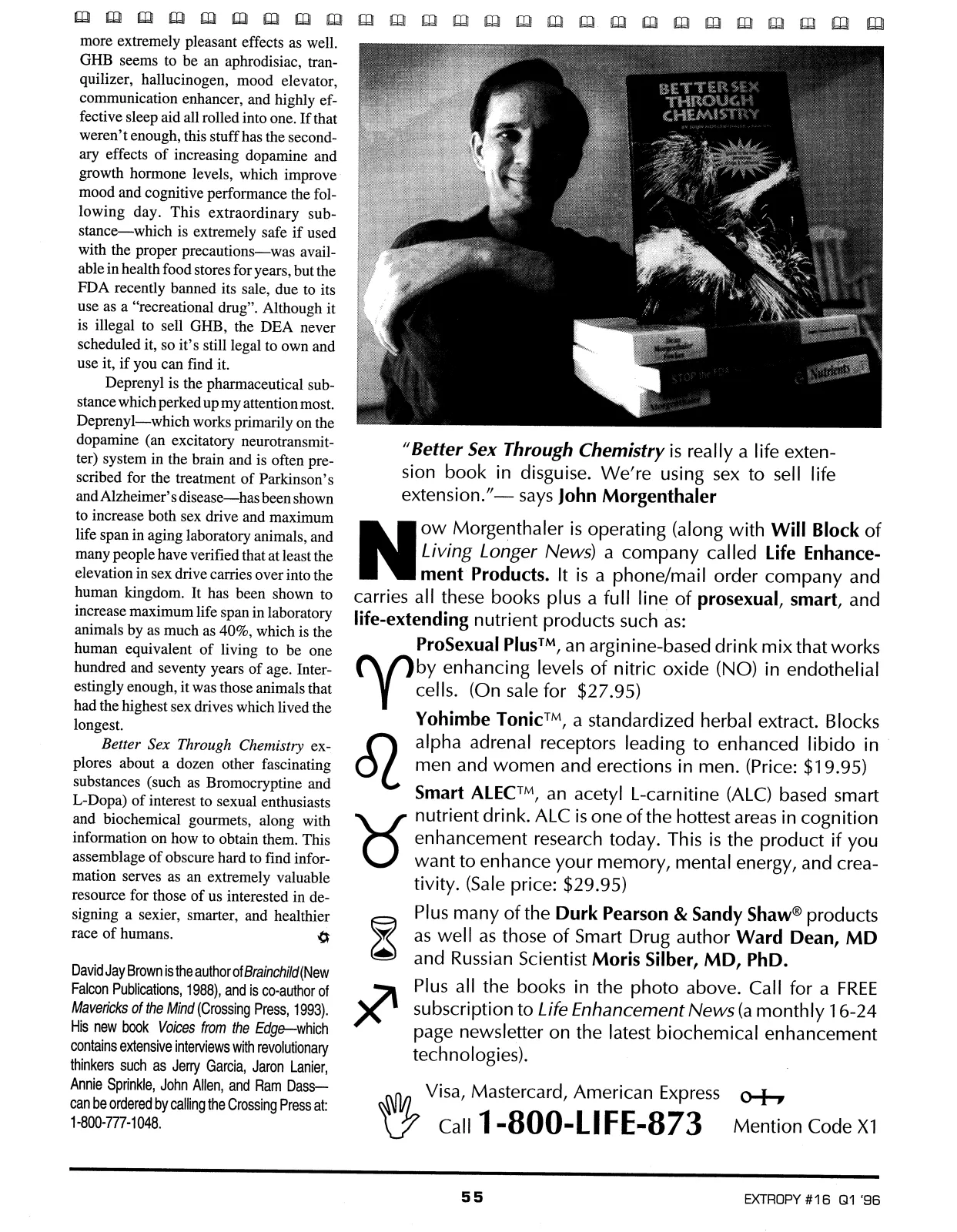
“Better Sex Through Chemistry is really a life extension book in disguise. We’re using sex to sell life extension.”— says John Morgenthaler
Now Morgenthaler is operating (along with Will Block of Living Longer News) a company called Life Enhancement Products. It is a phone/mail order company and carries all these books plus a full line of prosexual, smart, and life-extending nutrient products such as:
ProSexual Plus™, an arginine-based drink mix that works by enhancing levels of nitric oxide (NO) in endothelial cells. (On sale for $27.95)
Yohimbe Tonic™, a standardized herbal extract. Blocks alpha adrenal receptors leading to enhanced libido in men and women and erections in men. (Price: $19.95)
Smart ALEC™, an acetyl L-carnitine (ALC) based smart nutrient drink. ALC is one of the hottest areas in cognition enhancement research today. This is the product if you want to enhance your memory, mental energy, and creativity. (Sale price: $29.95)
Plus many of the Durk Pearson & Sandy Shaw® products as well as those of Smart Drug author Ward Dean, MD and Russian Scientist Moris Silber, MD, PhD.
Plus all the books in the photo above. Call for a FREE subscription to Life Enhancement News (a monthly 16-24 page newsletter on the latest biochemical enhancement technologies).
Visa, Mastercard, American Express
Call 1-800-LIFE-873
Mention Code X1
Nano:
The emerging science of nanotechnology: remaking the world molecule by molecule
by Ed Regis
Little, Brown and Company, 1995
325 pages; ISBN 0-316-73858-1
Reviewed by Rob Michels
Darwinian natural selection is nearly obsolete. Self and social selection have become much more important in today’s world because they act quickly and, in many cases, just as decisively as natural selection. Not only do these vital changes in our lives mimic Darwinian selection, but they can occur in an afternoon. When I realized my eyesight had deteriorated I had my new glasses “in less than an hour.” Had we, as a species, waited for natural selection to improve human eyesight, it would have been an exceptionally long wait. My great great… grandchildren would have been the beneficiaries; or rather I should I say, someone else’s great great… grandchildren. In a Darwinian world, the battle for improvement would be between us and other species. But, it’s rapidly becoming the case in our world that the battle is between social forces on one hand and autonomous selection on the other. Unfortunately, few people, other than Extropians, seem to think this way.
Nanotechnology, if we can de-development of nanotechnology.
Regis describes: some of the early meetings of the first nanotechnology study group; the difficulties that Drexler faced at MIT while developing the ideas that we now call nanotechnology; camping trips that he and Chris Peterson took; even how they met, courted, and got married. Regis devotes much of the book to describing Drexler’s life and his enthusiasm for this subject, even as an undergraduate.
Regis glorifies the work of Drexler as well as others who became involved in the development of this new technology after Drexler’s Ph.D., but at the same time he presents Drexler as a rather down to earth kind of guy who got his kicks at MIT scaring Chris Peterson by climbing tall sculptures on campus without any apparent regard for safety.
Drexler had to fight his way into the position he now occupies in the scientific community. He entered MIT’s Department of Electrical Engineering and Computer Science (EECS) in order to have a base department while he sought an intervelop it to an extremely sophisticated level, will not only accelerate the process of self selection, but it will give us an enormous number of lives, minds, and bodies from which to choose. Ed Regis, in Nano, gives us a book about the recent history of the people behind the development of the theories supporting nanotechnology. The book contains very little technical discussion; it is more of a history of the ideas and biographies of the people who deserve the credit for the sis. Once accepted to the EECS, he argued that he should not have to take the departmental exams that were required of every EECS degree candidate. He argued that he was not seeking a degree from EECS but rather an interdepartmental degree, so why should he take the exams required of an EECS student? He, after all, had a different agenda; the EECS was just a front and he made no real attempts to make it otherwise. This brought about the first round of battles he had to fight to bring his ideas to the forefront of science.
He had a difficult time filling out a committee. Marvin Minsky had agreed, had even seemed to be thrilled, to be his supervisor. This made a great deal of sense. The scientific community regarded Minsky to be a bit eccentric. Some regarded him as a bit heretical, if not down right nuts. Case in point: “Nuclear explosions” Minsky once told an audience, “aren’t so terrifying, because they’re not self replicating. They’re just irritating.” Minsky was already thinking about the most powerful aspect of nano-replicators—that they were self replicating, or so the theory went. Because of this difference, nanotechnology far surpassed the emerging science of nanotechnology: remaking the world - molecule by molecule
Ed Regis
Editor of the New York Times and the European Edition nuclear events both in their usefulness as well as in their destructive capabilities.
Where others thought of nuclear energy as both incredibly productive as well as destructive, Minsky and Drexler saw them as single (albeit incredible) events and hence quite limited in their application. Nanotechnology would make technological processes rather than events and that puts nanotechnology in a category of development wholly apart from all of the productive developments of the past.
Minsky had already become familiar with Drexler’s ideas, having written the foreword to Engines of Creation, and he wanted to see the technical details of that work spelled out in a Ph.D. thesis.
The rest of Drexler’s committee was, shall we say, a bit less enthusiastic. One of the problems was that Drexler’s work drew on so many disciplines that few, if any, were really qualified to comment on the technical aspects. They took a top down approach to understanding his thesis, looking at this new work through the eyes of people who already had an understanding of a body of knowledge and just had to apply that knowledge to the thesis.
This stands in contrast to people like Ralph Merkle who learned about nanotechnology from the bottom up. Starting with a sophisticated math background, Merkle learned nanotechnology from the basic theories up to the more generalized applications. But such people, other than Minsky, were hard to find and that was nearly the demise of Drexler’s thesis. However, having received the respect of Minsky and eventually the acquiescence of the rest of the committee, MIT finally awarded Drexler a Ph.D.
While I find the history of the development of nanotechnology quite interesting, it is far from the most important part of the book, though it does provide the largest part of it. Regis gives us an easily read book that shows how other technologies have also had the manipulation of individual molecules and atoms as their goals. He documents the use of STM’s (scanning tunneling microscopes) to write the IBM logo. He takes examples from biology including the study of E. coli’s propulsion system which relies on an electric motor envisioned by Drexler to be essential to working nanomachines. From individual particles which have been isolated for extended periods of time in magnetic fields, to molecular “shuttles” which could move along a “track” of atoms, Regis provides many examples of engineering feats which have manipulated individual atoms and molecules.
The importance of this lies primarily in showing skeptics that this work is already in progress and has achieved some degree of success as well as notoriety. Many people look at the grand claims of nanotechnology and see only science fiction. Regis’ book shows that the goals of nanotechnology are being successfully developed piecemeal by scientists in fields that nobody questions.
One of the drawbacks to Engines of Creation was that people who were not already sympathetic to many of the ideas presented therein just could not accept the grand conclusions. Nano builds up the theories first by showing that the people developing the theories are real people with senses of humor, frustrations, and yes, failed experiments. Then it goes on to bring the successes together into a description of a technology whose claims do not seem so outrageous given the sound foundation that it has in so many other respected and unquestioned fields of study.
Another important part of the book provides non-technical responses which Drexler has provided to technical objections. These extend from the well known gray goo problem to social and economic problems.
Extropians will not be particularly surprised by this. The rest of the world however, will view many of the goals of nanotechnology as a bit too extreme and implausible. This book shows in a clear way that the goals of nanotechnology are being sought successfully by other disciplines. This will allow supporters of nanotechnology to get their foot in the door of the general populous’ minds. We can now quite easily point to many examples of nanomachines or at least other machines which exhibit gears, switches, levers and so on which operate at the nano level.
If you are looking for a technical book, this is not for you. However if you are looking for some light reading with many examples of how nanotechnology is already becoming respectable in other fields (albeit under different names) I recommend this book. You will find out a lot about the people behind the scenes—even those who do not know that they are working toward the goals of nanotechnology.
VIDEOTAPES
PART 1 Transhumanist Philosophy
PART 2 Extropy Institute, MI, Uploads
Max More, Robin Hanson, Abe Heward, William Wiser
PART 3 Indefinite Lifespan, Uploads
PART 4 Alcor Foundation and Cryonics
Max More, Robin Hanson, Chris Heward, Regina Pancake, Dan Spitzer, Tim Freeman
PART 5 Mood Modification and Identity Choice
PART 6 The WWW and Virtual Communities
Dr. Ray Sahelian, Max More, Jeannine Parker, Coco Conn
PART 7 Rational Values 1
PART 8 Rational Values 2
Max More, Peter Voss, Robin Hanson, Tim Freeman
TURN ON - TUNE IN - TRANSFORM
Each videotape features two Parts.
$18.50 each donation. Dept. S, Extropy Institute, 13428
Maxella Avenue, #273, Marina Del Rey, CA 90292
HOST/PRODUCER: NANCIE CLARK
River Out of Eden:
A Darwinian View of Life
by Richard Dawkins
Basic Books, HarperCollins Publishers, 1995; 172pp.
Reviewed by Greg Erwin
The first thing to note is that this book is part of the “Science Masters” series—a global venture to publish books by leading scientists. If you recognize the names Richard Leakey, Stephen Jay Gould, Daniel Dennett, Jared Diamond, Stephen Pinker, Murray Gell-Mann, you will be anticipating them with joy, for these names are just some of those leading scientists who have written or are slated to write Science Masters books.
There are a mere five sections in Dawkins’ River: The Digital River, All Africa and Her Progenies, Do Good by Stealth, God’s Utility Function, and The Replication Bomb.
The river of the title (and the digital river of the first section) is not PishTosh or OshKoshB’Gosh, or any of the other rivers running out of Eden in myths or fairy tales, but is the metaphorical stream of digital information represented by DNA; not just humanity’s, but that of all life. Somehow, sometime, inanimate matter accidentally combined to form something that could replicate itself.
What follows from this occurrence anywhere in the universe, is Darwinian selection and hence the baroque extravaganza that, on this planet, we call life.
From that one event, all the rest follows. With no need for any other help from any outside entity. In fact, if Darwin is right there are no outside entities.
Science shares with religion the claim that it answers deep questions about origins, the nature of life, and the cosmos. but there the resemblance ends. Scientific beliefs are supported by evidence, and they get results. Myths and faiths are not and do not.
Isn’t that refreshing? Science is right. Religion is wrong.
Dawkins covers the digital nature of DNA, mitochondrial Eve, speciation, the design argument. He provides sound answers to many standard questions about the time available and the rate of mutation, (“there isn’t enough time available for reptiles to change into mammals”); creationist arguments against the possibility of developing an eye (“What good is half an eye, or half a wing?”).
As for the implications, he notes that: We cannot admit that things might be neither good nor evil, neither cruel nor kind, but simply callous—indifferent to all suffering, lacking all purpose.
However, that is, indeed, the case.
Towards the end, he introduces the term utility function, the penultimate chapter being titled “God’s Utility Function.” In economics, the utility function is “that which is maximized.”
[in] … the behavior of a country’s government, you may conclude that what is being maximized is employment and universal welfare. For another country, the utility function may turn out to be the continued power of the president, or the wealth of a particular ruling family, the size of the sultan’s harem,…It isn’t always obvious what individuals, or firms or governments are striving to maximize. But it is probably safe to assume that they are maximizing something.
So, “…imagine that living creatures were made by a Divine Engineer and try to work out, … what the Engineer was trying to maximize: What was God’s Utility Function?” See, it’s just a metaphor!
Well, it all comes down to DNA survival, nothing more, nothing less, and nothing else. Although we ask the question, why do tragedies happen? Dawkins answers:
…if the universe were just electrons and selfish genes, … meaningless tragedies … are exactly what we should expect, along with equally meaningless good fortune. Such a universe would be neither evil nor good in intention. It would manifest no intentions of any kind. … The universe we observe has precisely the properties we should expect if there is, at bottom, no design, no purpose, no evil and no good, nothing but blind, pitiless indifference…
DNA neither knows nor cares. DNA just is. And we dance to its music.
River Out of Eden is a basic, clear, forthright and thorough explanation of the Darwinian view of life and all of its consequences and implications. The main implication of interest being that if Darwin is right, theistic religion is wrong. Dawkins takes the time to answer the arguments against the various aspects and implications of the Darwinian paradigm and does so successfully. Just because the book is basic, does not make it less valuable; he manages to give a full treatment to the subject. And probably does so better than some others who have taken more time to say less.
Lastly, it is obvious, (he says so) that he has been in touch with others such as Daniel Dennett, while writing the book. It is completely up to date. For those who wish to read further, there is a good bibliography, and many of the books in it were published in 1995 or 1994.
So, the book comes with a thorough recommendation. If you aren’t well-versed in natural selection and evolution, you should be, and this is a very good way to start. If you already are, this is a very handy, short and yet complete reference book to have around. If you are neither, you are not likely to have read this far in the review, and need not be taken into consideration.
In fact, I have read all four of the Science Masters books so far, and can recommend the whole series. In addition to Dawkins there are: Paul Davies, The Last Three Minutes (End of the Universe); Richard Leakey, The Origin of Humankind (what else?); John D. Barrow, The Origin of the Universe; and more to come.
Dr. Walford’s Interactive Diet Planner
Reviewed by Max More
I’ve tried several software programs for monitoring diet. DWIDP (to use its abbreviation) I have found the most useful. This is also the only program created by a world-class gerontologist. Dr. Roy Walford, though most recently familiar as the medic of the original Biosphere 2 team, made his considerable scientific reputation in the field of aging research. (See our interview with Dr. Walford in Extropy #14 and #15.) Walford has written several books, including Maximum Life Span, The 120 Year Diet, and The Anti-Aging Plan.
Much of Walford’s work has investigated the effects of dietary restriction on life span and age-related disease. His research led him to recommend a High/Low Diet: a diet as high (and balanced) as possible in nutrition while low in calories. Ensuring that you maintain a high level of nutrition at a lowered caloric intake can be tricky. The Diet Planner makes it much easier. Even if you have no interest in lowering your caloric intake, wanting only to optimize your nutrition, the program will be ideal.
I should make a disclaimer here: I have helped out in some peripheral ways with this program (such as by putting together the Quick Reference Guide). So I’m not an impartial reviewer. However, I was an enthusiastic user of the previous DOS version years before I had any involvement with the creators of this new Windows version. Trust me!
To record the foods you’re eating, you create a foodlist. (See illustration 1.)
You can enter a food item either in grams, calories, or per serving. Each time you add an item to the foodlist, several nutritional totals (calories, protein, fat, fiber, etc.) will automatically be updated. The nutrient values for thousands of foods (from the Dept. of Agriculture database) are built into the program, so you don’t need to type in nutrient amounts for every food. You can add new foods as well as make recipes by saving combinations of foods.
The menus available from the foodlist screen give you access to two ways of totals for amino acids.
Alternatively, DWIDP can display these totals graphically in the form of a histogram bar chart. (See second illustration.)
You’ll find yourself checking your totals frequently as you add foods through the day. Having this information so accessible not only makes it easier to track your nutritional rationality but actually en-
2: Histogram chart of vitamins, minerals, and other nutrients. This chart gives a rapidly graspable display of the same information available in numerical table form.
Foods are entered in this window. Most other frequently used functions can be accessed from here.
1: Foodlist.
displaying detailed information on your nutrient totals. You can choose to View All Nutrients—Table. This gives you figures on the amounts of all vitamins and minerals plus total calories, protein, fat, fiber and others, as a percentage of your daily goal. With one click of the mouse you can switch to a courages you to improve your diet. Seeing a display of how well I’m doing (or how fair I’m allowing dietary entropy to insinuate) makes me want to push for 100% on each nutrient while keeping the bar representing fat as short as I can.
The nutrient total tables and displays are one way in which you will find yourself becoming painlessly but thoroughly educated about the foods you eat. Another way results from using the search functions. As shown in the third illustration, several options can be selected under the Search drop down menu. In addition to simply minimizing or maximizing nutrients such as saturated fat or vitamin E, the program allows you to find foods high in some values but low in others. You might want to find foods high in fiber and vitamin A but low in fat.
| Search | Nutrition |
|---|---|
| Optimize | |
| Min One | |
| Max One | |
| Min Several | |
| Max Several | |
| Min/Max Several | |
| Repeat |
3: Search options
Producing an ordered list of such foods is a matter of a few seconds to select options. DWIDP also lets you find foods with a good balance between several nutrients rather than simply minimizing or maximizing. You can search all categories, or you can narrow the categories searched, excluding those that you don’t eat from (or have had enough of), such as meat, nuts, or candy.
DWIDP allows you to save nutrient total information for a range of days in log files. This means as well as seeing how you’ve done on any particular day, you can survey your nutritional performance over a period of time.
If you want to try caloric restriction, for its many major health and longevity benefits, this program eases the otherwise difficult goal of achieving full nutrition on few calories. Trying to ensure adequate nutrition on a tightly calorie restricted diet is a real pain if you have to look up all those values in a book. Using the program to do it makes it fun. If you’re unsure of the value of calorie restriction, read Roy Walford’s The 120 Year Diet. You may decide the cost in effort is worth the extended life span.
The Diet Planner will appeal to several types. For those strongly concerned about longevity and health, the program provides a powerful and efficient means of monitoring nutritional intake. Overlapping this group are those who enjoy keeping personal records, noting figures relating to personal goals, and tracking progress. DWIDP will delight such organized record keepers. The ability to see numerous numbers and graphical displays of nutrients and to maintain daily and longer term totals allows anyone to satisfy, in the healthiest way, their craving for record keeping.
DWIDP requires Windows 3.1. If you are using Win95, call first to see if it has been tested with that OS. (A Mac version may be available in future.) DWIDP costs $95 + $3 shipping (and add another $3 if paying by credit card). California residents add 8.25% sales tax. From: Longbrook Company, 1015 Gayley Avenue, #1215, Los Angeles, CA 90024. 310-392-8208.
We welcome reviews of books, CDs, and software. Contact the Editor if you have want to write a review, or if there is something you think should be reviewed in Extropy.
Permutation City
by Greg Egan
HarperPrism, 1995; 340pp, $4.99 pb. ISBN: 0-06-105481-X
Reviewed by Max More
Greg Egan, an Australian writer, has been rapidly making his mark as a fresh, stimulating, intelligent new voice in science fiction. His first novel, Quarantine, dealt with the possibilities of neurotechnology more convincingly and absorbing than any I’ve come across. His latest, Permutation City, deals with how we might relate to Copies of ourselves running on a computer. (What we call uploads or infomorphs.)
The story starts grippingly. We follow the experiences of a Copy who discovers that his flesh self has trapped him in a virtual reality in order to conduct experiments. That, at least, appears to be the situation, until Egan leads the reader through a series of smartly executed twists. This thoroughly enjoyable initial episode serves as a setup for the main story.
Our next main character, Maria, allows Egan to sketch a virtual world called the Autoverse. The Autoverse compares well with Stephenson’s Metaverse (from Snowcrash). While the Metaverse was a well described if standard virtual world, the Autoverse is the domain of artificial life and full blown artificial physics and chemistry. The full import of the Autoverse only emerges later in the novel.
Rather than give away any of the plot, I’ll mention instead another aspect of the book I enjoyed. Our Autoverse programmer gets sucked into the intrigue by taking work in order to be able to afford to scan the brain of her terminally ill mother. Maria’s mother, a member of the Church of the God Who Makes No Difference, rejects her daughter’s plan, arguing that becoming a copy holds no appeal for her and that she is satisfied to die “at the appointed time”. Cryonicists who have remonstrated with family or friends will have heard the same peculiar words from those who have grown up to accept death, and will be touched by our protagonist’s frustration.
For those familiar with Ayn Rand’s Atlas Shrugged, one part of the book may give you a technology-tinged sense of deja vu. One of the central characters is making the rounds of uploaded billionaires, giving them detailed arguments for shrugging off society in favor of a virtual world:
She said, “What exactly is he promising these Copies?”
“A refuge. A place where they’ll be safe from any kind of backlash—because they won’t be connected to the outside world. No telecommunications, nothing to trace. He feeds them a long spiel about the coming dark age, when the unwashed masses will no longer put up with being lorded over by rich immortals—and evil socialist governments will confiscate all the supercomputers for weather control.”
Like Egan’s previous novel, Quarantine, this one was slightly spoiled for me by his preoccupation with a mystical view of quantum mechanics. If you can set this aside, Permutation City will reward you with an unusually intelligent and well crafted view of the future. This is a writer to watch.
VIEW ORIGINAL SCAN (7 pages)