Issue: EXTROPY #16 · First Quarter 1996
Author: Max More
Pages: 16–30 · 15 scanned pages
Neuroscience Pioneers: Berger, Arbib, Adleman, Thompson, Leahy, Kosko
PROFILE
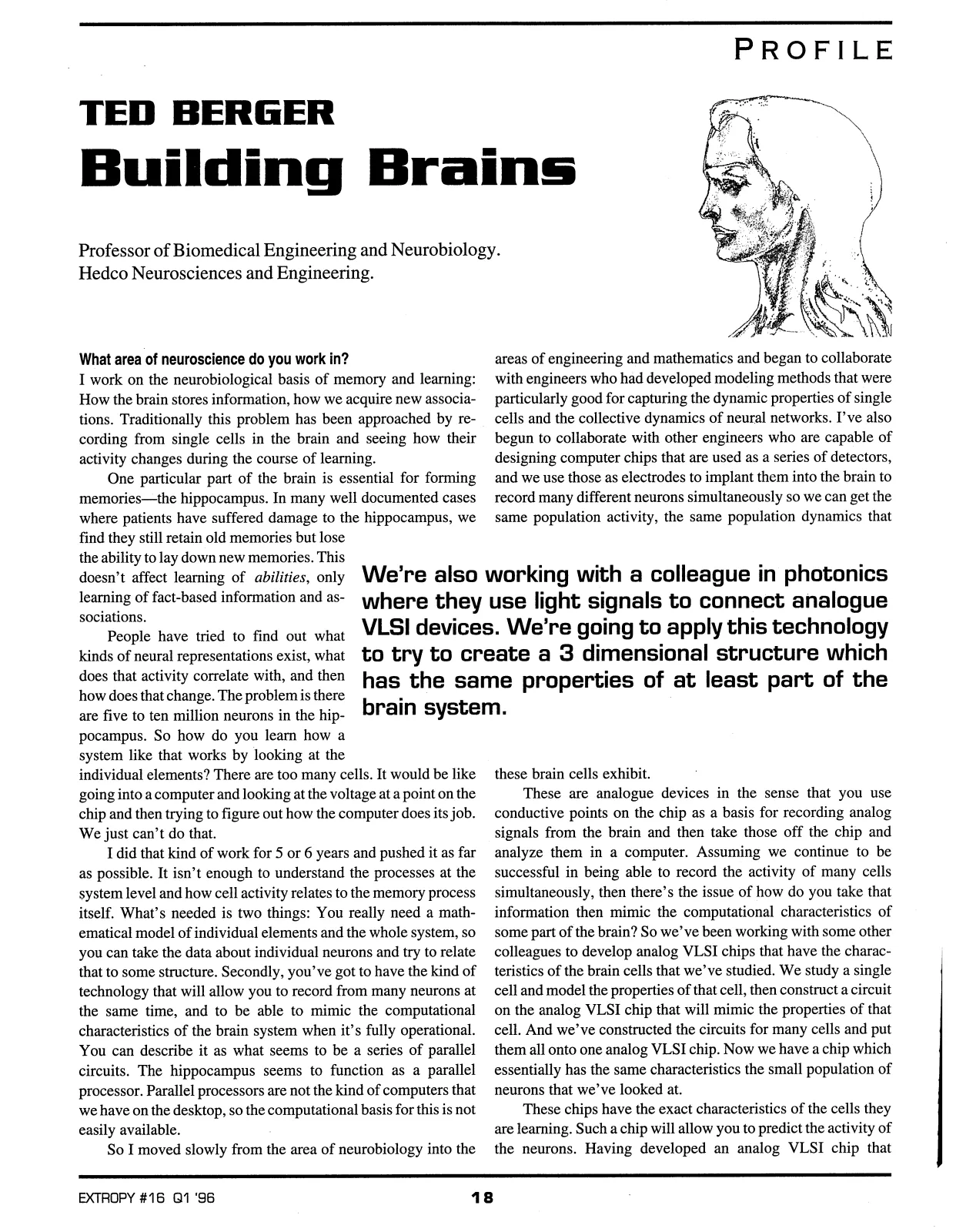
TED BERGER
Building Brains
Professor of Biomedical Engineering and Neurobiology. Hedco Neurosciences and Engineering.
What area of neuroscience do you work in?
I work on the neurobiological basis of memory and learning: How the brain stores information, how we acquire new associations. Traditionally this problem has been approached by recording from single cells in the brain and seeing how their activity changes during the course of learning.
One particular part of the brain is essential for forming memories—the hippocampus. In many well documented cases where patients have suffered damage to the hippocampus, we find they still retain old memories but lose the ability to lay down new memories. This doesn’t affect learning of abilities, only learning of fact-based information and associations.
People have tried to find out what kinds of neural representations exist, what does that activity correlate with, and then how does that change. The problem is there are five to ten million neurons in the hippocampus. So how do you learn how a system like that works by looking at the individual elements? There are too many cells. It would be like going into a computer and looking at the voltage at a point on the chip and then trying to figure out how the computer does its job. We just can’t do that.
I did that kind of work for 5 or 6 years and pushed it as far as possible. It isn’t enough to understand the processes at the system level and how cell activity relates to the memory process itself. What’s needed is two things: You really need a mathematical model of individual elements and the whole system, so you can take the data about individual neurons and try to relate that to some structure. Secondly, you’ve got to have the kind of technology that will allow you to record from many neurons at the same time, and to be able to mimic the computational characteristics of the brain system when it’s fully operational. You can describe it as what seems to be a series of parallel circuits. The hippocampus seems to function as a parallel processor. Parallel processors are not the kind of computers that we have on the desktop, so the computational basis for this is not easily available.
So I moved slowly from the area of neurobiology into the areas of engineering and mathematics and began to collaborate with engineers who had developed modeling methods that were particularly good for capturing the dynamic properties of single cells and the collective dynamics of neural networks. I’ve also begun to collaborate with other engineers who are capable of designing computer chips that are used as a series of detectors, and we use those as electrodes to implant them into the brain to record many different neurons simultaneously so we can get the same population activity, the same population dynamics that
We’re also working with a colleague in photonics where they use light signals to connect analogue VLSI devices. We’re going to apply this technology to try to create a 3 dimensional structure which has the same properties of at least part of the brain system.
these brain cells exhibit.
These are analogue devices in the sense that you use conductive points on the chip as a basis for recording analog signals from the brain and then take those off the chip and analyze them in a computer. Assuming we continue to be successful in being able to record the activity of many cells simultaneously, then there’s the issue of how do you take that information then mimic the computational characteristics of some part of the brain? So we’ve been working with some other colleagues to develop analog VLSI chips that have the characteristics of the brain cells that we’ve studied. We study a single cell and model the properties of that cell, then construct a circuit on the analog VLSI chip that will mimic the properties of that cell. And we’ve constructed the circuits for many cells and put them all onto one analog VLSI chip. Now we have a chip which essentially has the same characteristics the small population of neurons that we’ve looked at.
These chips have the exact characteristics of the cells they are learning. Such a chip will allow you to predict the activity of the neurons. Having developed an analog VLSI chip that
NEUROSCIENCE PIONEERS
BY MAX MORE
Even that dinosaur, the government, has declared this to be the Decade of the Brain. The premier science of this century has been physics. We have looked up to physics as the exemplary science. We have tried, sometimes misguidedly, to base other disciplines on the methods of physics. We have used physics for sources of metaphor and metaphysics. The next century will see the overthrow of physics and the installation of biology and the neurosciences as first among disciplines.
For this issue, I decided to go beyond my reading by talking to some researchers in neuroscience. Having just completed my Ph.D. at the University of Southern California, I investigated USC’s new interdisciplinary neuroscience department. I was delighted to find a top class institution. The Hedco Neurosciences department was created in the late ’80s and is home to an impressive collection of brilliant researchers in neurobiology, cognitive science, linguistics, engineering, and other fields. The range, depth, and innovativeness of this department may well be unmatched anywhere else.
In this series of profiles, I present just a taste of the richness of the research going on at the Hedco Neurosciences and its Neural, Informational, and Behavioral Sciences (NIBS) program. Here we have researchers building synthetic neurons, figuring out cognition and intelligent agents, understanding memory, scanning the brain, and fusing neural networks and fuzzy logic. Enjoy this glimpse of the future.
essentially has on it a small population of neurons, that’s essentially equivalent to creating a hardware model of a slice through a 3-dimensional structure. They have so far created a population of nine neurons and have designed one for 100. We’ve essentially modeled a 2-D plane of a 3-D structure. If you want to mimic how the whole system works you need to do this in three dimensions. So we’re also working with a colleague in photonics where they use light signals to connect analogue VLSI devices. They’ve developed a brand new technology that will allow you to stack analog VLSI chips together and sandwiched in between them is the photonic technology for connecting those VLSI chips. We’re going to apply this technology to try to create a 3 dimensional structure which has the same prop erties of at least part of the brain system.
There will be 100 neurons in each of the planes. As many of those as we can stack together. Then we can have the 3-dimensional characteristics of part of the brain system. That allows you to study the parallel processing capabilities of a brain in a way which you can’t on the kinds of computers that you use right now. We know the properties of those cells have the same properties as parts of the brain. We can begin to ask what are the dynamics of this brain system, and how is it that a network of this kind can be trained to learn something new.
What are your objectives with this research? There are several objectives to this project. One is to understand how brain systems work. What are the computational char acteristics and computational limits of different brain systems? We really need to have the three dimensional structure of that brain system in a model to be able to answer those kinds of questions. There is a second objective: We want to create a hardware device which will function like the parts of the brain. There are three major advantages to a hardware device. One is you can incorporate true parallel processing. The second is speed: you can do very rapid processing. The third is size. So the second objective relates to those three advantages.
If we can mimic the computational characteristics of the brain at a reduced scale using a hardware device then there’s no reason why we can’t begin to contemplate replacing parts of the brain that are damaged, with computer chips that have the same properties and can be connected to the rest of the brain through the specially designed interface electrodes. We can sense the activity within the brain and we can send out signals into the brain. These kinds of sensing probes or signaling probes could be sandwiched on the end of a 3-dimensional structure that could perform the same function as the part of the brain that we want to replace. The replacement parts would be of a similar volume of the parts of the brain they are replacing.
The third major objective is to understand enough about how the brain works to be able to build devices to solve problems in the real world that take advantage of the things the brain does really well. One of the things the brain does really well is to associate arbitrary kinds of objects. There are some real world problems the brain is very good at and does better than any other kind of device. If we can understand what those principles are, then we can build devices that will solve problems in the real world. We’ve designed a device that could function as a wireless duplication receiver based on some of the first principles that we’ve understood about the hippocampus. That may have an application in cellular phone technology.
How far off do you think any kind of neuroprosthesis will be?
It actually depends on the parts of the brain we’re talking about. There may be lower level functions—spinal cord functions, motor systems that control the limbs—that may be possible within ten years. For replacing the kind of higher cognitive functions that involve learning and memory, that would be more like ten to twenty year range. Replacing a damaged point in the spinal cord may be possible in ten years. The tissue above and below the point of damage is functioning normally. If you can sense the activity of all the cables that are on the brain side, and you can drive the activity of all the cables that are on the lower spinal cord side, and you have a set of chips which performs the correct connection and the correct transformational activity from the brain to the spinal cord, then why not?
How do inorganic chips connect to biological neurons?
There has been a lot of research identifying the kinds of conditions that will allow neurons to attach to the electronic current sensing part of the chip. Under the right conditions cells will attach to the metal surface and stay attached. Whenever the cell exhibits electrical activity then the underlying circuit will detect that activity and transmit it elsewhere. Or, in just the reverse way, you could actually supply current to the chip and that can drive the activity within the cell. So there’s a way of interfacing neurons and chips.
The additional problem is how to get the neurons that are interfaced with the chips to connect with the rest of the brain directly. That’s a problem where there are a lot of unknowns. But we do know two essential principles: One is, nerve cells connect themselves up together. There are growth factors and a lot of other things that guide the connections from one neuron to another. They may not find the right pairs, but they do find each other. Secondly, it turns out that during development these connections are formed between cells that are active simultaneously.
It involves part of the same process that’s used in the brain of the adult animal to store information. The strengths of connection between neurons in the hippocampus and in other parts of the brain changes as a function of activity. If two cells are active at the same time then the synaptic connection between them is strengthened. There are other conditions under which those connections can pocampus. All the feature analysis has been completed. That information is processed in some way, along with, for example, the auditory sounds that the creature made, so that the features (which have already been identified as a face) and the auditory signals which identify how your name sounds, those two things get fed into the hippocampus and they’re associated in some way and then sent back weaken.
We now understand a great deal about the principles for how connections between neurons are strengthened, and it’s primarily on the basis of activity. So if a cell has been grown to the surface of a chip and we put this chip into the brain, and we want to connect up correctly the cells that are on the interface one of the ways to do that is to drive the activity of the cells. We can control that and as a result control in part how these cells wire themselves up to the rest of the brain. Although that will be a very difficult problem we can see the beginnings of how to approach the problem.
Our objective is to create a hardware model of the function of the hippocampus. It’s situated in a part of the brain where after the rest of the sensory systems break down the incoming signal, determine what the features are and integrate all those features that identify a face—it’s that information that goes into the hipto the cortical regions that do the sensory analysis, and they’re stored there. This signal transformation process and the association process is done in some way that allows this human to learn this new information and to insert it into long term memory without disrupting all the other long term memories. The associations formed by the hippocampus allow each of our databases to be updated without destroying the existing databases and make retrieval of that data optimal. It’s that function that we’re trying to emulate. Not just learning new information or identifying speech patterns, but how to take that new item that’s learned and insert it into a database so that it has the correct associations with all the other things the person has learned.
This is a unique effort. People with very different backgrounds have agreed to work together. I’m one of five people. Without the different backgrounds the problems couldn’t be solved. The Hedco Neurosciences program is unique. The purpose is to get neurobiologists, biologists, computer scientists, engineers, psychologists, all in the same building. All the members of the team are willing to be members of a team. It turns out that there are an awful lot of problems that we have with the neurobiology that there are already solutions for in the field of engineering. We just don’t know about them. So breaking down the disciplinary areas is extremely important.
How long will it be until we have a real artificial brain of human level intelligence? What’s most important in answering that question is that in the last couple of years we have reached a point both in understanding the neurobiology of the brain and understanding the fundamental principles of engineering and computer science where we can entertain that question; where’s it’s actually reasonable to ask how long do you think it will be, just five or ten years ago, that would be seen as a science fiction question. But how it is feasible to start thinking about things like sential tenet of the scientific approach is that everything can be treated as a machine and broken down into its component parts.
People will become more comfortable with that—with the consequences of that approach, such as with the consequence of putting computers into the brain. Once they experience the benefits… Everyone has a problem with their mother but their children’s disease or their child having epilepsy. My solution is a good solution to such problems. We not talking about changing the entire function of the that, just as it’s feasible to start taking about replacing parts of the brain. I don’t have the faintest idea. I could say 50 years from now. I don’t think it’s unreasonable to think in those terms.
Much of the population is uneasy with the idea of replacing parts of the brain. They believe that there’s something up here that’s outside physics and chemistry. If we replace parts of the brain with things we’ve built, then aren’t we just a machine of some kind? How do feel about that and how do you think people ought to feel about it? Should we be losing a sense of being special, or should we just realize that we’re the most magnificent machines around?
To understand how the brain works and to approach the problem of understanding cognitive behavior scientifically it’s imperative to treat the brain as a kind of machine, that this system can be reduced to most of parts and they have relations to one another. When those relations are allowed to exist there’s a dynamic that provides that explains the global behavior of the system. When you’re trying to explain the complex thought processes that are made in what you have many examples and the dynamics of those elements in complex, it becomes a much more complex. But nonetheless, the ex-individual but simply replacing the part that used to be there, replacing the function that used to be there. Then I think a lot of that resistance will melt away.
What if we do start talking about altering and enhancing our capabilities? Without having to sit down out a computer, what if I can work out complex equations and trajectories, what if I can do all those things in my head? What if I can work out complex strategies and patterns that would normally have to do on a very powerful computer—do you think people will be more upset about those?
Yes, I think there are going to be great social debates over whether we should enhance the capabilities of the brain, and do anything other than replace non-functioning parts of the brain. As soon as the work began to move towards enhancing function of the brain I think that would cause a great deal of social debate. Personally I think it would be extremely interesting to find out how much we could enhance human brain function. I think it should be tried. Now we’re talking way downstream, but if we can replace brain function, well why not try to find out how well we can enhance brain function. I think it would be incredibly interesting to try. I would love to be able to remember things that I forget. How many times has it been that you wished you were in a certain cognitive or emotional state, and you can’t be in that state. It would be an incredible advantage to be able to have that choice.
I think it’s far more likely that these technological developments will allow the uploading into the brain of information from the computer. If we can understand how it is that certain signals input into a system, how that neural representation is transformed and how it’s associated with other representations, then it seems to me that we should be able to upload into a human the correct series of input signals at the right places at the right times; we’ll be able to build into the memory banks new associations that we haven’t in fact experienced. That’s because we’ve identified a very discrete part of the brain that’s important for laying down new memories. But we don’t know where the memories are stored. We think we know. We think they’re stored in the neocortex—phylogenetically the newest part of the brain. But exactly where and how it’s stored no one really has much idea.
I would love to. That would be extremely interesting to me. It’s a challenge in sense of being an entirely different dimension of testing, how well you’ve understood the system. Replacing functions is one thing, but when you’re trying to enhance brain function, that’s potentially different problem. We might not know how to change properties of the brain so you enhance the functions you wanted without disrupting other functions. That’s a very hard problem and a very interesting one.
Oh, you better believe it! Without a doubt. I’d love to.
BACK ISSUES: $6.00 each
V.1, #1-Tribute to Isaac Asimov By Steve Allen, Harlan Ellison, Martin Gardner; The “Amazing” Randi on the Paranormal; A Skeptical Manifesto; Triumph of Science.
V.1,#2-Can Science Cheat Death? Cryonics: Reaching for Tomorrow; Q & A About Cryonics; Can Science Cheat Death?; Society of Persons Apparently Dead; Abuse of Statistics.
V.1,#3-Revolution in Evolution? Punctuated Equilibrium by Gould; Punc 5a at 20; Historic 1840; Darwin Sketch on Evolution; The Darwinian Culture; Edgar Cayce investigation.
V.1,#4-Heretics, Scientists & Resistance to New Ideas Spirits, Witches & Science; Edgar Cayce Foun- dation Response; Can Religion be Rational?; Today’s Heretic; Tomorrow’s Saint; Ideological Immune System; Copernicus as a Heretic.
V.2,#1-Genius: Myths & Reality By Steve Allen, Paul MacCready, James Randi, Marilyn Vos Savant; Gleick on Feyn- man; Gene Roddenberry; The Amadeus Myth; Noah’s Ark; Who & What Mattered in History?
V.2,#2-Science, Religion, Cults Waco, Jonestown, and All that Madness; Millennium Watch; The Jesus Cults by Steve Allen; The Resurrection Myth; Was Christiani- ty a Cult?; Realism and Religion by Milton Rothman; The Unlikeliest Cult; Mathemagics.
V.2, #3-Fad Psychology False Memory Syndrome; Facilitated Communi- cation; Diagnoses are not Diseases by Stasz; William Reich; Sex, Brains, & Hands by Halpern; Pseudoscience/Psychiatry by Tavis; How Think- ing Goes Wrong; Flood Myths; The Ark Hoax; Anti-Science; Millennium; Mathemagics.
V.2, #4-Pseudohistory: Holo- caust Revision & Afrocentrism Holocaust Revisionism; Free Speech & Neo- Nasis; Denying the Holocaust review; Creation- ism & Racism; Goodby Columbus?; Were the Egyptians & Greeks Black?; Beyond Race; Noah’s Ark Hoax Update; Randi on the Millennium.
V.3, #1-Pseudomedicine Homeopathy; Therapeutic Touch; Alternative Healthcare; Randi on Liquifying “Blood”; Skep- tics & Religion; Update-FMS; Leftist Science & Skeptical Rhetoric; Mattoon Mass Hysteria.
V.3, #2-The AIDS Heresies The AIDS Heretics; Charles Murray Interview; Astrology Brouhaha; Extraordinary Claims/ Extraordinary Evidence?; Wallace, Darwin/Pri- ority Dispute; Culture Wars; Debunking Hal Lindsay; Should the Bible be Taken Literally? Why Did God Make Rice Cakes? Star Trek.
V.3, #3-Race, IQ, & Intelligence Skewed Logic of The Bell Curve by Halpern; A Place In The Sun by Tavis; Robert Sternberg Interview; Defense of The Bell Curve by Sanch. Scientology v. Internet; “Curse” of King Tut; Moral Panics; FMS Confession; Eat a Light Bulb.
Skeptic Magazine
Provocative & Informative!
SUBSCRIBE NOW AND SAVE $10 OFF THE REGULAR SUBSCRIPTION PRICE, PLUS GET A FREE BACK ISSUE OF YOUR CHOICE!!!
“One of the…top 10 best new publications.” —Library Journal
“Skeptic kicks ass.”
—Penn Jillette of “Penn & Teller”
“…the best journal in the field.”
Are you inter- ested in fringe and revolutionary science? Are you intellectually curious about the paranormal? Subscribe to Skeptic magazine and learn what the world’s leading scientists and experts have to say. Read investigative reports on pseudo- science. Succinct summaries of both sides of contemporary contro- versies and guides for further investi- gation. Skeptic Magazine devotes more space to opposing views than any other forum for reader’s responses. Skeptic also provides reviews of notewor- thy books and articles of related interest. Skeptic is a must read for curious minds.
“Let me congratulate you on the superb design, layout, typography, and intellectual content that has already made Skeptic the best journal in the field. I wish you the very best for the success of your important magazine and its even more vital mission.”
—Stephen J a y Gould
The Skeptics Society is a mem- ber-supported orga- nization of scholars, scientists, historians, magicians, and the intel- lectually curious, that spon- sors a lecture series at Caltech and publishes the quarterly mag- azine Skeptic, for the purpose of promoting science and critical thinking, and disseminating infor- mation on pseudoscience, pseudo- history, the paranormal, superstition, magic, fringe claims and groups, revolu- tionary science, frontier-science, and the history of science and pseudoscience, in arti- cles, essays, reviews, and letters. Transcripts of Caltech lectures are reprinted in Skeptic, and video- tapes of the lectures are available through the magazine.
☐ YES! I want to join the Skeptics Society and subscribe to Skeptic, a quarterly magazine, at the special limited time offer price of $25. I will SAVE $10 off the regular price of $35. The FREE BACK ISSUE that I want with my subscription is Vol.#.
☐ YES! I want to order additional back issues, videos, or books using the order form on the back of this page.
CHARGE IT! FAX your credit card order to 818/794-1301. To order by mail send a check made out to Skeptics Society, or your credit card number to: Skeptics Society, P.O. Box 338, Altadena, CA 91001. For information phone 818/794-3119. E-mail us at skepticmag@aol.com
NAME
ADDRESS
CITY
STATE ZIP
PHONE
Charge my:
☐ MASTERCARD
☐ VISA EXPIRATION DATE
Month Year
Account No.
Signature as name appears on credit card
Special price Skeptic Subscription/Membership at $25 for one year, (includes one free back issue, with free shipping.)
Special price Skeptic Subscription/Membership at $45 for two years. (includes one free back issue, with free shipping.)
Foreign Subscription at $55 for one year, (includes one free back issue, with free shipping.)
Foreign Subscription at $90 for two years (includes one free back issue, with free shipping.)
Total for additional Skeptic back issues, plus books and videos from the back of this page. (Please don’t forget to include shipping and handling)
TOTAL ENCLOSED
Subscribers—Moving? Please notify us immediately. The post office does not forward magazines!
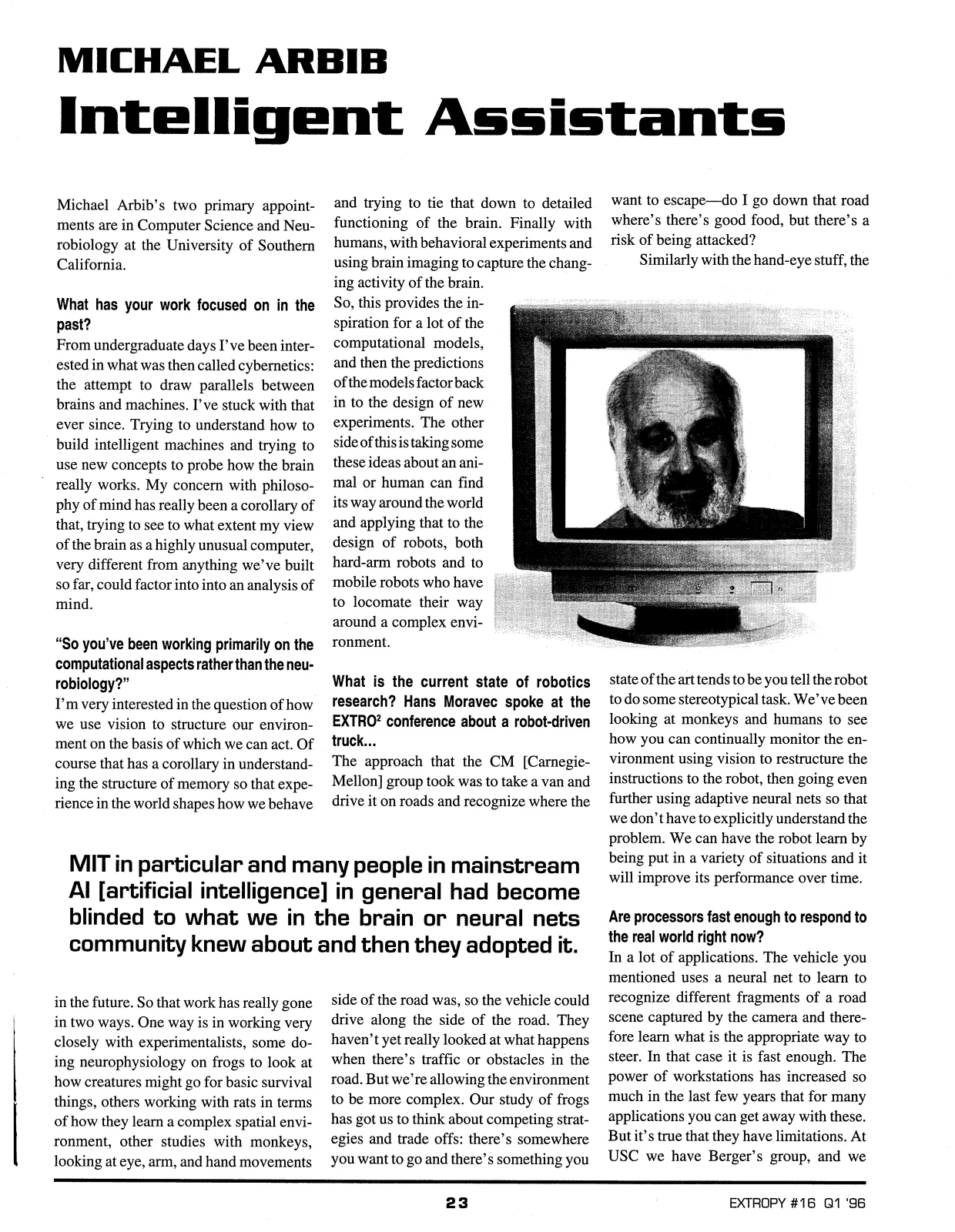
MICHAEL ARBIB
Intelligent Assistants
Michael Arbib’s two primary appointments are in Computer Science and Neurobiology at the University of Southern California.
What has your work focused on in the past?
From undergraduate days I’ve been interested in what was then called cybernetics: the attempt to draw parallels between brains and machines. I’ve stuck with that ever since. Trying to understand how to build intelligent machines and trying to use new concepts to probe how the brain really works. My concern with philosophy of mind has really been a corollary of that, trying to see to what extent my view of the brain as a highly unusual computer, very different from anything we’ve built so far, could factor into into an analysis of mind.
I’m very interested in the question of how we use vision to structure our environment on the basis of which we can act. Of course that has a corollary in understanding the structure of memory so that experience in the world shapes how we behave and trying to tie that down to detailed functioning of the brain. Finally with humans, with behavioral experiments and using brain imaging to capture the changing activity of the brain.
So, this provides the inspiration for a lot of the computational models, and then the predictions of the models factor back in to the design of new experiments. The other side of this is taking some these ideas about an animal or human can find its way around the world and applying that to the design of robots, both hard-arm robots and to mobile robots who have to locomate their way around a complex environment.
want to escape—do I go down that road where’s there’s good food, but there’s a risk of being attacked?
Similarly with the hand-eye stuff, the
The approach that the CM [Carnegie-Mellon] group took was to take a van and drive it on roads and recognize where the in the future. So that work has really gone in two ways. One way is in working very closely with experimentalists, some doing neurophysiology on frogs to look at how creatures might go for basic survival things, others working with rats in terms of how they learn a complex spatial environment, other studies with monkeys, looking at eye, arm, and hand movements side of the road was, so the vehicle could drive along the side of the road. They haven’t yet really looked at what happens when there’s traffic or obstacles in the road. But we’re allowing the environment to be more complex. Our study of frogs has got us to think about competing strategies and trade offs: there’s somewhere you want to go and there’s something you state of the art tends to be you tell the robot to do some stereotypical task. We’ve been looking at monkeys and humans to see how you can continually monitor the environment using vision to restructure the instructions to the robot, then going even further using adaptive neural nets so that we don’t have to explicitly understand the problem. We can have the robot learn by being put in a variety of situations and it will improve its performance over time.
Are processors fast enough to respond to the real world right now?
In a lot of applications. The vehicle you mentioned uses a neural net to learn to recognize different fragments of a road scene captured by the camera and therefore learn what is the appropriate way to steer. In that case it is fast enough. The power of workstations has increased so much in the last few years that for many applications you can get away with these. But it’s true that they have limitations. At USC we have Berger’s group, and we have groups working on using VLSI electronic chips to make parallel neural networks, and also a group working on optical methods.
The idea is that as we build more powerful algorithms in neural nets we need more computational power. In some of my work in modeling the brain of a monkey we may use tens or hundreds of thousands of neurons, and some of those neurons may be automatically changing their connections in a learning procedure. And then there’s no way with such a complex network we can get real time performance with an ordinary computer. In the long run we think we’ll need a network of that size.
I suspect that there’s always going to be a tradeoff between that work that’s trying to understand the brain and trying to build in the details of the biology and chemistry of the brain and those that are seeking technological efficacy. If you want to add numbers, you can have a special purpose chip that can does it effortlessly and a million times faster. For technology the migration path is not that you study the brain and then imitate it, rather you study the brain to get ideas and then you use those ideas to get technological efficacy. For example, one approach to putting neural networks on a chip is not that you represent all the connections that are present in the brain, but you use time-sharing so that particular processes can be used to do computations for many different neurons. In electronics the speed is thousands or millions of times faster than that of the individual neurons. On the other hand we have perhaps a 100,000 connections for every cell and it’s just impossible in near future technology to put that many connections into an electronic chip. There you trade off the speed of the computing against the time-sharing of the communication links. You have a technological answer that’s inspired by the brain but exploits the nature of the electronic medium.
Do you have an opinion on Marvin Minsky’s
Society of Mind thesis?
Well it’s funny because Marvin in about 1975 at an AI meeting gave a very staunch talk on why intelligence must be serial and why any consideration of distributed computing is totally inappropriate. And then about two years later he published Society of Mind which was very consistent with what those of us had stuck with the brain throughout and tried to build our models of intelligence on that basis agreed with. So I have always had, from both from modeling the brain and from schema theory, the attempt to understand the interaction of different units of the brain. I have always had a view that is similar in spirit at least to Minsky’s society of mind.
Rodney Brooks a few years later put out his subsumption architecture, which again was amusing in the sense that it was someone in the heart of MIT’s AI group finding religion as it were, talking as if this idea of having different layers of and puffing more on his evil black cheroot and finally said, “It’s no good, it’s no good. I’ve proved too much. I’ve proved there are no prime numbers.” I think if you look at Searle’s argument, because he goes through these intermediate steps and yet believes at the end that the brain is a special kind of machine, I think he’s proved too much. I think he’s proved that we can’t think, that we’re not intelligent. Because he doesn’t have any subtle appreciation of how accumulation of complexity can yield a difference in kind.
Now Penrose is quite different. Penrose is quite bizarre. I analyzed his second book in immense detail in the London Telegraph. I can summarize his argument like this. He first says machines can’t think because Godel showed that no matter how good a set of axioms you put down for arithmetic, there would be truths for arithmetic that wouldn’t be theorums. But that totally ignores that we do not computational interaction with each other was a new departure. But it was rather that MIT in particular and many people in mainstream AI in general had become blinded to what we in the brain or neural nets community knew about and then they adopted it. Now the lines are very much blurred. A lot of people in AI, a lot of people in autonomous robots, in animal behavior, in brain modeling, subscribe to these ideas that overlap what Minsky, Brooks, myself, and others espouse.
Do you have views on positions by Penrose or Searle?
I’ve written criticisms of both. Searle’s writing reminds me of a great story about Norbert Weiner who, many years ago, was said to have proved a very big mathematical result called the Reimann hypothesis, and all the mathematicians came flocking to MIT to hear this. Weiner started proving this on the board, and then finally starting writing less on the board operate our intelligence in terms of fault-free inference. We’re continually making analogies, we’re continually making mistakes, and we’re continually learning from our mistakes. So the consistent axiom system model just has nothing to do with the way the brain is. Although Penrose in his second book has discussed that, it’s not satisfying. He insists that he has shown that machines can’t think.
Then he does this incredible leap which says we really need some breakthrough in quantum gravity in order to solve the problem. The way in which this breakthrough is going to solve the problem is that there are things called microtubules in nerve cells and these are so fine they could exhibit some weird quantum gravity effects that would break the Godel barrier and allow the brain to be intelligent. There’s so much work on microtubules which show the supporting structure and transfer of chemicals through the cell. There is nothing in neuroscience, except for a few people very much on the fringe, which says there is a gap. The problem about the brain is that it has about a hundred billion components with on the arrays of data stored in the database and models which require immense amounts of computation to understand how things hang together. I believe this, rather than a
Hedco Neurosciences, University of Southern California average of ten thousand connections. We’re continually learning more about the molecular biology of the cell. Not only do we have more elements to work with, each of those elements is revealing more and more subtlety. None of those subtleties bring us up against the need to invoke a new physics.
How is all this growing information about the brain to be accessed and used effectively?
I spearhead the USC Brain Project. This brings together many different students and faculty to build databases about the brain, to provide new tools for visualizing the brain. Then to provide simulation tools so we can try to capture what we know in models of increasing complexity in such a way that it becomes relatively easy to go back and forth between huge breakthrough in physics, is the way we’re going to improve on our current understanding of the brain. The database consists of several parts: How do we get different data all the way from the molecules up to human activity? Multimedia… We may need recordings of sounds that cells make while they’re active, we may need pictures of different parts of the brain, we may need atlases. Finally, the simulation component.
Are you willing to speculate how long it will be until we have human-level machine intelligence?
I’m not sure what you mean by human-using the sort of conversation they would use in asking a human expert, with having themselves to be expert programmers or computer users. We already see that it can be done in very specialized domains quite effectively.
I have no problem with saying that in 20 years you will be able to talk to your computer about all your day to day assignments as if you were talking to a human assistant. The conversation may be similarly broad ranging. Notice that that answer includes two different things: One is the advance in the science of intelligence or understanding of the brain and the other is in miniaturization. So you’ll probably have a range of assistants, just like you might talk to one person about politics, someone else about the weather, and someone else about good restaurants. In the same way, you might not have all the data in your own personal computer, but
Once you put it in the silicon or whatever, as distinct from in a body with all these physiological markers of emotion, then I’m not sure to what extent you’ll want to see it as an emotion rather than as hierarchical priority setting.
level AI. If you mean as good at music as Beethoven, as good at physics as Einstein, that’s rather hard. If you mean as good at physics as you are, as good at musical composition as I am, then it’s not that hard. I suspect that we will not try to replicate general human intelligence, let alone genius, but rather we’ll try to build conversational interfaces so that people can sample repositories of information with the advances in networking you might well plug your computer in, in terms of what you want.
Are you confident that it will be possible to build intelligent machines without emotions? Or will we need to build in something like emotions to give them motivation, to give them interest in problems?
Tools to increase your critical thinking skills:
Independent Thinking Review (quarterly journal, $18/4 issues) Book Catalog (critical thinking/sensible psychology/questioning authorities/ springing belief traps) Children’s Catalog (critical thinking books for kids)
For samples, send $1 to: Resources for Independent Thinking 484 Lake Park Avenue, N° 24X Oakland, CA 94610 • (510) 601-9450
There are no really satisfying theories of the emotions yet. A primitive one might be to start from drives: hunger, thirst, fear, and then look what happens when you interface these basic survival mechanisms with the sophisticated rationality and planning capacities we have with language. Emotion is where you get a union of cognition and motivation. One can imagine that in a computer working in a realtime environment things like priorities are needed. If the air conditioning is going off and the temperature is getting out of the range of usability, do you switch your resources to solving the temperature problem or do you help the human you’re working for? This will require decisions that are somewhat like those that we might consider as emotional. Evaluating how much energy is involved in various courses of action, choosing that which seems more appropriate.
It seems that part of emotion is also physiological: it’s partly hormones, muscle tension, it’s body temperature also. If we separate those from the setting of priorities, it will be something like emotion but a little different.
That’s essentially what I was aiming towards. Once you put it in the silicon or whatever, as distinct from in a body with all these physiological markers of emotion, then I’m not sure to what extent you’ll want to see it as an emotion rather than as hierarchical priority setting. I would think we want to program a machine so that it doesn’t show fear; it will keep on computing to the best of its abilities. The fact that it may be about to be destroyed should not change the way it operates in a way that’s akin to the physiological sense of fear. It should, on the other hand, use an estimate of its remaining timeline and reorder its priorities accordingly. Similarly, anger is not something I think we’d welcome in a personal assistant. On the other hand in one mood I may want more flippancy out my machine, with a few jokes, in other cases I may want it to be very crisp and businesslike.
Enhanced Reality, from p.17
such projects seems more than important.
Unfortunately, though, a description of any idea sufficiently complex for protecting the world from such disasters wouldn’t fit into an article that my contemporaries would take time to read. So I just do what I can — clean my glasses and observe the events — and share some impressions.
I am grateful to Ron Hale-Evans, Bill Alexander, and Gary Bean for inspiration and discussions that helped me shape this text.
If you are interested in my more general and long-term views on evolution of intelligence, personhood and identity, I will be happy to e-mail you my essays on cyborgs, Mind Age, identity, Living Systems and other topics. You can also access them via my Web home page: http://linux1.uwc.edu/~sasha/home.html. Please send your comments to sasha1@netcom.com.
LEONARD ADLEMAN
DNA Computers
Until recently, if you used the phrase “genetic computing”, a listener (if not simply clueless) would assume you meant genetic algorithms. With the invention of the DNA computer in 1993, it can now be taken to refer to doing computation using DNA rather than silicon microprocessors.
Leonard Adleman, who has his office at Hedco Neurosciences at the University of Southern California, made a conceptual breakthrough in the summer of 1993. He realized that the way DNA stores information is very much like the way computers process binary numbers. By the end of 1993 he had a design for a molecular computer. Adleman wanted to test his DNA computer on a significant problem. He chose the traveling salesman problem—a simple version of the directed Hamiltonian path problem. This involves finding the shortest route between any collection of cities.
This is what mathematicians call a “hard problem”. It can be solved easily when the number of cities is small, but the difficulty of finding an answer explodes as the number increases. A DNA computer, such as Adleman’s prototype, is ideal for this kind of task since it works in massively parallel fashion with trillions of molecules. It can also store information a trillion times more densely, and is a billion times more energy efficient than an electronic computer.
In the ’80s, Adleman had become interested in AIDS research. He had familiarized himself with biochemistry and learned how to synthesize strands of DNA. This cross-disciplinary knowledge allowed him to see how an organic computer could be made. When he put this knowledge into practice, he had a device that solved the travelling salesman problem in a second. Extracting the result took another week, a fact that leads researchers in this new field to look at automating the process.
The idea that Adleman’s accomplishment was a mere curiosity, limited to this single application, was soon refuted by Richard Lipton in his paper “Speeding Up Computation via Molecular Biology.” Lipton saw how to give molecular computers Boolean algebra.
Not only can DNA (or other biological) computers solve a wide range of problems, their massive parallelism allows them to put electronic computers to shame for certain kinds of tasks. In Adleman’s second paper, “On Constructing a Molecular Computer” he foresaw DNA computers running a million times faster than today’s speediest silicon computers.
Adleman has previously made a name for himself in cryptography. He is the “A” in RSA public key cryptography. Adleman explains his ability as a mathematician to make a breakthrough in biology by pointing to the way in which biology and chemistry are becoming mathematicized, i.e., many of their problems can be turned into mathematical questions. He looks forward to scientists once again being able to make contributions in several disciplines, by applying mathematical skills across sciences.
ACGT RSA ACGT RSA ACGT RSA ACGT RSA ACGT RSA ACGT RSA ACGT RSA ACGT RSA ACGT RSA ACGT RSA ACGT RSA ACGT RSA ACGT RSA ACGT RSA ACGT RSA ACGT RSA ACGT RSA ACGT RSA ACGT RSA ACGT RSA ACGT RSA ACGT RSA ACGT RSA ACGT RSA ACGT RSA ACGT RSA ACGT RSA ACGT RSA ACGT RSA ACGT RSA ACGT RSA ACGT RSA ACGT RSA ACGT RSA ACGT
RICHARD THOMPSON
Memory and its improvement
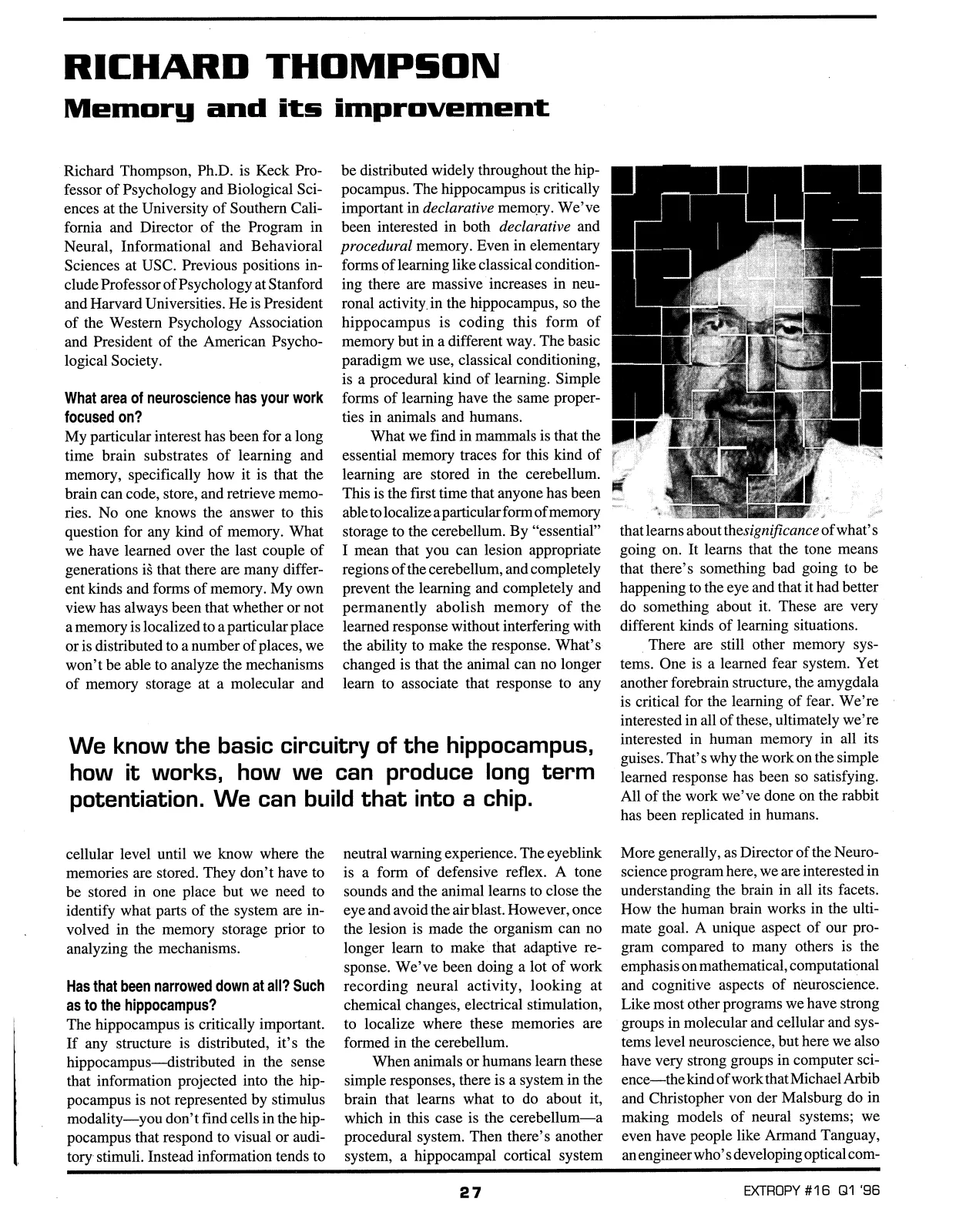
Richard Thompson, Ph.D. is Keck Professor of Psychology and Biological Sciences at the University of Southern California and Director of the Program in Neural, Informational and Behavioral Sciences at USC. Previous positions include Professor of Psychology at Stanford and Harvard Universities. He is President of the Western Psychology Association and President of the American Psychological Society.
What area of neuroscience has your work focused on?
My particular interest has been for a long time brain substrates of learning and memory, specifically how it is that the brain can code, store, and retrieve memories. No one knows the answer to this question for any kind of memory. What we have learned over the last couple of generations is that there are many different kinds and forms of memory. My own view has always been that whether or not a memory is localized to a particular place or is distributed to a number of places, we won’t be able to analyze the mechanisms of memory storage at a molecular and be distributed widely throughout the hippocampus. The hippocampus is critically important in declarative memory. We’ve been interested in both declarative and procedural memory. Even in elementary forms of learning like classical conditioning there are massive increases in neuronal activity in the hippocampus, so the hippocampus is coding this form of memory but in a different way. The basic paradigm we use, classical conditioning, is a procedural kind of learning. Simple forms of learning have the same properties in animals and humans.
What we find in mammals is that the essential memory traces for this kind of learning are stored in the cerebellum. This is the first time that anyone has been able to localize a particular form of memory storage to the cerebellum. By “essential” I mean that you can lesion appropriate regions of the cerebellum, and completely prevent the learning and completely and permanently abolish memory of the learned response without interfering with the ability to make the response. What’s changed is that the animal can no longer learn to associate that response to any cellular level until we know where the memories are stored. They don’t have to be stored in one place but we need to identify what parts of the system are involved in the memory storage prior to analyzing the mechanisms.
Has that been narrowed down at all? Such as to the hippocampus?
The hippocampus is critically important. If any structure is distributed, it’s the hippocampus—distributed in the sense that information projected into the hippocampus is not represented by stimulus modality—you don’t find cells in the hippocampus that respond to visual or auditory stimuli. Instead information tends to neutral warning experience. The eyeblink is a form of defensive reflex. A tone sounds and the animal learns to close the eye and avoid the air blast. However, once the lesion is made the organism can no longer learn to make that adaptive response. We’ve been doing a lot of work recording neural activity, looking at chemical changes, electrical stimulation, to localize where these memories are formed in the cerebellum.
When animals or humans learn these simple responses, there is a system in the brain that learns what to do about it, which in this case is the cerebellum—a procedural system. Then there’s another system, a hippocampal cortical system that learns about the significance of what’s going on. It learns that the tone means that there’s something bad going to be happening to the eye and that it had better do something about it. These are very different kinds of learning situations.
There are still other memory systems. One is a learned fear system. Yet another forebrain structure, the amygdala is critical for the learning of fear. We’re interested in all of these, ultimately we’re interested in human memory in all its guises. That’s why the work on the simple learned response has been so satisfying. All of the work we’ve done on the rabbit has been replicated in humans.
More generally, as Director of the Neuroscience program here, we are interested in understanding the brain in all its facets. How the human brain works in the ultimate goal. A unique aspect of our program compared to many others is the emphasis on mathematical, computational and cognitive aspects of neuroscience. Like most other programs we have strong groups in molecular and cellular and systems level neuroscience, but here we also have very strong groups in computer science—the kind of work that Michael Arbib and Christopher von der Malsburg do in making models of neural systems; we even have people like Armand Tanguay, an engineer who’s developing optical com-
Memory and its improvement
puting systems. In this building we have groups ranging everywhere from molecular neurobiology and cellular neurobiology through systems, cognitive and computational approaches to the study of the brain, and people even in areas like linguistics.
A significant part of the interest we have in our program relate to your field—philosophy, because we’re terribly interested in the fundamental problem of all time: What is the relation between brain and mind? It’s still a wide open question. I don’t mean we haven’t made progress. I think it’s safe to say that whatever the
What about vasopressin?
Yes, that’s interesting. We published a study looking at vasopressin’s effect on transmission. It enhances synaptic transmission. The animal literature says vasopressin does enhance memory, as do some of the hormones like norepinephrine. I say these are significant, but they’re not huge effects though statistically the animals are significantly better than without it. I doubt that we can do much better. Perhaps we can. Some people are developing drugs to modulate a certain receptor in the hippocampus. There’s animal evidence that those drugs may enhance
I see nothing conceptually different between a complex computer and a human mind. I see nothing in principle impossible about building a computer that has all the properties of a human brain, plus a better memory.
mind is, it’s an emergent property of the brain. Without the brain there is no mind. Beyond that—what that means—we don’t know.
The fundamental problem from a scientific point of view is to figure out methods of measuring the mind independent of behavior. The two approaches right now are to study behavior and the other is to record neural activity. We don’t have any memory performance as well.
There’s another approach that I think may eventually be possible. Not a drug approach but rather the approach of hooking up a brain to a computer. Ted Berger, Armand Tanguay, and I planned to do some research in that area, ultimately trying to attach computer chips to nerve cells. It’s been done a little bit with invertebrate nerve cells which are much stur-
I don’t see anything in principle impossible about it [reviving frozen brains]
other independent method for measuring mind. So it’s a still a problem because the introspectionist method is very unreliable.
There are just a few drugs that do improve memory performance significantly beyond normal performance. Two of those drugs, neither of which is recommended, are amphetamine and nicotine. Both do produce significant improvement in complex memory like declarative memory—both reasoning and memory, and perhaps attention.
dier than mammalian nerve cells. You can grow a few invertebrate neurons in a dish and they’re pretty tough, and you can grow them on a transistor grid and actually make functional connections between the neurons. This is purely speculation. We know the basic circuitry of the hippocampus, how it works, how we can produce long term potentiation. We can build that into a chip. What if someone’s hippocampus is damaged to the point where they are having memory problems. Couldn’t we eventually develop a chip-like hippocampus that we can implant into the human brain to substitute for the damaged tissue. It’s not inconceivable because you can activate nerve cells very easily by electrical stimulation. So if you have single axons on single connectors on a transistor in the right circumstances, you can activate individual neurons. I say easily but it’s not practically possible to do it now but it’s certainly conceptually possible. And of course you get into the possibility that we could plug a brain right into a huge computer.
I see nothing conceptually different between a complex computer and a human mind. It’s materialist view, but so far no one has come up with any reason to doubt it… I see nothing in principle impossible about building a computer that has all the properties of a human brain, plus a better memory!
You can freeze sperm right? They are perfectly viable after X years. There are a lot of technical problems, such as with crystallization, for example. But I don’t see anything in principle impossible about it… We do think that long term memories ultimately must have a structural basis in terms of changes in actual structures of synapses.
There are two areas: the ends of neuroscience. One end is the molecular, cellular aspects which get down to the changes in the genome. It’s increasingly clear that if you’re going to have structural changes in synapses to code memories, that requires changes in gene expression and that involves the whole cascade of molecular machinery inside the nerve cell which produces the structural substrate of these long term memories.
The other end is computational cognitive neuroscience which involves everything from PET scanning and brain imaging to developing computer models of the brain to eventually developing pieces of brain-like chips that can be stuck in brains. Those are the two areas in which I think the next level of advance will be made.
RICHARD LEAHY
Imaging the Brain
USC, Professor, Electrical Engineering—Systems.
You work on imaging brain function. What methods are used for imaging the brain?
There are two basic types of imaging systems: Anatomical imaging systems, and functional imaging systems. X-ray, CT, CAT scans, are anatomical imaging systems, which produce images of soft tissue and bone, and won’t tell you what the body is doing. You can scan a cadaver or a live person and they look much the same. Standard magnetic resonance imaging (MRI) is similar in that it produces images of anatomy. It images hydrogen nuclei and the molecules they are connected to.
The more interesting modalities are the functional ones. Of those the best is
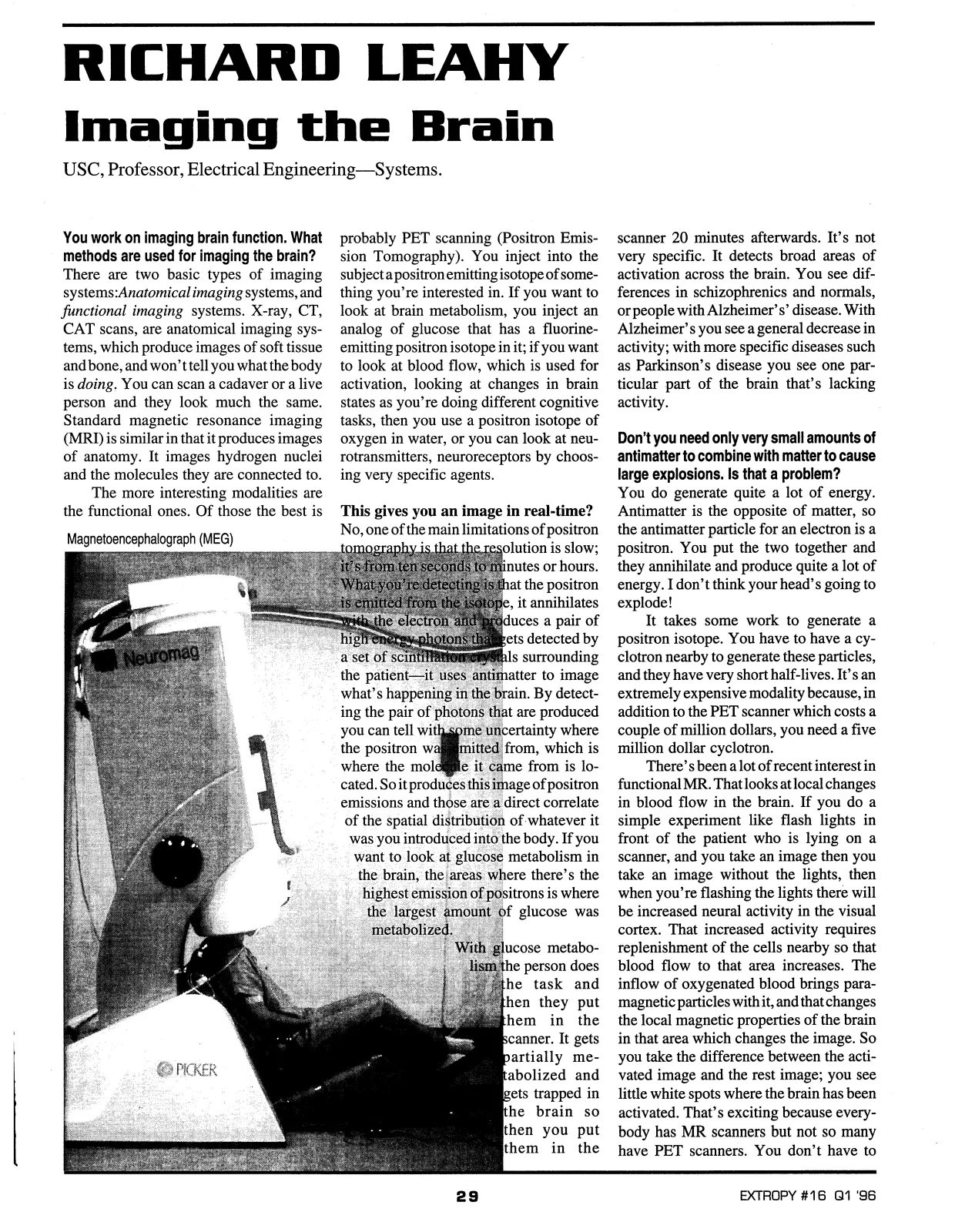
Magnetoencephalograph (MEG)
probably PET scanning (Positron Emission Tomography). You inject into the subject a positron emitting isotope of something you’re interested in. If you want to look at brain metabolism, you inject an analog of glucose that has a fluorine-emitting positron isotope in it; if you want to look at blood flow, which is used for activation, looking at changes in brain states as you’re doing different cognitive tasks, then you use a positron isotope of oxygen in water, or you can look at neurotransmitters, neuroreceptors by choosing very specific agents.
This gives you an image in real-time?
No, one of the main limitations of positron tomography is that the resolution is slow; it’s from ten seconds to minutes or hours. What you’re detecting is that the positron is emitted from the isotope, it annihilates with the electron and produces a pair of high energy photons that gets detected by a set of scintillation crystals surrounding the patient—it uses antimatter to image what’s happening in the brain. By detecting the pair of photons that are produced you can tell with some uncertainty where the positron was emitted from, which is where the molecule it came from is located. So it produces this image of positron emissions and those are a direct correlate of the spatial distribution of whatever it was you introduced into the body. If you want to look at glucose metabolism in the brain, the areas where there’s the highest emission of positrons is where the largest amount of glucose was metabolized.
With glucose metabolism the person does the task and then they put them in the scanner. It gets partially metabolized and gets trapped in the brain so then you put them in the scanner 20 minutes afterwards. It’s not very specific. It detects broad areas of activation across the brain. You see differences in schizophrenics and normals, or people with Alzheimer’s disease. With Alzheimer’s you see a general decrease in activity; with more specific diseases such as Parkinson’s disease you see one particular part of the brain that’s lacking activity.
Don’t you need only very small amounts of antimatter to combine with matter to cause large explosions. Is that a problem?
You do generate quite a lot of energy. Antimatter is the opposite of matter, so the antimatter particle for an electron is a positron. You put the two together and they annihilate and produce quite a lot of energy. I don’t think your head’s going to explode!
It takes some work to generate a positron isotope. You have to have a cyclotron nearby to generate these particles, and they have very short half-lives. It’s an extremely expensive modality because, in addition to the PET scanner which costs a couple of million dollars, you need a five million dollar cyclotron.
There’s been a lot of recent interest in functional MR. That looks at local changes in blood flow in the brain. If you do a simple experiment like flash lights in front of the patient who is lying on a scanner, and you take an image then you take an image without the lights, then when you’re flashing the lights there will be increased neural activity in the visual cortex. That increased activity requires replenishment of the cells nearby so that blood flow to that area increases. The inflow of oxygenated blood brings paramagnetic particles with it, and that changes the local magnetic properties of the brain in that area which changes the image. So you take the difference between the activated image and the rest image; you see little white spots where the brain has been activated. That’s exciting because everybody has MR scanners but not so many have PET scanners. You don’t have to inject radioactive material into people to find out what they are thinking about.
What prospects are there for doing real time scanning?
With positron tomography it’s impossible. You’re imaging individual photons or pairs of photons, and one photon tells you next to nothing. You have to collect on the order of at least a couple of hundred thousand for a two-dimensional image. There’s a physical limit to the rate at which the machine can count. It’s not the radiation dose that limits, it’s the machine itself.
For magnetic resonance imaging, where you can look at local blood flow, you don’t have that limit. You can do fast scanning. With the newer systems you can collect 20 frames per second. But you’re looking at changes in blood flow and that has its own time constant, on the order of not more than a second. So it’s the physiological process that’s limiting you there.
There’s only one modality that allows you look at the brain at the rate at which it functions, and that’s magnetoencephalography (MEG), which is what I work on. This uses the magnetic fields of the brain. You have an array of magnetometers around the brain. They consist of a pair of coils with a Josephson Junction on the end. You need a pair of coils because if you just had a single coil all you’d measure would be the Earth’s magnetic field, which is massive—about seven orders of magnitude than any field that comes from your head. You monitor around a thousand samples a second in each of these magnetometers. The biggest system that has been built so far has 122 magnetometers.
The sources are assumed to be the pyramidal cells in the cortex, specifically the current flow in the dendrites. You have synchronous or near synchronous activation of several thousand neurons together. This produces magnetic flux that cuts each of these coils and that produces a signal that you measure at the outputs for these devices. You use Maxwell’s equations to give you the relationship between the source and the measurements.
You can combine this with EEG. You can put electrodes on the scalp and simultaneously measure the EEG signal. You need to average about a hundred of these for a typical stimulus, like a tone played in the ear. At most you put on 128 electrodes. They take a long time to put on! The nice thing about MEG is that you just sit with your head inside a gantry.
Yes. The resolution of functional MR studies will probably improve. It’s still improving. There are no well worked out theoretical limits. In positron tomography you’re fundamentally limited by the fact that it had been used in chemistry for about 30 years before they figured out you could image with it. In hindsight it’s obvious. There may well be some other technique out there that hasn’t been considered.
One of the limitations is whether you’re dealing with a passive or an active system. One of the problems of MEG is that it’s entirely passive: it’s just measuring the fields that you produce outside that what you’re measuring is the point of the annihilation of the positron and electron. The positron gets emitted from the nucleus and travels up to a couple of millimeters before it annihilates with an electron. So, no matter what you do, you can never get resolution beyond that couple of millimeters.
MR doesn’t have that fundamental limitation. There are some systems built to scan little animals. They have high field magnets with a small bore that can give you ten-of-microns resolution. In principle you can get that same tens-of-microns resolution in a human scanner, but you might get such huge fields that it’s not feasible. A lot of it’s the engineering to build machines with high enough and clean fields with nice linear gradients.
With current systems, you’re looking at activation of around ten thousand neurons. The most sensitive techniques use a positron isotope of carbon on some relation of dopamine. That can show you very low levels of chemical activity. You can do that because with positron tomography each event is a single molecule or a single nucleus giving off a positron. You can do that with a couple of hundred thousand molecules and get in image in two dimensions. That’s many orders of magnitude finer than you’re looking at with magnetic resonance. You’re fundamentally limited by noise considerations.
It depends how invasive you want to get. You can record a single neuron if you want to stick a micron probe in there. I’ve spend a lot of time trying to get high spatial resolution. My gut feeling is that there’s got to be some undiscovered method because, until it came along, MR was unknown and in retrospect, given your head through what’s happening in this very complex three-dimensional volume. PET and MR get around that by selecting a specific part of the brain and encoding something on to that so you’re only looking at that part of the brain. Those active techniques are able to do something that you can’t do with a passive system. With MR you can only look at a certain part of the brain at a time, though that’s improving. With PET you look at the whole brain, but the resolution is limited. In both cases you’re looking at analogs of neural activity rather than the activity itself. You’re looking at glucose metabolism, which occurs over a timescale of minutes, or blood flow over a timescale of seconds. What you want to look at activity on the millisecond timescale. MEG is the only modality that but it doesn’t let you image. Maybe the future is to combine the relative attributes of both, so you get good spatial resolution from one and good temporal resolution from the other.
Yes. You’d have to slice it up and put it under a microscope. It would take up a lot of space. The closest thing to that for the whole body is this Adam and Eve project. They took a male and female cadaver, microtomed them and frozen them, enclosed them in cellulite. They chopped off half a millimeter at a time, photographed it, and scanned that into a computer to make a 3D image of the body. The results are on the Web. It’s gigabytes of data.*
*[This is the Visible Human Project. See: http://www.nlm.nih.gov —ed.]
BART KOSKO: Fuzzy Logic & Neural Nets
Prof. Electrical Engineering, USC
Q: What is the focus of your current research?
A: My research focuses on how nonlinear systems learn. Most math models in science are linear models or linearized models even though no one has found a truly linear process in nature. Nonlinear math models have more power and accuracy but have few closed-form properties or guarantees of stability or convergence.
The truth is the space shuttle runs as much on computer simulation as it does on formal models of space mechanics.
Neural and fuzzy systems are tools that let us model nonlinear systems without having to guess at their exact mathematical form. No one knows the equations that govern single-lane platoons of smart cars that drive 70 mph over curves and bumps. Neural and fuzzy systems can approximate these systems with finer and finer accuracy as test data and expert advice come in. They learn in the sense that the test data tunes their parameters. The data may change the synaptic weights in a neural network or change the size or structure of a rule in a fuzzy approximator.
I am working with students and colleagues on applying these tools to a wide range of problems in signal processing, control, and multimedia systems. These applications range from image compression and motion estimation in film to smart-car control and the design of neural-fuzzy intelligent agents. Meanwhile I always keep working on a few purely abstract math problems but like to keep them private until the theorems fall in line.
Q: In what ways do the kinds of neural networks you use differ from actual biological brain function, and in what ways are they the same? What practical significance is there to such similarities and differences?
A: There are four broad types of neural lems but they were just that and researched interest soon waned. Someday research interest will surely return to this no-man’s land of nonlinear feedback dynamical systems.
The most popular neural models are supervised and feedforward. A godlike teacher has to tell each neuron or synapses how well it helped or hurt some global payoff measure of error or cost. Signals flow from left to right in the feedforward net. So the teacher passes the error data backward from right to left to adjust all the parameters and may have to do this hundreds of thousands of times for a data set. These nets have real power in terms of
There is little evidence for supervised learning in flesh. That would be like you not making a move until you saw what effect you had on the gross domestic product or the interest rate of your country.
models based on how they learn and the structure of the synaptic connection topology. Learning is unsupervised or supervised. The topology is feedforward or feedback (with closed loops).
Biological neural nets are largely unsupervised feedback neural networks. These tend to occur deeper in the cortex and away from direct sensory input. I developed a large family of unsupervised feedback models in this area called RABAMS or random adaptive bidirectional associative memories. These models can learn new patterns while they display and recall old ones. That means their synapses and neurons can both change at the same time though on different time scales. Synaptic changes are slow and neuronal changes are fast. Real nerve nets certainly have this property. RABAMs can also operate in the presence of a great deal of noise or “unmodeled effects” and they give back as a special case many popular feedback neural models: Hopfield circuits, adaptive resonance theory (ART) nets, simulated annealing or “genetic algorithm” nets, and others. The trouble is no one has figured out how to get such feedback neural nets to do anything of real practical interest. A decade ago researchers put forth some tantalizing toy problearning complex boundaries between cancerous and non-cancerous pap smears or between bomblike and non-bomblike x-ray scans. But they cannot explain themselves. And like real brains they forget some of what they have learned each time they learn a new pattern and you never know which patterns they have forgotten.
My own work does not use a neural architecture for feedforward supervised learning. I use a feedforward fuzzy system instead. It contains a set of fuzzy if-then rules instead of a web of neurons and synapses. I have derived like supervised learning laws to tune the rules for the fuzzy sets that make up the rules. The fuzzy system learns a mapping from input to output as does the neural net. Both are in theory universal approximators. But the rules act as units of compression and are modular. You can “open” the fuzzy black box and take out rules or put them in and test to see which ones are most or least important. But this can come at a high price of too many rules. A neural net might get by with far fewer neurons for the same problem. You don’t know in advance.
The next most popular neural nets are unsupervised feedforward nets. These nets strike a nice balance between mathematical tractability and biological accuracy. Much of early vision uses feedforward layers of competing neurons. Each neuron competes with its neighbors for the incoming activation. The more it gets the more it increases its own firing strength and decreases that of its neighbors. The net acts much like a board full of lightbulbs that light up to varying degrees and then one light bulb wins and turns on 100% and the other turn off 100%. Competitive learning means that only the synapses of the winning neuron change to encode the incoming pattern. The new pattern does not affect the other neurons or their synapses and so they still remember what they have learned in the past. The winner forgets its old pattern in favor of the new one. This is just ‘blind clustering’ at the math level as are most unsupervised learning schemes.
Here is one way to think about the difference between unsupervised and supervised learning. Consider the Frankenstein monster coming to life at an international airport such as LAX. The monster hears many voices in many languages. The first thing it does is associate like with like. It clusters English with English and Spanish with Spanish and so on. The more speech it hears the better it gets at forming the pattern clusters. The striking thing is that no one tells the monster how to do it. The monster just matches features in some way.
Now suppose Dr. Frankenstein shows up. He can tell the monster whether a given speech sample is English or not or Spanish or not and so forth. He supervised the learning and compares the real pattern class to what the monster says or thinks it is to form the error signal. Frankenstein punishes misclassifications and rewards (or does not punish) correct classifications. Such supervised learning is powerful but good teachers are hard to come by.
There is little evidence for supervised learning in flesh. That is why most neural algorithms have only metaphorical connection to real mammalian brains. Supervised learning would require the body to somehow compute an error signal each second and feed that back to perhaps trillions of learning units. It may happen on a small scale in matters of coordination but certainly not at the large-scale brain level. That would be like you not making a move until you saw what effect you had on the gross domestic product or the interest rate of your country.
I have worked with unsupervised nets both with neural systems and with fuzzy systems. In 1985 I introduced something called differential Hebbian learning in contrast to correlation or Hebbian learning. The old idea of Donald Hebb from 1949 (or Friedrich Hayek from a year or two before in his book The Sensory Order) is that the synapses between neuron A and neuron B grows or decays according to the joint activity at A and B. Most mathematicians have understood this to mean that you multiply A and B to get the learning product AB.
I had a problem with that. I started out modeling the link from A to B not as a synapse but as a causal link in a semantic network or cognitive map. This puts the learning question in the context of causal induction in philosophy. Then Donald don’t just want the winning neuron to learn in a neural slug out. But you want to weight it by its rate of learning. So the synapses change or learn only if the competing neuron changes its win-loss status. This gives a type of pseudo-error signal to the learning process. The plus or minus value of the win rate acts like Dr. Frankenstein saying ‘Yes’ or ‘No.’ We benchmarked the DCL scheme against both unsupervised and supervised competitive learning and found that it always held its own and often did better than its supervised rivals—even though it used less information. I know of no evidence for DCL at the biological level. Such is the tradeoff between engineering utility and biological accuracy.
In my work I have used unsupervised
Hebb looks like David Hume who said that causality was just a ‘constant conjunction of events’ or AB. I thought John Stuart Mill had gotten it right in his Logic in the 1840s with his notion of ‘concomitant variation.’ You don’t infer a causal link between my arm and the light being on just because both are present. Rather you tend to infer cause and effect if the light goes off and on as my hand moves up and down. So I replaced the Hebb product AB with the product of time changes.
Only much later did I explore the effect of this at the neural level. Meanwhile other researchers did and have put forth some interesting evidence for it. Gluck and Parker at Stanford showed that if you modeled neural signals as pulses then the differential Hebbian model gives back a simple form. So the synapse does not have to compute a change. The presence or absence of the arriving neural pulse shows whether that change is positive or negative. In engineering we call this a form of delta-modulation. Graeme Mitchison of Cambridge has also argued for some form of this ‘differential synapse’ at the biological level.
In 1988 I realized I could apply the new differential idea to competitive learning as well. That lead to the unsupervised scheme that I call differential competitive learning or DCL. The idea is that you competitive learning schemes (including DCL) to grow the first set of fuzzy rules in a fuzzy system. The idea is that each competing neuron gives rise to a competing list or vector of synapses. In the big state space in the sky this vector forms a point. The system learns when the synapses change and thus when the point moves. But it tends to move in fits and starts and jumps and leaps. So there is an error ball or ‘covariance ellipsoid’ about each synaptic vector. These balls define the big fuzzy subsets or patches of the input-output state space that in turn define a fuzzy if-then rule of the form. ‘If the input is the fuzzy set A then the output is the fuzzy set B.’ Noisy or sparse training data leads to a big error ball and thus a large and uncertain fuzzy rule. More accurate data tends to give a smaller error ball and fuzzy rule patch.
My students and I have long since found that we can combine unsupervised and supervised learning to improve a fuzzy or neural system. First the unsupervised learning looks at the stream of sample data and clusters it to form the first set of rules. This is a hard task and often there is no expert to do it. We had this experience when we searched for rules to control the throttle and braking subsystems of continued on p.40
VIEW ORIGINAL SCAN (15 pages)