Issue: EXTROPY #16 · First Quarter 1996
Author: Dr. Ray Sahelian
Pages: 40–45 · 6 scanned pages
Bio-Enhancement Update: Melatonin, Part 2
Bio-Enhancement Update
Ray Sahelian, M.D.
The melatonin article from the last issue was quite timely. Over the last few weeks we have seen an unprecedented coverage of melatonin in the news including hundreds of articles in magazines and newspapers, along with local and national radio and television segments. The August 7th
What about negative feedback?
Dr. Rioux continues: “Is it possible that in taking the supplement long-term one may inadvertently send a negative feedback to the pineal gland so that it would produce
MELATONIN part 2
Dreams like you’ve never dreamed
Melatonin is a tryptamine, chemically similar to DMT and other potent hallucinogens. Many users of melatonin have noticed that their dreams are incredibly vivid. Is melatonin our “dream molecule”?
Newsweek article was mostly responsible for accelerating the melatonin mania. It quotes me as saying “This will eventually make prescription sleeping pills all but obsolete.”
Quite a few readers contacted me with questions regarding the use of this supplement. Dr. Pierre Rioux from Minot, North Dakota, asks:
How much melatonin is absorbed?
When melatonin is swallowed in tablet or capsule form, it is easily absorbed from the stomach or intestines and subsequently is metabolized by the liver. Only a portion of the ingested melatonin eventually makes it to the bloodstream. In one study volunteers were given 80 mg of melatonin and then had their blood levels checked. There was a 300 fold variation in the amount of melatonin present in their blood. This shows the uniqueness of each person’s absorption and metabolism. (Waldhauser F, Sleep laboratory investigations on hypnotic properties of melatonin. Psychopharmacology 100:222-6, 1990.)
The sublingual form of melatonin is more consistently effective since the absorbed melatonin from the oral mucosa goes directly into the bloodstream without having to initially be metabolized by the liver. A lower dose from a sublingual is often as effective as a higher dose from a pill.
even less melatonin, resulting in a person then becoming completely dependent on exogenous melatonin?”
A reliable way to find the answer to this question is by giving humans melatonin supplements for a long period, such as a year or two and them remove the pineal gland to analyze it under the microscope and see how healthy it is. This study, for obvious reasons, is not likely to be done. Another way of finding out is again supplementing for a long period, stopping the melatonin, and testing the amount of melatonin present in the blood stream the subsequent nights. To my knowledge, this study has also not been done.
However, we do have plenty of anecdotal evidence that does not indicate any clinical problems with discontinuation of chronic melatonin use. A number of my patients and people I have surveyed who stopped regular use of melatonin after a period of months subsequently kept sleeping well without any signs of withdrawal. The abrupt discontinuation of most pharmaceutical sleeping pills does lead to withdrawal.
Rats injected with melatonin every day showed reduction in pineal calcium concentrations and appeared to have healthier glands. Is it even possible that taking exogenous melatonin could keep our pineal glands in tip top shape? (Puigdevall V, Hypothalamic and pineal concentrations of magnesium and calcium after a sustained
AND
SETS
NO LIMITS
EXPAND YOUR MIND’S LIMITS
COGNITIVE ENHANCEMENT
ACETYL-L-CARNITINE 60 caps 500 mg. $49.95
MEMORY BOOST 180 caps $17.95
GINKGO BILOBA 90 caps 60 mg. $17.95
EXTENSION I.Q. 90 caps $15.95
MELATONIN 60 caps 3 mg. $9.00
VITAMIN RESEARCH PRODUCTS, INC.
1-800-877-2447 http://www.connectus.com/~vrp/
25% DISCOUNT ON ALL FIRST ORDERS, CALL FOR A FREE CATALOG.
VITAMIN RESEARCH PRODUCTS, INC. • 3579 HWY 50 E, CARSON CITY, NV 89701 • (702) 884-1300 administration of melatonin. J Endocrinol Invest 16 (Suppl 1 to no. 8):253, 1993.)
Vivid Dreams
Gary Miracle, a chemistry student from the University of Wisconsin, points out that melatonin is a tryptamine, chemically similar to DMT (dimethyltryptamine) and other potent hallucinogens. Many users of melatonin have noticed that their dreams are more memorable. Is there a connection?
I was riding a gigantic elephant through a thick jungle in India with vines crisscrossing from tree to tree above my head. We soon reached a clearing where there appeared a pond. The elephant continued on its steady march, its thick feet and legs wading through the shallow waters. There was something unusual about the bottom of the pond. It glittered… the glitter of priceless gems—of sapphires, rubies, and diamonds. A canoe filled with cut flowers slowly passed to my right. It had four posts holding a wooden plank that seemed to support a corpse. It passed silently, no one besides the corpse was on board. Strange…
The actual chemical name of melatonin is 5-methoxy-N-acetyl-tryptamine. Tryptamines are compounds found abun-
Vivid dreams are common with melatonin use. After experiencing more intense dreams myself, and finding out through my surveys that others had experienced the same, I became extremely curious. Throughout ages humankind has been seeking to find out about the nature of dreams and what causes them. Various metaphysical explanations have been proposed. Could the answer simply be melatonin? I strove to learn more about the chemistry of melatonin. This is what I’ve learned and wish to propose as an explanation for the chemicals responsible for dreams.
dantly in certain hallucinogenic tropical plants. In South America, amazonian natives use a form of tryptamine called DMT, (N,N-dimethyl-tryptamine), to induce an intense hallucinogenic experience. Some amazonian shamans use DMT and related hallucinogens for healing purposes and spiritual connections.
When melatonin is metabolized in the pineal gland, it is converted to 5-methoxy-tryptamine. When rats are given melatonin or 5-methoxy-tryptamine, they spend more time in REM sleep, the stage of sleep associated with dreams. It makes
Lifeline 445 Lierly Lane Arroyo Grande, CA 93420
Melatonin: (mel-a-toe-nin) n. 1. The principal hormone produced by the pineal gland. 2. Scientists say melatonin can boost the immune system, prevent cancer, ease insomnia, protect cells from free radical damage, reset the body’s aging clock and extend life.
3mg x 120 tablets…$13.00
3mg x 240 tablets…$25.00
DHEA: dehydroepiandrosterone (dee-hi-dro-epp-ee-an-dro-ster-own) n. 1. A naturally occurring steroid precursor produced by the adrenal gland and found in plasma levels and brain tissue. 2. Production rises dramatically during puberty but wanes as we age. 3. Is used by the body to make the sex hormones estrogen and testerone. 4. Increases our ability to cope with stress, decreases joint pain and improves mood.
25mg x 90 capsules…$22.00
25mg x 180 capsules…$40.00
25mg x 360 capsules…$75.00
Extropy subscribers receive a 20% discount
Orders must be prepaid ($5.00 S & H).
Phone: 805.473.1389, Fax: 805.473.2803, e-mail: delano@dax.win.net.
sense that melatonin, 5-methoxytryptamine or related tryptamines are involved with dreams. Are there more chemicals involved? We don’t know all the answers yet.
We’ve always thought that hallucinogens were substances foreign to the brain. It is interesting to note that we can synthesize natural hallucinogens during sleep; they are a normal part of our brain chemistry. Moreover, our brain does not seem to develop a tolerance to these tryptamine hallucinogens since we dream every night, whether we remember the dreams or not.
In order to find out whether anyone else had come up with the proposition that tryptamines were involved with dreams, I placed a question on the internet. Two days later I got a message from J.C. Callaway, Ph.D., from the University of Kuopio, Finland. He referred me to an article he had published in Medical Hypothesis titled “A proposed mechanism for the visions of dream sleep.” (26:119-124, 1988.) Dr. Callaway suggests tryptamines and related compounds are the chemicals responsible for dreams and his article gives a detailed explanation.
Throughout my surveys I found that slightly over half of respondents had experienced vivid dreams. The higher the melatonin dose, the more likely the possibility. David, a 35 year old, says, “I’ve been taking melatonin 3 mg for about five months—not every night, but perhaps 4 nights a week. I tend not to dream. Recently I tried 6 mg and noticed that I do have dreams on this dose.”
In my surveys, about 8% of people taking melatonin reported eventually having had a very bad dream, or nightmare. Melatonin accentuates dreams. If an individual’s dreams are usually pleasant, they will continue being pleasant, but more intensely. If dreams are normally unpleasant, then it is possible they will be more unpleasant with melatonin use. Pam, a 21 year old student writes, “I took 3 mg of melatonin. It worked quite fast and I slept fairly soundly except after an awful nightmare. From then on my sleep was restless and I kept waking up. This was the second time I had taken melatonin. The first time I had one particularly vivid dream, and it was okay.”
In order to reduce the likelihood of unpleasant dreams, develop a positive attitude and good self-esteem. Steer away from negative brain input such as violent TV shows or horror movies. Nurture a loving connection with people, nature, and animals. For a detailed approach to mood improvement and enhancing quality of life, thus more pleasant dreams, please refer to my book Be Happier Starting Now.
If you need to take melatonin for a sleep disorder but do not wish to have vivid dreams or nightmares, take as little a dose as necessary. Low doses, such as 0.5 mg, are less likely to intensify dreams.
Whether you believe that dreams have meaning or are due to random firing of neurons, or both (sleep researchers are still not in total agreement on this issue), it can be fun to recall these vivid dreams and write them down in a diary soon upon awakening. Even if you can’t find meaning in them, they can always be interesting conversational pieces over the breakfast table.
Don’t Blame the Burrito.
Every evening, after a long day in the office, I take a few mile walk by the ocean and streets of Marina Del Rey and Venice to release unused physical energy. On one of these recent walks, while passing by a Mexican restaurant, I got an incredible craving for a vegetarian burrito. After quickly downing one, I ordered a second, and since my mouth was dry, I went against my custom and ordered a small cola. I hadn’t drank a coke for a long time and I truly enjoyed the slow sips. Against my better judgment I ordered a refill.
That night I went to bed at my usual hour, midnight. Twenty minutes later, I was still awake. I got out of bed and turned on the TV. Not much was on except some Psychic Network enticements promising an accurate prediction of my upcoming love life and an infomercial that guaranteed an income of $8,000 a month from simply placing small classified ads in the backs of newspapers. Thinking to myself, “There’s got to be a better way I can nurture my neurons,” I picked up a recent article from Neuropsychopharmacology.
“Caffeine reduces Low-Frequency Delta Activity in the Human Sleep EEG,” was the title of the article by Landolt and colleagues from the Institute of Pharmacology, University of Zurich, Switzerland. How appropriate! Actually, “Caffeine Stops Entry Into Stage I Sleep,” might have been a more accurate title for my case.
There are four major stages of sleep defined as stages I, II, III, and IV. Each stage is progressively deeper, with IV being the deepest, most restorative stage. In the above study, eight young males paid to participate in a study—probably poor college students who chose this time to spend a sleepless night in the laboratory to pay for needed pencils and paper rather than donating their last remaining pint of blood to the blood bank—were given a capsule of 100 mg of caffeine at bedtime. A regular cup of caffeine on average contains anywhere between 80 to 140 mg of caffeine. They were then thoroughly monitored including a detailed EEG (electroencephalogram).
When levels of caffeine were checked in their saliva an hour later, a concentration of 7.5 micromol/L was found which leads to a concentration in the cerebrospinal fluid of approximately 6 micromol/L. At this concentration, caffeine blocks A1 and A2 adenosine receptors.
Caffeine has long been known to be a stimulant that inhibits the onset of sleep. This study also confirmed that Delta sleep, an EEG recorded pattern that occurs during stages 3 and 4, was suppressed. The researchers propose that adenosine receptors may be involved in the regulation of sleep.
Seven hours after the administration of caffeine, the amount present in saliva had dropped to 3.5 micromol/L. But what was really interesting was that the following night, the volunteers, even though they did not receive any additional caffeine pills, took longer to fall asleep. Delta sleep was also reduced. The researchers speculate that there may have been some residual effects from the previous night’s caffeine administration.
Reading this article confirmed some of my suspicions. Quite a number of my patients over the years have informed me that they thought drinking coffee, even in the morning or early afternoon, was interfering with their sleep. I have noticed this in myself, too. I’m very sensitive to stimulants. For instance, even two mg of deprenyl taken in the morning can sometimes lead to insomnia. Keeping this in mind, I generally recommend those who take stimulants of any kind (tyrosine, phenylalanine, DMAE, ginseng, ginkgo, diet pills, ephedrine, etc.), and are prone cont. on p.65
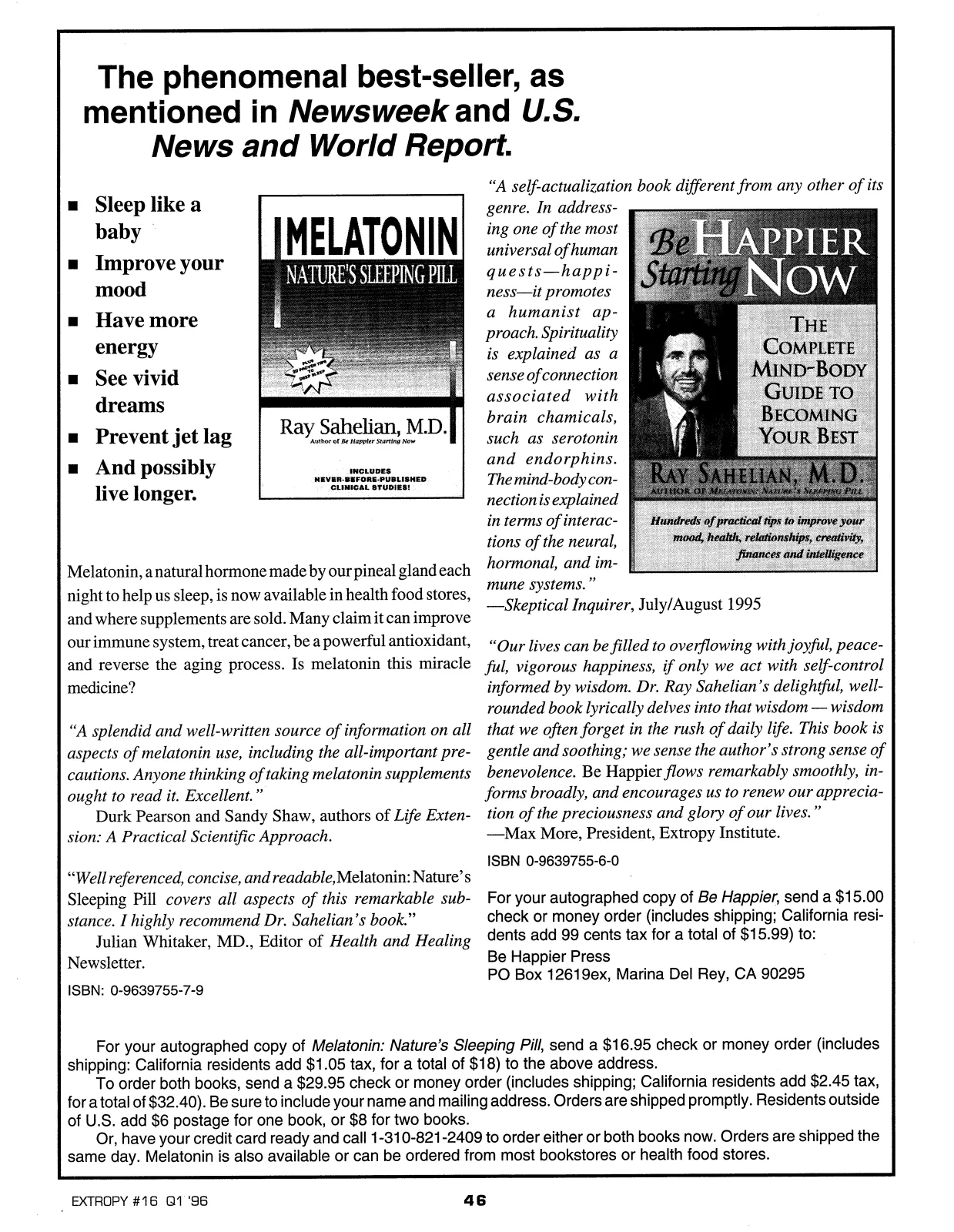
- Sleep like a baby
- Improve your mood
- Have more energy
- See vivid dreams
- Prevent jet lag
- And possibly live longer.
Melatonin, a natural hormone made by our pineal gland each night to help us sleep, is now available in health food stores, and where supplements are sold. Many claim it can improve our immune system, treat cancer, be a powerful antioxidant, and reverse the aging process. Is melatonin this miracle medicine?
“A splendid and well-written source of information on all aspects of melatonin use, including the all-important precautions. Anyone thinking of taking melatonin supplements ought to read it. Excellent.”
Durk Pearson and Sandy Shaw, authors of Life Extension: A Practical Scientific Approach.
“Well referenced, concise, and readable, Melatonin: Nature’s Sleeping Pill covers all aspects of this remarkable substance. I highly recommend Dr. Sahelian’s book.”
Julian Whitaker, MD., Editor of Health and Healing Newsletter.
ISBN: 0-9639755-7-9
“A self-actualization book different from any other of its genre. In addressing one of the most universal of human quests—happiness—it promotes a humanist approach. Spirituality is explained as a sense of connection associated with brain chemicals, such as serotonin and endorphins. The mind-body connection is explained in terms of interactions of the neural, hormonal, and immune systems.”
—Skeptical Inquirer, July/August 1995
“Our lives can be filled to overflowing with joyful, peaceful, vigorous happiness, if only we act with self-control informed by wisdom. Dr. Ray Sahelian’s delightful, well-rounded book lyrically delves into that wisdom — wisdom that we often forget in the rush of daily life. This book is gentle and soothing; we sense the author’s strong sense of benevolence. Be Happier flows remarkably smoothly, informs broadly, and encourages us to renew our appreciation of the preciousness and glory of our lives.”
—Max More, President, Extropy Institute.
ISBN 0-9639755-6-0
For your autographed copy of Be Happier, send a $15.00 check or money order (includes shipping; California residents add 99 cents tax for a total of $15.99) to:
Be Happier Press
PO Box 12619ex, Marina Del Rey, CA 90295
For your autographed copy of Melatonin: Nature’s Sleeping Pill, send a $16.95 check or money order (includes shipping; California residents add $1.05 tax, for a total of $18) to the above address.
To order both books, send a $29.95 check or money order (includes shipping; California residents add $2.45 tax, for a total of $32.40). Be sure to include your name and mailing address. Orders are shipped promptly. Residents outside of U.S. add $6 postage for one book, or $8 for two books.
Or, have your credit card ready and call 1-310-821-2409 to order either or both books now. Orders are shipped the same day. Melatonin is also available or can be ordered from most bookstores or health food stores.
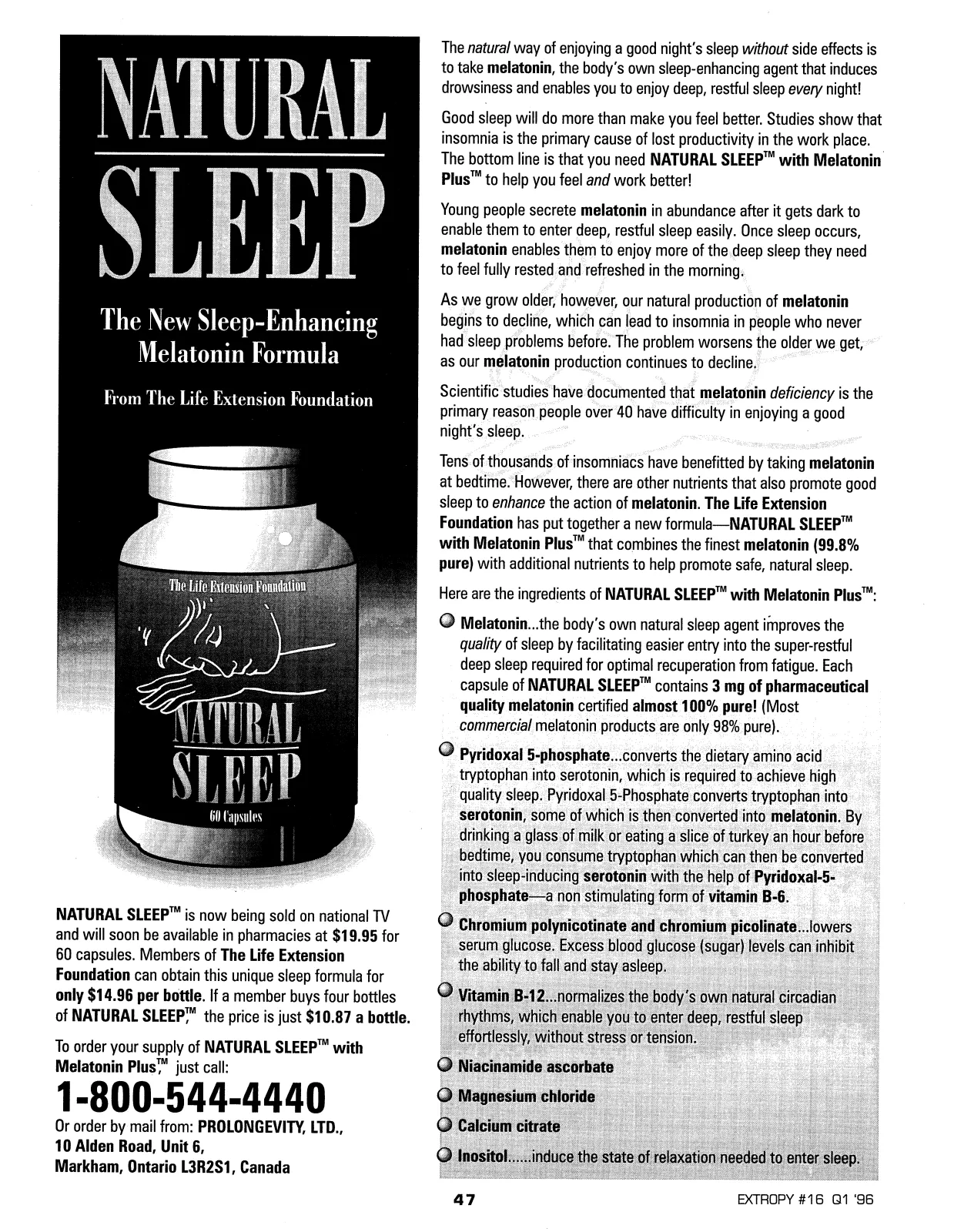
NATURAL SLEEP
The New Sleep-Enhancing Melatonin Formula
From The Life Extension Foundation
NATURAL SLEEP™ is now being sold on national TV and will soon be available in pharmacies at $19.95 for 60 capsules. Members of The Life Extension Foundation can obtain this unique sleep formula for only $14.96 per bottle. If a member buys four bottles of NATURAL SLEEP,™ the price is just $10.87 a bottle.
To order your supply of NATURAL SLEEP™ with Melatonin Plus,™ just call:
1-800-544-4440
Or order by mail from: PROLONGEVITY, LTD., 10 Alden Road, Unit 6, Markham, Ontario L3R2S1, Canada
The natural way of enjoying a good night’s sleep without side effects is to take melatonin, the body’s own sleep-enhancing agent that induces drowsiness and enables you to enjoy deep, restful sleep every night!
Good sleep will do more than make you feel better. Studies show that insomnia is the primary cause of lost productivity in the work place. The bottom line is that you need NATURAL SLEEP™ with Melatonin Plus™ to help you feel and work better!
Young people secrete melatonin in abundance after it gets dark to enable them to enter deep, restful sleep easily. Once sleep occurs, melatonin enables them to enjoy more of the deep sleep they need to feel fully rested and refreshed in the morning.
As we grow older, however, our natural production of melatonin begins to decline, which can lead to insomnia in people who never had sleep problems before. The problem worsens the older we get, as our melatonin production continues to decline.
Scientific studies have documented that melatonin deficiency is the primary reason people over 40 have difficulty in enjoying a good night’s sleep.
Tens of thousands of insomniacs have benefitted by taking melatonin at bedtime. However, there are other nutrients that also promote good sleep to enhance the action of melatonin. The Life Extension Foundation has put together a new formula—NATURAL SLEEP™ with Melatonin Plus™ that combines the finest melatonin (99.8% pure) with additional nutrients to help promote safe, natural sleep.
Here are the ingredients of NATURAL SLEEP™ with Melatonin Plus™:
Melatonin…the body’s own natural sleep agent improves the quality of sleep by facilitating easier entry into the super-restful deep sleep required for optimal recuperation from fatigue. Each capsule of NATURAL SLEEP™ contains 3 mg of pharmaceutical quality melatonin certified almost 100% pure! (Most commercial melatonin products are only 98% pure). Pyridoxal 5-phosphate…converts the dietary amino acid tryptophan into serotonin, which is required to achieve high quality sleep. Pyridoxal 5-Phosphate converts tryptophan into serotonin, some of which is then converted into melatonin. By drinking a glass of milk or eating a slice of turkey an hour before bedtime, you consume tryptophan which can then be converted into sleep-inducing serotonin with the help of Pyridoxal-5-phosphate—a non stimulating form of vitamin B-6. Chromium polynicotinate and chromium picolinate…lowers serum glucose. Excess blood glucose (sugar) levels can inhibit the ability to fall and stay asleep. Vitamin B-12…normalizes the body’s own natural circadian rhythms, which enable you to enter deep, restful sleep effortlessly, without stress or tension. Niacinamide ascorbate Magnesium chloride Calcium citrate Inositol…induce the state of relaxation needed to enter sleep.
VIEW ORIGINAL SCAN (6 pages)