Issue: EXTROPY #15 · 2nd/3rd Quarter 1995
Author: The Editors
Pages: 46–48 · 3 scanned pages
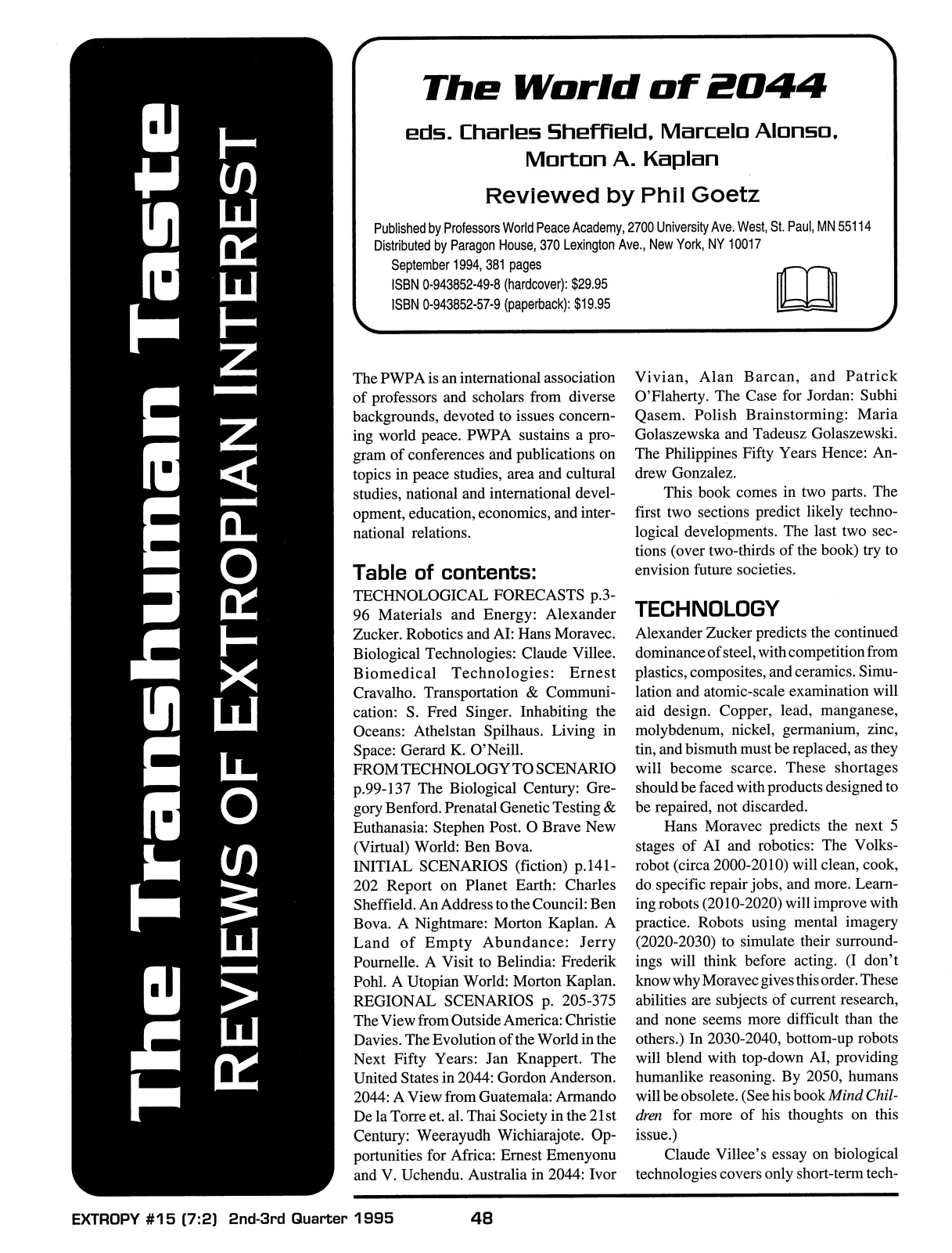
The Transhuman Taste: The World of 2044
The Transhuman Taste
REVIEWS OF EXTROPIAN INTEREST
The World of 2044
eds. Charles Sheffield, Marcelo Alonso, Morton A. Kaplan
Reviewed by Phil Goetz
Published by Professors World Peace Academy, 2700 University Ave. West, St. Paul, MN 55114 Distributed by Paragon House, 370 Lexington Ave., New York, NY 10017
September 1994, 381 pages
ISBN 0-943852-49-8 (hardcover): $29.95
ISBN 0-943852-57-9 (paperback): $19.95
The PWPA is an international association of professors and scholars from diverse backgrounds, devoted to issues concerning world peace. PWPA sustains a program of conferences and publications on topics in peace studies, area and cultural studies, national and international development, education, economics, and international relations.
Table of contents:
TECHNOLOGICAL FORECASTS p.3-96 Materials and Energy: Alexander Zucker. Robotics and AI: Hans Moravec. Biological Technologies: Claude Villee. Biomedical Technologies: Ernest Cravalho. Transportation & Communication: S. Fred Singer. Inhabiting the Oceans: Athelstan Spilhaus. Living in Space: Gerard K. O’Neill.
FROM TECHNOLOGY TO SCENARIO p.99-137 The Biological Century: Gregory Benford. Prenatal Genetic Testing & Euthanasia: Stephen Post. O Brave New (Virtual) World: Ben Bova.
INITIAL SCENARIOS (fiction) p.141-202 Report on Planet Earth: Charles Sheffield. An Address to the Council: Ben Bova. A Nightmare: Morton Kaplan. A Land of Empty Abundance: Jerry Pournelle. A Visit to Belindia: Frederik Pohl. A Utopian World: Morton Kaplan. REGIONAL SCENARIOS p. 205-375 The View from Outside America: Christie Davies. The Evolution of the World in the Next Fifty Years: Jan Knappert. The United States in 2044: Gordon Anderson. 2044: A View from Guatemala: Armando De la Torre et. al. Thai Society in the 21st Century: Weerayudh Wichiarajote. Opportunities for Africa: Ernest Emenyonu and V. Uchendu. Australia in 2044: Ivor
Vivian, Alan Barcan, and Patrick O’Flaherty. The Case for Jordan: Subhi Qasem. Polish Brainstorming: Maria Golaszewska and Tadeusz Golaszewski. The Philippines Fifty Years Hence: Andrew Gonzalez.
This book comes in two parts. The first two sections predict likely technological developments. The last two sections (over two-thirds of the book) try to envision future societies.
TECHNOLOGY
Alexander Zucker predicts the continued dominance of steel, with competition from plastics, composites, and ceramics. Simulation and atomic-scale examination will aid design. Copper, lead, manganese, molybdenum, nickel, germanium, zinc, tin, and bismuth must be replaced, as they will become scarce. These shortages should be faced with products designed to be repaired, not discarded.
Hans Moravec predicts the next 5 stages of AI and robotics: The Volksrobot (circa 2000-2010) will clean, cook, do specific repair jobs, and more. Learning robots (2010-2020) will improve with practice. Robots using mental imagery (2020-2030) to simulate their surroundings will think before acting. (I don’t know why Moravec gives this order. These abilities are subjects of current research, and none seems more difficult than the others.) In 2030-2040, bottom-up robots will blend with top-down AI, providing humanlike reasoning. By 2050, humans will be obsolete. (See his book Mind Children for more of his thoughts on this issue.)
Claude Villee’s essay on biological technologies covers only short-term technical developments: the Human Genome projects, hybridomas (fused cells of two types) used to make catalytic antibodies, genetic engineering, and retroviral cures. He worries that the increasing number of healthier old people will be a burden on society; he does not mention that people who are healthier longer work longer. He hopes that using different fuels and increasing the number of plants will reduce the greenhouse effect.
Ernest Cravalho begins his essay on biomedical technologies with the economic problem of paying for high-tech medicine, but does not pose the hard question: How much is too much to pay to save a human life? He predicts that the stethoscope will develop into a system that collects signals over a broad frequency spectrum. Active capsules will collect and transmit information from the patient’s digestive system, deliver drugs, and eventually perform microsurgery. MRI will be real-time. Expert systems will help cope with all the data. Chromophores (chemicals that glow under a certain wavelength of light) coupled to antibodies will locate pathologies precisely. He closes with the ethical problems of cloning, transspecies transplantation, cyborgs, and mind control.
S. Singer predicts that the automobile will survive, but will pollute less. Safety, he says, will be a major consideration in all advances — but he argues this based on the high costs to society of traffic accidents, not on any costs to manufacturers. Dynamic braking will convert kinetic energy into some other form on braking, then use it to accelerate. Smart cars with navigational software will appear, but smart highways demand the appearance of publicly funded highways and privately purchased cars at the same time. He also mentions maglev trains, air transport, and a hybrid personal/mass-transit system in which you rent out electric cars at a terminal. Singer hopes for partnerships of the private sector and governments to develop transportation infrastructures.
Athelstan Spilhaus’ brief piece on inhabiting the oceans does not mention many technical difficulties, nor the relative merits of colonizing the oceans versus colonizing space. He argues that ocean cities would have the advantages that now make our shorelines overcrowded. Sea cities will eventually seek independence. There is an Internet list planning for this eventuality; contact Eric Klien oceania@terminus.intermind.net. Also see Extropy #12 and The Millennial Foundation.
The late Gerald O’Neill, author of The High Frontier, writes that the need for solar power satellites will motivate travel into space. He hopes that cheap energy will bring high living standards to the entire world and save the environment from pollution, though to me it seems likely that cheap energy will make ecopart by maintaining a disease-based definition of the human suffering for which medical therapy is responsible. To widen the definition of suffering so as to provide enhancement interventions is precisely the wrong response to the human condition. Moreover, such interventions violate the purpose of the healing art, which is the restoration of physical and mental function when possible.” Besides being circular, this argument implies that transhumanism is immoral. I believe that the majority of doctors today concur with his opinion. That is why researchers who find drugs that seem to improve memory advocate them as “a possible Alzheimer’s
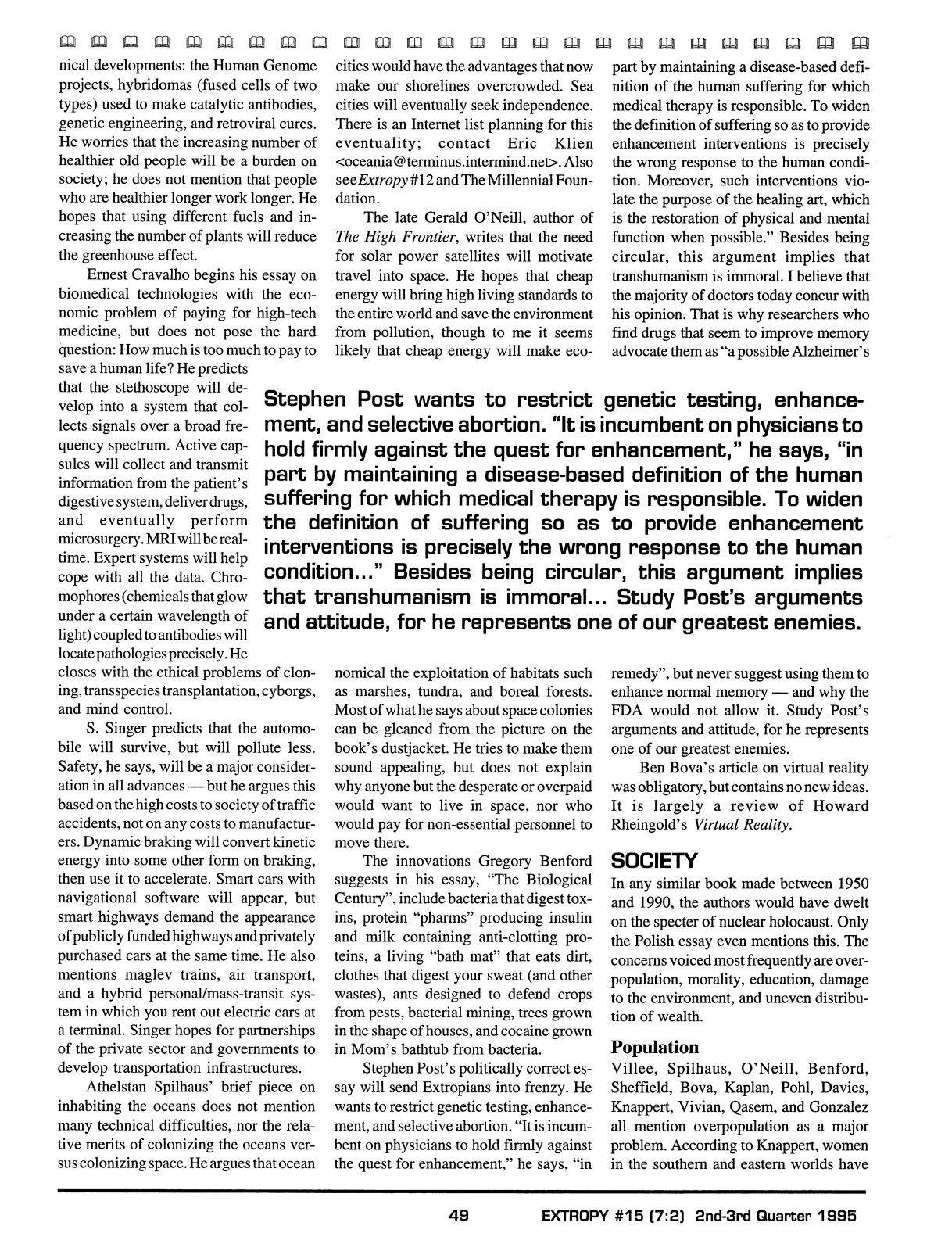
Stephen Post wants to restrict genetic testing, enhancement, and selective abortion. “It is incumbent on physicians to hold firmly against the quest for enhancement,” he says, “in part by maintaining a disease-based definition of the human suffering for which medical therapy is responsible. To widen the definition of suffering so as to provide enhancement interventions is precisely the wrong response to the human condition…” Besides being circular, this argument implies that transhumanism is immoral… Study Post’s arguments and attitude, for he represents one of our greatest enemies.
nomical the exploitation of habitats such as marshes, tundra, and boreal forests. Most of what he says about space colonies can be gleaned from the picture on the book’s dustjacket. He tries to make them sound appealing, but does not explain why anyone but the desperate or overpaid would want to live in space, nor who would pay for non-essential personnel to move there.
The innovations Gregory Benford suggests in his essay, “The Biological Century”, include bacteria that digest toxins, protein “pharms” producing insulin and milk containing anti-clotting proteins, a living “bath mat” that eats dirt, clothes that digest your sweat (and other wastes), ants designed to defend crops from pests, bacterial mining, trees grown in the shape of houses, and cocaine grown in Mom’s bathtub from bacteria.
Stephen Post’s politically correct essay will send Extropians into frenzy. He wants to restrict genetic testing, enhancement, and selective abortion. “It is incumbent on physicians to hold firmly against the quest for enhancement,” he says, “in remedy”, but never suggest using them to enhance normal memory — and why the FDA would not allow it. Study Post’s arguments and attitude, for he represents one of our greatest enemies.
Ben Bova’s article on virtual reality was obligatory, but contains no new ideas. It is largely a review of Howard Rheingold’s Virtual Reality.
SOCIETY
In any similar book made between 1950 and 1990, the authors would have dwelt on the specter of nuclear holocaust. Only the Polish essay even mentions this. The concerns voiced most frequently are overpopulation, morality, education, damage to the environment, and uneven distribution of wealth.
Population
Villee, Spilhaus, O’Neill, Benford, Sheffield, Bova, Kaplan, Pohl, Davies, Knappert, Vivian, Qasem, and Gonzalez all mention overpopulation as a major problem. According to Knappert, women in the southern and eastern worlds have on average five children each, and in tropical Africa, seven. Knappert, Qasem, and Vivian et. al. say there is already not enough fresh water.
Nations with low population growth are often besieged by immigrants: the US by Mexicans, western Europe by Muslims, and Australia by southeast Asians. Knappert predicts that either more nations will take the strict approach of Hong Kong, or the immigrants will soon outnumber the present inhabitants, particularly in Europe where the Islamic immigrants are urged to have as many children as God grants.
Sheffield envisions the use of artificial food, superplants that grow in soil unsuitable for other crops, and worldwide contraception as solutions to overpopulation. Villes mentions pest-resistant, high-yield crops and reduced beef consumption. Both believe that given the choice, women would rather have fewer children. But Gonzalez claims that contraception has been ineffective in curbing population growth in the Philippines for cultural and religious reasons.
Davies contends that “the only choices today for countries with runaway rates of population growth are either effective voluntary birth control and early abortion today or compulsory sterilization, late abortion and infanticide tomorrow.” Bova says that space will never serve as an outlet to reduce the Earth’s population, though he does not explain why. O’Neill, the advocate of space colonization, predicts only half a million people living in space by 2044. He does not present space as a vent for population on Earth. Rather, he says it will ease population pressures by providing the energy needed to bring affluence and low birth rates to the world. Benford fears a plague designed to reduce overpopulation.
Morality
The authors warn about the loss of morality, both because religion is weaker, and because multicultural societies have many conflicting sets of value systems. Pournelle gets to the heart of the matter: “No hint of religious origin of ‘values’ may be given in schools. Worse: most schools teach a kind of neutrality among cultures and value systems. We are, it seems, to produce a nation of ethical philosophers who will reason their way to civilized behavior — and do that in schools that cannot even teach the children to read. Any optimistic projection of the future must assume that the nation will undergo a revival of morality and find new wellsprings of moral behavior.” Vivian et. al. say that the American and French tradition of placing liberty above all else is not enough, and we need to reintroduce the idea of duty to society.
Most authors who admit the problem seem to think it is a simple matter of social engineering to construct some workable value system. Yet only Weerayudh Wichiarajote thinks he has a substitute for religious morality, and his article is the most frightening in the book. “Thai Society”, besides reading like an advertisement for foreign investors, exudes a bubbly enthusiasm for a Party-approved “democratic moral system”, based on balance between spiritual, social, and material well-being, that will be “successfully inculcated in the populace.” He is right in pointing out that chasing material gain without regard to psychological state leads to bad things, but one shudders to think of a government-run Ministry of the Science of Morality, or of a “democratic family system”.
Wichiarajote’s utopia could be Kaplan’s dystopia. Given the politically correct view that criminal behavior is a mental illness to be cured, Kaplan notes that “antisocial behavior, as interpreted by the received truth of the day, is sufficient to indicate the desirability of treatment.”
With the reductionist analysis of humans and the potential to build creatures midway between human and brute, the value of human life falls into question. Meanwhile, futurists argue trivial moral problems at the periphery of today’s ethics. Border skirmishes occupy them while the capital is under siege. Cravalho worries whether it is right to use a mouse’s islet cells to cure diabetes; a more relevant question would be whether it is right to use a cat’s brain to guide my lawnmower. Post indicates that adult onset polycystic kidney disease, which is treatable by dialysis or transplant, and Huntington’s, which has late onset, are not severe enough to justify abortion. By 2044 they may be judged severe enough to justify execution.
SUMMARY
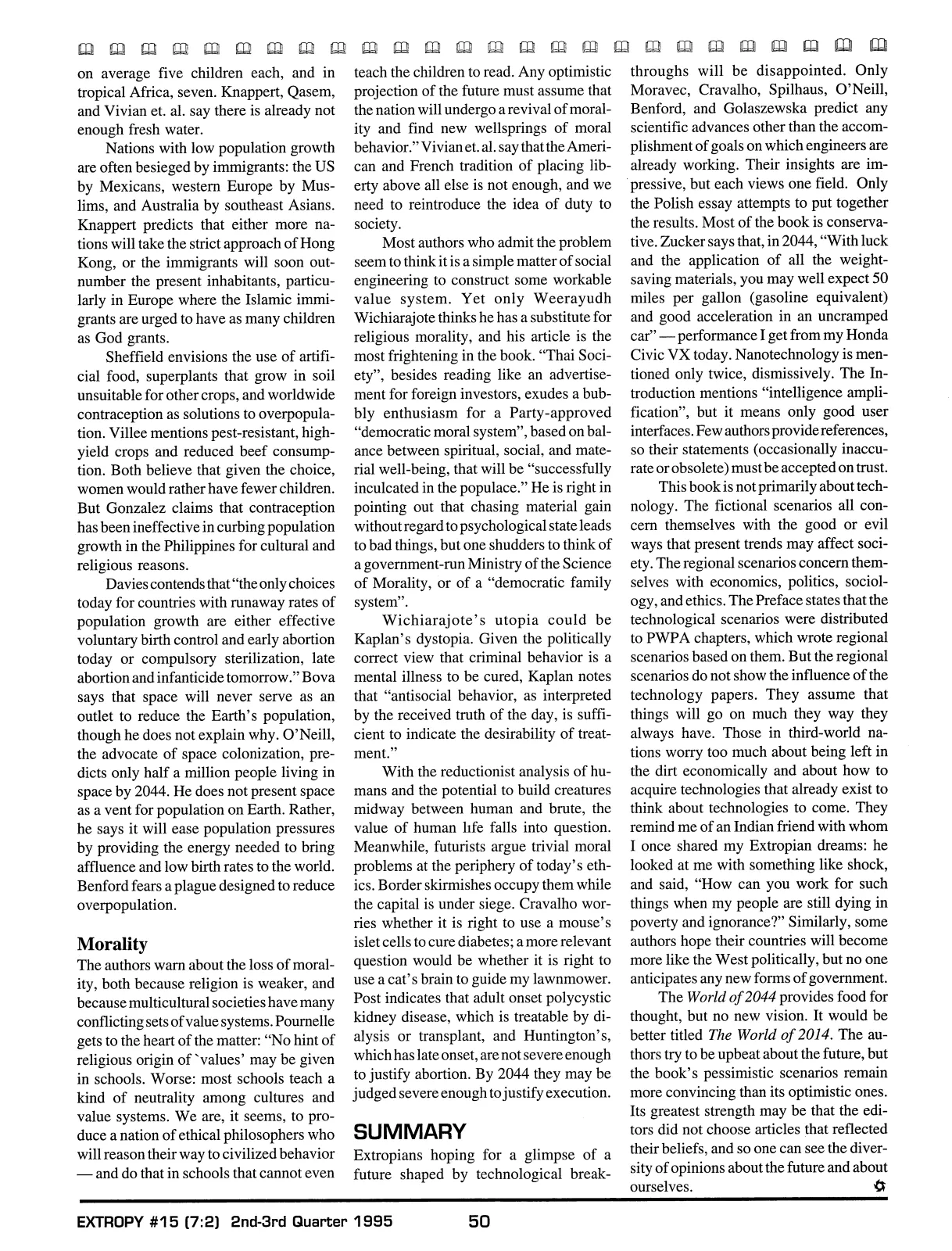
Extropians hoping for a glimpse of a future shaped by technological breakthroughs will be disappointed. Only Moravec, Cravalho, Spilhaus, O’Neill, Benford, and Golaszewska predict any scientific advances other than the accomplishment of goals on which engineers are already working. Their insights are impressive, but each views one field. Only the Polish essay attempts to put together the results. Most of the book is conservative. Zucker says that, in 2044, “With luck and the application of all the weight-saving materials, you may well expect 50 miles per gallon (gasoline equivalent) and good acceleration in an uncramped car” — performance I get from my Honda Civic VX today. Nanotechnology is mentioned only twice, dismissively. The Introduction mentions “intelligence amplification”, but it means only good user interfaces. Few authors provide references, so their statements (occasionally inaccurate or obsolete) must be accepted on trust.
This book is not primarily about technology. The fictional scenarios all concern themselves with the good or evil ways that present trends may affect society. The regional scenarios concern themselves with economics, politics, sociology, and ethics. The Preface states that the technological scenarios were distributed to PWPA chapters, which wrote regional scenarios based on them. But the regional scenarios do not show the influence of the technology papers. They assume that things will go on much they way they always have. Those in third-world nations worry too much about being left in the dirt economically and about how to acquire technologies that already exist to think about technologies to come. They remind me of an Indian friend with whom I once shared my Extropian dreams: he looked at me with something like shock, and said, “How can you work for such things when my people are still dying in poverty and ignorance?” Similarly, some authors hope their countries will become more like the West politically, but no one anticipates any new forms of government.
The World of 2044 provides food for thought, but no new vision. It would be better titled The World of 2014. The authors try to be upbeat about the future, but the book’s pessimistic scenarios remain more convincing than its optimistic ones. Its greatest strength may be that the editors did not choose articles that reflected their beliefs, and so one can see the diversity of opinions about the future and about ourselves.
VIEW ORIGINAL SCAN (3 pages)