Issue: EXTROPY #15 · 2nd/3rd Quarter 1995
Author: Benford, Bridge, Drexler, FM-2030, Miller, More & Szabo
Pages: 8–11 · 4 scanned pages
Future Forecasts
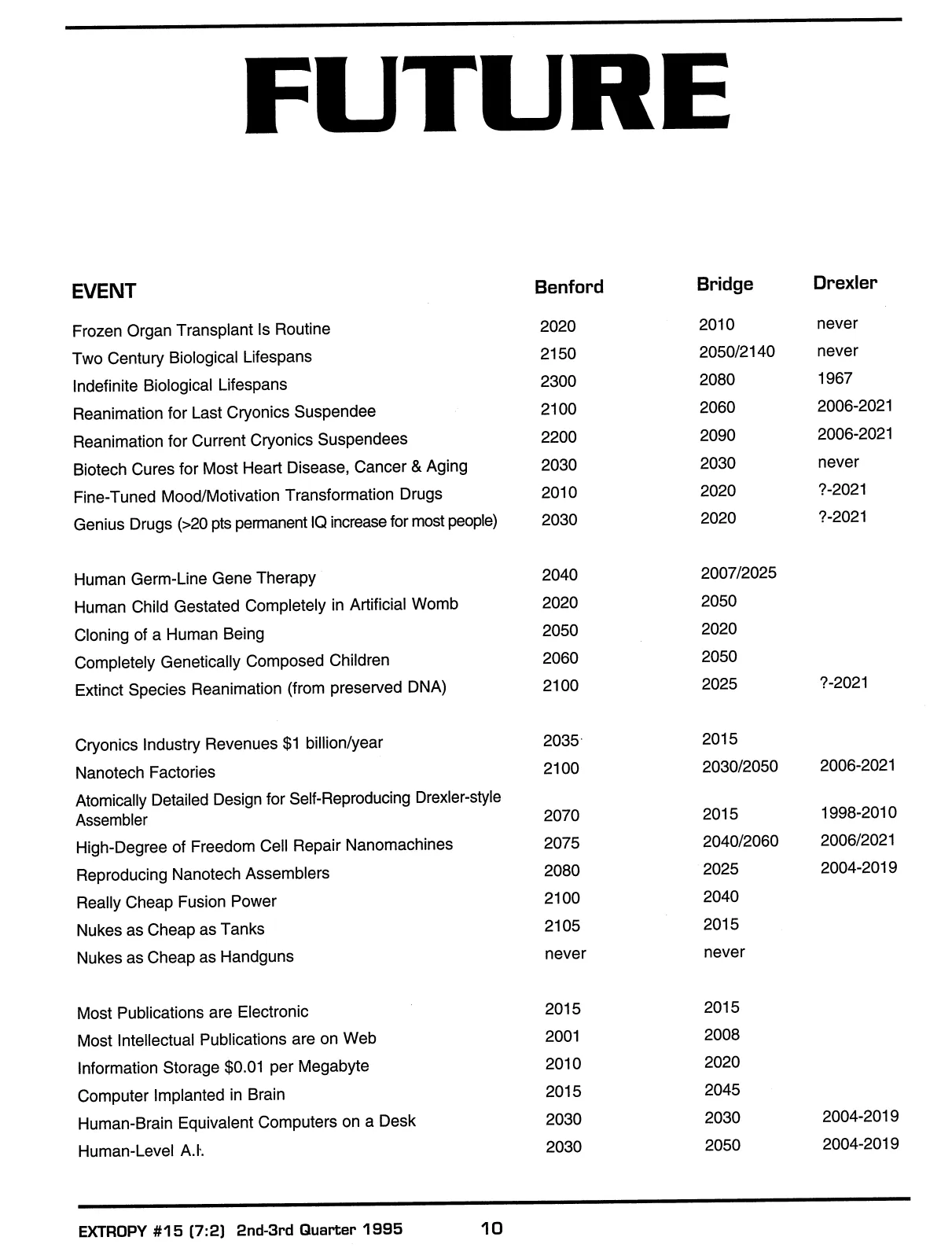
FUTURE
EVENT
Frozen Organ Transplant Is Routine
Two Century Biological Lifespans
Indefinite Biological Lifespans
Reanimation for Last Cryonics Suspendee
Reanimation for Current Cryonics Suspendees
Biotech Cures for Most Heart Disease, Cancer & Aging
Fine-Tuned Mood/Motivation Transformation Drugs
Genius Drugs (>20 pts permanent IQ increase for most people)
Human Germ-Line Gene Therapy
Human Child Gestated Completely in Artificial Womb
Cloning of a Human Being
Completely Genetically Composed Children
Extinct Species Reanimation (from preserved DNA)
Cryonics Industry Revenues $1 billion/year
Nanotech Factories
Atomically Detailed Design for Self-Reproducing Drexler-style Assembler
High-Degree of Freedom Cell Repair Nanomachines
Reproducing Nanotech Assemblers
Really Cheap Fusion Power
Nukes as Cheap as Tanks
Nukes as Cheap as Handguns
Most Publications are Electronic
Most Intellectual Publications are on Web
Information Storage $0.01 per Megabyte
Computer Implanted in Brain
Human-Brain Equivalent Computers on a Desk
Human-Level A.I.
Benford
2020
2150
2300
2100
2200
2030
2010
2030
2040
2020
2050
2060
2100
2035
2100
2070
2075
2080
2100
2105 never
2015
2001
2010
2015
2030
2030
Bridge
2010
2050/2140
2080
2060
2090
2030
2020
2020
2007/2025
2050
2020
2050
2025
2015
2030/2050
2015
2040/2060
2025
2040
2015 never
2015
2008
2020
2045
2030
2050
Drexler never never
1967
2006-2021
2006-2021 never
?-2021
?-2021
?-2021
2006-2021
1998-2010
2006/2021
2004-2019
2004-2019
2004-2019
FORECASTS
C O M M E N T S
NICK SZABO
The first number is when something might be possible under ideal engineering, economic, and political conditions. “now” means we could have done it already. The second number is the practical prediction, based primarily on the viewpoint of starting a business with engineering and political issues secondary. Big gaps between the two numbers usually indicate major economic or cultural barriers to adaptation of the technology. Many of the political developments (law choice, etc.) will be available much sooner for those who sacrifice other aspects of their lifestyle to pioneer these new jurisdictions.
STEVE BRIDGE
My answers are based on when something will “actually happen” rather than on when it will be possible. Some of the reasons why something could be possible at a particular time but not actually accomplished are economic, some are related to social objections, and some are simply because the top minds in these fields can’t pursue all avenues of research at once. What we are trying to do here is not only to predict technological development, but to predict what people will choose to work on first.
I am equally convinced that the time line for “actually happens” is not well connected to the time line for “most people do it.” Computers have existed for 50 years or so; home computers have been easily available for at least 15 years. Yet we are still not to a point where “most” people even own a home computer, much less use one for anything more than games. Most people own a television because it is passive. Most people are not interested in actually “doing” things. We tend to forget that, because we spend almost all of our work and social time with the people who are steeped in thinking and doing. The average American and the average human are not like those around us.
ERIC DREXLER
The rate of technological advance depends on the quality of tools, both material and computational. Both are getting better faster as better tools are used to build better tools. The result of this cannot be a singularity in the strict mathematical sense, but Vernor’s term still seems remarkably appropriate. For advances that we can already describe, a steady trickle of progress over the coming decades and centuries seems most unlikely.
Actual developments will depend not only on what is possible (a matter of physics) but on races between different technologies (a matter of complex competitive processes in an unfolding history). The
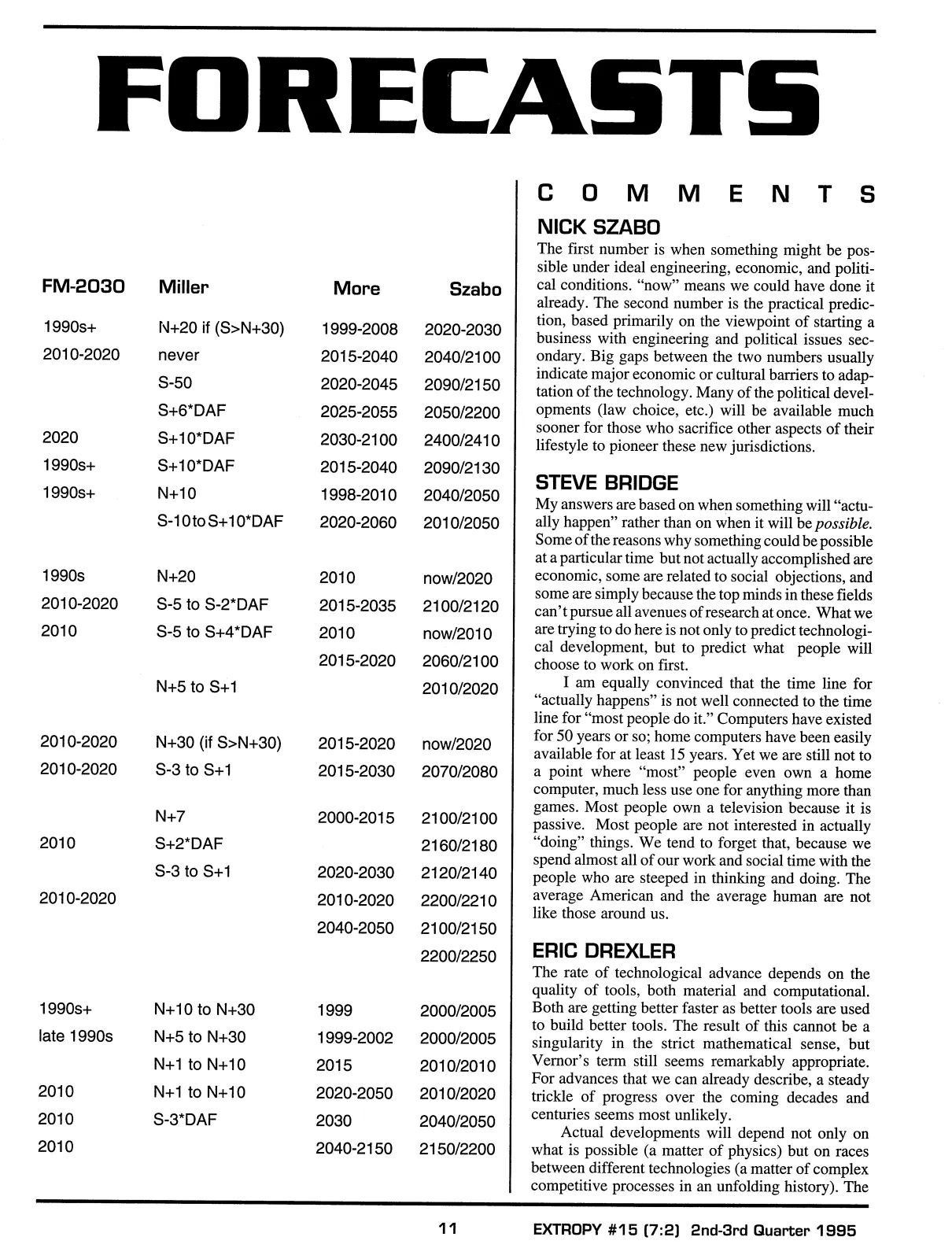
| FM-2030 | Miller | More | Szabo |
|---|---|---|---|
| 1990s+ | N+20 if (S>N+30) | 1999-2008 | 2020-2030 |
| 2010-2020 | never | 2015-2040 | 2040/2100 |
| S-50 | 2020-2045 | 2090/2150 | |
| S+6*DAF | 2025-2055 | 2050/2200 | |
| 2020 | S+10*DAF | 2030-2100 | 2400/2410 |
| 1990s+ | S+10*DAF | 2015-2040 | 2090/2130 |
| 1990s+ | N+10 | 1998-2010 | 2040/2050 |
| S-10 to S+10*DAF | 2020-2060 | 2010/2050 | |
| 1990s | N+20 | 2010 | now/2020 |
| 2010-2020 | S-5 to S-2*DAF | 2015-2035 | 2100/2120 |
| 2010 | S-5 to S+4*DAF | 2010 | now/2010 |
| 2015-2020 | 2060/2100 | ||
| N+5 to S+1 | 2010/2020 | ||
| 2010-2020 | N+30 (if S>N+30) | 2015-2020 | now/2020 |
| 2010-2020 | S-3 to S+1 | 2015-2030 | 2070/2080 |
| N+7 | 2000-2015 | 2100/2100 | |
| 2010 | S+2*DAF | 2160/2180 | |
| S-3 to S+1 | 2020-2030 | 2120/2140 | |
| 2010-2020 | 2010-2020 | 2200/2210 | |
| 2040-2050 | 2100/2150 | ||
| 2200/2250 | |||
| 1990s+ | N+10 to N+30 | 1999 | 2000/2005 |
| late 1990s | N+5 to N+30 | 1999-2002 | 2000/2005 |
| N+1 to N+10 | 2015 | 2010/2010 | |
| 2010 | N+1 to N+10 | 2020-2050 | 2010/2020 |
| 2010 | S-3*DAF | 2030 | 2040/2050 |
| 2010 | 2040-2150 | 2150/2200 |
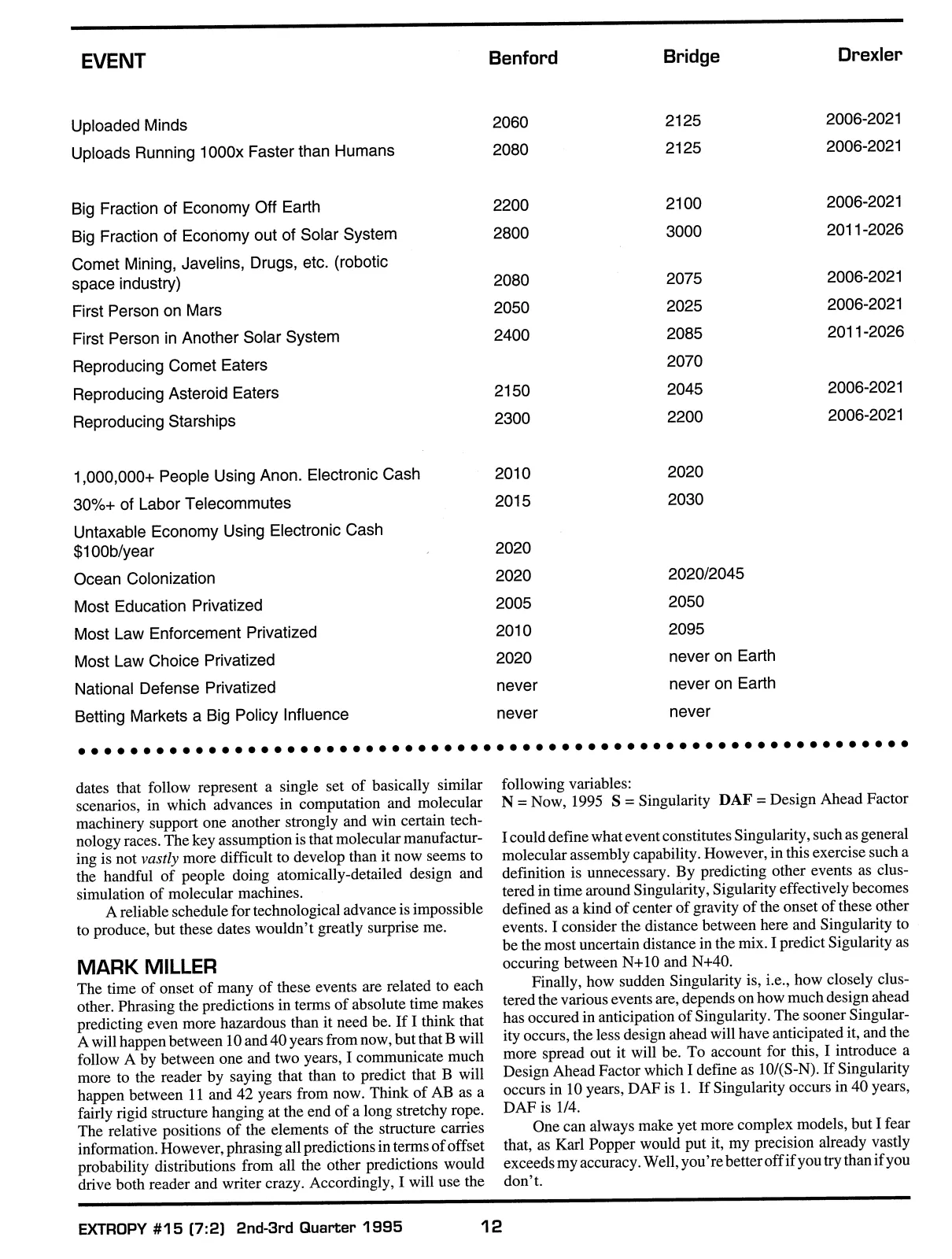
| EVENT | Benford | Bridge | Drexler |
|---|---|---|---|
| Uploaded Minds | 2060 | 2125 | 2006-2021 |
| Uploads Running 1000x Faster than Humans | 2080 | 2125 | 2006-2021 |
| Big Fraction of Economy Off Earth | 2200 | 2100 | 2006-2021 |
| Big Fraction of Economy out of Solar System | 2800 | 3000 | 2011-2026 |
| Comet Mining, Javelins, Drugs, etc. (robotic space industry) | 2080 | 2075 | 2006-2021 |
| First Person on Mars | 2050 | 2025 | 2006-2021 |
| First Person in Another Solar System | 2400 | 2085 | 2011-2026 |
| Reproducing Comet Eaters | 2070 | ||
| Reproducing Asteroid Eaters | 2150 | 2045 | 2006-2021 |
| Reproducing Starships | 2300 | 2200 | 2006-2021 |
| 1,000,000+ People Using Anon. Electronic Cash | 2010 | 2020 | |
| 30%+ of Labor Telecommutes | 2015 | 2030 | |
| Untaxable Economy Using Electronic Cash $100b/year | 2020 | ||
| Ocean Colonization | 2020 | 2020/2045 | |
| Most Education Privatized | 2005 | 2050 | |
| Most Law Enforcement Privatized | 2010 | 2095 | |
| Most Law Choice Privatized | 2020 | never on Earth | |
| National Defense Privatized | never | never on Earth | |
| Betting Markets a Big Policy Influence | never | never |
dates that follow represent a single set of basically similar scenarios, in which advances in computation and molecular machinery support one another strongly and win certain technology races. The key assumption is that molecular manufacturing is not vastly more difficult to develop than it now seems to the handful of people doing atomically-detailed design and simulation of molecular machines.
A reliable schedule for technological advance is impossible to produce, but these dates wouldn’t greatly surprise me.
MARK MILLER
The time of onset of many of these events are related to each other. Phrasing the predictions in terms of absolute time makes predicting even more hazardous than it need be. If I think that A will happen between 10 and 40 years from now, but that B will follow A by between one and two years, I communicate much more to the reader by saying that than to predict that B will happen between 11 and 42 years from now. Think of AB as a fairly rigid structure hanging at the end of a long stretchy rope. The relative positions of the elements of the structure carries information. However, phrasing all predictions in terms of offset probability distributions from all the other predictions would drive both reader and writer crazy. Accordingly, I will use the following variables:
N = Now, 1995 S = Singularity DAF = Design Ahead Factor
I could define what event constitutes Singularity, such as general molecular assembly capability. However, in this exercise such a definition is unnecessary. By predicting other events as clustered in time around Singularity, Sigularity effectively becomes defined as a kind of center of gravity of the onset of these other events. I consider the distance between here and Singularity to be the most uncertain distance in the mix. I predict Sigularity as occurring between N+10 and N+40.
Finally, how sudden Singularity is, i.e., how closely clustered the various events are, depends on how much design ahead has occurred in anticipation of Singularity. The sooner Singularity occurs, the less design ahead will have anticipated it, and the more spread out it will be. To account for this, I introduce a Design Ahead Factor which I define as 10/(S-N). If Singularity occurs in 10 years, DAF is 1. If Singularity occurs in 40 years, DAF is 1/4.
One can always make yet more complex models, but I fear that, as Karl Popper would put it, my precision already vastly exceeds my accuracy. Well, you’re better off if you try than if you don’t.
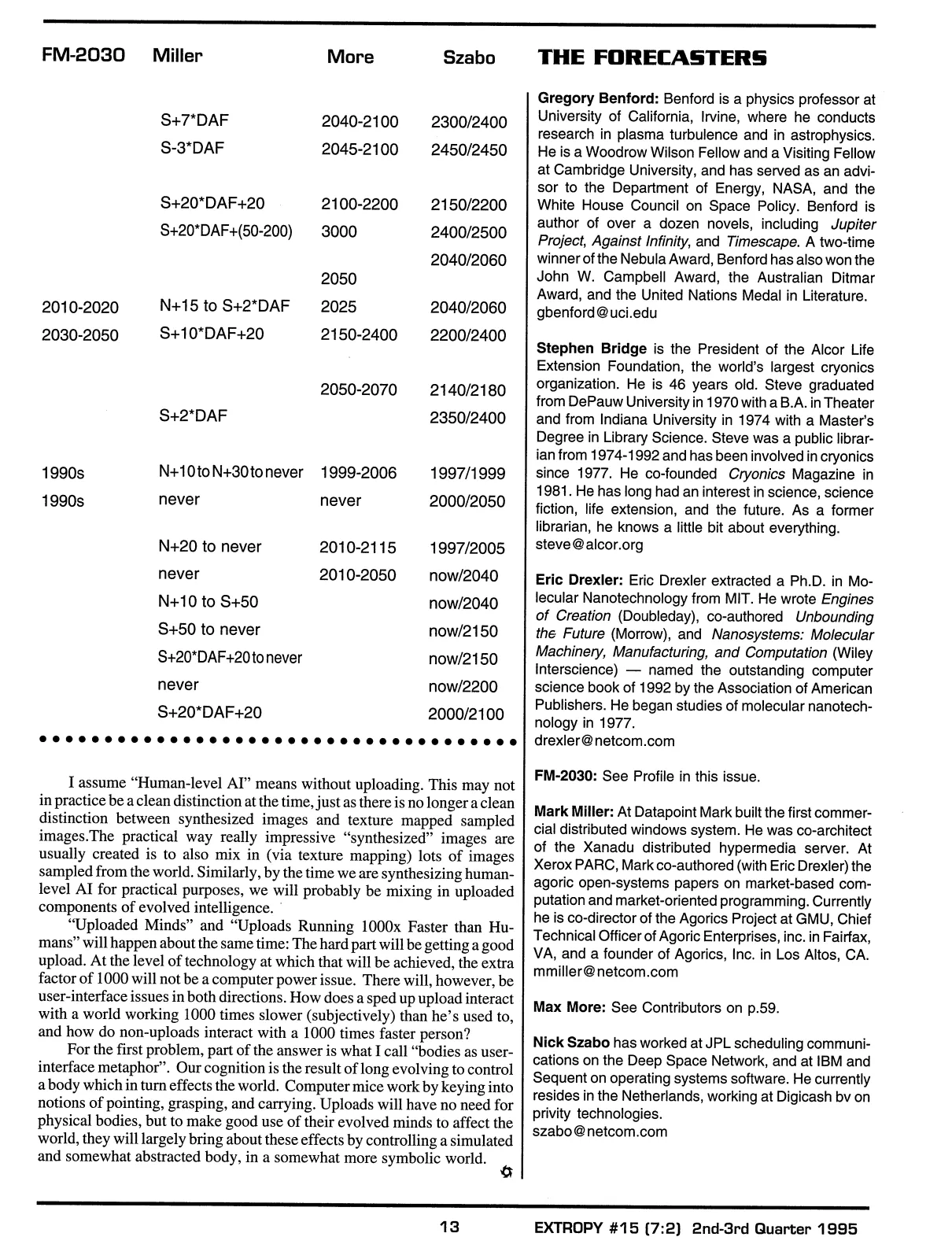
| FM-2030 | Miller | More | Szabo |
|---|---|---|---|
| S+7*DAF | 2040-2100 | 2300/2400 | |
| S-3*DAF | 2045-2100 | 2450/2450 | |
| S+20*DAF+20 | 2100-2200 | 2150/2200 | |
| S+20*DAF+(50-200) | 3000 | 2400/2500 | |
| 2040/2060 | |||
| 2050 | |||
| 2010-2020 | N+15 to S+2*DAF | 2025 | 2040/2060 |
| 2030-2050 | S+10*DAF+20 | 2150-2400 | 2200/2400 |
| 2050-2070 | 2140/2180 | ||
| S+2*DAF | 2350/2400 | ||
| 1990s | N+10 to N+30 to never | 1999-2006 | 1997/1999 |
| 1990s | never | never | 2000/2050 |
| N+20 to never | 2010-2115 | 1997/2005 | |
| never | 2010-2050 | now/2040 | |
| N+10 to S+50 | now/2040 | ||
| S+50 to never | now/2150 | ||
| S+20*DAF+20 to never | now/2150 | ||
| never | now/2200 | ||
| S+20*DAF+20 | 2000/2100 |
I assume “Human-level AI” means without uploading. This may not in practice be a clean distinction at the time, just as there is no longer a clean distinction between synthesized images and texture mapped sampled images. The practical way really impressive “synthesized” images are usually created is to also mix in (via texture mapping) lots of images sampled from the world. Similarly, by the time we are synthesizing human-level AI for practical purposes, we will probably be mixing in uploaded components of evolved intelligence.
“Uploaded Minds” and “Uploads Running 1000x Faster than Humans” will happen about the same time: The hard part will be getting a good upload. At the level of technology at which that will be achieved, the extra factor of 1000 will not be a computer power issue. There will, however, be user-interface issues in both directions. How does a sped up upload interact with a world working 1000 times slower (subjectively) than he’s used to, and how do non-uploads interact with a 1000 times faster person?
For the first problem, part of the answer is what I call “bodies as user-interface metaphor”. Our cognition is the result of long evolving to control a body which in turn effects the world. Computer mice work by keying into notions of pointing, grasping, and carrying. Uploads will have no need for physical bodies, but to make good use of their evolved minds to affect the world, they will largely bring about these effects by controlling a simulated and somewhat abstracted body, in a somewhat more symbolic world.
THE FORECASTERS
Gregory Benford: Benford is a physics professor at University of California, Irvine, where he conducts research in plasma turbulence and in astrophysics. He is a Woodrow Wilson Fellow and a Visiting Fellow at Cambridge University, and has served as an advisor to the Department of Energy, NASA, and the White House Council on Space Policy. Benford is author of over a dozen novels, including Jupiter Project, Against Infinity, and Timescape. A two-time winner of the Nebula Award, Benford has also won the John W. Campbell Award, the Australian Ditmar Award, and the United Nations Medal in Literature. gbenford@uci.edu
Stephen Bridge is the President of the Alcor Life Extension Foundation, the world’s largest cryonics organization. He is 46 years old. Steve graduated from DePauw University in 1970 with a B.A. in Theater and from Indiana University in 1974 with a Master’s Degree in Library Science. Steve was a public librarian from 1974-1992 and has been involved in cryonics since 1977. He co-founded Cryonics Magazine in 1981. He has long had an interest in science, science fiction, life extension, and the future. As a former librarian, he knows a little bit about everything. steve@alcor.org
Eric Drexler: Eric Drexler extracted a Ph.D. in Molecular Nanotechnology from MIT. He wrote Engines of Creation (Doubleday), co-authored Unbounding the Future (Morrow), and Nanosystems: Molecular Machinery, Manufacturing, and Computation (Wiley Interscience) — named the outstanding computer science book of 1992 by the Association of American Publishers. He began studies of molecular nanotechnology in 1977. drexler@netcom.com
FM-2030: See Profile in this issue.
Mark Miller: At Datapoint Mark built the first commercial distributed windows system. He was co-architect of the Xanadu distributed hypermedia server. At Xerox PARC, Mark co-authored (with Eric Drexler) the agoric open-systems papers on market-based computation and market-oriented programming. Currently he is co-director of the Agorics Project at GMU, Chief Technical Officer of Agoric Enterprises, Inc. in Fairfax, VA, and a founder of Agorics, Inc. in Los Altos, CA. mmiller@netcom.com
Max More: See Contributors on p.59.
Nick Szabo has worked at JPL scheduling communications on the Deep Space Network, and at IBM and Sequent on operating systems software. He currently resides in the Netherlands, working at Digicash bv on privity technologies. szabo@netcom.com
VIEW ORIGINAL SCAN (4 pages)