Issue: EXTROPY #15 · 2nd/3rd Quarter 1995
Author: Max More
Pages: 4 · 1 scanned page
Editorial: A Different Kind of Future
EDITORIAL
A different kind of future:
World government polycentric law
Monetary supranationalism competing private currencies
Many readers of this publication prefer to refer to themselves as transhumanists or Extropians rather than as futurists. One reason for this is most persons claiming to be futurists have social and economic views at odds with the principle of spontaneous order. Ever since H.G. Wells, many futurists have proclaimed the wisdom of world government and central control or central planning by a “scientific elite”. Today, these views still appear in futurist writings, though fortunately some of the best known writers such as Toffler and Naisbitt do see the virtues of free markets and decentralization to a fair degree.
In this issue of Extropy, we continue to explore a different kind of future, a future without centralized political institutions. In past issues we have looked at how the very legal system itself could work — and work better — if separated from government. This time we focus on economic issues and see how the monetary system could be run privately.
Electronic money has been discussed for years, with a recent surge of interest. Here, we combine an examination of electronic money and free banking or competing currencies. Anonymous digital money is expected to sharply reduce the state’s power to tax and control many economic activities. Competing currencies would curtail the state’s ability to control international money flows and to engage in harmful monetary policy. The two topics of electronic money and competing currencies therefore share a feature in common. The articles on pages 14, 16, and 19 are complemented by an extensive book review on free banking on p.51.
When might a sizeable proportion of the population use anonymous digital money? Several prognosticators give their estimates of this and other breakthroughs in “Future Forecasts”. Though the forecasters share many ideas about technology and society, you will find a wide range of dates for the forecasts events. Compare where you stand, and let us know where you think our forecasters went wrong. If the response justifies it, next issue we will publish a critical discussion of the feasibility and value of trying to forecast the future (a topic of recent discussion on the Extropians e-mail List).
New features: In addition to Dr. Ray Sahelian’s Bioenhancement Update, Extropy now features two new columns: An Internet feature by “Yow” — the online name of attorney/hacker Steve Arbuss. We also welcome Mark Wolf’s puzzle series, Enigma. The Letters section, though not really new, appears again after several issues absence, in response to reader demand. In this record-size issue, we continue to diversify our content in terms of its level of technical challenge. Start with the interview and work your way into Reilly Jones’ essay!
I look forward to meeting some of you at our June conference, EXTRO².
Upward and Outward!
Max More
EXTROPY — a measure of intelligence, information, energy, life, experience, diversity, opportunity and growth. Extropians are those who consciously seek to increase extropy. The Extropian Principles are: (1) Boundless Expansion; (2) Self-Transformation; (3) Dynamic Optimism; (4) Intelligent Technology; (5) Spontaneous Order. [See Extropy #11 for Extropian Principles v.2.5]
TRANSHUMANISM — Philosophies of life (such as Extropianism) that seek the continuation and acceleration of the evolution of intelligent life beyond its currently human form and human limitations by means of science and technology, guided by life-promoting principles and values, while avoiding dogma and mysticism. [See Extropy #6]
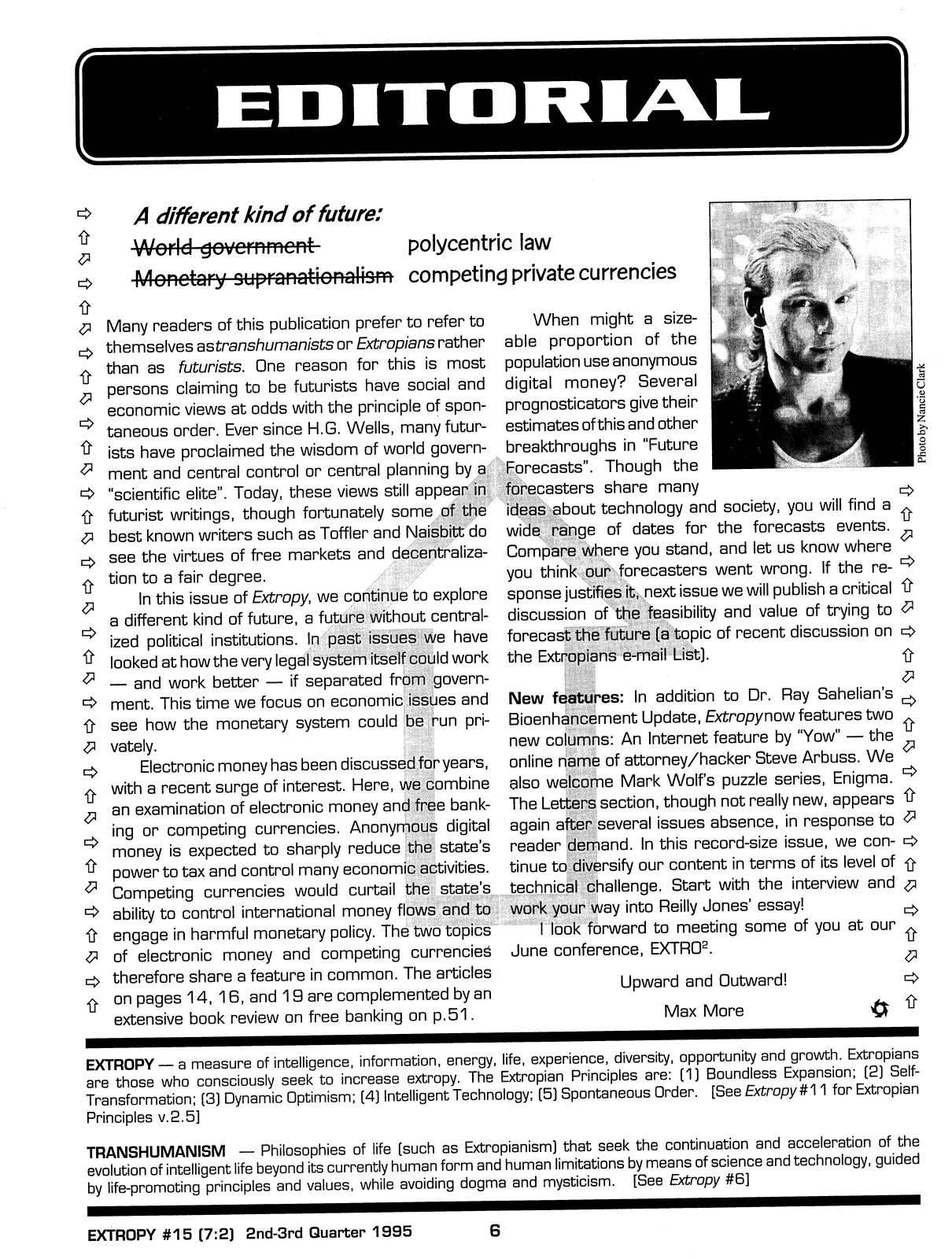
Photo by Nancie Clark
VIEW ORIGINAL SCAN (1 pages)