Issue: EXTROPY #14 · First Quarter 1995
Author: Michael C. Price
Pages: 40–43 · 4 scanned pages
Review: The Physics of Immortality (Tipler)
The Transhuman Taste REVIEWS OF EXTROPIAN INTEREST
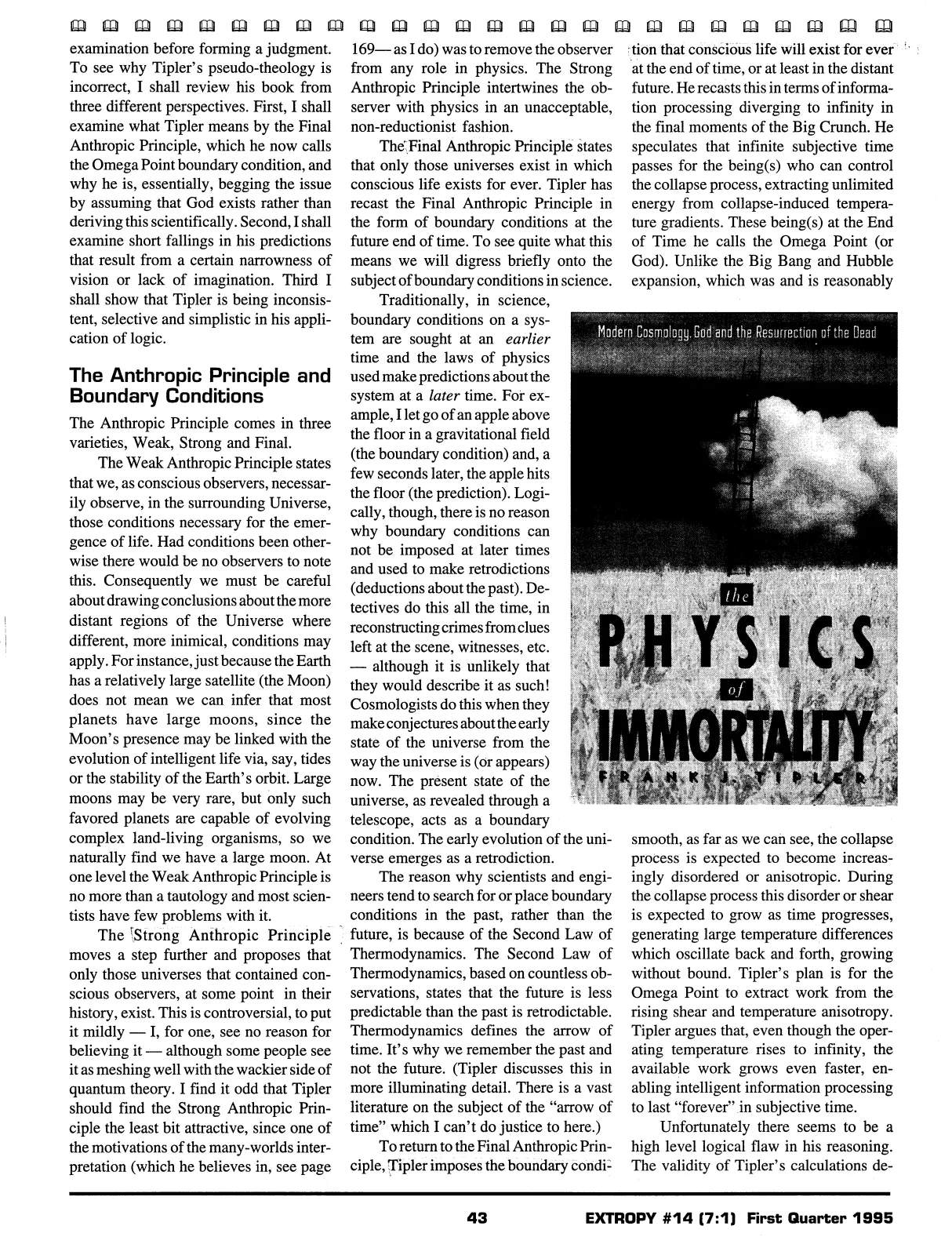
The Physics of Immortality:
by Frank Tipler
Doubleday, New York, 1994 528 pages, ISBN 0-385-46798-2
Reviewed by Michael C. Price
Frank Tipler, Professor of Mathematical Physics at Tulane University, has made major contributions to the subject of general relativity and in particular on singularities. SF readers will perhaps be aware of his article on the possibility of time travel in the vicinity of a massive rotating cylinder, directly inspiring a Larry Niven story of the same name: “Rotating Cylinders and the Possibility of Global Causality Violation”. Within quantum cosmology he is well known as a proponent of the many-worlds interpretation of quantum mechanics. To SETI enthusiasts and skeptics he is famous or infamous, depending on your viewpoint, and as having locked horns with Carl Sagan on the existence of extraterrestrial intelligent alien life. In 1985 he co-authored, with John Barrow, the monumental The Anthropic Cosmological Principle (reviewed in Extropy #9, Summer 1992). Now he has written a sequel, The Physics of Immortality, where he develops these ideas further.
In The Physics of Immortality, Tipler seeks nothing less than a unification of cosmology with theology. Questions like “Does God exist?”, does “It love us?”, and “Is there an afterlife?” are subjects to be tackled with the same rigor as the behavior of a star as it collapses into a black hole — in Tipler’s opinion. The book is cogently written and includes voluminous technical appendices and notes, backing up his logic. In addition to the physics (most of which is quite wisely confined to appendices) there are extensive discussions of identity, the arrow of time, reductionism, free-will and comparisons of the eschatology of the major world religions, and other topics.
Tipler’s thesis is that as the universe collapses towards the final Big Crunch the amount of information processing diverges asymptotically to infinity, even as at the same time as the universe is compressed down to zero volume within finite time. The final end point, which will exist only for an infinitesimal moment, he calls the Omega Point and achieves infinite complexity and information processing. In the Omega Point all the beings that have ever lived, you, me, Tipler and everyone else — or ever could have lived — are resurrected to live again in an infinitely advanced virtual reality. Subjective time stretches out forever for the denizens and controllers of the last moments.
I found it a technically interesting book, but I was repulsed by the application of religious language to scientific concepts. (I am an atheist, so others may not mind this so much or may mind it more). I find this use of language very dangerous and likely to cause much confusion. For all that, the discussion and comparisons of the major world religions is quite interesting and original, although the relevance of a lot of it, I have to confess, does escape me. Tipler’s re-interpretation of Moses’ encounter with the burning bush is worth reading (page 4). Even so, I feel that the theistic terms are misleading. It would have been better to avoid such language.
I have no doubt that many non-technical theists will take solace in this book as “proof” that science endorses notions of a personal God, Heaven, immortality of the “soul” and whatnot. Similarly many scientifically trained people will reject Tipler’s arguments out of hand. With this book Tipler will, I’m sure, cement his image in scientific circles as a one great scientist turned crank, joining the likes of Penrose, Eddington, Hoyle and others.
Tipler’s arguments deserve careful examination before forming a judgment. To see why Tipler’s pseudo-theology is incorrect, I shall review his book from three different perspectives. First, I shall examine what Tipler means by the Final Anthropic Principle, which he now calls the Omega Point boundary condition, and why he is, essentially, begging the issue by assuming that God exists rather than deriving this scientifically. Second, I shall examine short fallings in his predictions that result from a certain narrowness of vision or lack of imagination. Third I shall show that Tipler is being inconsistent, selective and simplistic in his application of logic.
The Anthropic Principle and Boundary Conditions
The Anthropic Principle comes in three varieties, Weak, Strong and Final.
The Weak Anthropic Principle states that we, as conscious observers, necessarily observe, in the surrounding Universe, those conditions necessary for the emergence of life. Had conditions been otherwise there would be no observers to note this. Consequently we must be careful about drawing conclusions about the more distant regions of the Universe where different, more inimical, conditions may apply. For instance, just because the Earth has a relatively large satellite (the Moon) does not mean we can infer that most planets have large moons, since the Moon’s presence may be linked with the evolution of intelligent life via, say, tides or the stability of the Earth’s orbit. Large moons may be very rare, but only such favored planets are capable of evolving complex land-living organisms, so we naturally find we have a large moon. At one level the Weak Anthropic Principle is no more than a tautology and most scientists have few problems with it.
The Strong Anthropic Principle moves a step further and proposes that only those universes that contained conscious observers, at some point in their history, exist. This is controversial, to put it mildly — I, for one, see no reason for believing it — although some people see it as meshing well with the wackier side of quantum theory. I find it odd that Tipler should find the Strong Anthropic Principle the least bit attractive, since one of the motivations of the many-worlds interpretation (which he believes in, see page
169—as I do) was to remove the observer from any role in physics. The Strong Anthropic Principle intertwines the observer with physics in an unacceptable, non-reductionist fashion.
The Final Anthropic Principle states that only those universes exist in which conscious life exists for ever. Tipler has recast the Final Anthropic Principle in the form of boundary conditions at the future end of time. To see quite what this means we will digress briefly onto the subject of boundary conditions in science.
Traditionally, in science, boundary conditions on a system are sought at an earlier time and the laws of physics used make predictions about the system at a later time. For example, I let go of an apple above the floor in a gravitational field (the boundary condition) and, a few seconds later, the apple hits the floor (the prediction). Logically, though, there is no reason why boundary conditions can not be imposed at later times and used to make retrodictions (deductions about the past). Detectives do this all the time, in reconstructing crimes from clues left at the scene, witnesses, etc. — although it is unlikely that they would describe it as such! Cosmologists do this when they make conjectures about the early state of the universe from the way the universe is (or appears) now. The present state of the universe, as revealed through a telescope, acts as a boundary condition. The early evolution of the universe emerges as a retrodiction.
The reason why scientists and engineers tend to search for or place boundary conditions in the past, rather than the future, is because of the Second Law of Thermodynamics. The Second Law of Thermodynamics, based on countless observations, states that the future is less predictable than the past is retrodictable. Thermodynamics defines the arrow of time. It’s why we remember the past and not the future. (Tipler discusses this in more illuminating detail. There is a vast literature on the subject of the ‘arrow of time’ which I can’t do justice to here.)
To return to the Final Anthropic Principle, Tipler imposes the boundary condition that conscious life will exist for ever at the end of time, or at least in the distant future. He recasts this in terms of information processing diverging to infinity in the final moments of the Big Crunch. He speculates that infinite subjective time passes for the being(s) who can control the collapse process, extracting unlimited energy from collapse-induced temperature gradients. These being(s) at the End of Time he calls the Omega Point (or God). Unlike the Big Bang and Hubble expansion, which was and is reasonably smooth, as far as we can see, the collapse process is expected to become increasingly disordered or anisotropic. During the collapse process this disorder or shear is expected to grow as time progresses, generating large temperature differences which oscillate back and forth, growing without bound. Tipler’s plan is for the Omega Point to extract work from the rising shear and temperature anisotropy. Tipler argues that, even though the operating temperature rises to infinity, the available work grows even faster, enabling intelligent information processing to last ‘forever’ in subjective time.
Unfortunately there seems to be a high level logical flaw in his reasoning. The validity of Tipler’s calculations de-
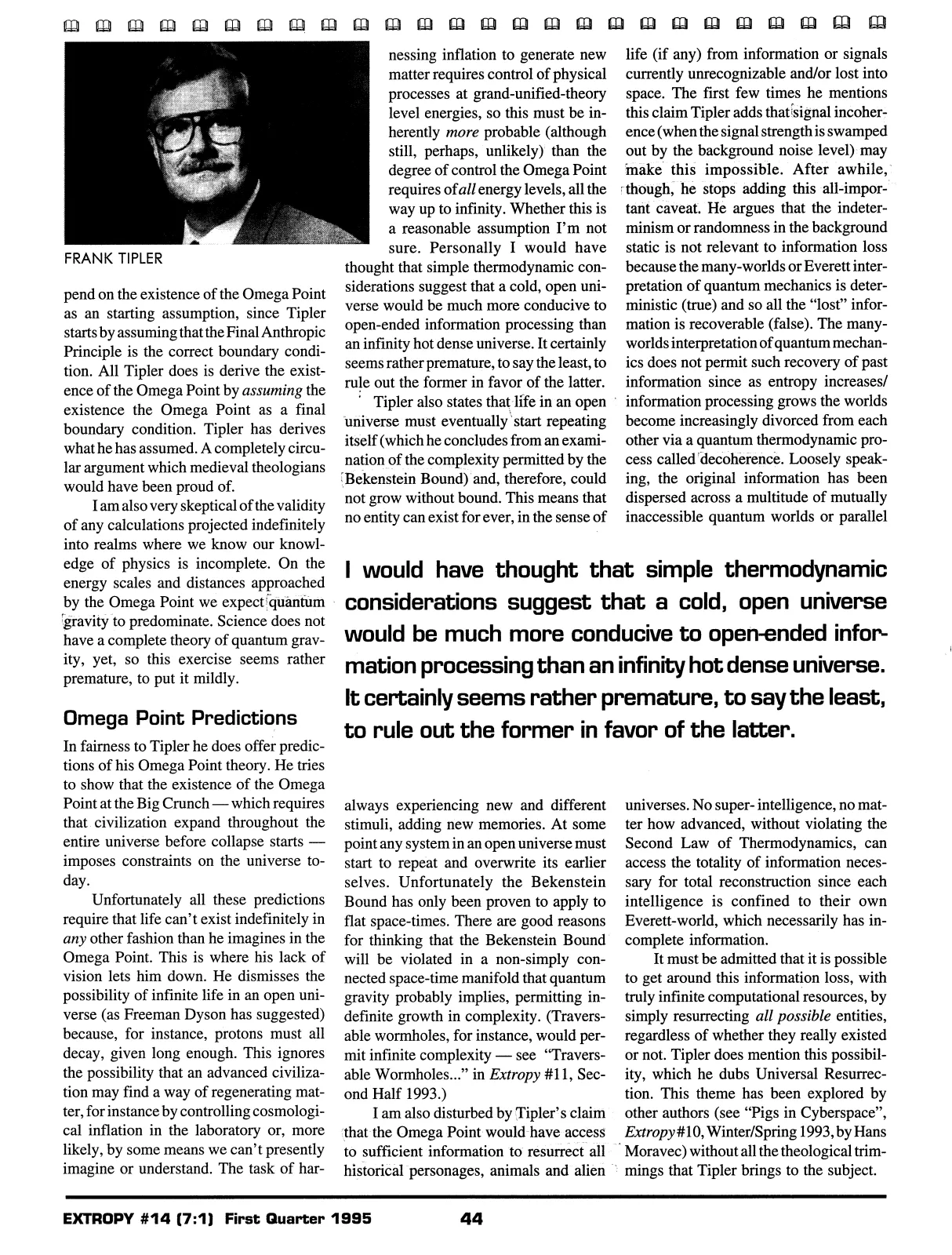
FRANK TIPLER pend on the existence of the Omega Point as an starting assumption, since Tipler starts by assuming that the Final Anthropic Principle is the correct boundary condition. All Tipler does is derive the existence of the Omega Point by assuming the existence the Omega Point as a final boundary condition. Tipler has derives what he has assumed. A completely circular argument which medieval theologians would have been proud of.
I am also very skeptical of the validity of any calculations projected indefinitely into realms where we know our knowledge of physics is incomplete. On the energy scales and distances approached by the Omega Point we expect quantum gravity to predominate. Science does not have a complete theory of quantum gravity, yet, so this exercise seems rather premature, to put it mildly.
Omega Point Predictions
In fairness to Tipler he does offer predictions of his Omega Point theory. He tries to show that the existence of the Omega Point at the Big Crunch — which requires that civilization expand throughout the entire universe before collapse starts — imposes constraints on the universe today.
Unfortunately all these predictions require that life can’t exist indefinitely in any other fashion than he imagines in the Omega Point. This is where his lack of vision lets him down. He dismisses the possibility of infinite life in an open universe (as Freeman Dyson has suggested) because, for instance, protons must all decay, given long enough. This ignores the possibility that an advanced civilization may find a way of regenerating matter, for instance by controlling cosmological inflation in the laboratory or, more likely, by some means we can’t presently imagine or understand. The task of harnessing inflation to generate new matter requires control of physical processes at grand-unified-theory level energies, so this must be inherently more probable (although still, perhaps, unlikely) than the degree of control the Omega Point requires of all energy levels, all the way up to infinity. Whether this is a reasonable assumption I’m not sure. Personally I would have thought that simple thermodynamic considerations suggest that a cold, open universe would be much more conducive to open-ended information processing than an infinity hot dense universe. It certainly seems rather premature, to say the least, to rule out the former in favor of the latter.
Tipler also states that life in an open universe must eventually start repeating itself (which he concludes from an examination of the complexity permitted by the Bekenstein Bound) and, therefore, could not grow without bound. This means that no entity can exist for ever, in the sense of life (if any) from information or signals currently unrecognizable and/or lost into space. The first few times he mentions this claim Tipler adds that signal incoherence (when the signal strength is swamped out by the background noise level) may make this impossible. After awhile, though, he stops adding this all-important caveat. He argues that the indeterminism or randomness in the background static is not relevant to information loss because the many-worlds or Everett interpretation of quantum mechanics is deterministic (true) and so all the ‘lost’ information is recoverable (false). The many-worlds interpretation of quantum mechanics does not permit such recovery of past information since as entropy increases/information processing grows the worlds become increasingly divorced from each other via a quantum thermodynamic process called decoherence. Loosely speaking, the original information has been dispersed across a multitude of mutually inaccessible quantum worlds or parallel always experiencing new and different stimuli, adding new memories. At some point any system in an open universe must start to repeat and overwrite its earlier selves. Unfortunately the Bekenstein Bound has only been proven to apply to flat space-times. There are good reasons for thinking that the Bekenstein Bound will be violated in a non-simply connected space-time manifold that quantum gravity probably implies, permitting indefinite growth in complexity. (Traversable wormholes, for instance, would permit infinite complexity — see ‘Traversable Wormholes…’ in Extropy #11, Second Half 1993.)
I am also disturbed by Tipler’s claim that the Omega Point would have access to sufficient information to resurrect all historical personages, animals and alien universes. No super-intelligence, no matter how advanced, without violating the Second Law of Thermodynamics, can access the totality of information necessary for total reconstruction since each intelligence is confined to their own Everett-world, which necessarily has incomplete information.
It must be admitted that it is possible to get around this information loss, with truly infinite computational resources, by simply resurrecting all possible entities, regardless of whether they really existed or not. Tipler does mention this possibility, which he dubs Universal Resurrection. This theme has been explored by other authors (see ‘Pigs in Cyberspace’, Extropy #10, Winter/Spring 1993, by Hans Moravec) without all the theological trimmings that Tipler brings to the subject.
Internal Inconsistencies
The alert reader will notice that I have not disproved Tipler’s central thesis — that in the future unbounded information processing will permit the resurrection of everyone who has, or might have, ever lived. Instead I criticize him for being too narrow in his outlook in dismissing other open-ended futures for immortals. The prospect of universal resurrection is far more
Tipler’s earlier work on the impossibility of “nearby” extraterrestrial life was based on the principle, by analogy with Darwinian diversity and capitalism, that societies naturally become more diverse as they evolve. Now that it suits his purpose to conclude the opposite he quietly ignores this work.
likely than he realizes. If these were the only faults in his thesis then I would have to accept his notion of universal resurrection.
Unfortunately his vision also has internal inconsistencies. In my opinion the motivation of the Omega Point is never satisfactorily explained. Tipler supposes that as the universe contracts then civilization will necessarily become more co-operative, altruistic and centralized. (Or else they will fail to control the collapse process, the possibility of which, remember, he excludes by assumption!) Therefore, he argues, the Omega Point “ends” up as a benign unified, singular, god-like super-intelligence, although he concedes that there may be semi-autonomous “subprograms” running.
I find this wholly unconvincing. The relevant parameter for describing the “size” of the Omega Point is, as Tipler argues everywhere else, complexity not volume. Tipler needs to think in terms of cyberspace, not physical space. There is sufficient “cyber”-space, within the Omega Point, by Tipler’s calculations, for infinite diversity. Within the infinite cyberspace domain there is absolutely no reason to suppose that the Omega Point will converge on a common set of values. Indeed all the trends in society and evolution point to more diversity with time, not less. It is interesting to note that Tipler’s earlier work on the impossibility of “nearby” extraterrestrial life was based on the principle, by analogy with Darwinian diversity and capitalism, that societies naturally become more diverse as they evolve. Now that it suits his purpose to conclude the opposite he quietly ignores this work.
If we buy Tipler’s line about being resurrected into blissful heaven by angels we must also accept that other copies of ourselves will be reincarnated into painful versions of hell, tortured forever by sadistic virtual demons. Indeed, to resurrect all possible individuals the Omega Point would necessarily have to create an infinite number of virtual hells, all fully stocked with anguished inmates.
In a paragraph tucked away in an footnote (page 359), the argument is presented that super-beings in the future will fear retribution (or of not being resurrected if they die) if they abuse resurrectees. There are many assumptions implicit in this. Surely more powerful beings will have less to fear, being immortal? All societies have contained sadistic individuals and sometimes torture and sadism is condoned at higher group level. I see no reason for supposing that such arational impulses will ever cease. I certainly would not bet eternity on it — lose and end up in hell!
There is also no reason for supposing that future societies would share our concept of morality and feel obliged to bring us back to life. An argument from super-rationality could have been presented here, but Tipler does not do that, unfortunately. Instead Tipler argues that there is common morality which we all agree on which we can expect the Omega Point to share. As an example he cites the human right to life, or the prohibition against murder, as applied to the abortion debate (page 331) and argues that both the pro- and anti-camps are agreed on the right to human life, they just disagree about at which stage a fetus becomes human. This is pure sophistry. There are numerous societies in the past which condoned murder of humans. The Thugs of India spring to mind, or the Aztecs with their human sacrifices. Or consider the Roman attitude to the gladiatorial slaughter in their arenas for public amusement. No doubt Tipler would argue that they viewed the victims as in some way sub-human. No matter, I could equally imagine future super-beings deciding that we have no rights because we are not super-beings!
I am surprised that a free thinking pro-capitalistic, Hayek-school “Austrian” libertarian, as Tipler seems to be (pages 172 and 267), could entrust his life to super-entities in the infinitely distant future. We have as little right to understand the motivations of our technological descendants as an amoeba has of understanding Einstein’s relativity. I prefer to entrust myself with myself, no matter how much I may develop and evolve over the ages. Surely that has to be a better bet than handing over your life to the caprices of the Omega Point descendants of, say, a race of alien intelligent spiders from a distant galaxy? (There is after all, in Tipler’s scheme, no guarantee that we humans will be the race that evolves into the Omega Point.)
Conclusion
I can’t help but feel that Tipler wants to live for ever without doing anything about it — the whole Omega Point theory is a just a rationalization for this Panglossian stance. To this end he has convinced himself that he will be resurrected by the Omega Point in heaven. I was reminded of my experiences reading Penrose’s The Emperor’s New Mind: bad logic and questionable science is being used to establish a preconceived position, rather than point the way forward in the spirit of inquiry. An interesting book, but the central message of the Omega Point is quite ridiculous. Buy this book only if you’re interested in theology — the discussions of religion are interesting (although repetitive) even to an atheist — or cosmology — the physics is fascinating. But if you want to live forever, start your own life extension program or sign up for cryonics!
VIEW ORIGINAL SCAN (4 pages)