Issue: EXTROPY #13 · Third Quarter 1994
Author: J. Storrs Hall
Pages: 14–19 · 6 scanned pages
Utility Fog, Part 1
N A N O T E C H N O L O G Y
UTILITY FOG
Part One
J. Storrs Hall
What I want to be when I grow up, is a cloud
Less poetically, consider the kind of technology that can support uploading: enormous computational power; the ability to build billions of cell-sized machines; structures smaller and/or more powerful than those of our existing bodies.
In a pinch, i.e. if I were going to die otherwise, I’d upload onto just about any working platform. But absent that, I’d want some advantage to induce me to take that somewhat hazardous step. In the words of E.E. Smith, I want it to run faster, jump higher, dive deeper, and come up drier than my existing hardware.
If a whole community of people uploads, they can live together in an almost limitlessly rich and varied, shared virtual environment. Indeed, physical humans can participate in such an environment with VR equipment, at least to the extent that the phenomena of the environment are translatable to human senses. But for the upload to participate in the real physical environment, it needs a robotic body to sense and affect its surroundings.
The human body, when you get right down to it, is a pretty nifty gadget. It has some maddening limitations, most of which are due to its essential nature as a bag of seawater. It wouldn’t be too hard, given nanotechnology, to design a human body that was stronger, lighter, with a faster brain and senses not limited to such a narrow range of electromagnetic and vibrational frequencies, nor so imprecise in their measurements of what they do perceive — a body able to operate comfortably in any natural environment on Earth or in outer space (excluding the Sun and a few other obvious places). But these would be basically extensions in degree, not kind, to the existing design.
In the virtual environment of the uploads, not only can the environment be anything you like; you can be anything you like. You can be big or small; you can be lighter than air, and fly; you can teleport and walk through walls. You can be a lion or an antelope, a frog or a fly, a tree, a pool, the coat of paint on a ceiling. (Let’s assume for the sake of the discussion that you can imagine retaining your mind and senses while taking on the physical form of a coat of paint!)
You can be these things in the real world, too, if your body is made of Utility Fog. Utility Fog is an intelligent substance, able to simulate the physical properties of most common substances, and having enough processing power that human-level processes could run in a handful or so of it.
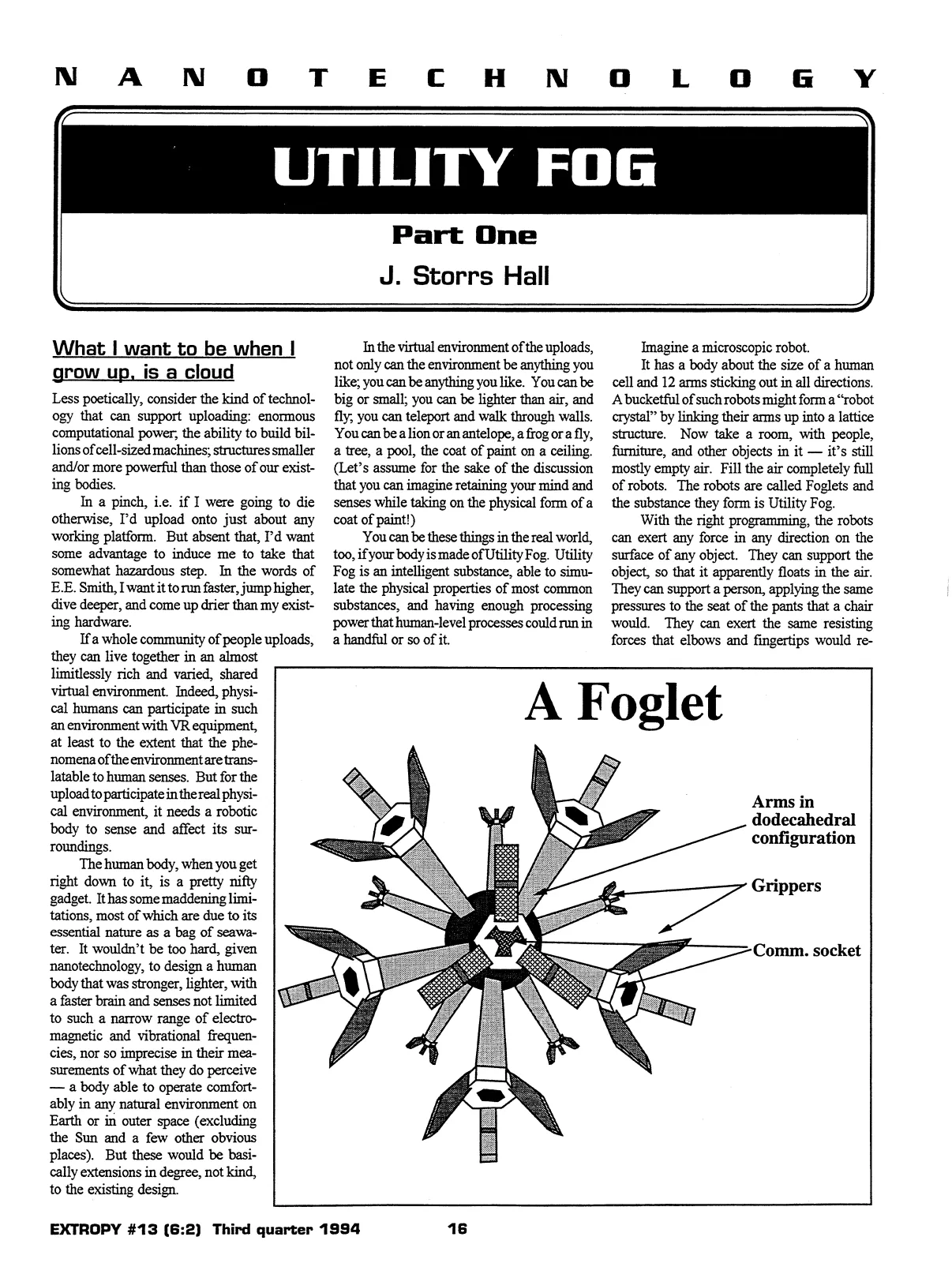
Imagine a microscopic robot.
It has a body about the size of a human cell and 12 arms sticking out in all directions. A bucketful of such robots might form a ‘robot crystal’ by linking their arms up into a lattice structure. Now take a room, with people, furniture, and other objects in it — it’s still mostly empty air. Fill the air completely full of robots. The robots are called Foglets and the substance they form is Utility Fog.
With the right programming, the robots can exert any force in any direction on the surface of any object. They can support the object, so that it apparently floats in the air. They can support a person, applying the same pressures to the seat of the pants that a chair would. They can exert the same resisting forces that elbows and fingertips would re-
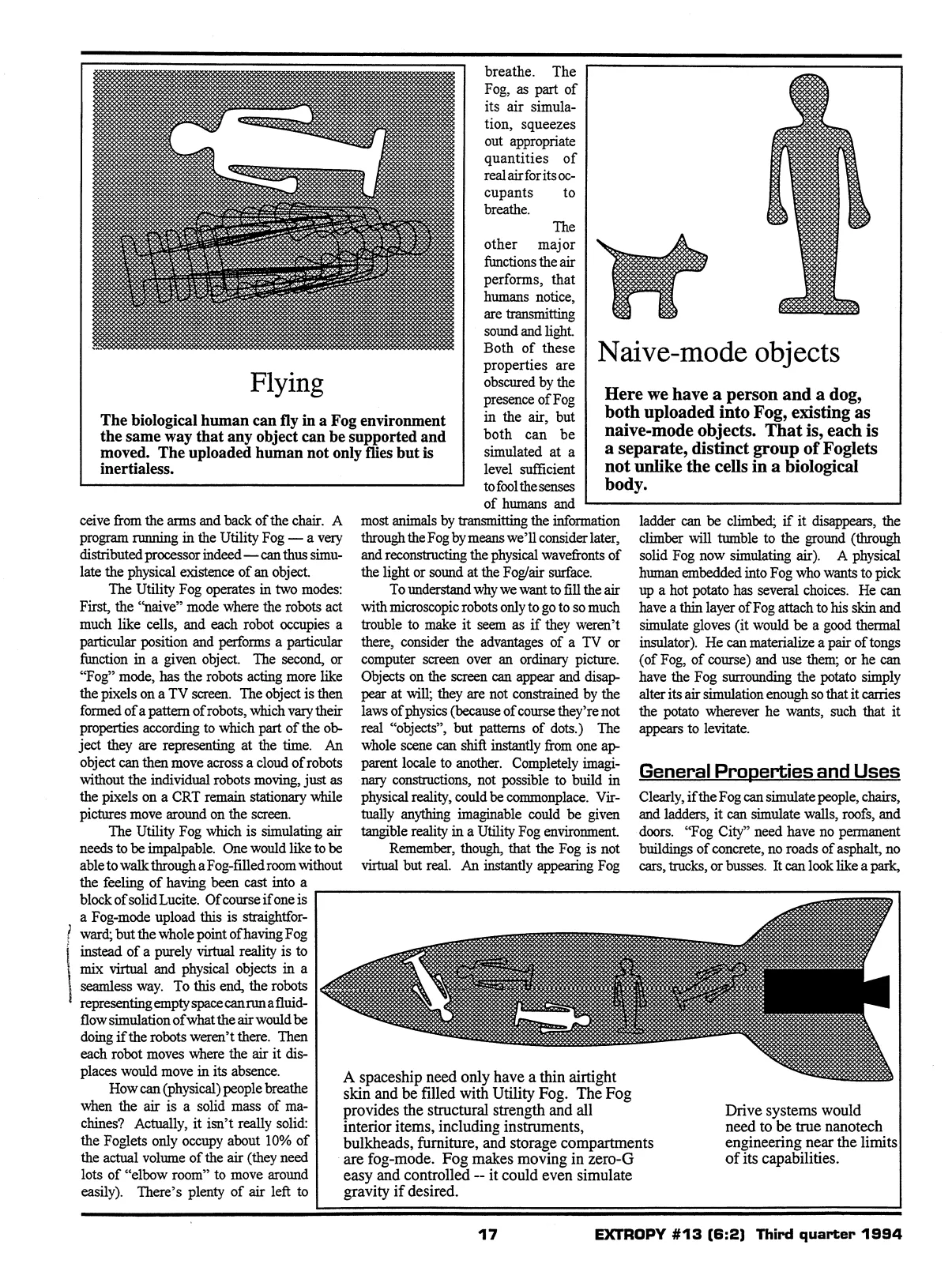
Flying
The biological human can fly in a Fog environment the same way that any object can be supported and moved. The uploaded human not only flies but is inertialess.
breathe. The Fog, as part of its air simulation, squeezes out appropriate quantities of real air for its occupants to breathe.
The other major functions the air performs, that humans notice, are transmitting sound and light. Both of these properties are obscured by the presence of Fog in the air, but both can be simulated at a level sufficient to fool the senses of humans and
Naive-mode objects
Here we have a person and a dog, both uploaded into Fog, existing as naive-mode objects. That is, each is a separate, distinct group of Foglets not unlike the cells in a biological body.
ceive from the arms and back of the chair. A program running in the Utility Fog — a very distributed processor indeed — can thus simulate the physical existence of an object.
The Utility Fog operates in two modes: First, the “naive” mode where the robots act much like cells, and each robot occupies a particular position and performs a particular function in a given object. The second, or “Fog” mode, has the robots acting more like the pixels on a TV screen. The object is then formed of a pattern of robots, which vary their properties according to which part of the object they are representing at the time. An object can then move across a cloud of robots without the individual robots moving, just as the pixels on a CRT remain stationary while pictures move around on the screen.
The Utility Fog which is simulating air needs to be impalpable. One would like to be able to walk through a Fog-filled room without the feeling of having been cast into a block of solid Lucite. Of course if one is a Fog-mode upload this is straightforward; but the whole point of having Fog instead of a purely virtual reality is to mix virtual and physical objects in a seamless way. To this end, the robots representing empty space can run a fluid-flow simulation of what the air would be doing if the robots weren’t there. Then each robot moves where the air it displaces would move in its absence.
How can (physical) people breathe when the air is a solid mass of machines? Actually, it isn’t really solid: the Foglets only occupy about 10% of the actual volume of the air (they need lots of “elbow room” to move around easily). There’s plenty of air left to most animals by transmitting the information through the Fog by means we’ll consider later, and reconstructing the physical wavefronts of the light or sound at the Fog/air surface.
To understand why we want to fill the air with microscopic robots only to go to so much trouble to make it seem as if they weren’t there, consider the advantages of a TV or computer screen over an ordinary picture. Objects on the screen can appear and disappear at will; they are not constrained by the laws of physics (because of course they’re not real “objects”, but patterns of dots.) The whole scene can shift instantly from one apparent locale to another. Completely imaginary constructions, not possible to build in physical reality, could be commonplace. Virtually anything imaginable could be given tangible reality in a Utility Fog environment.
Remember, though, that the Fog is not virtual but real. An instantly appearing Fog ladder can be climbed; if it disappears, the climber will tumble to the ground (through solid Fog now simulating air). A physical human embedded into Fog who wants to pick up a hot potato has several choices. He can have a thin layer of Fog attach to his skin and simulate gloves (it would be a good thermal insulator). He can materialize a pair of tongs (of Fog, of course) and use them; or he can have the Fog surrounding the potato simply alter its air simulation enough so that it carries the potato wherever he wants, such that it appears to levitate.
General Properties and Uses
Clearly, if the Fog can simulate people, chairs, and ladders, it can simulate walls, roofs, and doors. “Fog City” need have no permanent buildings of concrete, no roads of asphalt, no cars, trucks, or busses. It can look like a park,
A spaceship need only have a thin airtight skin and be filled with Utility Fog. The Fog provides the structural strength and all interior items, including instruments, bulkheads, furniture, and storage compartments are fog-mode. Fog makes moving in zero-G easy and controlled — it could even simulate gravity if desired.
Drive systems would need to be true nanotech engineering near the limits of its capabilities.
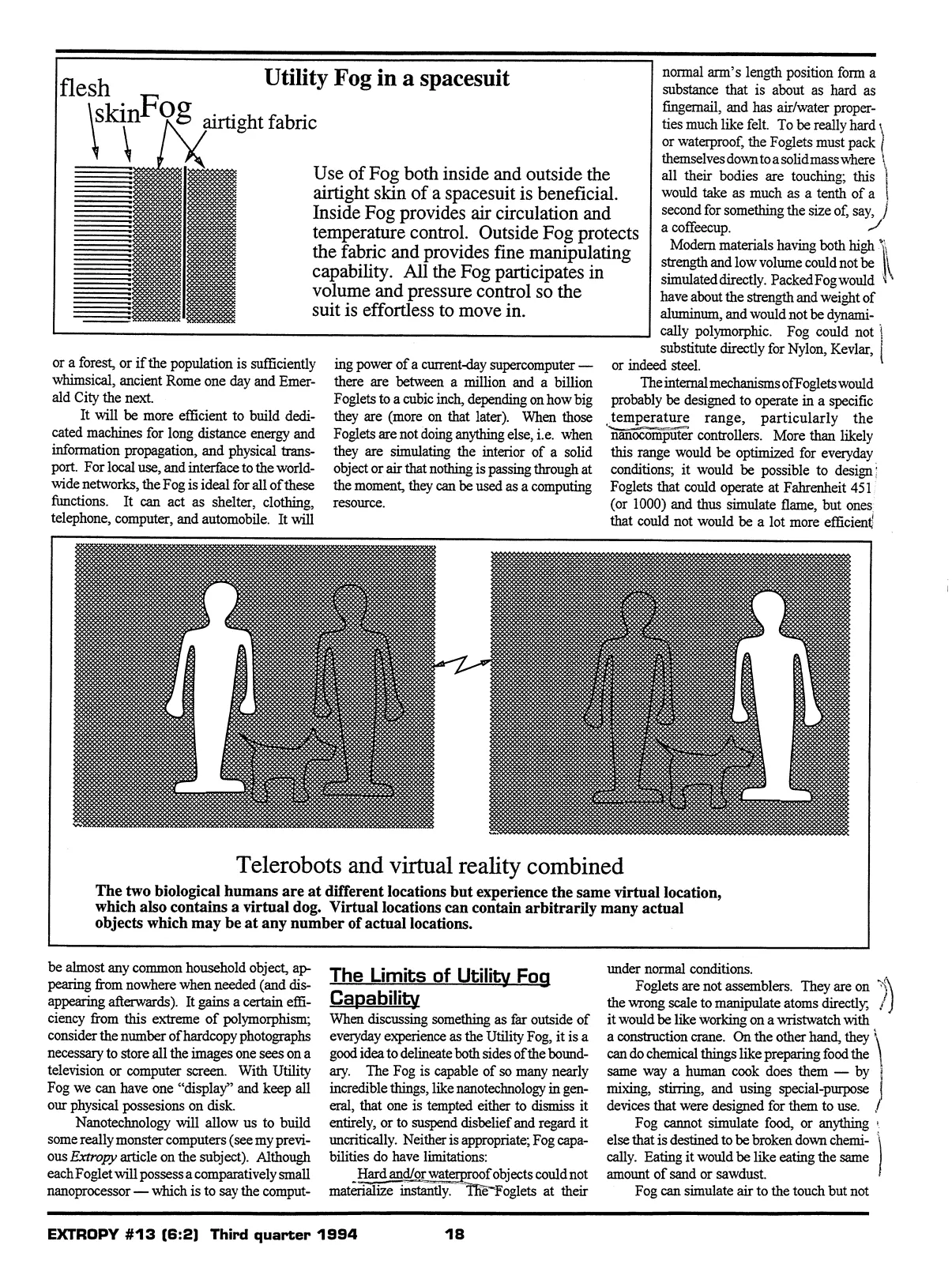
Utility Fog in a spacesuit
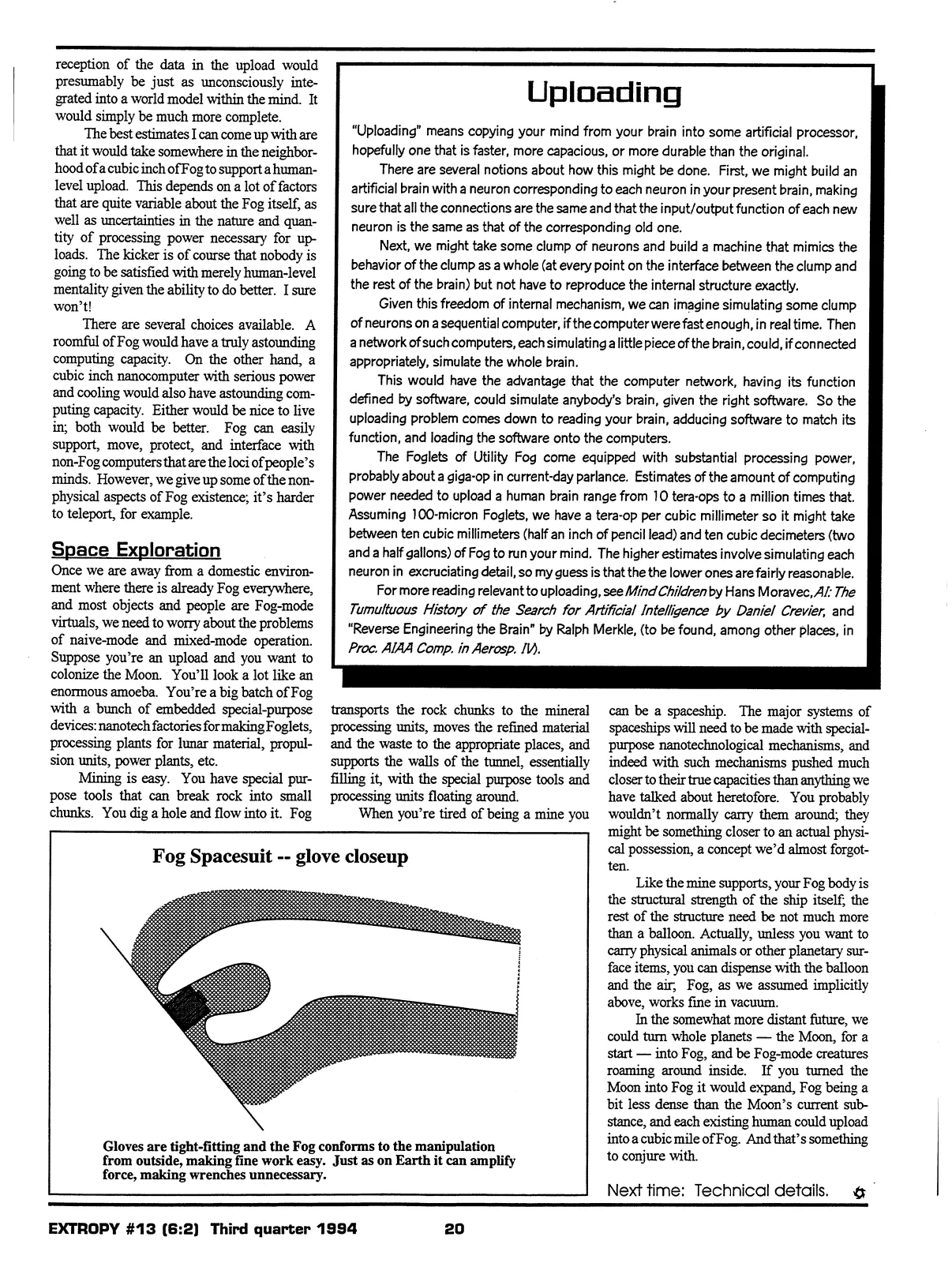
Use of Fog both inside and outside the airtight skin of a spacesuit is beneficial. Inside Fog provides air circulation and temperature control. Outside Fog protects the fabric and provides fine manipulating capability. All the Fog participates in volume and pressure control so the suit is effortless to move in.
normal arm’s length position form a substance that is about as hard as fingernail, and has air/water properties much like felt. To be really hard or waterproof, the Foglets must pack themselves down to a solid mass where all their bodies are touching; this would take as much as a tenth of a second for something the size of, say, a coffeecup.
Modern materials having both high strength and low volume could not be simulated directly. Packed Fog would have about the strength and weight of aluminum, and would not be dynamically polymorphic. Fog could not substitute directly for Nylon, Kevlar, or a forest, or if the population is sufficiently whimsical, ancient Rome one day and Emerald City the next.
It will be more efficient to build dedicated machines for long distance energy and information propagation, and physical transport. For local use, and interface to the worldwide networks, the Fog is ideal for all of these functions. It can act as shelter, clothing, telephone, computer, and automobile. It will ing power of a current-day supercomputer — there are between a million and a billion Foglets to a cubic inch, depending on how big they are (more on that later). When those Foglets are not doing anything else, i.e. when they are simulating the interior of a solid object or air that nothing is passing through at the moment, they can be used as a computing resource.
or indeed steel.
The internal mechanisms of Foglets would probably be designed to operate in a specific temperature range, particularly the nanocomputer controllers. More than likely this range would be optimized for everyday conditions; it would be possible to design Foglets that could operate at Fahrenheit 451 (or 1000) and thus simulate flame, but ones that could not would be a lot more efficient
Telerobots and virtual reality combined
The two biological humans are at different locations but experience the same virtual location, which also contains a virtual dog. Virtual locations can contain arbitrarily many actual objects which may be at any number of actual locations.
be almost any common household object, appearing from nowhere when needed (and disappearing afterwards). It gains a certain efficiency from this extreme of polymorphism; consider the number of hardcopy photographs necessary to store all the images one sees on a television or computer screen. With Utility Fog we can have one ‘display’ and keep all our physical possessions on disk.
Nanotechnology will allow us to build some really monster computers (see my previous Extropy article on the subject). Although each Foglet will possess a comparatively small nanoprocessor — which is to say the comput-
The Limits of Utility Fog Capability
When discussing something as far outside of everyday experience as the Utility Fog, it is a good idea to delineate both sides of the boundary. The Fog is capable of so many nearly incredible things, like nanotechnology in general, that one is tempted either to dismiss it entirely, or to suspend disbelief and regard it uncritically. Neither is appropriate; Fog capabilities do have limitations:
Hard and/or waterproof objects could not materialize instantly. The Foglets at their under normal conditions.
Foglets are not assemblers. They are on the wrong scale to manipulate atoms directly; it would be like working on a wristwatch with a construction crane. On the other hand, they can do chemical things like preparing food the same way a human cook does them — by mixing, stirring, and using special-purpose devices that were designed for them to use.
Fog cannot simulate food, or anything else that is destined to be broken down chemically. Eating it would be like eating the same amount of sand or sawdust.
Fog can simulate air to the touch but not
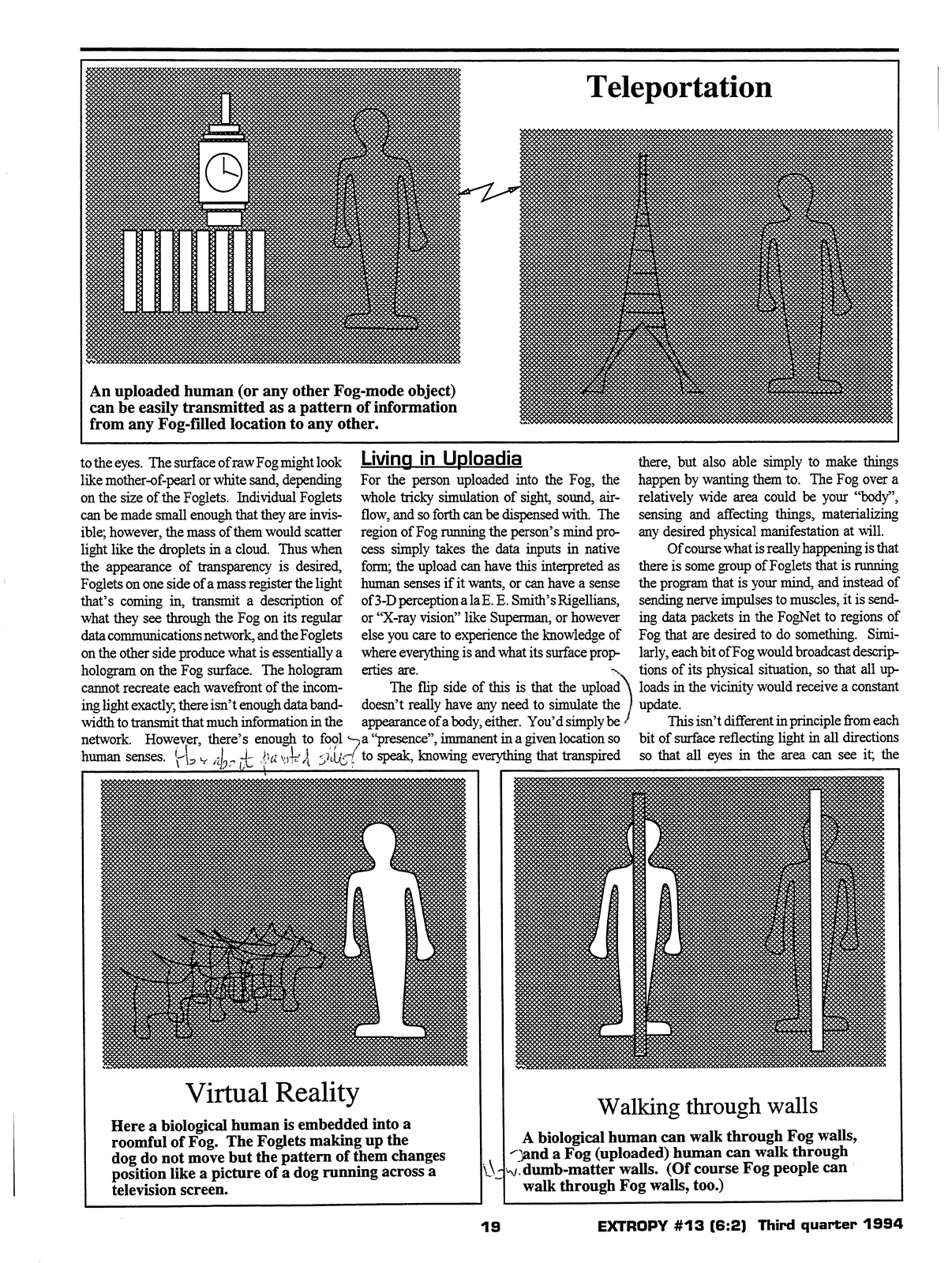
An uploaded human (or any other Fog-mode object) can be easily transmitted as a pattern of information from any Fog-filled location to any other.
Teleportation
to the eyes. The surface of raw Fog might look like mother-of-pearl or white sand, depending on the size of the Foglets. Individual Foglets can be made small enough that they are invisible; however, the mass of them would scatter light like the droplets in a cloud. Thus when the appearance of transparency is desired, Foglets on one side of a mass register the light that’s coming in, transmit a description of what they see through the Fog on its regular data communications network, and the Foglets on the other side produce what is essentially a hologram on the Fog surface. The hologram cannot recreate each wavefront of the incoming light exactly; there isn’t enough data bandwidth to transmit that much information in the network. However, there’s enough to fool human senses. Flow about painted slides
Living in Uploadia
For the person uploaded into the Fog, the whole tricky simulation of sight, sound, airflow, and so forth can be dispensed with. The region of Fog running the person’s mind process simply takes the data inputs in native form; the upload can have this interpreted as human senses if it wants, or can have a sense of 3-D perception a la E. E. Smith’s Rigellians, or “X-ray vision” like Superman, or however else you care to experience the knowledge of where everything is and what its surface properties are.
The flip side of this is that the upload doesn’t really have any need to simulate the appearance of a body, either. You’d simply be a “presence”, immanent in a given location so to speak, knowing everything that transpired there, but also able simply to make things happen by wanting them to. The Fog over a relatively wide area could be your “body”, sensing and affecting things, materializing any desired physical manifestation at will.
Of course what is really happening is that there is some group of Foglets that is running the program that is your mind, and instead of sending nerve impulses to muscles, it is sending data packets in the FogNet to regions of Fog that are desired to do something. Similarly, each bit of Fog would broadcast descriptions of its physical situation, so that all uploads in the vicinity would receive a constant update.
This isn’t different in principle from each bit of surface reflecting light in all directions so that all eyes in the area can see it; the
Virtual Reality
Here a biological human is embedded into a roomful of Fog. The Foglets making up the dog do not move but the pattern of them changes position like a picture of a dog running across a television screen.
Walking through walls
A biological human can walk through Fog walls, and a Fog (uploaded) human can walk through dumb-matter walls. (Of course Fog people can walk through Fog walls, too.)
reception of the data in the upload would presumably be just as unconsciously integrated into a world model within the mind. It would simply be much more complete.
The best estimates I can come up with are that it would take somewhere in the neighborhood of a cubic inch of Fog to support a human-level upload. This depends on a lot of factors that are quite variable about the Fog itself, as well as uncertainties in the nature and quantity of processing power necessary for uploads. The kicker is of course that nobody is going to be satisfied with merely human-level mentality given the ability to do better. I sure won’t!
There are several choices available. A roomful of Fog would have a truly astounding computing capacity. On the other hand, a cubic inch nanocomputer with serious power and cooling would also have astounding computing capacity. Either would be nice to live in; both would be better. Fog can easily support, move, protect, and interface with non-Fog computers that are the loci of people’s minds. However, we give up some of the non-physical aspects of Fog existence; it’s harder to teleport, for example.
Space Exploration
Once we are away from a domestic environment where there is already Fog everywhere, and most objects and people are Fog-mode virtuals, we need to worry about the problems of naive-mode and mixed-mode operation. Suppose you’re an upload and you want to colonize the Moon. You’ll look a lot like an enormous amoeba. You’re a big batch of Fog with a bunch of embedded special-purpose devices: nanotech factories for making Foglets, processing plants for lunar material, propulsion units, power plants, etc.
Mining is easy. You have special purpose tools that can break rock into small chunks. You dig a hole and flow into it. Fog
Uploading
“Uploading” means copying your mind from your brain into some artificial processor, hopefully one that is faster, more capacious, or more durable than the original.
There are several notions about how this might be done. First, we might build an artificial brain with a neuron corresponding to each neuron in your present brain, making sure that all the connections are the same and that the input/output function of each new neuron is the same as that of the corresponding old one.
Next, we might take some clump of neurons and build a machine that mimics the behavior of the clump as a whole (at every point on the interface between the clump and the rest of the brain) but not have to reproduce the internal structure exactly.
Given this freedom of internal mechanism, we can imagine simulating some clump of neurons on a sequential computer, if the computer were fast enough, in real time. Then a network of such computers, each simulating a little piece of the brain, could, if connected appropriately, simulate the whole brain.
This would have the advantage that the computer network, having its function defined by software, could simulate anybody’s brain, given the right software. So the uploading problem comes down to reading your brain, adducing software to match its function, and loading the software onto the computers.
The Foglets of Utility Fog come equipped with substantial processing power, probably about a giga-op in current-day parlance. Estimates of the amount of computing power needed to upload a human brain range from 10 tera-ops to a million times that. Assuming 100-micron Foglets, we have a tera-op per cubic millimeter so it might take between ten cubic millimeters (half an inch of pencil lead) and ten cubic decimeters (two and a half gallons) of Fog to run your mind. The higher estimates involve simulating each neuron in excruciating detail, so my guess is that the lower ones are fairly reasonable.
For more reading relevant to uploading, see Mind Children by Hans Moravec, AI: The Tumultuous History of the Search for Artificial Intelligence by Daniel Crevier, and “Reverse Engineering the Brain” by Ralph Merkle, (to be found, among other places, in Proc. AIAA Comp. in Aerosp. IV).
transports the rock chunks to the mineral processing units, moves the refined material and the waste to the appropriate places, and supports the walls of the tunnel, essentially filling it, with the special purpose tools and processing units floating around.
When you’re tired of being a mine you can be a spaceship. The major systems of spaceships will need to be made with special-purpose nanotechnological mechanisms, and indeed with such mechanisms pushed much closer to their true capacities than anything we have talked about heretofore. You probably wouldn’t normally carry them around; they might be something closer to an actual physical possession, a concept we’d almost forgotten.
Like the mine supports, your Fog body is the structural strength of the ship itself; the rest of the structure need be not much more than a balloon. Actually, unless you want to carry physical animals or other planetary surface items, you can dispense with the balloon and the air; Fog, as we assumed implicitly above, works fine in vacuum.
In the somewhat more distant future, we could turn whole planets — the Moon, for a start — into Fog, and be Fog-mode creatures roaming around inside. If you turned the Moon into Fog it would expand, Fog being a bit less dense than the Moon’s current substance, and each existing human could upload into a cubic mile of Fog. And that’s something to conjure with.
Fog Spacesuit — glove closeup
Gloves are tight-fitting and the Fog conforms to the manipulation from outside, making fine work easy. Just as on Earth it can amplify force, making wrenches unnecessary.
Next time: Technical details.
9
EXTRO 1 T-shirt
Utility Fog in New Book
There will be a chapter about Utility Fog in Nanotechnology and the Culture of Abundance, B.C. Crandall, ed., forthcoming from MIT Press. The chapter deals with Utility Fog completely from the perspective of interfacing organic humans to a Fog environment; no uploading.
T-shirts cost $15 each ($14 for Exl members), postage included.
To order your EXTRO 1 T-shirt, send a check or cash to:
Department S, Extropy Institute
13428 Maxella Avenue, #273
Marina Del Rey, CA 90292
VIEW ORIGINAL SCAN (6 pages)