Issue: EXTROPY #12 · First Quarter 1994
Author: Max More & Harry S. Hawk
Pages: 40–44 · 5 scanned pages
The Transhuman Taste: Reviews (Fuzzy Thinking, The Children's Machine)
The Transhuman Taste
REVIEWS OF EXTROPIAN INTEREST
Fuzzy Thinking:
The New Science of Fuzzy Logic
By Bart Kosko
Hyperion, New York, 1993. 318 pages. ISBN: 1-56282-839-8 $24.95
Reviewed by Max More
2/00 wds
Seeking to continually improve the power and accuracy of our thinking, we Extropians ceaselessly search for new tools for thought. Fuzzy logic and, more broadly, fuzzy thinking — despite its initially off-putting nomenclature — adds to our intellectual arsenal of stupidity-destroying weapons. Fuzzy Thinking goes deeper than McNeill and Freiburger’s recent groundbreaking book on the topic, as is to be expected since Dr. Kosko may fairly be described as the leading fuzzy proponent. Kosko teaches classes on neural networks and fuzzy systems at USC, and has written two technical books in the area (Neural Networks and Fuzzy Systems, and Neural Networks for Signal Processing). Fuzzy Thinking is of further interest due to Kosko’s explicit advocacy of libertarian values and physical immortality and cryonics, and his discussion of the prospect of nanotechnology and the shape of the future. I first became aware of Kosko in 1988 when he gave a guest lecture to a cognitive science class in the philosophy department at USC (where he did undergraduate work) — a class attended by Tom Morrow and myself.
First introducing the reader to the Fuzzy Principle (Everything is a Matter of Degree), Fuzzy Thinking proceeds historically, with sections on The Fuzzy Past, The Fuzzy Present, and The Fuzzy Future. Though much fuzzy theory is the product of the last three decades, it originated in the work of philosophers such as Charles Pierce, Bertrand Russell, and Max Black. Heisenberg’s uncertainty principle prompted logicians such as Jan Lukasiewicz in the 1920s and ’30s to develop multivalued logic. The invention of fuzzy set theory — a crucial advance — was made by philosopher Max Black in his 1937 paper ‘Vagueness: An Exercise in Logical Analysis’, published in Philosophy of Science. Unfortunately Black’s untraditional analysis was ignored by other philosophers and scientists, otherwise the field might now be termed ‘vague logic’. The name ‘fuzzy logic’ was bestowed by fuzzy pioneer Lofti Zadeh in 1962. Bart Kosko himself two offers definitions of ‘fuzzy logic’:
The first meaning is multivalued or ‘vague’ logic. Everything is a matter of degree including truth and set membership. This dates back to the turn of the century. The second meaning is reasoning with fuzzy sets or with sets of fuzzy rules. [292]
The choice of the term ‘fuzzy’ strikes me as an unfortunate strategic error. The connotation of imprecision and wooliness, though unmerited, will stiffen opposition to fuzzy logic’s acceptance by the scientific and rationalist communities. This nomenclature probably contributed to the distress evident in this comment by Professor William Kahan: ‘Fuzzy theory is wrong, wrong, and pernicious. What we need is more logical thinking, not less. The danger of fuzzy logic is that it will encourage the sort of imprecise thinking that has brought us so much trouble. Fuzzy logic is the cocaine of science.’ I would be tempted to reply that many scientists need some kind of stimulant to their thinking.
Compounding the obstacle raised by the field’s name is Kosko’s linking of it with Eastern philosophy. While Eastern philosophy indeed has — to a minor extent — anticipated the field, emphasizing the connection will repel many Occidental-centric rationalists. Prior to actually reading the book they are likely to see it as another ludicrous comparison in the tradition of Fritjof Capra’s linkage of Eastern mysticism to quantum physics in The Tao of Physics (a book I cannot recommend too lowly).
The Eastern connection enters by way of the ‘Aristotle vs. the Buddha’ theme. Aristotle invented Western bivalent logic, and represents that tradition. According to Aristotelian bivalence, everything is either A or not-A — either grass is green or is not green. Nothing can both have an attribute and not have it at the same time. As Kosko argues, this view has rarely been questioned and is built into the thinking of practically all Western scientists and philosophers. (There are exceptions: Philosopher Derek Parfit, in Reasons and Persons, bases his personal identity theory on a relation of psychological connectedness that holds to varying degrees.) The Buddha is taken to represent the idea, never developed formally in the East, that truth is a matter of degree, that a thing can be A and not-A to varying degrees. A man may be tall and not-tall to a certain extent. The fuzzy view allows that not only is the part contained in the whole, but the whole is contained in the part — to some degree ranging from 0% to 100%. These conflicting views are revealed by these two authoritative statements:
Everything must either be or not be, whether in the present or the future. (Aristotle, De Interpretatione)
I have not explained that the world is eternal or not eternal. I have not explained that the world is finite or not finite.
(The Buddha, Majjhima-Nikaya)
Subsethood appears able to take the place of probability in explaining phenomena, and avoids the need to see probability as a metaphysical rather than an epistemic notion (i.e., avoids seeing things as having a probability, rather than probability being a statement about our knowledge of things). Kosko shows that the degree of subsethood equals the conditional probability of traditional theory. ‘What is the probability of success? The degree to which all trials are successful, the degree to which the set of successful trials contains the set of all trials… In general the probability of a set or event A equals the degree to which the part A contains the ‘sample space’ X.’
Randomness and metaphysical probability, Kosko argues, can be dispensed with.
And Einstein looks right again: God need not play dice. The universe is not random. You can take it one step deeper and get rid of the ‘randomness.’ The universe is deterministic but gray. Chaos theory had already gotten the determination part right. Fuzzy theory now confirmed that and [showed] that all things were matters of degree too.’ [63]
Some care should be exercised in interpreting a statement such as ‘the universe is deterministic but gray.’ At the quantum level, entities may truly be fuzzy themselves. Here, fuzzy logic can be applied directly, as has already been done (for instance by Hilary Putnam in his discussion of quantum logic as applied to the Measurement Problem. At the macro level things themselves are determinate and unfuzzy. Individual objects have a determinate mass, number of atoms, positions, and so on (unless they are things like clouds…). Fuzziness appears when we consider attributes or qualities of things, and when we consider concepts of things-of-a-type. In the case of attributes (‘This apple is red’) our descriptions are fuzzily true or false (the apple may be mostly red but also partly green). In the case of concepts of types of things or actions (including scientific concepts), fuzziness is revealed when we realize there are many borderline cases. Our concepts are fuzzy sets. I like one of Kosko’s illustrations of the fuzziness of an action: ‘Touch your mother’s toe. Is that incest or not incest? Touch her ankle, her shin, her knee. Is that incest? And so on up.’
Having introduced the Fuzzy Principle, in the Fuzzy Present, Kosko explains that fuzzy logic is reasoning with fuzzy sets. This section begins by arguing that mathematics is just a limiting case of fuzzy set theory, then develops the idea of fuzzy entropy as a measure of fuzziness (measured in fuzzy units or fits as distinguished from binary units or bits). This section of the book contains plenty of solid material, such as an accessible presentation of the Fuzzy Approximation Theorem (FAT), Fuzzy Associative Memory, adaptive fuzzy systems, and fuzzy cognitive maps. Kosko demonstrates that fuzzy logic, rather
THINKING
BART KOSKO
A MIND-BEARING MEDITATION WITH THE FOREMOST FUZZY PHILOSOPHER SCIENTIST than being merely a fascinating idea, has immediate practical applications, providing a list of patented applications such as fuzzy systems that control anti-lock brakes, eliminate hand-jitter from cameras, regulate the mixing of chemicals, and one that stabilizes a helicopter in flight when it loses one of its rotor blades — a feat unmatched by any human operator or math model.
‘Chapter 11: Adaptive Fuzzy Systems’ clearly explains the tight connection between fuzzy systems and neural networks. Anyone familiar with neurocomputing will immediately see how fuzzy rules (or principles) and the Fuzzy Approximation Theorem are interwoven with connectionist systems. Fuzzy reasoning already has increased machine IQ, allowing computers to adapt, learn, and recognize far more effectively than allowed by traditional rigid, rule-based, symbol-manipulating AI approaches (what Fodor calls GOFAI — Good Old-Fashioned AI). Fuzzy Thinking (or Kosko’s textbook, Neural Networks and Fuzzy Systems) combine with neurophilosopher Paul Churchland’s brilliant A Neurocomputational Perspective to illuminate the power and promise of this approach to machine intelligence and neuroscience.
The final section of the book, The Fuzzy Future, applies fuzzy thinking to issues of life and death, the ‘social contract’, why the universe exists, and our future. In Life and Death, Kosko analyzes the fuzzy nature of life and death, illustrating the latter by introducing many readers to cryonics and nanotechnology. Kosko boldly comes out and states that he himself has made arrangements for being cryonically suspended. ‘Chapter 15: Man and God’, being crammed with several fascinating and stimulating discussions, left me hungry for more. Included here are speculations as to how mathematics may require that the universe exist, the effects on us of widely used smart drugs and smart weapons, and the prospects of advanced machine intelligence and indefinite lifespans.
I would not have fulfilled my duty as a reviewer if I failed to pick out a few errors that detract from the overall excellence of this book. Kosko offhandedly claims that ‘Most modern philosophers are behaviorists’ (82) — an assertion that I’ve heard from others but which clashes with my experience. Though true in the ’50s and ’60s, philosophy has moved on, most contemporary philosophers esposing functionalism (a view which developed out of behaviorism but which allows room for the causal power of internal cognitive states in addition to sensory input and behavioral output).
I also take issue with Kosko’s equation of a coherence theory of truth with logical truth: ‘Coherent truth is empty if achieved, and self-contradictory if not achieved…’ Certainly this is correct if coherence is restricted to the domain of logical and mathematical truths (excluding applied geometry), but coherence theories apply also to factual and moral questions. A coherence theory holds that the justifiability of a belief depends on the other beliefs one holds, and denies that there is any special set of beliefs (such as those based on sense perception) that are certain and that provide foundations for other beliefs.
I wish to emphasize that Fuzzy Thinking is not a dry, if trenchant, study. The book is effectively balanced by absorbing personal anecdotes and vignettes of leading figures in fuzzy research, such as Professor Takeshi Yamakawa — a fifth dan black belt in Shotokan karate, fuzzy chip designer, and leader of the Fuzzy Logic Systems Institute in south Japan.
Although irrelevant to the value of the ideas, Extropian readers will appreciate Kosko’s personality as it emerges throughout the book (and as reported in McNeill and Freiberger’s earlier book). Clearly Kosko is extropian: Highly intelligent, self-confident, physically fit, and an iconoclast. Far from being the vague, soft-headed, lazy person that might be connoted by the word ‘fuzzy’, Kosko comes across as thoroughly undecadent — hardworking, innovative, and disciplined.
Dr. Kosko’s exceptional ideas provide powerful new tools for thought, to the delight of anyone committed to intensifying their intelligence and enhancing their rationality. Lucid, incisive, and startling, Fuzzy Thinking should spur a productive re-evaluation of methodology in numerous fields of science, and illuminate some of the fundamental questions about life that we all ponder. Expect to see widespread and virulent opposition to fuzzy logic from those who choose tradition over transformation and agreement over advancement.
The Children’s Machine:
Rethinking School in the Age of the Computer
by Seymour Papert
Published by Basic Books, a division of Harper Collins
Publishers, Inc. New York, 1993.
230 pages; ISBN: 0-465-01830-0
Reviewed by Harry S. Hawk
Seymour Papert is one of the more well known faculty members of the MIT Media Lab. He is also known for his work with Logo and Lego Logo, the computer language/learning environment. His latest book, ‘The Children’s Machine,’ focuses on many aspects of society that are of interest to Extropians. This includes the evolution of technology, and the process of learning. He writes, ‘this book focuses on… How does the relationship between children and computers effect learning,’ adding, ‘Understanding this relationship will be crucial to our ability to shape the future.’ He is optimistic because he sees ‘synergy between the technological revolution and the epistemological changes in how we think about knowledge.’
Michael Rothschild in Bionomics, puts forth the following idea: Faster modes of learning lead directly to economic efficiencies and profits. Papert acknowledges this theme when he writes, ‘the Japanese success is exactly the ability responsible for America’s past success — the willingness to learn. Complainers would do well to relearn from the Japanese the skill of learning, at which America was once the world’s champion.’ Papert has made his career in learning about how young children learn.
Papert makes an insightful point about how our society has been changed by technology. He uses an example of a operating room, and the technology found in that operating room, and how much that technology has changed in the last 200 years. Then he compares the technology and other aspects of school rooms. He feels, and I agree, the technology has changed very little in the same time period. He feels that this a major problem facing America.
Papert asks, ‘Why, through a period when so much human activity has been revolutionized, have we not seen comparable change in the ways we help our children learn?’ Extropians can easily answer this question, ‘government control of our schools.’ Papert might lump Extropians in the group he calls, ‘the Yearners, who respond by citing impediments to change in education such as costs, politics, the immense power of the vested interests of school bureaucrats…’ He has found another group, ‘the Schoolers [who] are taken aback by the suggestion for megachange [in schooling].’ Papert who is clearly a Yearner wants to overcome the difficulties associated with bringing change to our schools.
The Children’s Machine is Papert’s journey through the education landscape; it is his call for action for megachange in our education system. While Extropians might prefer a frontal attack on governmental control and entrenched bureaucrats through voucher systems or tax credits, they should find Papert’s work quite rewarding, even though he doesn’t call for any of these measures. He is seeking to radically alter school curricula through technology. The book is divided into 10 chapters: Yearners and Schools; Personal Thinking; School: Change and Resistance to Change; Teachers; A Word for Learning; An Anthology of Learning Stories; Instructionism versus Constructionism; Computerists; Cybernetics; and What Can be Done? What is interesting about Papert’s ideas is that those who are interested in them don’t have to wait for the government to implement them. We can use them to teach our children and perhaps ourselves. However, Papert is a strong supporter of pluralist, democratic public education and is concerned that the changes he is proposing might ‘first enhance the lives of the children of the wealthy and powerful.’ He hopes the changes will first occur in the public school system. Given that private school students often seem better motivated with the traditional approaches, a public school implementation might have the most impact. However, I feel that Papert’s ideas are too good to wait until the public school sector embraces them.
Papert coins a new word — mathetic — and then uses this word throughout the book. He was looking for a word to denote learning as heuristics denotes problem solving. He revisited a ‘family of Greek words related to learning… ma[king] restitution for a semantic theft perpetrated by [those]… who stole the word mathematics…mathematikos meant ‘disposed to learn,’ mathema was ‘a lesson,’ and menthanien was the verb ‘to learn.’
A central theme of mathetic based education is constructing environments where students are self-motivated to learn because of their interactions with an environment. Certainly that is how many of us learn. For example, I observed Perry Metzger using PERL, and I wanted to play with it too. In playing with PERL I learned about not only programming, but how to run a mailing list, and about other aspects of the Internet. It is unlikely I would have acquired so much knowledge so quickly in a formal learning environment. Indeed Papert rejects the formal; Papert disputes the view that there is a single method of teaching a single subject. That makes sense on several levels. First, given the memetic differences among individuals it makes sense that individuals will behave as individuals. That the most effective learning mode for them will be a learning environment that focuses (or rather allows them to focus) on their own interests. That is the essence of Papert’s view.
Papert introduces John Dewey who, ‘began his campaign for a more active and self-directed style of learning in schools over a hundred years ago… Dewey remains a hero to those who believe in a twentieth-century vision of a child as a person with the right to intellectual self-determination.’ He likes to use video games as one example of an ‘ideal.’ He says, ‘School would have parents… believe that children love them [video games] and dislike homework because the first is easy and the second is hard. In reality, the reverse is more often true… These toys, by empowering children to test out ideas about working within prefixed rules and structures in a way few other toys are capable of doing, have proved capable of teaching students about the possibilities and drawbacks of a newly presented system in ways many adults should envy. Video games teach … [us] that some forms of learning are fast-paced, immensely compelling, and rewarding. By comparison school strikes many young people as slow, boring and frankly out of touch.’
As individualists, I think many if not most Extropian-minded persons can relate to the idea of intellectual self-determination. However, based on my conversations with many Extropians, I am unsure how many would endorse this idea for children (biological, mind, or other…). I have certainly heard many call for a return to some sort of classical education, you know, ‘Education the way it used to be when it was good!; force children to learn Latin, etc.’ Papert would strongly disagree; he wants to turn education upside down — and I agree with him. He writes, ‘there can be little doubt that a child treated with respect and encouragement rather than threatened with rejection and punishment will fare better…’
Papert is trying to create such environments for learning. In Lego Logo and video games there is no right and wrong¹, there are only techniques to be learned and rules to be discovered rather than dogma being preached and reinforced by teachers. Papert writes, ‘I have always yearned for ways of learning in which children act as creators rather than consumer of knowledge… There is a family resemblance … between the vision of learning I am presenting here and certain philosophical principles expressed in the diverse forms of innovations that go under such names as progressive or open or child-centered or constructivist or radical education.’
A critical issue is how do we teach subjects that many consider highly formal, like mathematics. Papert states,
My goal became to create an environment in which children could learn algebra and geometry… in ways more like the informal learning of the unschooled toddler or the exceptional child than the educational process followed in schools… [For example] every preschool child has amassed on his or her own special mathematical knowledge about quantities², about space, about the reliability of various reasoning processes, elements that will be useful later in the math class… The central problem for math education is to find ways to draw on this vast experience… [to] construct microworlds in which children pursue mathematical activity… giving children the opportunity to learn and use mathematics in a nonformalized way of knowing [that] encourages rather than inhibits the eventual adoption of a formalized way.³
Papert is clear that these nonformalized methods can’t be tricks: ‘the point of developing nonformalized ways of knowing… is entirely subverted if these are conceived as… a trick to lure children into formalized instruction. They have to be valued for themselves and genuinely useful to the learner in and of themselves.’ He provides an example of a class programming with turtle geometry⁴ African textile designs. All of what they learned can be used to build a formal knowledge of geometry but the purpose in which they used the turtle geometry for was to simply learn about African textile designs. Seymour says, ‘Geometry is not there for being learned. It is there for being used.’ He finds that since different students learn differently they must be ‘taught’ differently; some will thrive with rigid formalism while others will thrive when allowed to follow their educational ‘muse.’ I don’t think anything could be more extropic than the acknowledgment of the uniqueness of an individual. Papert describes a few of the programming projects undertaken with Lego Logo and the results are very interesting. Students learning math and engineering skills while they are building ‘trucks, robots, and houses.’
He talks about Schoolers having immunological reactions to his methods; I can understand that. The meta point about Papert’s call for megachange is that not only does he want to challenge how lessons are taught, but he also wants to change the subjects. He is looking for a big ‘departure from the [current] curriculum.’ He wants us to question, ‘not only how a school teaches but what as well.’ Papert is also a fan of what I call Integrationism — that many things are related and do not have to be divided and taught separately⁵.
Surprisingly, by the end of the book, he does come out strongly against large bureaucrat school administrations. He also compares national standardized testing and the curriculum to support it to GOSPLAN in Russia under the communists. In fact he compares all hard inflexible curricula to GOSPLAN. What he calls for, ultimately, is a learning environment that is almost like a market for ideas and assignments. He is saying that in the right environment children will order themselves and their learning spontaneously. That certainly sounds extropian. It should be noted that he is not proposing, directly, such an educational system for high school students but rather for grammar school students. He is saying before we teach children to read and count by rote, we should first put them in an environment where they learn how to learn and more importantly learn how to think and reason with logic. He wants teachers who are not specialized technicians but rather facilitators of knowledge; he wants students to bring and retain their innate desire for fun⁶ into the class room and harness it to turn them into world class learners.
I highly recommend this book. Any Extropian who is interested in either improving educational instruction and is interested the subject of how children learn will find it especially useful.
[Notes on next page]
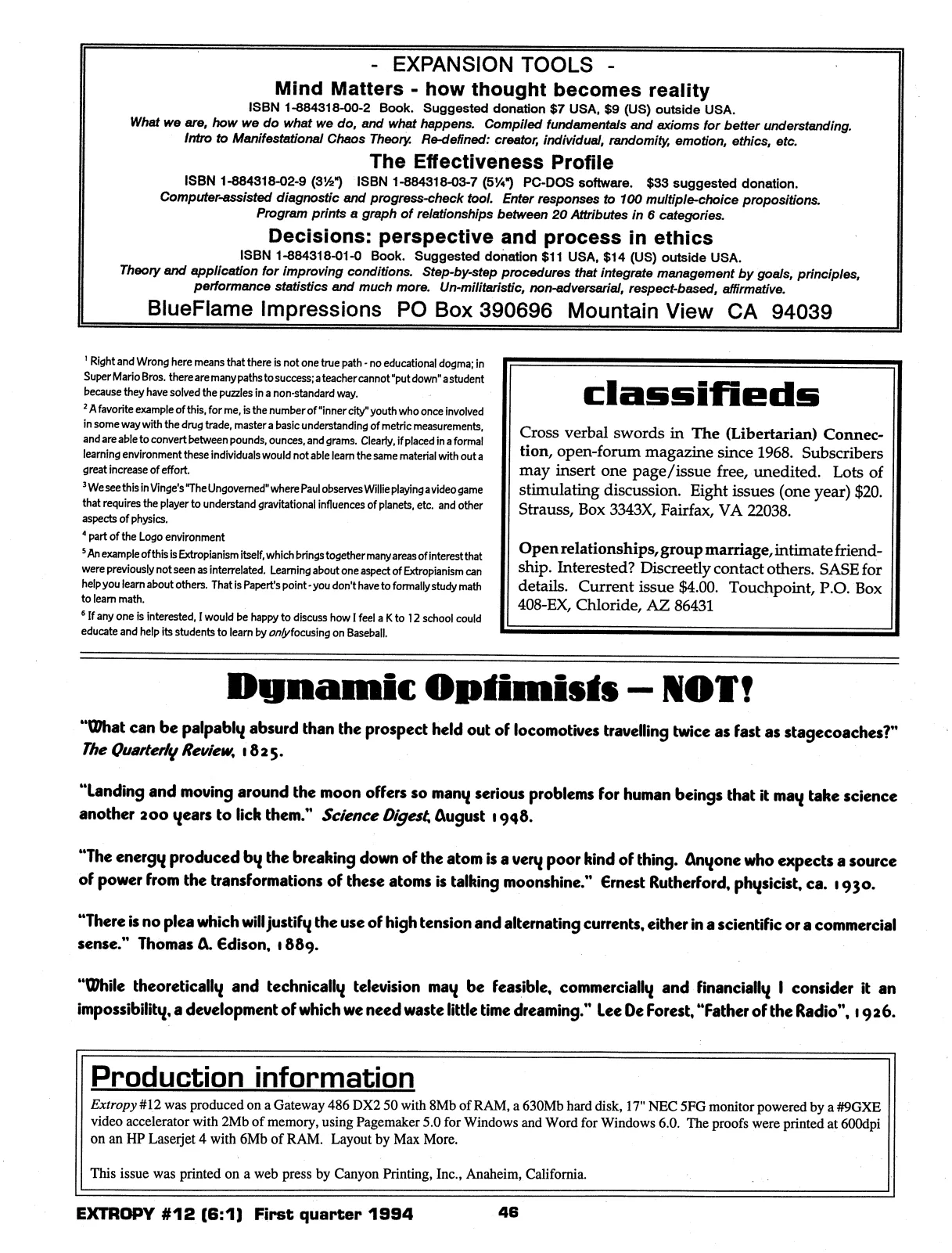
- EXPANSION TOOLS -
Mind Matters - how thought becomes reality
ISBN 1-884318-00-2 Book. Suggested donation $7 USA, $9 (US) outside USA.
What we are, how we do what we do, and what happens. Compiled fundamentals and axioms for better understanding.
Intro to Manifestational Chaos Theory. Re-defined: creator, individual, randomity, emotion, ethics, etc.
The Effectiveness Profile
ISBN 1-884318-02-9 (3½”) ISBN 1-884318-03-7 (5¼”) PC-DOS software. $33 suggested donation.
Computer-assisted diagnostic and progress-check tool. Enter responses to 100 multiple-choice propositions.
Program prints a graph of relationships between 20 Attributes in 6 categories.
Decisions: perspective and process in ethics
ISBN 1-884318-01-0 Book. Suggested donation $11 USA, $14 (US) outside USA.
Theory and application for improving conditions. Step-by-step procedures that integrate management by goals, principles, performance statistics and much more. Un-militaristic, non-adversarial, respect-based, affirmative.
BlueFlame Impressions PO Box 390696 Mountain View CA 94039
¹ Right and Wrong here means that there is not one true path - no educational dogma; in Super Mario Bros. there are many paths to success; a teacher cannot “put down” a student because they have solved the puzzles in a non-standard way.
² A favorite example of this, for me, is the number of “inner city” youth who once involved in some way with the drug trade, master a basic understanding of metric measurements, and are able to convert between pounds, ounces, and grams. Clearly, if placed in a formal learning environment these individuals would not able learn the same material with out a great increase of effort.
³ We see this in Vinge’s “The Ungoverned” where Paul observes Willie playing a video game that requires the player to understand gravitational influences of planets, etc. and other aspects of physics.
⁴ part of the Logo environment
⁵ An example of this is Extropianism itself, which brings together many areas of interest that were previously not seen as interrelated. Learning about one aspect of Extropianism can help you learn about others. That is Papert’s point - you don’t have to formally study math to learn math.
⁶ If any one is interested, I would be happy to discuss how I feel a K to 12 school could educate and help its students to learn by only focusing on Baseball.
classifieds
Cross verbal swords in The (Libertarian) Connection, open-forum magazine since 1968. Subscribers may insert one page/issue free, unedited. Lots of stimulating discussion. Eight issues (one year) $20. Strauss, Box 3343X, Fairfax, VA 22038.
Open relationships, group marriage, intimate friendship. Interested? Discreetly contact others. SASE for details. Current issue $4.00. Touchpoint, P.O. Box 408-EX, Chloride, AZ 86431
Dynamic Optimists - NOT!
“What can be palpably absurd than the prospect held out of locomotives travelling twice as fast as stagecoaches?” The Quarterly Review, 1825.
“Landing and moving around the moon offers so many serious problems for human beings that it may take science another 200 years to lick them.” Science Digest, August 1948.
“The energy produced by the breaking down of the atom is a very poor kind of thing. Anyone who expects a source of power from the transformations of these atoms is talking moonshine.” Ernest Rutherford, physicist, ca. 1930.
“There is no plea which will justify the use of high tension and alternating currents, either in a scientific or a commercial sense.” Thomas A. Edison, 1889.
“While theoretically and technically television may be feasible, commercially and financially I consider it an impossibility, a development of which we need waste little time dreaming.” Lee De Forest, “Father of the Radio”, 1926.
Production information
This issue was printed on a web press by Canyon Printing, Inc., Anaheim, California.
VIEW ORIGINAL SCAN (5 pages)