Issue: EXTROPY #11 · Summer/Fall 1993
Author: David Krieger
Pages: 22–29 · 8 scanned pages
A Conversation with Mark S. Miller (Pt. 2): The Day the Universe Stood Still
A CONVERSATION WITH MARK S. MILLER
by David Krieger
PART TWO:
The Day the Universe Stood Still
Mark S. Miller is one of the system architects of the Xanadu project, the electronic hypertext system conceived by Ted Nelson as the future of publishing. Miller is also co-author, with K. Eric Drexler, of the Agorics papers (published in The Ecology of Computation, B. A. Huberman, ed.; New York: Elsevier-North Holland, 1988) which first presented the idea of agoric open computing systems — computer operating systems in which system resources such as memory and processing cycles are traded by programs and processes on an internal open market. I spoke with Mark in Palo Alto, California, in September, 1992. In Part One of this interview (see Extropy #10), we discussed “creole physics” and the credit theory of identity. In this, the conclusion of the interview, we talk about the five flavors of libertarianism, including “nanarchy,” and Jim Bennett’s “Reverse Polish Moon Treaty”:
Let’s talk about libertarianism. In Literary Machines¹, Ted Nelson refers to your complaints about there being too much gravity, and your detestation of governments. How did you become a libertarian?
Well, I started out as a socialist. I was a socialist for the reason I believe many people are socialist, which is for actually much the same reason many people are libertarians, which is a deep desire to see people being more free and, in the case of when I was a socialist, a misunderstanding of under what kind of system people would in fact be more free. A strong anti-authoritarianism, a strong sense that the current structures and institutions in society are in need of much change and reform, and that something much better is possible.
So I was a socialist for many years. I would argue with my cousin Neil. Finally he handed me a copy of The Moon Is A Harsh Mistress.² When I put that book down, I was certainly not convinced of the case for free markets or for libertarianism — it doesn’t even use the word libertarianism — but I knew that my socialism was wrong. When I put that book down I was no longer a socialist. I knew that my socialism had been naive, that there were a lot of things I hadn’t thought through, and that I needed to reassess things. It got me started thinking about all of these matters again from a fresh perspective.
I went through the sequence many libertarians go through, which is getting into libertarianism wholeheartedly by becoming a Randroid, by getting in through Objectivism. So I read all of Rand’s novels, I inhaled them, I loved them. This was the Truth, the Beauty, the Light — it was such an incredible experience that I did become an obsessive, obnoxious Randroid for a while, and many of the people from the XanAMIX community remember me from those days.
The next stage that many of us go through, which I went through, is to go from there to a kind of Nozick-style first-principles axiomatic libertarianism. From there, you kind of mellow out, if you will, into more of a Hayekian, Austrian, evolutionary libertarian.
Spontaneous orders and emergent systems, rather than a rigid “These are the rules, these are the results” kind of thing.
I have an interesting observation about libertarianism, which I think will be especially interesting to Extropians. There are, as far as I can see, five internally-consistent libertarian political philosophies, and they’re on a spectrum, from least to most statist, where even the most statist I am content to call libertarian.
There is David Friedman’s anarcho-capitalism³. I specifically say “David Friedman’s” anarcho-capitalism, because no one else, and that means Rothbard, has constructed an anarcho-capitalist story that deals with all the meta-issues by actually dealing with them, as opposed to defining them away. There’s the basic “Who will watch the watchers?” problem.
Next to anarcho-capitalism you have something which I’m going to label “nanarchy” and will be getting back to. That’s sort of a non-conventional one that I regard as actually the most important.
Next to nanarchy is minarchy. There are an infinite number of gradations of minarchy. Nozick has done a very good job of defining all the different gradations there⁴, but basically, a minarchy is a government that uses force both to preserve its monopoly on force as well as to enforce people’s rights. So, centralized enforcement mechanisms, and perhaps a centralized judicial system… and also, most dangerous of all, a centralized legislative system. And obviously you can have all sorts of gradations of minarchy that leave some of these in and some out.
Next over is Epstein’s libertarianism. I don’t think Epstein ever calls himself a libertarian, but his book Takings⁵ lays out apolitical philosophy that to me is clearly libertarian. The fascinating thing about it is that it’s a libertarianism that doesn’t get stuck on externality problems. Essentially, in Epstein’s system, the role of the state, by derivation from the takings clause, is to use force to solve externalities. Epstein does a very good job of grounding his interpretation in the history of English common law, which is where it comes from, in order to make the case that this is the proper historical understanding of what they meant, and therefore the interpretation that the Supreme Court should currently be using, which it’s not, unfortunately.
Epstein’s interpretation is that a “taking” in any action by the government by coercive force, that decreases your property in some way. It might be that it’s decreasing the amount of property you own; it might be that it’s a decrease in the set of rights that you hold with respect to that property… so zoning would be a decrease in your rights with respect to that property; it is a taking equally well as losing title to the land…
In reducing the utility of the land.
Right. And, that just compensation is to be assessed by the courts at somewhat above fair market value for the good. It has to be assessed by the courts because the fact that a taking happened meant that you don’t necessarily have a market to give you a price. Going back to the whole history of tort law, one could do some kind of adequate job of assessing such things perhaps.
The reason that the government can only use force to solve externality problems is, if the value of what it has to give in compensation is greater than the value of what it took, then it can only proceed if the net effect of using the force is a net creation of wealth, so that there’s a surplus of value to be returned to the people whose property was taken. The particular externality problem which David Friedman acknowledges as the hardest problem for libertarians, in Machinery of Freedom, is national defense, which is easily solved under Epstein’s takings system, as follows: The compensation itself doesn’t have to be in money, so, in the case of national defense, there is a takings on the tax dollars, and there is compensation in national defense, with the right of anyone to challenge in court whether the value of the national defense that they got—
Was worth what was taken from them. Exactly.
And there’s one more.
Right. The fifth one is something that is called ‘libertarian socialism.’ It’s proposed by David Miller — by the way, not the David Miller who’s a friend of Phil Salin’s; it’s a different David Miller — in an article in Critical Review, in the special issue they had on The Fatal Conceit.⁶ The article was written in response to Hayek. The article really was, to me, an explication of libertarian socialism.
David Miller buys, and has really internalized, all of the Austrian arguments, all of the libertarian arguments, all of the free-market economist arguments about the ineffectiveness of centralized planning, about the value of spontaneous order, and about the ability of an unconstrained market to produce more wealth than any centralized interference with that market — that is, the inability of a centralized interference to increase the market’s wealth-creating capacity. However, the part of the Austrian story he doesn’t buy is Hayek’s demolishing of ‘social-justice.’ The system he proposes is basically absolute free-market minarchy, plus negative income-tax transfer payments. There’s exactly this one program.
He also, by the way, buys all of the libertarian criticism of how welfare bureaucracies and food stamps and all of these interventions in poor people’s lives are demeaning and destructive of the lives of poor people, and that you need to get the hands of these bureaucrats out of the lives of those people. However, he doesn’t buy the arguments against the transfer payments, his basic argument for the transfer payments being that a dollar is worth more to a poor person than to a rich person. So, therefore, in a sort of ‘greatest good to greatest number,’ or maximizing net total utility, that a dollar is worth more utility to a poor person than to a rich person, and therefore if you have this net transfer of wealth from rich to poor, you’ve increased the overall good of society. There’s that one way in which poor people get additional money. They’re free to spend that money on whatever the hell they want, and they get no targeted help.
Definitions of Terms
Lotus Marketplace — A product proposed by Lotus Development Corporation in 1990. Lotus Marketplace would have been a CD-ROM database with demographic information about millions of individuals and households, including estimated income. There was vocal opposition to the product from consumer and privacy advocacy groups like the Computer Professionals for Social Responsibility, and Lotus discontinued the product without ever releasing it commercially.
Program proving — Techniques that allow one to prove that a program will operate as advertised, without actually executing the program. Program proving is complicated by the halting problem, the proof that it is possible to construct programs for which it cannot be determined in advance whether or not they will ever finish executing.
Util — A notional unit for measuring the usefulness, or utility, of a particular outcome; employed in economics and game theory.
Zero-knowledge proofs — Cryptographic techniques that allow the members of a group to, for example, present conclusive proof that one of them has taken a particular action, without it being possible to prove which of them took the action. The canonical application of zero-knowledge proofs is the dining cryptographers problem, in which three notional cryptographers wish to demonstrate that one of them has paid for their dinner, without revealing which of the three it was. Zero-knowledge proofs have been generalized to provide services like anonymous remailers and ‘DC nets’ for electronic mail, which can generate e-mail messages that cannot be traced to their author.
I think, by the way, that that libertarian socialism is something that libertarians should do more to promote, whether they believe in it or not, because it’s a wonderful step in an argument. It’s also a good system compared to all the systems we have in the world right now. It’s a worthwhile thing to move to, and the reason it’s so worthwhile to promote, is that in terms of the stated goals of the left-liberals, the most important stated goals are the goals which you can’t easily demolish by argumentation. All the kinds of elitist intervention in people’s lives, I think are easy targets, comparatively, but in terms of what those folks really care about, this really gives it to them, and lets us really get what we care about, as well. Really, it’s a brilliant compromise. Whether you think of it as a compromise, or if you, like David Miller, think that it’s the best solution, at least there’s a brilliant compromise that deserves to be promoted.
You wanted to return to nonarchy.
The basic problem with the libertarian anarchy/minarchy debate is that both sides are trying to solve a problem that’s incredibly difficult to solve, which is the old ‘Who will watch the watchers?’ problem. Free markets are a wonderful mechanism of evolutionary interaction within a framework of rules of lack of coercion. However, the enforcement of those rules itself relies on the ability to use coercion…
so the enforcers are operating in a biological framework, not a market framework, in which force is possible, and they need to operate in that framework in order to create a setting in which people are operating as if force was not possible.
David Friedman especially does, I think, a fairly brilliant job of trying to wrap the whole thing into a circle in a way that’s completely self-consistent, of trying to turn market forces in on the users of force, but the paradox is that it’s only by the proper activities of those users of force that there is a market framework to turn back on them. It may be the case that anarcho-capitalism is much better at dealing with this paradox than any centralized system, but it’s still not very good. In the film The Day The Earth Stood Still⁷ —
I see where you’re going —
— it was presented to the Earth-folk, that the aliens, the people who lived in the rest of the solar system, were operating under a system of very loose non-aggression rules that operate only between planets, that were enforced by a ‘race of robots’ — a strange choice of term, but that’s what they said. The result was that the alien who came to earth was clearly not threatening the Earthfolk himself, because he had no choice in whether the robots would smash the Earth for engaging in aggression. He was simply informing them so that they would know before they stepped into it that there was this additional constraint that simply was there, it was enforced by the robots. Neither the Earthfolk nor the aliens could do anything about it, and it was as if another law of physics had been added to the Universe. There was simply this additional constraint, which was not corruptible, not subject to new legislation, not subject to amendment, not subject to any kind of corruption, not subject to overthrow — it was as if suddenly you found yourself living in a Universe where the laws of physics had an additional constraint added.
Blue goo.
Blue goo. By the way, the historical derivation of blue goo: Drexler and I were discussing the gray goo problem, and talking about nanarchy as a possible way out. Roger Gregory, who was as aghast as the rest of us at the idea of nanarchy, and we were all fairly aghast at it — I’m for it, because I think all the other alternatives are worse, not that I think there’s anything particularly good about this one —
*Sort of like what Churchill said about democracy.*⁸
The system that was presented in The Day The Earth Stood Still is a literal implementation of the rhetorical ideal of classical liberalism. These robots were executing a program where the program embodied the laws. This was in fact the first time that it’s ever been presented, as far as I know, in any work of fiction or in any other work — a presentation of ‘a government of laws and not men.’
Applications of nanotechnology are left to the reader as an exercise? Essentially.
I haven’t seen The Day The Earth Stood Still. I’d like to ask you, is there any indication in the film how the creators of the robots were removed from control?
The creators of the robots were not removed from control. It was clearly the case, as I would advocate for our near future, that the creators of the robots created them to be autonomous, and the creators purposely denied themselves the ability to control the robots, because had they retained that ability, the system of robots would have been corruptible.
Essentially, the builders of the robots themselves needed to be somewhat incorruptible in order to not put backdoors and trapdoors and so forth into the coding that drives the robots. That was certainly not covered in the movie. The issue of us building a dispersed system of communicating nano-Gorts —
Exactly. Roger Gregory expressed his revulsion at nanarchy very elegantly when he termed it ‘bluegoo,’ and I think perhaps stated, ‘I prefer graygoo.’ I’m not sure about that last clause; you can check it out with Roger. [I asked Roger about this at the First General Conference on Nanotechnology in November, 1992, and he said this sounds like something he would say. — dk]
Back to the issue of corruptibility and trusting the creators of the system. The kind of thing that we will need to engineer will be extraordinarily difficult to begin with: a mutually-constraining developmental process for designing a secure mechanism and a secure software system to run on that mechanism, such that, by virtue of the nature of the social process by which it was created, and the way in which the pieces of that social process were mutually constraining, we can be confident that the system as a whole does not have any trapdoors in it.
Let’s say you’ve got N groups cooperating. If you’ve arranged the social process such that to successfully insert a trapdoor would require a coordinated conspiracy among at least one half of those N groups, then by going through the appropriate procedure for picking those N groups, and keeping them out of unmonitored communication with each other, you can be confident that there are no large conspiracies.
As precedent for that, [an acquaintance of ours] was once a missile comcommander — he was the guy in the bunker of a missile silo that you see portrayed at the beginning of War Games⁹, with his finger on the button.
The other fellow sits over in the next chair, and they’ve got the keys. If one of them goes berserk, the other’s supposed to shoot him. Exactly. I don’t know how accurate that was; you can ask [him], he’ll tell you. That was his position for a while. So he actually knows a lot about the procedure by which a launch decision is made, reported, and carried out, and what the interlocks are along the way. It turns out they’ve gamed this thing out to see what it would take to do a Dr. Strangelove¹⁰ — to have an unauthorized launch. The government did a hell of a lot of engineering of that particular system of people and machines and authorization; they did an incredible amount of engineering and gaming of the system. Nevertheless, under the best system they designed — I won’t say the best they could do, but the best they did do — it was still the case that three particular people, none of whom were the President, Vice-President, or Speaker of the House, or the Chairman of the Joint Chiefs of Staff — none of whom was in any of those privileged positions, just three particular people involved in the carrying-through of the launch authorization or the reporting of it — had they formed a conspiracy, could have successfully caused a false launch. And, what they depended on — which I think was a wise decision, something we can reliably depend on — is, you pick these people from large pools of candidates that generally don’t know each other. By picking them out of large pools it’s very hard to have foreknowledge of who’s going to be picked, so it’s very hard to have pre-arranged a conspiracy.
And you rotate them rapidly so they’re always working with different people.
Actually, I don’t know if they do that. And, they’re careful to make sure that the particular people they’ve picked have not been in contact. And then, once they’re picked, they’re very careful not to let them be in unmonitored contact. And it’s incredibly hard to form a conspiracy, or to have a conspiracy pre-arranged, under those constraints.
Something else which that reminds me of is the existence of things like zero-knowledge proofs and digital cash, where, presumably, even if all of the other participants are conspiring, you can’t reconstruct the connection between a given person and a given digital pseudonym. So I would assume it would be possible to create a software-engineering environment where every piece of code, in a sense, goes through a zero-knowledge proof so that even if N-1 conspirators are trying to put in a trapdoor, the Nth person is still able to check
and prevent a conspiracy of that type.
That’s exactly the kind of thing to look for, to try to engineer this process so that it can succeed. Finally, it’s that progress on zero-knowledge proofs, and similar kinds of cryptographic technologies, as well as the progress on program proving — which is easy to disparage but it’s actually been good progress — those are the things that give me hope that we could actually carry this thing out, and have, not absolute confidence in the result, but sufficiently high confidence in the result that, given that we’re in this real-time situation and to not turn the system on has all sorts of other dangers, this system wins if we have sufficient confidence that it’s clearly less dangerous to turn it on than not to turn it on. It doesn’t have to be 100%.
This brings us around to — what’s the name of the holiday involved in the Reverse Polish Moon Treaty?
Inheritance Day¹¹. The false dichotomy that people keep raising is they imagine that if we don’t do something like nanarchy, that somehow it’ll be this nice spontaneous-order free-for-all of people dispersing in all sorts of different directions, and “Let a million flowers bloom,” and a diversity happening in the colonization of the universe as different people go indifferent directions, and a continuation of diversity on into the future. If I believed that could happen without the proper seed having been arranged through a difficult coordinated social process ahead of time, I would think that’s clearly the way to go, because I hate central planning, and what I’m advocating here is central planning, and central authority —
Of a non-human agency.
Of a non-human agency, creating an additional constraint which will forever be imposed on everybody. That’s pretty goddamn offensive. So, the question is, what else can be bad enough to think that that alternative is the best chance we’ve got?
Ralph Merkle has a nice image for this issue, which is that some initial wave from human civilization, from human technology, is going to explode out into the universe, expanding out into the universe at close to the speed of light¹². And Drexler has pointed out that the nature of that wave, of what is on the frontier of that wave, will determine the long-term nature of the universe, and will determine what universe it is that everything that follows that wave has to work with. And we have no choice about whether that initial wave happens, and whether it happens soon, other than self-destruction. We can all kill ourselves, destroy civilization and prevent the wave, but then we’re no better off; probably the one scenario in which we’re worse off. The only choice we’ve got is what the wave will be.
In the absence of a coordinated nanarchy development effort, if you go with the homestead model, and in the presence of the possibility soon of self-replicating, space-faring machines that are able to arrange for their own military defense and able to use the resources that they’re acquiring by spreading to engage in that defense, what results is a terrible winner-take-all race, where “take all” in this case is “take the entire Universe.” You’ve got this race where whoever gets there first takes the entire Universe, and the rest of us are left with essentially nothing. Alternatively, if no one power gets out there first in a defensible way, you might end up with several powers getting out there first and spreading in somewhat different directions —
That’s still a very extreme oligarchy.
It’s a very extreme oligarchy, and it’s also not necessarily stable because of the logic of military power in a system where whoever expands outward fastest or expands in the direction of more available mass-energy most effectively, gets to have more mass-energy at his disposal to beat on the other guys. There’s a positive feedback in there that probably still ends up with one winner taking all.
So, what we can choose to do instead, very carefully, with incredible dangers, is to have the first wave that explodes out there into the universe be the minimum framework of enforced rules such that, within that framework of enforced rules, that kind of military instability cannot happen.
Then there’s the open question — and it’s important to emphasize that the question is open — of what is a decent and minimal framework of enforced rules that is sufficient to give us more confidence with those rules than without, that we will have a universe of ongoing diversity? My proposed set of rules is a division of property according to the Reverse Polish interpretation of Inheritance Day, the Reverse Polish Moon Treaty, and an enforcement of non-aggression between the property whose title is recognized according to the Reverse Polish treaty. Beyond that, then one would like to say, “Anything goes.” Beyond that, the only rules that are enforced are the laws of physics. Anything further, people can arrange to have enforced within their own property, since it’s theirs, but they can’t inflict those conditions by force on someone else’s property, since that violates the framework. Have Extropians been adequately introduced to the Reverse Polish Moon Treaty?
I don’t think so.
The person to really talk to about this is Jim Bennett.
I was there the night that you were talking about it with him and you drew your utility curve.
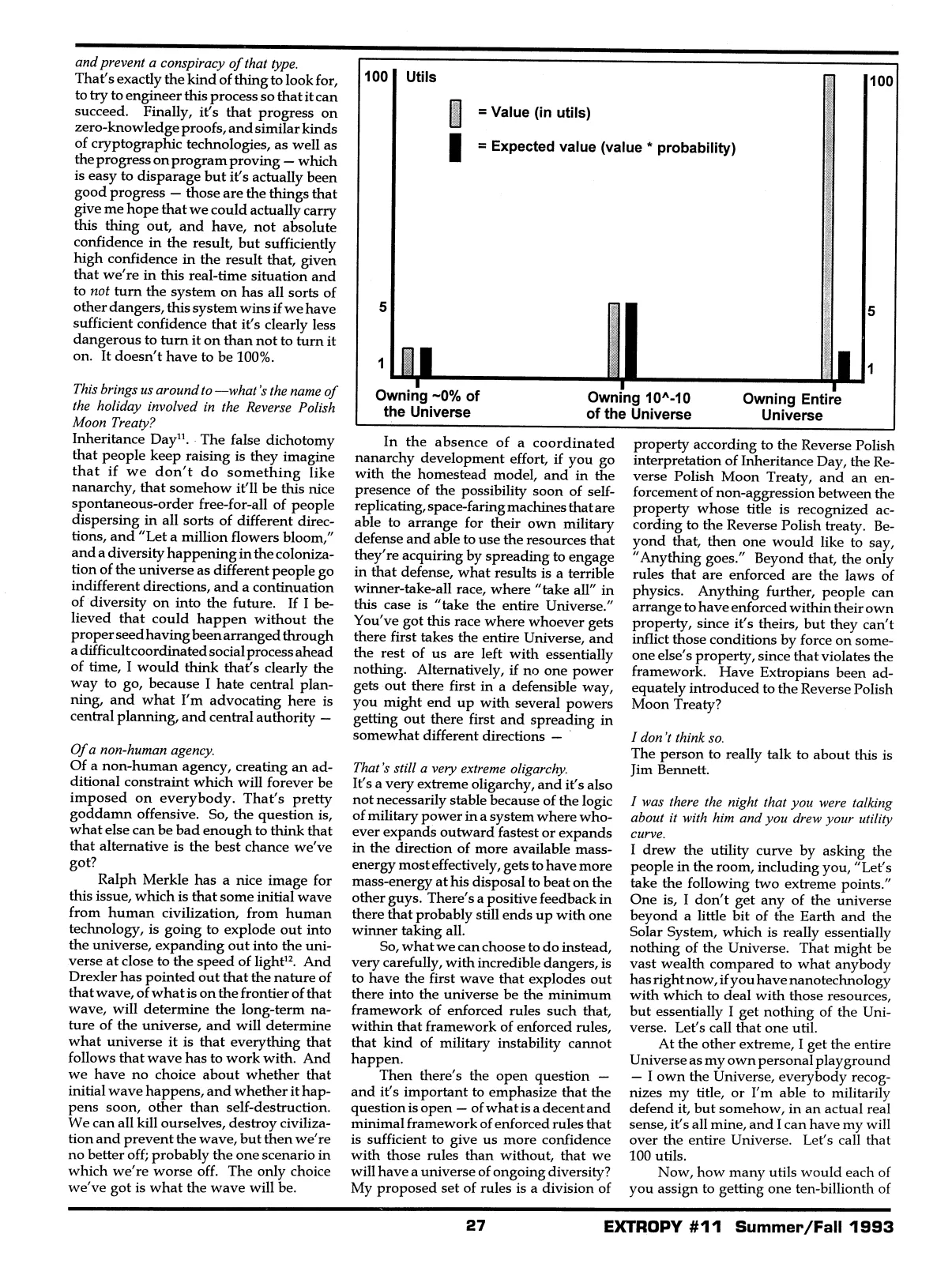
I drew the utility curve by asking the people in the room, including you, “Let’s take the following two extreme points.” One is, I don’t get any of the universe beyond a little bit of the Earth and the Solar System, which is really essentially nothing of the Universe. That might be vast wealth compared to what anybody has right now, if you have nanotechnology with which to deal with those resources, but essentially I get nothing of the Universe. Let’s call that one util.
At the other extreme, I get the entire Universe as my own personal playground — I own the Universe, everybody recognizes my title, or I’m able to militarily defend it, but somehow, in an actual real sense, it’s all mine, and I can have my will over the entire Universe. Let’s call that 100 utils.
Now, how many utils would each of you assign to getting one ten-billionth of the universe? Typical answers are, 5%, 10%, 50% even. Let’s take the lowest that I’ve heard, which is like 5%.
The odds of being the one person to get everything —
Right. The odds of being the one person to get everything is, let’s say, one in a billion, because you’re enough of an elitist to say you’re above average — you’re in the top billion. Let’s do an expected-value calculation. If we go with the home-steading model, your expected value is essentially one plus epsilon. You’re taking the 100 utils and multiplying it by the probability that you will be the one who got to homestead the universe. Contrast that with the Inheritance Day model, in which you have basically a certainty of getting one ten-billionth of the value of the universe, that gets you five utils.
I think it’s clear that now, in terms of choosing which of these two regimes of assignment of property right in the currently unowned Universe, which one is in the best interest of each of us? I think that it’s clearly the Inheritance Day model.
The Inheritance Day model says: the whole Universe is currently unowned; value is value to people; it’s important not to do a continual re-allocation, because that only creates a tragedy-of-the-commons problem which leads to universal starvation. It’d be a tragedy to take this incredible amount of wealth which could make all of us incredibly wealthy, and instead make all of us incredibly poor by engaging in a system of continual redistribution… which is, by the way, the reason that, even though libertarian socialism is great in the short term, it would still be fatal applied to the Universe. So, if we go around advocating libertarian socialism, we need to be clear —
That it has a time limit.
It has a time limit, or it has a resource limit. Inheritance Day says, only those resources covered by the Moon Treaty, which starts at somewhere between the Earth and the Moon’s orbit, and proceeds outward from the Moon. You could have a libertarian-socialist system for redistributing Earth wealth, then a one-time equal distribution of wealth-in-the-rest-of-the-Universe, never to be re-distributed. I suspect that, when it’s clear how much wealth we’re talking about giving to everybody now, that any motivation of compassion people have will clearly not be an issue for arguing for continual redistribution.
‘But you’ve got a billion star systems and I only have a million.’ It would be difficult to make plea like that credibly in such a situation.
One very interesting additional point about Inheritance Day: Inheritance Day, once it is carried out, actually leads, in a way that is more effective than anything else that I know of that is politically realistic, to a net redistribution of current wealth from richer to poorer, without any coercion, in a completely voluntary, non-offensive way. It lets people who are miserably poor now, benefit now, before moving out into the universe, from the wealth that rich people have now. It’s the only non-coercive redistribution scheme that I’ve ever heard of that can work, and the way it works is simply by giving everyone a title to all of these resources whose future value has some net present value, and allowing them to trade. Somebody who’s on the edge of starvation naturally has a very short time horizon.
So they’re going to trade Some of their distant real estate to increase the probability that they will survive to reach it, by trading it to someone who’s presently richer.
Right, who’s presently richer and can therefore afford to have a longer-term time horizon. Therefore, speculators in the future value of these resources will actually be paying people who are currently miserably poor money now — to someone who’s currently starving in Somalia, that could very well save their life. And I think that it’s very interesting to point out that it’s a completely free-market solution that dumps money into relief for starving people, in a way that actually helps them out, and that doesn’t create any conflict between the rich and poor. So it really gives all sides of the political debate what they want.
You might say a little bit more about the present Moon Treaty, and why the Inheritance Day model is called the Reverse Polish Moon Treaty.
The Moon Treaty states that the moon and all extraterrestrial resources shall be considered to be the common heritage of mankind, but the treaty itself doesn’t specify an implementation protocol. The reason that the L5 organization, and all freedom-loving organizations that take the future seriously, either fought or should have fought the Moon Treaty when it first came up, is that it was before the fall of Communism, in a situation where a lot of the countries voting in the U.N. thought central planning was the natural way to do things, and in which the language of the Moon Treaty was modeled on the Law of the Sea Treaty.
The Law of the Sea Treaty was a terrible precedent for a central-planning way of allocating rights and resources, in fact a non-property right. ‘The common heritage of all mankind’ meant that no one could own any property out there, which meant that really it would be owned by the bureaucracy that got to say what would be done with it — the common heritage of a small elitist U.N. bureaucracy which got to use it as a permanent source of power over the rest of humanity. The understanding of what would be the implementation protocol, back then, was incredibly awful.
Now that the inability of central planning to function is universally acknowledged —
Except over in Berkeley.
Except in Berkeley. The proposal is that the U.S. in fact should now be encouraged to ratify the Moon Treaty, and Jim is drafting an implementation protocol that basically says, ‘In these days of the universally-acknowledged failure of central planning, it’s clear how to correctly interpret the common-heritage clause, which is, if it’s the common heritage of all mankind, give everyone their piece.’ It’s ours, right?
Where the Polish part comes in is, what does it mean to give everyone their piece? What does it mean to take the whole Universe and divide it equally? Because Poland had very much the same problem, which is, they had all of these businesses, all of these large factories, which were all run ‘in the name of the people.’ They were in fact run by a small elitist bureaucracy who ran it for their own aggrandizement, but once that bureaucracy was out of power, there was now a government interested in freedom and free markets, but faced with all this state property and trying to figure out what to do with it. Well… it was all run in the name of the people, let’s give it to the people.
How do you give it to the people? Milton Friedman, I believe, had a proposal. It was the right conceptual model, but was impractical in practice, which is, make these companies publicly-traded companies, with stock in them, then give every member of the population an equal share of stock in each of the companies, then allow them to trade on an open stock market. It’s the perfect model — it succeeds at dividing things equally without having to make any judgments ahead of time as to what the relative valuations of different things are; and, by allowing trade from there, it allows people to determine the values and to individually own certain things by buying it up from everybody else.
The reason it’s impractical is that the transaction costs are too high, because, let’s say, just to pick numbers out of the air, you have 10,000 companies, you have a population of a million, then each member of the population would have a one-millionth share in each of 10,000 companies. So each individual stock certificate is worth so little that you end up not keeping track of it, not looking for trading opportunities, and not looking for opportunities to buy from someone else because what you’re buying from them is so much less than the effort of finding them and convincing them that they should sell it to you.
So what they did instead is something which I think is quite brilliant—it’s the first practical alternative to ‘I cut, you choose,’ and it’s something that game theorists should really take seriously because it solves the ‘I cut, you choose’ model for a large multi-person game, whereas the standard multi-person generalization of ‘I cut, you choose’ is an N-squared algorithm.
What they did was to create a set of mutual funds. Once again, these are not the real numbers, let’s say they created ten mutual funds. Each of the mutual funds has an equal share in each of the 10,000 companies, and then each member of the population has an equal share in each of the ten mutual funds. Now, every individual bit of ownership is itself individually sufficiently valuable to make a market at it, and after $t_0$, everything’s tradable on the open market —
The managers of the mutual funds can trade in shares of the companies, and the individual members of the population can trade in shares of the mutual funds.
But in addition, individuals can trade in the shares of companies, the companies can trade in the shares of the mutual funds —
The mutual funds can buy shares of each other.
Right. So the whole thing’s on the open market, no constraints. Now, unfortunately, Poland did not succeed at implementing this scheme in this neutral way because it got bogged down in a political process of special interests. But it was the right model and it’s exactly the same problem: Poland faced the common heritage problem. Those companies were the common heritage of the Polish population; they were declared to be so by the Communists. The successor government decided to actually implement what the Communists had been saying, through a real system that actually implemented common heritage through private property, and succeeded in coming up with a way to do so. I think that there’s a lot of details to be worked out, because the Universe is not publicly-traded companies, but I think that that’s the first viable structure I’ve heard for Inheritance Day.
It deals with the fact that the Universe in different directions has very different value, so you can’t do a spatial division. You largely don’t know what’s out there yet, so you can’t do a division based on having mapped things out. And you don’t have a market in it yet, so you can’t use any notion of market prices to use that as your basis for division. You need this in order to create that system.
Now, taking it back to nanarchy. The system of property rights that we legislate
At the conclusion of The Day the Earth Stood Still, the alien, Klaatu (played by Michael Rennie), having been murdered by the American army, then rescued and restored to life by the robot policeman Gort, delivers this speech to a gathering of scientists from every Earth nation:
I am leaving soon, and you will forgive me if I speak bluntly. The Universe grows smaller every day, and the threat of aggression by any group, anywhere, can no longer be tolerated. There must be security for all, or no one is secure. This does not mean giving up any freedom, except the freedom to act irresponsibly. Your ancestors knew this, when they made laws to govern themselves, and hired policemen to enforce them. We of the other planets have long accepted this principle. We have an organization for the mutual protection of all planets, and for the complete elimination of aggression. The test of any such higher authority is of course the police force that supports it. For our policemen, we created a race of robots. Their function is to patrol the planets, in spaceships like this one, and preserve the peace. In matters of aggression, we have given them absolute power over us. This power cannot be revoked. At the first sign of violence, they act automatically against the aggressor. The penalty for provoking their action is too terrible to risk. The result is, we live in peace, without arms or armies, secure in the knowledge that we are free from aggression and war… free to pursue more profitable enterprises. We do not pretend to have achieved perfection… but we do have a system, and it works. I came here to give you these facts. It is no concern of ours how you run your own planet, but if you threaten to extend your violence, this Earth of yours will be reduced to a burned-out cinder. Your choice is simple: join us, and live in peace, or pursue your present course, and face obliteration. We shall be waiting for your answer. The decision rests with you.
by signing on to the Moon Treaty, as written, with this attached implementation protocol — that’s the proposed system of property rights for a future nanarchic system to either directly impose or, if we can get away with something more minimal (which would be good, because something that ambitious has a lot to it), to impose a more minimal set of constraints, on top of which we can bootstrap a system of enforcement mechanisms that are capable of enforcing such a system of property rights, but in which that system that’s layered on top is not an irrevocable system.
This is very much like operating system design. The kernel of the operating system is something that you can’t escape from. It sets the foundational rules. There’s a methodology in software engineering called ‘mechanism/policy separation,’ where you want to embody in the irrevocable kernel as few policies about how to do things as possible…basically, just the enabling mechanisms that allow all of those policies to be built in a diverse way by different users of the operating system to serve different needs, and enabling experimentation.
There’s also a good analogy to the essence of constitutional systems. An ‘unamendable constitution’ is really sort of the kernel of your operating system. What you’d like is that the kernel of that nanarchy system (which we’ve spread into the universe in an irrevocable way) is just sufficient that we can convince ourselves that systems layered on top of it to enforce complex systems of property rights are themselves things that we can experiment with and change and modify and amend, as we learn more and as we evolve, and that the underlying nanarchic framework is just sufficient to let that process of amending that system of enforced property rights be one which is not destabilized by runaway military replicators.
By the way, one enormous piece of credit that I’m amazed that I haven’t been saying repeatedly over and over again in this is Eric Drexler. A lot of these ideas, perhaps most of these ideas, about nanotechnology and military stability in the future come from conversations with him, as part of the conversational process. I would say I did more of the bouncing and he did more of the thinking for a lot of this. In all of the years in which Drexler and I have collaborated and engaged in intense conversations out of which wonderful ideas came up, there’s only one incident where we each thought we were the proper author of the idea and the other one was mistaken. Sometimes, when we think we’re mistaken, it’s when we each think the other one’s the proper author, not himself.
I’d like to make another point here: the issue of ‘What is property rights? What is aggression and coercion?’ so that we can have something for this framework to be enforcing. The great problem there is, humankind has been arguing political philosophy with each other for many many centuries, and we’re a long way from universal global consensus. And, we’re also about to step into a world in which, by virtue of these problems of identity, the discreteness of ‘moral agency’ goes away. ‘Who is a moral agent?’ becomes problematic.
If I build a fully sapient AI that then goes out and murders someone, am I responsible?
Right. The second issue is, ‘What is a good reconstruction of political philosophy in a world of ambiguous moral agency?’ This question is fascinating to me, and is much of the reason why I pursued the work that Eric Drexler and I did on agoric open systems.
Now, libertarians have often said that the only things which should be considered moral agents, and therefore the only things which should be covered by non-aggression rules, are things which are sentient. That gets you into the infinite morass of ‘What the hell is ‘sentient’?’ And it’s unresolvable: it’s an observer question, not an intrinsic question of the thing that you’re labeling.
Agoric open systems are a system of rules that are extraordinarily similar to the system of rules that libertarians of all five stripes have been proposing; it’s a system of rules extraordinarily similar to that, as the operating rules for a computer system — an operating system or a programming-language system. Both programming languages and operating systems are foundational computational systems on top of which you have a lot of computational entities interacting with each other, and different operating system designs and different language designs establish different frameworks for the interaction of agents. Another way to think of it is that, every operating system and every programming language is essentially a different set of laws of physics, in which the agents are interacting.
The thing that’s fascinating to me is that we did not need to impose any ‘sentient’ constraints. In fact the issues brought up by the whole process of thinking about agoric systems made clear that you want to assign rights to lots of little things that are clearly very far from sentient. A little mathematical server, a sort of equation-solver object in your computer system, is something you want the agoric framework to treat as having full property rights. Similarly, any other little computational server object that other objects make requests of and that itself uses computational resources writes subcontracts out to other objects. It’s a system of property rights governing the interaction of all these computational objects. Even though none of them are sentient, it’s clearly the case that the system as a whole does much better by giving to each of these non-sentient objects full ‘libertarian’ rights, because that’s a better framework of rules for governing their interactions than any other.
Let’s examine the issue you brought up. You create an AI, and it goes out and kills somebody; are you responsible? Now, the interesting thing is, under nanarchy, and under agoric open systems, that issue doesn’t come up, and the reason it doesn’t come up is the other difference between this and governmental systems, which is that current governmental systems of rights enforcement don’t actually enforce rights, they punish violators of rights. The idea with both nanarchy and agoric open systems is that we’ve added this additional constraint: It’s impossible for you or an agent you create to murder that person. When the coercion is attempted, it is prevented. That would be the case in a nanarchy — the thing that is monitoring for certain inter-boundary activities that may be coercive, stops any that fall within the possibility of coercion. They just don’t succeed in happening. There’s also no issue of whom to punish — what does execution mean to someone with backup copies?
And, in agoric open systems, you can no more steal from someone than you or I could go faster than the speed of light. You just don’t have the language to express coercion; you don’t have the tools available in which you could create a concept of coercion. So, we can talk about the distinction between pre-enforcement and post-enforcement. Post-enforcement depends on punishment creating an incentive to not commit a crime, and that gets trashed by post-Singularity confusions of identity, so what we need to do is transfer to a system of pre-enforcement.
A lot of these ideas about the strategies of the long-term future of the Universe are actually ideas that are many years old; I feel like I have had very few new ideas with respect to that in the last few years. The thing that’s really changed is that now there’s a community to say these ideas to. Back when these ideas were being hatched, there was no such community. And I want to express my deep gratitude to the whole phenomenon of Extropianism for creating a community of people that can share and bounce around ideas like this.
*I think you’ve put your finger on something that everybody in the Extropian community feels; I felt the same way when I first discovered
ered that there was an Extropian mailing list—I discovered the mailing list before the magazine. That there were other people out there—‘Yeah, they have all these same ideas, and they consider them mutually consistent—*
The XanAMIX community, the Extropian group, and the Assembler Multitude, I consider to be really all one community; it’s just that different names are for different foci of the community. We need to get more integration between the Agorics folk at George Mason University and Extropianism. Extropianism is much more technologically literate and much more technologically informed than they are. Obviously, going the other way, they’re much more economically inclined than the Extropians are; the non-obvious but much more important thing is they’re much more epistemologically well-informed than the Extropians are. It seems to me that epistemological issues are the great missing piece in Extropian philosophy right now.
I think Max More would be surprised to hear you say that, and I know that he would want to launch into a long and involved conversation on that topic.
Very, very late at the Too Many Erics party, I actually did say this to Max More, and he wrote down my recommendation, which I will repeat here. I have certainly not read every book on epistemology, but in my opinion, the very best book on epistemology, for what that means from somebody who hasn’t read all of them is, The Retreat to Commitment¹³, by Bill Bartley. My one-paragraph summary of the history of epistemology is:
Hume said, ‘We can’t really know anything,’ but nobody believed him, including Hume. Then Popper came along and said, ‘Hume was right, but here’s what you can do instead.’ And then Bartley came along and had one hell of a debugging session.
Bartley’s evolutionary epistemology is essentially Popper’s work debugged, and it’s the only debugged epistemology that I’ve ever encountered.
While the tape was off just now, you said you find it weird that you find yourself so often going back to a scene from a movie as an illustration for discussions about post-Singularity life. That reminded me of something that Jim Bennett said the other night at the Assembler Multitude. The topic for discussion was privacy and technology, and he used the example of the Sicilian organized crime families in the United States and the tongs in China, who would develop these idiomatic languages that were very rich in allusions to tales and stories that were not familiar to the outside, so that they could use that as a communication code, in order to conceal meaning from outsiders while communicating with insiders. So there’s an Extropian core of
common movies and stories, and I can refer to ‘The Ungoverned’ and you automatically have an indication of what topics that might lead to.
Yes, and even though you haven’t actually seen ‘The Day The Earth Stood Still’, nevertheless my reference to it had a lot of content for you.
Other references to it in our environment are rich enough that I got the gist of it.
Another big issue about libertarianism and technology in the future, is that libertarians are of confused and contradictory minds about the issue of privacy, and what a right to privacy is.
That became apparent at the Assembler Multitude session that I was describing. We went from ‘Gee, it would be nice if we could keep an eye on all the people in high places,’ to ‘Gee, it would be nice if no one could keep an eye on anyone.’
People who thought they were defending the cause of freedom thought they scored a big victory in preventing Lotus Marketplace from being distributed, and I think that they’re rather badly mistaken. I think that something that I have to say about you to a third person is not your information, it’s my information. It’s something that I know; it’s in my head, it happens to be about you but it’s my information about you, and I am not violating your privacy by speaking that information to somebody else, unless I have an agreement with you not to do so — unless either I heard that information in a way that contractually constrained me from revealing it further, or I acquired the information itself through illegitimate means such as by breaking into your house.
If I am, let’s say, witness to a transaction that took place — I watched you engage in a transaction with a shopkeeper, and I saw you buy that stick of bubble gum for five cents. I saw you do it, you and the shopkeeper didn’t do what you may have needed to do to prevent me from being able to see it. The fact that the transaction occurred is my information, and I don’t violate anyone’s rights by reporting it further.
Credit reporting agencies, and Lotus Marketplace, are essentially a large-scale form of that kind of reporting of information that no one was contractually obligated not to report.
It’s my understanding that a large part of Lotus Marketplace was census information, in the sense that it broke down average incomes by nine-digit ZIP code, to the extent that you would know that the average income on the block where So-and-so lives is X dollars.
One of the things that’s going to happen with large-scale online databases and online media where people post things that other people can read, is that in some sense gossip will travel faster and be more persistent. Spontaneous order admirers, particularly libertarians and Extropians, should understand, first of all, that gossip is speech that should be protected by free speech — what Lotus was doing was in some sense engaging in a very large-scale piece of gossip — and spontaneous order admirers should appreciate and understand the positive values of gossip.
In some sense I’m being provocative and hurting my cause by using the word gossip for this because it’s a word that has negative connotations, but in fact a lot of the dynamics by which people in small towns were constrained to be decent to each other, and a dynamic which, to a significant extent, has been breaking down in large cities where so many interactions are anonymous and untraceable, is the fact that actions have consequences, in that they would be reported back and forth through the gossip mill — people realized the cost of a negative reputation, as well as value of a positive reputation, through the mechanism of people feeling free to talk to each other about other people.
With larger-scale societies, verbal communication between people just doesn’t have the spreading power to keep the dynamic of that reputation system intact. However, computer-based media that violate people’s intuitions about privacy are simply the old small-town reputation mechanisms, scaled-up by technology to a scale that can deal with the current scale of society that the old gossip mechanisms can no longer deal with.
I can see how through something like Netnews, I can have an opinion about the trustworthiness or the judgment of someone on the opposite coast whom I’ve never met, based on the evaluation of their behaviors, particularly verbal behaviors they’ve emitted over the net, by other people.
By the way, I should point out that much of the credit for this thinking comes from Gayle Pergamit, via conversations I had with Phil Salin.
I think that due to the public online media, combined with cryptographic technology, we’re going to find that information which is not out of the bag is able to be kept in the bag; people are able to keep certain information private, much more effectively than they ever have in the past, and private from eyes that are prying with millions of dollars worth of resources behind the prying effort —
And acres of computing power.
Right. And we’ve never been able before to be securely private against those resources when they’re concentrated on anybody; cryptography gives us that. So, in some sense, things that successfully get defended in their privacy are really defended much better than they have been in the past, but on the other hand, once it’s out of the bag, once it’s public, it becomes much more visibly and persistently public. I think that it’s very important to recognize that what we have in this transition is a system that’s much more equitable with respect to information because, previously, information that got out of the bag was accessible to elites and not accessible in general.
This is why the Lotus Marketplace decision should be incredibly offensive to lovers of freedom. It’s not that the information on that CD-ROM is otherwise inaccessible; it is simply otherwise accessible only to elites. It’s not a question of people’s privacy being violated, it’s a question of accessibility to information that is claimed to already be used to ‘violate people’s privacy’ —
It would be more equitable to have it more widely distributed, to at least give the non-elites the same access to the same information. Right. By the way, I have no idea whether it’s even conceivable that you could work any of this into a single article.
What I’m envisioning now is a series of these interviews… and I’d like to thank you for getting things off to a great start.
I pride myself on being one of the few people — Max More and Eric Drexler also certainly included — to take seriously both hard issues of philosophy and a post-Singularity future, to really take both seriously, and I think that that, rather than any skill at philosophizing, is really what’s responsible for my being able to make interesting progress in the philosophy for a post-Singularity world.
Notes
¹Nelson, Ted. Literary Machines, Edition 87.1. Published by the author.
²Heinlein, Robert. The Moon is a Harsh Mistress. New York: Berkeley, 1966.
³Friedman, David. The Machinery of Freedom, 2d Edition. La Salle, Ill.: Open Court, 1989.
⁴Nozick, Robert. Anarchy, State, and Utopia. New York: Basic Books, 1974.
⁵Epstein, Richard A. Takings. Cambridge, Mass.: Harvard University Press, 1985.
⁶The bibliographic citation for this article is not available.
⁷The Day the Earth Stood Still. Twentieth-Century Fox, 1951. Available on CBS-Fox Video.
⁸’Democracy is the worst form of government — except for all the others.’
⁹War Games. United Artists, 1983. Available on CBS-Fox Video.
¹⁰Doctor Strangelove: Or, How I Stopped Worrying and Learned to Love the Bomb. Hawk Films, 1963.
¹¹Inheritance Day was proposed by Eric Drexler in Engines of Creation (New York: Doubleday, 1986).
¹²Also in Engines of Creation, Drexler presents an evolutionary argument explaining why near-lightspeed expansion is almost inevitable.
¹³Bartley, William W., III. The Retreat to Commitment. La Salle, Ill.: Open Court, 1984.
VIEW ORIGINAL SCAN (8 pages)