Issue: EXTROPY #10 · Winter/Spring 1993
Author: Mark Plus, J. Storrs Hall & Harry Shapiro
Pages: 38–44 · 7 scanned pages
The Transhuman Taste: Reviews (Ayn Rand and Objectivism, Nanosystems, Genius)
The Transhuman Taste
Reviews of Extropian interest
by Mark Plus
(A) Atheism, Ayn Rand, and Other Heresies, by George H. Smith. (Buffalo, New York: Prometheus Books, 1991). 324 pages. ISBN 0-87975-577-6.
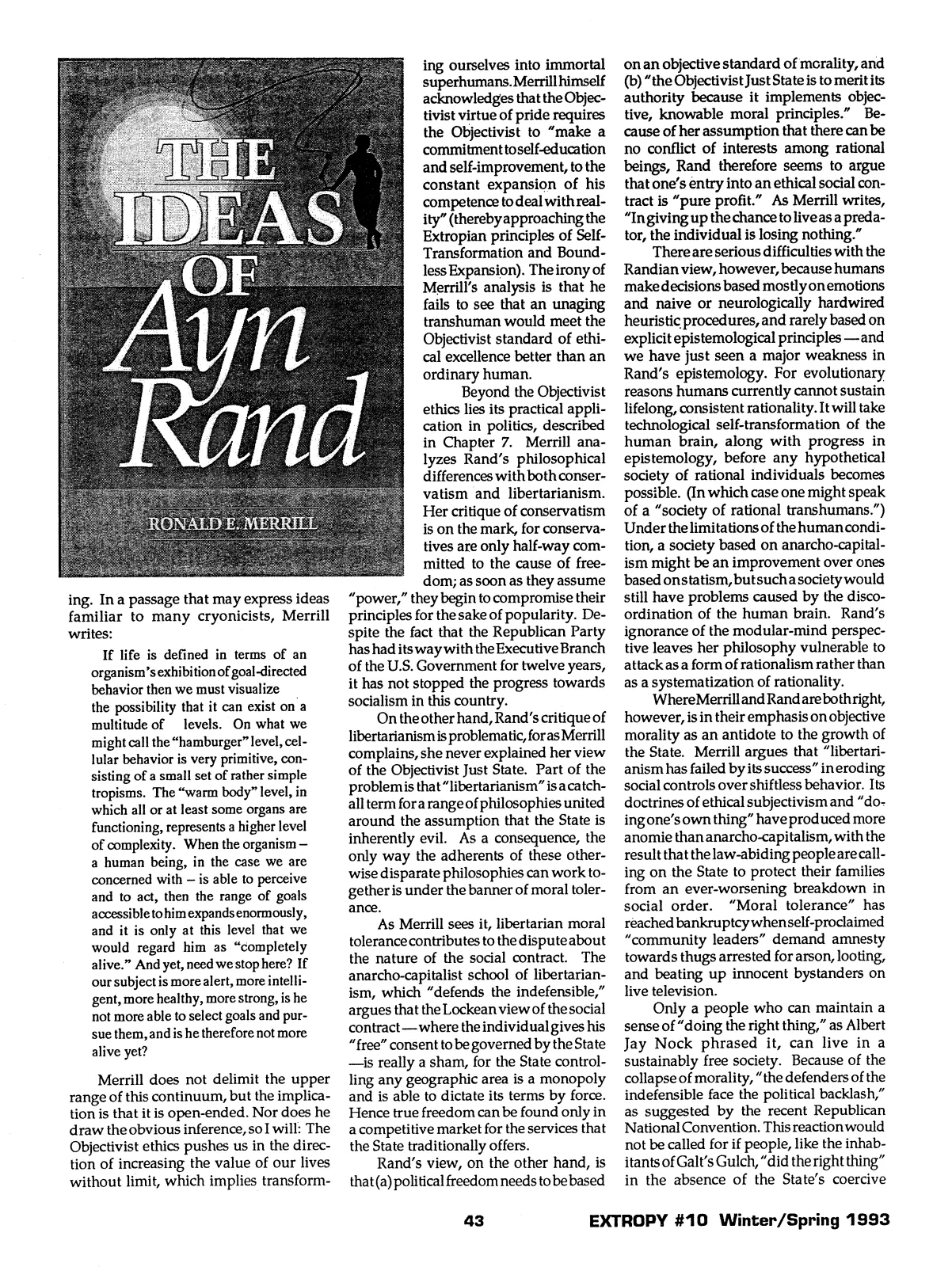
(B) The Ideas of Ayn Rand, by Ronald E. Merrill. (La Salle, Illinois: Open Court, 1991). 191 pages. ISBN 0-8126-9157-1.
Introduction
The Extropian eupraxophy, although currently associated with relatively few individuals, is an example of a spontaneous order. Rather than being presented as a completed intellectual system in the manner of, say, Thomas Aquinas, it is instead the open-ended confluence of ideas from many individuals and disciplines. A “fountainhead” of much Extropian thinking has been the late novelist-philosopher Ayn Rand, who, although succumbing to entropy in 1982, sketched out a philosophy, called Objectivism, which is compatible with the Extropian principles of Boundless Expansion, Self-Transformation, Intelligent Technology, Spontaneous Order, and Dynamic Optimism. (Indeed, her novel Atlas Shrugged is on the recommended reading list for “The Extropian Principles v. 2.0.”)
Unfortunately Rand never developed the full extropic implications of her system. She has left her followers to make do with a bug-ridden “Objectivism 1.0,” a kind of poor man’s Extropianism. Hence Objectivism, although still a powerful eupraxophy, lacks the vigor and appeal it would have if certain errors were corrected and many Extropian features, e.g. immortalism, were explicitly expressed.
Fortunately in recent years a number of independent Randian scholars have been working on versions of “Objectivism 2.0,” which, although falling short of full Extropianism, demonstrate attempts to grapple with the realities of tomorrow. These efforts have helped to ground Objectivism in the thought of the past, while preparing for its growth and improvement in the future. As this review will make clear, Objectivism must engage in Boundless Expansion to maintain its intellectual power. The two books under review describe these revisions.
(A) Objectivism’s Heritage: Thomism without “God” (the G-word)
George H. Smith is an independent scholar who moves comfortably in both freethought and libertarian circles. His earlier book, Atheism: The Case Against God, has been a steady seller at Prometheus Books for over a decade, while during the same time he has been writing and lecturing in advocacy of libertarian ideas.
In his new book, Atheism, Ayn Rand, and Other Heresies, Smith combines his interests by grouping both freethought and libertarian essays together around the theme of “heresy.” As Smith explains in his Introduction, heresy (from Greek hairesis, “choice”) was originally a morally neutral disagreement with someone else’s “right belief” or orthodoxy. When one ideological group attains political power, however, its orthodoxy defines heresy as evil and corrupting, giving the orthodox both the means and the incentive to persecute heretics. It is only in the open society, where everyone can freely associate and delimit his or her respective orthodoxy, that the heretic can live without fear of physical sanctions, although there may be moral and social sanctions instead.
Though most of Smith’s essays are both readable and thought-provoking, of relevance to this review are the three essays in the middle section of the book dealing with Ayn Rand. Rand was certainly a heretic, especially in her uncompromising secularism. In his essay “Atheism and Objectivism,” Smith points out that Rand’s atheism offends conservatives who might otherwise be open to her philosophy. According to the traditional religious critique of atheism, rejection of belief in the g-word leads to all sorts of theoretical and practical disasters.
Ironically, as Smith demonstrates, there is a grain of truth in this criticism, though the religionists are right for the wrong reasons. Many philosophies promote atheism, but at unacceptable costs.
After analyzing different approaches to atheism, Smith discusses the various kinds of epistemological atheism, one of which is Objectivism. Most of these – Humean skepticism, logical positivism, linguistic analysis – reject theism as nonsensical, but for the same reason also jettison objective ethics, certainty, causality, and metaphysical speculation.
Objectivism, like the other epistemological critiques of theism, requires that the g-word be defined in an intelligible way, and then places the onus of proof upon the theist. Since no intelligible, nontrivial definition of the g-word has ever been produced, and no argument for the existence of the g-word has withstood analysis, Objectivism accepts atheism as the only rational possibility.
Where Rand differs from other atheistic philosophers, however, is that she is an Aristotelian, with Aristotle’s conception of philosophy as a necessity for human life. Thus her philosophy is equipped for worldly success, unlike the other ‘stripped down’ secular philosophies of modernity. This seems rather odd, for the majority of Aristotelians on the scene today, the Thomists — the Catholic intellectual heirs of Thomas Aquinas — are opposed to secularism. As Smith writes, ‘With Objectivism and Thomism we have two philosophical movements claiming Aristotle as their intellectual ancestor, but that are on opposite sides of the religious spectrum.’ In other words, although Smith does not phrase it in this way, Objectivism is a kind of Thomism without the g-word.
Smith maintains that Rand’s ‘rejection of God does not stem from the limitation or distrust of reason, rather, it is in the name of reason that she rejects faith, mysticism, and belief in the supernatural.’ He then concludes in this essay:
In short, the atheism of Ayn Rand is not destructive in the least. In rejecting God, Rand does not reject metaphysics, ethics, certainty, or the possibility of happiness. On the contrary, it is because Rand has so much positive value to offer that she considers atheism to be a comparatively minor issue.
Of course, from our perspective Rand would have offered a lot more if she had advocated—and practiced!—immortalism. This is a major defect of Objectivism 1.0. Nevertheless she deserves credit for promoting a secularism which is a radical improvement over the dreary atheistic philosophies of Marxism, existentialism, and secular humanism.
In his second Randian essay, ‘Ayn Rand: Philosophy and Controversy,’ Smith develops the Rand / Aquinas parallel further. He commits his own heresy by arguing that, although Rand was not well read in philosophy, many of her epistemological and ethical arguments are similar to those made by modern Aristotelians such as the Thomists, while her political philosophy is clearly derived from classical liberalism. The components of much of Rand’s thought may be borrowed from others, or else independently reinvented, but the way she puts them together into one system gives Objectivism its freshness and vitality. By identifying the ancestors and antecedents of Objectivism, Smith can place it firmly in the context of Western philosophy, while showing that it is not that far out of the mainstream. Rand may be a heretic, but she is one with a familiar genealogy.
After documenting these similarities, Smith speculates about the future of Objectivism. He considers the ‘official’ school, led by Leonard Peikoff (the ‘Randian Grand Inquisitor’) to be brain dead, and argues that the future lies in the work of independent, ‘neo-Randian’ philosophers such as David Kelly, Tibor Machan, Douglas Rasmussen, and others. (I had considered reviewing Leonard Peikoff’s book, Objectivism: The Philosophy of Ayn Rand, but it is not comparable to the other two in quality. Under Peikoff’s care, dogmatic Objectivism, following the example of its cousin Thomism, is hardening into a dead scholasticism.) However, these neo-Randians may not get much closer to Extropianism than Rand if they continue to accept the limitations of the human envelope. The book reviewed in section B, written by a neo-Randian not mentioned by Smith, implies a way beyond the human condition.
Finally, in the third essay, ‘Objectivism as a Religion,’ Smith deplores the tendency of many Objectivists to turn Randian ethics into a system of rules one has to follow, regardless of the consequences to one’s happiness. As he argues, a rule-based ethics is essentially religious, whereas Rand’s ethics is based on the idea of ethical standards, which one chooses not out of fear or guilt, but rather out of intellectual conviction. One can obey or disobey a rule, but it makes no sense to obey or disobey a standard. In the Objectivist ethics one follows a standard as a guide for attaining the goal of personal happiness. As Smith concludes in this final Randian essay:
Whatever her errors, Ayn Rand struggled mightily against a religious view of morality, and she sought to place ethics on a rational foundation, free of any appeal to faith or force. Rand was a humanist in the best sense; for her, the happiness of the human being is the summum bonum of ethics.
Of course Rand, like her philosophical opponents, promoted a deathist concept of happiness. Beyond deathist eudaimonism lies the challenge of immortalist Dynamic Optimism.
(B) Objectivism’s Future: The Trans-Randian condition
If George H. Smith can show Objectivism’s place in the thought of the past, Ronald E. Merrill suggests and implies what Objectivism has to do if it wishes to reach for the future, even to the threshold of trans-humanism.
I had not heard of Merrill until I read his book The Ideas of Ayn Rand, but I can now state without reservation that it is the most fascinating study of Rand’s thinking I have yet encountered. Indeed, there is so much material in the book that I have trouble selecting what I want to review.
Like Smith, Merrill wishes to locate Rand and Objectivism in their historical context. Unlike the recent biographies of Rand, however, Merrill avoids the prurient details, and concentrates instead on the ideas of Ayn Rand, as the book’s title says. He writes that he became a ‘Randroid’ at fifteen after reading Atlas Shrugged, and was associated with the Nathaniel Branden Institute (NBI) for awhile back in the 1960’s. Although he met some eccentric people, he never encountered the cape-wearing Rand cultists other critics of the NBI period have described.
The break between Rand and Branden in 1968 destroyed what could have otherwise become a powerful force for reason and freedom, but Rand nevertheless continues to exert a covert influence on American thinking. Her novels still sell in the hundreds of thousands annually (in what is otherwise an increasingly illiterate society), while many of her ideas, advocated without proper acknowledgement through ‘conservative’ ideologues, are becoming more widely accepted. (For example, the ‘conservative’ broadcaster Rush Limbaugh sounds Randian much of the time, except when he starts mouthing off about the g-word. As Smith explains in his book, Rand’s atheism is an impediment to a general recognition of her legitimacy.) Her on-going popularity suggests that Rand’s vision is timeless, a vision which Merrill tries to explain.
In Chapters 2 through 5, where Merrill discusses Rand’s development as a writer, he makes it clear that he considers her to be a deep and complex literary artist. As she struggled to master English prose while trying to survive in her adopted country, Rand also struggled with and eventually overcame her devotion to the philosophy of Friedrich Nietzsche.
Although according to the ‘official’ history Rand flirted with Nietzsche briefly as a young woman before inventing Objectivism, Merrill documents how Rand was still a Nietzschean in the 1930’s when she wrote the first version of We the Living. Comparing the original novel with the version Rand ‘revised’ in the 1950’s shows that she felt embarrassed by the Nietzschean dialogue she had written in the 1930’s. It was only in The Fountainhead, where Rand contrasted the Objectivist Howard Roark with the Nietzschean Dominique Francon and Gail Wynand, that Rand was able to show her break with Nietzsche. By this time Rand had decided that true mastery over one’s circumstances came not from wielding the whip over the common people, as Nietzsche taught and Wynand practiced, but rather from self-discipline exercised through intellectual and economic productivity, as shown in the life of Roark.
Finally in Atlas Shrugged Rand dramatizes the outlines of her mature philosophy. Merrill argues that Rand’s critics have misrepresented or misinterpreted many of that novel’s controversial passages (the train tunnel explosion, for example), and that a full exegesis of all of Atlas Shrugged’s plots, ideas, psychological insights, and symbolism has still to be done. (He describes one theory that Galt’s strike is based on a Talmudic exegesis of the biblical story of the destruction of Sodom, whose inhabitants were guilty not of perversion, but of collectivism. Rand did come from a Jewish family, but I have seen no hard evidence that she ever used her heritage as a source of literary allusions.) Clearly there is more information encoded in Atlas Shrugged than either its admirers or its detractors have yet extricated.
After analyzing Rand’s literary development, in Chapter 6 Merrill comes the meat of his subject, Rand’s formal philosophical ideas. As Merrill argues, Rand carried on the tradition of the Greek sophists, the market intellectuals who sold their wisdom to all comers. This placed her in direct opposition to the Socratic tradition in philosophy, for Rand took an anti-skeptical and anti-relativistic approach to the fundamental issues. Philosophy phy is too important to be left as a game for the intellectual elite.
Starting with the essentials of Aristotle’s metaphysics, Rand assumes that ‘existence is identity,’ thus relieving her of the burden of explaining ultimate origins. Her metaphysics form the ‘boundary conditions’ of the rest of her philosophy, to borrow a metaphor from mathematics, which determine everything else that follows. From there Merrill describes how Rand’s theory of concepts, building blocks of her epistemology, emphasizes understanding over proof. This has the unfortunate consequence of leaving us without epistemological guidance in a lot of areas – including, as it will be shown, in Rand’s theory of ethics. Merrill laments that Rand never directed her mind towards the epistemological paradoxes raised by general relativity and quantum mechanics. (Since Merrill seems to be well read in both science and philosophy, why doesn’t he try to solve these puzzles?) And as an example of the epistemological wilderness in which Rand has left us, he writes:
It not infrequently occurs that we must choose between two theories. One theory, call it A, is internally self-consistent, but there are some experimental facts that contradict it. The other theory, call it B, is consistent with all the facts but contains internal contradictions. No better theory is currently available, but one must make decisions, and right now – to design a spacecraft, to plan a campaign against a deadly epidemic, to prevent an explosion in a refinery. One must act, and on the basis of one theory or the other. Which should be chosen, A or B? This in an epistemological problem. The solution is left as an exercise for the reader.
From an analysis of Rand’s epistemology Merrill moves on to his attempt to state and then reformulate Rand’s derivation of ethics (‘ought’ statements) from the facts of human nature (‘is’ statements). Ironically the above thought-experiment bears directly on one weakness in Merrill’s reformulation, though he does not seem to be aware of it.
Merrill paraphrases the ‘Randian Argument’ as follows:
i. Living beings, and only living beings, have values (goals).
ii. Man, being volitional, must choose his values.
iii. Values – goals – may be means to an end, but must lead to some ultimate end. An infinite chain of means leading to no final end would be meaningless and impossible.
iv. Life is an ultimate end, and furthermore it is the only possible ultimate end, the only ‘end in itself.’
v. Therefore, the only meaningful or justifiable values a man can choose are those which serve to sustain his life.
The sticking point in this argument is the fourth premise, involving the concept of ‘ends in themselves.’ Merrill better defines this concept by quoting from other Objectivist writings to the effect that life is an end in itself in that it ‘is an ordered collection of activities, which are means to achieving an end, which is – simply those activities.’ He also disposes of the problem of competing ends in themselves by arguing that life is the necessary prerequisite to all other ends, so that it is the most important end in itself, regardless of whether ends in themselves exist.
Next Merrill shows how to derive ethical statements from the facts of reality by equating normative ought statements – e.g., ‘You ought always to tell the truth.’ – with operational ought statements – e.g., ‘You ought to format a new disk before attempting to write a file to it.’ – in a manner analogous to Einstein’s equation of gravity with acceleration in General Relativity. If one accepts this approach, then ‘ethics reduces to a matter of engineering’ and ‘Objectivist ethics … can provide a prescription for any specified moral dilemma.’
Unfortunately Merrill’s reformulation of the Randian Argument suffers from its own problems. First of all, if one accepts the proffered definition of life as an end in itself, the fact remains that the activities of life lose their efficiency, and eventually break down, due to aging. It cannot be argued that aging is one of the activities of life one engages in today in order to repeat those activities tomorrow. Aging eventually destroys one’s ability to engage in the activities of life. Hence one’s life is a depreciating ethical standard unless the aging process could be prevented. But neither Rand nor Merrill derives immortalism from this argument.
Second, if Rand, as interpreted by Merrill, really has turned ethics into a ‘matter of engineering,’ then the burden in decision-making is shifted from ethics onto epistemology – which by Merrill’s own admission is the weak link in Objectivism! The thought-experiment I quoted above is perforce an ethical problem which Objectivism cannot obviously solve.
Fortunately Merrill provides himself an escape from the first dilemma by presenting life not as one state of a binary condition (the other state being death), but rather as a continuum of value-seeking. In a passage that may express ideas familiar to many cryonicists, Merrill writes:
If life is defined in terms of an organism’s exhibition of goal-directed behavior then we must visualize the possibility that it can exist on a multitude of levels. On what we might call the ‘hamburger’ level, cellular behavior is very primitive, consisting of a small set of rather simple tropisms. The ‘warm body’ level, in which all or at least some organs are functioning, represents a higher level of complexity. When the organism – a human being, in the case we are concerned with – is able to perceive and to act, then the range of goals accessible to him expands enormously, and it is only at this level that we would regard him as ‘completely alive.’ And yet, need we stop here? If our subject is more alert, more intelligent, more healthy, more strong, is he not more able to select goals and pursue them, and is he therefore not more alive yet?
Merrill does not delimit the upper range of this continuum, but the implication is that it is open-ended. Nor does he draw the obvious inference, so I will: The Objectivist ethics pushes us in the direction of increasing the value of our lives without limit, which implies transforming ourselves into immortal superhumans. Merrill himself acknowledges that the Objectivist virtue of pride requires the Objectivist to ‘make a commitment to self-education and self-improvement, to the constant expansion of his competence to deal with reality’ (thereby approaching the Extropian principles of Self-Transformation and Boundless Expansion). The irony of Merrill’s analysis is that he fails to see that an unaging transhuman would meet the Objectivist standard of ethical excellence better than an ordinary human.
Beyond the Objectivist ethics lies its practical application in politics, described in Chapter 7. Merrill analyzes Rand’s philosophical differences with both conservatism and libertarianism. Her critique of conservatism is on the mark, for conservatives are only half-way committed to the cause of freedom; as soon as they assume
‘power,’ they begin to compromise their principles for the sake of popularity. Despite the fact that the Republican Party has had its way with the Executive Branch of the U.S. Government for twelve years, it has not stopped the progress towards socialism in this country.
On the other hand, Rand’s critique of libertarianism is problematic, for as Merrill complains, she never explained her view of the Objectivist Just State. Part of the problem is that ‘libertarianism’ is a catch-all term for a range of philosophies united around the assumption that the State is inherently evil. As a consequence, the only way the adherents of these otherwise disparate philosophies can work together is under the banner of moral tolerance.
As Merrill sees it, libertarian moral tolerance contributes to the dispute about the nature of the social contract. The anarcho-capitalist school of libertarianism, which ‘defends the indefensible,’ argues that the Lockean view of the social contract — where the individual gives his ‘free’ consent to be governed by the State — is really a sham, for the State controlling any geographic area is a monopoly and is able to dictate its terms by force. Hence true freedom can be found only in a competitive market for the services that the State traditionally offers.
Rand’s view, on the other hand, is that (a) political freedom needs to be based on an objective standard of morality, and (b) ‘the Objectivist Just State is to merit its authority because it implements objective, knowable moral principles.’ Because of her assumption that there can be no conflict of interests among rational beings, Rand therefore seems to argue that one’s entry into an ethical social contract is ‘pure profit.’ As Merrill writes, ‘In giving up the chance to live as a predator, the individual is losing nothing.’
There are serious difficulties with the Randian view, however, because humans make decisions based mostly on emotions and naive or neurologically hardwired heuristic procedures, and rarely based on explicit epistemological principles — and we have just seen a major weakness in Rand’s epistemology. For evolutionary reasons humans currently cannot sustain lifelong, consistent rationality. It will take technological self-transformation of the human brain, along with progress in epistemology, before any hypothetical society of rational individuals becomes possible. (In which case one might speak of a ‘society of rational transhumans.’) Under the limitations of the human condition, a society based on anarcho-capitalism might be an improvement over ones based on statism, but such a society would still have problems caused by the disordination of the human brain. Rand’s ignorance of the modular-mind perspective leaves her philosophy vulnerable to attack as a form of rationalism rather than as a systematization of rationality.
Where Merrill and Rand are both right, however, is in their emphasis on objective morality as an antidote to the growth of the State. Merrill argues that ‘libertarianism has failed by its success’ in eroding social controls over shiftless behavior. Its doctrines of ethical subjectivism and ‘doing one’s own thing’ have produced more anomie than anarcho-capitalism, with the result that the law-abiding people are calling on the State to protect their families from an ever-worsening breakdown in social order. ‘Moral tolerance’ has reached bankruptcy when self-proclaimed ‘community leaders’ demand amnesty towards thugs arrested for arson, looting, and beating up innocent bystanders on live television.
Only a people who can maintain a sense of ‘doing the right thing,’ as Albert Jay Nock phrased it, can live in a sustainably free society. Because of the collapse of morality, ‘the defenders of the indefensible face the political backlash,’ as suggested by the recent Republican National Convention. This reaction would not be called for if people, like the inhabitants of Galt’s Gulch, ‘did the right thing’ in the absence of the State’s coercive supervision.
Fortunately Merrill ends his book on a positive note. He calls for the re-creation of the Objectivist social network that existed before the abolition of NBI, and recommends that Objectivists study new areas of knowledge, such as sociobiology and chaos theory, to add ‘smart weapons’ to their intellectual ammunition: ‘Technology has changed, the economy has changed, society has changed — and our vision of the organization of the free society must change too.’ And: ‘Half the genius of Ayn Rand was that she saw what everybody saw, and said what nobody dared to say. We need once again to become intellectual leaders, to have the courage to approach the cutting edge of new thought.’ (Merrill seems to be looking once again for Self-Transformation and Boundless Expansion.)
Along with networking, education, and setting good examples, the Objectivists’ most powerful tool is Rand’s concept of ‘the sanction of the victim.’ Evil survives by drawing its strength from the good, so withholding the sanction is one of the keys to victory in the long term. (Merrill’s example of a sanction of the victim: ‘When businesses give money to universities and foundations that attack capitalism, … the moral force of their example far outweighs the financial assistance. Whenever and however we may choose to fight, this kind of issue is the where.’) However, Objectivist leaders ought not to ‘excommunicate’ freethinking neo-Randians who disagree on peripheral issues, for Rand’s, and now Peikoff’s, habit of condemning dissenting Objectivists has caused more harm than good. Merrill then expresses his hope that Rand will be remembered by history as one of the greatest thinkers of our century, with our views of the just society and the function of philosophy changed in her favor.
Clearly the writings of George H. Smith and Ronald E. Merrill represent progress in upgrading the Objectivist worldview into something I call ‘Objectivism 2.0.’ Merrill, especially, is a ‘trans-Randian’ groping towards something like Extropianism. His kind of boundlessly expansive Objectivist thinking needs to be nurtured and encouraged to counter the dogmatism of the Peikoff school. Both of the books I have reviewed are worth adding to one’s Extropian library, but Merrill’s is the better value of the two.
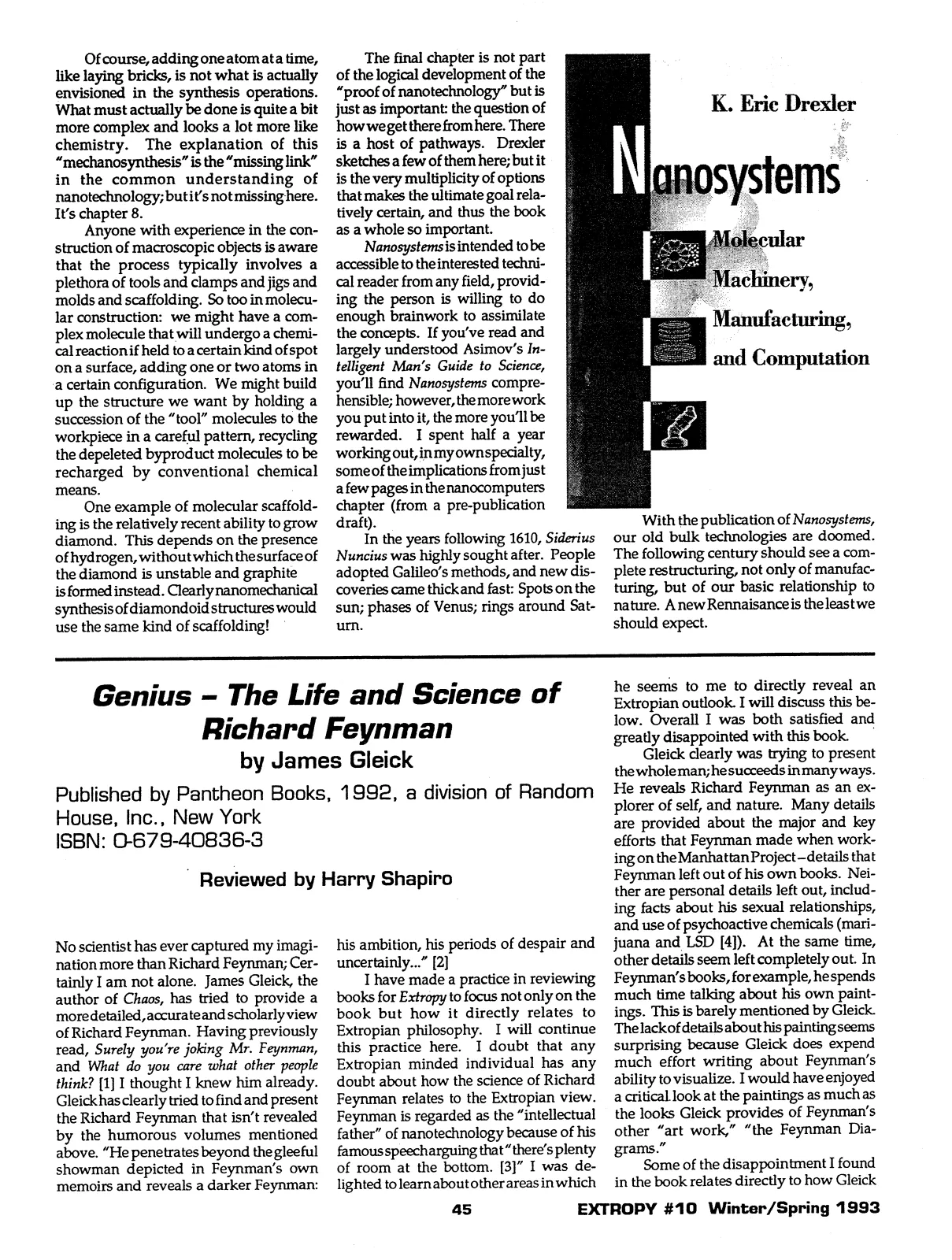
Nanosystems: Molecular Machinery, Manufacturing, and Computation
By K. Eric Drexler
New York: Wiley-Interscience, 1992; 556 pp. Hardcover $42.95, ISBN 0-471-57547-X Paperback $22.95, ISBN 0-471-57518-6
Reviewed by J. Storrs Hall
In 1610, Galileo published a small book entitled Siderius Nuncius which set the world on its ear. It was, in many respects, the keynote publication of the 17th century. In it he described what happened when he took an existing tool, the telescope, and turned it on the realm of the heavens. He had discovered mountains on the moon, and moons around Jupiter. The old conceptions of the universe were, at that point, doomed, and the following century would see a complete restructuring of our basic understandings of nature, and kick the Renaissance into high gear.
In Nanosystems, Drexler takes the tool of mechanical engineering and turns it on the realm of the molecular. Nanosystems, in my humble opinion, is destined to be the keynote publication of the 21st century. There will not be a person alive in 2100 who is completely unaffected by the consequences of the ideas presented here.
Suppose you had a mechanical manipulator so small, and so precise, that it could handle individual molecules, maybe even atoms? You could build (small) objects with a precision that would allow you to specify in your design where each individual atom was to be, exactly which atoms would be covalently bonded to which other atoms, and so forth. If indeed you could build objects with this degree of precision, you could design and build some rather incredible things — like the mechanical manipulator we assumed in the first place.
If we could bootstrap ourselves into such a technology, we could gain essentially atomic-level control over the structure of matter for a multitude of purposes. Such a technology is called nanotechnology or, to distinguish it from more conventional approaches to nanometer-scale operations, molecular nanotechnology.
Drexler’s previous books, Engines of Creation and Unbounding the Future, gave a glimpse of what molecular nanotechnology might mean. Indeed ‘Engines’ was one of the major factors behind the flourishing of the cryonics movement in the mid-80’s. However, these books were written for the popular audience. Nanosystems is written for the technical audience.
Even so, much of Nanosystems is introductory or explanatory compared to the average technical book. The reason for this is clear: most technical books are written for the specialist in a particular field, and there are virtually no specialists in this one.
The burden of Nanosystems is simple in overall concept: it is a proof that molecular nanotechnology can work. As such it has two major parts.
First Drexler develops and justifies the theoretical tools he needs to analyze nanomechanical devices. This involves a unification of principles from physics, chemistry, and engineering. He explores the various levels of abstraction at which physical laws are used, from quantum mechanics to the continuum models of engineering which ignore the molecular nature of matter entirely. Of particular interest are the empirical molecular mechanics models, which seem to be the appropriate tradeoff between accuracy and efficiency for analyzing nanomechanical designs.
Second, he exhibits actual designs, with analyses, sufficient to make a strong case that a full-fledged, self-reproducing, molecular technology could be built from the devices presented and others like them. We have axles and bearings, gears and cams, pumps, motors, generators, and computers. There are chapters on the internal processes of, and the overall structure of, molecular factories. There is a detailed design for a robot arm 100 nanometers long.
There is a point of some importance that is generally ignored in higher-level discussions of nanotechnology. It forms the bridge between the first and second sections. If you had the manipulator arm with the ability to put each atom where you wanted it, would that really give you the ability to build objects with them? Surely the reactive atom you were trying to add to your workpiece would bond more quickly to the manipulator itself?
Of course, adding one atom at a time, like laying bricks, is not what is actually envisioned in the synthesis operations. What must actually be done is quite a bit more complex and looks a lot more like chemistry. The explanation of this ‘mechanosynthesis’ is the ‘missing link’ in the common understanding of nanotechnology; but it’s not missing here. It’s chapter 8.
Anyone with experience in the construction of macroscopic objects is aware that the process typically involves a plethora of tools and clamps and jigs and molds and scaffolding. So too in molecular construction: we might have a complex molecule that will undergo a chemical reaction if held to a certain kind of spot on a surface, adding one or two atoms in a certain configuration. We might build up the structure we want by holding a succession of the ‘tool’ molecules to the workpiece in a careful pattern, recycling the depleted byproduct molecules to be recharged by conventional chemical means.
One example of molecular scaffolding is the relatively recent ability to grow diamond. This depends on the presence of hydrogen, without which the surface of the diamond is unstable and graphite is formed instead. Clearly nanomechanical synthesis of diamondoid structures would use the same kind of scaffolding!
The final chapter is not part of the logical development of the ‘proof of nanotechnology’ but is just as important: the question of how we get there from here. There is a host of pathways. Drexler sketches a few of them here; but it is the very multiplicity of options that makes the ultimate goal relatively certain, and thus the book as a whole so important.
Nanosystems is intended to be accessible to the interested technical reader from any field, providing the person is willing to do enough brainwork to assimilate the concepts. If you’ve read and largely understood Asimov’s Intelligent Man’s Guide to Science, you’ll find Nanosystems comprehensible; however, the more work you put into it, the more you’ll be rewarded. I spent half a year working out, in my own specialty, some of the implications from just a few pages in the nanocomputers chapter (from a pre-publication draft).
In the years following 1610, Siderius Nuncius was highly sought after. People adopted Galileo’s methods, and new discoveries came thick and fast: Spots on the sun; phases of Venus; rings around Saturn.
With the publication of Nanosystems, our old bulk technologies are doomed. The following century should see a complete restructuring, not only of manufacturing, but of our basic relationship to nature. A new Renaissance is the least we should expect.
Genius – The Life and Science of Richard Feynman
Published by Pantheon Books, 1992, a division of Random House, Inc., New York
Reviewed by Harry Shapiro
No scientist has ever captured my imagination more than Richard Feynman; Certainly I am not alone. James Gleick, the author of Chaos, has tried to provide a more detailed, accurate and scholarly view of Richard Feynman. Having previously read, Surely you’re joking Mr. Feynman, and What do you care what other people think? [1] I thought I knew him already. Gleick has clearly tried to find and present the Richard Feynman that isn’t revealed by the humorous volumes mentioned above. ‘He penetrates beyond the gleeful showman depicted in Feynman’s own memoirs and reveals a darker Feynman:
his ambition, his periods of despair and uncertainly…’ [2]
I have made a practice in reviewing books for Extropy to focus not only on the book but how it directly relates to Extropian philosophy. I will continue this practice here. I doubt that any Extropian minded individual has any doubt about how the science of Richard Feynman relates to the Extropian view. Feynman is regarded as the ‘intellectual father’ of nanotechnology because of his famous speech arguing that ‘there’s plenty of room at the bottom. [3]’ I was delighted to learn about other areas in which he seems to me to directly reveal an Extropian outlook. I will discuss this below. Overall I was both satisfied and greatly disappointed with this book.
Gleick clearly was trying to present the whole man; he succeeds in many ways. He reveals Richard Feynman as an explorer of self, and nature. Many details are provided about the major and key efforts that Feynman made when working on the Manhattan Project—details that Feynman left out of his own books. Neither are personal details left out, including facts about his sexual relationships, and use of psychoactive chemicals (marijuana and LSD [4]). At the same time, other details seem left completely out. In Feynman’s books, for example, he spends much time talking about his own paintings. This is barely mentioned by Gleick. The lack of details about his painting seems surprising because Gleick does expend much effort writing about Feynman’s ability to visualize. I would have enjoyed a critical look at the paintings as much as the looks Gleick provides of Feynman’s other ‘art work,’ ‘the Feynman Diagrams.’
Some of the disappointment I found in the book relates directly to how Gleick presented Feynman’s various scientific discoveries. It wasn’t enough to talk about each topic (from particles and waves to DNA). Some detail of previous discoveries was clearly called for. Gleick not only provided these details but what amounted to an oral history of modern physics, and, almost, a primer in modern physics. I am not a physicist, though I have taken courses in it. I found Gleick’s long, often several page descriptions, background details, and philosophical overviews to either tell me what I already knew or didn’t really tell me enough. I suspect, that except for a select group of readers these parts of the book will be seen as rather boring, though Gleick was true to the books sub-title – ‘The … Science of Richard Feynman.’
The most interesting parts of the book were for me, as indicated above, those details that seem to scream out: ‘Richard Feynman was an Extropian!’ This included a rejection of religion, and a seemingly libertarian view of economics (page 397). I will present a few of these below.
One of the famous, or perhaps infamous, topics on the Extropian Mailing list [5] is the uploading of human consciousness into computer-like devices, and related topics such as the nature of consciousness. On page 124 Gleick details a cross-examination of philosopher Adolph Gruenbaum by Feynman who was identified as ‘Mr. X.’
Gruenbaum: I want to say that there is a difference between a conscious thing and an unconscious thing.
Mr. X: What is the difference?
Gruenbaum: Well … I would not be worried if a computer is unemployed,… I would worry about the sorrows which that human being experiences in virtue of conceptualized self-awareness.
Mr. X: Are dogs conscious?
Gruenbaum: Well, yes. It is going to be a question of degree. But I wonder whether they have conceptualized self-awareness.
Mr. X: Are cockroaches conscious?
Gruenbaum: Well, I don’t know about the nervous system of the cockroach.
Mr. X: Well, they don’t suffer from unemployment.
Gleick writes, ‘It seemed to Feynman that a robust conception of ‘now’ ought not to depend on murky notions of mentalism. The minds of humans are manifestations of physical law, too, he pointed out. Whatever hidden brain machinery created Gruenbaum’s coming into being must have to do with a correlation between events in two regions of space – the one inside the cranium and the other elsewhere ‘on the space-time diagram.’ In theory one should be able to create a feeling of nowness in a sufficiently elaborate machine, said Mr. X.’
Another topic that appeared on the Extropian list is the issue of how small computers could actually be made. Someone wondered if they could be reduced below the atomic level. On page 435 Gleick writes, ‘He joined two Caltech authorities on computation, John Hopfield and Carver Mead, in constructing a course on issues from brain analogues and pattern recognition to error correction and uncomputability. For several summers he worked with the founders of Thinking Machines Corporation, near MIT, creating a radical approach to parallel processing; he served as a high-class technician, applying differential equations to circuit diagrams… And he began to produce maverick research at the intersection of computing and physics: on how small computers could be; on entropy and the uncertainty principle in computing; on simulating quantum physics and probabilistic behavior; and on the possibility of building a quantum-mechanical computer, with packets of spin waves roaming ballistically back and forth through the logic gates.’
Of course computers were not new to Feynman. He had worked with the primitive card-driven mechanical calculators at Los Alamos. On page 201 Gleick writes, ‘His computing team had put everything aside to concentrate on one final problem: the likely energy of the device to be exploded a few weeks hence at Alamogordo in the first and only trial of the atomic bomb… He had invented a system for sending three problems through the machine simultaneously. In the annals of computing this was an ancestor to what would later be called parallel processing or pipelining. He made sure that the component operations of an ongoing computation were standardized, so that they could be used with only slight variations in different computations… He also invented an efficient technique for correcting errors without halting a run.’
There are many other examples to choose from. I have chosen these because they seem to stick out in my mind. Examples of pushing technology to the edge of understanding, examples of innovation and the optimism to forge ahead in the face of adversity. Adversity in the nature of our universe – Feynman writes, ‘If it turns out there is a simple ultimate law which explains everything, so be it – that would be very nice to discover. If it turns out it’s like an onion with millions of layers … then that the way it is.’ [6] Also adversity on more a more personal level – Feynman’s first wife Arline was dying throughout his time at Los Alamos – he had the strength and courage to be with her emotionally and physically almost every weekend, while having the concentration to continue his work on ‘the bomb.’ He was dying of cancer during his work on the independent commission investigating the Challenger explosion. Again adversity was met and overcome, while Feynman was once again able to capture the attention of the nation.
If there is anything non-Extropian about him it is that he accepted his own death. However, he didn’t retreat into the mythos of religion: ‘I can live with doubt and uncertainty and not knowing… I don’t feel frightened by not knowing things, by being lost in a universe without any purpose, which is the way it really is as far as I can tell. It doesn’t frighten me.’ [7]
In conclusion, I will say that for anyone who wants to have a deeper insight into Richard Feynman, Genius, is required reading. However the book does not stand alone. For readers who have a detailed knowledge of physics, or for those who don’t want one, the book may very well prove disappointing. If you are looking to introduce someone to both Feynman and the science he espoused, then the book comes highly recommended. I found the book hard to put down, but did on occasion, yet I am glad I have read it. I would urge Mr. Gleick to write more about science, using people as backdrops rather than using a biography to teach science.
[1] Written by Ralph Leighton as told by Richard Feynman.
[2] From the book jacket to Genius
[3] A speech presented at the 1959 Annual meeting of the American Physical Society and later reprinted in Caltech’s Engineering and Science magazine and Popular Science Monthly. (See Genius pages 17, 354-355)
[4] His use of LSD came as a revelation to me. I thought I remembered reading that he didn’t use it for fear of disturbing his thought processes.
[5] You can join the Extropians list by sending e-mail to extropians-request@gnu.ai.mit.edu. Prepare to be besieged by many messages per day.
[6] Page 432
[7] Page 438
VIEW ORIGINAL SCAN (7 pages)