Issue: EXTROPY #9 · Summer 1992
Author: David Krieger, Simon D. Levy, Max More & Harry Schapiro
Pages: 34–42 · 9 scanned pages
The Transhuman Taste: Reviews (Anthropic Cosmological Principle, Blind Watchmaker, Julian Simon, Bionomics)
The Transhuman Taste
Reviews of Extropian interest
The Anthropic Cosmological Principle
by John D. Barrow and Frank J. Tipler. Oxford: Oxford University Press, 1988. 706 pp.; £9.95 UK, $15.95 U.S (paper).
Reviewed by David Krieger
This book is almost too big to review. This is perhaps the single most relevant book to Extropian thought about the future. Barrow and Tipler present convincing and rigorous answers to questions like: What is the place of humanity in the universe? Are there other civilizations in our galaxy? What is the ultimate fate of the cosmos? Must life and intelligence eventually come to an end?
The anthropic cosmological principle of the title comes in three flavors, described in detail in the book. The Weak Anthropic Principle (WAP) is the simple statement that the values of physical constants are not random, but restricted by the requirement that it must be possible for intelligent observers to arise, for we are here to make the observation. This version has some limited predictive value. Knowing that carbon atoms are a necessary ingredient of our makeup, and being able to measure the rate of expansion of the universe, we can infer its size: the universe must be large enough to be old enough for the concentration of carbon to be great enough for carbon-based life to evolve – at least ten billion light years in extent.
The WAP is almost a tautology; the Strong Anthropic Principle goes much farther:
Strong Anthropic Principle (SAP): The universe must have those properties which allow life to develop within it at some stage in its history.
This controversial statement provides a reason for all we observe around us: the universe is constrained to accommodate our existence. Barrow and Tipler consider three possible cases which could give rise to the SAP. They rightly dispense with the first – that there exists one possible Universe “designed” with the goal of generating and sustaining “observers” – as immune to scientific proof or disproof, noting that “Indeed it is a view either implicit or explicit in most theologies.”
The other two interpretations of the SAP are founded on two competing interpretations of quantum mechanics: second, that observers are necessary to bring the universe into being; and third, that an ensemble of other universes is necessary for the existence of our universe. The third, springing from the “Many-Worlds” interpretation proposed by Wheeler, Everett, and Graham, is explored in depth by Barrow and Tipler, who provide a mathematical expression of this interpretation and show a number of potentially testable consequences.
Along the way, the authors explore the application of and the evidence for the WAP and SAP in the fields of biochemistry, physics, astrophysics, cosmology, and of course quantum mechanics. I guarantee that once you read and understand this book, you will know a great deal more about each of these sciences than you did before.
Perhaps the most relevant variant of the anthropic principle for Extropians is the Final Anthropic Principle: essentially, that life will never die out. More precisely, the amount of cogitation accomplished and the amount of information processed must increase without bound over time. This variation requires the universe and certain elementary particles to have specific properties, providing an experimental test of the FAP.
Barrow and Tipler demonstrate that the FAP can be satisfied in either a closed or an open universe. If the universe is open, that is, if its mass is not sufficient to cause it to collapse back to an inverse Big Bang, the Second Law of Thermodynamics decrees that it will suffer a Heat Death. The authors show that careful “energy husbandry” will permit intelligences to continue to operate, at slower and slower rates, for an infinite amount of time. Satisfying the FAP in this way will require that intelligent life survive the disappearance of all baryonic matter due to proton decay; the surviving leptons must be capable of making up some form of information-processing machinery. Leptonic minds, if they are possible at all, will be cool, slow, and vast, exchanging photons sparingly among individual beta particles light years apart, over unimaginably long epochs.
If, however, the universe is closed, the time available to us is finite. Barrow and Tipler demonstrate that the intelligences of that time still have the potential to do an infinite amount of thinking in that finite amount of time, thanks to the increasing density of shear energy (not to be confused with “Sheer Energy,” a brand of ladies’ pantyhose) in the universe during the era of collapse. From thermodynamics, they derive an integral expressing the maximum amount of information that can be processed and show that, over our remaining interval of time and even with a finite amount of available energy, this integral diverges - an infinite amount of thought can occur. Good news for devotees of Boundless Expansion!
The present state of scientific knowledge has neither confirmed nor denied the Strong Anthropic Principle. In their survey of the sciences mentioned above, the authors point out a wide variety of suggestive evidence. For example, if the resonance level of the C¹² nucleus were not almost exactly its actual level of 7.656 MeV, no carbon could arise, as almost all carbon has, through stellar nucleosynthesis. If it were slightly lower, the nucleosynthetic process would stop with beryllium; if slightly higher, all carbon would swiftly fuse further with helium to form oxygen.
Furthermore, the criteria for a suitable solvent for organic reactions are many and, in many cases, mutually contradictory. Barrow and Tipler show that only water fits into the very narrow window left by these many requirements. In fact:
Water is actually one of the strangest substances known to science. This may seem a rather odd thing to say about a substance as familiar but it is surely true. Its specific heat, its surface tension, and most of its other physical properties have values anomalously higher or lower than those of any other known material. The fact that its solid phase is less dense than its liquid phase (ice floats) is virtually a unique property… Indeed it is difficult to conceive of a form of life which can spontaneously evolve from non-self-replicating collections of atoms to the complexity of living cells and yet is not based in an essential way on water.
Meanwhile Barrow and Tipler consider the Fermi question (Where is everybody?) and reach Fermi’s perhaps unpopular conclusion, “If they existed, they would be here.” - that we are alone in the galaxy, and perhaps in the universe. Barrow and Tipler present a convincing argument that a civilization capable of launching a single self-replicating Von Neumann probe would have such an artifact (and the industrial base to build the next generation of probes) in every solar system of the galaxy within 300 million years. (Barrow and Tipler have reckoned without the development of nanotechnology, which would greatly strengthen, not weaken, their argument - by my calculations, nanotech reduces this time-frame to three million years.) Also, the cost relative to wages of raw materials is always dropping in a society that is advancing technologically - for example, a project within the means of the United States government today will, in a few generations, be within the means of individuals. (Nanotech shortens this period considerably as well.) Thus, it would take only one nut, anywhere, to blanket the galaxy with self-replicating space probes. Until we discover evidence of such developments in our own solar system, the authors argue, we must conclude that We Are, in fact, Alone.
Why should you run out and buy this book right now? First and foremost, it will definitely expand your understanding of the nuts-and-bolts mechanisms that make life as we know it, and human consciousness, possible. The prospect of immortality (to coin a phrase) has now been given a solid theoretical basis. The dilemma of the Heat Death or the Big Crunch has always been dangled mockingly in the faces of immortalists. Barrow and Tipler show that while such events might lead to the end to life and consciousness, they need not. With 10³⁰ (or 10⁴⁰, depending on the flavor of proton decay you prefer) years to work on the problem, if we can’t design a beta-particles-only platform for consciousness, then we don’t deserve to live for the rest of the Long Haul.
The most important aspect of the book, to me, is the light it sheds on what we may call the God Axiom. For our entire history, discussion on this topic has been dominated by the ravings of madmen (the Revelation of St. John the Divine comes to mind) and the prevarications of those in a position to profit (medieval Popes, “televangelists,” and similar snake-oil salesmen). Science (as opposed to individual scientists) has remained aloof from the fray, because the God Axiom was immune to disproof, and therefore an unscientific notion.
The SAP, however, is the first statement relevant to the God Theorem that has testable consequences. If the SAP holds up under experiment - say, to the same extent as the Law of Conservation of Energy - then it ties the hands of the Deity: either God requires an audience, or God is required to keep making universes until we (or some intelligent species) show up. So much for the omnipotence of God. If the definition of God includes omnipotence, then so much for God. (Arthur C. Clarke has proposed a similar application of Gödel’s Theorem to God’s omniscience.)
If the SAP is disproven (i.e., if it is physically possible to have a uni(multi)verse with no consciousness in it), then the God Axiom is dealt a different blow. God may exist, but cannot be the kind of personal God who wants burnt offerings and goes peeking in people’s bedrooms. If the SAP is disproven, then humanity was not part of some Divine Plan; we arose by accident, in a universe where we could just as easily have never existed. Disproof will leave only the various sects of Deists standing, while proof will knock the crutch out from all theologies. If the SAP is true, then there is no omnipotent God - yet:
Barrow and Tipler point out that the infinity of consciousness is not optional. In order to continue to process information, whatever intelligence exists in the remote future must continue to expand and to take control of greater and greater quantities of matter. The “intelligence community” of that time will expand until, in the authors’ words (and with their emphasis),
At the instant the Omega Point is reached, life will have gained control of all matter and forces not only in a single universe, but in all universes whose existence is logically possible; life will have spread into all spatial regions in all universes which could logically exist, and will have stored an infinite amount of information, including all bits of knowledge which it is logically possible to know. And this is the end.
Why?
The academic and scientific credentials of both authors are impeccable. Barrow is an astronomer; Tipler, a physicist and mathematician. Science fiction fans may be familiar with Tipler’s name from his time-travel paper “On Rotating Cylinders and the Possibility of Global Causality Violation” (Larry Niven later borrowed the title for a short story about a time machine such as Tipler proposed).
I found that this book simultaneously expanded my mind and disabused me of long-held reassuring notions. The book is a gold mine for futurists and science fiction authors, containing enough ideas to fuel the average writer’s career for decades. Anyone seriously interested in our future, particularly the Long View, must read this book.
I scanned it. It’s made it. -Ph/
Richard Dawkins is my kind of writer. In an age when academics like to express themselves in terms such as ‘not inconsistent with,’ Professor Dawkins starts his book about evolution with the statement that ‘our existence… is a mystery no longer because it is solved. Darwin and Wallace solved it…’ After those refreshingly audacious beginnings, Dawkins goes on to present the clearest, most convincing, and most entertaining explication of a scientific theory that I have read.
The fundamental question that pre-occupies Dawkins and shapes his argument is the question of complexity. Choosing the example of the human eye, he echoes the incredulity of the creationists, against whom he convincingly argues, in asking how such a fantastically intricate structure could ever have evolved spontaneously. In a nutshell, the answer is that the difficulty we have in understanding evolution is the result of an incorrect metaphor. According to this metaphor, which Dawkins calls the ‘Boeing 747 macromutation,’ evolution proceeds like a hurricane blowing through a junkyard: What are the chances that, among the inconceivably huge number of ways the junk could get blown around, the final arrangement of the junk will be a fully assembled and operating jetliner? Or, to use the argument of eighteenth-century theologian William Paley, if we stumble across a rock in a field, we are perfectly satisfied to believe that the rock has always been there, without wondering about where it came from or who made it. If, however, we were to stumble across a watch in a field, the same answer would hardly suffice. Instead, we would be forced to attribute the existence of the watch to a watchmaker. In much the same way, argued Paley, the existence of fantastically complex structures in Nature must force us to admit the existence of a Divine Watchmaker, who is responsible for the creation of us and of all living things.
The answer, of course, is that such a macromutation from functionless disorder to functional order is effectively impossible. Watches don’t spring full-blown from rocky fields, and 747’s don’t get put together by a hurricane from scraps in a junkyard. Clearly, then, evolution could not have worked this way. A complete human eye couldn’t spontaneously evolve from a bare patch of skin. Instead, as Dawkins shows, evolution is understandable in terms of its gradualness. A random mutation, caused for example by cosmic rays, may lead to a small change in the genes that an organism passes on to its offspring. If this change is beneficial to the offspring — if, for example, the change produces a body better able to avoid predators
The Blind Watchmaker
by Richard Dawkins
New York: W. W. Norton & Company, 332 pages.
Reviewed by Simon! D. Levy tors or detect prey — then the offspring will have a greater chance of surviving long enough to pass their mutant genes onto their own offspring. These two forces, mutation and natural selection, have acted (and continue to act) together as a ‘blind watchmaker,’ producing structures of fantastic complexity.
In a chapter called ‘Accumulating Small Change,’ Dawkins shows how these little mutations could build up to something really big: Imagine a piece of graph paper on which all possible genetic configurations are represented. Similar configurations will be closer together in the graph; for example, the genetic configuration of a monkey is very close to that of a human being, so these two primates will be close together on the graph. Primates have a very different genetic makeup from viruses, so primates and viruses will be far apart on the graph. Large changes in genetic makeup — for example, the change from a bare patch of skin to an eye — represent long-distance movements across the graph.
A major point of The Blind Watchmaker is that such movements necessarily require movement through every intervening stage. You can’t make large jumps from one stage to another, any more than a hurricane can assemble an airliner out of a pile of scrap. So the first movement on the path from bare skin to eye probably involved some sort of small mutation, which made a patch of skin more light-sensitive than the skin on the rest of the animal. This increased sensitivity gave the mutant animal a competitive edge, so that it was able to pass the sensitive-patch genes onto its descendants, one of which mutated further in the advantageous ‘eye’ direction, and so forth.
Now, this gradualist view of evolution is not without its detractors. First are those like C.E. Raven who argue, somewhat persuasively, that individual small steps on the evolutionary graph are of dubious value to the organism. It is clear that an organism with eyes has a big advantage, ceteris paribus, over its blind counterparts. But how could some very small change — for example, a mutation that makes the a proto-eye just a bit more sensitive to light — provide a major benefit for survival?
Dawkins’ answer to this question is twofold. First, he points out that even the tiniest mutation may be advantageous: ‘A simple, rudimentary, half-cocked eye… is better than none.’ This part of the answer is made more convincing by the second part, which is the amount of time involved. If we think of the trip from bare skin to eye in terms of a few generations, or a few dozen, it is extremely unlikely that the proper mutations would arise quickly enough to make the journey possible. As Dawkins points out, however, the time spans involved in evolution are on the order of several hundred million years. If we acknowledge the enormous number of generations that must have elapsed between successive small mutations, the development of complex structures such as the eye becomes far more comprehensible.
The second attack on gradualism comes from the so-called punctuationist school of evolutionary theory, whose most famous exponent is Harvard paleontologist Steven Jay Gould. Based on their observation of fossils dated by radioactive testing, the punctuationists have argued that evolution does not seem to take place gradually. For example, the size of the brain of Homo sapiens represents a tripling of the size of the brain of this species’ ancestors, in a period of three million years. If this size increase were gradual, i.e., spread out evenly over the years, the difference in brain sizes between successive generations would be far too small to provide any advantage. Furthermore, the fossil record fails to reveal this kind of gradual change.
In his counter-attack on the punctuationists, Dawkins points out that this view of gradualism is essentially a straw-man. No sensible biologist, least of all Dawkins, would take such a position. In fact, Dawkins seems particularly angry at the media attention that Gould and his ilk have been given because of the erroneous belief that they were challenging a widely held view. According to Dawkins, the punctuationists, like all reasonable evolutionists, do embrace some form of gradualism; the alternative is to believe in the Boeing 747 macromutation. Instead, the significant way in which punctuationists differ from people like Dawkins is that the punctuationists believe in long periods with no evolution, interrupted by brief periods of accelerated evolution. Dawkins, on the other hand, seems either to stick to the steady-rate-of-evolution view, or to consider punctuationism a ‘minor ripple’ in Darwinian theory. Usually, I have no patience for this sort of ‘we’re all saying the same thing’ approach, because it is only through controversy and disagreement that science proceeds. Nevertheless, Dawkins makes his point convincingly. Not having read Gould, I am in not in a position to evaluate Dawkins’ criticisms further, but it would not surprise me in the least if what he has said is true, given the way that television and the popular press report on science.
All in all, I found The Blind Watchmaker a thoroughly enjoyable and worthwhile book. It gave me a sense of why Charles Darwin, clearly a hero in Dawkins’ eyes, is so revered by thinking people everywhere, including a past Alcor president who adopted the nineteenth-century genius’ surname as his own. Dawkins himself pulls no punches in demolishing the creationists, showing even their most plausible arguments to be full of holes; his book is therefore indispensable for Extropians trying to explain the origin of life (and hence the material nature of consciousness) to bewildered loved ones and students.
To be fair, there were one or two glaring errors that were surprising, given the generally high quality of scholarship and writing of this Oxford professor. For example, candelabra is plural, not singular; this kind of mistake makes one wonder about the worth of editors nowadays. But such peccadilloes are more than offset by an engaging style that is rare in science writing. Dawkins has an ear for language; he tells us how animals ‘make their living’ and that ‘however many ways there may be of being alive, it is certain that there are vastly more ways of being dead.’ This charming way of writing, combined with Dawkins’ obvious passion for the issues in his field, make for truly pleasurable reading. In short, I recommend The Blind Watchmaker without reservation.
- Dawkins even wrote a program to illustrate this ‘evolutionary space’ idea with little stick-figure creatures that he calls ‘biomorphs.’ We had a copy of the program (Apple Macintosh version) lying around at the lab where I work, and I had a good time running a few of Dawkins’ attractive simulations, though I couldn’t get the thing to work on System 6.05 or higher. In any event, it’s a bargain at $10.95, and you can have fun while supporting a worthy cause.
Economist Against The Apocalyptics:
The wisdom of Julian Simon: Three books.
The Ultimate Resource (Martin Robertson, Oxford, 1981). 415 pages. ISBN: 0-85520-563-6
The Resourceful Earth: A Response to Global 2000 (Basil Blackwell, Oxford 1984). Edited by Julian Simon and Herman Kahn. 585 pages. ISBN: 0-631-13467-0
Population Matters: People, Resources, Environment and Immigration (Transaction Publishers, 1990). 577 pages. ISSN: 0-88738-300-9
Dualistic thinking is always tempting. I’m tempted to portray Julian Simon as the heroic rebel fighting Paul Ehrlich’s Evil Empire of environmental crisis-mongers, people-haters, and coercion enthusiasts. Forcing viewpoints into diametrically opposing positions usually distorts the situation and obscures information. Yet, from an Extropian perspective, so bad are the facts and values of Ehrlich and those like him, and so perceptive and agreeable the writings of Simon, that dualistic treatment might be close to the truth.
Julian Simon is a professor at the University of Maryland, College of Business and Management, and a researcher for the Hudson Institute. He is one of the valiant few standing against the tide of irrationalist, apocalyptic environmentalism and is deeply unpopular with the dark forces of anti-growth, pro-statist environmentalists. Recently, in addition to besting his opponents intellectually, he backed his principles with money. Simon challenged Ehrlich to make a bet on the real cost of raw materials ten years in the future. According to Ehrlich’s view, these prices should rise greatly, due to their purportedly increasing scarcity. On this view, resources are a fixed stock, and they will be gradually consumed at an accelerating rate as population grows. Simon’s economistic viewpoint holds that resources are effectively unlimited, and that substitution and technological innovation (boosted by population growth) will hold down the prices of resources. Recently, the ten years expired. Simon won the bet and Ehrlich paid up. Did this prevent Ehrlich from continuing to make more incredible and unfounded claims? Of course not. But neither would he renew the bet.
Format of the Books
Each of the three books reviewed here differ in format. The earliest, The Ultimate Resource (TUR), is a book-length treatment of resource trends and population effects, written for the intelligent layperson, but solidly based in economic theory. Some of the same issues treated in TUR and the other books are analyzed in full professional detail in Simon’s The Economics of Population Growth (1977). TUR explains the theory of scarce resources, looks at technological and economic forecasts, questions the finiteness of resources, and delves into issues of food supply and famine, availability of land, energy supplies, pollution, and the negative and positive effects of population growth.
The Resourceful Earth (TRE) is not written by Simon (apart from one of the essays), but his editorial light shines through (nicely complemented by co-editor Herman Kahn). TRE is an unparalleled source of information on environmental and resource issues by a collection of experts. D. Gale Johnson examines world food trends and argues that ‘the prospects for the long run are in the direction of gradual declines in the real prices of the primary sources of calories for poor people.’ The essay on global forests, followed by the discussion of the data (or lack of it) regarding species loss by Simon and Wildavsky, shows just how far from the evidence popular beliefs about environmental issues stray. (More on this example below.) Other authors sharply probe the available information on supplies of agricultural land, soil erosion, water availability, global climatic trends, trends in non-mineral resources as well as in oil and petroleum, nuclear power, solar energy, coal, environmental quality, air and water quality, nutrition and health trends, and cancer rates. The overall message of the collection is certainly not complacent, but does show that most trends are in the right direction, and solutions to current problems lie in market mechanisms, not centralized coercion.
Population Matters, the most recent book, is a collection of essays written by Julian Simon. These 58 essays are a concentrated source of invaluable information for enlightening yourself and for gathering intellectual ammunition. The collection consists of eight parts: General Overview; Natural Resources; Population Growth; Population Policies, Programs,
and Beliefs; Immigration; Failed Prophecies and the Doomsaying Establishment; Progress, World Views, and Modes of Thought; Publication, Funding, and the Population Establishment.
Far more than the other books, PM reveals in horrifying detail the power and unity of the doomsday establishment view. Simon relates his difficulties in getting published, and shows how the various anti-growth environmentalist groups are interlocked. He also explains how funding imperatives drive researchers into exaggeration and distortion. Funds are more accessible to those claiming their work to be vital to the future of all life! This effect demonstrates the ineffectiveness of feedback mechanisms linking researchers’ claims and their costs and benefits. (In Extropy #8, Robin Hanson proposed a system of Idea Futures to improve incentives to make reasonable claims.)
Scarcity
Having given an idea of the format of each book, rather than go through them chapter by chapter, I will give an idea of Simon’s approach throughout the books. First, in any discussion of resource issues, the concept of scarcity must be clarified and its consequences drawn out. Increasing scarcity of a resource will (in a free market) be reflected in a persistently rising price. A related important measure of scarcity is the relationship between price and income. If the price of aluminum remains constant while our income rises, then we will feel that aluminum is becoming less scarce.
This method of measuring scarcity is the economic measure, and differs importantly from technological tests of scarcity. The economist’s approach relies on price mechanisms and on long-run cost trends. The technological method begins by estimating the currently known quantity of the resource on or in our current planet. Sec-
Second, it calculates the future use rate of the resource on the basis of the current rate and, finally, calculates the numbers of years, given the prior calculations, before the resource is exhausted. Such technological estimates generally suggest that resources will become increasingly scarce and will eventually run out entirely. If this were so, we should expect resource prices to climb. Yet, as Simon shows:
Considerable data showing trends in raw-material prices are available, as seen in the Appendix to this book. The overwhelming impression given by these figures is that costs for extractive materials have fallen over the course of recorded price history. The economist’s first-approximation forecast is that these trends toward less scarcity should continue into the foreseeable future unless there is some reason to believe that conditions have changed, that is, unless there is something wrong with the data as a basis for extrapolation. [TUR: 21]
Since technological progress is accelerating, not slowing, projecting future price trends on the basis of the past is likely to understate the decreasing scarcity of resources. We should also note that current prices contain information about future scarcity: If speculators have reason to believe a resource will become more costly to acquire in the future, they will buy it now to hoard and resell in the future. This action will raise the current price of the resource.
Two Types of Forecast
Technological forecasts, in contrast with economic forecasts, suffer from several shortcomings. They rely on the as-assumption that ‘a certain quantity of a given mineral ‘exists’ in the earth, and that one can, at least in principle, answer the question: How much (say) copper is there?’ Intuitively plausible as it may be to the economically unsophisticated, this assumption is replete with difficulties. Attempting to define the available quantity of a resource, such as copper, is hopeless in principle, let alone in practice. The grades of a resource differ dramatically, varying in difficulty of extraction and amounts at low concentrations (such as metals in sea water) vastly exceed the amounts normally counted as ‘proven reserves’. New sources may arise outside the system considered by the forecaster, such as resources from the seas, from other planets, or by processes such as nuclear breeding of fuel or nucleosynthesis of elements. Trying to define total availability of a resource is a vain endeavor.
Consider the definition of the potential supply of oil that is implicitly or explicitly used by many: the amount that would be recorded if someone conducted an exhaustive survey of all the earth’s contents. This supply is apparently fixed. But such a definition is thoroughly non-operational, because such a survey is impossible even in principle. The operational supply is that which is known today, or that which we may forecast as being known in the future, or that which we estimate will be sought and found under varying conditions of demand. These latter two quantities are decidedly not fixed but rather variable, and they are the ones relevant for policy decisions. [TUR: 31-32]
Simon identifies five major difficulties
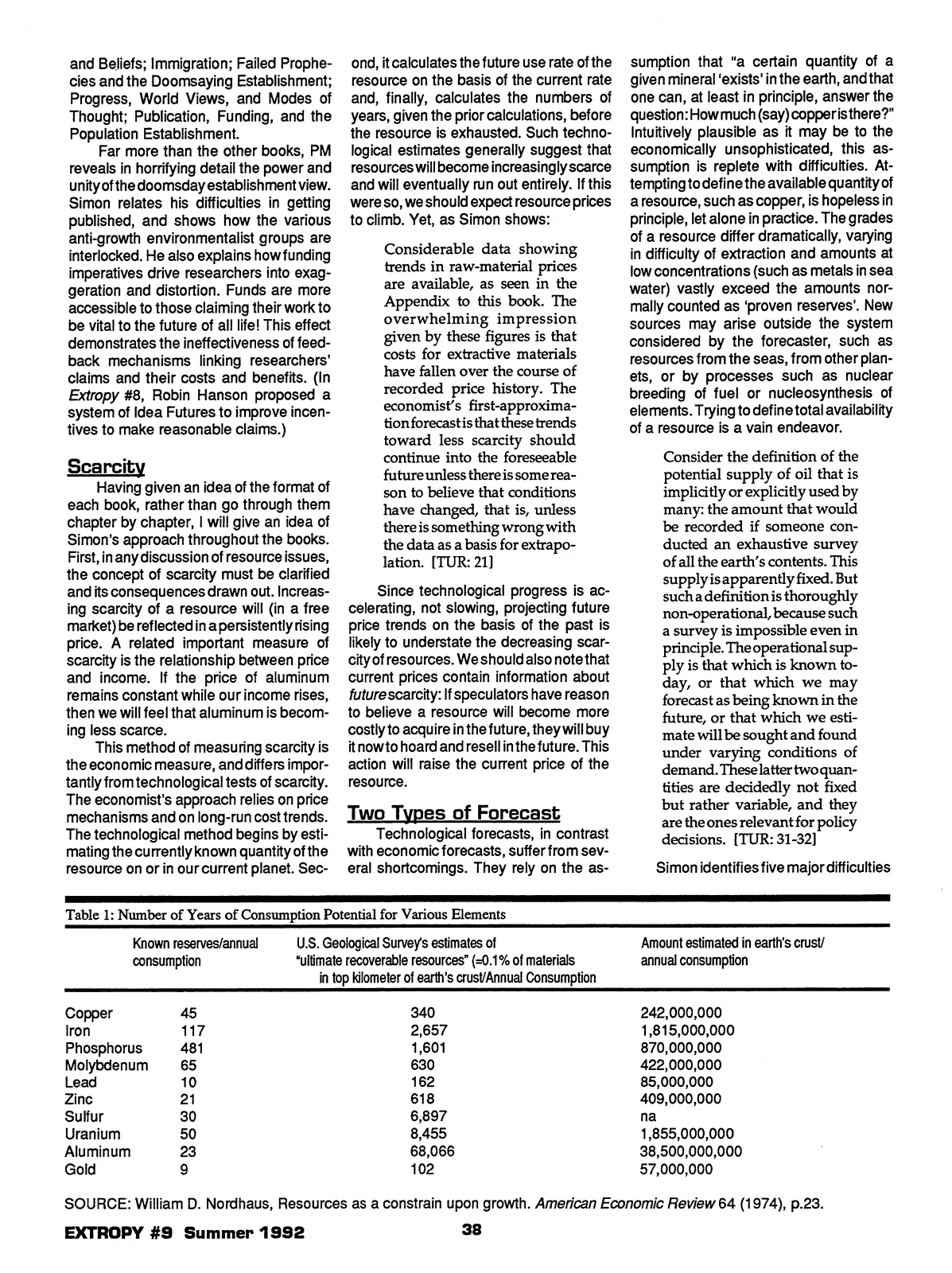
Table 1: Number of Years of Consumption Potential for Various Elements
| Known reserves/annual consumption | U.S. Geological Survey’s estimates of ‘ultimate recoverable resources’ (=0.1% of materials in top kilometer of earth’s crust/Annual Consumption | Amount estimated in earth’s crust/annual consumption |
|---|---|---|
| Copper 45 | 340 | 242,000,000 |
| Iron 117 | 2,657 | 1,815,000,000 |
| Phosphorus 481 | 1,601 | 870,000,000 |
| Molybdenum 65 | 630 | 422,000,000 |
| Lead 10 | 162 | 85,000,000 |
| Zinc 21 | 618 | 409,000,000 |
| Sulfur 30 | 6,897 | na |
| Uranium 50 | 8,455 | 1,855,000,000 |
| Aluminum 23 | 68,066 | 38,500,000,000 |
| Gold 9 | 102 | 57,000,000 |
SOURCE: William D. Nordhaus, Resources as a constrain upon growth. American Economic Review 64 (1974), p.23.
in technological forecasting. Table 1 (previous page) illustrates the growth in known reserves between 1950 and 1970, reinforcing the economist’s view that use of the known-reserve idea is misleading and worthless.
Second, the supply of minerals tends to be highly price elastic. That is, a small increase in price greatly increases the potential resources that can be profitably extracted. Many technological forecasts are based on current prices and current technology and so inevitably show rapid exhaustion of resources. Third, technological forecasts that attempt to go beyond ‘known reserves’ must make highly uncertain guesses about future discoveries of new reserves and about technological innovations. The economic approach only needs to assume that the long-run cost trend will continue. Fourth, the mineral resources of the Earth have not been thoroughly inventoried because it has never been worth anyone’s effort to do this. Finally, technological forecasts depend on how imaginative a forecaster is in thinking up future extraction methods.
Pollution
The popular view is that pollution is getting worse in just about all respects. The truth is very different. With some exceptions pollution is becoming less of a problem. Some previous pollution blamed on human activity is really the result of natural forces, such as the falling oxygen content of the Baltic Sea.
Despite propaganda about the dead Great Lakes, since the 1970s their quality has been improving. The fish catch in Lake Erie, one of the two most polluted of the Lakes, increased from its low in the ’60s, with 10 million pounds of fish caught there in 1977. ‘Lake Superior’s purity seems to have been increasing rather steadily or holding constant, at least in terms of the dissolved solids for which we have data.’ [Baumol & Oates, TRE: 444] Water quality in other areas is heading in the right direction. The oxygen content of the Thames river in England has risen since the 1960s, and the Hudson river is cleaner now than it has been in decades. ‘By almost every measure available – amount of money spent, number of sewage treatment plants constructed, number of crabs returning, number and size of fish, visibility of sewage, number of people swimming – the 155-mile long main stem of the Hudson River between New York City and Troy is improving.’ [TRE: 449]
Air is improving: Levels of carbon monoxide, sulfur dioxide, and suspended particulates have all been falling, and unleaded gas has contributed to reduced lead levels. For example, in New York by
1975, soot levels in Brooklyn fell to one-sixth of their 1945 level, and in Manhattan the level declined by two-thirds. Chicago also showed dramatic improvements, and the air in other cities became cleaner, if not by as much.
Some choice descriptions of pollution in the past, making our own environment appear pristine and pure by comparison can found in both TUR and TRE. In the streets of London in 1890, red-jacketed boys would run around trying to collect the horse manure than threatened to drown the city. Passing wagons would spray passersby with the filth and it accumulated along the sides of the road where it would be thrown. In addition, the noise of the incessant horse-drawn traffic was deafening. Many examples of terrible pollution in the past are available; the point is that we cannot realistically estimate our pollution situation without comparing it to the past. Another point well made by Simon and undoubtedly obvious to most readers of this journal is that zero pollution is not a viable option. Pollution is a by-product of desirable production, reduction of pollution is costly in terms of other desired goods and services forgone (the ‘opportunity cost’).
Population and Technology
Population projections have been made for decades and have almost invariably turned out to be wide of the mark. For example: ‘As of 1969, the U.S. Department of State Bulletin forecast 7.5 billion people for the year 2000, echoing the original UN source. By 1974, the figure quoted in the media was 7.2 billion. By 1976, Raphael Salas, the executive director of the UN Fund for Population Activities (UNFPA) was forecasting ‘nearly 7 billion.’ Soon Salas was all the way down to ‘at least 5.8 billion.’ And as early as 1977, Lester Brown and the Worldwatch Institute (which the UN is supporting) dropped it down again, forecasting 5.4 billion people for the year 2000.’ [TUR: 169-70] These and other examples should make us wary of making drastic policy decisions on the basis of forecasts.
Simon’s position has sometimes incorrectly been characterized by critics as holding that population growth is always and in every way a good thing, but his position is more complicated. The reader should consult Simon’s books to get an accurate idea of his position. For present purposes my understanding of Simon’s position is that he claims that whether population growth has positive effects depends in part on the values of the people involved, and that while population growth can be expected to have powerfully positive long-run effects, it does bring some short-run costs.
Discussions in The Ultimate Resource and Population Matters (and in great detail in his technical work, The Economics of Population Growth) demonstrate that population growth tends to accelerate technological progress. One reason for this is an increased rate of innovation. The more people there are, the more minds are working on finding solutions, whether grand or mundane: ‘…the data show clearly that the bigger the population of a country, the greater the number of scientists and the larger the amount of scientific knowledge produced; more specifically, scientific output is proportional to population size, in countries at the same level of income.’ [TUR: 202]
In addition, faster population growth speeds up the growth rate of industries, and faster-growing industries have faster rates of growth of productivity and technological practice. Simon even provides graphs refuting the contention that population growth and scientific discoveries were not correlated in ancient Greece and Rome. Rising population not only increases the rate of innovation, it spurs the adoption of existing technology. New methods, in agriculture for example, may be initially more laborious (though more efficient and productive later) and so will only be adopted under pressure of population growth.
Economies of scale provide another reason for the acceleration of technological progress in a growing population. A bigger population implies a bigger market; Greater division of labor occurs and therefore more specialized skills develop; A wider variety of services is offered; A larger population means larger production runs, and this means more learning by doing; Better infrastructure becomes affordable.
Simon demonstrates other surprising and perhaps counter-intuitive results of population growth. I will only briefly mention the effects of population growth on the availability of land for recreation. In the U.S.A., ‘Land dedicated to wildlife areas, national and state parks and forests, and recreational uses has risen from 8 million acres in 1920 to 61 million acres in 1974. And the President’s Commission in 1972 foresaw a further rise of about 37 percent from 1964 to 1980 in ‘pure recreation land outside towns.” [TUR: 235] Long-term population growth has increased income and transportation systems, making recreational land more accessible.
Species Loss
‘20% of all species will be extinct by the year 2000.’ ‘One hundred species are becoming extinct every day.’ You have probably seen these figures, or similar, bandied about in the press and stated with conviction by numerous commentators. (Even the Nature Conservancy, of which I was a member, and which protected land mostly by the proper method of buying it, used these figures in a recent fund-raising effort.) Julian Simon and Aaron Wildavsky’s essay, ‘On Species Loss, the Absence of Data, and Risks to Humanity,’ reinforced by Roger Sedjo and Marion Clawson’s ‘Global Forests’ (both in The Resourceful Earth) show these figures for the irresponsible fabrications they are.
The falsely alarming statistics come from the Global 2000 report (to which The Resourceful Earth is an effective rejoinder). Lovejoy’s figures in Global 2000 are based on Myer’s The Sinking Ark (1979) ‘which was written under the auspices of a committee of which Lovejoy was one of three members, and whose prologue is a motto of the World Wildlife Fund, on whose staff Lovejoy serves.’ [TRE: 173] Myers estimates an extinction rate of one species every 4 years between 1600 and 1900. Myers then estimates an extinction rate of one species per year from 1900 to the present (then 1980), but gives no source for this estimate). To continue, in Simon and Wildavsky’s words:
Some scientists have (in Myers’ words) ‘hazarded a guess’ that the extinction rate ‘could now have reached’ 100 species per year. That is, the estimate is simply conjecture and is not even a point estimate but rather an upper bound… Even this guessed upper limit is then increased and used by Myer’s, and then by Lovejoy, as the basis for the ‘projections’ quoted above. In Global 2000 the language has become that economic developments ‘are likely to lead’ to the extinction of between 14 and 20 percent of all species before the year 2000 (Global 2000, vol. II, p. 328), which calculates to about 40,000 species lost per year. Observe that an upper limit for the present that is pure guesswork, and that is 100 times the observed rate in the recent past, has become the basis of a forecast for the future which is 40,000 times greater than at present, and which has been published in newspapers to be read by tens or hundreds of millions of people and understood as a scientific statement.
The authors go on to further undermine the credibility of the Global 2000 statements by analyzing that report’s use of deforestation data. The essay concludes with a discussion placing the risks from species loss into proportion. As the authors note, they do not intend to suggest that we should ignore possible dangers to species.
Individual species, and perhaps all species taken together, constitute a valuable endowment, and we should guard their survival just as we guard our other physical and social assets. But we should strive for a sensible view of this set of assets in order to make the best possible judgements about how much time and money, and human welfare, should be spent in guarding them in a world in which this valuable activity must compete with other valuable activities, including the guarding of other valuable assets and of human life.
Immigration
The environmentalists not only try to restrain technology and growth, they also oppose immigration. The free flow of persons is increasingly important to the dynamism of economies. If the environmentalists, allied with traditional anti-immigration groups, have their way, yet another chain will have been wrapped around economic growth, not to mention around the lives of those trying to better their condition.
Simon provides helpful data to show the overall beneficial impact of immigrants on the economy. After putting the likely numbers of illegal immigrants into perspective, Simon refutes the contention that immigrants abuse welfare and government services. Small proportions of illegal immigrants use government services, being afraid of getting caught if they apply for welfare. Legal immigrant families make use of welfare about as much as do citizens, and much less if services for the elderly are included.
One reason why immigrants are a net boon to the economy is their demographic composition: ‘On average, it is the young, strong, and single who make the move. Of the illegal Mexicans, more than 80 percent are male, half are single (most of the married men leave their wives and children in Mexico), and most are youthful – less than 20 percent of the workers are over 35, and they average perhaps 27. Among the Vietnam refugees, only 12 percent are 45 or over, compared to 32 percent for the 45-and-over group in the U.S. population as a whole.’ [TUR: 273]
I would like to have seen a statement from Simon to the effect that immigration laws are unjust and should be abolished entirely. However, despite Simon’s strongly free market approach, he writes as an economist and so we cannot expect such directly political pronouncements. He does state one of two ideological positions as ‘The freedom to move across national boundaries is a human right that ought to be recognized.’ [PM: 282] but goes on to cite economic data in favor of this view rather than explicitly agreeing with it as a political view.
You know that Simon must be doing a good job of attacking apocalyptic environmentalism when you see how upset they become at the mention of his name. I found it hilarious and witty for Simon to include on the back cover of Population Matters some comments from his critics, in addition to the usual favorable comments (including one from F.A. Hayek): ‘The man’s a terrorist’ – Mark Plotkin, World Wildlife Fund, Cox Newspapers. ‘Schizophrenic nonsense and baloney…sabotaging the human race.’ – Dr. L.E. Marshall, Estherville, Iowa. How nice to see the balanced thought and intellectual care of these critics!
The works reviewed here should be on the shelves and reading lists of all who think of themselves as Extropians. They make fascinating and enlightening reading, and will serve as invaluable sources of intellectual ammunition for years to come. Future works by Julian Simon will be reviewed in Extropy or Exi’s new newsletter Exponent.
Select Bibliography
Issues in the Economics of Advertising (1971) The Effects of Income on Fertility (1974) The Economics of Population Growth (1977) The Ultimate Resource (1981) Theory of Population and Economic Growth (1986) Effort, Opportunity, and Growth (1987) The Economic Consequences of Immigration (1989) Essays on the Effects of Population Growth in LDC’s (forthcoming)
Edited Books
Research in Population Economics: Vol. I (1978); Vol. II (1980) (with Julie da Vanzo); Vols. III (1981) and IV (1982) (with Peter Lindert) The Resourceful Earth (with Herman Kahn, 1984)
Bionomics: The Inevitability of Capitalism
By Michael Rothschild, New York: Henry Holt and Company, Inc., 1990. 423 pp; $24.95 (hardback). ISBN: 0-8050-1068-8.
Reviewed by Harry Schapiro
This review is in both a short and a long form. If you want to read the short form, stop at the end of this paragraph. Bionomics, written by Michael Rothschild is philosophically compatible with many Extropian views. In simple terms, bionomic theory combines Austrian economics with classical and neo-classical Darwinian biology to explain the current state of world economics (circa 1990). “Bionomics argues that what we call capitalism (or free-market economics) is not an ism at all but a naturally occurring phenomenon.”¹ Rothschild was a business consultant and the book is crafted to appeal to an educated but non-extropian readership. For its clever synthesis of biological and economic theory and its promotion of spontaneous order, I highly recommend it. Extropians should consider promoting this book as it promotes a weakened set of extropian meme’s.
Extropian principles of Boundless Expansion, Dynamic Optimism, Self-Transformation, and Spontaneous Order fit well into bionomic theory. Rothschild brings out these and other views by discussing the following eight topics in the book:
- Evolution and Innovation
- Organism and Organization
- Energy and Value
- Learning and Progress
- Struggle and Competition
- Feedback loops and Free Markets
- Parasitism and Exploitation
- Mutualism and Cooperation
In as simple terms as possible, bionomics holds that replicating information makes economies dynamic, that organizations making better marginal use of this information will thrive, and that because new information is always being created, Malthusian/doomsday economics will never produce predictive or useful theories.
A Malthusian-orientated economist might hold that a healthy business will reach diminishing returns at high levels of productivity. Bionomic theory holds that a healthy business will learn more about production, will innovate, and will gain greater economies of scale and scope.
This is similar to the Extropian principles of Boundless Expansion and Dynamic Optimism. The learning process healthy businesses go though can be likened to the Extropian principle of Self-Transformation. In bionomics, it is not life forms that are self-evolving but businesses. As businesses grow and learn and transform themselves, bionomics predicts that those businesses that focus on a niche in the economic system, thus avoiding direct competition, will thrive. This is not unlike species in biology evolving so they can live near each other without competition for the same resources.
My own background is in general studies, Liberal Arts, Management, and Writing. Since I am not trained in economics I will not analyze each page of Bionomics. However, I would like to show how Rothschild’s bionomics diverges from Extropian philosophy. I will example, briefly, his chapters on: Theories of Change, Brains and Tools, Surplus and Genes, and Profits and Technology.
Chapter 2 — Theories of Change
Rothschild relates how Hegel and the dialectic serves as a basis for Marx’s economic theory. This is an orthodox view; Rothschild compares the dialectic to the theories of biological catastrophe” like Cuvier’s.
Rothschild develops a position that Marx was the first to propose to the effect that economic systems change throughout history in the same manner that Cuvier (Catastrophe) and Lamarck (inherited variation) first proposed that biological systems also change/evolve.
Rothschild holds that Smith, Ricardo and Malthus viewed economics with a “Mechanical/Newtonian” world view. Although not stated by Rothschild, he thus views Marx as having a more organic world view. While Newtonian-minded Ricardo may have been a mechanist, and while this seems to be true of Malthus, I don’t see such a view as being held by Smith. True, Smith did hold that economics reached its maturity in the age of Commerce and he was not fully laissez-faire² but rather partly interventionist³ in view (perhaps revealing a component of
“economics as physics” within in his otherwise organic view⁴) Smith did write and demonstrate that economics had changed as a result of environmental influences. Smith states that these changes took place in a self-ordering manner. (An important test for “organic” theories.) The four “economies” that human life moved through were “Hunters, Shepherds, Agricultural and Commerce.”⁵ In this regard, Smith’s views can be seen as an economic version of punctuated equilibrium⁶ which Rothschild describes in chapter 5. Why Smith did not believe that economies would further change is unknown. What is clear is that he believed that economies had changed. In this regard, Smith is likened to Cuvier or Lamarck in the limited view or scope of his theory.
Chapter 6 — Brains and Tools
Throughout his book, Rothschild makes a insightful point in talking about the power of DNA. He views it as the biological “library”, relating it by analogy to the written language used by humans. He also presents the orthodox Darwinian view that DNA evolved spontaneously. At the end of chapter 6 he goes further in stating:
Our lineage is unique because our anatomy allowed our ancestors to supplement their genetic evolution with technological evolution. Through creativity and innovation-behaviors made possible by the vastly enlarged brains of a strain of juvenilized apes - our ancestors were able to satisfy their most fundamental economic needs. The brains of our forebears became a living bridge connecting the ancient process of genetic evolution with the brand-new process of technological evolution. Up to this point in earth’s history, the only form of living information was nature’s - the mechanism of DNA. But, once the Habilis brain, itself a product of DNA, began to innovate, it launched an entirely new realm of living information.” (Emphasis mine.)
It is at this point, if not sooner, that Rothschild could have introduced the concept of the meme. He did not feel the need for its inclusion. This raises several questions:
- Does meme theory (memetics) have any effect upon the theory of bionomics?
- Does memetics affect bionomics? In what way?
- Was Rothschild aware of memetics? In the article written by Rothschild in Liberty, he talks about his lack of knowledge of the Austrian school of economics and then delineates how bionomics interacts with Austrian economics. It is very likely that Rothschild likewise never heard of meme theory. However, the 8th footnote in his book is: ‘See Dawkins, Richard, The Selfish Gene (Oxford: Oxford University Press, 1976).’ It is in this book, Chapter 11: Memes the New Replicators, that the concept of memetics was first proposed. Since Rothschild is so focused upon encoded information, and since memes are nothing if not examples of physically encoded, stored, and transmitted information, surely bionomics and meme theory must integrate.
In personal conversation Rothschild indicated that he is aware of memetics. He finds that cultural aspects of memetics are too soft, or ‘mushy.’ Because written information is stored outside of the body, Rothschild indicated that the transfer and evolution of such information can be tracked through historical records. It remains my personal belief that memetics is compatible with bionomic theory. Today we lack the ability to locate and study the storage sites of memes. Thus Rothschild is correct that in a direct and focused manner memetics cannot help bionomics. One day we may well gain the ability to find receptor sites in the brain. On that day, meme theory and bionomics will converge. Today they remain convergent only in theory. The theory being the effect of coded and replicating information on human existence and evolution.
Chapters 12 and 13: Surplus and Genes; Profits and Technology
Every genetic mutation has an effect upon the survival of that gene. The aggregate effects of various genetic mutations effect the survival vehicle in which those genes reside. The product of genes are their phenotypic expression; Richard Dawkins extends phenotypical effects to artifacts which are outside the survival vehicle. The size and general construction of dams are among the extended phenotypes of beavers.
Whether visible like a beaver dam, or ‘invisible’ like microscopic changes in a survival vehicle’s ‘eye,’ phenotypic expression affects the ability of a survival vehicle to thrive. Apparent advances in phenotypic expression can lead to extinction rather than reproductive success. Poor expressions might result from genetic mutations that lead to ‘investments’ in wings that are larger than needed, or a larger brain that consumes too much of a survival vehicle’s food. Exploring how genes compete within a species, Dawkins finds that marginal changes often work best. Marginal changes provide ‘niche’ advantage combined with reasonable energy costs. Natural selection within a dynamic environment favors the fittest survival vehicles. Fitness can be defined as possessing marginal survival advantage. Winning genes have the best evolutionarily stable strategy (ESS).
The previous paragraph is paraphrased from Richard Dawkins books, The Selfish Gene and The Extended Phenotype. In chapters 12 & 13 of Bionomics Rothschild covers similar ground. Drawing upon his business consulting background, Rothschild is able to present the previously mentioned material, in a highly practical form. All the central data is there. What are absent are the related, more radical ‘memes’ associated with Dawkins, ‘Libertarians,’ and perhaps even Extropy. This is not to imply Rothschild is whitewashing the material, nor to imply that Rothschild is an Extropian at heart. In Extropian terms, the meme set presented in these chapters contains all the important ‘infectious’ thoughts in a manner that is not likely to cause a meme-based immunological response. Proof of his success is evidenced by an article by John Hillkirk in the September 20, 1991 Money section of USA Today in which Donald Peterson, Retired Ford Motor Company CEO lists Bionomics as one of three ‘favorite books.’
Rothschild, in a manner likely to appeal to a ‘Big Three’ CEO, draws detailed case studies from both biology and economics. His analysis shows that successful survival vehicles benefit from the same type of marginal efficiencies. He presents his compelling conclusion in both text and in the form of a typical business income statement. These income statements compare bumblebee hives and super-warehouse grocery stores. Rothschild created his income statements from University of Vermont Zoology professor Bernard Heinrich’s physiological and ecological study of bumblebees² and case studies by Willard Bishop Consulting Economists Ltd. Not only is Rothschild convincing in presenting the benefits of marginal effects of advantage in evolutionarily stable systems (ESS) but he is able successfully to prove the pivotal function of replicators (like genes or memes), without the language of Dawkins. In the case of the bumblebees this is the phenotypic expression of its genes and the resulting ESS employed by successful hives. In the case of Super Valu/Cub Food, he demonstrates how the grocery business knowledge memes) of a post-Civil War Saint Paul area butcher (Grandfather Hooley) mutated into specific blueprints, training manuals and classroom exercises for the Cub Food franchisees.
Rothschild details how information expressed (phenotypically) in business strategy and practice is the basis for Cub Food’s success. Grocery stores are a genus. The species include ‘24-hour convenience,’ ‘neighborhood supermarket,’ and ‘mom & pop.’ Hooley’s Butcher Shop, the antecedent species of Cub Food, evolved into a tiny grocery store. It continued evolving, faster than competing locals of the same species. Hooley family groceries evolved steadily into new species. The memes of Grandfather Hooley (minimize costs, maximize revenues, innovate) fostered a new species: the nations first super-warehouse grocery.
By the end of chapter 13, the reader, in the language of bionomics understands the importance of survival strategies [read: ESS] and the role of DNA and information [read: genes and memes]. Rothschild promotes this information with vigor and scholarship while tuning it to his readers, educated people who are business minded. His success in this effort will undoubtedly lead to the success of Bionomics.
¹From the front flap of the Jacket to Bionomics.
²In the modern ‘libertarian’ sense (he believed in ‘regulation of paper money banking, the compulsory registration of mortgages, government participation in education, the granting of temporary monopolies to merchants engaged in enterprises of risk…, government stamps of quality on plate and on linen and woollen cloth, and the establishment of a maximum rate of interest.’) Ronald Hamowy, The Scottish Enlightenment and the Theory of Spontaneous Order (Illinois: Southern Illinois University Press, 1987) p. 21.
³Calling Adam Smith, often referred to as the father of laissez-faire economics, an interventionist is an unorthodox view at best. Perhaps it is more fair to say Smith was not an anarchist and his beliefs in the ‘legitimate role of government’ result in visible governmental ‘hands’ affecting the marketplace. If laissez-faire economics is defined in terms of a free and unfettered marketplace, Smith can be called a (limited) interventionist.
⁴Ronald Hamowy, The Scottish Enlightenment and the Theory of Spontaneous Order (Illinois: Southern Illinois University Press, 1987) p. 13. In as much as the central theme of Smith’s work in The Wealth of Nations is based upon his theory of spontaneous order—a theory first delineated in his prior work, Theory of Moral Sentiments. ‘Probably the clearest exposition of the idea of spontaneous order as it related to economic phenomena is offered in the work of Adam Smith. It should be emphasized, however, that the theory that complex social patterns are self-coordinating and need
VIEW ORIGINAL SCAN (9 pages)