Issue: EXTROPY #8 · Winter 1991/92
Author: The Editors
Pages: 48–50 · 3 scanned pages
News and Zine Reviews
NEWS
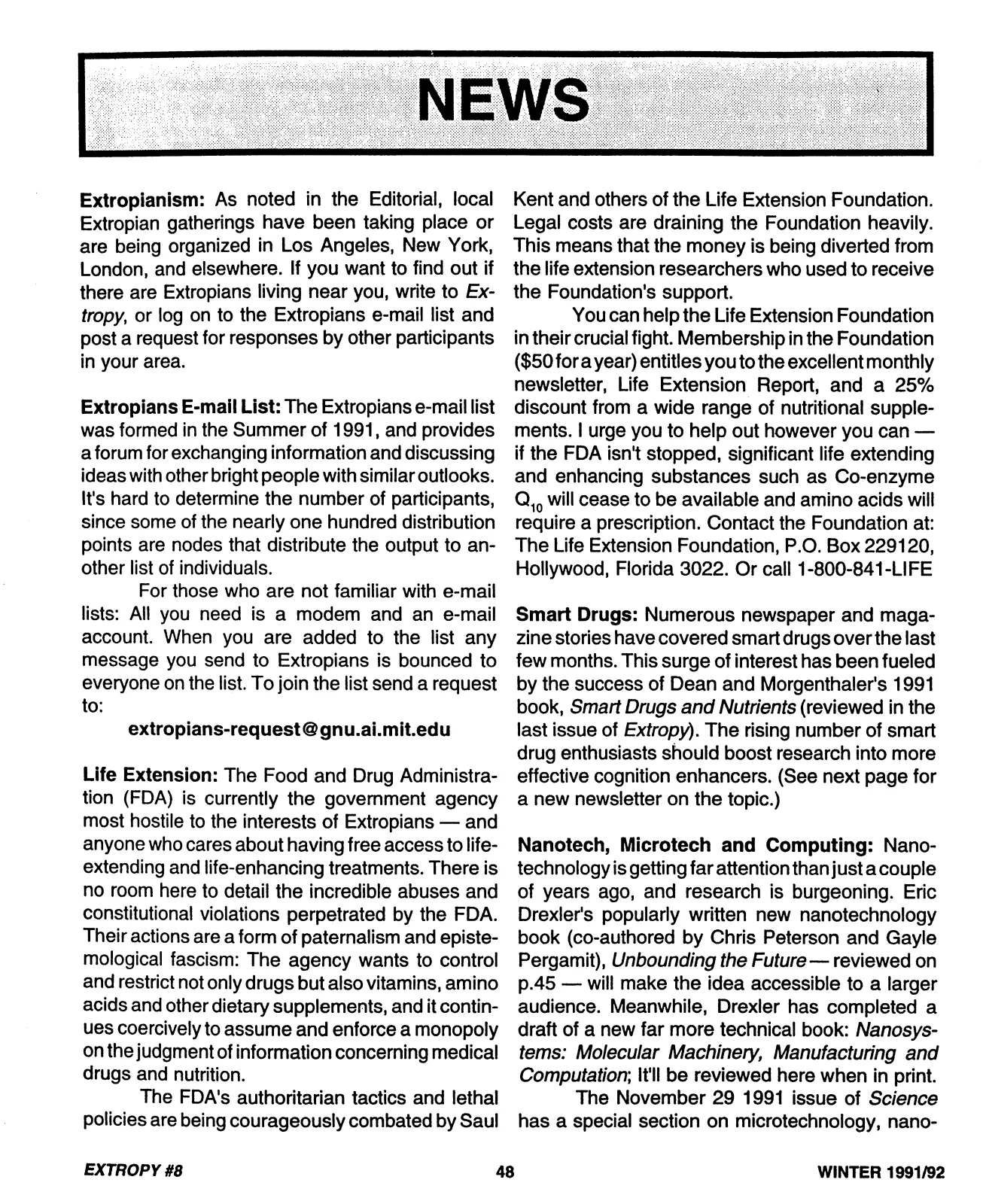
Extropianism: As noted in the Editorial, local Extropian gatherings have been taking place or are being organized in Los Angeles, New York, London, and elsewhere. If you want to find out if there are Extropians living near you, write to Extropy, or log on to the Extropians e-mail list and post a request for responses by other participants in your area.
Extropians E-mail List: The Extropians e-mail list was formed in the Summer of 1991, and provides a forum for exchanging information and discussing ideas with other bright people with similar outlooks. It’s hard to determine the number of participants, since some of the nearly one hundred distribution points are nodes that distribute the output to another list of individuals.
For those who are not familiar with e-mail lists: All you need is a modem and an e-mail account. When you are added to the list any message you send to Extropians is bounced to everyone on the list. To join the list send a request to:
extropians-request@gnu.ai.mit.edu
Life Extension: The Food and Drug Administration (FDA) is currently the government agency most hostile to the interests of Extropians — and anyone who cares about having free access to life-extending and life-enhancing treatments. There is no room here to detail the incredible abuses and constitutional violations perpetrated by the FDA. Their actions are a form of paternalism and epistemological fascism: The agency wants to control and restrict not only drugs but also vitamins, amino acids and other dietary supplements, and it continues coercively to assume and enforce a monopoly on the judgment of information concerning medical drugs and nutrition.
The FDA’s authoritarian tactics and lethal policies are being courageously combated by Saul
Kent and others of the Life Extension Foundation. Legal costs are draining the Foundation heavily. This means that the money is being diverted from the life extension researchers who used to receive the Foundation’s support.
You can help the Life Extension Foundation in their crucial fight. Membership in the Foundation ($50 for a year) entitles you to the excellent monthly newsletter, Life Extension Report, and a 25% discount from a wide range of nutritional supplements. I urge you to help out however you can — if the FDA isn’t stopped, significant life extending and enhancing substances such as Co-enzyme Q₁₀ will cease to be available and amino acids will require a prescription. Contact the Foundation at: The Life Extension Foundation, P.O. Box 229120, Hollywood, Florida 3022. Or call 1-800-841-LIFE
Smart Drugs: Numerous newspaper and magazine stories have covered smart drugs over the last few months. This surge of interest has been fueled by the success of Dean and Morgenthaler’s 1991 book, Smart Drugs and Nutrients (reviewed in the last issue of Extropy). The rising number of smart drug enthusiasts should boost research into more effective cognition enhancers. (See next page for a new newsletter on the topic.)
Nanotech, Microtech and Computing: Nanotechnology is getting far attention than just a couple of years ago, and research is burgeoning. Eric Drexler’s popularly written new nanotechnology book (co-authored by Chris Peterson and Gayle Pergamit), Unbounding the Future — reviewed on p.45 — will make the idea accessible to a larger audience. Meanwhile, Drexler has completed a draft of a new far more technical book: Nanosystems: Molecular Machinery, Manufacturing and Computation; It’ll be reviewed here when in print.
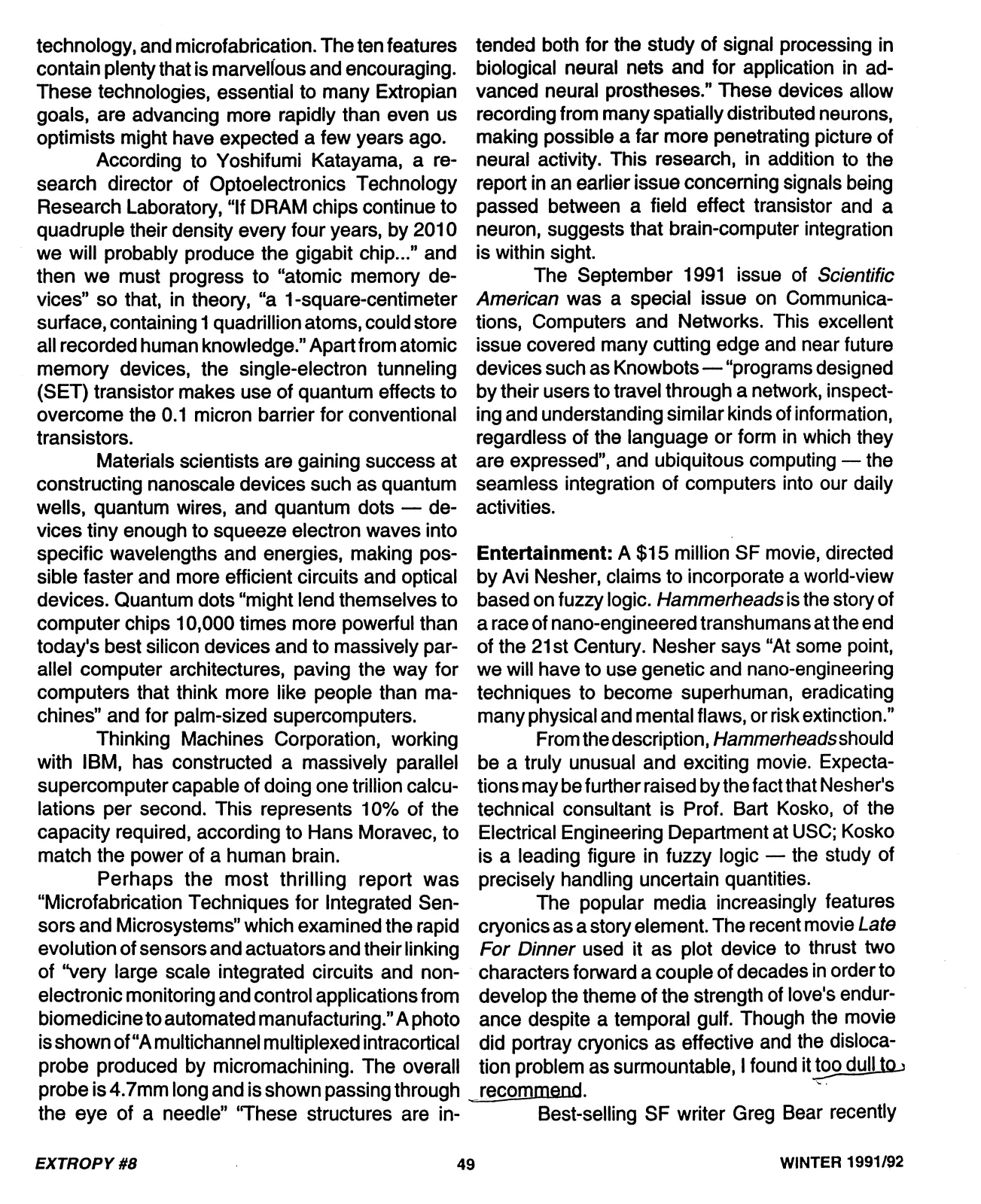
The November 29 1991 issue of Science has a special section on microtechnology, nanotechnology, and microfabrication. The ten features contain plenty that is marvellous and encouraging. These technologies, essential to many Extropian goals, are advancing more rapidly than even us optimists might have expected a few years ago.
According to Yoshifumi Katayama, a research director of Optoelectronics Technology Research Laboratory, ‘If DRAM chips continue to quadruple their density every four years, by 2010 we will probably produce the gigabit chip…’ and then we must progress to ‘atomic memory devices’ so that, in theory, ‘a 1-square-centimeter surface, containing 1 quadrillion atoms, could store all recorded human knowledge.’ Apart from atomic memory devices, the single-electron tunneling (SET) transistor makes use of quantum effects to overcome the 0.1 micron barrier for conventional transistors.
Materials scientists are gaining success at constructing nanoscale devices such as quantum wells, quantum wires, and quantum dots — devices tiny enough to squeeze electron waves into specific wavelengths and energies, making possible faster and more efficient circuits and optical devices. Quantum dots ‘might lend themselves to computer chips 10,000 times more powerful than today’s best silicon devices and to massively parallel computer architectures, paving the way for computers that think more like people than machines’ and for palm-sized supercomputers.
Thinking Machines Corporation, working with IBM, has constructed a massively parallel supercomputer capable of doing one trillion calculations per second. This represents 10% of the capacity required, according to Hans Moravec, to match the power of a human brain.
Perhaps the most thrilling report was ‘Microfabrication Techniques for Integrated Sensors and Microsystems’ which examined the rapid evolution of sensors and actuators and their linking of ‘very large scale integrated circuits and non-electronic monitoring and control applications from biomedicine to automated manufacturing.’ A photo is shown of ‘A multichannel multiplexed intracortical probe produced by micromachining. The overall probe is 4.7mm long and is shown passing through the eye of a needle’ ‘These structures are in-intended both for the study of signal processing in biological neural nets and for application in advanced neural prostheses.’ These devices allow recording from many spatially distributed neurons, making possible a far more penetrating picture of neural activity. This research, in addition to the report in an earlier issue concerning signals being passed between a field effect transistor and a neuron, suggests that brain-computer integration is within sight.
The September 1991 issue of Scientific American was a special issue on Communications, Computers and Networks. This excellent issue covered many cutting edge and near future devices such as Knowbots — ‘programs designed by their users to travel through a network, inspecting and understanding similar kinds of information, regardless of the language or form in which they are expressed’, and ubiquitous computing — the seamless integration of computers into our daily activities.
Entertainment: A $15 million SF movie, directed by Avi Nesher, claims to incorporate a world-view based on fuzzy logic. Hammerheads is the story of a race of nano-engineered transhumans at the end of the 21st Century. Nesher says ‘At some point, we will have to use genetic and nano-engineering techniques to become superhuman, eradicating many physical and mental flaws, or risk extinction.’
From the description, Hammerheads should be a truly unusual and exciting movie. Expectations may be further raised by the fact that Nesher’s technical consultant is Prof. Bart Kosko, of the Electrical Engineering Department at USC; Kosko is a leading figure in fuzzy logic — the study of precisely handling uncertain quantities.
The popular media increasingly features cryonics as a story element. The recent movie Late For Dinner used it as plot device to thrust two characters forward a couple of decades in order to develop the theme of the strength of love’s endurance despite a temporal gulf. Though the movie did portray cryonics as effective and the dislocation problem as surmountable, I found it too dull to recommend.
Best-selling SF writer Greg Bear recently came out with a novella called Heads. Much of the plot revolves around an attempt to extract information from the frozen brain of a cult leader strongly reminiscent of L. Ron Hubbard.
During 1992 look for a novel called Chiller. Central to the story will be a well-informed and sympathetic portrayal of cryonics. Chiller is written by a highly successful author writing under an assumed name. More details, perhaps including a review, should be available by next time.
Futique Media
Cryonics: This is the informative and high-quality monthly magazine of the Alcor Life Extension Foundation — the largest of the cryonics organizations. Apart from cryonics, typically found are discussions of uploading, life extension, and nanotechnology.
A subscription costs only $11 for new subscribers (normally $35 in the US, $40 in Canada and Mexico, $45 elsewhere) from: Alcor Foundation, 12327 Doherty Street, Riverside, CA 92503. Tel: 800-367-2228 or 714-736-1703
Smart Drugs News: This newsletter is not yet available (as of December 16 1991) but the first issue is reportedly in production. It will appear nine times a year and will “feature the latest information on smart drugs and nutrients which enhance mental performance.” The first year’s subscription is a hefty $35 (normally $40). Write to: The Cognitive Enhancement Research Institute, P.O. Box 4029, Menlo Park, CA 94026.
Mondo 2000: The glossy, fashion-conscious magazine of hip technology, Mondo appears at irregular intervals ev-
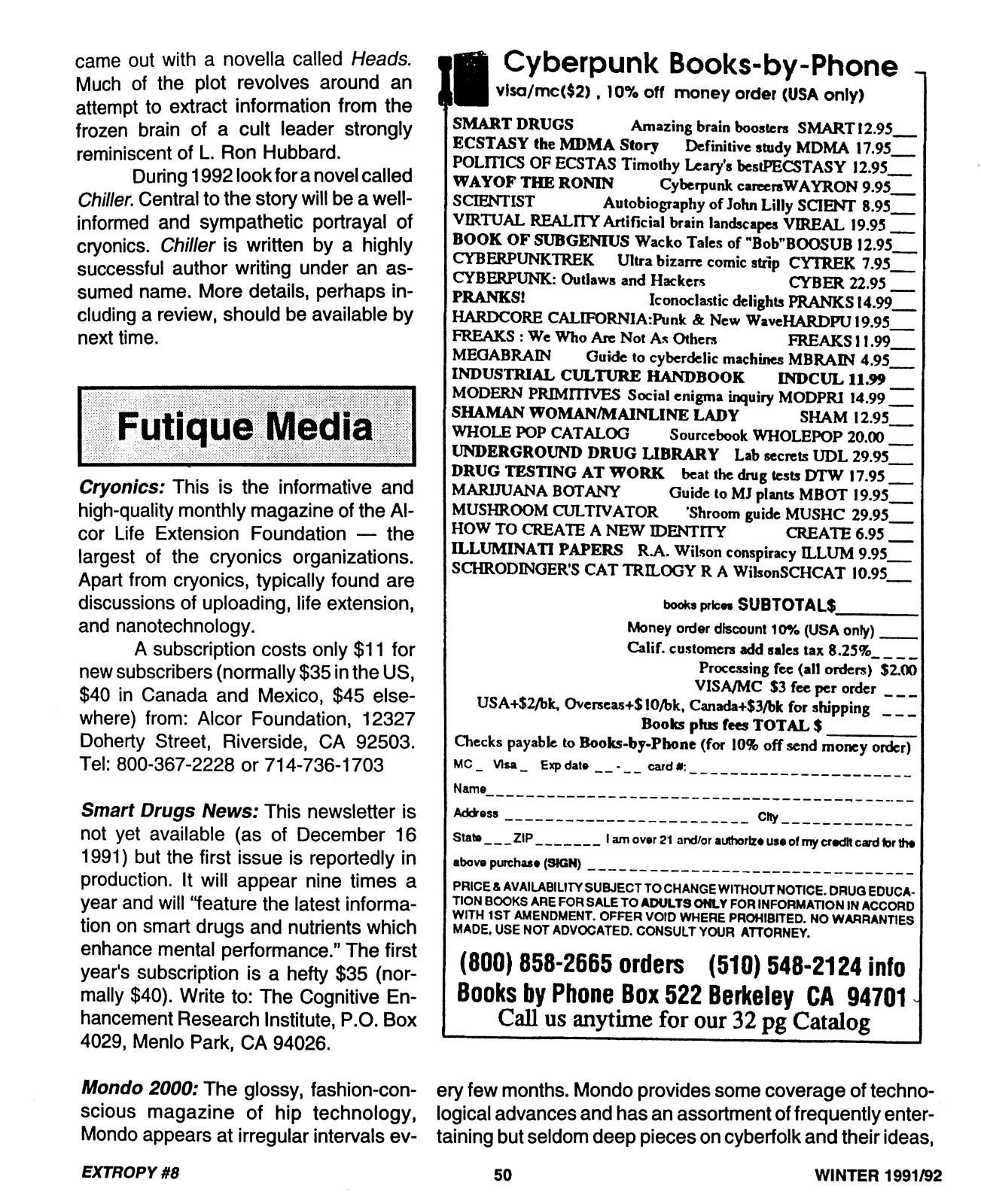
Cyberpunk Books-by-Phone
visa/mc($2), 10% off money order (USA only)
| SMART DRUGS | Amazing brain boosters | SMART 12.95 |
|---|---|---|
| ECSTASY the MDMA Story | Definitive study | MDMA 17.95 |
| POLITICS OF ECSTAS | Timothy Leary’s best | PECSTASY 12.95 |
| WAY OF THE RONIN | Cyberpunk careers | WAYRON 9.95 |
| SCIENTIST | Autobiography of John Lilly | SCIENT 8.95 |
| VIRTUAL REALITY | Artificial brain landscapes | VIREAL 19.95 |
| BOOK OF SUBGENIUS | Wacko Tales of ‘Bob’ | BOOSUB 12.95 |
| CYBERPUNKTREK | Ultra bizarre comic strip | CYTREK 7.95 |
| CYBERPUNK: Outlaws and Hackers | CYBER 22.95 | |
| PRANKS! | Iconoclastic delights | PRANKS 14.99 |
| HARDCORE CALIFORNIA: Punk & New Wave | HARDPU 19.95 | |
| FREAKS: We Who Are Not As Others | FREAKS 11.99 | |
| MEGABRAIN | Guide to cyberdelic machines | MBRAIN 4.95 |
| INDUSTRIAL CULTURE HANDBOOK | INDCUL 11.99 | |
| MODERN PRIMITIVES | Social enigma inquiry | MODPRI 14.99 |
| SHAMAN WOMAN/MAINLINE LADY | SHAM 12.95 | |
| WHOLE POP CATALOG | Sourcebook | WHOLEPOP 20.00 |
| UNDERGROUND DRUG LIBRARY | Lab secrets | UDL 29.95 |
| DRUG TESTING AT WORK | beat the drug tests | DTW 17.95 |
| MARIJUANA BOTANY | Guide to MJ plants | MBOT 19.95 |
| MUSHROOM CULTIVATOR | ’Shroom guide | MUSHC 29.95 |
| HOW TO CREATE A NEW IDENTITY | CREATE 6.95 | |
| ILLUMINATI PAPERS | R.A. Wilson conspiracy | ILLUM 9.95 |
| SCHRODINGER’S CAT TRILOGY | R A Wilson | SCHCAT 10.95 |
books prices SUBTOTAL$
Money order discount 10% (USA only)
Calif. customers add sales tax 8.25%
Processing fee (all orders) $2.00
VISA/MC $3 fee per order
USA+$2/bk, Overseas+$10/bk, Canada+$3/bk for shipping
Books plus fees TOTAL $
Checks payable to Books-by-Phone (for 10% off send money order)
MC Visa Exp date --- card #:
Name
Address City
State ZIP I am over 21 and/or authorize use of my credit card for the above purchase (SIGN)
PRICE & AVAILABILITY SUBJECT TO CHANGE WITHOUT NOTICE. DRUG EDUCATION BOOKS ARE FOR SALE TO ADULTS ONLY FOR INFORMATION IN ACCORD WITH 1ST AMENDMENT. OFFER VOID WHERE PROHIBITED. NO WARRANTIES MADE, USE NOT ADVOCATED. CONSULT YOUR ATTORNEY.
(800) 858-2665 orders (510) 548-2124 info
Books by Phone Box 522 Berkeley CA 94701
Call us anytime for our 32 pg Catalog ery few months. Mondo provides some coverage of technological advances and has an assortment of frequently entertaining but seldom deep pieces on cyberfolk and their ideas,
VIEW ORIGINAL SCAN (3 pages)