Issue: EXTROPY #8 · Winter 1991/92
Author: Simon D. Levy
Pages: 30–32 · 3 scanned pages
Neurocomputing 5: Artificial Life
Neurocomputing 5: Artificial Life
by Simon! D. Levy
Did you ever watch a flock of birds in flight and wonder how they do it? Even though the flock may be spread out over hundreds of meters of airspace, each bird seems to know exactly what direction the others are moving. The birds never collide; they manage to avoid obstacles, and in general they exhibit all sorts of behavior that suggests some massive control program for the entire flock.
An answer to this kind of question, and to the issue of large-scale complex behavior in general, is being formulated in an exciting new framework called Artificial Life. In contrast to the top-down, goal-directed models of the Artificial Intelligence movement that flourished during the 80’s, Artificial Life (or A-Life) seeks to model complex, lifelike behavior through a bottom-up approach. Instead of giving their programs complicated tasks and massive rule arsenals to solve these tasks, A-Lifers tend to create small programs based on a few simple rules. The idea is to let a whole bunch of these programs loose and see what develops. If you think that this sounds suspiciously like a free-market, laissez-faire approach to computing, I’d say you’re on the right track.
Because A-Life is such a comparatively new field, it’s difficult to come up with a set of definitions or standards by which everyone operates. (This situation contrasts with the field of neural nets, where many algorithms have been described in exhaustive mathematical detail. See my articles Neurocomputation 1 through 4 in previous issues of this magazine for an introduction.) Instead, it is instructive to look at a small number of examples of what people are doing in A-Life, and to hear what some of the leaders in the field think about the directions that A-Life may take in the future.
The Game of Life
One of the simplest and most famous A-Life programs is the Game of Life (or simply “Life”), invented by John Conway, a mathematician at the University of Cambridge. This game, which is part of a general class of programs called cellular automata, takes place in an infinite two-dimensional lattice of cells. Each cell is either on or off. Whether a cell is on or off is at a given time is determined by two simple rules:
- (1) If a cell is off at time t, it is turns on at time t+1, if and only if exactly three of its neighbors (adjacent cells) are on at time t.
- (2) If a cell is on at time t, it turns off at time t+1, if and only if fewer than two or more than three of its neighbors are on at time t.
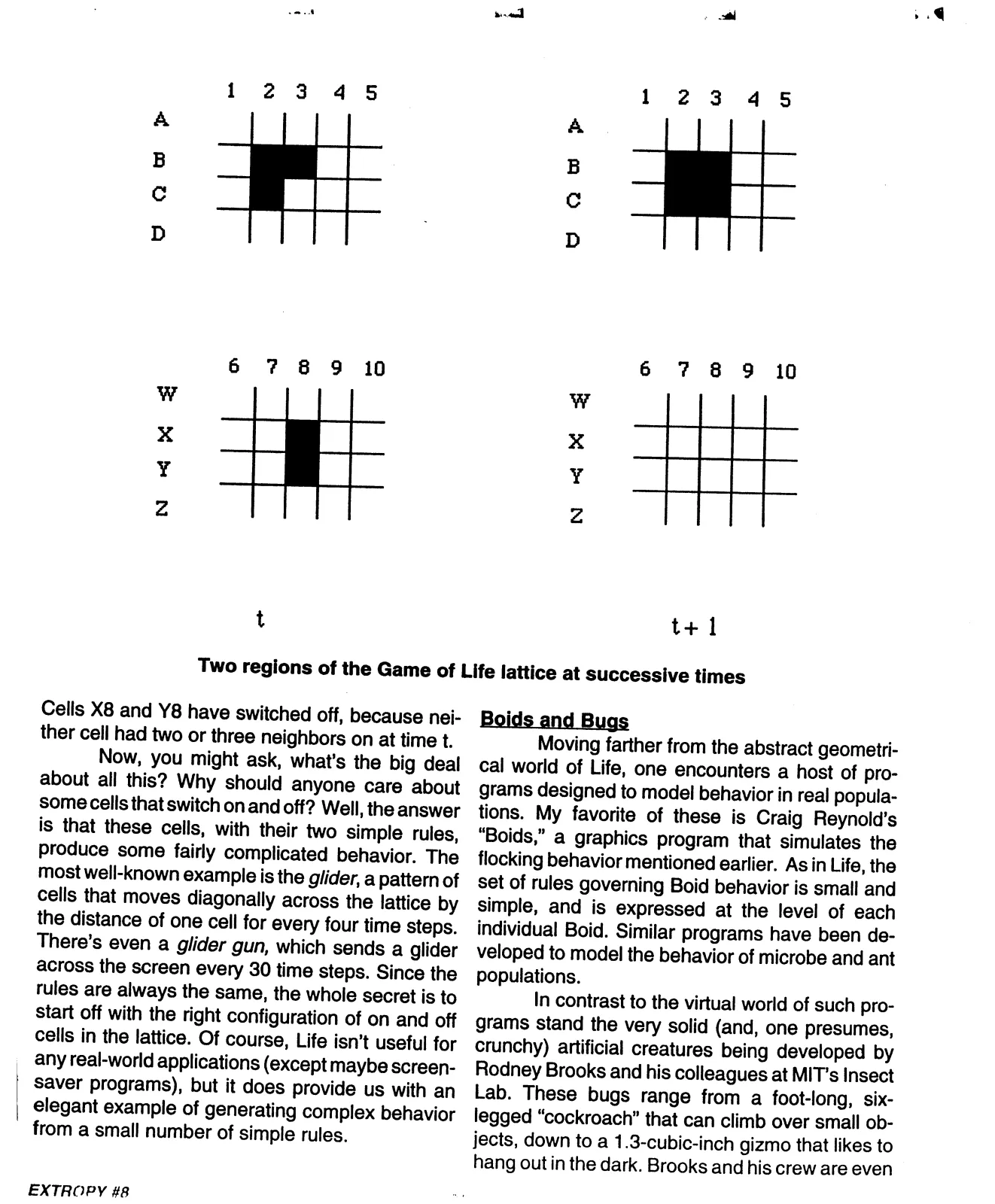
To make this a bit clearer, take a look at the following figure (p.31), which shows the states for two different parts of a lattice at times t and t+1. (Rows are labeled with arbitrary letters, and columns with arbitrary numbers.)
As you can see, each cell has eight neighbors (three above, one on each side, and three below). At time t, cells B2, B3, C2, X8 and Y8 are all on, and the rest of the cells are off. At time t+1, Cell C3 has switched on, because exactly three of its neighbors (B2, B3, and C2) were on at time t.
t
t + 1
Two regions of the Game of Life lattice at successive times
Cells X8 and Y8 have switched off, because neither cell had two or three neighbors on at time t.
Now, you might ask, what’s the big deal about all this? Why should anyone care about some cells that switch on and off? Well, the answer is that these cells, with their two simple rules, produce some fairly complicated behavior. The most well-known example is the glider, a pattern of cells that moves diagonally across the lattice by the distance of one cell for every four time steps. There’s even a glider gun, which sends a glider across the screen every 30 time steps. Since the rules are always the same, the whole secret is to start off with the right configuration of on and off cells in the lattice. Of course, Life isn’t useful for any real-world applications (except maybe screen-saver programs), but it does provide us with an elegant example of generating complex behavior from a small number of simple rules.
Boids and Bugs
Moving farther from the abstract geometrical world of Life, one encounters a host of programs designed to model behavior in real populations. My favorite of these is Craig Reynold’s ‘Boids,’ a graphics program that simulates the flocking behavior mentioned earlier. As in Life, the set of rules governing Boid behavior is small and simple, and is expressed at the level of each individual Boid. Similar programs have been developed to model the behavior of microbe and ant populations.
In contrast to the virtual world of such programs stand the very solid (and, one presumes, crunchy) artificial creatures being developed by Rodney Brooks and his colleagues at MIT’s Insect Lab. These bugs range from a foot-long, six-legged ‘cockroach’ that can climb over small objects, down to a 1.3-cubic-inch gizmo that likes to hang out in the dark. Brooks and his crew are even talking about developing tiny ‘gnat robots’ whose entire structure, motors and all, would fit on a microchip. The implications for nanotechnology are obvious: Program a zillion gnats for a specific task (say, repairing tissue damage), and let them do their thing. Equally exciting is the idea of letting a bunch of A-Life critters set up their own colonies on other planets, free from the biological requirements that limit human beings. I am intrigued by the idea of how members of these artificial societies might evolve a means of communicating with one another, creating a true artificial language (as contrasted with man-made languages such as Lojban and Esperanto).
What all these A-Life investigations have in common is a very anti-cognitive design philosophy. Nowhere is there an explicit, symbolic model of the world; rather, behavior that could be modeled as symbolic computation emerges as the result of the interaction of a number of simple ‘subbehaviors,’ such as keeping a minimum distance from one’s neighbors (in the case of Boids), or lifting one’s leg when it comes in contact with an obstacle (in the case of the six-legged robot). Again, this approach to behavior strikes me as very Extropian, both in its anti-dualism and its insistence on spontaneous orders.
Strong A-Life
The response of many people to all this would probably be that A-Life is an interesting, perhaps even ‘correct’ way of modeling what goes on in living systems, but just a model, not the real thing. Such an attitude could be called the ‘weak’ version of A-Life. If there is a ‘strong’ version of A-Life, it is exemplified in the thinking of Christopher Langton, one of the field’s most eloquent spokesmen. In his opening article to the Proceedings of the First A-Life Conference, in Santa Fe, New Mexico, Langton writes:
The dynamic processes that constitute life — in whatever material bases they might occur — must share some universal features — features that will allow us to recognize life by its dynamic form alone, without reference to its matter. This general phenomenon of life — writ-large across all possible material substrates — is the true subject matter of biology.
This attitude toward life strikes me as very similar to Hans Moravec’s attitude toward consciousness and its uploading: If there is some fundamental formal property of consciousness, independent of a material substrate (i.e., brain tissue), it may be possible to transfer one’s ‘self’ to a more robust, longer-lived machine, without losing any identity in the process.
Certainly such attitudes are likely to generate controversy. First, it remains to be seen that the formal properties of life, or of consciousness, can emerge on any large scale from a non-carbon substrate. This objection is essentially empirical. As Langton says, it is unlikely that non-carbon life forms will present themselves as a refutation of the objection, so it remains a task for A-Life to demonstrate more sophisticated, lifelike behaviors in artificial media.
A second objection has more to do with the philosophy of science: A very interesting question — perhaps the fundamental question about the origin of life — is how life and consciousness arose from precisely the material conditions that existed on earth a few billion years ago. Now, practitioners of A-Life might shrug off this objection, saying that other researchers (biochemists, geologists) are already investigating such issues. Nevertheless, I would hate to see A-Life go the way of AI. (Remember The Fifth Generation?) AI people avoided the study of learning in favor of the study of knowledge representation, only to fade into the background as neural networks entered the limelight. A-Lifers may be making the same mistake in shirking the material substrate question to get at what they consider the formal properties of life.
This is not to say that A-Life has ignored the question of how rules of behavior may evolve. In the next issue of Extropy I’ll discuss genetic algorithms, a field closely allied to Artificial Life, but where individuals compete and evolve. For those who are wondering what A-Life has to do with neurocomputation, genetic algorithms should provide some insight.
[For Sources, turn to page 34.]
VIEW ORIGINAL SCAN (3 pages)