Issue: EXTROPY #8 · Winter 1991/92
Author: Max More
Pages: 42–43 · 2 scanned pages
From Human to Transhuman to Posthuman
From Human to Transhuman to Posthuman
by Max More
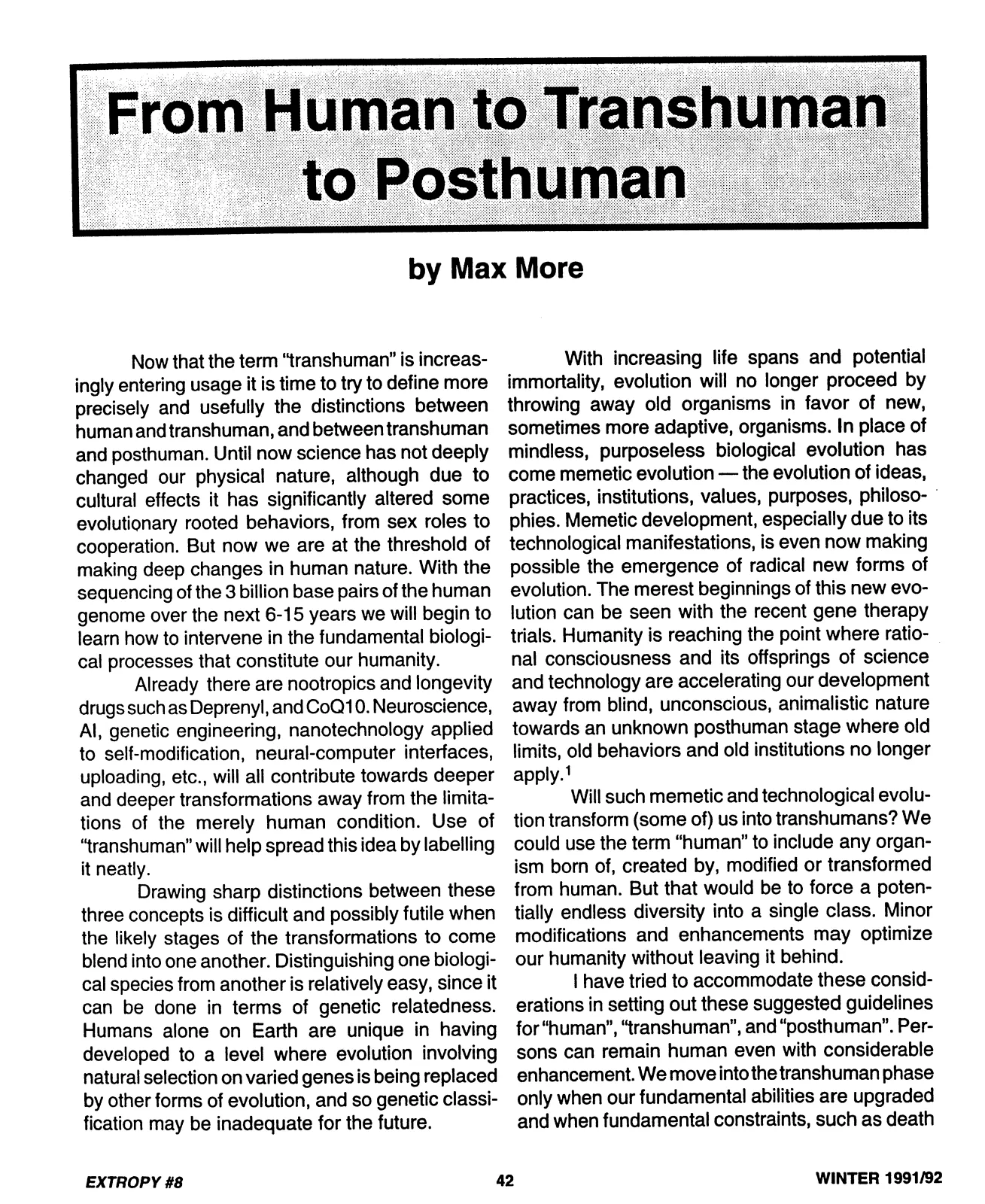
Now that the term “transhuman” is increasingly entering usage it is time to try to define more precisely and usefully the distinctions between human and transhuman, and between transhuman and posthuman. Until now science has not deeply changed our physical nature, although due to cultural effects it has significantly altered some evolutionary rooted behaviors, from sex roles to cooperation. But now we are at the threshold of making deep changes in human nature. With the sequencing of the 3 billion base pairs of the human genome over the next 6-15 years we will begin to learn how to intervene in the fundamental biological processes that constitute our humanity.
Already there are nootropics and longevity drugs such as Deprenyl, and CoQ10. Neuroscience, AI, genetic engineering, nanotechnology applied to self-modification, neural-computer interfaces, uploading, etc., will all contribute towards deeper and deeper transformations away from the limitations of the merely human condition. Use of “transhuman” will help spread this idea by labelling it neatly.
Drawing sharp distinctions between these three concepts is difficult and possibly futile when the likely stages of the transformations to come blend into one another. Distinguishing one biological species from another is relatively easy, since it can be done in terms of genetic relatedness. Humans alone on Earth are unique in having developed to a level where evolution involving natural selection on varied genes is being replaced by other forms of evolution, and so genetic classification may be inadequate for the future.
With increasing life spans and potential immortality, evolution will no longer proceed by throwing away old organisms in favor of new, sometimes more adaptive, organisms. In place of mindless, purposeless biological evolution has come memetic evolution — the evolution of ideas, practices, institutions, values, purposes, philosophies. Memetic development, especially due to its technological manifestations, is even now making possible the emergence of radical new forms of evolution. The merest beginnings of this new evolution can be seen with the recent gene therapy trials. Humanity is reaching the point where rational consciousness and its offsprings of science and technology are accelerating our development away from blind, unconscious, animalistic nature towards an unknown posthuman stage where old limits, old behaviors and old institutions no longer apply.¹
Will such memetic and technological evolution transform (some of) us into transhumans? We could use the term “human” to include any organism born of, created by, modified or transformed from human. But that would be to force a potentially endless diversity into a single class. Minor modifications and enhancements may optimize our humanity without leaving it behind.
I have tried to accommodate these considerations in setting out these suggested guidelines for “human”, “transhuman”, and “posthuman”. Persons can remain human even with considerable enhancement. We move into the transhuman phase only when our fundamental abilities are upgraded and when fundamental constraints, such as death and unsupplemented brains, are overcome.
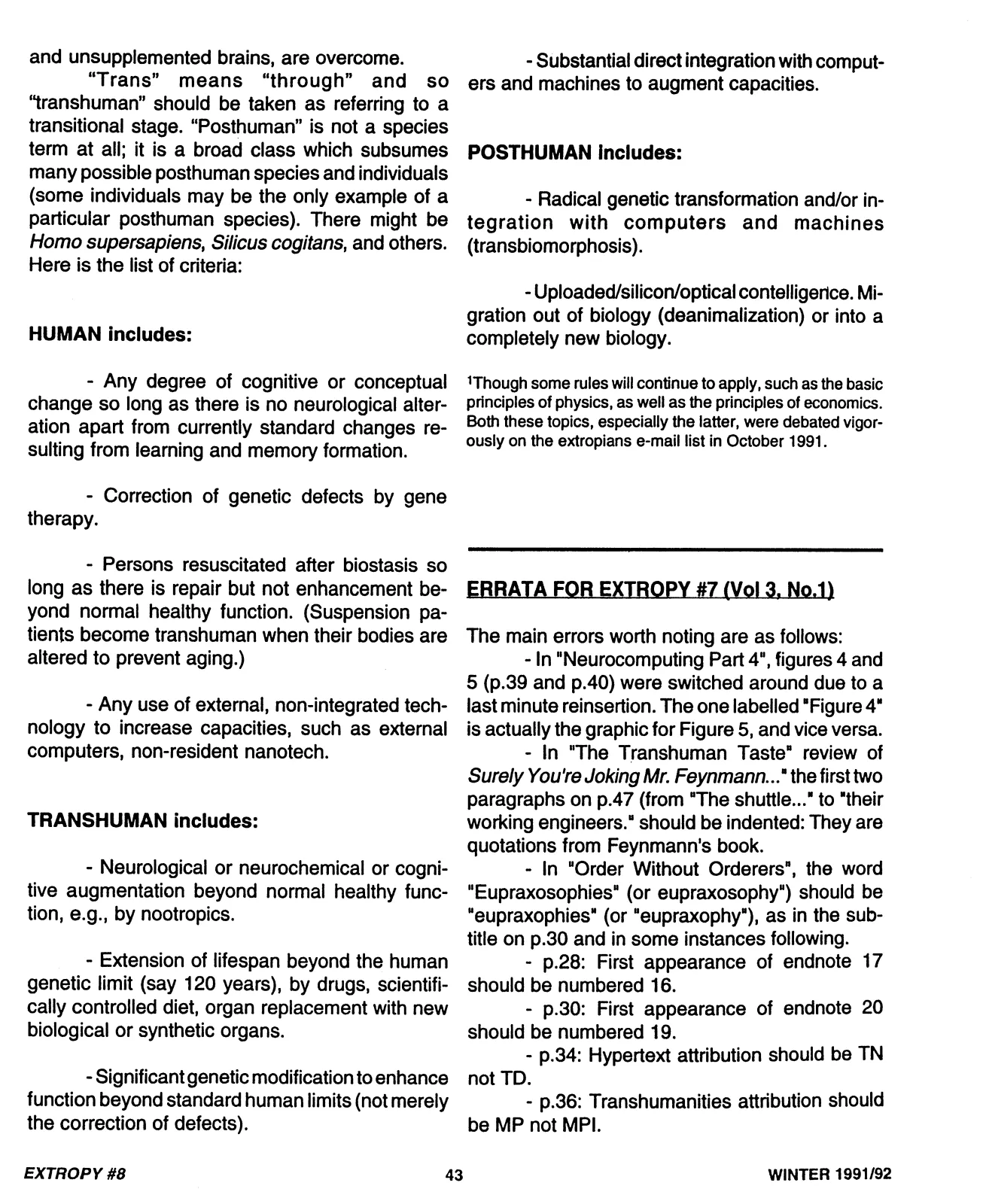
“Trans” means “through” and so “transhuman” should be taken as referring to a transitional stage. “Posthuman” is not a species term at all; it is a broad class which subsumes many possible posthuman species and individuals (some individuals may be the only example of a particular posthuman species). There might be Homo supersapiens, Silicus cogitans, and others. Here is the list of criteria:
HUMAN includes:
- Any degree of cognitive or conceptual change so long as there is no neurological alteration apart from currently standard changes resulting from learning and memory formation.
- Correction of genetic defects by gene therapy.
- Persons resuscitated after biostasis so long as there is repair but not enhancement beyond normal healthy function. (Suspension patients become transhuman when their bodies are altered to prevent aging.)
- Any use of external, non-integrated technology to increase capacities, such as external computers, non-resident nanotech.
TRANSHUMAN includes:
-
Neurological or neurochemical or cognitive augmentation beyond normal healthy function, e.g., by nootropics.
-
Extension of lifespan beyond the human genetic limit (say 120 years), by drugs, scientifically controlled diet, organ replacement with new biological or synthetic organs.
-
Significant genetic modification to enhance function beyond standard human limits (not merely the correction of defects).
-
Substantial direct integration with computers and machines to augment capacities.
POSTHUMAN includes:
- Radical genetic transformation and/or integration with computers and machines (transbiomorphosis).
- Uploaded/silicon/optical contelligence. Migration out of biology (deanimalization) or into a completely new biology.
¹Though some rules will continue to apply, such as the basic principles of physics, as well as the principles of economics. Both these topics, especially the latter, were debated vigorously on the extropians e-mail list in October 1991.
ERRATA FOR EXTROPY #7 (Vol 3, No.1)
The main errors worth noting are as follows:
- In “Neurocomputing Part 4”, figures 4 and 5 (p.39 and p.40) were switched around due to a last minute reinsertion. The one labelled “Figure 4” is actually the graphic for Figure 5, and vice versa.
- In “The Transhuman Taste” review of Surely You’re Joking Mr. Feynmann…” the first two paragraphs on p.47 (from “The shuttle…” to “their working engineers.” should be indented: They are quotations from Feynmann’s book.
- In “Order Without Orderers”, the word “Eupraxosophies” (or eupraxosophy”) should be “eupraxophies” (or “eupraxophy”), as in the subtitle on p.30 and in some instances following.
- p.28: First appearance of endnote 17 should be numbered 16.
- p.30: First appearance of endnote 20 should be numbered 19.
- p.34: Hypertext attribution should be TN not TD.
- p.36: Transhumanities attribution should be MP not MPI.
VIEW ORIGINAL SCAN (2 pages)