Issue: EXTROPY #7 · Winter/Spring 1991
Author: Max More
Pages: 5–6 · 2 scanned pages
Editorial
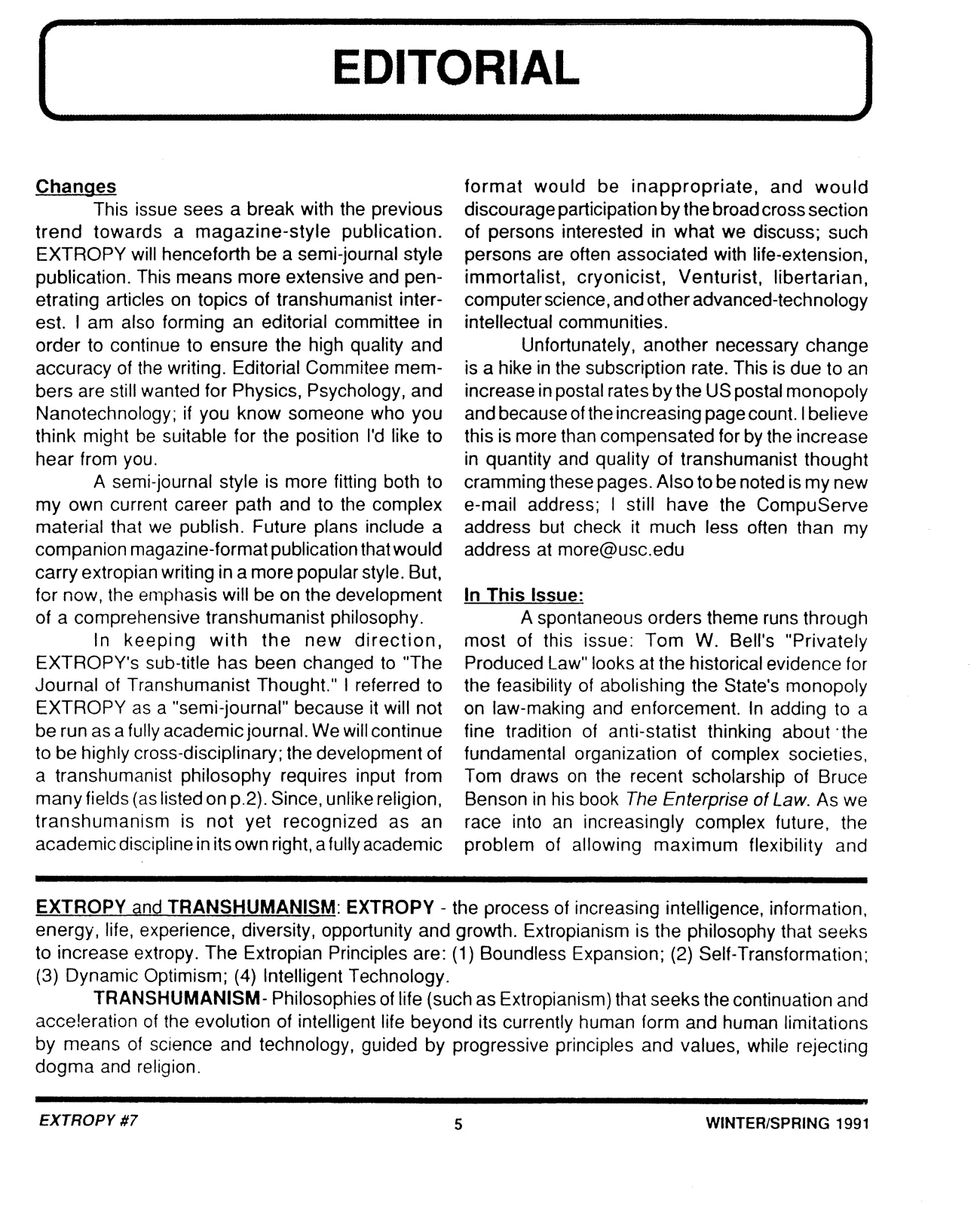
EDITORIAL
Changes
This issue sees a break with the previous trend towards a magazine-style publication. EXTROPY will henceforth be a semi-journal style publication. This means more extensive and penetrating articles on topics of transhumanist interest. I am also forming an editorial committee in order to continue to ensure the high quality and accuracy of the writing. Editorial Committee members are still wanted for Physics, Psychology, and Nanotechnology; if you know someone who you think might be suitable for the position I’d like to hear from you.
A semi-journal style is more fitting both to my own current career path and to the complex material that we publish. Future plans include a companion magazine-format publication that would carry extropian writing in a more popular style. But, for now, the emphasis will be on the development of a comprehensive transhumanist philosophy.
In keeping with the new direction, EXTROPY’s sub-title has been changed to “The Journal of Transhumanist Thought.” I referred to EXTROPY as a “semi-journal” because it will not be run as a fully academic journal. We will continue to be highly cross-disciplinary; the development of a transhumanist philosophy requires input from many fields (as listed on p.2). Since, unlike religion, transhumanism is not yet recognized as an academic discipline in its own right, a fully academic format would be inappropriate, and would discourage participation by the broad cross section of persons interested in what we discuss; such persons are often associated with life-extension, immortalist, cryonicist, Venturist, libertarian, computer science, and other advanced-technology intellectual communities.
Unfortunately, another necessary change is a hike in the subscription rate. This is due to an increase in postal rates by the US postal monopoly and because of the increasing page count. I believe this is more than compensated for by the increase in quantity and quality of transhumanist thought cramming these pages. Also to be noted is my new e-mail address; I still have the CompuServe address but check it much less often than my address at more@usc.edu
In This Issue:
A spontaneous orders theme runs through most of this issue: Tom W. Bell’s “Privately Produced Law” looks at the historical evidence for the feasibility of abolishing the State’s monopoly on law-making and enforcement. In adding to a fine tradition of anti-statist thinking about the fundamental organization of complex societies, Tom draws on the recent scholarship of Bruce Benson in his book The Enterprise of Law. As we race into an increasingly complex future, the problem of allowing maximum flexibility and
EXTROPY and TRANSHUMANISM: EXTROPY - the process of increasing intelligence, information, energy, life, experience, diversity, opportunity and growth. Extropianism is the philosophy that seeks to increase extropy. The Extropian Principles are: (1) Boundless Expansion; (2) Self-Transformation; (3) Dynamic Optimism; (4) Intelligent Technology.
TRANSHUMANISM- Philosophies of life (such as Extropianism) that seeks the continuation and acceleration of the evolution of intelligent life beyond its currently human form and human limitations by means of science and technology, guided by progressive principles and values, while rejecting dogma and religion.
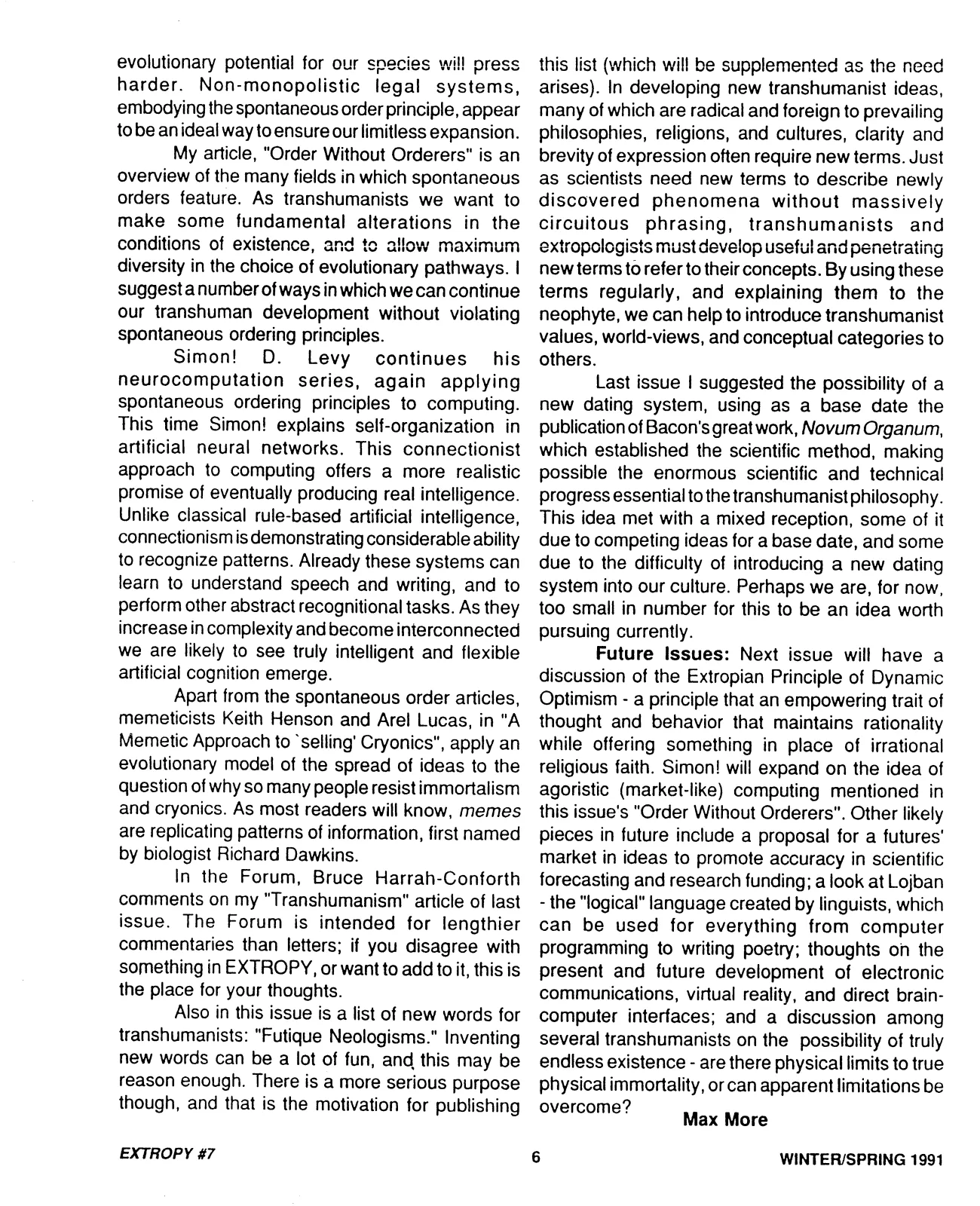
evolutionary potential for our species will press harder. Non-monopolistic legal systems, embodying the spontaneous order principle, appear to be an ideal way to ensure our limitless expansion.
My article, “Order Without Orderers” is an overview of the many fields in which spontaneous orders feature. As transhumanists we want to make some fundamental alterations in the conditions of existence, and to allow maximum diversity in the choice of evolutionary pathways. I suggest a number of ways in which we can continue our transhuman development without violating spontaneous ordering principles.
Simon! D. Levy continues his neurocomputation series, again applying spontaneous ordering principles to computing. This time Simon! explains self-organization in artificial neural networks. This connectionist approach to computing offers a more realistic promise of eventually producing real intelligence. Unlike classical rule-based artificial intelligence, connectionism is demonstrating considerable ability to recognize patterns. Already these systems can learn to understand speech and writing, and to perform other abstract recognitional tasks. As they increase in complexity and become interconnected we are likely to see truly intelligent and flexible artificial cognition emerge.
Apart from the spontaneous order articles, memeticists Keith Henson and Arel Lucas, in “A Memetic Approach to ‘selling’ Cryonics”, apply an evolutionary model of the spread of ideas to the question of why so many people resist immortalism and cryonics. As most readers will know, memes are replicating patterns of information, first named by biologist Richard Dawkins.
In the Forum, Bruce Harrah-Conforth comments on my “Transhumanism” article of last issue. The Forum is intended for lengthier commentaries than letters; if you disagree with something in EXTROPY, or want to add to it, this is the place for your thoughts.
Also in this issue is a list of new words for transhumanists: “Futique Neologisms.” Inventing new words can be a lot of fun, and this may be reason enough. There is a more serious purpose though, and that is the motivation for publishing this list (which will be supplemented as the need arises). In developing new transhumanist ideas, many of which are radical and foreign to prevailing philosophies, religions, and cultures, clarity and brevity of expression often require new terms. Just as scientists need new terms to describe newly discovered phenomena without massively circuitous phrasing, transhumanists and extrapolologists must develop useful and penetrating new terms to refer to their concepts. By using these terms regularly, and explaining them to the neophyte, we can help to introduce transhumanist values, world-views, and conceptual categories to others.
Last issue I suggested the possibility of a new dating system, using as a base date the publication of Bacon’s great work, Novum Organum, which established the scientific method, making possible the enormous scientific and technical progress essential to the transhumanist philosophy. This idea met with a mixed reception, some of it due to competing ideas for a base date, and some due to the difficulty of introducing a new dating system into our culture. Perhaps we are, for now, too small in number for this to be an idea worth pursuing currently.
Future Issues: Next issue will have a discussion of the Extropian Principle of Dynamic Optimism - a principle that an empowering trait of thought and behavior that maintains rationality while offering something in place of irrational religious faith. Simon! will expand on the idea of agoristic (market-like) computing mentioned in this issue’s “Order Without Orderers”. Other likely pieces in future include a proposal for a futures’ market in ideas to promote accuracy in scientific forecasting and research funding; a look at Lojban - the “logical” language created by linguists, which can be used for everything from computer programming to writing poetry; thoughts on the present and future development of electronic communications, virtual reality, and direct brain-computer interfaces; and a discussion among several transhumanists on the possibility of truly endless existence - are there physical limits to true physical immortality, or can apparent limitations be overcome?
Max More
VIEW ORIGINAL SCAN (2 pages)