Issue: EXTROPY #6 · Summer 1990
Author: MP-Infinity
Pages: 23 · 1 scanned page
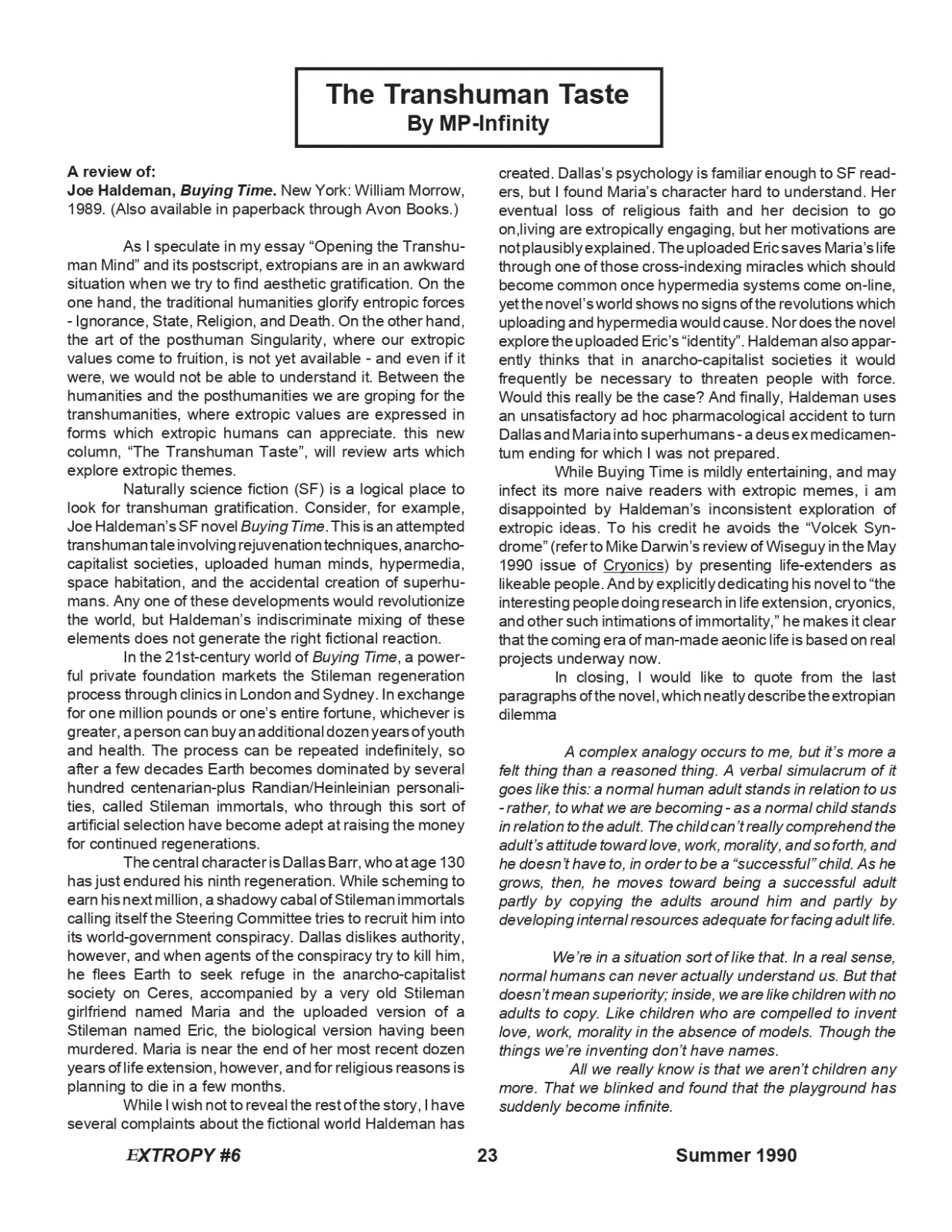
The Transhuman Taste: Review of 'Buying Time'
The Transhuman Taste
A review of:
Joe Haldeman, Buying Time. New York: William Morrow, 1989. (Also available in paperback through Avon Books.)
As I speculate in my essay ‘Opening the Transhuman Mind’ and its postscript, extropians are in an awkward situation when we try to find aesthetic gratification. On the one hand, the traditional humanities glorify entropic forces - Ignorance, State, Religion, and Death. On the other hand, the art of the posthuman Singularity, where our extropic values come to fruition, is not yet available - and even if it were, we would not be able to understand it. Between the humanities and the posthumanities we are groping for the transhumanities, where extropic values are expressed in forms which extropic humans can appreciate. this new column, ‘The Transhuman Taste’, will review arts which explore extropic themes.
Naturally science fiction (SF) is a logical place to look for transhuman gratification. Consider, for example, Joe Haldeman’s SF novel Buying Time. This is an attempted transhuman tale involving rejuvenation techniques, anarcho-capitalist societies, uploaded human minds, hypermedia, space habitation, and the accidental creation of superhumans. Any one of these developments would revolutionize the world, but Haldeman’s indiscriminate mixing of these elements does not generate the right fictional reaction.
In the 21st-century world of Buying Time, a powerful private foundation markets the Stileman regeneration process through clinics in London and Sydney. In exchange for one million pounds or one’s entire fortune, whichever is greater, a person can buy an additional dozen years of youth and health. The process can be repeated indefinitely, so after a few decades Earth becomes dominated by several hundred centenarian-plus Randian/Heinleinian personalities, called Stileman immortals, who through this sort of artificial selection have become adept at raising the money for continued regenerations.
The central character is Dallas Barr, who at age 130 has just endured his ninth regeneration. While scheming to earn his next million, a shadowy cabal of Stileman immortals calling itself the Steering Committee tries to recruit him into its world-government conspiracy. Dallas dislikes authority, however, and when agents of the conspiracy try to kill him, he flees Earth to seek refuge in the anarcho-capitalist society on Ceres, accompanied by a very old Stileman girlfriend named Maria and the uploaded version of a Stileman named Eric, the biological version having been murdered. Maria is near the end of her most recent dozen years of life extension, however, and for religious reasons is planning to die in a few months.
While I wish not to reveal the rest of the story, I have several complaints about the fictional world Haldeman has created. Dallas’s psychology is familiar enough to SF readers, but I found Maria’s character hard to understand. Her eventual loss of religious faith and her decision to go on, living are extropically engaging, but her motivations are not plausibly explained. The uploaded Eric saves Maria’s life through one of those cross-indexing miracles which should become common once hypermedia systems come on-line, yet the novel’s world shows no signs of the revolutions which uploading and hypermedia would cause. Nor does the novel explore the uploaded Eric’s ‘identity’. Haldeman also apparently thinks that in anarcho-capitalist societies it would frequently be necessary to threaten people with force. Would this really be the case? And finally, Haldeman uses an unsatisfactory ad hoc pharmacological accident to turn Dallas and Maria into superhumans - a deus ex medicamentum ending for which I was not prepared.
While Buying Time is mildly entertaining, and may infect its more naive readers with extropic memes, I am disappointed by Haldeman’s inconsistent exploration of extropic ideas. To his credit he avoids the ‘Volcek Syndrome’ (refer to Mike Darwin’s review of Wiseguy in the May 1990 issue of Cryonics) by presenting life-extenders as likeable people. And by explicitly dedicating his novel to ‘the interesting people doing research in life extension, cryonics, and other such intimations of immortality,’ he makes it clear that the coming era of man-made aeonic life is based on real projects underway now.
In closing, I would like to quote from the last paragraphs of the novel, which neatly describe the extropian dilemma
A complex analogy occurs to me, but it’s more a felt thing than a reasoned thing. A verbal simulacrum of it goes like this: a normal human adult stands in relation to us - rather, to what we are becoming - as a normal child stands in relation to the adult. The child can’t really comprehend the adult’s attitude toward love, work, morality, and so forth, and he doesn’t have to, in order to be a ‘successful’ child. As he grows, then, he moves toward being a successful adult partly by copying the adults around him and partly by developing internal resources adequate for facing adult life.
We’re in a situation sort of like that. In a real sense, normal humans can never actually understand us. But that doesn’t mean superiority; inside, we are like children with no adults to copy. Like children who are compelled to invent love, work, morality in the absence of models. Though the things we’re inventing don’t have names.
All we really know is that we aren’t children any more. That we blinked and found that the playground has suddenly become infinite.
VIEW ORIGINAL SCAN (1 pages)