Issue: EXTROPY #6 · Summer 1990
Author: Rob Michels
Pages: 34–35 · 2 scanned pages
Review: The Machinery of Freedom
Reviewed by Rob Michels.
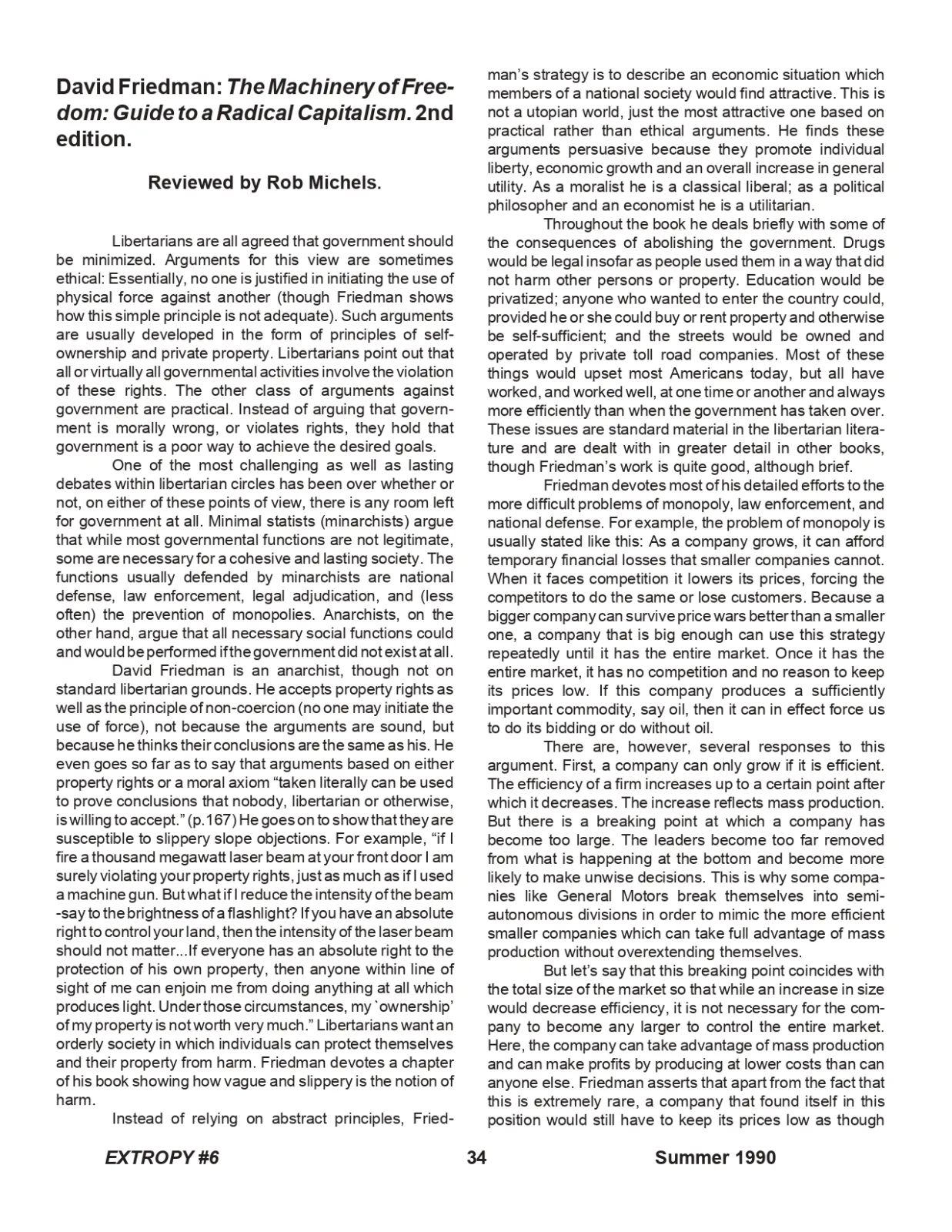
Libertarians are all agreed that government should be minimized. Arguments for this view are sometimes ethical: Essentially, no one is justified in initiating the use of physical force against another (though Friedman shows how this simple principle is not adequate). Such arguments are usually developed in the form of principles of self-ownership and private property. Libertarians point out that all or virtually all governmental activities involve the violation of these rights. The other class of arguments against government are practical. Instead of arguing that government is morally wrong, or violates rights, they hold that government is a poor way to achieve the desired goals.
One of the most challenging as well as lasting debates within libertarian circles has been over whether or not, on either of these points of view, there is any room left for government at all. Minimal statists (minarchists) argue that while most governmental functions are not legitimate, some are necessary for a cohesive and lasting society. The functions usually defended by minarchists are national defense, law enforcement, legal adjudication, and (less often) the prevention of monopolies. Anarchists, on the other hand, argue that all necessary social functions could and would be performed if the government did not exist at all.
David Friedman is an anarchist, though not on standard libertarian grounds. He accepts property rights as well as the principle of non-coercion (no one may initiate the use of force), not because the arguments are sound, but because he thinks their conclusions are the same as his. He even goes so far as to say that arguments based on either property rights or a moral axiom ‘taken literally can be used to prove conclusions that nobody, libertarian or otherwise, is willing to accept.’ (p. 167) He goes on to show that they are susceptible to slippery slope objections. For example, ‘if I fire a thousand megawatt laser beam at your front door I am surely violating your property rights, just as much as if I used a machine gun. But what if I reduce the intensity of the beam -say to the brightness of a flashlight? If you have an absolute right to control your land, then the intensity of the laser beam should not matter…If everyone has an absolute right to the protection of his own property, then anyone within line of sight of me can enjoin me from doing anything at all which produces light. Under those circumstances, my ‘ownership’ of my property is not worth very much.’ Libertarians want an orderly society in which individuals can protect themselves and their property from harm. Friedman devotes a chapter of his book showing how vague and slippery is the notion of harm.
Instead of relying on abstract principles, Friedman’s man’s strategy is to describe an economic situation which members of a national society would find attractive. This is not a utopian world, just the most attractive one based on practical rather than ethical arguments. He finds these arguments persuasive because they promote individual liberty, economic growth and an overall increase in general utility. As a moralist he is a classical liberal; as a political philosopher and an economist he is a utilitarian.
Throughout the book he deals briefly with some of the consequences of abolishing the government. Drugs would be legal insofar as people used them in a way that did not harm other persons or property. Education would be privatized; anyone who wanted to enter the country could, provided he or she could buy or rent property and otherwise be self-sufficient; and the streets would be owned and operated by private toll road companies. Most of these things would upset most Americans today, but all have worked, and worked well, at one time or another and always more efficiently than when the government has taken over. These issues are standard material in the libertarian literature and are dealt with in greater detail in other books, though Friedman’s work is quite good, although brief.
Friedman devotes most of his detailed efforts to the more difficult problems of monopoly, law enforcement, and national defense. For example, the problem of monopoly is usually stated like this: As a company grows, it can afford temporary financial losses that smaller companies cannot. When it faces competition it lowers its prices, forcing the competitors to do the same or lose customers. Because a bigger company can survive price wars better than a smaller one, a company that is big enough can use this strategy repeatedly until it has the entire market. Once it has the entire market, it has no competition and no reason to keep its prices low. If this company produces a sufficiently important commodity, say oil, then it can in effect force us to do its bidding or do without oil.
There are, however, several responses to this argument. First, a company can only grow if it is efficient. The efficiency of a firm increases up to a certain point after which it decreases. The increase reflects mass production. But there is a breaking point at which a company has become too large. The leaders become too far removed from what is happening at the bottom and become more likely to make unwise decisions. This is why some companies like General Motors break themselves into semi-autonomous divisions in order to mimic the more efficient smaller companies which can take full advantage of mass production without overextending themselves.
But let’s say that this breaking point coincides with the total size of the market so that while an increase in size would decrease efficiency, it is not necessary for the company to become any larger to control the entire market. Here, the company can take advantage of mass production and can make profits by producing at lower costs than can anyone else. Friedman asserts that apart from the fact that this is extremely rare, a company that found itself in this position would still have to keep its prices low as though
34
Summer 1990
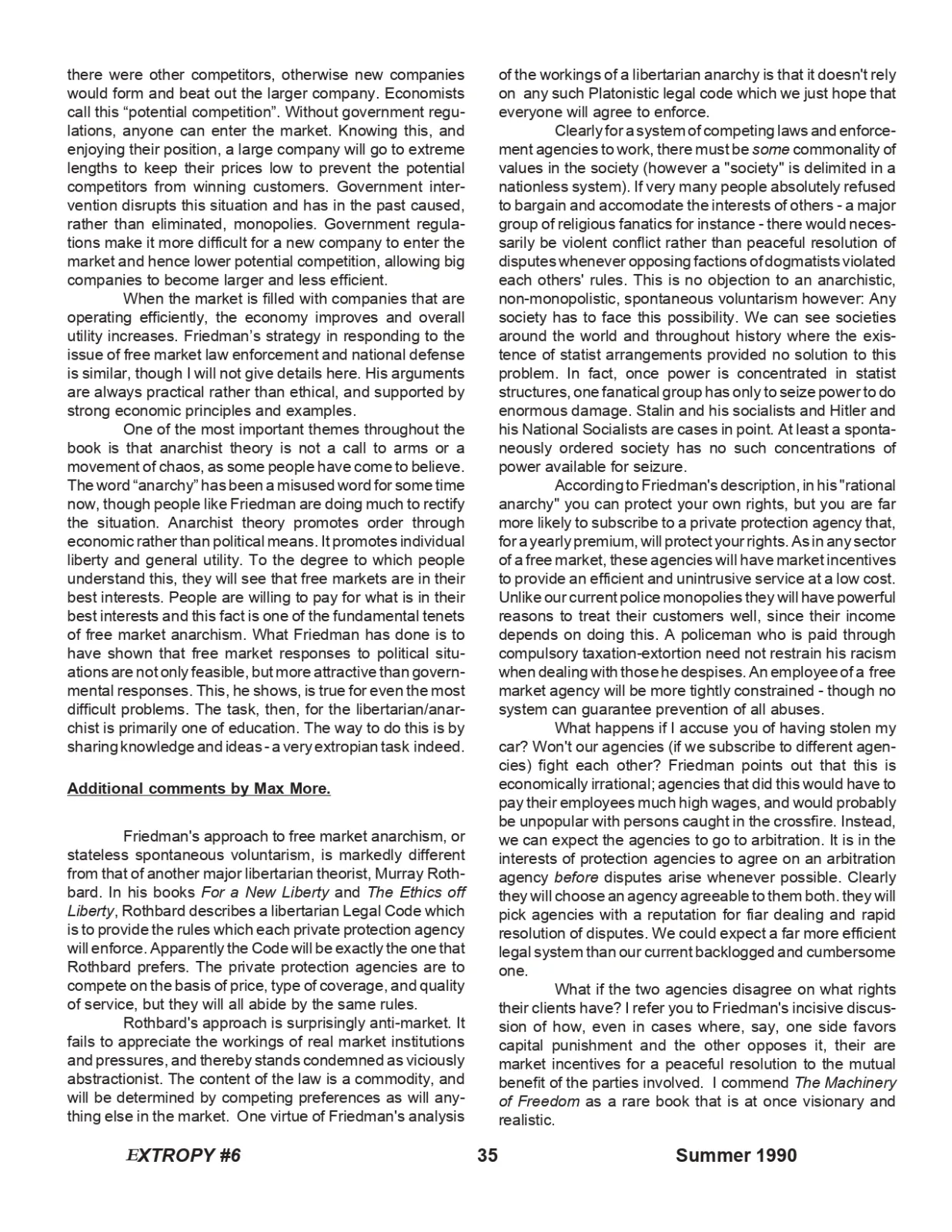
there were other competitors, otherwise new companies would form and beat out the larger company. Economists call this ‘potential competition’. Without government regulations, anyone can enter the market. Knowing this, and enjoying their position, a large company will go to extreme lengths to keep their prices low to prevent the potential competitors from winning customers. Government intervention disrupts this situation and has in the past caused, rather than eliminated, monopolies. Government regulations make it more difficult for a new company to enter the market and hence lower potential competition, allowing big companies to become larger and less efficient.
When the market is filled with companies that are operating efficiently, the economy improves and overall utility increases. Friedman’s strategy in responding to the issue of free market law enforcement and national defense is similar, though I will not give details here. His arguments are always practical rather than ethical, and supported by strong economic principles and examples.
One of the most important themes throughout the book is that anarchist theory is not a call to arms or a movement of chaos, as some people have come to believe. The word ‘anarchy’ has been a misused word for some time now, though people like Friedman are doing much to rectify the situation. Anarchist theory promotes order through economic rather than political means. It promotes individual liberty and general utility. To the degree to which people understand this, they will see that free markets are in their best interests. People are willing to pay for what is in their best interests and this fact is one of the fundamental tenets of free market anarchism. What Friedman has done is to have shown that free market responses to political situations are not only feasible, but more attractive than governmental responses. This, he shows, is true for even the most difficult problems. The task, then, for the libertarian/anarchist is primarily one of education. The way to do this is by sharing knowledge and ideas - a very extropian task indeed.
Additional comments by Max More.
Friedman’s approach to free market anarchism, or stateless spontaneous voluntarism, is markedly different from that of another major libertarian theorist, Murray Rothbard. In his books For a New Liberty and The Ethics off Liberty, Rothbard describes a libertarian Legal Code which is to provide the rules which each private protection agency will enforce. Apparently the Code will be exactly the one that Rothbard prefers. The private protection agencies are to compete on the basis of price, type of coverage, and quality of service, but they will all abide by the same rules.
Rothbard’s approach is surprisingly anti-market. It fails to appreciate the workings of real market institutions and pressures, and thereby stands condemned as viciously abstractionist. The content of the law is a commodity, and will be determined by competing preferences as will anything else in the market. One virtue of Friedman’s analysis of the workings of a libertarian anarchy is that it doesn’t rely on any such Platonic legal code which we just hope that everyone will agree to enforce.
Clearly for a system of competing laws and enforcement agencies to work, there must be some commonality of values in the society (however a ‘society’ is delimited in a nationless system). If very many people absolutely refused to bargain and accommodate the interests of others - a major group of religious fanatics for instance - there would necessarily be violent conflict rather than peaceful resolution of disputes whenever opposing factions of dogmatists violated each others’ rules. This is no objection to an anarchistic, non-monopolistic, spontaneous voluntarism however: Any society has to face this possibility. We can see societies around the world and throughout history where the existence of statist arrangements provided no solution to this problem. In fact, once power is concentrated in statist structures, one fanatical group has only to seize power to do enormous damage. Stalin and his socialists and Hitler and his National Socialists are cases in point. At least a spontaneously ordered society has no such concentrations of power available for seizure.
According to Friedman’s description, in his ‘rational anarchy’ you can protect your own rights, but you are far more likely to subscribe to a private protection agency that, for a yearly premium, will protect your rights. As in any sector of a free market, these agencies will have market incentives to provide an efficient and unintrusive service at a low cost. Unlike our current police monopolies they will have powerful reasons to treat their customers well, since their income depends on doing this. A policeman who is paid through compulsory taxation-extortion need not restrain his racism when dealing with those he despises. An employee of a free market agency will be more tightly constrained - though no system can guarantee prevention of all abuses.
What happens if I accuse you of having stolen my car? Won’t our agencies (if we subscribe to different agencies) fight each other? Friedman points out that this is economically irrational; agencies that did this would have to pay their employees much high wages, and would probably be unpopular with persons caught in the crossfire. Instead, we can expect the agencies to go to arbitration. It is in the interests of protection agencies to agree on an arbitration agency before disputes arise whenever possible. Clearly they will choose an agency agreeable to them both, they will pick agencies with a reputation for fair dealing and rapid resolution of disputes. We could expect a far more efficient legal system than our current backlogged and cumbersome one.
What if the two agencies disagree on what rights their clients have? I refer you to Friedman’s incisive discussion of how, even in cases where, say, one side favors capital punishment and the other opposes it, their are market incentives for a peaceful resolution to the mutual benefit of the parties involved. I commend The Machinery of Freedom as a rare book that is at once visionary and realistic.
35
Summer 1990
VIEW ORIGINAL SCAN (2 pages)