Issue: EXTROPY #6 · Summer 1990
Author: Simon D. Levy
Pages: 13–14 · 2 scanned pages
Book Reviews: The Emperor's New Dualism & Extropy Courtesy of Entropy
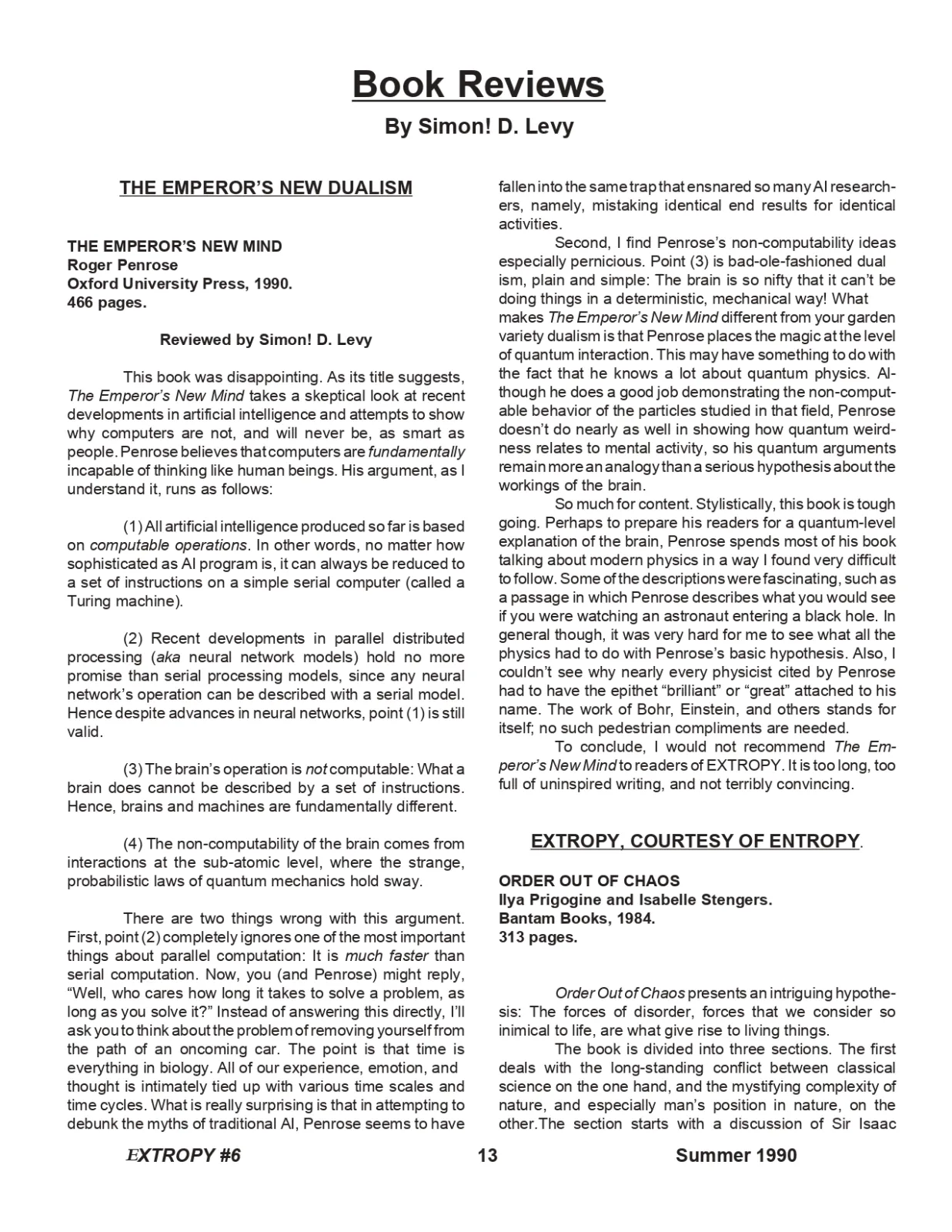
Book Reviews
By Simon! D. Levy
THE EMPEROR’S NEW DUALISM
THE EMPEROR’S NEW MIND
Roger Penrose
Oxford University Press, 1990.
466 pages.
Reviewed by Simon! D. Levy
This book was disappointing. As its title suggests, The Emperor’s New Mind takes a skeptical look at recent developments in artificial intelligence and attempts to show why computers are not, and will never be, as smart as people. Penrose believes that computers are fundamentally incapable of thinking like human beings. His argument, as I understand it, runs as follows:
(1) All artificial intelligence produced so far is based on computable operations. In other words, no matter how sophisticated as AI program is, it can always be reduced to a set of instructions on a simple serial computer (called a Turing machine). (2) Recent developments in parallel distributed processing (aka neural network models) hold no more promise than serial processing models, since any neural network’s operation can be described with a serial model. Hence despite advances in neural networks, point (1) is still valid. (3) The brain’s operation is not computable: What a brain does cannot be described by a set of instructions. Hence, brains and machines are fundamentally different. (4) The non-computability of the brain comes from interactions at the sub-atomic level, where the strange, probabilistic laws of quantum mechanics hold sway.
There are two things wrong with this argument. First, point (2) completely ignores one of the most important things about parallel computation: It is much faster than serial computation. Now, you (and Penrose) might reply, “Well, who cares how long it takes to solve a problem, as long as you solve it?” Instead of answering this directly, I’ll ask you to think about the problem of removing yourself from the path of an oncoming car. The point is that time is everything in biology. All of our experience, emotion, and thought is intimately tied up with various time scales and time cycles. What is really surprising is that in attempting to debunk the myths of traditional AI, Penrose seems to have fallen into the same trap that ensnared so many AI researchers, namely, mistaking identical end results for identical activities.
Second, I find Penrose’s non-computability ideas especially pernicious. Point (3) is bad-ole-fashioned dualism, plain and simple: The brain is so nifty that it can’t be doing things in a deterministic, mechanical way! What makes The Emperor’s New Mind different from your garden variety dualism is that Penrose places the magic at the level of quantum interaction. This may have something to do with the fact that he knows a lot about quantum physics. Although he does a good job demonstrating the non-computable behavior of the particles studied in that field, Penrose doesn’t do nearly as well in showing how quantum weirdness relates to mental activity, so his quantum arguments remain more an analogy than a serious hypothesis about the workings of the brain.
So much for content. Stylistically, this book is tough going. Perhaps to prepare his readers for a quantum-level explanation of the brain, Penrose spends most of his book talking about modern physics in a way I found very difficult to follow. Some of the descriptions were fascinating, such as a passage in which Penrose describes what you would see if you were watching an astronaut entering a black hole. In general though, it was very hard for me to see what all the physics had to do with Penrose’s basic hypothesis. Also, I couldn’t see why nearly every physicist cited by Penrose had to have the epithet “brilliant” or “great” attached to his name. The work of Bohr, Einstein, and others stands for itself; no such pedestrian compliments are needed.
To conclude, I would not recommend The Emperor’s New Mind to readers of EXTROPY. It is too long, too full of uninspired writing, and not terribly convincing.
EXTROPY, COURTESY OF ENTROPY.
ORDER OUT OF CHAOS
Ilya Prigogine and Isabelle Stengers.
Bantam Books, 1984.
313 pages.
Order Out of Chaos presents an intriguing hypothesis: The forces of disorder, forces that we consider so inimical to life, are what give rise to living things.
The book is divided into three sections. The first deals with the long-standing conflict between classical science on the one hand, and the mystifying complexity of nature, and especially man’s position in nature, on the other. The section starts with a discussion of Sir Isaac
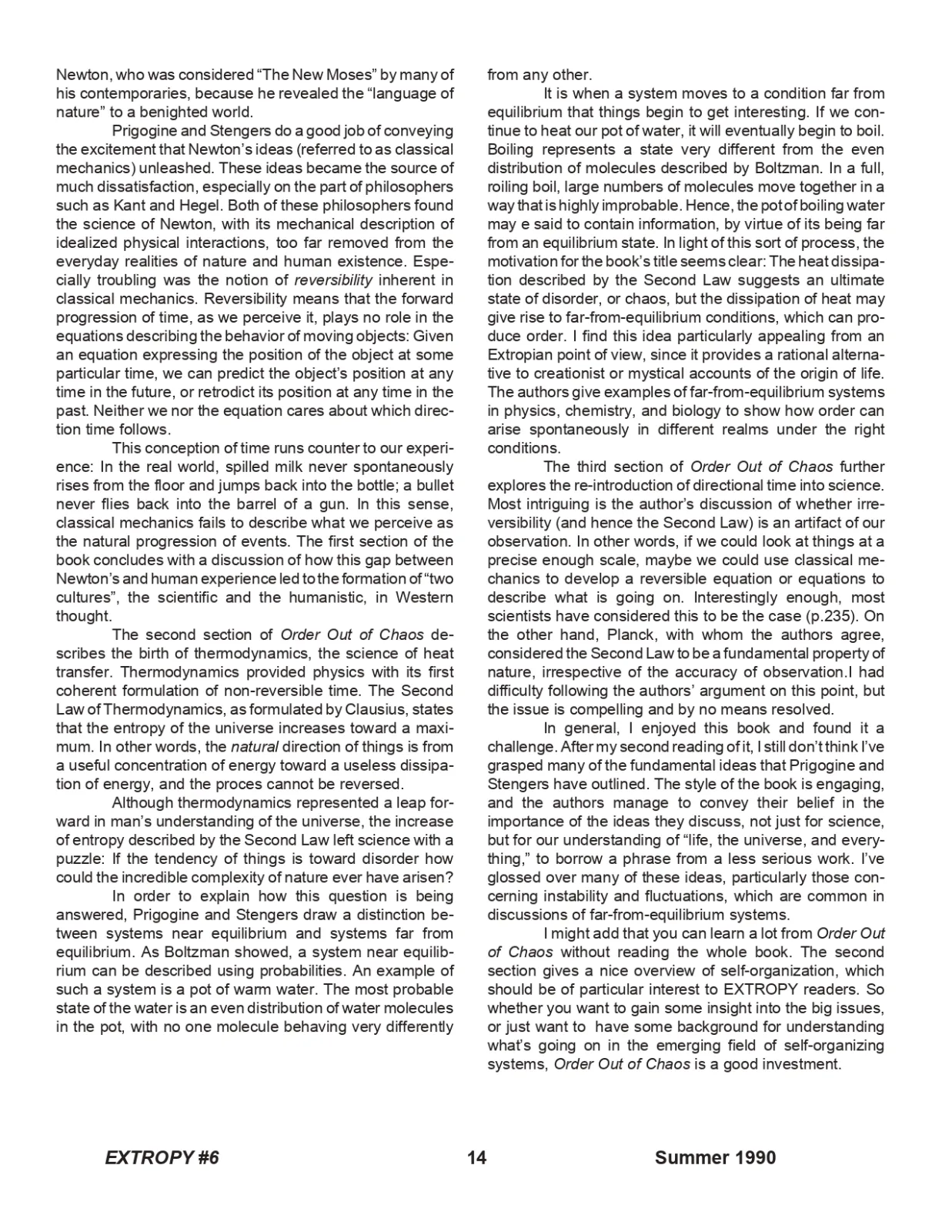
Newton, who was considered “The New Moses” by many of his contemporaries, because he revealed the “language of nature” to a benighted world.
Prigogine and Stengers do a good job of conveying the excitement that Newton’s ideas (referred to as classical mechanics) unleashed. These ideas became the source of much dissatisfaction, especially on the part of philosophers such as Kant and Hegel. Both of these philosophers found the science of Newton, with its mechanical description of idealized physical interactions, too far removed from the everyday realities of nature and human existence. Especially troubling was the notion of reversibility inherent in classical mechanics. Reversibility means that the forward progression of time, as we perceive it, plays no role in the equations describing the behavior of moving objects: Given an equation expressing the position of the object at some particular time, we can predict the object’s position at any time in the future, or retrodict its position at any time in the past. Neither we nor the equation cares about which direction time follows.
This conception of time runs counter to our experience: In the real world, spilled milk never spontaneously rises from the floor and jumps back into the bottle; a bullet never flies back into the barrel of a gun. In this sense, classical mechanics fails to describe what we perceive as the natural progression of events. The first section of the book concludes with a discussion of how this gap between Newton’s and human experience led to the formation of “two cultures”, the scientific and the humanistic, in Western thought.
The second section of Order Out of Chaos describes the birth of thermodynamics, the science of heat transfer. Thermodynamics provided physics with its first coherent formulation of non-reversible time. The Second Law of Thermodynamics, as formulated by Clausius, states that the entropy of the universe increases toward a maximum. In other words, the natural direction of things is from a useful concentration of energy toward a useless dissipation of energy, and the process cannot be reversed.
Although thermodynamics represented a leap forward in man’s understanding of the universe, the increase of entropy described by the Second Law left science with a puzzle: If the tendency of things is toward disorder how could the incredible complexity of nature ever have arisen?
In order to explain how this question is being answered, Prigogine and Stengers draw a distinction between systems near equilibrium and systems far from equilibrium. As Boltzman showed, a system near equilibrium can be described using probabilities. An example of such a system is a pot of warm water. The most probable state of the water is an even distribution of water molecules in the pot, with no one molecule behaving very differently from any other.
It is when a system moves to a condition far from equilibrium that things begin to get interesting. If we continue to heat our pot of water, it will eventually begin to boil. Boiling represents a state very different from the even distribution of molecules described by Boltzman. In a full, roiling boil, large numbers of molecules move together in a way that is highly improbable. Hence, the pot of boiling water may be said to contain information, by virtue of its being far from an equilibrium state. In light of this sort of process, the motivation for the book’s title seems clear: The heat dissipation described by the Second Law suggests an ultimate state of disorder, or chaos, but the dissipation of heat may give rise to far-from-equilibrium conditions, which can produce order. I find this idea particularly appealing from an Extropian point of view, since it provides a rational alternative to creationist or mystical accounts of the origin of life. The authors give examples of far-from-equilibrium systems in physics, chemistry, and biology to show how order can arise spontaneously in different realms under the right conditions.
The third section of Order Out of Chaos further explores the re-introduction of directional time into science. Most intriguing is the author’s discussion of whether irreversibility (and hence the Second Law) is an artifact of our observation. In other words, if we could look at things at a precise enough scale, maybe we could use classical mechanics to develop a reversible equation or equations to describe what is going on. Interestingly enough, most scientists have considered this to be the case (p.235). On the other hand, Planck, with whom the authors agree, considered the Second Law to be a fundamental property of nature, irrespective of the accuracy of observation. I had difficulty following the authors’ argument on this point, but the issue is compelling and by no means resolved.
In general, I enjoyed this book and found it a challenge. After my second reading of it, I still don’t think I’ve grasped many of the fundamental ideas that Prigogine and Stengers have outlined. The style of the book is engaging, and the authors manage to convey their belief in the importance of the ideas they discuss, not just for science, but for our understanding of “life, the universe, and everything,” to borrow a phrase from a less serious work. I’ve glossed over many of these ideas, particularly those concerning instability and fluctuations, which are common in discussions of far-from-equilibrium systems.
I might add that you can learn a lot from Order Out of Chaos without reading the whole book. The second section gives a nice overview of self-organization, which should be of particular interest to EXTROPY readers. So whether you want to gain some insight into the big issues, or just want to have some background for understanding what’s going on in the emerging field of self-organizing systems, Order Out of Chaos is a good investment.
VIEW ORIGINAL SCAN (2 pages)