Issue: EXTROPY #5 · Winter 1990
Author: Max T. O'Connor
Pages: 37–38 · 2 scanned pages
On Competition and Species Loss
ON COMPETITION AND SPECIES
By Max T. O’Connor
COMPETITION
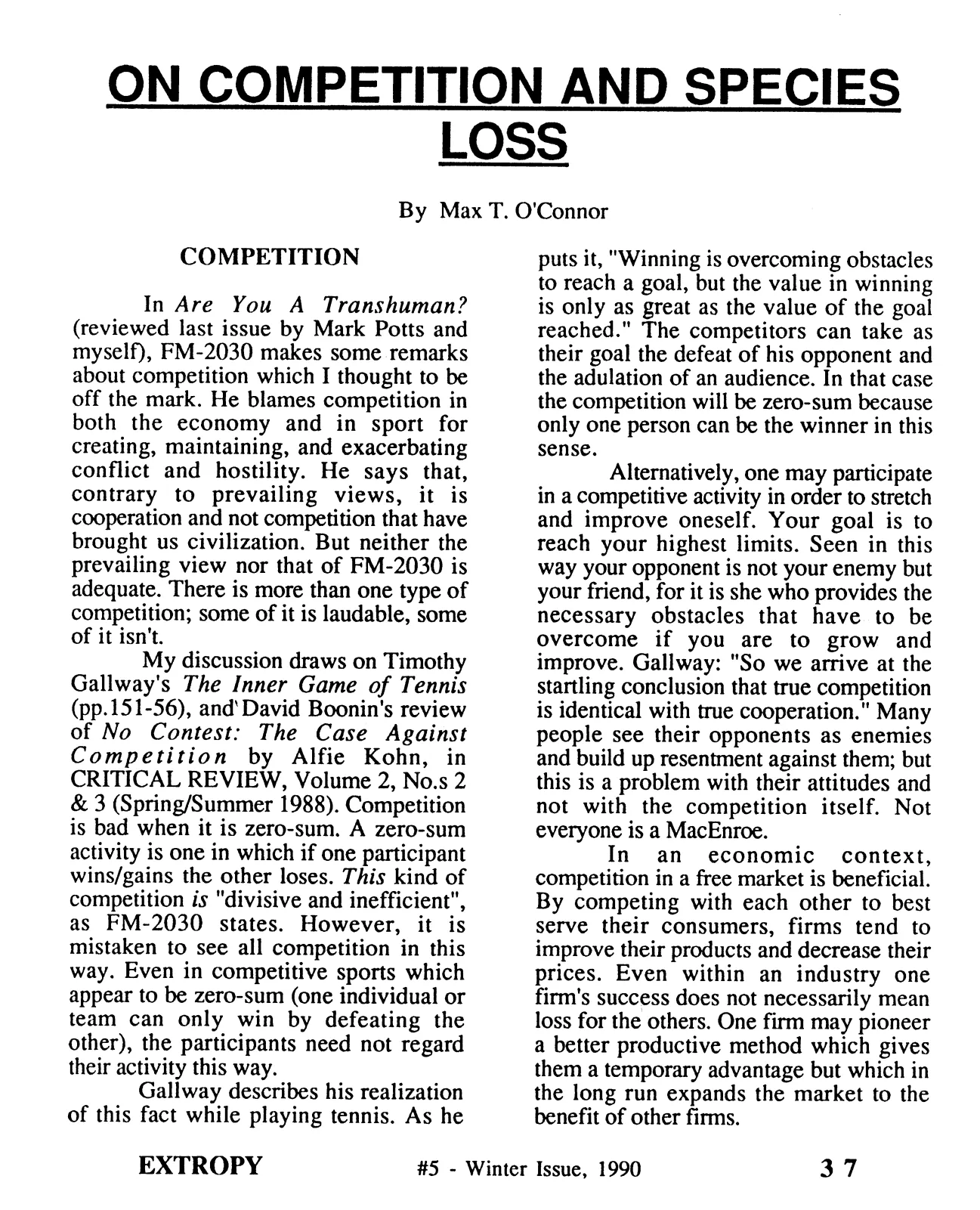
In Are You A Transhuman? (reviewed last issue by Mark Potts and myself), FM-2030 makes some remarks about competition which I thought to be off the mark. He blames competition in both the economy and in sport for creating, maintaining, and exacerbating conflict and hostility. He says that, contrary to prevailing views, it is cooperation and not competition that have brought us civilization. But neither the prevailing view nor that of FM-2030 is adequate. There is more than one type of competition; some of it is laudable, some of it isn’t.
My discussion draws on Timothy Gallway’s The Inner Game of Tennis (pp.151-56), and David Boonin’s review of No Contest: The Case Against Competition by Alfie Kohn, in CRITICAL REVIEW, Volume 2, No.s 2 & 3 (Spring/Summer 1988). Competition is bad when it is zero-sum. A zero-sum activity is one in which if one participant wins/gains the other loses. This kind of competition is ‘divisive and inefficient’, as FM-2030 states. However, it is mistaken to see all competition in this way. Even in competitive sports which appear to be zero-sum (one individual or team can only win by defeating the other), the participants need not regard their activity this way.
Gallway describes his realization of this fact while playing tennis. As he puts it, ‘Winning is overcoming obstacles to reach a goal, but the value in winning is only as great as the value of the goal reached.’ The competitors can take as their goal the defeat of his opponent and the adulation of an audience. In that case the competition will be zero-sum because only one person can be the winner in this sense.
Alternatively, one may participate in a competitive activity in order to stretch and improve oneself. Your goal is to reach your highest limits. Seen in this way your opponent is not your enemy but your friend, for it is she who provides the necessary obstacles that have to be overcome if you are to grow and improve. Gallway: ‘So we arrive at the startling conclusion that true competition is identical with true cooperation.’ Many people see their opponents as enemies and build up resentment against them; but this is a problem with their attitudes and not with the competition itself. Not everyone is a MacEnroe.
In an economic context, competition in a free market is beneficial. By competing with each other to best serve their consumers, firms tend to improve their products and decrease their prices. Even within an industry one firm’s success does not necessarily mean loss for the others. One firm may pioneer a better productive method which gives them a temporary advantage but which in the long run expands the market to the benefit of other firms.
3 7
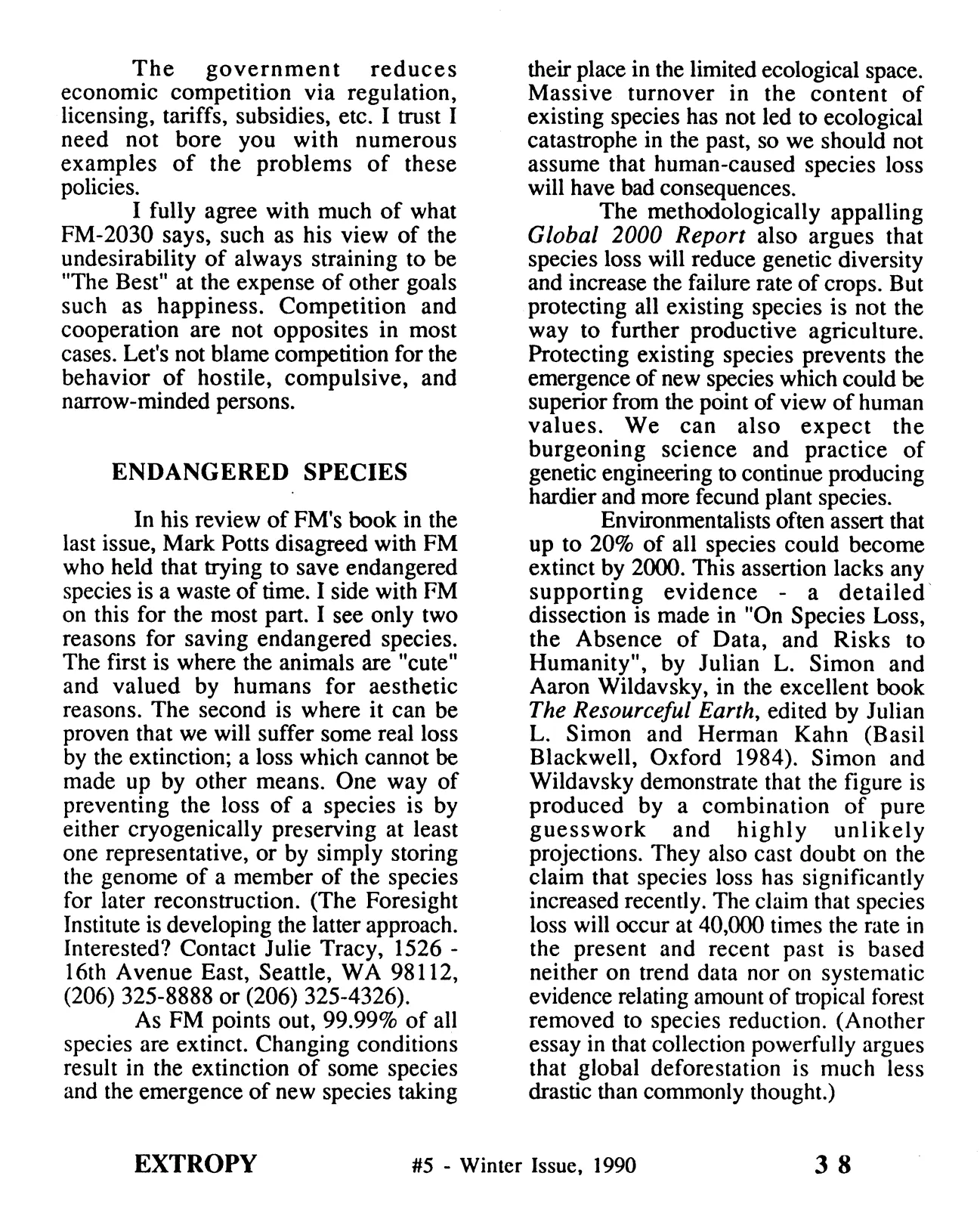
The government reduces economic competition via regulation, licensing, tariffs, subsidies, etc. I trust I need not bore you with numerous examples of the problems of these policies.
I fully agree with much of what FM-2030 says, such as his view of the undesirability of always straining to be ‘The Best’ at the expense of other goals such as happiness. Competition and cooperation are not opposites in most cases. Let’s not blame competition for the behavior of hostile, compulsive, and narrow-minded persons.
ENDANGERED SPECIES
In his review of FM’s book in the last issue, Mark Potts disagreed with FM who held that trying to save endangered species is a waste of time. I side with FM on this for the most part. I see only two reasons for saving endangered species. The first is where the animals are ‘cute’ and valued by humans for aesthetic reasons. The second is where it can be proven that we will suffer some real loss by the extinction; a loss which cannot be made up by other means. One way of preventing the loss of a species is by either cryogenically preserving at least one representative, or by simply storing the genome of a member of the species for later reconstruction. (The Foresight Institute is developing the latter approach. Interested? Contact Julie Tracy, 1526 - 16th Avenue East, Seattle, WA 98112, (206) 325-8888 or (206) 325-4326).
As FM points out, 99.99% of all species are extinct. Changing conditions result in the extinction of some species and the emergence of new species taking their place in the limited ecological space. Massive turnover in the content of existing species has not led to ecological catastrophe in the past, so we should not assume that human-caused species loss will have bad consequences.
The methodologically appalling Global 2000 Report also argues that species loss will reduce genetic diversity and increase the failure rate of crops. But protecting all existing species is not the way to further productive agriculture. Protecting existing species prevents the emergence of new species which could be superior from the point of view of human values. We can also expect the burgeoning science and practice of genetic engineering to continue producing hardier and more fecund plant species.
Environmentalists often assert that up to 20% of all species could become extinct by 2000. This assertion lacks any supporting evidence - a detailed dissection is made in ‘On Species Loss, the Absence of Data, and Risks to Humanity’, by Julian L. Simon and Aaron Wildavsky, in the excellent book The Resourceful Earth, edited by Julian L. Simon and Herman Kahn (Basil Blackwell, Oxford 1984). Simon and Wildavsky demonstrate that the figure is produced by a combination of pure guesswork and highly unlikely projections. They also cast doubt on the claim that species loss has significantly increased recently. The claim that species loss will occur at 40,000 times the rate in the present and recent past is based neither on trend data nor on systematic evidence relating amount of tropical forest removed to species reduction. (Another essay in that collection powerfully argues that global deforestation is much less drastic than commonly thought.)
3 8
VIEW ORIGINAL SCAN (2 pages)